



Augmented Reality (AR) Shopping Market
Augmented Reality (AR) Shopping Market Insights, Competitive Landscape, and Market Forecast - 2033
Augmented Reality (AR) Shopping Market Size, Share, and Growth Forecast 2026 - 2033
Key Market Highlights
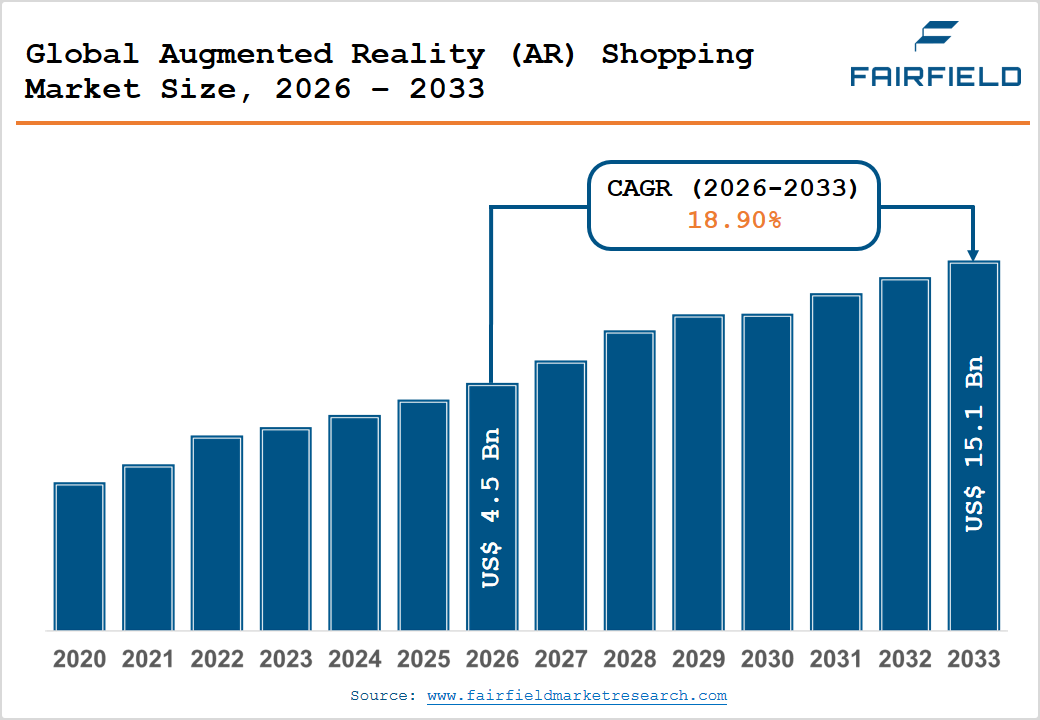
- The global Augmented Reality (AR) Shopping market size is likely to be valued at US$ 4.5 Billion in 2026 and is expected to reach US$ 15.1 Billion by 2033, growing at a CAGR of 18.90% during the forecast period from 2026 to 2033.
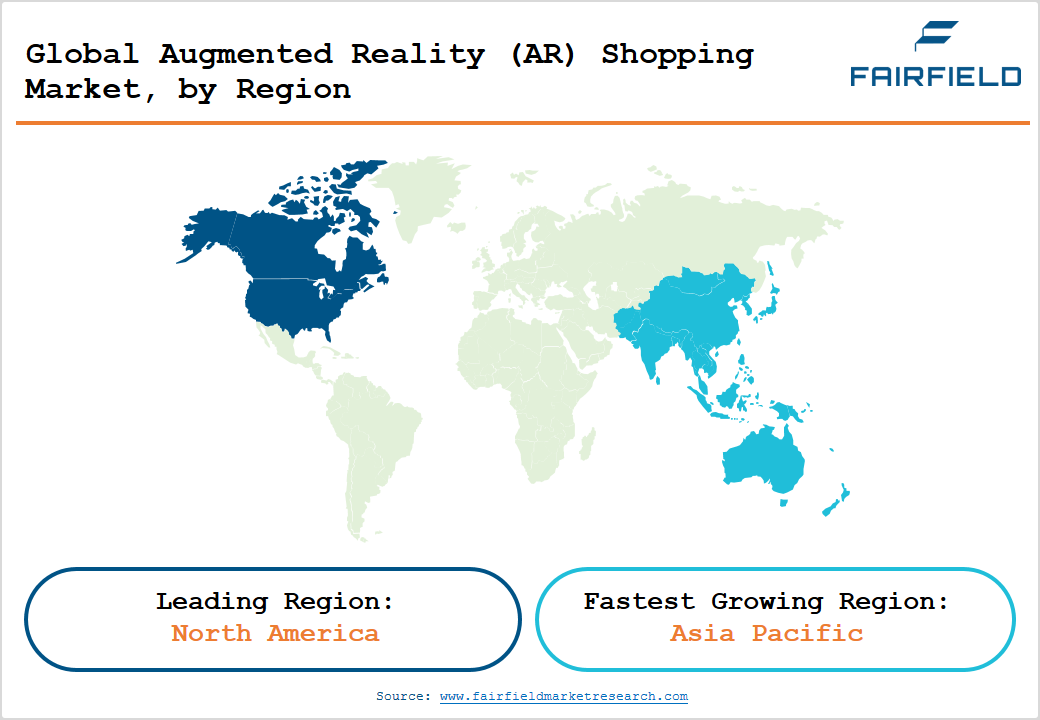
- North America leads the global AR Shopping market with approximately 39% share, driven by the U.S.'s advanced digital retail infrastructure, high e-commerce penetration, and concentration of major AR technology innovators including Apple, Google, and Snap Inc.
- Asia Pacific is the fastest-growing region, propelled by China's massive e-commerce scale, India's digital retail expansion, and rapid smartphone adoption across ASEAN markets, creating significant near-term demand for AR try-on and product visualization solutions.
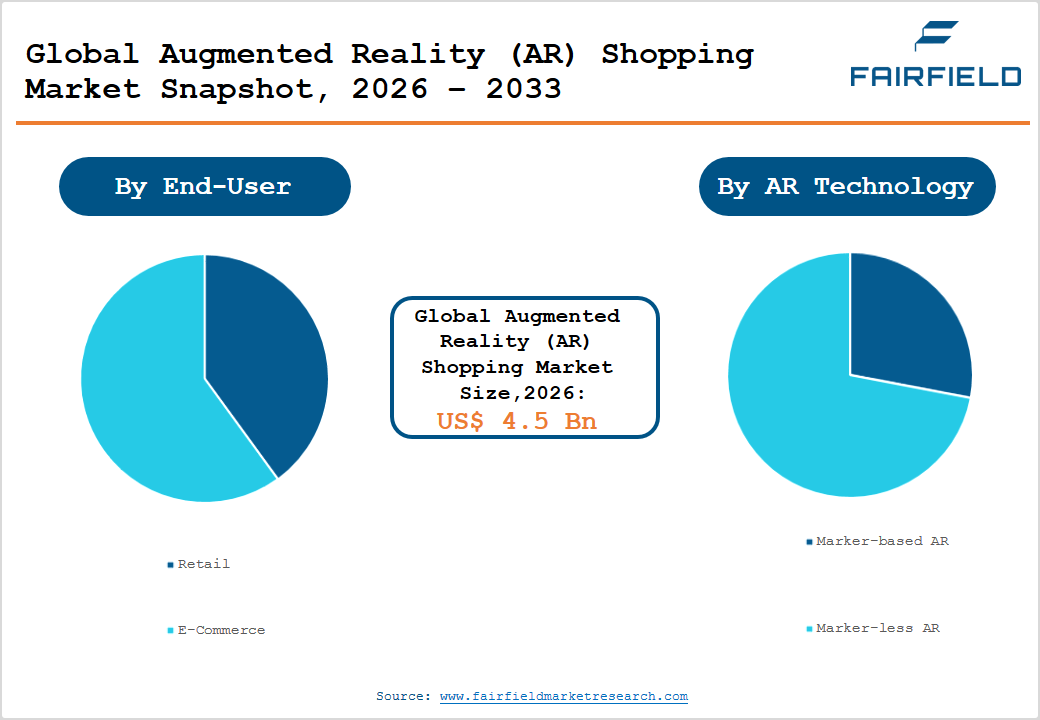
- E-Commerce leads by end use with approximately 62% share, as online retailers deploy AR solutions to reduce return rates and improve consumer purchase confidence, directly addressing the US$ 743 billion annual return challenge reported by the NRF.
- Try-on Solutions is among the fastest-growing application segments, with AR-enabled virtual try-ons delivering up to 94% higher conversion rates and attracting investment from global fashion, beauty, and eyewear brands seeking to replicate in-store trial experiences digitally.
- The home furnishing and interior design e-commerce sector presents a high-growth opportunity, with AR Planning & Designing tools enabling consumers to visualize products in real spaces driving adoption across the US$ 120 billion+ U.S. home furnishings market.
Market Dynamics
Market Growth Drivers
- Surging E-Commerce Adoption and Rising Consumer Demand for Immersive Shopping Experiences
The exponential growth of global e-commerce is a primary catalyst for AR shopping adoption. According to the U.S. Department of Commerce, U.S. e-commerce sales reached US$ 1.1 trillion in 2023, representing a significant share of total retail. As online shopping becomes the dominant channel, consumers increasingly demand immersive, confidence-building pre-purchase experiences. AR-powered virtual try-on tools deployed by brands in apparel, footwear, eyewear, and furniture demonstrably reduce return rates and improve conversion. A study published in the Journal of Retailing and Consumer Services found that AR product visualization increases purchase intent by up to 65% compared to standard product images, establishing AR shopping technology as a commercially compelling investment for retailers and e-commerce platforms globally.
- Proliferation of Smartphones and Advancements in Markerless AR Technology
The near-ubiquitous penetration of smartphones equipped with advanced cameras and processing capabilities is dramatically widening the AR shopping addressable market. According to the GSMA Intelligence, global smartphone connections exceeded 6.9 billion in 2024, providing an enormous installed base for markerless AR application deployment without dedicated hardware. Simultaneously, technology advancements in platforms such as Apple's ARKit and Google's ARCore have significantly lowered the barrier to developing high-fidelity AR shopping experiences accessible via standard consumer devices. The integration of machine learning-based object recognition and real-time 3D rendering into these frameworks is enabling increasingly realistic virtual product placements, accelerating adoption across retail and e-commerce end-use segments.
Market Restraints
- High Development and Integration Costs for Retailers
Despite compelling consumer benefits, the high upfront investment required to build and integrate AR shopping solutions poses a significant barrier particularly for small and mid-sized retailers. Developing high-quality 3D product models and AR-enabled applications can cost between US$ 50,000 and US$ 500,000 per project, while ongoing platform maintenance adds further operational costs. This creates an asymmetric competitive landscape where large enterprises can afford deployment while smaller retailers are effectively priced out, limiting the overall diffusion speed of AR shopping technologies across the global retail ecosystem.
- Privacy Concerns and Data Security Challenges
AR shopping applications especially virtual try-on tools using facial recognition and body-scanning technologies collect sensitive biometric and behavioral data, raising significant privacy concerns among consumers and regulators. The European Union's General Data Protection Regulation (GDPR) and the U.S. Illinois Biometric Information Privacy Act (BIPA) impose strict requirements on the collection and storage of biometric data, creating compliance complexity for AR platform developers. Consumer surveys consistently indicate that privacy apprehension reduces willingness to adopt AR try-on features, constraining user engagement rates and impeding the market's full growth potential.
Market Opportunities
- Expansion of AR Try-On Solutions in the Fashion, Beauty, and Eyewear Sectors
Virtual try-on solutions represent one of the highest-growth opportunity areas within the AR shopping ecosystem, particularly across fashion, cosmetics, and eyewear verticals. Snap Inc. reported that over 250 million users engage with AR shopping lenses daily on its platform, underscoring mass-market consumer appetite. Leading beauty brands such as L'Oréal and Estée Lauder have reported conversion rate improvements of up to 2.5x following deployment of AR virtual makeup try-on tools. As AR try-on accuracy and realism continue to improve driven by AI-powered face-mapping and real-time skin-tone matching companies developing scalable, brand-agnostic virtual try-on platforms stand to capture premium revenues across a global consumer base that is increasingly comfortable with digital-first purchase journeys.
- Growing Adoption of AR in Home Furnishing and Interior Design E-Commerce
The home furnishing and interior design segment presents a structurally compelling growth opportunity for AR shopping platforms, particularly for Planning & Designing applications. IKEA's IKEA Place app powered by Apple ARKit has been downloaded over 30 million times, demonstrating the scale of consumer interest in AR-assisted home product visualization. According to the American Home Furnishings Alliance (AHFA), the U.S. home furnishings market exceeds in billions annually, with e-commerce representing a rapidly growing share. AR solutions that allow consumers to visualize furniture and décor in their actual living spaces dramatically reduce return rates and increase basket sizes. Platform providers and software developers targeting furniture and home décor e-commerce are therefore positioned to unlock substantial near-term revenue opportunities.
Segmental Insights
- End Use Analysis
E-Commerce leads the AR Shopping market by end use, commanding approximately 62% of total market share. The dominance of e-commerce is directly attributable to the structural limitations of online retail namely, the inability of consumers to physically interact with products before purchase which AR solutions are uniquely positioned to overcome. Global e-commerce platforms such as Amazon, Alibaba, and Shopify have invested heavily in AR product visualization capabilities to address consumer uncertainty and reduce costly return rates. According to the NRF, U.S. retail returns totalled over US$ 743 billion in 2023, creating a powerful commercial incentive for e-commerce operators to deploy AR technologies that enhance pre-purchase decision accuracy and improve overall customer satisfaction metrics.
- AR Technology Analysis
Markerless AR holds the leading position in the AR Shopping market by technology type, accounting for approximately 68% of market share. Unlike marker-based systems that require physical triggers such as QR codes or printed targets, markerless AR leverages GPS, accelerometers, and computer-vision algorithms to anchor digital content in the real world without any physical reference enabling seamless, frictionless consumer experiences. The wide availability of ARKit and ARCore-compatible smartphones has made markerless AR the de facto standard for consumer-facing retail AR applications, including virtual try-ons and in-home product placement tools. As processing power and AI integration continue to improve, markerless AR's accuracy and reliability advantages over marker-dependent systems are expected to further consolidate its market-leading position.
- Offering Analysis
Software is the dominant offering segment in the AR Shopping market, holding approximately 55% share. Software platform encompassing AR development engines, SDKs, cloud-based rendering services, and white-label virtual try-on solutions form the commercial backbone of the AR shopping ecosystem. Platforms such as PTC Vuforia, Wikitude SDK, and Blippar's AR platform enable brands and retailers to rapidly develop and deploy AR experiences without building proprietary infrastructure. The subscription-based software-as-a-service (SaaS) model adopted by many AR platform providers generates recurring revenues and high customer retention, making software the most commercially attractive and scalable offering category. Continued advancements in cloud-based AR rendering are further expanding the software segment's addressable market.
- Device Type Analysis
Handheld Devices dominate the AR Shopping market by device type, representing approximately 72% of total market share. Smartphones and tablets are the primary consumption interface for AR shopping experiences due to their mass-market penetration, built-in camera systems, and compatibility with major AR development platforms. The GSMA reports that smartphone adoption rates exceed 85% in developed markets and are rising rapidly in emerging economies, ensuring an expansive and accessible user base for mobile-first AR shopping apps. The absence of additional hardware investment requirements makes handheld-device-based AR the most commercially viable deployment pathway, particularly for mainstream retail and e-commerce operators targeting broad demographic audiences at scale.
- Application Analysis
Try-on Solutions lead the AR Shopping market by application, commanding approximately 40% of market share. Virtual try-on tools for apparel, cosmetics, eyewear, and accessories represent the most commercially impactful and consumer-adopted AR shopping application. Industry data from Snap Inc. indicates that products featured with AR try-on capabilities see up to 94% higher conversion rates compared to those without. Retailers including Warby Parker, Sephora, and Nike have reported measurable improvements in purchase confidence and customer engagement following virtual try-on deployments. As computer vision and 3D body-mapping technologies advance, the accuracy and realism of try-on solutions continue to improve, reinforcing the segment's leadership and drawing increased investment from fashion and beauty brands globally.
Regional Insights
- North America Augmented Reality (AR) Shopping Trends
North America is the leading regional market for AR shopping, accounting for approximately 39% of global market share, underpinned by a highly digitized retail ecosystem, strong technology infrastructure, and a consumer base that readily embraces digital shopping innovations. The U.S. is home to major AR technology developers and retail innovators, including Apple, Google, Amazon, and Snap Inc., all of whom are actively investing in AR commerce capabilities. According to the U.S. Census Bureau, e-commerce now represents approximately 16% of total retail sales, providing a significant platform for AR solution deployment.
The U.S. regulatory environment, while increasingly attentive to biometric data privacy through legislation such as the Illinois BIPA and proposed federal frameworks, is broadly supportive of technology-led retail innovation. Canada is also witnessing growing adoption of AR shopping tools among national retailers and fashion brands. North America's robust venture capital ecosystem continues to fund AR startup activity, driving ongoing innovation in virtual try-on platforms, AI-enhanced product visualization, and spatial computing for retail applications.
- Europe Augmented Reality (AR) Shopping Trends
Europe represents a significant and evolving market for AR shopping, characterized by strong privacy regulations, rising digital retail adoption, and growing consumer interest in experiential commerce. Germany, France, the U.K., and Spain are the primary country-level markets, each supported by expanding e-commerce ecosystems. According to Eurostat, approximately 75% of EU internet users shopped online in 2023, providing a substantial audience for AR shopping experiences. The GDPR framework shapes the data collection practices of AR platform providers operating across the region, compelling privacy-by-design approaches.
U.K. retailers including ASOS and Marks & Spencer have implemented virtual try-on features, while French luxury and cosmetics brands leverage AR for premium product visualization. Germany's strong manufacturing base is also driving interest in AR for industrial retail and B2B procurement applications. The European Commission's Digital Single Market Strategy promotes cross-border e-commerce harmonization, indirectly expanding the operational scale for AR shopping platform providers across member states.
- Asia Pacific Augmented Reality (AR) Shopping Trends
Asia Pacific is the fastest-growing regional market for AR shopping, driven by the world's largest e-commerce markets, hyper-mobile consumer bases, and rapid integration of AR features into leading super-apps. China is the dominant market, where platforms such as Alibaba's Taobao and JD.com have pioneered AR virtual try-on and 3D product visualization features at massive scale. According to China's Ministry of Commerce, the country's online retail sales exceeded in 2023, with AR-enabled shopping becoming increasingly mainstream among younger consumers.
Japan's sophisticated consumer technology market supports adoption of AR beauty and fashion try-on tools, while India's rapidly growing e-commerce sector supported by the Government of India's Digital India initiative is creating new deployment opportunities for AR platform providers. ASEAN markets, particularly Indonesia, Vietnam, and the Philippines, are witnessing rising smartphone penetration and social commerce growth, accelerating AR shopping adoption. Local manufacturing advantages for AR hardware components and the region's large base of mobile-first consumers position Asia Pacific as the most dynamic long-term growth frontier for AR shopping technologies.
Competitive Landscape
The AR Shopping market is moderately fragmented, featuring a mix of global technology giants and specialized AR software startups competing across distinct value chain layers. Apple, Google, Microsoft, and Amazon dominate platform infrastructure and device ecosystems, while companies such as Snap Inc., Blippar, and Wikitude differentiate through specialized AR commerce solutions. Key competitive strategies include platform API integrations with major e-commerce systems, proprietary 3D content creation tools, and AI-enhanced body and face recognition capabilities. SaaS-based business models are increasingly prevalent, offering recurring revenue streams. Strategic partnerships between AR developers and global retail brands are a defining go-to-market trend shaping the competitive landscape.
Key Market Developments
- In February 2025, Apple Inc. launched enhanced AR shopping integration within its Apple Vision Pro spatial computing platform, enabling retailers to deploy immersive 3D product showrooms directly within the visionOS environment, targeting premium e-commerce brands.
- In September 2024, Snap Inc. announced its expanded AR Enterprise Services (ARES) platform, enabling fashion and beauty brands to embed Snap's AR try-on technology natively within their own websites and mobile apps, broadening its B2B revenue model.
- In April 2024, com, Inc. rolled out an AI-powered virtual try-on feature for apparel across its U.S. marketplace, allowing shoppers to visualize how clothing items fit on personalized avatars, significantly expanding its AR shopping capabilities.
Companies Covered in Augmented Reality (AR) Shopping Market
- Google LLC
- Apple Inc.
- com, Inc.
- Microsoft Corporation
- PTC Inc.
- Blippar Group Limited
- Zugara, Inc.
- Augment
- Holition Ltd.
- Marxent Labs LLC
- ViewAR GmbH
- Wikitude GmbH
- Imaginate Technologies
- Snap Inc.
- Alibaba Group Holding Limited
- Meta Platforms, Inc.
- Shopify Inc.
- Perfect Corp.
- ZERO10
Market Segmentation
By End Use
- Retail
- E-Commerce
By AR Technology
- Marker-based AR
- Markerless AR
By Offering
- Hardware
- Software
- Services
By Device Type
- AR Head-Mounted Displays (HMD)
- Smart AR Mirror
- Handheld Devices
By Application
- Try-on Solutions
- Planning & Designing
- Advertising & Marketing
- Information Systems
By Region
- North America
- Europe
- Asia Pacific
- Latin America
- Middle East & Africa
- Executive Summary
- Global Augmented Reality (AR) Shopping Market Snapshot
- Future Projections
- Key Market Trends
- Regional Snapshot, by Value, 2026
- Analyst Recommendations
- Market Overview
- Market Definitions and Segmentations
- Market Dynamics
- Drivers
- Restraints
- Market Opportunities
- Value Chain Analysis
- COVID-19 Impact Analysis
- Porter's Five Forces Analysis
- Impact of Russia-Ukraine Conflict
- PESTLE Analysis
- Regulatory Analysis
- Price Trend Analysis
- Current Prices and Future Projections, 2025-2033
- Price Impact Factors
- Global Augmented Reality (AR) Shopping Market Outlook, 2020 - 2033
- Global Augmented Reality (AR) Shopping Market Outlook, by End-User, Value (US$ Bn), 2020-2033
- Retail
- E-Commerce
- Global Augmented Reality (AR) Shopping Market Outlook, by AR Technology, Value (US$ Bn), 2020-2033
- Marker-based AR
- Markerless AR
- Global Augmented Reality (AR) Shopping Market Outlook, by Offering, Value (US$ Bn), 2020-2033
- Hardware
- Software
- Services
- Global Augmented Reality (AR) Shopping Market Outlook, by Device Type, Value (US$ Bn), 2020-2033
- AR Head-Mounted Displays (HMD)
- Smart AR Mirror
- Handheld Devices
- Global Augmented Reality (AR) Shopping Market Outlook, by Application, Value (US$ Bn), 2020-2033
- Try-on Solutions
- Planning & Designing
- Advertising & Marketing
- Global Augmented Reality (AR) Shopping Market Outlook, by Region, Value (US$ Bn), 2020-2033
- North America
- Europe
- Asia Pacific
- Latin America
- Middle East & Africa
- Global Augmented Reality (AR) Shopping Market Outlook, by End-User, Value (US$ Bn), 2020-2033
- North America Augmented Reality (AR) Shopping Market Outlook, 2020 - 2033
- North America Augmented Reality (AR) Shopping Market Outlook, by End-User, Value (US$ Bn), 2020-2033
- Retail
- E-Commerce
- North America Augmented Reality (AR) Shopping Market Outlook, by AR Technology, Value (US$ Bn), 2020-2033
- Marker-based AR
- Markerless AR
- North America Augmented Reality (AR) Shopping Market Outlook, by Offering, Value (US$ Bn), 2020-2033
- Hardware
- Software
- Services
- North America Augmented Reality (AR) Shopping Market Outlook, by Device Type, Value (US$ Bn), 2020-2033
- AR Head-Mounted Displays (HMD)
- Smart AR Mirror
- Handheld Devices
- North America Augmented Reality (AR) Shopping Market Outlook, by Application, Value (US$ Bn), 2020-2033
- Try-on Solutions
- Planning & Designing
- Advertising & Marketing
- North America Augmented Reality (AR) Shopping Market Outlook, by Country, Value (US$ Bn), 2020-2033
- S. Augmented Reality (AR) Shopping Market Outlook, by End-User, 2020-2033
- S. Augmented Reality (AR) Shopping Market Outlook, by AR Technology, 2020-2033
- S. Augmented Reality (AR) Shopping Market Outlook, by Offering, 2020-2033
- S. Augmented Reality (AR) Shopping Market Outlook, by Device Type, 2020-2033
- S. Augmented Reality (AR) Shopping Market Outlook, by Application, 2020-2033
- Canada Augmented Reality (AR) Shopping Market Outlook, by End-User, 2020-2033
- Canada Augmented Reality (AR) Shopping Market Outlook, by AR Technology, 2020-2033
- Canada Augmented Reality (AR) Shopping Market Outlook, by Offering, 2020-2033
- Canada Augmented Reality (AR) Shopping Market Outlook, by Device Type, 2020-2033
- Canada Augmented Reality (AR) Shopping Market Outlook, by Application, 2020-2033
- BPS Analysis/Market Attractiveness Analysis
- North America Augmented Reality (AR) Shopping Market Outlook, by End-User, Value (US$ Bn), 2020-2033
- Europe Augmented Reality (AR) Shopping Market Outlook, 2020 - 2033
- Europe Augmented Reality (AR) Shopping Market Outlook, by End-User, Value (US$ Bn), 2020-2033
- Retail
- E-Commerce
- Europe Augmented Reality (AR) Shopping Market Outlook, by AR Technology, Value (US$ Bn), 2020-2033
- Marker-based AR
- Markerless AR
- Europe Augmented Reality (AR) Shopping Market Outlook, by Offering, Value (US$ Bn), 2020-2033
- Hardware
- Software
- Services
- Europe Augmented Reality (AR) Shopping Market Outlook, by Device Type, Value (US$ Bn), 2020-2033
- AR Head-Mounted Displays (HMD)
- Smart AR Mirror
- Handheld Devices
- Europe Augmented Reality (AR) Shopping Market Outlook, by Application, Value (US$ Bn), 2020-2033
- Try-on Solutions
- Planning & Designing
- Advertising & Marketing
- Europe Augmented Reality (AR) Shopping Market Outlook, by Country, Value (US$ Bn), 2020-2033
- Germany Augmented Reality (AR) Shopping Market Outlook, by End-User, 2020-2033
- Germany Augmented Reality (AR) Shopping Market Outlook, by AR Technology, 2020-2033
- Germany Augmented Reality (AR) Shopping Market Outlook, by Offering, 2020-2033
- Germany Augmented Reality (AR) Shopping Market Outlook, by Device Type, 2020-2033
- Germany Augmented Reality (AR) Shopping Market Outlook, by Application, 2020-2033
- Italy Augmented Reality (AR) Shopping Market Outlook, by End-User, 2020-2033
- Italy Augmented Reality (AR) Shopping Market Outlook, by AR Technology, 2020-2033
- Italy Augmented Reality (AR) Shopping Market Outlook, by Offering, 2020-2033
- Italy Augmented Reality (AR) Shopping Market Outlook, by Device Type, 2020-2033
- Italy Augmented Reality (AR) Shopping Market Outlook, by Application, 2020-2033
- France Augmented Reality (AR) Shopping Market Outlook, by End-User, 2020-2033
- France Augmented Reality (AR) Shopping Market Outlook, by AR Technology, 2020-2033
- France Augmented Reality (AR) Shopping Market Outlook, by Offering, 2020-2033
- France Augmented Reality (AR) Shopping Market Outlook, by Device Type, 2020-2033
- France Augmented Reality (AR) Shopping Market Outlook, by Application, 2020-2033
- K. Augmented Reality (AR) Shopping Market Outlook, by End-User, 2020-2033
- K. Augmented Reality (AR) Shopping Market Outlook, by AR Technology, 2020-2033
- K. Augmented Reality (AR) Shopping Market Outlook, by Offering, 2020-2033
- K. Augmented Reality (AR) Shopping Market Outlook, by Device Type, 2020-2033
- K. Augmented Reality (AR) Shopping Market Outlook, by Application, 2020-2033
- Spain Augmented Reality (AR) Shopping Market Outlook, by End-User, 2020-2033
- Spain Augmented Reality (AR) Shopping Market Outlook, by AR Technology, 2020-2033
- Spain Augmented Reality (AR) Shopping Market Outlook, by Offering, 2020-2033
- Spain Augmented Reality (AR) Shopping Market Outlook, by Device Type, 2020-2033
- Spain Augmented Reality (AR) Shopping Market Outlook, by Application, 2020-2033
- Russia Augmented Reality (AR) Shopping Market Outlook, by End-User, 2020-2033
- Russia Augmented Reality (AR) Shopping Market Outlook, by AR Technology, 2020-2033
- Russia Augmented Reality (AR) Shopping Market Outlook, by Offering, 2020-2033
- Russia Augmented Reality (AR) Shopping Market Outlook, by Device Type, 2020-2033
- Russia Augmented Reality (AR) Shopping Market Outlook, by Application, 2020-2033
- Rest of Europe Augmented Reality (AR) Shopping Market Outlook, by End-User, 2020-2033
- Rest of Europe Augmented Reality (AR) Shopping Market Outlook, by AR Technology, 2020-2033
- Rest of Europe Augmented Reality (AR) Shopping Market Outlook, by Offering, 2020-2033
- Rest of Europe Augmented Reality (AR) Shopping Market Outlook, by Device Type, 2020-2033
- Rest of Europe Augmented Reality (AR) Shopping Market Outlook, by Application, 2020-2033
- BPS Analysis/Market Attractiveness Analysis
- Europe Augmented Reality (AR) Shopping Market Outlook, by End-User, Value (US$ Bn), 2020-2033
- Asia Pacific Augmented Reality (AR) Shopping Market Outlook, 2020 - 2033
- Asia Pacific Augmented Reality (AR) Shopping Market Outlook, by End-User, Value (US$ Bn), 2020-2033
- Retail
- E-Commerce
- Asia Pacific Augmented Reality (AR) Shopping Market Outlook, by AR Technology, Value (US$ Bn), 2020-2033
- Marker-based AR
- Markerless AR
- Asia Pacific Augmented Reality (AR) Shopping Market Outlook, by Offering, Value (US$ Bn), 2020-2033
- Hardware
- Software
- Services
- Asia Pacific Augmented Reality (AR) Shopping Market Outlook, by Device Type, Value (US$ Bn), 2020-2033
- AR Head-Mounted Displays (HMD)
- Smart AR Mirror
- Handheld Devices
- Asia Pacific Augmented Reality (AR) Shopping Market Outlook, by Application, Value (US$ Bn), 2020-2033
- Try-on Solutions
- Planning & Designing
- Advertising & Marketing
- Asia Pacific Augmented Reality (AR) Shopping Market Outlook, by Country, Value (US$ Bn), 2020-2033
- China Augmented Reality (AR) Shopping Market Outlook, by End-User, 2020-2033
- China Augmented Reality (AR) Shopping Market Outlook, by AR Technology, 2020-2033
- China Augmented Reality (AR) Shopping Market Outlook, by Offering, 2020-2033
- China Augmented Reality (AR) Shopping Market Outlook, by Device Type, 2020-2033
- China Augmented Reality (AR) Shopping Market Outlook, by Application, 2020-2033
- Japan Augmented Reality (AR) Shopping Market Outlook, by End-User, 2020-2033
- Japan Augmented Reality (AR) Shopping Market Outlook, by AR Technology, 2020-2033
- Japan Augmented Reality (AR) Shopping Market Outlook, by Offering, 2020-2033
- Japan Augmented Reality (AR) Shopping Market Outlook, by Device Type, 2020-2033
- Japan Augmented Reality (AR) Shopping Market Outlook, by Application, 2020-2033
- South Korea Augmented Reality (AR) Shopping Market Outlook, by End-User, 2020-2033
- South Korea Augmented Reality (AR) Shopping Market Outlook, by AR Technology, 2020-2033
- South Korea Augmented Reality (AR) Shopping Market Outlook, by Offering, 2020-2033
- South Korea Augmented Reality (AR) Shopping Market Outlook, by Device Type, 2020-2033
- South Korea Augmented Reality (AR) Shopping Market Outlook, by Application, 2020-2033
- India Augmented Reality (AR) Shopping Market Outlook, by End-User, 2020-2033
- India Augmented Reality (AR) Shopping Market Outlook, by AR Technology, 2020-2033
- India Augmented Reality (AR) Shopping Market Outlook, by Offering, 2020-2033
- India Augmented Reality (AR) Shopping Market Outlook, by Device Type, 2020-2033
- India Augmented Reality (AR) Shopping Market Outlook, by Application, 2020-2033
- Southeast Asia Augmented Reality (AR) Shopping Market Outlook, by End-User, 2020-2033
- Southeast Asia Augmented Reality (AR) Shopping Market Outlook, by AR Technology, 2020-2033
- Southeast Asia Augmented Reality (AR) Shopping Market Outlook, by Offering, 2020-2033
- Southeast Asia Augmented Reality (AR) Shopping Market Outlook, by Device Type, 2020-2033
- Southeast Asia Augmented Reality (AR) Shopping Market Outlook, by Application, 2020-2033
- Rest of SAO Augmented Reality (AR) Shopping Market Outlook, by End-User, 2020-2033
- Rest of SAO Augmented Reality (AR) Shopping Market Outlook, by AR Technology, 2020-2033
- Rest of SAO Augmented Reality (AR) Shopping Market Outlook, by Offering, 2020-2033
- Rest of SAO Augmented Reality (AR) Shopping Market Outlook, by Device Type, 2020-2033
- Rest of SAO Augmented Reality (AR) Shopping Market Outlook, by Application, 2020-2033
- BPS Analysis/Market Attractiveness Analysis
- Asia Pacific Augmented Reality (AR) Shopping Market Outlook, by End-User, Value (US$ Bn), 2020-2033
- Latin America Augmented Reality (AR) Shopping Market Outlook, 2020 - 2033
- Latin America Augmented Reality (AR) Shopping Market Outlook, by End-User, Value (US$ Bn), 2020-2033
- Retail
- E-Commerce
- Latin America Augmented Reality (AR) Shopping Market Outlook, by AR Technology, Value (US$ Bn), 2020-2033
- Marker-based AR
- Markerless AR
- Latin America Augmented Reality (AR) Shopping Market Outlook, by Offering, Value (US$ Bn), 2020-2033
- Hardware
- Software
- Services
- Latin America Augmented Reality (AR) Shopping Market Outlook, by Device Type, Value (US$ Bn), 2020-2033
- AR Head-Mounted Displays (HMD)
- Smart AR Mirror
- Handheld Devices
- Latin America Augmented Reality (AR) Shopping Market Outlook, by Application, Value (US$ Bn), 2020-2033
- Try-on Solutions
- Planning & Designing
- Advertising & Marketing
- Latin America Augmented Reality (AR) Shopping Market Outlook, by Country, Value (US$ Bn), 2020-2033
- Brazil Augmented Reality (AR) Shopping Market Outlook, by End-User, 2020-2033
- Brazil Augmented Reality (AR) Shopping Market Outlook, by AR Technology, 2020-2033
- Brazil Augmented Reality (AR) Shopping Market Outlook, by Offering, 2020-2033
- Brazil Augmented Reality (AR) Shopping Market Outlook, by Device Type, 2020-2033
- Brazil Augmented Reality (AR) Shopping Market Outlook, by Application, 2020-2033
- Mexico Augmented Reality (AR) Shopping Market Outlook, by End-User, 2020-2033
- Mexico Augmented Reality (AR) Shopping Market Outlook, by AR Technology, 2020-2033
- Mexico Augmented Reality (AR) Shopping Market Outlook, by Offering, 2020-2033
- Mexico Augmented Reality (AR) Shopping Market Outlook, by Device Type, 2020-2033
- Mexico Augmented Reality (AR) Shopping Market Outlook, by Application, 2020-2033
- Argentina Augmented Reality (AR) Shopping Market Outlook, by End-User, 2020-2033
- Argentina Augmented Reality (AR) Shopping Market Outlook, by AR Technology, 2020-2033
- Argentina Augmented Reality (AR) Shopping Market Outlook, by Offering, 2020-2033
- Argentina Augmented Reality (AR) Shopping Market Outlook, by Device Type, 2020-2033
- Argentina Augmented Reality (AR) Shopping Market Outlook, by Application, 2020-2033
- Rest of LATAM Augmented Reality (AR) Shopping Market Outlook, by End-User, 2020-2033
- Rest of LATAM Augmented Reality (AR) Shopping Market Outlook, by AR Technology, 2020-2033
- Rest of LATAM Augmented Reality (AR) Shopping Market Outlook, by Offering, 2020-2033
- Rest of LATAM Augmented Reality (AR) Shopping Market Outlook, by Device Type, 2020-2033
- Rest of LATAM Augmented Reality (AR) Shopping Market Outlook, by Application, 2020-2033
- BPS Analysis/Market Attractiveness Analysis
- Latin America Augmented Reality (AR) Shopping Market Outlook, by End-User, Value (US$ Bn), 2020-2033
- Middle East & Africa Augmented Reality (AR) Shopping Market Outlook, 2020 - 2033
- Middle East & Africa Augmented Reality (AR) Shopping Market Outlook, by End-User, Value (US$ Bn), 2020-2033
- Retail
- E-Commerce
- Middle East & Africa Augmented Reality (AR) Shopping Market Outlook, by AR Technology, Value (US$ Bn), 2020-2033
- Marker-based AR
- Markerless AR
- Middle East & Africa Augmented Reality (AR) Shopping Market Outlook, by Offering, Value (US$ Bn), 2020-2033
- Hardware
- Software
- Services
- Middle East & Africa Augmented Reality (AR) Shopping Market Outlook, by Device Type, Value (US$ Bn), 2020-2033
- AR Head-Mounted Displays (HMD)
- Smart AR Mirror
- Handheld Devices
- Middle East & Africa Augmented Reality (AR) Shopping Market Outlook, by Application, Value (US$ Bn), 2020-2033
- Try-on Solutions
- Planning & Designing
- Advertising & Marketing
- Middle East & Africa Augmented Reality (AR) Shopping Market Outlook, by Country, Value (US$ Bn), 2020-2033
- GCC Augmented Reality (AR) Shopping Market Outlook, by End-User, 2020-2033
- GCC Augmented Reality (AR) Shopping Market Outlook, by AR Technology, 2020-2033
- GCC Augmented Reality (AR) Shopping Market Outlook, by Offering, 2020-2033
- GCC Augmented Reality (AR) Shopping Market Outlook, by Device Type, 2020-2033
- GCC Augmented Reality (AR) Shopping Market Outlook, by Application, 2020-2033
- South Africa Augmented Reality (AR) Shopping Market Outlook, by End-User, 2020-2033
- South Africa Augmented Reality (AR) Shopping Market Outlook, by AR Technology, 2020-2033
- South Africa Augmented Reality (AR) Shopping Market Outlook, by Offering, 2020-2033
- South Africa Augmented Reality (AR) Shopping Market Outlook, by Device Type, 2020-2033
- South Africa Augmented Reality (AR) Shopping Market Outlook, by Application, 2020-2033
- Egypt Augmented Reality (AR) Shopping Market Outlook, by End-User, 2020-2033
- Egypt Augmented Reality (AR) Shopping Market Outlook, by AR Technology, 2020-2033
- Egypt Augmented Reality (AR) Shopping Market Outlook, by Offering, 2020-2033
- Egypt Augmented Reality (AR) Shopping Market Outlook, by Device Type, 2020-2033
- Egypt Augmented Reality (AR) Shopping Market Outlook, by Application, 2020-2033
- Nigeria Augmented Reality (AR) Shopping Market Outlook, by End-User, 2020-2033
- Nigeria Augmented Reality (AR) Shopping Market Outlook, by AR Technology, 2020-2033
- Nigeria Augmented Reality (AR) Shopping Market Outlook, by Offering, 2020-2033
- Nigeria Augmented Reality (AR) Shopping Market Outlook, by Device Type, 2020-2033
- Nigeria Augmented Reality (AR) Shopping Market Outlook, by Application, 2020-2033
- Rest of Middle East Augmented Reality (AR) Shopping Market Outlook, by End-User, 2020-2033
- Rest of Middle East Augmented Reality (AR) Shopping Market Outlook, by AR Technology, 2020-2033
- Rest of Middle East Augmented Reality (AR) Shopping Market Outlook, by Offering, 2020-2033
- Rest of Middle East Augmented Reality (AR) Shopping Market Outlook, by Device Type, 2020-2033
- Rest of Middle East Augmented Reality (AR) Shopping Market Outlook, by Application, 2020-2033
- BPS Analysis/Market Attractiveness Analysis
- Middle East & Africa Augmented Reality (AR) Shopping Market Outlook, by End-User, Value (US$ Bn), 2020-2033
- Competitive Landscape
- Company Vs Segment Heatmap
- Company Market Share Analysis, 2025
- Competitive Dashboard
- Company Profiles
- Google LLC
- Company Overview
- Product Portfolio
- Financial Overview
- Business Strategies and Developments
- Apple Inc.
- com, Inc.
- Microsoft Corporation
- PTC Inc.
- Blippar Group Limited
- Zugara, Inc.
- Augment
- Holition Ltd.
- Marxent Labs LLC
- ViewAR GmbH
- Wikitude GmbH
- Imaginate Technologies
- Snap Inc.
- Alibaba Group Holding Limited
- Google LLC
- Appendix
- Research Methodology
- Report Assumptions
- Acronyms and Abbreviations
|
BASE YEAR |
HISTORICAL DATA |
FORECAST PERIOD |
UNITS |
|||
 |
2025 |
 |
2019 - 2024 |
 |
2026 - 2033 |
Value: US$ Million |
|
REPORT FEATURES |
DETAILS |
|
By End-User Coverage |
|
|
By AR Technology Coverage |
|
|
Geographical Coverage |
|
|
Leading Companies |
|
|
Report Highlights |
Key Market Indicators, Macro-micro economic impact analysis, Technological Roadmap, Key Trends, Driver, Restraints, and Future Opportunities & Revenue Pockets, Porter’s 5 Forces Analysis, Historical Trend (2019-2024), Market Estimates and Forecast, Market Dynamics, Industry Trends, Competition Landscape, Category, Region, Country-wise Trends & Analysis, COVID-19 Impact Analysis (Demand and Supply Chain) |
Our Research Methodology
Considering the volatility of business today, traditional approaches to strategizing a game plan can be unfruitful if not detrimental. True ambiguity is no way to determine a forecast. A myriad of predetermined factors must be accounted for such as the degree of risk involved, the magnitude of circumstances, as well as conditions or consequences that are not known or unpredictable. To circumvent binary views that cast uncertainty, the application of market research intelligence to strategically posture, move, and enable actionable outcomes is necessary.
View Methodology
Quality Assured
Rigorous Validation Process

Confidentiality Assured
End-to-end Data Security

Custom Research Services
Tailored To Your Objectives
FAQs
The Augmented Reality (AR) Shopping Market size is US$4.5 billion in 2026.
The Augmented Reality (AR) Shopping Market is projected 18.90% CAGR by 2033.
The Augmented Reality (AR) Shopping Market growth drivers include e-commerce visualization demand, smartphone/5G proliferation, and omnichannel integration.
North America is a dominating region for Augmented Reality (AR) Shopping Market.
Google, Alibaba, Snapchat, Apple, and IKEA are some leading industry players in the Augmented Reality (AR) Shopping Market.
Related Reports
Smart Water Management Market Size, Share, Insights, Competitive Landscape, and Forecast 2026 to 2033
Explore the smart water management market, reaching US$ 45.2 billion by 2033 at 11.0% CAGR, with solution, regional and competitive insights.
Infusion Pump Software Market Size, Share, Insights, Competitive Landscape, and Forecast 2026 to 2033
Explore the infusion pump software market, reaching US$ 2.4 billion by 2033 at 10.4% CAGR, with software, regional and competitive insights.
Database Security Market Size, Share, Insights, Competitive Landscape, and Forecast 2026 to 2033
Explore the database security market, reaching US$ 28.5 billion by 2033 at 14.3% CAGR, with offering, regional and competitive insights.
Smart Home Appliances Market Size, Share, Insights, Competitive Landscape, and Forecast 2026 to 2033
Explore the smart home appliances market, reaching US$ 113.0 billion by 2033 at 13.0% CAGR, with product, regional and competitive insights.
Smart Cities Market Size, Share, Insights, Competitive Landscape, and Forecast 2026 to 2033
Explore the smart cities market, reaching US$ 420.0 billion by 2033 at 12.7% CAGR, with solution, regional and competitive insights.
Industrial Robotics Market Size, Share, Insights, Competitive Landscape, and Forecast 2026 to 2033
Explore the industrial robotics market, reaching US$ 95.0 billion by 2033 at 8.4% CAGR, with robot types, regional and competitive insights.