



Automotive Alternator and Starter Motor Market
Automotive Alternator and Starter Motor Market Size, Share, Insights, Competitive Landscape, and Forecast 2026 to 2033
Automotive Alternator and Starter Motor Market Size and Trend Analysis
Is the Alternator and Starter Motor Market Still Growing?
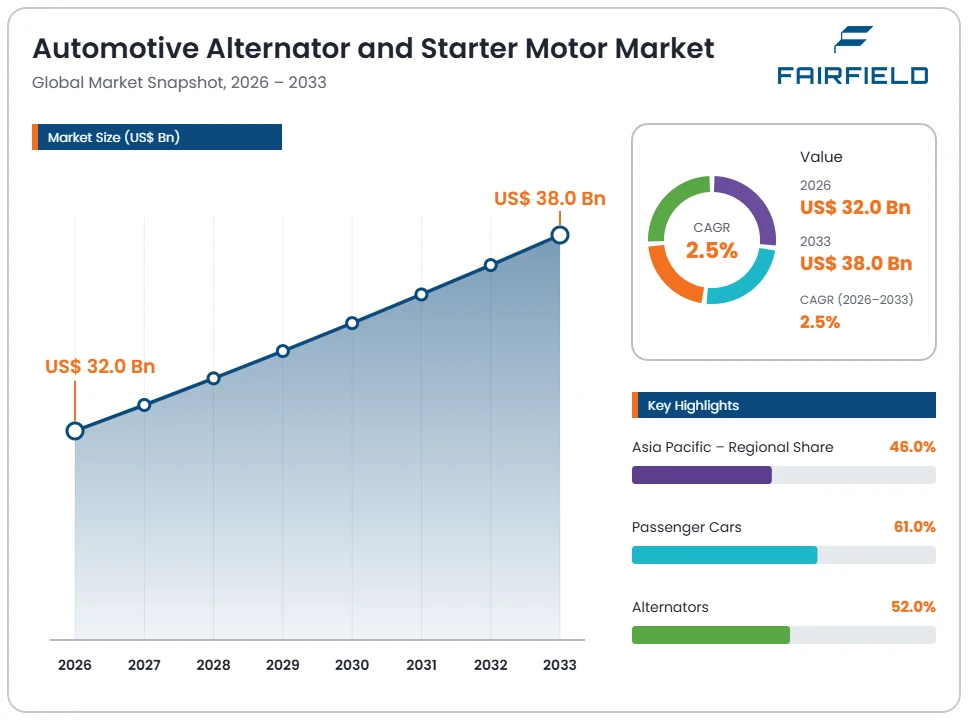
The global Automotive Alternator and Starter Motor market size is expected to be valued at US$ 32.0 billion in 2026 and projected to reach US$ 38.0 billion by 2033, growing at a CAGR of 2.5% between 2026 and 2033.
The market grew at a 2.9% CAGR between 2020 and 2025, with the recovery in vehicle production offsetting the first visible losses to battery electric powertrains. The outlook is best understood as two markets moving in opposite directions. Original equipment demand faces structural decline, because every battery electric vehicle built removes one alternator and one starter motor from the bill of materials, and electric share of new sales keeps rising in China, Europe and North America. The aftermarket and remanufacturing side is resilient, since it follows the existing vehicle parc rather than new registrations, and that parc is both large and ageing. Mild hybrid belt-driven starter generators add value density that partly cushions unit losses.
Key Report Takeaways
- By Product Type: Alternators held 52% share in 2026, while Belt-Driven Starter Generators are projected to expand at a 6.8% CAGR through 2033, driven by 48-volt mild hybrid adoption in European and Chinese passenger car platforms.
- By Vehicle Type: Passenger Cars held 61% share in 2026, while Heavy Commercial Vehicles are projected to expand at a 3.8% CAGR through 2033, driven by slower electrification of long-haul freight and higher electrical loads per truck.
- By Sales Channel: Original Equipment held 44% share in 2026, while Remanufactured Units are projected to expand at a 4.6% CAGR through 2033, driven by circularity rules and the cost advantage of rebuilt rotating electrics.
- By Powertrain Type: Start-Stop Internal Combustion Engine held 45% share in 2026, while 48-Volt Mild Hybrid is projected to expand at a 7.2% CAGR through 2033, driven by fleet carbon dioxide compliance at lower cost than full hybridisation.
- By Geography: Asia Pacific held 46% share in 2026, while Middle East & Africa is projected to expand at a 4.1% CAGR through 2033, driven by an ageing imported vehicle parc and minimal battery electric penetration.
Global Automotive Alternator and Starter Motor Market Trends and Insights
Drivers Impact Analysis
Two forces keep this mature component market growing despite powertrain change.
| Driver | Impact on CAGR Forecast | Geographic Relevance | Impact Timeline |
| Ageing global vehicle parc sustaining aftermarket replacement demand | High | Global | Long term ≥4 years |
| 48-volt mild hybrid adoption raising value per rotating electric unit | Medium | Europe, Asia Pacific | Medium term 2–4 years |
Ageing Vehicle Parc Keeps Rotating Electrics Replacement Demand Resilient
Replacement demand follows the vehicle parc, not new car sales, and the parc is getting older in every major market. Average light vehicle age in the United States has climbed past twelve years, and European fleets show a similar drift. Alternators and starter motors are wear items with service lives typically shorter than the vehicle itself, so an older fleet generates more failures per year. This decoupling is why aftermarket volumes hold up even as original equipment fitment falls.
The mechanism is simple arithmetic across a very large installed base. More than a billion internal combustion vehicles remain in service worldwide, and most will stay on the road for another decade or more. Brush wear, bearing failure, rectifier diode breakdown and solenoid contact erosion all occur on predictable duty cycles. Independent garages and fleet operators buy on availability and price, which supports both new aftermarket units and remanufactured rotating electrics.
Mild Hybrid Belt-Driven Starter Generators Raise Value per Vehicle Fitted
The shift to 48-volt mild hybrid architecture raises revenue per vehicle even where unit counts fall. A belt-driven starter generator replaces a conventional alternator and often the starter motor with a single higher-output machine that provides torque assist, regenerative braking and smoother stop-start. Its price to the vehicle manufacturer is several times that of a conventional alternator. This value density partly offsets the units lost to battery electric vehicles in the original equipment channel.
Carbon dioxide compliance economics explain the adoption. Regulation (EU) 2019/631, as amended by Regulation (EU) 2023/851, tightens fleet average limits for manufacturers selling in the European Union. Mild hybridisation delivers a measurable reduction in fuel use for a fraction of the cost of a full hybrid or plug-in system. Chinese and European manufacturers have accordingly standardised 48-volt systems across large passenger car and light commercial platforms.
Restraints Impact Analysis
Two constraints weigh on long-term demand and on supplier input costs.
| Restraint | Impact on CAGR Forecast | Geographic Relevance | Impact Timeline |
| Structural decline in original equipment fitment as battery electric share rises | High | Europe, North America, Asia Pacific | Long term ≥4 years |
| Copper and rare earth input cost and supply exposure | Medium | Global | Short term ≤2 years |
Battery Electric Vehicle Share Erodes Original Equipment Fitment Permanently
Every battery electric vehicle produced removes an alternator and a starter motor from the build. There is no equivalent component in a battery electric drivetrain, because the traction inverter and the DC-DC converter handle both functions. This is a permanent loss of fitment rather than a cyclical downturn, and it compounds as electric share of new registrations rises. Original equipment volumes are already declining in Norway, China and several European Union markets.
Policy sets the pace of that erosion. Regulation (EU) 2019/631 as amended requires a 100% reduction in fleet average carbon dioxide emissions from new cars from 2035, which effectively ends internal combustion sales in the bloc. Several national and subnational jurisdictions have set comparable targets. Vehicle manufacturers plan platforms years ahead, so component suppliers lose design wins long before the sales ban arrives. Capacity utilisation at dedicated rotating electrics plants is the first casualty.
Copper and Rare Earth Exposure Pressures Rotating Electrics Production Margins
Raw material intensity makes margins unusually sensitive to commodity moves. An alternator stator and rotor contain a significant mass of copper winding wire, and a starter motor adds further copper in its field and armature windings. Copper has traded at high levels on grid and electrification demand, and suppliers under multi-year fixed-price contracts with vehicle manufacturers cannot always pass that through. Scrap and hairpin winding techniques reduce but do not eliminate the exposure.
Magnet materials add a second vulnerability. Permanent magnet designs in compact starter motors and belt-driven starter generators use neodymium and dysprosium, whose refining is concentrated in a small number of facilities. Export licensing changes in supplying countries have produced sharp price movements and delivery uncertainty. Steel laminations, aluminium housings and electronic rectifier components complete a bill of materials with limited substitution headroom, which leaves little room for cost recovery.
Market Opportunities
Two revenue pools grow independently of new vehicle production volumes.
Remanufacturing Scale-Up Turns Circularity Rules into a Service Revenue Pool
Remanufacturing converts end-of-life rotating electrics into a higher-margin revenue stream with a defensible competitive position. A core alternator or starter motor returned from a workshop can be disassembled, cleaned, rewound, fitted with new bearings and brushes, tested and sold at a meaningful discount to a new unit while carrying a comparable warranty. Margins on remanufactured product typically exceed those on new aftermarket units, because the core is recovered rather than purchased.
Circularity policy is pulling this forward. The European Commission has proposed replacing the End-of-Life Vehicles Directive 2000/53/EC with a regulation that strengthens recycled content, dismantling and parts reuse obligations. Insurers, fleet operators and independent garages are the immediate buyers, since all three face cost pressure on repair. Suppliers with established core collection logistics and test capability are positioned to capture the volume as reuse requirements firm up.
Commercial Vehicle and Off-Highway Electrical Upgrades Create a Premium Niche
Heavy duty and off-highway applications open a high-value niche insulated from passenger car electrification. Long-haul trucks, buses, agricultural machinery and construction equipment carry growing electrical loads from telematics, refrigeration, hydraulic controls, cab comfort systems and auxiliary power. These vehicles need higher output alternators, frequently 24-volt and often brushless, and heavy duty starter motors able to crank large displacement engines repeatedly in severe conditions.
Fleet operators and equipment manufacturers drive the demand, and they buy on durability and total cost of ownership rather than on unit price. Battery electric penetration in long-haul freight and heavy off-highway work remains low, because duty cycles, payload and charging infrastructure constrain adoption. Euro 7, set out in Regulation (EU) 2024/1257, extends durability requirements for heavy duty vehicles, which rewards suppliers able to document component life over extended service intervals.
Segment Analysis
- By Product Type: Alternators Lead Revenue While Belt-Driven Starter Generators Advance Fastest
Alternators held 52% of revenue in 2026, the largest product position, because every internal combustion vehicle carries one and average output ratings keep rising with onboard electrical load. Higher amperage units command better pricing, and replacement rates are steady across the parc. Starter Motors account for most of the balance, with demand lifted by start-stop duty cycles that multiply engagement counts by a wide factor. Belt-Driven Starter Generators are the fastest-growing product line at a 6.8% CAGR to 2033, expanding from a comparatively small base. These machines combine generation, cranking, torque assist and regenerative braking in one unit, and they sell at a substantial premium. Growth concentrates in 48-volt architectures on European and Chinese platforms. The business implication is that revenue mix is shifting toward fewer, more expensive machines, which protects value even as total unit counts in the original equipment channel decline.
- By Vehicle Type: Passenger Cars Dominate Volume as Heavy Commercial Vehicles Grow Faster
Passenger Cars represented 61% of demand in 2026, reflecting their share of both global production and the installed parc. This segment also carries the greatest exposure to battery electric substitution, which caps its growth. Light Commercial Vehicles form the second block, supported by last-mile delivery fleet expansion and high annual mileage that accelerates component wear. Heavy Commercial Vehicles are growing fastest at a 3.8% CAGR through 2033. Electrification of long-haul freight is advancing slowly because of payload, range and charging constraints, so diesel tractors continue to be built and operated in volume. Their electrical systems are also growing more demanding, with 24-volt high-output alternators serving telematics, auxiliary heating and refrigeration. Off-Highway and Agricultural Vehicles contribute a smaller, durable share. For suppliers, commercial and off-highway lines offer a hedge against the passenger car decline with better pricing discipline.
- By Sales Channel: Original Equipment Leads Today While Remanufactured Units Expand Quickest
Original Equipment held 44% of value in 2026, supplying first fitment to vehicle manufacturers under long-term contracts. This channel offers scale but thin margins and is the one directly exposed to electrification losses. The Independent Aftermarket holds a large secondary share and benefits from the ageing parc, from workshop preference for rotating electrics replacement over repair, and from distribution rules that preserve access to parts and technical information for independent operators in the European Union. Remanufactured Units are the fastest-growing channel at a 4.6% CAGR to 2033. Cost pressure on repair bills, improving core collection networks and firming circularity policy all support that expansion. Remanufactured alternators and starter motors typically sell well below new equivalents while carrying similar warranties. The strategic consequence is that channel mix, rather than total volume, now determines which suppliers grow through the forecast period.
- By Powertrain Type: Start-Stop Systems Hold the Largest Base While 48-Volt Mild Hybrids Surge
Start-Stop Internal Combustion Engine platforms accounted for 45% of demand in 2026, the largest powertrain position. Start-stop is now near-standard on new internal combustion vehicles in regulated markets, and it requires reinforced starter motors with upgraded solenoids, brushes and bearings rated for many times the engagement count of a conventional unit. That specification uplift raises average selling prices across a very large volume base. Conventional Internal Combustion Engine platforms still dominate the existing parc and thus the aftermarket, though their share of new fitment keeps shrinking. 48-Volt Mild Hybrid is the fastest-growing powertrain type at a 7.2% CAGR through 2033, because it delivers fleet carbon dioxide reductions at a fraction of full hybrid cost. The implication is that suppliers must sustain legacy 12-volt production for the aftermarket while funding 48-volt development for shrinking original equipment programmes.
Geography Analysis
- North America Leans on an Ageing Light Vehicle Parc for Replacement Volumes
North America held 20% of global revenue in 2026, with the United States dominating and Mexico adding significant production capacity for export. The defining regional feature is parc age. Average light vehicle age has risen above twelve years, and the proportion of vehicles beyond warranty keeps growing, which sustains a large and stable aftermarket for rotating electrics. Pickup trucks and sport utility vehicles carry high electrical loads and large displacement engines, raising both alternator output requirements and starter motor duty. Mexico is a major manufacturing base for alternators and starter motors supplying the region under integrated trade arrangements. Battery electric adoption is advancing but remains below European levels, so original equipment fitment erodes more slowly. Fleet operators and big-box retail distribution networks shape how replacement parts reach workshops.
- Europe Combines Mild Hybrid Fitment with Independent Repair Channel Strength
Europe accounted for 21% of revenue in 2026, led by Germany, France, Italy, Spain and the United Kingdom. The region shows the highest 48-volt mild hybrid fitment rate globally, driven by fleet carbon dioxide targets that make belt-driven starter generators a cost-effective compliance tool. That raises revenue per vehicle even as total internal combustion output declines. The independent aftermarket is unusually strong here, protected by motor vehicle block exemption rules that preserve competition in parts distribution and by right to repair provisions securing access to technical information. Remanufacturing is well established, supported by end-of-life vehicle rules and by organised core collection. The central regional risk is the 2035 endpoint for new internal combustion car sales, which will steadily remove original equipment programmes from supplier portfolios.
- Which Region Is Leading the Automotive Alternator and Starter Motor Market?
Asia Pacific leads with 46% of global revenue in 2026, a position built on sheer vehicle production scale. China, Japan, India and South Korea together build the majority of the world’s light vehicles, and most rotating electrics are manufactured within the region. Three causes explain the lead. Production volume is the first, since original equipment fitment follows assembly output. Component manufacturing concentration is the second, with dense supplier clusters supporting low delivered cost. A rapidly growing vehicle parc in India and Indonesia is the third, generating replacement demand that is still in its early phase. The complication is that China also has the highest battery electric share of new sales anywhere, so the region leads both in current revenue and in the speed of original equipment erosion. Aftermarket growth in India partly offsets that.
- Latin America Grows Replacement Demand Through Long Vehicle Service Lives
Latin America held 7% of revenue in 2026, with Brazil, Mexico, Argentina and Colombia supplying most demand. Vehicles stay in service far longer than in wealthier markets, and owners repair rather than replace, which makes this a replacement-weighted rather than fitment-weighted market. Flex-fuel engines in Brazil add specific starter motor duty requirements. Remanufactured and rebuilt rotating electrics hold a high share, supported by a dense network of small independent rebuilders. Barriers are meaningful. Currency volatility raises the cost of imported components, import tariffs and homologation requirements add friction, and counterfeit or low-quality parts undercut established brands in informal channels. Battery electric penetration is minimal, which protects the internal combustion base. The regional change worth watching is formalisation of parts distribution through organised retail and online channels.
- Which Region Is Growing Fastest in the Automotive Alternator and Starter Motor Market?
Middle East & Africa is growing fastest, at a 4.1% CAGR between 2026 and 2033, from 6% share in 2026. Saudi Arabia, the United Arab Emirates, Egypt, Nigeria and South Africa account for most of that demand. The mechanism is parc growth combined with minimal powertrain substitution. Used vehicle imports continue to expand the regional fleet, and those vehicles arrive already several years old, so replacement demand begins almost immediately. Battery electric penetration is negligible outside a few Gulf cities, which leaves the internal combustion base intact. High ambient temperatures and dust accelerate bearing, brush and rectifier failure, shortening service intervals for rotating electrics. South Africa hosts vehicle assembly and component manufacturing that serves the wider region. Barriers include fragmented distribution, limited workshop diagnostic capability and heavy exposure to counterfeit parts.
Competitive Landscape
The market is moderately concentrated on the original equipment side and highly fragmented in the aftermarket. A handful of global tier one suppliers holds most first-fitment business, because vehicle manufacturers award multi-year platform contracts that demand global footprint, validated quality systems under IATF 16949 and the capital to fund programme development. Below that layer, hundreds of independent manufacturers, rebuilders and brand owners compete in replacement channels, where barriers to entry are far lower. Consolidation pressure is building in original equipment as suppliers rationalise capacity that electrification will eventually strand.
Competition rests on different factors in each channel. In original equipment it turns on cost per unit at volume, weight and packaging, durability validation and the ability to co-develop 48-volt systems with the vehicle manufacturer. In the aftermarket it turns on catalogue coverage across thousands of vehicle applications, parts availability within a day, and brand trust among workshop technicians. New competitive pressure comes from Chinese and Indian manufacturers moving up the quality curve and from remanufacturers selling directly to fleets and insurers.
Strategic positioning differs across the field. Robert Bosch GmbH, DENSO Corporation and Valeo SE combine original equipment programmes with large branded aftermarket operations, which gives them a hedge against fitment decline. Mitsubishi Electric Corporation and BorgWarner Inc. emphasise electrification portfolios alongside legacy rotating electrics. Regional specialists concentrate on commercial vehicle and off-highway applications where volumes are smaller and pricing is firmer.
Strategic direction across suppliers points to three themes: managing the decline of 12-volt original equipment capacity without abandoning aftermarket service obligations, investing in remanufacturing and core logistics, and redirecting engineering resources toward commercial vehicle, off-highway and mild hybrid applications that retain longer runways.
Recent Industry Developments
- April 2023: The European Commission extended the motor vehicle block exemption framework governing distribution and repair of vehicles and spare parts – the extension preserves independent aftermarket access to parts and technical information, protecting replacement demand channels for rotating electrics.
- April 2023: Regulation (EU) 2023/851 amended Regulation (EU) 2019/631 to require a 100% reduction in fleet average carbon dioxide emissions from new cars and vans from 2035 – it sets a firm endpoint for internal combustion original equipment fitment in the bloc.
- July 2023: The European Commission proposed a regulation on circularity requirements for vehicle design and end-of-life vehicle management, intended to replace Directive 2000/53/EC – stronger reuse and recycled content obligations would expand the addressable market for remanufactured components.
- May 2024: Regulation (EU) 2024/1257 establishing the Euro 7 emission type-approval framework was published in the Official Journal of the European Union – its extended durability and lifetime compliance requirements raise validation demands on starter motors and alternators in start-stop duty.
Companies Covered in the Report
- Robert Bosch GmbH
- DENSO Corporation
- Valeo SE
- Mitsubishi Electric Corporation
- BorgWarner Inc.
- Hitachi Astemo, Ltd.
- MAHLE GmbH
- Marelli Holdings Co., Ltd.
- Lucas TVS Limited
- Sawafuji Electric Co., Ltd.
- Prestolite Electric Incorporated
- HELLA GmbH & Co. KGaA
Automotive Alternator and Starter Motor Market Report Scope
| Metric | Value |
| Study Period | 2020–2033 |
| Market Size 2026 | US$ 32.0 Billion |
| Market Size 2033 | US$ 38.0 Billion |
| CAGR 2026–2033 | 2.5% |
| Absolute Dollar Opportunity | US$ 6.0 Billion |
| Largest Market | Asia Pacific, 46% share in 2026 |
| Fastest-Growing Market | Middle East & Africa, 4.1% CAGR |
| Market Concentration | Medium |
| Major Players | Robert Bosch GmbH, DENSO Corporation, Valeo SE, Mitsubishi Electric Corporation, BorgWarner Inc. |
Automotive Alternator and Starter Motor Market Segmentation
Product Type
- Alternators
- Starter Motors
- Belt-Driven Starter Generators
Vehicle Type
- Passenger Cars
- Light Commercial Vehicles
- Heavy Commercial Vehicles
- Off-Highway and Agricultural Vehicles
Sales Channel
- Original Equipment
- Independent Aftermarket
- Remanufactured Units
Powertrain Type
- Conventional Internal Combustion Engine
- Start-Stop Internal Combustion Engine
- 48-Volt Mild Hybrid
Regions
- North America
- Europe
- Asia Pacific
- Latin America
- Middle East & Africa
- Executive Summary
- Global Automotive Alternator and Starter Motor Market Snapshot
- Market Size and Trend Analysis 2020–2033
- Historical Growth 2020–2025
- Base Year 2025
- Forecast Outlook 2026–2033
- Key Report Takeaways
- Market Overview
- Market Definition and Report Scope
- Market Dynamics
- Drivers
- Ageing Vehicle Parc Keeps Rotating Electrics Replacement Demand Resilient
- Mild Hybrid Belt-Driven Starter Generators Raise Value per Vehicle Fitted
- Restraints
- Battery Electric Vehicle Share Erodes Original Equipment Fitment Permanently
- Copper and Rare Earth Exposure Pressures Rotating Electrics Production Margins
- Market Opportunities
- Remanufacturing Scale-Up Turns Circularity Rules into a Service Revenue Pool
- Commercial Vehicle and Off-Highway Electrical Upgrades Create a Premium Niche
- Drivers
- Segment Analysis
- By Product Type: Alternators Lead Revenue While Belt-Driven Starter Generators Advance Fastest
- By Vehicle Type: Passenger Cars Dominate Volume as Heavy Commercial Vehicles Grow Faster
- By Sales Channel: Original Equipment Leads Today While Remanufactured Units Expand Quickest
- By Powertrain Type: Start-Stop Systems Hold the Largest Base While 48-Volt Mild Hybrids Surge
- Global Automotive Alternator and Starter Motor Market Outlook, 2020–2033
- Global Automotive Alternator and Starter Motor Market Outlook, by Product Type, Value (US$ Billion), 2020–2033
- Alternators
- Starter Motors
- Belt-Driven Starter Generators
- Global Automotive Alternator and Starter Motor Market Outlook, by Vehicle Type, Value (US$ Billion), 2020–2033
- Passenger Cars
- Light Commercial Vehicles
- Heavy Commercial Vehicles
- Off-Highway and Agricultural Vehicles
- Global Automotive Alternator and Starter Motor Market Outlook, by Sales Channel, Value (US$ Billion), 2020–2033
- Original Equipment
- Independent Aftermarket
- Remanufactured Units
- Global Automotive Alternator and Starter Motor Market Outlook, by Powertrain Type, Value (US$ Billion), 2020–2033
- Conventional Internal Combustion Engine
- Start-Stop Internal Combustion Engine
- 48-Volt Mild Hybrid
- Global Automotive Alternator and Starter Motor Market Outlook, by Region, Value (US$ Billion), 2020–2033
- North America
- Europe
- Asia Pacific
- Latin America
- Middle East & Africa
- Global Automotive Alternator and Starter Motor Market Outlook, by Product Type, Value (US$ Billion), 2020–2033
- North America Automotive Alternator and Starter Motor Market Outlook, 2020–2033
- North America Leans on an Ageing Light Vehicle Parc for Replacement Volumes
- North America Automotive Alternator and Starter Motor Market Outlook, by Product Type, Value (US$ Billion), 2020–2033
- Alternators
- Starter Motors
- Belt-Driven Starter Generators
- North America Automotive Alternator and Starter Motor Market Outlook, by Vehicle Type, Value (US$ Billion), 2020–2033
- Passenger Cars
- Light Commercial Vehicles
- Heavy Commercial Vehicles
- Off-Highway and Agricultural Vehicles
- North America Automotive Alternator and Starter Motor Market Outlook, by Sales Channel, Value (US$ Billion), 2020–2033
- Original Equipment
- Independent Aftermarket
- Remanufactured Units
- North America Automotive Alternator and Starter Motor Market Outlook, by Powertrain Type, Value (US$ Billion), 2020–2033
- Conventional Internal Combustion Engine
- Start-Stop Internal Combustion Engine
- 48-Volt Mild Hybrid
- North America Automotive Alternator and Starter Motor Market Outlook, by Country, Value (US$ Billion), 2020–2033
- United States Automotive Alternator and Starter Motor Market Outlook, by Product Type, 2020–2033
- United States Automotive Alternator and Starter Motor Market Outlook, by Vehicle Type, 2020–2033
- United States Automotive Alternator and Starter Motor Market Outlook, by Sales Channel, 2020–2033
- United States Automotive Alternator and Starter Motor Market Outlook, by Powertrain Type, 2020–2033
- Mexico Automotive Alternator and Starter Motor Market Outlook, by Product Type, 2020–2033
- Mexico Automotive Alternator and Starter Motor Market Outlook, by Vehicle Type, 2020–2033
- Mexico Automotive Alternator and Starter Motor Market Outlook, by Sales Channel, 2020–2033
- Mexico Automotive Alternator and Starter Motor Market Outlook, by Powertrain Type, 2020–2033
- Europe Automotive Alternator and Starter Motor Market Outlook, 2020–2033
- Europe Combines Mild Hybrid Fitment with Independent Repair Channel Strength
- Europe Automotive Alternator and Starter Motor Market Outlook, by Product Type, Value (US$ Billion), 2020–2033
- Alternators
- Starter Motors
- Belt-Driven Starter Generators
- Europe Automotive Alternator and Starter Motor Market Outlook, by Vehicle Type, Value (US$ Billion), 2020–2033
- Passenger Cars
- Light Commercial Vehicles
- Heavy Commercial Vehicles
- Off-Highway and Agricultural Vehicles
- Europe Automotive Alternator and Starter Motor Market Outlook, by Sales Channel, Value (US$ Billion), 2020–2033
- Original Equipment
- Independent Aftermarket
- Remanufactured Units
- Europe Automotive Alternator and Starter Motor Market Outlook, by Powertrain Type, Value (US$ Billion), 2020–2033
- Conventional Internal Combustion Engine
- Start-Stop Internal Combustion Engine
- 48-Volt Mild Hybrid
- Europe Automotive Alternator and Starter Motor Market Outlook, by Country, Value (US$ Billion), 2020–2033
- Germany Automotive Alternator and Starter Motor Market Outlook, by Product Type, 2020–2033
- Germany Automotive Alternator and Starter Motor Market Outlook, by Vehicle Type, 2020–2033
- Germany Automotive Alternator and Starter Motor Market Outlook, by Sales Channel, 2020–2033
- Germany Automotive Alternator and Starter Motor Market Outlook, by Powertrain Type, 2020–2033
- France Automotive Alternator and Starter Motor Market Outlook, by Product Type, 2020–2033
- France Automotive Alternator and Starter Motor Market Outlook, by Vehicle Type, 2020–2033
- France Automotive Alternator and Starter Motor Market Outlook, by Sales Channel, 2020–2033
- France Automotive Alternator and Starter Motor Market Outlook, by Powertrain Type, 2020–2033
- Italy Automotive Alternator and Starter Motor Market Outlook, by Product Type, 2020–2033
- Italy Automotive Alternator and Starter Motor Market Outlook, by Vehicle Type, 2020–2033
- Italy Automotive Alternator and Starter Motor Market Outlook, by Sales Channel, 2020–2033
- Italy Automotive Alternator and Starter Motor Market Outlook, by Powertrain Type, 2020–2033
- Spain Automotive Alternator and Starter Motor Market Outlook, by Product Type, 2020–2033
- Spain Automotive Alternator and Starter Motor Market Outlook, by Vehicle Type, 2020–2033
- Spain Automotive Alternator and Starter Motor Market Outlook, by Sales Channel, 2020–2033
- Spain Automotive Alternator and Starter Motor Market Outlook, by Powertrain Type, 2020–2033
- United Kingdom Automotive Alternator and Starter Motor Market Outlook, by Product Type, 2020–2033
- United Kingdom Automotive Alternator and Starter Motor Market Outlook, by Vehicle Type, 2020–2033
- United Kingdom Automotive Alternator and Starter Motor Market Outlook, by Sales Channel, 2020–2033
- United Kingdom Automotive Alternator and Starter Motor Market Outlook, by Powertrain Type, 2020–2033
- Asia Pacific Automotive Alternator and Starter Motor Market Outlook, 2020–2033
- Regional Market Leadership
- Asia Pacific Automotive Alternator and Starter Motor Market Outlook, by Product Type, Value (US$ Billion), 2020–2033
- Alternators
- Starter Motors
- Belt-Driven Starter Generators
- Asia Pacific Automotive Alternator and Starter Motor Market Outlook, by Vehicle Type, Value (US$ Billion), 2020–2033
- Passenger Cars
- Light Commercial Vehicles
- Heavy Commercial Vehicles
- Off-Highway and Agricultural Vehicles
- Asia Pacific Automotive Alternator and Starter Motor Market Outlook, by Sales Channel, Value (US$ Billion), 2020–2033
- Original Equipment
- Independent Aftermarket
- Remanufactured Units
- Asia Pacific Automotive Alternator and Starter Motor Market Outlook, by Powertrain Type, Value (US$ Billion), 2020–2033
- Conventional Internal Combustion Engine
- Start-Stop Internal Combustion Engine
- 48-Volt Mild Hybrid
- Asia Pacific Automotive Alternator and Starter Motor Market Outlook, by Country, Value (US$ Billion), 2020–2033
- China Automotive Alternator and Starter Motor Market Outlook, by Product Type, 2020–2033
- China Automotive Alternator and Starter Motor Market Outlook, by Vehicle Type, 2020–2033
- China Automotive Alternator and Starter Motor Market Outlook, by Sales Channel, 2020–2033
- China Automotive Alternator and Starter Motor Market Outlook, by Powertrain Type, 2020–2033
- Japan Automotive Alternator and Starter Motor Market Outlook, by Product Type, 2020–2033
- Japan Automotive Alternator and Starter Motor Market Outlook, by Vehicle Type, 2020–2033
- Japan Automotive Alternator and Starter Motor Market Outlook, by Sales Channel, 2020–2033
- Japan Automotive Alternator and Starter Motor Market Outlook, by Powertrain Type, 2020–2033
- India Automotive Alternator and Starter Motor Market Outlook, by Product Type, 2020–2033
- India Automotive Alternator and Starter Motor Market Outlook, by Vehicle Type, 2020–2033
- India Automotive Alternator and Starter Motor Market Outlook, by Sales Channel, 2020–2033
- India Automotive Alternator and Starter Motor Market Outlook, by Powertrain Type, 2020–2033
- South Korea Automotive Alternator and Starter Motor Market Outlook, by Product Type, 2020–2033
- South Korea Automotive Alternator and Starter Motor Market Outlook, by Vehicle Type, 2020–2033
- South Korea Automotive Alternator and Starter Motor Market Outlook, by Sales Channel, 2020–2033
- South Korea Automotive Alternator and Starter Motor Market Outlook, by Powertrain Type, 2020–2033
- Indonesia Automotive Alternator and Starter Motor Market Outlook, by Product Type, 2020–2033
- Indonesia Automotive Alternator and Starter Motor Market Outlook, by Vehicle Type, 2020–2033
- Indonesia Automotive Alternator and Starter Motor Market Outlook, by Sales Channel, 2020–2033
- Indonesia Automotive Alternator and Starter Motor Market Outlook, by Powertrain Type, 2020–2033
- Latin America Automotive Alternator and Starter Motor Market Outlook, 2020–2033
- Latin America Grows Replacement Demand Through Long Vehicle Service Lives
- Latin America Automotive Alternator and Starter Motor Market Outlook, by Product Type, Value (US$ Billion), 2020–2033
- Alternators
- Starter Motors
- Belt-Driven Starter Generators
- Latin America Automotive Alternator and Starter Motor Market Outlook, by Vehicle Type, Value (US$ Billion), 2020–2033
- Passenger Cars
- Light Commercial Vehicles
- Heavy Commercial Vehicles
- Off-Highway and Agricultural Vehicles
- Latin America Automotive Alternator and Starter Motor Market Outlook, by Sales Channel, Value (US$ Billion), 2020–2033
- Original Equipment
- Independent Aftermarket
- Remanufactured Units
- Latin America Automotive Alternator and Starter Motor Market Outlook, by Powertrain Type, Value (US$ Billion), 2020–2033
- Conventional Internal Combustion Engine
- Start-Stop Internal Combustion Engine
- 48-Volt Mild Hybrid
- Latin America Automotive Alternator and Starter Motor Market Outlook, by Country, Value (US$ Billion), 2020–2033
- Brazil Automotive Alternator and Starter Motor Market Outlook, by Product Type, 2020–2033
- Brazil Automotive Alternator and Starter Motor Market Outlook, by Vehicle Type, 2020–2033
- Brazil Automotive Alternator and Starter Motor Market Outlook, by Sales Channel, 2020–2033
- Brazil Automotive Alternator and Starter Motor Market Outlook, by Powertrain Type, 2020–2033
- Mexico Automotive Alternator and Starter Motor Market Outlook, by Product Type, 2020–2033
- Mexico Automotive Alternator and Starter Motor Market Outlook, by Vehicle Type, 2020–2033
- Mexico Automotive Alternator and Starter Motor Market Outlook, by Sales Channel, 2020–2033
- Mexico Automotive Alternator and Starter Motor Market Outlook, by Powertrain Type, 2020–2033
- Argentina Automotive Alternator and Starter Motor Market Outlook, by Product Type, 2020–2033
- Argentina Automotive Alternator and Starter Motor Market Outlook, by Vehicle Type, 2020–2033
- Argentina Automotive Alternator and Starter Motor Market Outlook, by Sales Channel, 2020–2033
- Argentina Automotive Alternator and Starter Motor Market Outlook, by Powertrain Type, 2020–2033
- Colombia Automotive Alternator and Starter Motor Market Outlook, by Product Type, 2020–2033
- Colombia Automotive Alternator and Starter Motor Market Outlook, by Vehicle Type, 2020–2033
- Colombia Automotive Alternator and Starter Motor Market Outlook, by Sales Channel, 2020–2033
- Colombia Automotive Alternator and Starter Motor Market Outlook, by Powertrain Type, 2020–2033
- Middle East & Africa Automotive Alternator and Starter Motor Market Outlook, 2020–2033
- Regional Growth Outlook
- Middle East & Africa Automotive Alternator and Starter Motor Market Outlook, by Product Type, Value (US$ Billion), 2020–2033
- Alternators
- Starter Motors
- Belt-Driven Starter Generators
- Middle East & Africa Automotive Alternator and Starter Motor Market Outlook, by Vehicle Type, Value (US$ Billion), 2020–2033
- Passenger Cars
- Light Commercial Vehicles
- Heavy Commercial Vehicles
- Off-Highway and Agricultural Vehicles
- Middle East & Africa Automotive Alternator and Starter Motor Market Outlook, by Sales Channel, Value (US$ Billion), 2020–2033
- Original Equipment
- Independent Aftermarket
- Remanufactured Units
- Middle East & Africa Automotive Alternator and Starter Motor Market Outlook, by Powertrain Type, Value (US$ Billion), 2020–2033
- Conventional Internal Combustion Engine
- Start-Stop Internal Combustion Engine
- 48-Volt Mild Hybrid
- Middle East & Africa Automotive Alternator and Starter Motor Market Outlook, by Country, Value (US$ Billion), 2020–2033
- Saudi Arabia Automotive Alternator and Starter Motor Market Outlook, by Product Type, 2020–2033
- Saudi Arabia Automotive Alternator and Starter Motor Market Outlook, by Vehicle Type, 2020–2033
- Saudi Arabia Automotive Alternator and Starter Motor Market Outlook, by Sales Channel, 2020–2033
- Saudi Arabia Automotive Alternator and Starter Motor Market Outlook, by Powertrain Type, 2020–2033
- United Arab Emirates Automotive Alternator and Starter Motor Market Outlook, by Product Type, 2020–2033
- United Arab Emirates Automotive Alternator and Starter Motor Market Outlook, by Vehicle Type, 2020–2033
- United Arab Emirates Automotive Alternator and Starter Motor Market Outlook, by Sales Channel, 2020–2033
- United Arab Emirates Automotive Alternator and Starter Motor Market Outlook, by Powertrain Type, 2020–2033
- Egypt Automotive Alternator and Starter Motor Market Outlook, by Product Type, 2020–2033
- Egypt Automotive Alternator and Starter Motor Market Outlook, by Vehicle Type, 2020–2033
- Egypt Automotive Alternator and Starter Motor Market Outlook, by Sales Channel, 2020–2033
- Egypt Automotive Alternator and Starter Motor Market Outlook, by Powertrain Type, 2020–2033
- Nigeria Automotive Alternator and Starter Motor Market Outlook, by Product Type, 2020–2033
- Nigeria Automotive Alternator and Starter Motor Market Outlook, by Vehicle Type, 2020–2033
- Nigeria Automotive Alternator and Starter Motor Market Outlook, by Sales Channel, 2020–2033
- Nigeria Automotive Alternator and Starter Motor Market Outlook, by Powertrain Type, 2020–2033
- South Africa Automotive Alternator and Starter Motor Market Outlook, by Product Type, 2020–2033
- South Africa Automotive Alternator and Starter Motor Market Outlook, by Vehicle Type, 2020–2033
- South Africa Automotive Alternator and Starter Motor Market Outlook, by Sales Channel, 2020–2033
- South Africa Automotive Alternator and Starter Motor Market Outlook, by Powertrain Type, 2020–2033
- Competitive Landscape
- Market Concentration and Supplier Participation
- Competitive Factors and Strategic Direction
- Recent Industry Developments
- EU Motor Vehicle Block Exemption Framework Extension April 2023
- EU New Car and Van Carbon Dioxide Regulation Amendment April 2023
- EU End-of-Life Vehicle Circularity Proposal July 2023
- Euro 7 Emission Type-Approval Framework May 2024
- Company Profiles
- Robert Bosch GmbH
- DENSO Corporation
- Valeo SE
- Mitsubishi Electric Corporation
- BorgWarner Inc.
- Hitachi Astemo, Ltd.
- MAHLE GmbH
- Marelli Holdings Co., Ltd.
- Lucas TVS Limited
- Sawafuji Electric Co., Ltd.
- Prestolite Electric Incorporated
- HELLA GmbH & Co. KGaA
- Appendix
- Research Methodology
- Report Assumptions
- Acronyms and Abbreviations
Product Type
- Alternators
- Starter Motors
- Belt-Driven Starter Generators
Vehicle Type
- Passenger Cars
- Light Commercial Vehicles
- Heavy Commercial Vehicles
- Off-Highway and Agricultural Vehicles
Sales Channel
- Original Equipment
- Independent Aftermarket
- Remanufactured Units
Powertrain Type
- Conventional Internal Combustion Engine
- Start-Stop Internal Combustion Engine
- 48-Volt Mild Hybrid
Regions
- North America
- Europe
- Asia Pacific
- Latin America
- Middle East & Africa
Our Research Methodology
Considering the volatility of business today, traditional approaches to strategizing a game plan can be unfruitful if not detrimental. True ambiguity is no way to determine a forecast. A myriad of predetermined factors must be accounted for such as the degree of risk involved, the magnitude of circumstances, as well as conditions or consequences that are not known or unpredictable. To circumvent binary views that cast uncertainty, the application of market research intelligence to strategically posture, move, and enable actionable outcomes is necessary.
View Methodology
Quality Assured
Rigorous Validation Process

Confidentiality Assured
End-to-end Data Security

Custom Research Services
Tailored To Your Objectives
FAQs
The market is valued at US$ 32.0 billion in 2026, covering alternators, starter motors and belt-driven starter generators across original equipment, aftermarket and remanufactured channels.
Revenue is projected to reach US$ 38.0 billion by 2033, a 2.5% CAGR and an absolute dollar opportunity of US$ 6.0 billion over the period.
Alternators lead with 52% share in 2026, because every internal combustion vehicle carries one and rising onboard electrical loads push output ratings and prices higher.
Remanufactured Units grow fastest at a 4.6% CAGR through 2033, supported by repair cost pressure, improving core collection networks and tightening vehicle circularity requirements.
Asia Pacific holds 46% share in 2026, built on vehicle production scale, dense component manufacturing clusters and a rapidly expanding vehicle parc.
Related Reports
Automotive Start-Stop Battery Market Size, Share, Insights, Competitive Landscape, and Forecast 2026 to 2033
Hybrid Electric Vehicle (EV) Conversion Kit Market Size, Share, Insights, Competitive Landscape, and Forecast 2026 to 2033
The global hybrid EV conversion kit market will reach US$ 1.42 Bn by 2033, growing at 11.09% CAGR from 2026-2033, driven by cost-effective electrification
Passenger Vehicles HVAC Services Market Size, Share, Insights, Competitive Landscape, and Forecast 2026 to 2033
The passenger vehicles HVAC services market, valued at US$ 48.6 billion in 2026, and projected to reach US$ 73.4 billion by 2033, growing at 6.1% CAGR
Automotive 48-Volt Electronic Junction Box and Power Distribution Center Market Size, Share, Insights, Competitive Landscape, and Forecast 2026 to 2033
The global automotive 48-volt junction box and power distribution center market will reach US$ 4.55 Bn by 2033, growing at 11.68% CAGR from 2026-2033
Ultra-Fast EV Charging (350kW+) Systems Market Size, Share, Insights, Competitive Landscape, and Forecast 2026 to 2033
The global Ultra-Fast EV charging systems market will grow from US$ 7.1 billion in 2026 to US$ 34.5 billion by 2033, at a 25.3% CAGR. Discover key trends
Full-System Vehicle Twins Market Size, Share, Insights, Competitive Landscape, and Forecast 2026 to 2033
The global full-system vehicle twins market will reach US$ 10.4374 Bn by 2033, growing at 15.1% CAGR, driven by demand for digital vehicle simulation