



Autonomous Driving Software Market
Autonomous Driving Software Market Insights, Competitive Landscape, and Market Forecast - 2033
Global Autonomous Driving Software Market Forecast
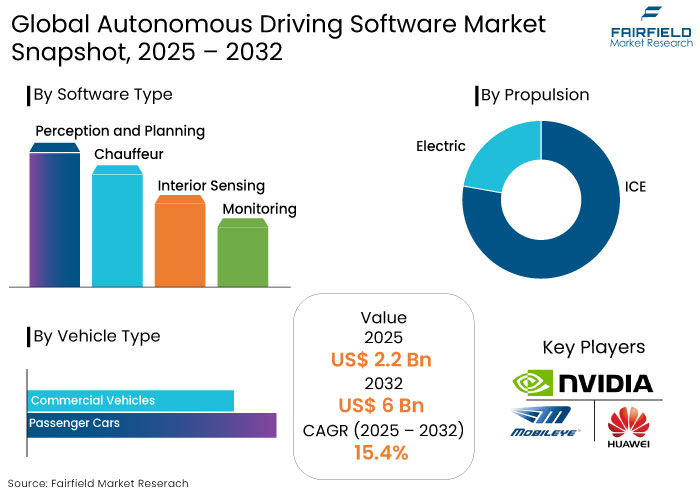
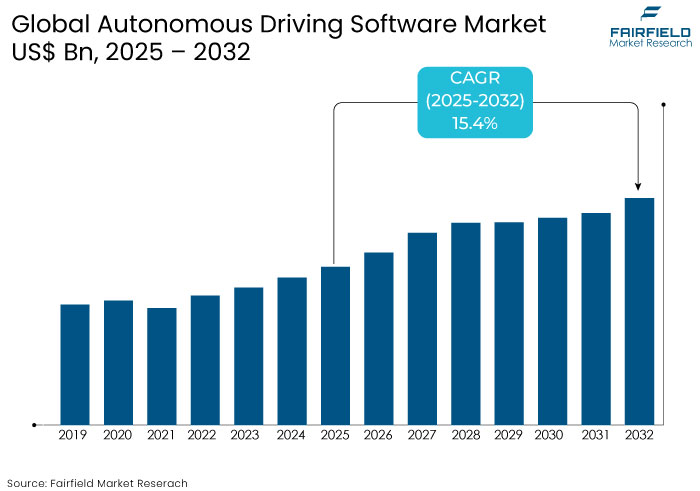
- The Autonomous Driving Software Market is valued at USD 1.3 Bn in 2026 and is projected to reach USD 4.4 Bn, growing at a CAGR of 19% by 2033
Autonomous Driving Software Market Insights
A Look Back and a Look Forward - Comparative Analysis
The autonomous driving software market growth during the historical period was primarily driven by advancements in AI, sensor technology, and growing investments from automotive giants. Early adoption of autonomous driving software was prominent in developed regions where governments promoted self-driving technology through supportive policies and infrastructure.
The market is set to show rapid growth over the forecast period, fuelled by significant breakthroughs in AI algorithms, 5G connectivity, and machine learning capabilities. With companies like Tesla, Waymo, and Baidu intensifying their research and development efforts, Level 4 and Level 5 automation are closer to reality.
Rising demand for electric vehicles (EVs) is creating synergies as autonomous software integrates seamlessly with EV platforms. Growth in public awareness and trust, coupled with favourable regulations, poses the market to redefine the future of mobility, creating safer and efficient transportation systems.
Key Growth Determinants
- Advancements in ADAS Technology
Rapid evolution of advanced driver assistance systems (ADAS) has significantly boosted the demand for cutting-edge autonomous driving software in the automotive industry. ADAS technologies, such as adaptive cruise control and lane-keeping assistance, have transformed vehicle safety and automation.
- In February 2024, Plus launched the Open Platform for Autonomy, a modular software platform that supports all levels of autonomous driving.
- Tesla reports that vehicles operating with Autopilot have fewer accidents than those without. For instance, in Q2 2023, Tesla recorded one accident per 6.18 million miles driven with Autopilot, compared to one accident per 1.46 million miles without it.
Active lane keeping assistance is one of the key innovations in the automotive industry. It assists and alerts drivers when they drift out of lanes and helps realign the vehicle to maintain lane discipline.
The evolution of such features boosts the demand for high-performance software for autonomous vehicles. The software processes vast amounts of data generated by ADAS sensors, enabling real-time decision-making for safer driving.
- Rising Commercial Applications
Numerous companies are redirecting their focus from passenger vehicles to autonomous solutions for logistics, delivery services, and ridesharing.
- In December 2022, Baidu, Inc., a leading AI company with a strong internet infrastructure, obtained permission to test autonomous vehicles on public highways without any human driver or safety operator in the vehicle.
Strategic alliances and partnerships among conventional automotive manufacturers, technology firms, and start-ups are becoming increasingly common. These alliances and partnerships seek to utilize complementary strengths and expedite the advancement and implementation of autonomous technologies.
Key Growth Barriers
- Challenges in Standardization
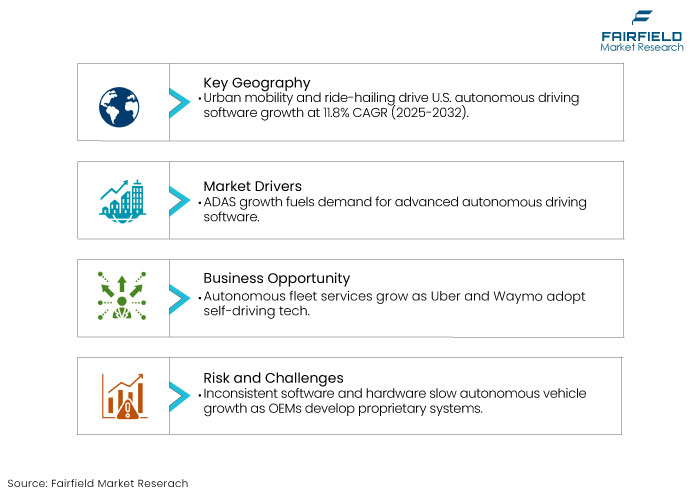
The lack of uniformity in autonomous driving software and hardware platforms is likely to hinder growth. Leading automotive OEMs and technology companies are developing their proprietary software for autonomous vehicles.
The development of such high-end software comes with adverse discrepancies, leading to issues with interoperability and compatibility across systems. Companies rely on a mix of algorithms, programming languages, and development frameworks. The diversity hampers collaboration and slows down innovation, complicating the entire process of unifying systems for seamless deployment.
Key Growth Opportunities
- Expansion of Autonomous Fleet Services
Rise of autonomous fleet services, particularly in the shared mobility sector is facilitating immense growth. Industry leaders like Uber and Waymo are exploring the use of automated driving software to manage autonomous vehicle fleets.
The shift towards automotive fleets presents a major opportunity to transform the traditional vehicle ownership model, offering consumers more convenient, cost-effective, and eco-friendly transportation options.
- Waymo, a subsidiary of Alphabet Inc., has surpassed 100,000 weekly fares in select U.S. cities, demonstrating the growing demand for autonomous ride-hailing services.
The autonomous driving software in these fleets plays a critical role in ensuring the safe and efficient operation of self-driving vehicles. As cities transition into smarter and connected environments, the demand for shared transportation services is likely to continue to rise.
Autonomous fleets are poised to become an integral part of city transportation systems, with the ability to streamline fleet management and improve service efficiency, thereby fueling growth.
- In China, over 32,000 km of roads have been opened for robotaxi services, with companies like Baidu, WeRide, and Pony.ai leading the way.
- Integration of Artificial Intelligence and Machine Learning
Advancements in AI and ML are predicted to empower autonomous systems to evaluate complex real-time data and render accurate decisions on the road. AI and ML technologies enable vehicles to assimilate information from their surroundings and enhance performance.
Self-driving cars integrated with AI can effectively function through varying weather conditions, detect impediments, and anticipate the actions of pedestrians or other vehicles. The capacity to adjust to diverse driving situations is likely to improve the dependability and safety of autonomous vehicles.
How is Regulatory Scenario Shaping this Industry?
The regulatory landscape plays a crucial role in developing and deploying autonomous driving software. As self-driving vehicles become a reality, governments and regulatory bodies are working to create frameworks that balance innovation with safety, security, and public acceptance. Such regulations are shaping the growth and direction of the autonomous driving software market.
Regulatory bodies are exploring liability laws regarding software failures or miscalculations by automated driving software. By defining clear accountability structures, these regulations provide a transparent framework for manufacturers and consumers.
Segment Covered in the Report
- Widespread Adoption by Automotive Manufacturers to Foster Growth in L2+ Level
The L2+ level of autonomy includes advanced driver-assistance systems (ADAS) that provide features like adaptive cruise control and lane-keeping assistance. Vehicle manufacturers like Tesla, Audi, and BMW have already integrated advanced features in several production models.
Key features include like enhanced adaptive cruise control, automated lane-keeping, and limited hands-free driving capabilities. Such systems rely on hardware as well as the integration of autonomous driving software to allow the vehicle to manage specific driving tasks.
The dominant position of L2+ automation reflects a balance between technological feasibility and consumer adoption. These systems enhance driving safety, comfort, and convenience while maintaining human oversight. L2+ automation is likely to witness exponential growth as it strikes a balance between advanced technology and practical usability.
- Consumer Desire for Safety and Convenience Propel Growth in Passenger Vehicles
Technical developments, consumer desire for safety and convenience, and expenditures in research and development primarily drive the passenger vehicle segment's growth. Urbanization, economic advantages, technical infrastructure, and increased consumer awareness propel expansion. The effective implementation and favorable experiences with autonomous functions in passenger vehicles foster consumer confidence while promoting increased adoption.
Regional Analysis
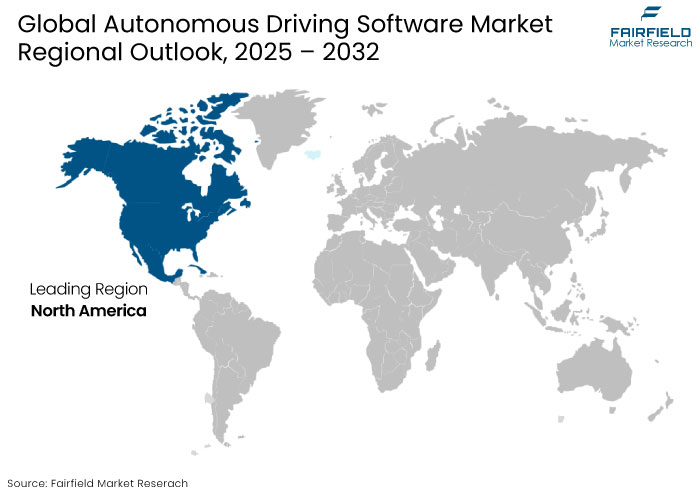
- High Investments from Government Authorities in North America Support Growth
Expansion of urban mobility solutions and ride-hailing services generates a need for autonomous vehicles to improve transportation efficiency and alleviate congestion in the area. The U.S. autonomous driving software industry is projected to expand at a CAGR of 11.8% from 2025 to 2032.
Increased consumer interest in ADAS and autonomous driving capabilities is likely to push the demand for autonomous driving software. Substantial investment from venture capital and established automotive firms is likely to enhance the development and implementation of autonomous driving technologies.
North America has made significant investments in autonomous driving software from the public and corporate sectors. The region attracts venture capitalists, investors, and government entities that endorse autonomous vehicle development, establishing it as a centre for innovation.
- Rising Demand for Innovative Transportation Solutions to Facilitate Growth in Asia Pacific
Asia Pacific particularly countries like China, Japan, and South Korea, are home to some of the world's largest automotive manufacturers, including Toyota, Honda, Hyundai, and BYD. The region's expertise in mass manufacturing and advancements in autonomous technology positions it as a driver of innovation.
Asia Pacific is experiencing an increased demand for innovative transportation solutions owing to fast urbanization and population growth in nations like China and India. Autonomous driving software is integral to the transition towards smart mobility, offering a sustainable and convenient alternative to urban commuters. Expansion of ride-hailing services generates significant demand for autonomous fleets, intensifying the necessity for autonomous vehicle software.
Fairfield’s Competitive Landscape Analysis
The autonomous driving software market is witnessing rapid evolution owing to technological advancements and increasing demand for self-driving vehicles. The growing trend of smart mobility further bolsters growth.
The market's competitive landscape is dynamic as companies focus on key strategies to strengthen their market position. Companies like Waymo and Aurora are integrating cutting-edge AI and machine learning algorithms in their autonomous driving software to enable vehicles to interpret complex data in real-time and make intelligent decisions.
Key Market Companies
- NVIDIA Corporation
- Mobileye
- Huawei Technologies Co, Ltd
- Aurora Innovation Inc.
- Qualcomm Technologies, Inc.
- Navista
- Aptiv
- Autoliv
- Baidu
- Bosch
- Continental
- Daimler Truck
- General Motors
Recent Industry Developments
- In May 2024, PlusAI, Inc. introduced PlusProtect, an AI technology designed to improve safety systems.
- In June 2024, Rivian and Volkswagen Group signed a joint venture for the development of sophisticated car software technology.
An Expert’s Eye
- Continuous development of AI and machine learning is critical for the growth of the market.
- Significant investments in research and development are accelerating the development of reliable, safe, and scalable autonomous driving systems.
- Autonomous driving is increasingly integrated with electric vehicle (EV) technologies, enhancing the potential for seamless and eco-friendly transportation systems.
Global Autonomous Driving Software Market is Segmented as-
By Level of Autonomy
- L2+
- L3
- L4
By Vehicle Type
- Passenger Cars
- Commercial Vehicles
By Propulsion
- ICE
- Electric
By Software Type
- Perception and Planning
- Chauffeur
- Interior Sensing
- Monitoring
By Region
- North America
- Europe
- Asia Pacific
- Latin America
- Middle East & Africa
- Executive Summary
- Global Autonomous Driving Software Market Snapshot
- Future Projections
- Key Market Trends
- Regional Snapshot, by Value, 2026
- Analyst Recommendations
- Market Overview
- Market Definitions and Segmentations
- Market Dynamics
- Drivers
- Restraints
- Market Opportunities
- Value Chain Analysis
- COVID-19 Impact Analysis
- Porter's Fiver Forces Analysis
- Impact of Russia-Ukraine Conflict
- PESTLE Analysis
- Regulatory Analysis
- Price Trend Analysis
- Current Prices and Future Projections, 2025-2033
- Price Impact Factors
- Global Autonomous Driving Software Market Outlook, 2020 - 2033
- Global Autonomous Driving Software Market Outlook, by Level of Autonomy, Value (US$ Mn), 2020-2033
- L2+
- L3
- L4
- Global Autonomous Driving Software Market Outlook, by Vehicle Type, Value (US$ Mn), 2020-2033
- Passenger Cars
- Commercial Vehicles
- Global Autonomous Driving Software Market Outlook, by Propulsion, Value (US$ Mn), 2020-2033
- ICE
- Electric
- Global Autonomous Driving Software Market Outlook, by Software Type, Value (US$ Mn), 2020-2033
- Perception and Planning
- Chauffeur
- Interior Sensing
- Monitoring
- Global Autonomous Driving Software Market Outlook, by Region, Value (US$ Mn), 2020-2033
- North America
- Europe
- Asia Pacific
- Latin America
- Middle East & Africa
- Global Autonomous Driving Software Market Outlook, by Level of Autonomy, Value (US$ Mn), 2020-2033
- North America Autonomous Driving Software Market Outlook, 2020 - 2033
- North America Autonomous Driving Software Market Outlook, by Level of Autonomy, Value (US$ Mn), 2020-2033
- L2+
- L3
- L4
- North America Autonomous Driving Software Market Outlook, by Vehicle Type, Value (US$ Mn), 2020-2033
- Passenger Cars
- Commercial Vehicles
- North America Autonomous Driving Software Market Outlook, by Propulsion, Value (US$ Mn), 2020-2033
- ICE
- Electric
- North America Autonomous Driving Software Market Outlook, by Software Type, Value (US$ Mn), 2020-2033
- Perception and Planning
- Chauffeur
- Interior Sensing
- Monitoring
- North America Autonomous Driving Software Market Outlook, by Country, Value (US$ Mn), 2020-2033
- S. Autonomous Driving Software Market Outlook, by Level of Autonomy, 2020-2033
- S. Autonomous Driving Software Market Outlook, by Vehicle Type, 2020-2033
- S. Autonomous Driving Software Market Outlook, by Propulsion, 2020-2033
- S. Autonomous Driving Software Market Outlook, by Software Type, 2020-2033
- Canada Autonomous Driving Software Market Outlook, by Level of Autonomy, 2020-2033
- Canada Autonomous Driving Software Market Outlook, by Vehicle Type, 2020-2033
- Canada Autonomous Driving Software Market Outlook, by Propulsion, 2020-2033
- Canada Autonomous Driving Software Market Outlook, by Software Type, 2020-2033
- BPS Analysis/Market Attractiveness Analysis
- North America Autonomous Driving Software Market Outlook, by Level of Autonomy, Value (US$ Mn), 2020-2033
- Europe Autonomous Driving Software Market Outlook, 2020 - 2033
- Europe Autonomous Driving Software Market Outlook, by Level of Autonomy, Value (US$ Mn), 2020-2033
- L2+
- L3
- L4
- Europe Autonomous Driving Software Market Outlook, by Vehicle Type, Value (US$ Mn), 2020-2033
- Passenger Cars
- Commercial Vehicles
- Europe Autonomous Driving Software Market Outlook, by Propulsion, Value (US$ Mn), 2020-2033
- ICE
- Electric
- Europe Autonomous Driving Software Market Outlook, by Software Type, Value (US$ Mn), 2020-2033
- Perception and Planning
- Chauffeur
- Interior Sensing
- Monitoring
- Europe Autonomous Driving Software Market Outlook, by Country, Value (US$ Mn), 2020-2033
- Germany Autonomous Driving Software Market Outlook, by Level of Autonomy, 2020-2033
- Germany Autonomous Driving Software Market Outlook, by Vehicle Type, 2020-2033
- Germany Autonomous Driving Software Market Outlook, by Propulsion, 2020-2033
- Germany Autonomous Driving Software Market Outlook, by Software Type, 2020-2033
- Italy Autonomous Driving Software Market Outlook, by Level of Autonomy, 2020-2033
- Italy Autonomous Driving Software Market Outlook, by Vehicle Type, 2020-2033
- Italy Autonomous Driving Software Market Outlook, by Propulsion, 2020-2033
- Italy Autonomous Driving Software Market Outlook, by Software Type, 2020-2033
- France Autonomous Driving Software Market Outlook, by Level of Autonomy, 2020-2033
- France Autonomous Driving Software Market Outlook, by Vehicle Type, 2020-2033
- France Autonomous Driving Software Market Outlook, by Propulsion, 2020-2033
- France Autonomous Driving Software Market Outlook, by Software Type, 2020-2033
- K. Autonomous Driving Software Market Outlook, by Level of Autonomy, 2020-2033
- K. Autonomous Driving Software Market Outlook, by Vehicle Type, 2020-2033
- K. Autonomous Driving Software Market Outlook, by Propulsion, 2020-2033
- K. Autonomous Driving Software Market Outlook, by Software Type, 2020-2033
- Spain Autonomous Driving Software Market Outlook, by Level of Autonomy, 2020-2033
- Spain Autonomous Driving Software Market Outlook, by Vehicle Type, 2020-2033
- Spain Autonomous Driving Software Market Outlook, by Propulsion, 2020-2033
- Spain Autonomous Driving Software Market Outlook, by Software Type, 2020-2033
- Russia Autonomous Driving Software Market Outlook, by Level of Autonomy, 2020-2033
- Russia Autonomous Driving Software Market Outlook, by Vehicle Type, 2020-2033
- Russia Autonomous Driving Software Market Outlook, by Propulsion, 2020-2033
- Russia Autonomous Driving Software Market Outlook, by Software Type, 2020-2033
- Rest of Europe Autonomous Driving Software Market Outlook, by Level of Autonomy, 2020-2033
- Rest of Europe Autonomous Driving Software Market Outlook, by Vehicle Type, 2020-2033
- Rest of Europe Autonomous Driving Software Market Outlook, by Propulsion, 2020-2033
- Rest of Europe Autonomous Driving Software Market Outlook, by Software Type, 2020-2033
- BPS Analysis/Market Attractiveness Analysis
- Europe Autonomous Driving Software Market Outlook, by Level of Autonomy, Value (US$ Mn), 2020-2033
- Asia Pacific Autonomous Driving Software Market Outlook, 2020 - 2033
- Asia Pacific Autonomous Driving Software Market Outlook, by Level of Autonomy, Value (US$ Mn), 2020-2033
- L2+
- L3
- L4
- Asia Pacific Autonomous Driving Software Market Outlook, by Vehicle Type, Value (US$ Mn), 2020-2033
- Passenger Cars
- Commercial Vehicles
- Asia Pacific Autonomous Driving Software Market Outlook, by Propulsion, Value (US$ Mn), 2020-2033
- ICE
- Electric
- Asia Pacific Autonomous Driving Software Market Outlook, by Software Type, Value (US$ Mn), 2020-2033
- Perception and Planning
- Chauffeur
- Interior Sensing
- Monitoring
- Asia Pacific Autonomous Driving Software Market Outlook, by Country, Value (US$ Mn), 2020-2033
- China Autonomous Driving Software Market Outlook, by Level of Autonomy, 2020-2033
- China Autonomous Driving Software Market Outlook, by Vehicle Type, 2020-2033
- China Autonomous Driving Software Market Outlook, by Propulsion, 2020-2033
- China Autonomous Driving Software Market Outlook, by Software Type, 2020-2033
- Japan Autonomous Driving Software Market Outlook, by Level of Autonomy, 2020-2033
- Japan Autonomous Driving Software Market Outlook, by Vehicle Type, 2020-2033
- Japan Autonomous Driving Software Market Outlook, by Propulsion, 2020-2033
- Japan Autonomous Driving Software Market Outlook, by Software Type, 2020-2033
- South Korea Autonomous Driving Software Market Outlook, by Level of Autonomy, 2020-2033
- South Korea Autonomous Driving Software Market Outlook, by Vehicle Type, 2020-2033
- South Korea Autonomous Driving Software Market Outlook, by Propulsion, 2020-2033
- South Korea Autonomous Driving Software Market Outlook, by Software Type, 2020-2033
- India Autonomous Driving Software Market Outlook, by Level of Autonomy, 2020-2033
- India Autonomous Driving Software Market Outlook, by Vehicle Type, 2020-2033
- India Autonomous Driving Software Market Outlook, by Propulsion, 2020-2033
- India Autonomous Driving Software Market Outlook, by Software Type, 2020-2033
- Southeast Asia Autonomous Driving Software Market Outlook, by Level of Autonomy, 2020-2033
- Southeast Asia Autonomous Driving Software Market Outlook, by Vehicle Type, 2020-2033
- Southeast Asia Autonomous Driving Software Market Outlook, by Propulsion, 2020-2033
- Southeast Asia Autonomous Driving Software Market Outlook, by Software Type, 2020-2033
- Rest of SAO Autonomous Driving Software Market Outlook, by Level of Autonomy, 2020-2033
- Rest of SAO Autonomous Driving Software Market Outlook, by Vehicle Type, 2020-2033
- Rest of SAO Autonomous Driving Software Market Outlook, by Propulsion, 2020-2033
- Rest of SAO Autonomous Driving Software Market Outlook, by Software Type, 2020-2033
- BPS Analysis/Market Attractiveness Analysis
- Asia Pacific Autonomous Driving Software Market Outlook, by Level of Autonomy, Value (US$ Mn), 2020-2033
- Latin America Autonomous Driving Software Market Outlook, 2020 - 2033
- Latin America Autonomous Driving Software Market Outlook, by Level of Autonomy, Value (US$ Mn), 2020-2033
- L2+
- L3
- L4
- Latin America Autonomous Driving Software Market Outlook, by Vehicle Type, Value (US$ Mn), 2020-2033
- Passenger Cars
- Commercial Vehicles
- Latin America Autonomous Driving Software Market Outlook, by Propulsion, Value (US$ Mn), 2020-2033
- ICE
- Electric
- Latin America Autonomous Driving Software Market Outlook, by Software Type, Value (US$ Mn), 2020-2033
- Perception and Planning
- Chauffeur
- Interior Sensing
- Monitoring
- Latin America Autonomous Driving Software Market Outlook, by Country, Value (US$ Mn), 2020-2033
- Brazil Autonomous Driving Software Market Outlook, by Level of Autonomy, 2020-2033
- Brazil Autonomous Driving Software Market Outlook, by Vehicle Type, 2020-2033
- Brazil Autonomous Driving Software Market Outlook, by Propulsion, 2020-2033
- Brazil Autonomous Driving Software Market Outlook, by Software Type, 2020-2033
- Mexico Autonomous Driving Software Market Outlook, by Level of Autonomy, 2020-2033
- Mexico Autonomous Driving Software Market Outlook, by Vehicle Type, 2020-2033
- Mexico Autonomous Driving Software Market Outlook, by Propulsion, 2020-2033
- Mexico Autonomous Driving Software Market Outlook, by Software Type, 2020-2033
- Argentina Autonomous Driving Software Market Outlook, by Level of Autonomy, 2020-2033
- Argentina Autonomous Driving Software Market Outlook, by Vehicle Type, 2020-2033
- Argentina Autonomous Driving Software Market Outlook, by Propulsion, 2020-2033
- Argentina Autonomous Driving Software Market Outlook, by Software Type, 2020-2033
- Rest of LATAM Autonomous Driving Software Market Outlook, by Level of Autonomy, 2020-2033
- Rest of LATAM Autonomous Driving Software Market Outlook, by Vehicle Type, 2020-2033
- Rest of LATAM Autonomous Driving Software Market Outlook, by Propulsion, 2020-2033
- Rest of LATAM Autonomous Driving Software Market Outlook, by Software Type, 2020-2033
- BPS Analysis/Market Attractiveness Analysis
- Latin America Autonomous Driving Software Market Outlook, by Level of Autonomy, Value (US$ Mn), 2020-2033
- Middle East & Africa Autonomous Driving Software Market Outlook, 2020 - 2033
- Middle East & Africa Autonomous Driving Software Market Outlook, by Level of Autonomy, Value (US$ Mn), 2020-2033
- L2+
- L3
- L4
- Middle East & Africa Autonomous Driving Software Market Outlook, by Vehicle Type, Value (US$ Mn), 2020-2033
- Passenger Cars
- Commercial Vehicles
- Middle East & Africa Autonomous Driving Software Market Outlook, by Propulsion, Value (US$ Mn), 2020-2033
- ICE
- Electric
- Middle East & Africa Autonomous Driving Software Market Outlook, by Software Type, Value (US$ Mn), 2020-2033
- Perception and Planning
- Chauffeur
- Interior Sensing
- Monitoring
- Middle East & Africa Autonomous Driving Software Market Outlook, by Country, Value (US$ Mn), 2020-2033
- GCC Autonomous Driving Software Market Outlook, by Level of Autonomy, 2020-2033
- GCC Autonomous Driving Software Market Outlook, by Vehicle Type, 2020-2033
- GCC Autonomous Driving Software Market Outlook, by Propulsion, 2020-2033
- GCC Autonomous Driving Software Market Outlook, by Software Type, 2020-2033
- South Africa Autonomous Driving Software Market Outlook, by Level of Autonomy, 2020-2033
- South Africa Autonomous Driving Software Market Outlook, by Vehicle Type, 2020-2033
- South Africa Autonomous Driving Software Market Outlook, by Propulsion, 2020-2033
- South Africa Autonomous Driving Software Market Outlook, by Software Type, 2020-2033
- Egypt Autonomous Driving Software Market Outlook, by Level of Autonomy, 2020-2033
- Egypt Autonomous Driving Software Market Outlook, by Vehicle Type, 2020-2033
- Egypt Autonomous Driving Software Market Outlook, by Propulsion, 2020-2033
- Egypt Autonomous Driving Software Market Outlook, by Software Type, 2020-2033
- Nigeria Autonomous Driving Software Market Outlook, by Level of Autonomy, 2020-2033
- Nigeria Autonomous Driving Software Market Outlook, by Vehicle Type, 2020-2033
- Nigeria Autonomous Driving Software Market Outlook, by Propulsion, 2020-2033
- Nigeria Autonomous Driving Software Market Outlook, by Software Type, 2020-2033
- Rest of Middle East Autonomous Driving Software Market Outlook, by Level of Autonomy, 2020-2033
- Rest of Middle East Autonomous Driving Software Market Outlook, by Vehicle Type, 2020-2033
- Rest of Middle East Autonomous Driving Software Market Outlook, by Propulsion, 2020-2033
- Rest of Middle East Autonomous Driving Software Market Outlook, by Software Type, 2020-2033
- BPS Analysis/Market Attractiveness Analysis
- Middle East & Africa Autonomous Driving Software Market Outlook, by Level of Autonomy, Value (US$ Mn), 2020-2033
- Competitive Landscape
- Company Vs Segment Heatmap
- Company Market Share Analysis, 2025
- Competitive Dashboard
- Company Profiles
- NVIDIA Corporation
- Company Overview
- Product Portfolio
- Financial Overview
- Business Strategies and Developments
- Mobileye
- Huawei Technologies Co, Ltd
- Aurora Innovation Inc.
- Qualcomm Technologies, Inc.
- Navista
- Aptiv
- Autoliv
- Baidu
- Bosch
- NVIDIA Corporation
- Appendix
- Research Methodology
- Report Assumptions
- Acronyms and Abbreviations
|
BASE YEAR |
HISTORICAL DATA |
FORECAST PERIOD |
UNITS |
|||
 |
2025 |
 |
2019 - 2024 |
 |
2026 - 2033 |
Value: US$ Billion |
|
REPORT FEATURES |
DETAILS |
|
Level of Autonomy Coverage |
|
|
Vehicle Type Coverage |
|
|
Propulsion Coverage |
|
|
Software Type Coverage |
|
|
Geographical Coverage |
|
|
Leading Companies |
|
|
Report Highlights |
Key Market Indicators, Macro-micro economic impact analysis, Technological Roadmap, Key Trends, Driver, Restraints, and Future Opportunities & Revenue Pockets, Porter’s 5 Forces Analysis, Historical Trend (2019-2021), Market Estimates and Forecast, Market Dynamics, Industry Trends, Competition Landscape, Category, Region, Country-wise Trends & Analysis, COVID-19 Impact Analysis (Demand and Supply Chain) |
Our Research Methodology
Considering the volatility of business today, traditional approaches to strategizing a game plan can be unfruitful if not detrimental. True ambiguity is no way to determine a forecast. A myriad of predetermined factors must be accounted for such as the degree of risk involved, the magnitude of circumstances, as well as conditions or consequences that are not known or unpredictable. To circumvent binary views that cast uncertainty, the application of market research intelligence to strategically posture, move, and enable actionable outcomes is necessary.
View Methodology
Quality Assured
Rigorous Validation Process

Confidentiality Assured
End-to-end Data Security

Custom Research Services
Tailored To Your Objectives
FAQs
The autonomous driving software industry is estimated to be valued at US$ 4.4 Bn in 2026.
Developments in ADAS technology and focus on commercial applications of autonomous vehicles are key factors propelling growth.
North America is anticipated to account for the largest market share in 2025.
The industry is estimated to rise at a CAGR of 19% from 2026 to 2033.
NVIDIA Corporation, Mobileye, and Huawei Technologies Co, Ltd are a few key players.
Related Reports
Smart Elevator Market Insights, Competitive Landscape, and Market Forecast 2033
Smart Elevator Market to reach US$52.96 Bn by 2033, growing at 6.9% CAGR, driven by urbanization, IoT integration, AI dispatch, and smart city projects.
Vehicle Anti-theft System Market Insights, Competitive Landscape, and Market Forecast 2026–2033
Vehicle Anti-Theft System Market to reach US$19.44 Bn by 2033, growing at 5.8% CAGR, driven by OEM integration, and connected security systems.
Crane Market Insights, Competitive Landscape, and Market Forecast 2033
Crane Market is projected to reach US$59.26 billion by 2033, driven by infrastructure investment, industrial demand, and renewable energy projects.
Personal Protective Equipment (PPE) Market Insights, Competitive Landscape, and Market Forecast 2033
Personal Protective Equipment Market is projected to reach US$91.92 billion by 2033, driven by safety regulations, industrial demand, and smart PPE adoption.
Luxury Car Market Insights, Competitive Landscape, and Market Forecast 2026–2033
The luxury car market will grow from US$625.40 billion in 2026 to US$952.86 billion by 2033 at a 6.2% CAGR, driven by HNWI growth & vehicle premiumization.
EV Charging Management Software Platform Market Insights, Competitive Landscape, and Market Forecast 2033
EV Charging Management Software Platform Market is projected to reach US$7.85 billion by 2033, driven by smart charging and fleet electrification.