



Broadcasting Equipment Market
Broadcasting Equipment Market Insights, Competitive Landscape, and Market Forecast - 2033
Global Broadcasting Equipment Market Forecast
The Broadcasting Equipment Market is expected to grow from USD 6.2 billion in 2026 to USD 9.5 billion by 2033, reflecting strong industry expansion and registering a CAGR of 6.3% during the forecast period from 2026 to 2033.
Quick Report Digest
- The key trend anticipated to fuel the global broadcasting equipment market growth is the increasing popularity of television applications.
- The broadcasting equipment market is growing due to increased demand for high-quality content production and distribution driven by digital broadcasting, streaming services, and technological advancements, including 4K and 8K formats, IP-based infrastructure, and immersive media experiences.
- Analog broadcasting technology held the largest market share historically in the broadcasting equipment market because of its long-standing presence and gradual transition to digital formats, maintaining a dominant position due to legacy infrastructure and gradual adoption of digital technologies.
- Dish antennas have captured the largest market share in the broadcasting equipment market due to their essential role in signal reception. They offer high signal quality, reliability, and adaptability across various broadcasting applications, making them indispensable components in broadcasting infrastructure.
- Television applications secured the largest market share in the broadcasting equipment market due to their enduring popularity, substantial investments in content production and infrastructure, and the widespread viewership of television broadcasts, maintaining a dominant position in the market.
- The Asia Pacific region captured the largest market share in the broadcasting equipment market due to its massive population, rising middle class, robust digital transformation, and strong demand for broadcasting services, supported by favourable government policies and regulatory developments.
- North America is experiencing the highest CAGR in the broadcasting equipment market due to its role as an innovation hub for the media and entertainment industry, rapid adoption of advanced broadcasting technologies, investments in equipment upgrades, and robust infrastructure supporting cutting-edge broadcasting experiences.
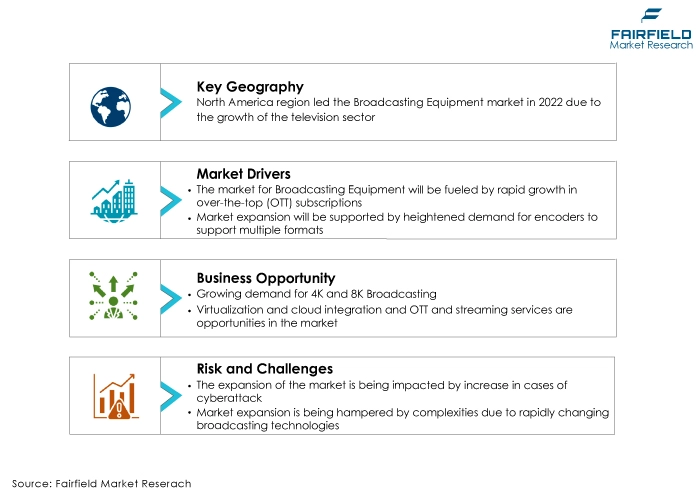
- The increase in cyberattacks presents a challenge to the broadcasting equipment market. It disrupts broadcasting operations, compromises content security, and requires additional investments in cybersecurity measures, impacting both equipment manufacturers and broadcasters in terms of costs and resources.
- Rapid Growth in OTT Subscriptions
- Heightening Demand for Encoders to Support Multiple Formats
- Growing Investments in Content Production
- Increase in Cyberattacks
- Complexities due to Rapidly Changing Broadcasting Technologies
- 4K and 8K Broadcasting
- Virtualisation, and Cloud Integration
- OTT, and Streaming Services
- Analog Broadcasting Technology Continues to Dominate
- Dish Antennas will Surge Ahead
- Television Remains the Largest Application Area
- Sony Corporation
- Panasonic Corporation
- Grass Valley
- Blackmagic Design
- Cisco Systems, Inc.
- Ross Video
- Imagine Communications
- Snell Advanced Media
- Evertz Microsystems
- Harmonic Inc.
- Avid Technology, Inc.
- NewTek
- BFE Studio und Medien Systeme GmbH
- EVS Broadcast Equipment
- Lawo AG
- Analog Broadcasting
- Digital Broadcasting
- Dish Antennas
- Amplifiers
- Switches
- Encoders
- Video Servers
- Transmitters/Repeaters
- Modulators
- Others (Power Control Systems and Media Asset Management Systems)
- Radio
- Television
- North America
- Europe
- Asia Pacific
- Latin America
- Middle East & Africa
A Look Back and a Look Forward - Comparative Analysis
The broadcasting equipment market is experiencing growth due to several factors. The expansion of digital media, streaming services, and increasing demand for high-quality content drive market demand. Technological advancements, such as 4K and 8K broadcasting, IP-based infrastructure, and augmented reality applications, further propel growth. Additionally, emerging markets and evolving consumer preferences for immersive and on-demand content contribute to the industry's continuous expansion.
The broadcasting equipment market is driven by the surge in digital content consumption through streaming platforms and the expansion of 4K and 8K broadcasting. Growing demand for high-quality, immersive content, along with advancements in IP-based Technology, and 5G network fuels the market. The need for efficient production workflows and the emergence of new technologies, such as augmented reality and virtual reality, contribute to market growth.
The future of the broadcasting equipment market looks promising, with a focus on innovation. Advancements in IP-based Technology, 5G networks, and immersive media formats will drive growth. Enhanced content production capabilities, including 4K and 8K broadcasting, along with evolving consumer preferences for personalised and on-the-go content, will shape the industry's trajectory. Moreover, sustainability and energy-efficient solutions will play a crucial role in the market's future.
Key Growth Determinants
The rapid growth in over-the-top (OTT) subscriptions is a significant driver of the broadcasting equipment market. As more consumers shift towards OTT platforms for on-demand content, there is a heightened demand for high-quality video production and streaming solutions.
Broadcasting equipment manufacturers are responding by developing advanced equipment that can deliver seamless streaming experiences, support 4K and 8K content, and enhance bandwidth efficiency. This surge in demand for OTT services is pushing the industry to innovate and invest in infrastructure, thereby driving the broadcasting equipment market's growth.
The heightened demand for encoders that can support multiple formats is a key driver of the broadcasting equipment market. As broadcasters and content providers aim to reach diverse audiences on various devices, the need for versatile encoding solutions has grown.
Encoders that can handle different formats (such as H.264, H.265, and AV1) ensure efficient content delivery to different platforms and screens. This adaptability is essential in today's multi-platform broadcasting landscape, driving the market's growth as it caters to evolving content distribution requirements.
The broadcasting equipment market is experiencing significant growth due to growing investments in content production. As the demand for high-quality, original content increases, broadcasters and streaming platforms are investing heavily in content creation and enhancement.
It has led to a surge in the need for advanced broadcasting equipment, including cameras, editing suites, and production tools. To meet these demands and maintain a competitive edge, companies are continually upgrading their equipment, thus driving the growth of the broadcasting equipment market.
Major Restraints
The increase in cases of cyberattacks presents a significant challenge to the broadcasting equipment market. As broadcasting infrastructure becomes more interconnected and reliant on digital technologies, it becomes vulnerable to cyber threats.
Cyberattacks can disrupt broadcasting operations, compromise content security, and result in financial losses. To mitigate these risks, the industry must invest in robust cybersecurity measures and solutions, adding a layer of complexity and cost to broadcasting equipment deployment posing a challenge for the market's stakeholders.
The broadcasting equipment market faces challenges due to the rapid evolution of broadcasting technologies. As new standards, formats, and delivery methods emerge, equipment manufacturers must adapt quickly. This leads to complexities in product development, compatibility, and obsolescence management.
Broadcasters must navigate these changes while ensuring seamless operations. The need to keep pace with evolving technologies poses challenges in terms of investment, training, and maintaining competitiveness, making it a dynamic and challenging landscape for the broadcasting equipment market.
Key Trends and Opportunities to Look at
4K and 8K broadcasting technology in the broadcasting equipment market involves the production and transmission of ultra-high-definition (UHD) video content, offering viewers significantly enhanced image quality and clarity. This technology trend is driven by consumer demand for superior viewing experiences, pushing broadcasters and equipment manufacturers to invest in equipment capable of capturing, processing, and delivering content in these high-resolution formats.
Virtualisation and cloud integration in the broadcasting equipment market refer to the adoption of cloud-based platforms and virtualised resources for broadcasting operations. This technology trend enables broadcasters to efficiently store, process, and distribute content remotely, reducing infrastructure costs and increasing scalability.
It facilitates remote production workflows, content management, and real-time collaboration, transforming traditional broadcasting practices to be more agile and adaptable in the digital era.
Over-the-top (OTT), and streaming services technology in the broadcasting equipment market relates to the equipment and infrastructure needed to deliver content directly to viewers over the Internet, bypassing traditional broadcast channels. This technology trend includes encoding, content delivery networks (CDNs), and adaptive streaming solutions.
The growing popularity of OTT platforms demands robust equipment to ensure seamless streaming experiences on various devices, fueling innovation and investment in this segment.
How Does the Regulatory Scenario Shape this Industry?
The regulatory scenario significantly shapes the broadcasting equipment market by influencing technology standards, content distribution, and market dynamics. Regulations govern aspects like content licensing, spectrum allocation, and technology standards (e.g., ATSC, DVB). These regulations impact the types of equipment broadcasters need to comply with legal requirements and industry standards.
Additionally, content censorship and copyright laws influence content creation and distribution, driving demand for equipment that enables secure content management and protection. Regulatory changes, such as spectrum reallocation or emerging broadcast standards, can require broadcasters to invest in new equipment and infrastructure.
Regulations related to environmental standards and energy efficiency encourage equipment manufacturers to develop sustainable solutions. Overall, regulatory frameworks have a profound impact on the Broadcasting Equipment Market, dictating technological advancements, compliance requirements, and market competitiveness.
Fairfield’s Ranking Board
Top Segments
Analog broadcasting technology, historically prevalent, captured the largest market share in the broadcasting equipment market due to its long-standing presence and gradual transition to digital formats. Many regions initially relied on analog systems, which created a vast user base and legacy infrastructure. The transition to digital broadcasting is a costly and gradual process, which allowed analog equipment to maintain its dominance.
Analog Technology was often more affordable for smaller broadcasters and offered broad compatibility. However, digital broadcasting technologies have been steadily gaining ground due to superior quality, efficiency, and regulatory mandates for the eventual phase-out of analog systems.
Digital broadcasting is likely to witness the quickest pace of growth in the broadcasting equipment market as it offers superior picture and sound quality, driving consumer demand. Moreover, regulatory mandates in many regions have accelerated the transition from analog to digital broadcasting.
Digital broadcasting enables more efficient spectrum usage and the ability to transmit multiple channels within the same bandwidth. Moreover, the increasing popularity of OTT streaming, and on-demand content has spurred investments in digital infrastructure and equipment, making it a key growth driver in the market.
Dish antennas have captured the largest market share in the broadcasting equipment market due to their fundamental role in signal reception. They are widely used for receiving satellite and terrestrial signals, making them essential for broadcasting and communication.
Dish antennas offer high signal quality, reliability, and coverage, making them suitable for various broadcasting applications, including direct-to-home (DTH) television, satellite radio, and data transmission. Their adaptability, efficiency, and a broad range of sizes cater to diverse broadcasting needs, contributing to their dominant market position and consistent demand in the industry.
As consumer demand for high-quality video streaming increases, encoders become essential for efficient video compression and transmission. Their ability to support various codecs, resolutions, and adaptive streaming technologies is crucial for delivering content seamlessly to different devices and platforms.
The rapid expansion of OTT services, live streaming, and on-demand content has heightened the demand for versatile encoders, making them a key growth driver in the broadcasting equipment market.
Television applications have secured the largest market share in the broadcasting equipment market due to their enduring popularity and widespread use. Television broadcasting remains a primary source of information and entertainment globally, maintaining a vast and stable viewer base.
Investments in television infrastructure, content production, and broadcasting equipment have been substantial. In addition, advancements like the transition to digital and high-definition formats have driven upgrades in equipment.
While digital media and streaming services have grown, traditional television broadcasting still commands a significant share, underscoring its dominant position in the market.
Radio applications, on the other hand, will most likely observe the fastest growth through 2030, attributing to higher accessibility and affordability of radio make it a preferred choice for mass communication, especially in developing markets.
The evolution of radio into digital formats, such as digital audio broadcasting (DAB), and Internet radio, has expanded its reach and capabilities. Additionally, the growth of podcasting and online radio stations has revitalised the radio industry, prompting investments in modern broadcasting equipment, thus fuelling its rapid growth.
Regional Frontrunners
Asia Pacific Takes up the Largest Share of Market Pie
Asia Pacific boasts a massive and diverse population, including emerging economies like China, and India, which are experiencing rapid urbanisation, and an increasing middle-class population.
This has led to growing demand for television and broadcasting services. Secondly, the Asia Pacific region has been at the forefront of digital transformation, with countries investing heavily in upgrading broadcasting infrastructure to support digital and high-definition broadcasting.
Furthermore, the proliferation of OTT streaming services and the expansion of mobile networks have contributed to the region's broadcasting equipment market growth.
Favourable government policies, regulatory support, and increasing investments in content production have further fueled the market's expansion, making Asia Pacific a dominant player in the global broadcasting equipment market.
North America Awaits Noteworthy Prospects
North America is likely to be experiencing the highest CAGR in the broadcasting equipment market. The region is a hub for media and entertainment industry innovation, with a strong presence of technology giants and content producers. Moreover, the rapid adoption of advanced broadcasting technologies such as 4K and 8K broadcasting has fueled equipment upgrades.
In addition, the growth of OTT streaming services and the demand for high-quality content have spurred investments in broadcasting equipment. Moreover, North America's robust infrastructure and consumer demand for cutting-edge broadcasting experiences contribute to its rapid growth in the market.
Fairfield’s Competitive Landscape Analysis
The global broadcasting equipment market is a consolidated market with fewer major players present globally. The key players are introducing new products and working on the distribution channels to enhance their worldwide presence. Moreover, Fairfield Market Research expects more consolidation over the coming years.
Who are the Leaders in the Global Broadcasting Equipment Market space?
The Global Broadcasting Equipment Market is Segmented as Below:
By Technology:
By Product Type:
By Application:
By Geographic Coverage:
- Executive Summary
- Global Broadcasting Equipment Market Snapshot
- Future Projections
- Key Market Trends
- Regional Snapshot, by Value, 2026
- Analyst Recommendations
- Market Overview
- Market Definitions and Segmentations
- Market Dynamics
- Drivers
- Restraints
- Market Opportunities
- Value Chain Analysis
- COVID-19 Impact Analysis
- Porter's Five Forces Analysis
- Impact of Russia-Ukraine Conflict
- PESTLE Analysis
- Regulatory Analysis
- Price Trend Analysis
- Current Prices and Future Projections, 2025-2033
- Price Impact Factors
- Global Broadcasting Equipment Market Outlook, 2020 - 2033
- Global Broadcasting Equipment Market Outlook, by Technology, Value (US$ Mn), 2020-2033
- Analog Broadcasting
- Digital Broadcasting
- Global Broadcasting Equipment Market Outlook, by Product Type, Value (US$ Mn), 2020-2033
- Dish Antennas
- Amplifiers
- Switches
- Encoders
- Video Servers
- Transmitters/Repeaters
- Modulators
- Others (Power Control Systems and Media Asset Management Systems)
- Global Broadcasting Equipment Market Outlook, by Application, Value (US$ Mn), 2020-2033
- Radio
- Television
- Global Broadcasting Equipment Market Outlook, by Region, Value (US$ Mn), 2020-2033
- North America
- Europe
- Asia Pacific
- Latin America
- Middle East & Africa
- Global Broadcasting Equipment Market Outlook, by Technology, Value (US$ Mn), 2020-2033
- North America Broadcasting Equipment Market Outlook, 2020 - 2033
- North America Broadcasting Equipment Market Outlook, by Technology, Value (US$ Mn), 2020-2033
- Analog Broadcasting
- Digital Broadcasting
- North America Broadcasting Equipment Market Outlook, by Product Type, Value (US$ Mn), 2020-2033
- Dish Antennas
- Amplifiers
- Switches
- Encoders
- Video Servers
- Transmitters/Repeaters
- Modulators
- Others (Power Control Systems and Media Asset Management Systems)
- North America Broadcasting Equipment Market Outlook, by Application, Value (US$ Mn), 2020-2033
- Radio
- Television
- North America Broadcasting Equipment Market Outlook, by Country, Value (US$ Mn), 2020-2033
- U.S. Broadcasting Equipment Market Outlook, by Technology, 2020-2033
- U.S. Broadcasting Equipment Market Outlook, by Product Type, 2020-2033
- U.S. Broadcasting Equipment Market Outlook, by Application, 2020-2033
- Canada Broadcasting Equipment Market Outlook, by Technology, 2020-2033
- Canada Broadcasting Equipment Market Outlook, by Product Type, 2020-2033
- Canada Broadcasting Equipment Market Outlook, by Application, 2020-2033
- BPS Analysis/Market Attractiveness Analysis
- North America Broadcasting Equipment Market Outlook, by Technology, Value (US$ Mn), 2020-2033
- Europe Broadcasting Equipment Market Outlook, 2020 - 2033
- Europe Broadcasting Equipment Market Outlook, by Technology, Value (US$ Mn), 2020-2033
- Analog Broadcasting
- Digital Broadcasting
- Europe Broadcasting Equipment Market Outlook, by Product Type, Value (US$ Mn), 2020-2033
- Dish Antennas
- Amplifiers
- Switches
- Encoders
- Video Servers
- Transmitters/Repeaters
- Modulators
- Others (Power Control Systems and Media Asset Management Systems)
- Europe Broadcasting Equipment Market Outlook, by Application, Value (US$ Mn), 2020-2033
- Radio
- Television
- Europe Broadcasting Equipment Market Outlook, by Country, Value (US$ Mn), 2020-2033
- Germany Broadcasting Equipment Market Outlook, by Technology, 2020-2033
- Germany Broadcasting Equipment Market Outlook, by Product Type, 2020-2033
- Germany Broadcasting Equipment Market Outlook, by Application, 2020-2033
- Italy Broadcasting Equipment Market Outlook, by Technology, 2020-2033
- Italy Broadcasting Equipment Market Outlook, by Product Type, 2020-2033
- Italy Broadcasting Equipment Market Outlook, by Application, 2020-2033
- France Broadcasting Equipment Market Outlook, by Technology, 2020-2033
- France Broadcasting Equipment Market Outlook, by Product Type, 2020-2033
- France Broadcasting Equipment Market Outlook, by Application, 2020-2033
- U.K. Broadcasting Equipment Market Outlook, by Technology, 2020-2033
- U.K. Broadcasting Equipment Market Outlook, by Product Type, 2020-2033
- U.K. Broadcasting Equipment Market Outlook, by Application, 2020-2033
- Spain Broadcasting Equipment Market Outlook, by Technology, 2020-2033
- Spain Broadcasting Equipment Market Outlook, by Product Type, 2020-2033
- Spain Broadcasting Equipment Market Outlook, by Application, 2020-2033
- Russia Broadcasting Equipment Market Outlook, by Technology, 2020-2033
- Russia Broadcasting Equipment Market Outlook, by Product Type, 2020-2033
- Russia Broadcasting Equipment Market Outlook, by Application, 2020-2033
- Rest of Europe Broadcasting Equipment Market Outlook, by Technology, 2020-2033
- Rest of Europe Broadcasting Equipment Market Outlook, by Product Type, 2020-2033
- Rest of Europe Broadcasting Equipment Market Outlook, by Application, 2020-2033
- BPS Analysis/Market Attractiveness Analysis
- Europe Broadcasting Equipment Market Outlook, by Technology, Value (US$ Mn), 2020-2033
- Asia Pacific Broadcasting Equipment Market Outlook, 2020 - 2033
- Asia Pacific Broadcasting Equipment Market Outlook, by Technology, Value (US$ Mn), 2020-2033
- Analog Broadcasting
- Digital Broadcasting
- Asia Pacific Broadcasting Equipment Market Outlook, by Product Type, Value (US$ Mn), 2020-2033
- Dish Antennas
- Amplifiers
- Switches
- Encoders
- Video Servers
- Transmitters/Repeaters
- Modulators
- Others (Power Control Systems and Media Asset Management Systems)
- Asia Pacific Broadcasting Equipment Market Outlook, by Application, Value (US$ Mn), 2020-2033
- Radio
- Television
- Asia Pacific Broadcasting Equipment Market Outlook, by Country, Value (US$ Mn), 2020-2033
- China Broadcasting Equipment Market Outlook, by Technology, 2020-2033
- China Broadcasting Equipment Market Outlook, by Product Type, 2020-2033
- China Broadcasting Equipment Market Outlook, by Application, 2020-2033
- Japan Broadcasting Equipment Market Outlook, by Technology, 2020-2033
- Japan Broadcasting Equipment Market Outlook, by Product Type, 2020-2033
- Japan Broadcasting Equipment Market Outlook, by Application, 2020-2033
- South Korea Broadcasting Equipment Market Outlook, by Technology, 2020-2033
- South Korea Broadcasting Equipment Market Outlook, by Product Type, 2020-2033
- South Korea Broadcasting Equipment Market Outlook, by Application, 2020-2033
- India Broadcasting Equipment Market Outlook, by Technology, 2020-2033
- India Broadcasting Equipment Market Outlook, by Product Type, 2020-2033
- India Broadcasting Equipment Market Outlook, by Application, 2020-2033
- Southeast Asia Broadcasting Equipment Market Outlook, by Technology, 2020-2033
- Southeast Asia Broadcasting Equipment Market Outlook, by Product Type, 2020-2033
- Southeast Asia Broadcasting Equipment Market Outlook, by Application, 2020-2033
- Rest of SAO Broadcasting Equipment Market Outlook, by Technology, 2020-2033
- Rest of SAO Broadcasting Equipment Market Outlook, by Product Type, 2020-2033
- Rest of SAO Broadcasting Equipment Market Outlook, by Application, 2020-2033
- BPS Analysis/Market Attractiveness Analysis
- Asia Pacific Broadcasting Equipment Market Outlook, by Technology, Value (US$ Mn), 2020-2033
- Latin America Broadcasting Equipment Market Outlook, 2020 - 2033
- Latin America Broadcasting Equipment Market Outlook, by Technology, Value (US$ Mn), 2020-2033
- Analog Broadcasting
- Digital Broadcasting
- Latin America Broadcasting Equipment Market Outlook, by Product Type, Value (US$ Mn), 2020-2033
- Dish Antennas
- Amplifiers
- Switches
- Encoders
- Video Servers
- Transmitters/Repeaters
- Modulators
- Others (Power Control Systems and Media Asset Management Systems)
- Latin America Broadcasting Equipment Market Outlook, by Application, Value (US$ Mn), 2020-2033
- Radio
- Television
- Latin America Broadcasting Equipment Market Outlook, by Country, Value (US$ Mn), 2020-2033
- Brazil Broadcasting Equipment Market Outlook, by Technology, 2020-2033
- Brazil Broadcasting Equipment Market Outlook, by Product Type, 2020-2033
- Brazil Broadcasting Equipment Market Outlook, by Application, 2020-2033
- Mexico Broadcasting Equipment Market Outlook, by Technology, 2020-2033
- Mexico Broadcasting Equipment Market Outlook, by Product Type, 2020-2033
- Mexico Broadcasting Equipment Market Outlook, by Application, 2020-2033
- Argentina Broadcasting Equipment Market Outlook, by Technology, 2020-2033
- Argentina Broadcasting Equipment Market Outlook, by Product Type, 2020-2033
- Argentina Broadcasting Equipment Market Outlook, by Application, 2020-2033
- Rest of LATAM Broadcasting Equipment Market Outlook, by Technology, 2020-2033
- Rest of LATAM Broadcasting Equipment Market Outlook, by Product Type, 2020-2033
- Rest of LATAM Broadcasting Equipment Market Outlook, by Application, 2020-2033
- BPS Analysis/Market Attractiveness Analysis
- Latin America Broadcasting Equipment Market Outlook, by Technology, Value (US$ Mn), 2020-2033
- Middle East & Africa Broadcasting Equipment Market Outlook, 2020 - 2033
- Middle East & Africa Broadcasting Equipment Market Outlook, by Technology, Value (US$ Mn), 2020-2033
- Analog Broadcasting
- Digital Broadcasting
- Middle East & Africa Broadcasting Equipment Market Outlook, by Product Type, Value (US$ Mn), 2020-2033
- Dish Antennas
- Amplifiers
- Switches
- Encoders
- Video Servers
- Transmitters/Repeaters
- Modulators
- Others (Power Control Systems and Media Asset Management Systems)
- Middle East & Africa Broadcasting Equipment Market Outlook, by Application, Value (US$ Mn), 2020-2033
- Radio
- Television
- Middle East & Africa Broadcasting Equipment Market Outlook, by Country, Value (US$ Mn), 2020-2033
- GCC Broadcasting Equipment Market Outlook, by Technology, 2020-2033
- GCC Broadcasting Equipment Market Outlook, by Product Type, 2020-2033
- GCC Broadcasting Equipment Market Outlook, by Application, 2020-2033
- South Africa Broadcasting Equipment Market Outlook, by Technology, 2020-2033
- South Africa Broadcasting Equipment Market Outlook, by Product Type, 2020-2033
- South Africa Broadcasting Equipment Market Outlook, by Application, 2020-2033
- Egypt Broadcasting Equipment Market Outlook, by Technology, 2020-2033
- Egypt Broadcasting Equipment Market Outlook, by Product Type, 2020-2033
- Egypt Broadcasting Equipment Market Outlook, by Application, 2020-2033
- Nigeria Broadcasting Equipment Market Outlook, by Technology, 2020-2033
- Nigeria Broadcasting Equipment Market Outlook, by Product Type, 2020-2033
- Nigeria Broadcasting Equipment Market Outlook, by Application, 2020-2033
- Rest of Middle East Broadcasting Equipment Market Outlook, by Technology, 2020-2033
- Rest of Middle East Broadcasting Equipment Market Outlook, by Product Type, 2020-2033
- Rest of Middle East Broadcasting Equipment Market Outlook, by Application, 2020-2033
- BPS Analysis/Market Attractiveness Analysis
- Middle East & Africa Broadcasting Equipment Market Outlook, by Technology, Value (US$ Mn), 2020-2033
- Competitive Landscape
- Company Vs Segment Heatmap
- Company Market Share Analysis, 2025
- Competitive Dashboard
- Company Profiles
- Sony Corporation
- Company Overview
- Product Portfolio
- Financial Overview
- Business Strategies and Developments
- Panasonic Corporation
- Grass Valley
- Blackmagic Design
- Cisco Systems, Inc.
- Ross Video
- Imagine Communications
- Snell Advanced Media
- Evertz Microsystems
- Harmonic Inc.
- Sony Corporation
- Appendix
- Research Methodology
- Report Assumptions
- Acronyms and Abbreviations
|
BASE YEAR |
HISTORICAL DATA |
FORECAST PERIOD |
UNITS |
|||
 |
2025 |
 |
2020 - 2025 |
 |
2026 - 2033 |
Value: US$ Million |
|
REPORT FEATURES |
DETAILS |
|
Technology Coverage |
|
|
Product Type Coverage |
|
|
Application Coverage |
|
|
Geographical Coverage |
|
|
Leading Companies |
|
|
Report Highlights |
Key Market Indicators, Macro-micro economic impact analysis, Technological Roadmap, Key Trends, Driver, Restraints, and Future Opportunities & Revenue Pockets, Porter’s 5 Forces Analysis, Historical Trend (2019-2021), Market Estimates and Forecast, Market Dynamics, Industry Trends, Competition Landscape, Category, Region, Country-wise Trends & Analysis, COVID-19 Impact Analysis (Demand and Supply Chain) |
Our Research Methodology
Considering the volatility of business today, traditional approaches to strategizing a game plan can be unfruitful if not detrimental. True ambiguity is no way to determine a forecast. A myriad of predetermined factors must be accounted for such as the degree of risk involved, the magnitude of circumstances, as well as conditions or consequences that are not known or unpredictable. To circumvent binary views that cast uncertainty, the application of market research intelligence to strategically posture, move, and enable actionable outcomes is necessary.
View Methodology
Quality Assured
Rigorous Validation Process

Confidentiality Assured
End-to-end Data Security

Custom Research Services
Tailored To Your Objectives
FAQs
The global broadcasting equipment market is valued at approximately USD 6.2 billion in 2026, driven by the increasing demand for high-definition content, live broadcasting, and technological advancements in production equipment.
The shift towards digital broadcasting fosters market growth, with broadcasters investing in advanced equipment like digital transmitters, encoders, and multiplexers for improved signal quality, efficiency, and spectrum utilization.
Asia Pacific is a key growth region, experiencing a surge in broadcasting infrastructure development, while North America, and Europe continue to dominate, driven by ongoing technological upgrades and the demand for content across various platforms.
The proliferation of OTT platforms intensifies the demand for sophisticated broadcasting equipment, such as content delivery networks (CDNs) and transcoding solutions, as traditional broadcasters adapt to the evolving media landscape.
Continuous innovation is crucial, with the integration of technologies like 5G, AI, and VR transforming production workflows and content delivery methods, creating opportunities for businesses in the broadcasting equipment sector.
Related Reports
Malware Analysis Market Size, Share, Insights, Competitive Landscape, and Forecast 2026 to 2033
Explore the malware analysis market, reaching US$ 21.0 billion by 2033 at 14.0% CAGR, with component, deployment and regional insights.
Language Translation Device Market Size, Share, Insights, Competitive Landscape, and Forecast 2026 to 2033
Explore the language translation device market, reaching US$ 3.43 billion by 2033 at 11.9% CAGR, with product, application and regional insights.
Smart Water Management Market Size, Share, Insights, Competitive Landscape, and Forecast 2026 to 2033
Explore the smart water management market, reaching US$ 45.2 billion by 2033 at 11.0% CAGR, with solution, regional and competitive insights.
Infusion Pump Software Market Size, Share, Insights, Competitive Landscape, and Forecast 2026 to 2033
Explore the infusion pump software market, reaching US$ 2.4 billion by 2033 at 10.4% CAGR, with software, regional and competitive insights.
Database Security Market Size, Share, Insights, Competitive Landscape, and Forecast 2026 to 2033
Explore the database security market, reaching US$ 28.5 billion by 2033 at 14.3% CAGR, with offering, regional and competitive insights.
Smart Home Appliances Market Size, Share, Insights, Competitive Landscape, and Forecast 2026 to 2033
Explore the smart home appliances market, reaching US$ 113.0 billion by 2033 at 13.0% CAGR, with product, regional and competitive insights.