



CAR T-Cell Therapy Market
CAR T-Cell Therapy Market Insights, Competitive Landscape, and Market Forecast - 2033
Global CAR T-Cell Therapy Market Forecast
- The CAR T-Cell therapy market is projected to reach a size of USD 10.7 Bn by 2033, showing significant growth from the USD 7.2 Bn achieved in 2026.
- The market for CAR T-cell therapy is expected to show a significant expansion rate, with a healthy CAGR of 6% from 2026 to 2033.
CAR T-Cell Therapy Market Insights
A Look Back and a Look Forward - Comparative Analysis
The CAR T-cell therapy market experienced exponential growth during the period from 2019 to 2023 driven by advancements in immunotherapy and successful regulatory approvals. Landmark therapies such as Novartis' Kymriah and Gilead's Yescarta transformed cancer treatment, particularly for hematologic malignancies like leukemia and lymphoma.
North America dominated the market due to its advanced healthcare infrastructure and significant investments in biotechnology. Europe also witnessed rapid adoption following EMA approvals. However, the market faced challenges such as high treatment costs, manufacturing complexity, and adverse effect management, which limited its scalability.
The market is projected to enter a new growth phase over the forecast period, with anticipated advancements in "off-the-shelf" allogeneic CAR T-cell therapies, improving accessibility and reducing costs. Expansion into treating solid tumors is expected to diversify applications and drive demand.
Emerging markets in Asia Pacific are poised for substantial growth due to increasing healthcare investments and favorable regulatory frameworks. North America and Europe will continue leading the market but will face intensified competition from new entrants. Innovations in gene editing, automation in manufacturing, and improved safety profiles will catalyze broader adoption, pushing market growth further.
Key Growth Determinants
- Supportive Government Initiatives and Awareness Programs to Surge the Demand
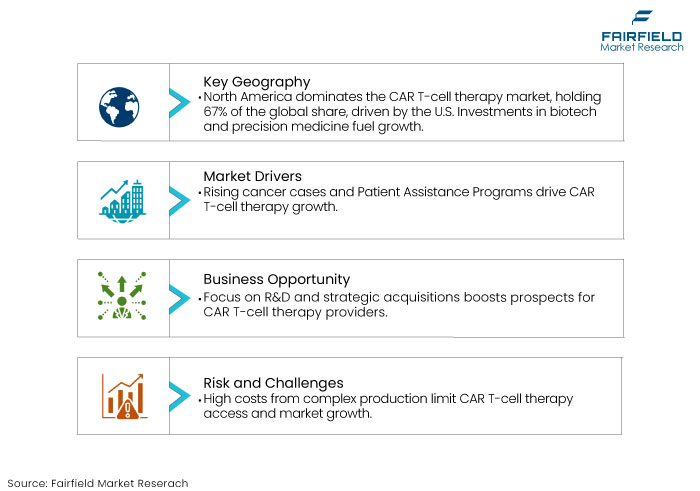
The primary factor propelling the CAR T-cell treatment market is the rising incidence of cancer. The presence of Patient Assistance Programs (PAPs) is a contributing factor to the increased uptake of therapy.
Governments and groups are implementing efforts and programs to raise awareness about cancer, which also facilitates market expansion. Organizations such as the American Cancer Society and CancerCare provide an array of services designed to assist patients in managing the difficulties related to cancer treatment.
- According to recent research by the National Cancer Institute in the United States, cancer is the primary cause of death worldwide. Approximately 20 million new cancer cases were reported in 2022, with projections indicating an increase to 29.9 million by 2024.
The data indicates that the cancer rate in men exceeds that of women. The incidence of cancers such as prostate, lung, and colorectal cancer is projected to reach almost 48% in males by 2024. The data indicates the growing necessity for effective solutions such as CAR T-cell therapy and the role of government in fostering awareness of its significance.
- Increase in Clinical Trials to Establish New Pathways for Advanced Therapies
The proliferation of clinical studies is another key driver for the CAR T-cell therapy market growth. These trials seek to investigate novel applications and enhance current medicines. Pharmaceutical businesses and academic organizations are investing in developing sophisticated CAR T-cell therapies.
The huge investments are to target diverse malignancies and enhance patient outcomes. It encompasses experiments to improve the efficacy and safety profiles of CAR T-cells. Research examining combination therapies that incorporate CAR T-cell therapy with additional modalities.
The growing quantity of clinical trials substantiates the promise of CAR T-cell treatments, drawing investment and interest from stakeholders, which further accelerates market expansion.
Key Growth Barriers
- High Cost of Car T-Cell Therapy to Hamper Market Expansion
The exorbitant expense of CAR T-cell treatment constitutes a significant obstacle to its broad application and accessibility. The intricate and customized production process is the primary factor contributing to this exorbitant pricing. This factor hinders the CAR T-cell therapy market.
Each treatment involves the extraction and genetic modification of T-cells from the patient. This arduous and protracted process incurs substantial costs. Certain therapies, such as KYMRIAH and Yescarta, frequently exceed $350,000 per treatment.
The National Institute of Health data indicates that CAR T-cell therapy is the costliest treatment, with expenses ranging from $373,000 to over $500,000 per patient. The elevated cost is prompting global shifts in market acceptance.
- Stringent Eligibility Requirements for Therapy to Hinder Market Growth
Another hindrance for the CAR T-cell therapy market is its availability to patients who have previously received significant treatments. Patients must have undergone a minimum of two lines of systemic therapy to qualify for treatments such as tisagenlecleucel or axicabtagene ciloleucel.
Certain individuals who have undergone various therapies are apprehensive about enduring the severe adverse effects of chimeric antigen receptor T-cell treatments. Stringent eligibility requirements for CAR T-cell therapy correlate with elevated treatment expenses, which is expected to impede the uptake of CAR T treatment.
According to an article in MJH Life Sciences from April 2021, a recent examination of real-world data indicates that the average overall cost of CAR T-cell therapy surpasses US$700,000, with certain instances exceeding $1 million.
CAR T-Cell Therapy Market Trends and Opportunities
- Research and Development in Oncology Treatments to Generate Growth Opportunities
There is an increased emphasis on research and development for cancer medicines, including those for lung cancer, colorectal cancer, multiple myeloma, and prostate cancer. This trend is anticipated to generate numerous potential prospects for CAR T-cell treatment providers. Strategic acquisitions might assist manufacturers in expediting their endeavours to secure a greater market share.
Favourable government regulations and financial backing for life sciences are anticipated to stimulate demand for CAR T-cell therapy in the imminent future. The Life Sciences legislation designates US$1 billion over a decade to fund diverse programs in the United States.
The growing demand for novel cancer treatment alternatives is expected to generate substantial revenue prospects for participants in the chimeric immunoreceptor therapy industry.
- Progress in Therapeutics to Propel Industry Growth
The application of CAR T-cell therapy in solid tumours presents a significant prospect for the CAR T-cell therapy market expansion and medical breakthroughs. CAR T-cell treatments have demonstrated significant efficacy in the treatment of hematological malignancies such as B-cell lymphomas and Acute Lymphoblastic Leukemia (ALL). However, their application in solid tumours has proven to be more difficult.
It is mostly attributable to distinctive challenges, including the harsh tumour microenvironment, the heterogeneity of tumour cells, and the physical limitations present within solid tumours. Surmounting these challenges may result in novel chances for growth and innovation within the sector. Organizations in this sector are advancing many goods and pioneering therapies.
Stanford Medicine, located in the United States, has become the inaugural American institution to use a novel cell-based therapy to treat metastatic melanoma. It is the inaugural treatment sanctioned by the FDA for solid tumours. Like CAR-T therapies, this therapy uses immune cells to augment cancer-fighting capabilities.
How Does Regulatory Scenario Shape this Industry?
The regulatory landscape is pivotal in shaping the CAR T-cell therapy market, driving its growth and accessibility while ensuring patient safety. Key regions like North America, Europe, and Asia Pacific have developed frameworks to expedite the approval and commercialization of these transformative therapies.
The FDA has been at the forefront in the United States, granting accelerated approvals to landmark therapies like Kymriah (Novartis) and Yescarta (Gilead Sciences). The agency’s priority review and breakthrough therapy designations have streamlined the development process, fostering innovation.
The European Medicines Agency (EMA) has approved several therapies under its PRIME (Priority Medicines) scheme, boosting Europe market growth. Emerging economies in Asia Pacific, such as China and Japan, are revising regulatory guidelines to attract clinical trials and accelerate approvals.
China’s National Medical Products Administration (NMPA) introduced policies to support local CAR T-cell manufacturing, creating a competitive global market. Regulatory challenges persist, including the high costs of compliance, complex manufacturing standards, and addressing long-term safety concerns.
Regulators worldwide focus on refining guidelines for allogeneic (off-the-shelf) CAR T-cell therapies, aiming to expand accessibility and affordability. The evolving regulatory framework underpins market expansion, driving innovation and broad adoption globally.
Segments Covered in the Report
- Yescarta Dominates the Market with Its Robust Performance and Efficacy
Yescarta is projected to have a substantial market share of 57% in by 2024. Yescarta therapy is specifically intended for individuals with large B-cell lymphoma who have exhibited inadequate responses to conventional treatment modalities. Its robust market performance demonstrates its efficacy in meeting the demands of patients with this difficult disease.
A substantial randomized phase 3 clinical trial of CAR T-cell treatment Yescarta has demonstrated its potential to cure certain individuals with aggressive non-Hodgkin lymphoma (NHL). The research showcased at the American Society of Clinical Oncology (ASCO) annual meeting projected that 55% of patients would remain alive four years’ post-axis-cell treatment, in contrast to 46% of those who initially had standard therapy for relapsed disease.
The findings indicate that axis-cell is currently the preferred therapy for those with rapidly recurring or treatment-resistant diffuse large B-cell lymphoma.
- Increasing Investments in Relapsed Large B-Cell Lymphoma
Relapsed large B-cell lymphoma is projected to have approximately 90% of the market share in 2024. The substantial market share underscores the critical demand for efficacious medicines in addressing this difficult lymphoma, as patients frequently encounter restricted therapy alternatives upon recurrence or lack of improvement of their illness.
Diverse corporations and institutions are allocating resources to research and comprehend big B-cell lymphoma and its treatment. The Phase 3 ECHELON-3 research conducted by the American pharmaceutical and biotechnology corporation Pfizer showed that ADCETRIS, in conjunction with lenalidomide and rituximab, decreased the mortality risk of patients by 37% relative to placebo. The study findings indicate a novel optimism for cancer therapy.
Regional Analysis
- North America Remains Dominant with Huge Investment in Biotechnology & Healthcare Industry
North America holds approximately 67% of the global CAR T-cell therapy market share, with the United States contributes greatly toward growth. High levels of investment in biotechnology and healthcare industries ensure robust revenue growth. Established companies with a focus on precision medicine support the market.
The incidence of hematologic malignancies like leukemia, lymphoma, and multiple myeloma is high in the United States and Canada. The demand for targeting this prevalence drives effective therapies like CAR T-cell therapy.
North America benefits from a well-developed healthcare infrastructure capable of supporting advanced therapies. Access to specialized hospitals and treatment centers facilitates the implementation of CAR T-cell therapy.
The FDA has approved multiple CAR T-cell therapies, such as Novartis' Kymriah and Gilead's Yescarta, boosting market growth. Accelerated approval pathways and supportive clinical trial frameworks encourage innovation.
North America's dominance in market is underpinned by its advanced healthcare infrastructure, significant research and development investments, and a supportive regulatory environment. While challenges exist, the region is poised to maintain its leadership through innovation and expansion of treatment applications.
- Asia Pacific CAR T-Cell Therapy Market Emerges Lucrative with Robust Government Support
Asia Pacific is anticipated to experience substantial growth in CAR T-cell treatment market by 2031. This region is estimated to expand at a CAGR of 28% from 2024 to 2031. An increasing patient demographic and robust governmental backing for products and market stakeholders propels this swift growth.
Prominent players are progressively concentrating on the development of improved medicines, hence enhancing market growth. China's National Medical Products Administration (NMPA) has sanctioned the supplemental biological license application for JW Therapeutics' Carteyva, intended for people with relapsed or refractory mantle cell lymphoma. A clinical investigation in China additionally corroborates this supplement.
The rising number of clinical studies also facilitates industry growth. The Clinical Studies Database 2023 indicates that approximately 103 CAR T treatments are presently undergoing active clinical studies in China.
Fairfield’s Competitive Landscape Analysis
The CAR T-cell therapy market is intensely competitive, dominated by leading players like Novartis, Gilead Sciences (Kite Pharma), and Bristol-Myers Squibb, pioneers in commercializing landmark therapies such as Kymriah, Yescarta, and Breyanzi.
Emerging biotech companies, including Legend Biotech and CARsgen Therapeutics, are driving innovation with novel approaches to CAR T-cell engineering and solid tumor treatments. The market also witnesses regional players, particularly in Asia Pacific, leveraging cost-effective manufacturing to challenge global leaders. Partnerships between biotech firms and research institutions are fostering rapid advancements.
Key competitive factors include proprietary technology, manufacturing capabilities, regulatory approvals, and pipeline diversification. The race for allogeneic therapies and expanded indications is intensifying, creating opportunities for new entrants and driving market dynamics.
Key Market Companies
- Bristol-Myers Squibb Company
- Novartis AG
- Gilead Sciences, Inc.
- Johnson & Johnson Services, Inc.
- JW Therapeutics (Shanghai) Co., Ltd.
- Bluebird Bio, Inc.
- Merck & Co., Inc.
- Sangamo Therapeutics
- Sorrento Therapeutics, Inc.
- GSK PLC
Recent Industry Developments
- In April 2024, India introduced its inaugural indigenously developed CAR T-cell therapy for cancer treatment, marking a significant advancement in combating the disease. The gene therapy, created by IIT Bombay and Tata Memorial Centre, is being introduced in India at one-tenth of its cost outside.
- In September 2024, MOC Cancer Care and Research Centre in Mumbai commenced offering CAR-T Cell Therapy for patients with blood cancers, including Leukemias, Myeloma, and Lymphomas. The said therapy seeks to enhance results for individuals who have depleted standard treatment alternatives.
An Expert’s Eye
- Researchers are optimistic about ongoing advancements targeting solid tumours, though achieving similar success remains a significant challenge for CAR T-cell therapy market.
- Allogeneic or "off-the-shelf" CAR T-cell therapies are a key innovation to reduce costs and broaden accessibility.
- Collaborative efforts between regulatory agencies and biotech firms accelerate approvals and expand clinical trials globally.
- Experts highlight significant growth potential in Asia Pacific due to increasing healthcare investments and regulatory reforms.
Global CAR T-Cell Therapy Market is Segmented as-
By Product
- Yescarta
- Kymriah
- JCAR017
- Bb2121
By Indication
- Relapsed Large B-Cell Lymphoma
- Acute Lymphoblastic Leukemia (ALL)
- Multiple Myeloma
By End User
- Hospitals
- Cancer Treatment Centers
By Region
- North America
- Europe
- Asia Pacific
- Latin America
- The Middle East & Africa
- Executive Summary
- Global Car T Cell Therapy Market Snapshot
- Future Projections
- Key Market Trends
- Regional Snapshot, by Value, 2026
- Analyst Recommendations
- Market Overview
- Market Definitions and Segmentations
- Market Dynamics
- Drivers
- Restraints
- Market Opportunities
- Value Chain Analysis
- COVID-19 Impact Analysis
- Porter's Five Forces Analysis
- Impact of Russia-Ukraine Conflict
- PESTLE Analysis
- Regulatory Analysis
- Price Trend Analysis
- Current Prices and Future Projections, 2025-2033
- Price Impact Factors
- Global Car T Cell Therapy Market Outlook, 2020 - 2033
- Global Car T Cell Therapy Market Outlook, by Product, Value (US$ Bn), 2020-2033
- Yescarta
- Kymriah
- JCAR017
- Bb2121
- Global Car T Cell Therapy Market Outlook, by Indication, Value (US$ Bn), 2020-2033
- Relapsed Large B-Cell Lymphoma
- Acute Lymphoblastic Leukemia (ALL)
- Multiple Myeloma
- Global Car T Cell Therapy Market Outlook, by End User, Value (US$ Bn), 2020-2033
- Hospitals
- Cancer Treatment Centers
- Global Car T Cell Therapy Market Outlook, by Region, Value (US$ Bn), 2020-2033
- North America
- Europe
- Asia Pacific
- Latin America
- Middle East & Africa
- Global Car T Cell Therapy Market Outlook, by Product, Value (US$ Bn), 2020-2033
- North America Car T Cell Therapy Market Outlook, 2020 - 2033
- North America Car T Cell Therapy Market Outlook, by Product, Value (US$ Bn), 2020-2033
- Yescarta
- Kymriah
- JCAR017
- Bb2121
- North America Car T Cell Therapy Market Outlook, by Indication, Value (US$ Bn), 2020-2033
- Relapsed Large B-Cell Lymphoma
- Acute Lymphoblastic Leukemia (ALL)
- Multiple Myeloma
- North America Car T Cell Therapy Market Outlook, by End User, Value (US$ Bn), 2020-2033
- Hospitals
- Cancer Treatment Centers
- North America Car T Cell Therapy Market Outlook, by Country, Value (US$ Bn), 2020-2033
- U.S. Car T Cell Therapy Market Outlook, by Product, 2020-2033
- U.S. Car T Cell Therapy Market Outlook, by Indication, 2020-2033
- U.S. Car T Cell Therapy Market Outlook, by End User, 2020-2033
- Canada Car T Cell Therapy Market Outlook, by Product, 2020-2033
- Canada Car T Cell Therapy Market Outlook, by Indication, 2020-2033
- Canada Car T Cell Therapy Market Outlook, by End User, 2020-2033
- BPS Analysis/Market Attractiveness Analysis
- North America Car T Cell Therapy Market Outlook, by Product, Value (US$ Bn), 2020-2033
- Europe Car T Cell Therapy Market Outlook, 2020 - 2033
- Europe Car T Cell Therapy Market Outlook, by Product, Value (US$ Bn), 2020-2033
- Yescarta
- Kymriah
- JCAR017
- Bb2121
- Europe Car T Cell Therapy Market Outlook, by Indication, Value (US$ Bn), 2020-2033
- Relapsed Large B-Cell Lymphoma
- Acute Lymphoblastic Leukemia (ALL)
- Multiple Myeloma
- Europe Car T Cell Therapy Market Outlook, by End User, Value (US$ Bn), 2020-2033
- Hospitals
- Cancer Treatment Centers
- Europe Car T Cell Therapy Market Outlook, by Country, Value (US$ Bn), 2020-2033
- Germany Car T Cell Therapy Market Outlook, by Product, 2020-2033
- Germany Car T Cell Therapy Market Outlook, by Indication, 2020-2033
- Germany Car T Cell Therapy Market Outlook, by End User, 2020-2033
- Italy Car T Cell Therapy Market Outlook, by Product, 2020-2033
- Italy Car T Cell Therapy Market Outlook, by Indication, 2020-2033
- Italy Car T Cell Therapy Market Outlook, by End User, 2020-2033
- France Car T Cell Therapy Market Outlook, by Product, 2020-2033
- France Car T Cell Therapy Market Outlook, by Indication, 2020-2033
- France Car T Cell Therapy Market Outlook, by End User, 2020-2033
- U.K. Car T Cell Therapy Market Outlook, by Product, 2020-2033
- U.K. Car T Cell Therapy Market Outlook, by Indication, 2020-2033
- U.K. Car T Cell Therapy Market Outlook, by End User, 2020-2033
- Spain Car T Cell Therapy Market Outlook, by Product, 2020-2033
- Spain Car T Cell Therapy Market Outlook, by Indication, 2020-2033
- Spain Car T Cell Therapy Market Outlook, by End User, 2020-2033
- Russia Car T Cell Therapy Market Outlook, by Product, 2020-2033
- Russia Car T Cell Therapy Market Outlook, by Indication, 2020-2033
- Russia Car T Cell Therapy Market Outlook, by End User, 2020-2033
- Rest of Europe Car T Cell Therapy Market Outlook, by Product, 2020-2033
- Rest of Europe Car T Cell Therapy Market Outlook, by Indication, 2020-2033
- Rest of Europe Car T Cell Therapy Market Outlook, by End User, 2020-2033
- BPS Analysis/Market Attractiveness Analysis
- Europe Car T Cell Therapy Market Outlook, by Product, Value (US$ Bn), 2020-2033
- Asia Pacific Car T Cell Therapy Market Outlook, 2020 - 2033
- Asia Pacific Car T Cell Therapy Market Outlook, by Product, Value (US$ Bn), 2020-2033
- Yescarta
- Kymriah
- JCAR017
- Bb2121
- Asia Pacific Car T Cell Therapy Market Outlook, by Indication, Value (US$ Bn), 2020-2033
- Relapsed Large B-Cell Lymphoma
- Acute Lymphoblastic Leukemia (ALL)
- Multiple Myeloma
- Asia Pacific Car T Cell Therapy Market Outlook, by End User, Value (US$ Bn), 2020-2033
- Hospitals
- Cancer Treatment Centers
- Asia Pacific Car T Cell Therapy Market Outlook, by Country, Value (US$ Bn), 2020-2033
- China Car T Cell Therapy Market Outlook, by Product, 2020-2033
- China Car T Cell Therapy Market Outlook, by Indication, 2020-2033
- China Car T Cell Therapy Market Outlook, by End User, 2020-2033
- Japan Car T Cell Therapy Market Outlook, by Product, 2020-2033
- Japan Car T Cell Therapy Market Outlook, by Indication, 2020-2033
- Japan Car T Cell Therapy Market Outlook, by End User, 2020-2033
- South Korea Car T Cell Therapy Market Outlook, by Product, 2020-2033
- South Korea Car T Cell Therapy Market Outlook, by Indication, 2020-2033
- South Korea Car T Cell Therapy Market Outlook, by End User, 2020-2033
- India Car T Cell Therapy Market Outlook, by Product, 2020-2033
- India Car T Cell Therapy Market Outlook, by Indication, 2020-2033
- India Car T Cell Therapy Market Outlook, by End User, 2020-2033
- Southeast Asia Car T Cell Therapy Market Outlook, by Product, 2020-2033
- Southeast Asia Car T Cell Therapy Market Outlook, by Indication, 2020-2033
- Southeast Asia Car T Cell Therapy Market Outlook, by End User, 2020-2033
- Rest of SAO Car T Cell Therapy Market Outlook, by Product, 2020-2033
- Rest of SAO Car T Cell Therapy Market Outlook, by Indication, 2020-2033
- Rest of SAO Car T Cell Therapy Market Outlook, by End User, 2020-2033
- BPS Analysis/Market Attractiveness Analysis
- Asia Pacific Car T Cell Therapy Market Outlook, by Product, Value (US$ Bn), 2020-2033
- Latin America Car T Cell Therapy Market Outlook, 2020 - 2033
- Latin America Car T Cell Therapy Market Outlook, by Product, Value (US$ Bn), 2020-2033
- Yescarta
- Kymriah
- JCAR017
- Bb2121
- Latin America Car T Cell Therapy Market Outlook, by Indication, Value (US$ Bn), 2020-2033
- Relapsed Large B-Cell Lymphoma
- Acute Lymphoblastic Leukemia (ALL)
- Multiple Myeloma
- Latin America Car T Cell Therapy Market Outlook, by End User, Value (US$ Bn), 2020-2033
- Hospitals
- Cancer Treatment Centers
- Latin America Car T Cell Therapy Market Outlook, by Country, Value (US$ Bn), 2020-2033
- Brazil Car T Cell Therapy Market Outlook, by Product, 2020-2033
- Brazil Car T Cell Therapy Market Outlook, by Indication, 2020-2033
- Brazil Car T Cell Therapy Market Outlook, by End User, 2020-2033
- Mexico Car T Cell Therapy Market Outlook, by Product, 2020-2033
- Mexico Car T Cell Therapy Market Outlook, by Indication, 2020-2033
- Mexico Car T Cell Therapy Market Outlook, by End User, 2020-2033
- Argentina Car T Cell Therapy Market Outlook, by Product, 2020-2033
- Argentina Car T Cell Therapy Market Outlook, by Indication, 2020-2033
- Argentina Car T Cell Therapy Market Outlook, by End User, 2020-2033
- Rest of LATAM Car T Cell Therapy Market Outlook, by Product, 2020-2033
- Rest of LATAM Car T Cell Therapy Market Outlook, by Indication, 2020-2033
- Rest of LATAM Car T Cell Therapy Market Outlook, by End User, 2020-2033
- BPS Analysis/Market Attractiveness Analysis
- Latin America Car T Cell Therapy Market Outlook, by Product, Value (US$ Bn), 2020-2033
- Middle East & Africa Car T Cell Therapy Market Outlook, 2020 - 2033
- Middle East & Africa Car T Cell Therapy Market Outlook, by Product, Value (US$ Bn), 2020-2033
- Yescarta
- Kymriah
- JCAR017
- Bb2121
- Middle East & Africa Car T Cell Therapy Market Outlook, by Indication, Value (US$ Bn), 2020-2033
- Relapsed Large B-Cell Lymphoma
- Acute Lymphoblastic Leukemia (ALL)
- Multiple Myeloma
- Middle East & Africa Car T Cell Therapy Market Outlook, by End User, Value (US$ Bn), 2020-2033
- Hospitals
- Cancer Treatment Centers
- Middle East & Africa Car T Cell Therapy Market Outlook, by Country, Value (US$ Bn), 2020-2033
- GCC Car T Cell Therapy Market Outlook, by Product, 2020-2033
- GCC Car T Cell Therapy Market Outlook, by Indication, 2020-2033
- GCC Car T Cell Therapy Market Outlook, by End User, 2020-2033
- South Africa Car T Cell Therapy Market Outlook, by Product, 2020-2033
- South Africa Car T Cell Therapy Market Outlook, by Indication, 2020-2033
- South Africa Car T Cell Therapy Market Outlook, by End User, 2020-2033
- Egypt Car T Cell Therapy Market Outlook, by Product, 2020-2033
- Egypt Car T Cell Therapy Market Outlook, by Indication, 2020-2033
- Egypt Car T Cell Therapy Market Outlook, by End User, 2020-2033
- Nigeria Car T Cell Therapy Market Outlook, by Product, 2020-2033
- Nigeria Car T Cell Therapy Market Outlook, by Indication, 2020-2033
- Nigeria Car T Cell Therapy Market Outlook, by End User, 2020-2033
- Rest of Middle East Car T Cell Therapy Market Outlook, by Product, 2020-2033
- Rest of Middle East Car T Cell Therapy Market Outlook, by Indication, 2020-2033
- Rest of Middle East Car T Cell Therapy Market Outlook, by End User, 2020-2033
- BPS Analysis/Market Attractiveness Analysis
- Middle East & Africa Car T Cell Therapy Market Outlook, by Product, Value (US$ Bn), 2020-2033
- Competitive Landscape
- Company Vs Segment Heatmap
- Company Market Share Analysis, 2025
- Competitive Dashboard
- Company Profiles
- Bristol-Myers Squibb Company (US)
- Company Overview
- Product Portfolio
- Financial Overview
- Business Strategies and Developments
- Johnson & Johnson (US)
- Gilead Sciences, Inc. (US)
- Novartis AG (Switzerland)
- JW (Cayman) Therapeutics Co. Ltd (China)
- ImmunoACT (India)
- CARsgen Therapeutics Holdings Limited (China)
- IASO biotherapeutics (China)
- Autolus Therapeutics (UK)
- Cartesian Therapeutics, Inc. (US)
- Bristol-Myers Squibb Company (US)
- Appendix
- Research Methodology
- Report Assumptions
- Acronyms and Abbreviations
|
BASE YEAR |
HISTORICAL DATA |
FORECAST PERIOD |
UNITS |
|||
 |
2025 |
 |
2020 - 2025 |
 |
2026 - 2033 |
Value: US$ Billion |
|
REPORT FEATURES |
DETAILS |
|
Product Coverage |
|
|
Indication Coverage |
|
|
End User Coverage |
|
|
Geographical Coverage |
|
|
Leading Companies |
|
|
Report Highlights |
Key Market Indicators, Macro-micro economic impact analysis, Technological Roadmap, Key Trends, Driver, Restraints, and Future Opportunities & Revenue Pockets, Porter’s 5 Forces Analysis, Historical Trend (2019-2021), Market Estimates and Forecast, Market Dynamics, Industry Trends, Competition Landscape, Category, Region, Country-wise Trends & Analysis, COVID-19 Impact Analysis (Demand and Supply Chain) |
Our Research Methodology
Considering the volatility of business today, traditional approaches to strategizing a game plan can be unfruitful if not detrimental. True ambiguity is no way to determine a forecast. A myriad of predetermined factors must be accounted for such as the degree of risk involved, the magnitude of circumstances, as well as conditions or consequences that are not known or unpredictable. To circumvent binary views that cast uncertainty, the application of market research intelligence to strategically posture, move, and enable actionable outcomes is necessary.
View Methodology
Quality Assured
Rigorous Validation Process

Confidentiality Assured
End-to-end Data Security

Custom Research Services
Tailored To Your Objectives
FAQs
The global market was valued at USD 7.2 Bn in 2026.
Novartis has been a pioneer in CAR T-cell Therapy.
The industry is estimated to witness a CAGR of 6% from 2026to 2033.
Increasing prevalence of blood cancer and regulatory support are driving the industry.
A key opportunity lies in rising investments by government bodies to enhance research.
Related Reports
Durable Medical Equipment Rental Market Insights, Competitive Landscape, and Market Forecast - 2033
Durable medical equipment rental market is valued at USD 8.20 billion in 2026 and is projected to reach USD 13.08 billion by 2033, growing at a CAGR of 6.9%.
Dental Piezoelectric Ultrasonic Unit Market Insights, Competitive Landscape, and Market Forecast 2033
The dental piezoelectric ultrasonic unit market is valued at USD 890 million in 2026 and is projected to reach USD 1.49 billion by 2033, growing at 7.6% CAGR
Endoscopic Probe Disinfection Market Insights, Competitive Landscape, and Market Forecast - 2033
The global endoscopic probe disinfection market is valued at USD 1.40 billion in 2026 and is projected to reach USD 2.46 billion by 2033, at a CAGR of 8.4%.
Lateral Flow Assay Component Market Insights, Competitive Landscape, and Market Forecast 2033
The global lateral flow assay component market is valued at USD 2.80 billion in 2026 and is projected to reach USD 4.74 billion by 2033, growing at 7.8%
Advanced Therapy Medicinal Products Market
The global advanced therapy medicinal products market will reach US$ 48.04 Bn by 2033, growing at a 14.6% CAGR, driven by demand for innovative therapies
Pen and Injector Drug Delivery Devices Market
The global pen and injector drug delivery devices market will reach US$ 20.88 Billion by 2033, growing at an 8.9% CAGR from 2026-2033