



CGRP Inhibitors Market
Cgrp Inhibitors Market Insights, Competitive Landscape, and Market Forecast - 2033
The global CGRP Inhibitors Market is estimated to be valued at USD 6.8 Bn in 2026 and is projected to reach USD 10.4 Bn by 2033, expanding at a CAGR of 6% during the forecast period.
CGRP Inhibitors Market Insights
- CGRP inhibitors market are gaining popularity due to their targeted action, offering a safer and more effective alternative to traditional migraine treatments.
- The North American market remains the largest for CGRP inhibitors, driven by high patient awareness, advanced healthcare infrastructure, and strong demand for new migraine therapies.
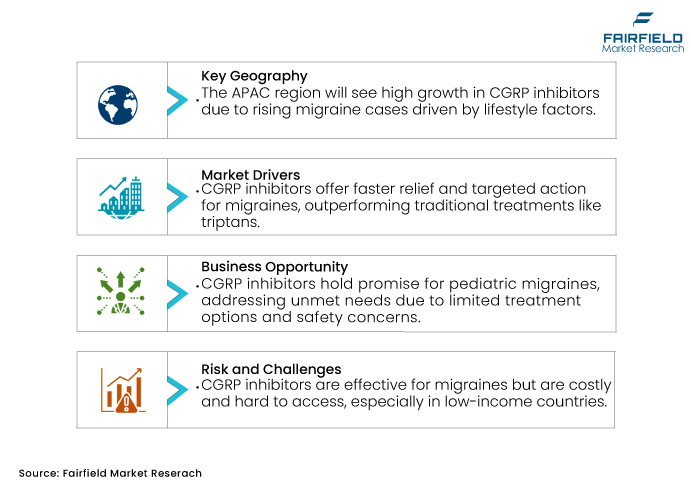
- Asia Pacific is expected to experience the highest growth rate for CGRP inhibitors, fueled by increasing migraine prevalence linked to stress, lifestyle changes, and environmental factors.
- Expanding indications to include pediatric and adolescent populations represents a major opportunity, as clinical trials continue to show positive results for pediatric patients.
- Faster regulatory approvals in key markets such as the U.S. and Europe are driving the availability of CGRP inhibitors, improving access for patients.
- New oral CGRP inhibitors are emerging, offering patients an easier-to-administer alternative to injectables, further expanding treatment options.
- The potential introduction of CGRP biosimilars could help lower costs and increase accessibility, opening up new opportunities for market growth.
A Look Back and a Look Forward - Comparative Analysis
CGRP inhibitors have transformed migraine treatment since their introduction, offering targeted therapy with fewer side effects compared to traditional options such as triptans or antiepileptics. Initially approved for adults with episodic and chronic migraines, drugs such as erenumab, fremanezumab, and galcanezumab demonstrated strong efficacy in reducing migraine frequency and improving quality of life. However, high costs and insurance limitations have restricted access for many patients.
Looking ahead, the CGRP inhibitors market is poised for growth through expanded indications, including pediatric use, and the development of oral CGRP receptor antagonists, which offer more convenient dosing. Clinical trials continue to evaluate safety and effectiveness in younger populations and those with treatment-resistant migraines. Additionally, the potential introduction of biosimilars or lower-cost alternatives could broaden accessibility. As awareness increases and payer policies evolve, CGRP inhibitors are likely to become a more widely used solution for migraine management, offering long-term relief and reducing the overall burden of the disease.
Key Growth Determinants
- Superior Efficacy and Faster Onset of Action Boosting CGRP Inhibitor Adoption
CGRP inhibitors market have emerged as a promising advancement in migraine treatment due to their superior efficacy and quicker onset of action compared to traditional therapies. Conventional treatments, such as triptans and analgesics, often take longer to alleviate symptoms and may require repeated dosing. These medications also carry risks like medication overuse headaches, making them less suitable for long-term use. In contrast, CGRP inhibitors provide a targeted approach by blocking the activity of calcitonin gene-related peptide (CGRP), a molecule that plays a central role in migraine-related pain. This targeted mechanism helps relieve symptoms more quickly and addresses the root biological causes of migraines.
Clinical studies show that CGRP inhibitors, including monoclonal antibodies and receptor antagonists, can reduce migraine frequency and intensity, often within the first month of use. Their rapid and sustained effects make them especially beneficial for patients with chronic migraines who require ongoing symptom control. As awareness of their benefits increases among patients and healthcare providers, the use of CGRP inhibitors is expanding. Their ability to offer immediate relief and long-term prevention positions them as a valuable option in the evolving landscape of migraine management.
Key Growth Barriers
- Cost and Accessibility-related Constraints
CGRP inhibitors are effective treatments for migraines, but they are very expensive and hard to access for many people. Injectable drugs like erenumab, fremanezumab, and galcanezumab often cost over $500–$600 a month without insurance. This makes them too costly for many patients, especially in low- and middle-income countries. Even in developed countries, people face high co-pays, insurance rejections, and rules that require trying cheaper treatments first. A 2022 article on Migraine.com shared stories of patients being denied these drugs by their insurance or struggling to afford them.
In Europe, government health plans usually only cover CGRP inhibitors for people with very severe migraines. In emerging CGRP inhibitors markets, the situation is more pronounced, as many public health systems do not include CGRP inhibitors in their essential drug lists, forcing patients to rely on out-of-pocket payments or less effective alternatives. Until costs go down or insurance improves, many people will struggle to get the treatment they need.
CGRP Inhibitors Market Trends and Opportunities
- Pediatric and Adolescent Migraine Treatment
The pediatric and adolescent migraine segment presents a significant growth opportunity within the CGRP inhibitor market. Although current approvals for CGRP-targeting therapies mainly cover adults, migraines affect roughly 8–10% of children and adolescents, with prevalence rising during teenage years, especially among girls. Traditional migraine treatments like triptans and antiepileptics often have poor tolerability and safety concerns in younger populations, leaving a substantial unmet need for more suitable options.
CGRP inhibitors market, known for their targeted action and favorable safety profiles, are emerging as promising alternatives. Recent clinical trials are exploring their use in younger patients. For example, a Phase 3 study of fremanezumab in adolescents with episodic migraine showed that 47.2% of treated participants experienced a 50% or greater reduction in monthly migraine days, compared to just 27% in the placebo group. Side effects were comparable between both groups, indicating good tolerability.
Securing regulatory approval for pediatric use could not only extend product lifecycles but also introduce these therapies to a largely untapped patient population. Early treatment may also help prevent the progression to chronic migraine, reducing long-term healthcare burdens. Addressing this need offers both clinical value and strong commercial potential, making the pediatric segment a compelling area for market expansion.
Leading Segment Overview
- Demand from the CGRP Antagonists dominates the Market.
The CGRP inhibitors market is mainly driven by strong demand for CGRP antagonists, especially oral options like rimegepant and ubrogepant. These drugs are popular because they are easy to take and work quickly to relieve migraine pain. Many patients prefer them over older treatments, which often have more side effects. This rising demand has helped oral CGRP drugs gain a large share of the market.
Meanwhile, monoclonal antibodies such as erenumab, fremanezumab, and galcanezumab also play a key role in the market. These are usually given by injection and are used for migraine prevention rather than immediate relief. They are effective in reducing the number of migraine days each month and are well-tolerated by most patients. Although they are more expensive and less convenient than pills, they are a good option for people with frequent or severe migraines. Together, CGRP antagonists and monoclonal antibodies are shaping the future of migraine treatment.
Regional Analysis
- North America is the largest market for CGRP Inhibitors
North America is currently the largest market for CGRP inhibitors. This is mainly because of the high number of people diagnosed with migraines, better awareness about new treatments, and strong healthcare infrastructure. In the United States, many patients have access to specialists and advanced therapies, which have helped increase the use of CGRP inhibitors like erenumab, fremanezumab, and rimegepant. Insurance coverage, although sometimes challenging, is more widespread than in many other regions, making these treatments more accessible.
Pharmaceutical companies also focus heavily on the North American CGRP inhibitors market for launching new drugs and conducting clinical trials. The region’s strong presence of key market players and faster regulatory approvals help in quicker product availability. In addition, growing efforts to improve insurance coverage and include younger patients, like adolescents, are expected to further boost demand. Overall, North America is set to remain a leading region in the CGRP inhibitor market in the near future.
- Growth Opportunities for CGRP Inhibitors in the Asia Pacific Market
The Asia Pacific (APAC) region is projected to experience the highest compound annual growth rate (CAGR) for CGRP inhibitors during the forecast period. This growth is largely driven by the increasing prevalence of migraines, influenced by a mix of cultural, lifestyle, and environmental factors like stress, sleep deprivation, and other regional challenges. As the demand for effective migraine treatments rises, CGRP inhibitors are expected to play a key role in addressing the needs of the population.
For example, a study published in the Journal of Population Therapeutics and Clinical Pharmacology in January 2024 highlighted common migraine triggers in India, including emotional stress (97.5%), weather changes (69%), physical exertion (64.5%), missed meals (63.5%), travel (55.5%), and sleep deprivation (55%). These factors are contributing to the increasing demand for migraine treatments, which is anticipated to drive the regional market's growth, positioning APAC as a key area for the expansion of CGRP inhibitors market.
Competitive Landscape
The CGRP inhibitors market is highly competitive, with major pharmaceutical companies focusing on innovation and strategic partnerships. Key players include Amgen, Eli Lilly, Teva Pharmaceuticals, and AbbVie, each offering FDA-approved therapies targeting migraine prevention and treatment. Companies are investing heavily in research and development to expand therapeutic indications and enhance drug efficacy.
The market is witnessing increasing biosimilar development and regional expansion efforts. Mergers, acquisitions, and collaborations are common strategies to strengthen market presence and access new patient populations. Continuous clinical trials and regulatory approvals are expected to shape future dynamics, ensuring sustained growth and heightened competition in the industry.
- In April 2024, AbbVie announced an interim analysis of an ongoing Phase 3, open-label 156-week extension study evaluating the long-term safety and tolerability of oral atogepant for the prevention of migraine in participants with chronic or episodic migraine.
- In August 2024, Organon healthcare company with a focus on women’s health, announced it has expanded its agreement with Eli Lilly and Company to become the sole distributor and promoter for the migraine medicine Emgality ® (galcanezumab) in Canada, Colombia, Israel, South Korea, Kuwait, Mexico, Qatar, Saudi Arabia, Taiwan, Turkey and the United Arab Emirates.
- In March 2023, the FDA approved Pfizer’s ZAVZPRET™ (zavegepant), a nasal spray treatment for migraines.
Key Companies
• AbbVie Inc.
• Amgen Inc.
• Eli Lilly and Company
• Teva Pharmaceutical Industries Ltd.
• Pfizer Inc.
• Lundbeck A/S
• Novartis AG
Global CGRP Inhibitors Market is Segmented as-
By Drug Type
- Monoclonal Antibodies
- CGRP Antagonists
By Treatment Type
- Acute (Abortive)
- Preventative
By Route of Administration
- Oral
- Injectable
- Nasal
By Distribution Channel
- Hospital Pharmacies
- Retail Pharmacies
- Online Pharmacies
By Patient Demographics
- Adult
- Geriatric
- Pediatric
By Region
- North America
- Europe
- Asia Pacific
- Latin America
- The Middle East & Africa
- Executive Summary
- Global Cgrp Inhibitors Market Snapshot
- Future Projections
- Key Market Trends
- Regional Snapshot, by Value, 2026
- Analyst Recommendations
- Market Overview
- Market Definitions and Segmentations
- Market Dynamics
- Drivers
- Restraints
- Market Opportunities
- Value Chain Analysis
- COVID-19 Impact Analysis
- Porter's Five Forces Analysis
- Impact of Russia-Ukraine Conflict
- PESTLE Analysis
- Regulatory Analysis
- Price Trend Analysis
- Current Prices and Future Projections, 2025-2033
- Price Impact Factors
- Global Cgrp Inhibitors Market Outlook, 2020 - 2033
- Global Cgrp Inhibitors Market Outlook, by Drug Type, Value (US$ Bn), 2020-2033
- Monoclonal Antibodies
- CGRP Antagonists
- Global Cgrp Inhibitors Market Outlook, by Treatment Type, Value (US$ Bn), 2020-2033
- Acute (Abortive)
- Preventative
- Global Cgrp Inhibitors Market Outlook, by Route of Administration, Value (US$ Bn), 2020-2033
- Oral
- Injectable
- Nasal
- Global Cgrp Inhibitors Market Outlook, by Distribution Channel, Value (US$ Bn), 2020-2033
- Hospital Pharmacies
- Retail Pharmacies
- Online Pharmacies
- Global Cgrp Inhibitors Market Outlook, by Patient Demographics, Value (US$ Bn), 2020-2033
- Adult
- Geriatric
- Pediatric
- Global Cgrp Inhibitors Market Outlook, by Region, Value (US$ Bn), 2020-2033
- North America
- Europe
- Asia Pacific
- Latin America
- Middle East & Africa
- Global Cgrp Inhibitors Market Outlook, by Drug Type, Value (US$ Bn), 2020-2033
- North America Cgrp Inhibitors Market Outlook, 2020 - 2033
- North America Cgrp Inhibitors Market Outlook, by Drug Type, Value (US$ Bn), 2020-2033
- Monoclonal Antibodies
- CGRP Antagonists
- North America Cgrp Inhibitors Market Outlook, by Treatment Type, Value (US$ Bn), 2020-2033
- Acute (Abortive)
- Preventative
- North America Cgrp Inhibitors Market Outlook, by Route of Administration, Value (US$ Bn), 2020-2033
- Oral
- Injectable
- Nasal
- North America Cgrp Inhibitors Market Outlook, by Distribution Channel, Value (US$ Bn), 2020-2033
- Hospital Pharmacies
- Retail Pharmacies
- Online Pharmacies
- North America Cgrp Inhibitors Market Outlook, by Patient Demographics, Value (US$ Bn), 2020-2033
- Adult
- Geriatric
- Pediatric
- North America Cgrp Inhibitors Market Outlook, by Country, Value (US$ Bn), 2020-2033
- U.S. Cgrp Inhibitors Market Outlook, by Drug Type, 2020-2033
- U.S. Cgrp Inhibitors Market Outlook, by Treatment Type, 2020-2033
- U.S. Cgrp Inhibitors Market Outlook, by Route of Administration, 2020-2033
- U.S. Cgrp Inhibitors Market Outlook, by Distribution Channel, 2020-2033
- U.S. Cgrp Inhibitors Market Outlook, by Patient Demographics, 2020-2033
- Canada Cgrp Inhibitors Market Outlook, by Drug Type, 2020-2033
- Canada Cgrp Inhibitors Market Outlook, by Treatment Type, 2020-2033
- Canada Cgrp Inhibitors Market Outlook, by Route of Administration, 2020-2033
- Canada Cgrp Inhibitors Market Outlook, by Distribution Channel, 2020-2033
- Canada Cgrp Inhibitors Market Outlook, by Patient Demographics, 2020-2033
- BPS Analysis/Market Attractiveness Analysis
- North America Cgrp Inhibitors Market Outlook, by Drug Type, Value (US$ Bn), 2020-2033
- Europe Cgrp Inhibitors Market Outlook, 2020 - 2033
- Europe Cgrp Inhibitors Market Outlook, by Drug Type, Value (US$ Bn), 2020-2033
- Monoclonal Antibodies
- CGRP Antagonists
- Europe Cgrp Inhibitors Market Outlook, by Treatment Type, Value (US$ Bn), 2020-2033
- Acute (Abortive)
- Preventative
- Europe Cgrp Inhibitors Market Outlook, by Route of Administration, Value (US$ Bn), 2020-2033
- Oral
- Injectable
- Nasal
- Europe Cgrp Inhibitors Market Outlook, by Distribution Channel, Value (US$ Bn), 2020-2033
- Hospital Pharmacies
- Retail Pharmacies
- Online Pharmacies
- Europe Cgrp Inhibitors Market Outlook, by Patient Demographics, Value (US$ Bn), 2020-2033
- Adult
- Geriatric
- Pediatric
- Europe Cgrp Inhibitors Market Outlook, by Country, Value (US$ Bn), 2020-2033
- Germany Cgrp Inhibitors Market Outlook, by Drug Type, 2020-2033
- Germany Cgrp Inhibitors Market Outlook, by Treatment Type, 2020-2033
- Germany Cgrp Inhibitors Market Outlook, by Route of Administration, 2020-2033
- Germany Cgrp Inhibitors Market Outlook, by Distribution Channel, 2020-2033
- Germany Cgrp Inhibitors Market Outlook, by Patient Demographics, 2020-2033
- Italy Cgrp Inhibitors Market Outlook, by Drug Type, 2020-2033
- Italy Cgrp Inhibitors Market Outlook, by Treatment Type, 2020-2033
- Italy Cgrp Inhibitors Market Outlook, by Route of Administration, 2020-2033
- Italy Cgrp Inhibitors Market Outlook, by Distribution Channel, 2020-2033
- Italy Cgrp Inhibitors Market Outlook, by Patient Demographics, 2020-2033
- France Cgrp Inhibitors Market Outlook, by Drug Type, 2020-2033
- France Cgrp Inhibitors Market Outlook, by Treatment Type, 2020-2033
- France Cgrp Inhibitors Market Outlook, by Route of Administration, 2020-2033
- France Cgrp Inhibitors Market Outlook, by Distribution Channel, 2020-2033
- France Cgrp Inhibitors Market Outlook, by Patient Demographics, 2020-2033
- U.K. Cgrp Inhibitors Market Outlook, by Drug Type, 2020-2033
- U.K. Cgrp Inhibitors Market Outlook, by Treatment Type, 2020-2033
- U.K. Cgrp Inhibitors Market Outlook, by Route of Administration, 2020-2033
- U.K. Cgrp Inhibitors Market Outlook, by Distribution Channel, 2020-2033
- U.K. Cgrp Inhibitors Market Outlook, by Patient Demographics, 2020-2033
- Spain Cgrp Inhibitors Market Outlook, by Drug Type, 2020-2033
- Spain Cgrp Inhibitors Market Outlook, by Treatment Type, 2020-2033
- Spain Cgrp Inhibitors Market Outlook, by Route of Administration, 2020-2033
- Spain Cgrp Inhibitors Market Outlook, by Distribution Channel, 2020-2033
- Spain Cgrp Inhibitors Market Outlook, by Patient Demographics, 2020-2033
- Russia Cgrp Inhibitors Market Outlook, by Drug Type, 2020-2033
- Russia Cgrp Inhibitors Market Outlook, by Treatment Type, 2020-2033
- Russia Cgrp Inhibitors Market Outlook, by Route of Administration, 2020-2033
- Russia Cgrp Inhibitors Market Outlook, by Distribution Channel, 2020-2033
- Russia Cgrp Inhibitors Market Outlook, by Patient Demographics, 2020-2033
- Rest of Europe Cgrp Inhibitors Market Outlook, by Drug Type, 2020-2033
- Rest of Europe Cgrp Inhibitors Market Outlook, by Treatment Type, 2020-2033
- Rest of Europe Cgrp Inhibitors Market Outlook, by Route of Administration, 2020-2033
- Rest of Europe Cgrp Inhibitors Market Outlook, by Distribution Channel, 2020-2033
- Rest of Europe Cgrp Inhibitors Market Outlook, by Patient Demographics, 2020-2033
- BPS Analysis/Market Attractiveness Analysis
- Europe Cgrp Inhibitors Market Outlook, by Drug Type, Value (US$ Bn), 2020-2033
- Asia Pacific Cgrp Inhibitors Market Outlook, 2020 - 2033
- Asia Pacific Cgrp Inhibitors Market Outlook, by Drug Type, Value (US$ Bn), 2020-2033
- Monoclonal Antibodies
- CGRP Antagonists
- Asia Pacific Cgrp Inhibitors Market Outlook, by Treatment Type, Value (US$ Bn), 2020-2033
- Acute (Abortive)
- Preventative
- Asia Pacific Cgrp Inhibitors Market Outlook, by Route of Administration, Value (US$ Bn), 2020-2033
- Oral
- Injectable
- Nasal
- Asia Pacific Cgrp Inhibitors Market Outlook, by Distribution Channel, Value (US$ Bn), 2020-2033
- Hospital Pharmacies
- Retail Pharmacies
- Online Pharmacies
- Asia Pacific Cgrp Inhibitors Market Outlook, by Patient Demographics, Value (US$ Bn), 2020-2033
- Adult
- Geriatric
- Pediatric
- Asia Pacific Cgrp Inhibitors Market Outlook, by Country, Value (US$ Bn), 2020-2033
- China Cgrp Inhibitors Market Outlook, by Drug Type, 2020-2033
- China Cgrp Inhibitors Market Outlook, by Treatment Type, 2020-2033
- China Cgrp Inhibitors Market Outlook, by Route of Administration, 2020-2033
- China Cgrp Inhibitors Market Outlook, by Distribution Channel, 2020-2033
- China Cgrp Inhibitors Market Outlook, by Patient Demographics, 2020-2033
- Japan Cgrp Inhibitors Market Outlook, by Drug Type, 2020-2033
- Japan Cgrp Inhibitors Market Outlook, by Treatment Type, 2020-2033
- Japan Cgrp Inhibitors Market Outlook, by Route of Administration, 2020-2033
- Japan Cgrp Inhibitors Market Outlook, by Distribution Channel, 2020-2033
- Japan Cgrp Inhibitors Market Outlook, by Patient Demographics, 2020-2033
- South Korea Cgrp Inhibitors Market Outlook, by Drug Type, 2020-2033
- South Korea Cgrp Inhibitors Market Outlook, by Treatment Type, 2020-2033
- South Korea Cgrp Inhibitors Market Outlook, by Route of Administration, 2020-2033
- South Korea Cgrp Inhibitors Market Outlook, by Distribution Channel, 2020-2033
- South Korea Cgrp Inhibitors Market Outlook, by Patient Demographics, 2020-2033
- India Cgrp Inhibitors Market Outlook, by Drug Type, 2020-2033
- India Cgrp Inhibitors Market Outlook, by Treatment Type, 2020-2033
- India Cgrp Inhibitors Market Outlook, by Route of Administration, 2020-2033
- India Cgrp Inhibitors Market Outlook, by Distribution Channel, 2020-2033
- India Cgrp Inhibitors Market Outlook, by Patient Demographics, 2020-2033
- Southeast Asia Cgrp Inhibitors Market Outlook, by Drug Type, 2020-2033
- Southeast Asia Cgrp Inhibitors Market Outlook, by Treatment Type, 2020-2033
- Southeast Asia Cgrp Inhibitors Market Outlook, by Route of Administration, 2020-2033
- Southeast Asia Cgrp Inhibitors Market Outlook, by Distribution Channel, 2020-2033
- Southeast Asia Cgrp Inhibitors Market Outlook, by Patient Demographics, 2020-2033
- Rest of SAO Cgrp Inhibitors Market Outlook, by Drug Type, 2020-2033
- Rest of SAO Cgrp Inhibitors Market Outlook, by Treatment Type, 2020-2033
- Rest of SAO Cgrp Inhibitors Market Outlook, by Route of Administration, 2020-2033
- Rest of SAO Cgrp Inhibitors Market Outlook, by Distribution Channel, 2020-2033
- Rest of SAO Cgrp Inhibitors Market Outlook, by Patient Demographics, 2020-2033
- BPS Analysis/Market Attractiveness Analysis
- Asia Pacific Cgrp Inhibitors Market Outlook, by Drug Type, Value (US$ Bn), 2020-2033
- Latin America Cgrp Inhibitors Market Outlook, 2020 - 2033
- Latin America Cgrp Inhibitors Market Outlook, by Drug Type, Value (US$ Bn), 2020-2033
- Monoclonal Antibodies
- CGRP Antagonists
- Latin America Cgrp Inhibitors Market Outlook, by Treatment Type, Value (US$ Bn), 2020-2033
- Acute (Abortive)
- Preventative
- Latin America Cgrp Inhibitors Market Outlook, by Route of Administration, Value (US$ Bn), 2020-2033
- Oral
- Injectable
- Nasal
- Latin America Cgrp Inhibitors Market Outlook, by Distribution Channel, Value (US$ Bn), 2020-2033
- Hospital Pharmacies
- Retail Pharmacies
- Online Pharmacies
- Latin America Cgrp Inhibitors Market Outlook, by Patient Demographics, Value (US$ Bn), 2020-2033
- Adult
- Geriatric
- Pediatric
- Latin America Cgrp Inhibitors Market Outlook, by Country, Value (US$ Bn), 2020-2033
- Brazil Cgrp Inhibitors Market Outlook, by Drug Type, 2020-2033
- Brazil Cgrp Inhibitors Market Outlook, by Treatment Type, 2020-2033
- Brazil Cgrp Inhibitors Market Outlook, by Route of Administration, 2020-2033
- Brazil Cgrp Inhibitors Market Outlook, by Distribution Channel, 2020-2033
- Brazil Cgrp Inhibitors Market Outlook, by Patient Demographics, 2020-2033
- Mexico Cgrp Inhibitors Market Outlook, by Drug Type, 2020-2033
- Mexico Cgrp Inhibitors Market Outlook, by Treatment Type, 2020-2033
- Mexico Cgrp Inhibitors Market Outlook, by Route of Administration, 2020-2033
- Mexico Cgrp Inhibitors Market Outlook, by Distribution Channel, 2020-2033
- Mexico Cgrp Inhibitors Market Outlook, by Patient Demographics, 2020-2033
- Argentina Cgrp Inhibitors Market Outlook, by Drug Type, 2020-2033
- Argentina Cgrp Inhibitors Market Outlook, by Treatment Type, 2020-2033
- Argentina Cgrp Inhibitors Market Outlook, by Route of Administration, 2020-2033
- Argentina Cgrp Inhibitors Market Outlook, by Distribution Channel, 2020-2033
- Argentina Cgrp Inhibitors Market Outlook, by Patient Demographics, 2020-2033
- Rest of LATAM Cgrp Inhibitors Market Outlook, by Drug Type, 2020-2033
- Rest of LATAM Cgrp Inhibitors Market Outlook, by Treatment Type, 2020-2033
- Rest of LATAM Cgrp Inhibitors Market Outlook, by Route of Administration, 2020-2033
- Rest of LATAM Cgrp Inhibitors Market Outlook, by Distribution Channel, 2020-2033
- Rest of LATAM Cgrp Inhibitors Market Outlook, by Patient Demographics, 2020-2033
- BPS Analysis/Market Attractiveness Analysis
- Latin America Cgrp Inhibitors Market Outlook, by Drug Type, Value (US$ Bn), 2020-2033
- Middle East & Africa Cgrp Inhibitors Market Outlook, 2020 - 2033
- Middle East & Africa Cgrp Inhibitors Market Outlook, by Drug Type, Value (US$ Bn), 2020-2033
- Monoclonal Antibodies
- CGRP Antagonists
- Middle East & Africa Cgrp Inhibitors Market Outlook, by Treatment Type, Value (US$ Bn), 2020-2033
- Acute (Abortive)
- Preventative
- Middle East & Africa Cgrp Inhibitors Market Outlook, by Route of Administration, Value (US$ Bn), 2020-2033
- Oral
- Injectable
- Nasal
- Middle East & Africa Cgrp Inhibitors Market Outlook, by Distribution Channel, Value (US$ Bn), 2020-2033
- Hospital Pharmacies
- Retail Pharmacies
- Online Pharmacies
- Middle East & Africa Cgrp Inhibitors Market Outlook, by Patient Demographics, Value (US$ Bn), 2020-2033
- Adult
- Geriatric
- Pediatric
- Middle East & Africa Cgrp Inhibitors Market Outlook, by Country, Value (US$ Bn), 2020-2033
- GCC Cgrp Inhibitors Market Outlook, by Drug Type, 2020-2033
- GCC Cgrp Inhibitors Market Outlook, by Treatment Type, 2020-2033
- GCC Cgrp Inhibitors Market Outlook, by Route of Administration, 2020-2033
- GCC Cgrp Inhibitors Market Outlook, by Distribution Channel, 2020-2033
- GCC Cgrp Inhibitors Market Outlook, by Patient Demographics, 2020-2033
- South Africa Cgrp Inhibitors Market Outlook, by Drug Type, 2020-2033
- South Africa Cgrp Inhibitors Market Outlook, by Treatment Type, 2020-2033
- South Africa Cgrp Inhibitors Market Outlook, by Route of Administration, 2020-2033
- South Africa Cgrp Inhibitors Market Outlook, by Distribution Channel, 2020-2033
- South Africa Cgrp Inhibitors Market Outlook, by Patient Demographics, 2020-2033
- Egypt Cgrp Inhibitors Market Outlook, by Drug Type, 2020-2033
- Egypt Cgrp Inhibitors Market Outlook, by Treatment Type, 2020-2033
- Egypt Cgrp Inhibitors Market Outlook, by Route of Administration, 2020-2033
- Egypt Cgrp Inhibitors Market Outlook, by Distribution Channel, 2020-2033
- Egypt Cgrp Inhibitors Market Outlook, by Patient Demographics, 2020-2033
- Nigeria Cgrp Inhibitors Market Outlook, by Drug Type, 2020-2033
- Nigeria Cgrp Inhibitors Market Outlook, by Treatment Type, 2020-2033
- Nigeria Cgrp Inhibitors Market Outlook, by Route of Administration, 2020-2033
- Nigeria Cgrp Inhibitors Market Outlook, by Distribution Channel, 2020-2033
- Nigeria Cgrp Inhibitors Market Outlook, by Patient Demographics, 2020-2033
- Rest of Middle East Cgrp Inhibitors Market Outlook, by Drug Type, 2020-2033
- Rest of Middle East Cgrp Inhibitors Market Outlook, by Treatment Type, 2020-2033
- Rest of Middle East Cgrp Inhibitors Market Outlook, by Route of Administration, 2020-2033
- Rest of Middle East Cgrp Inhibitors Market Outlook, by Distribution Channel, 2020-2033
- Rest of Middle East Cgrp Inhibitors Market Outlook, by Patient Demographics, 2020-2033
- BPS Analysis/Market Attractiveness Analysis
- Middle East & Africa Cgrp Inhibitors Market Outlook, by Drug Type, Value (US$ Bn), 2020-2033
- Competitive Landscape
- Company Vs Segment Heatmap
- Company Market Share Analysis, 2025
- Competitive Dashboard
- Company Profiles
- AbbVie Inc.
- Company Overview
- Product Portfolio
- Financial Overview
- Business Strategies and Developments
- Amgen Inc.
- Eli Lilly and Company
- Teva Pharmaceutical Industries Ltd.
- Pfizer Inc.
- Lundbeck A/S
- Novartis AG
- AbbVie Inc.
- Appendix
- Research Methodology
- Report Assumptions
- Acronyms and Abbreviations
BASE YEAR |
HISTORICAL DATA |
FORECAST PERIOD |
UNITS |
|||
 |
2025 |
 |
2020 - 2025 |
 |
2026 - 2033 |
Value: US$ Million |
Our Research Methodology
Considering the volatility of business today, traditional approaches to strategizing a game plan can be unfruitful if not detrimental. True ambiguity is no way to determine a forecast. A myriad of predetermined factors must be accounted for such as the degree of risk involved, the magnitude of circumstances, as well as conditions or consequences that are not known or unpredictable. To circumvent binary views that cast uncertainty, the application of market research intelligence to strategically posture, move, and enable actionable outcomes is necessary.
View Methodology
Quality Assured
Rigorous Validation Process

Confidentiality Assured
End-to-end Data Security

Custom Research Services
Tailored To Your Objectives
FAQs
The CGRP Inhibitors Market is valued at USD 6.8 Bn in 2026.
The CGRP Inhibitors Market is projected to grow at a CAGR of 6% through 2033, reaching USD 10.4 Bn.
The market is driven by the rising prevalence of migraine disorders, superior efficacy of CGRP-targeted therapies, and increasing adoption of oral and injectable migraine treatments.
North America is the dominant regional market for CGRP Inhibitors due to high migraine awareness, advanced healthcare infrastructure, and strong uptake of innovative therapies.
AbbVie Inc., Amgen Inc., Eli Lilly and Company, Teva Pharmaceutical Industries Ltd., and Pfizer Inc. are among the leading players in the CGRP Inhibitors Market.
Related Reports
Group Life Insurance Market Size, Share, Insights, Competitive Landscape, and Forecast 2026 to 2033
The global group life insurance market is valued at US$120.0 billion in 2026, reaching US$165.0 billion by 2033, growing at a 4.7% CAGR
Group Health Insurance Market Size, Share, Insights, Competitive Landscape, and Forecast 2026 to 2033
The global group health insurance market is valued at US$625.0 billion in 2026, reaching US$1,060.0 billion by 2033, growing at a 7.8% CAGR
5G in Healthcare Market Size, Share, Insights, Competitive Landscape, and Forecast 2026 to 2033
The global 5G in healthcare market is valued at US$3.6 billion in 2026, reaching US$19.5 billion by 2033, growing at a 27.3% CAGR
Wearable Skin Adhesives Market Size, Share, Insights, Competitive Landscape, and Forecast 2026 to 2033
The global wearable skin adhesives market is valued at US$1.2 billion in 2026, reaching US$2.1 billion by 2033, growing at an 8.3% CAGR
Healthcare Reimbursement Market Size, Share, Insights, Competitive Landscape, and Forecast 2026 to 2033
The global healthcare reimbursement market is valued at US$65.0 billion in 2026, reaching US$135.0 billion by 2033, growing at an 11.0% CAGR
3D Bioprinted Human Tissue Market Size, Share, Insights, Competitive Landscape, and Forecast 2026 to 2033
The global 3D bioprinted human tissue market is valued at US$2.92 billion in 2026, reaching US$10.37 billion by 2033, growing at a 19.8% CAGR