



Chlorobutyl Rubber Market
Chlorobutyl Rubber Market Size, Share, Insights, Competitive Landscape, and Forecast 2026 to 2033
Chlorobutyl Rubber Market Size and Trend Analysis
How Fast Is the Chlorobutyl Rubber Market Growing?
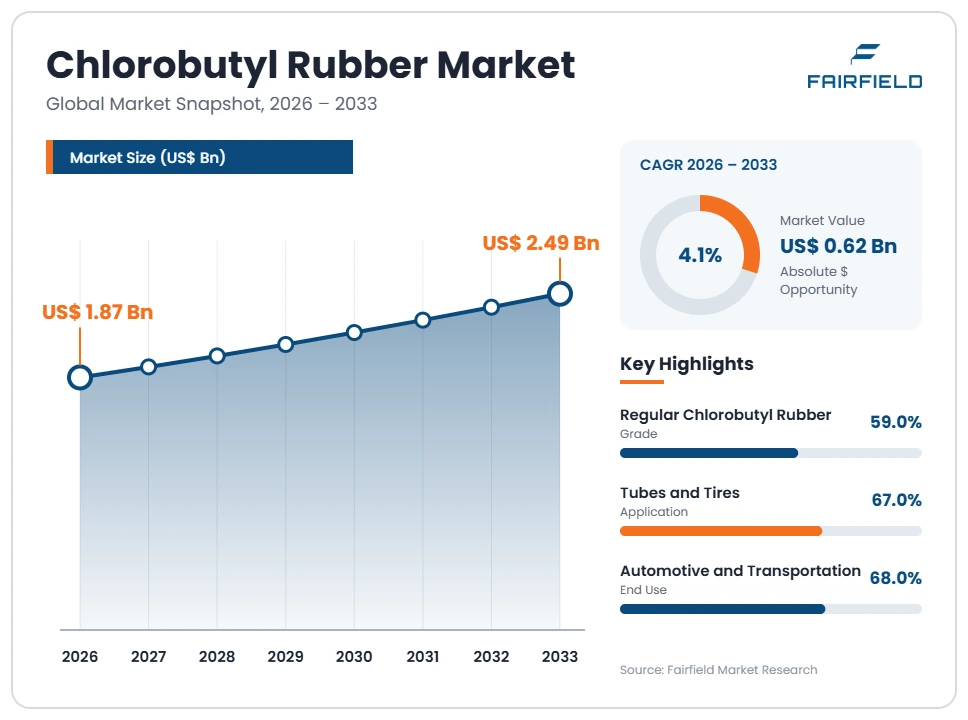
The global chlorobutyl rubber market size is expected to be valued at US$ 1.87 billion in 2026 and projected to reach US$ 2.49 billion by 2033, growing at a CAGR of 4.1% between 2026 and 2033.
Between 2020 and 2025, the market grew at a CAGR of about 3.7%, rising from roughly US$ 1.50 billion to about US$ 1.80 billion, as tire production recovered after the pandemic, demand for pharmaceutical vial stoppers surged with vaccine programs, and new capacity came online in China and India. The chlorobutyl rubber market covers a synthetic elastomer made by adding chlorine to butyl rubber, a polymer of isobutylene and a small amount of isoprene. Chlorination makes the rubber cure faster and bond better with other rubbers, while keeping butyl's excellent resistance to air and moisture, heat, chemicals, and ageing. These properties make chlorobutyl ideal for tire inner liners that keep air inside tubeless tires, inner tubes, pharmaceutical stoppers and seals, adhesives and sealants, and hoses. In January 2025, Zhejiang Cenway announced plans to expand halobutyl capacity in China.
Key Report Takeaways
- By Grade: Regular Chlorobutyl Rubber held about 59% share in 2025, while Pharmaceutical Grade is projected to expand at a 5.5% CAGR through 2033, driven by rising production of injectable drugs, biologics, vaccines, and prefilled syringes that need clean, low-extractable closures.
- By Application: Tubes and Tires held about 67% share in 2025, while Pharmaceutical Closures are projected to expand at a 5.8% CAGR through 2033, driven by growing demand for vial stoppers, syringe plungers, and seals that protect sensitive drugs from air and moisture.
- By End Use: Automotive and Transportation held about 68% share in 2025, while Construction and Industrial is projected to expand at a 4.8% CAGR through 2033, driven by roofing membranes, sealants, adhesives, hoses, and tank linings used in infrastructure and industrial plants.
- By Region: Asia Pacific held about 51% share in 2025, while India is projected to expand at a 6.0% CAGR through 2033, driven by fast tire production growth, a large generic drug industry, local halobutyl production at Jamnagar, and rising vehicle ownership.
Global Chlorobutyl Rubber Market Trends and Insights
Drivers Impact Analysis
Two drivers carry the strongest influence on chlorobutyl rubber market demand during the forecast period.
| Driver | Impact on CAGR Forecast | Geographic Relevance | Impact Timeline |
| Growth of tubeless tire production | High | Global | Long term (≥4 years) |
| Rising pharmaceutical packaging demand | Medium | Asia Pacific, North America, Europe | Medium term (2-4 years) |
Tubeless Tire Growth Is Driving the Chlorobutyl Rubber Market
Growth of tubeless tire production is the strongest driver of the chlorobutyl rubber market. Nearly every modern tire needs a halobutyl inner liner.
The mechanism is that tubeless tires rely on a thin inner liner made from chlorobutyl or bromobutyl rubber to keep air from leaking through the tire wall, and better air retention improves fuel economy, safety, and tire life. Global tire production exceeds two billion units a year, and demand keeps rising with vehicle sales, replacement tires, and the shift from tube-type to tubeless tires in India, Indonesia, and Middle East & Africa. Electric vehicles are heavier and need tires that hold pressure well to protect driving range, which increases the importance of high-quality inner liners. Truck and bus radial tires also use large amounts of halobutyl. These trends create steady, long-term demand for chlorobutyl rubber from major tire makers.
Pharmaceutical Packaging Is Expanding the Chlorobutyl Rubber Market
Rising pharmaceutical packaging demand is expanding the chlorobutyl rubber market. Injectable drugs need reliable closures.
The cause is that chlorobutyl rubber has very low gas and moisture permeability, good chemical resistance, and low levels of extractable substances, making it one of the preferred materials for vial stoppers, syringe plungers, and infusion bag seals. The number of injectable medicines, including biologics, insulin, GLP-1 drugs, vaccines, and cancer treatments, keeps rising, and many are sensitive to oxygen and moisture. Prefilled syringes and cartridges are also growing quickly. Closure makers such as West Pharmaceutical Services, Datwyler, and Aptar use pharmaceutical-grade halobutyl. Generic drug manufacturing in India and China adds strong demand. Stricter quality rules from drug regulators also favor proven materials. These trends support higher-value growth for specialty chlorobutyl grades.
Restraints Impact Analysis
Two restraints limit how quickly the chlorobutyl rubber market grows.
| Restraint | Impact on CAGR Forecast | Geographic Relevance | Impact Timeline |
| Raw material price volatility | High | Global | Medium term (2-4 years) |
| Competition from bromobutyl and trade disputes | Medium | Asia Pacific, North America | Long term (≥4 years) |
Raw Material Volatility Slows the Chlorobutyl Rubber Market
Raw material price volatility slows the chlorobutyl rubber market. Feedstock costs change quickly.
The problem is that chlorobutyl rubber is made from isobutylene, isoprene, and chlorine, which come from oil refining and petrochemical processes, so their prices rise and fall with crude oil, natural gas, and refinery operations. Sudden feedstock increases raise production costs, and producers cannot always pass them on to large tire makers with strong buying power. In March 2026, for example, isobutylene prices in the United States rose sharply, pushing butyl rubber prices higher. Energy costs for polymerization and halogenation also affect margins, especially in Europe. Plant outages, weather events, and maintenance shutdowns at the few global producers can quickly tighten supply. These factors create price swings that slow demand growth and complicate contract pricing.
Bromobutyl Competition and Trade Disputes Restrict the Chlorobutyl Rubber Market
Competition from bromobutyl and trade disputes restrict the chlorobutyl rubber market. Buyers have alternatives and face trade barriers.
The constraint is that bromobutyl rubber, the other main halobutyl type, cures even faster and offers better adhesion in some tire compounds, so many tire makers prefer it for premium radial tire inner liners, limiting chlorobutyl's share. Some closure makers also use bromobutyl. At the same time, anti-dumping investigations are disrupting trade. India opened an investigation in October 2025 into halobutyl imports from China, Singapore, and the United States, and China extended its own probe into halobutyl from Canada, Japan, and India to March 2026. Duties can raise costs for tire makers and shift supply chains. Sanctions affecting Russian producers also complicate trade. These factors restrict growth for some suppliers.
Market Opportunities
High-Purity Pharmaceutical Grades Open a Fast-Growth Revenue Pool
High-purity pharmaceutical grades open a fast-growth revenue pool. Drug makers need cleaner closures.
The opportunity comes from strict regulatory requirements for drug packaging, which push closure makers to use chlorobutyl grades with very low extractables, leachables, and particles. Biologics, insulin, cell and gene therapies, mRNA vaccines, and GLP-1 weight-loss drugs are especially sensitive, and many are stored frozen or in prefilled syringes that need special materials. These grades sell at much higher prices than tire grades and need dedicated clean production lines. Suppliers can work with closure makers on coated stoppers, ready-to-use sterilized components, and special formulations for frozen storage. Companies that offer consistent quality, regulatory support files, and secure supply can win long-term contracts with leading pharmaceutical packaging companies in every region.
Asia Pacific Capacity and Local Supply Create a Growth Revenue Pool
Asia Pacific capacity and local supply create a growth revenue pool. Production is moving closer to tire makers.
The opportunity reflects strong tire production growth in China, India, Thailand, Indonesia, and Vietnam, along with rising pharmaceutical and vaccine production in India and China, which need large volumes of closures. Local producers are adding capacity: Zhejiang Cenway plans to raise its Zhejiang plant to 120 ktpa, including 40.4 ktpa of chlorobutyl, and Befar Group plans a new halobutyl complex in Shandong province. Reliance Sibur Elastomers supplies the Indian market from Jamnagar. Pharmaceutical closure makers are also building plants in India and China. Companies that build local capacity, meet tire maker specifications, secure feedstock, and offer competitive pricing can capture growth in this fast-expanding region.
Segment Analysis
- By Grade: Regular Chlorobutyl Rubber Leads While Pharmaceutical Grade Grows Fastest
Regular Chlorobutyl Rubber held about 59% share in 2025. Standard grades are used in tire inner liners, inner tubes, adhesives, sealants, and industrial products, and they are produced in large volumes by all major suppliers. Tire makers buy these grades under long-term contracts, and consistent quality is essential to meet tire performance standards and pass strict qualification tests.
Pharmaceutical Grade is the fastest-growing grade, expanding at a 5.5% CAGR through 2033. These high-purity grades meet strict standards for extractables and cleanliness and are used in stoppers and seals for injectable drugs. Other Specialty Grades form another segment, used in adhesives and industrial compounds. For the market, pharmaceutical grade growth raises average selling prices and supports specialty production lines.
- By Application: Tubes and Tires Lead While Pharmaceutical Closures Grow Fastest
Tubes and Tires held about 67% share in 2025. Inner liners for passenger, truck, bus, and off-road tires, along with inner tubes for two-wheelers and bicycles, consume most chlorobutyl rubber. Rising tire production keeps this segment dominant, and larger tires for SUVs, electric vehicles, and trucks use more inner liner material per tire. Replacement tire demand from the growing global vehicle fleet adds steady volumes.
Pharmaceutical Closures are the fastest-growing application, expanding at a 5.8% CAGR through 2033. Vial stoppers, syringe plungers, and seals benefit from chlorobutyl's barrier and chemical resistance. Adhesives and Sealants, Hoses and Belts, and Other Applications form other segments, using chlorobutyl's weather and chemical resistance. For the market, closure growth supports higher-value demand and better margins for producers.
- By End Use: Automotive and Transportation Leads While Construction and Industrial Grows Fastest
Automotive and Transportation held about 68% share in 2025. Tire makers, automotive hose and belt producers, and component makers are the largest buyers worldwide. Rising vehicle production and replacement tire demand drive volumes, and motorcycle and bicycle inner tubes add strong demand in India and Indonesia. Heavier electric vehicles also need better air retention to protect driving range and tire life.
Construction and Industrial is the fastest-growing end use, expanding at a 4.8% CAGR through 2033. Roofing membranes, sealants, chemical tank linings, and conveyor belts use chlorobutyl for durability, weather resistance, and low gas permeability. Healthcare and Consumer Goods form other segments, including closures, gloves, and sports balls. For the market, industrial growth diversifies demand beyond the tire sector.
Geography Analysis
- Why Is North America Important to the Chlorobutyl Rubber Market?
North America is a major chlorobutyl rubber market. The United States has large tire production by Goodyear, Michelin, Bridgestone, and other makers, as well as major pharmaceutical closure producers such as West Pharmaceutical Services. ExxonMobil produces butyl and halobutyl rubber in Baton Rouge, Louisiana, and ARLANXEO operates a halobutyl plant in Sarnia, Canada. Mexico has growing tire production for export, and Canada has strong pharmaceutical manufacturing. Key barriers include feedstock price swings and trade duties. One change shaping the region is rising demand from EV tires, GLP-1 drugs, and other injectable medicines.
- Europe Shapes the Chlorobutyl Rubber Market Through Specialty Applications
Europe is a major chlorobutyl rubber market. Germany, France, Italy, Poland, and Belgium have strong tire production by Michelin, Continental, and Pirelli, and large pharmaceutical packaging industries. ARLANXEO operates a halobutyl plant in Belgium, and closure maker Datwyler is based in Switzerland with plants across the region. Strict European Union chemical and pharmaceutical rules favor high-quality grades from trusted suppliers. Key barriers include high energy costs and slower car sales. One opportunity is pharmaceutical-grade supply for biologics and vaccines, supported by strong drug manufacturing in Ireland, Germany, and Switzerland.
- Which Region Is Leading the Chlorobutyl Rubber Market?
Asia Pacific is leading the chlorobutyl rubber market with about 51% share in 2025, while India is the fastest-growing country, expanding at a 6.0% CAGR through 2033. China is the world's largest tire producer and home to Zhejiang Cenway, Sinopec Beijing Yanshan, and Panjin Heyun. ExxonMobil produces halobutyl in a large Singapore plant, Japan Butyl serves Japan, and Reliance Sibur produces in India. Thailand and Vietnam are growing tire export hubs. Key barriers include trade disputes and overcapacity. One change shaping the region is local capacity growth in China and India.
- Latin America Grows the Chlorobutyl Rubber Market Through Tire Manufacturing
Latin America is a growing chlorobutyl rubber market. Brazil, Mexico, Argentina, Colombia, and Chile have tire plants operated by global makers such as Pirelli, Bridgestone, Goodyear, and Michelin, and Brazil has a large pharmaceutical industry with growing injectable drug production. Most chlorobutyl is imported from North America, Europe, and Asia Pacific because there is little local halobutyl production. Key barriers include currency swings, high import costs, long shipping times, and economic cycles. One opportunity is supply for tire plant expansions, supported by rising vehicle sales, replacement tire demand, and pharmaceutical production growth.
- Middle East & Africa Builds the Chlorobutyl Rubber Market Through Industrial Growth
Middle East & Africa is an emerging chlorobutyl rubber market. Saudi Arabia is investing heavily in petrochemicals, tires, and pharmaceuticals and owns ARLANXEO through Aramco, while Morocco, South Africa, and Egypt have tire and pharmaceutical production, and new tire plants are planned in Saudi Arabia and the United Arab Emirates. Key barriers include limited local rubber processing, small market size, high logistics costs, and reliance on imports from Asia Pacific and Europe. One opportunity is new tire plants and drug packaging production, supported by national industrial strategies, rising car ownership, local vaccine manufacturing goals, and growing vehicle fleets.
Competitive Landscape
The chlorobutyl rubber market is highly consolidated. ExxonMobil Corporation, ARLANXEO, SIBUR (Nizhnekamskneftekhim), Reliance Sibur Elastomers, and Zhejiang Cenway New Materials are leading players, while Japan Butyl, Sinopec Beijing Yanshan, Panjin Heyun, Befar Group, Chambroad Sinopoly, JSR, and ENEOS compete in regional markets. A handful of companies control most global halobutyl capacity because building plants requires large investment, complex polymerization and halogenation technology, and integrated access to isobutylene feedstock. ExxonMobil and ARLANXEO, owned by Aramco, are the main suppliers to global tire makers, while SIBUR operates the world's largest halobutyl capacity at Nizhnekamsk.
Companies compete on product consistency, purity, tire maker approvals, pharmaceutical certifications, production capacity, feedstock integration, logistics, technical service, and price. Qualification with tire makers and closure producers takes years, which creates strong customer loyalty and high barriers for new entrants in the market.
Strategic moves show how competition is changing. In January 2025, Zhejiang Cenway announced a major halobutyl expansion. In September 2025, China extended its anti-dumping probe on halobutyl imports, and in October 2025, India launched its own investigation. In July 2026, Befar Group announced plans for a new halobutyl complex in Shandong, adding to Chinese capacity.
Three themes shape vendor strategy. First, Chinese and Indian producers are adding local capacity to replace imports. Second, global suppliers are focusing on premium tire and pharmaceutical grades. Third, trade measures are reshaping supply chains across Asia Pacific and North America.
Chlorobutyl Rubber Market Industry Leaders
- ExxonMobil Corporation
- ARLANXEO
- SIBUR (Nizhnekamskneftekhim)
- Reliance Sibur Elastomers
- Zhejiang Cenway New Materials
Recent Industry Developments
- July 2026: Befar Group announced plans to invest RMB 1.82 billion in the first phase of a new special rubber complex in Binzhou, Shandong, including halobutyl rubber production - adds new capacity to the chlorobutyl rubber market in China.
- October 2025: India's Directorate General of Trade Remedies opened an anti-dumping investigation into halobutyl rubber imports from China, Singapore, and the United States, following a petition from Reliance Sibur Elastomers - may reshape supply to Indian tire makers.
- September 2025: China's Ministry of Commerce extended its anti-dumping probe into halogenated butyl rubber from Canada, Japan, and India until March 14, 2026 - adds uncertainty to Asian trade flows.
- January 2025: Zhejiang Cenway announced plans to expand butyl rubber capacity at its Zhejiang plant by 70 ktpa to 120 ktpa, including 40.4 ktpa of chlorobutyl rubber - strengthens Chinese supply.
Companies Covered in the Report
- ExxonMobil Corporation
- ARLANXEO
- SIBUR (Nizhnekamskneftekhim)
- Reliance Sibur Elastomers
- Zhejiang Cenway New Materials
- Japan Butyl Co., Ltd.
- Sinopec Beijing Yanshan
- Panjin Heyun Group
- Befar Group
- Chambroad Sinopoly New Materials
- JSR Corporation
- ENEOS Corporation
Chlorobutyl Rubber Market Report Scope
| Metric | Value |
| Study Period | 2020-2033 |
| Market Size 2026 | US$ 1.87 Billion |
| Market Size 2033 | US$ 2.49 Billion |
| CAGR 2026-2033 | 4.1% |
| Absolute Dollar Opportunity | US$ 0.62 Billion |
| Largest Market | Asia Pacific |
| Fastest-Growing Market | India |
| Market Concentration | Highly Consolidated |
| Major Players | ExxonMobil Corporation, ARLANXEO, SIBUR (Nizhnekamskneftekhim), Reliance Sibur Elastomers, Zhejiang Cenway New Materials |
Chlorobutyl Rubber Market Segmentation
- Executive Summary
- Chlorobutyl Rubber Market Snapshot
- Future Projections
- Key Market Trends
- Regional Snapshot
- Market Overview
- Market Definition and Report Scope
- Historical Market Trends
- Market Dynamics
- Drivers
- Tubeless Tire Growth Is Driving the Chlorobutyl Rubber Market
- Pharmaceutical Packaging Is Expanding the Chlorobutyl Rubber Market
- Restraints
- Raw Material Volatility Slows the Chlorobutyl Rubber Market
- Bromobutyl Competition and Trade Disputes Restrict the Chlorobutyl Rubber Market
- Market Opportunities
- High-Purity Pharmaceutical Grades Open a Fast-Growth Revenue Pool
- Asia Pacific Capacity and Local Supply Create a Growth Revenue Pool
- Drivers
- Global Chlorobutyl Rubber Market Outlook, 2020–2033
- Global Chlorobutyl Rubber Market Outlook, by Grade, Value (US$ Billion), 2020–2033
- Regular Chlorobutyl Rubber
- Pharmaceutical Grade
- Other Specialty Grades
- Global Chlorobutyl Rubber Market Outlook, by Application, Value (US$ Billion), 2020–2033
- Tubes and Tires
- Pharmaceutical Closures
- Adhesives and Sealants
- Hoses and Belts
- Other Applications
- Global Chlorobutyl Rubber Market Outlook, by End Use, Value (US$ Billion), 2020–2033
- Automotive and Transportation
- Construction and Industrial
- Healthcare
- Consumer Goods
- Global Chlorobutyl Rubber Market Outlook, by Region, Value (US$ Billion), 2020–2033
- North America
- Europe
- Asia Pacific
- Latin America
- Middle East & Africa
- Global Chlorobutyl Rubber Market Outlook, by Grade, Value (US$ Billion), 2020–2033
- North America Chlorobutyl Rubber Market Outlook, 2020–2033
- North America Chlorobutyl Rubber Market Outlook, by Grade, Value (US$ Billion), 2020–2033
- Regular Chlorobutyl Rubber
- Pharmaceutical Grade
- Other Specialty Grades
- North America Chlorobutyl Rubber Market Outlook, by Application, Value (US$ Billion), 2020–2033
- Tubes and Tires
- Pharmaceutical Closures
- Adhesives and Sealants
- Hoses and Belts
- Other Applications
- North America Chlorobutyl Rubber Market Outlook, by End Use, Value (US$ Billion), 2020–2033
- Automotive and Transportation
- Construction and Industrial
- Healthcare
- Consumer Goods
- North America Chlorobutyl Rubber Market Outlook, by Country, Value (US$ Billion), 2020–2033
- United States Chlorobutyl Rubber Market Outlook, by Grade, 2020–2033
- United States Chlorobutyl Rubber Market Outlook, by Application, 2020–2033
- United States Chlorobutyl Rubber Market Outlook, by End Use, 2020–2033
- Canada Chlorobutyl Rubber Market Outlook, by Grade, 2020–2033
- Canada Chlorobutyl Rubber Market Outlook, by Application, 2020–2033
- Canada Chlorobutyl Rubber Market Outlook, by End Use, 2020–2033
- Mexico Chlorobutyl Rubber Market Outlook, by Grade, 2020–2033
- Mexico Chlorobutyl Rubber Market Outlook, by Application, 2020–2033
- Mexico Chlorobutyl Rubber Market Outlook, by End Use, 2020–2033
- North America Chlorobutyl Rubber Market Outlook, by Grade, Value (US$ Billion), 2020–2033
- Europe Chlorobutyl Rubber Market Outlook, 2020–2033
- Europe Chlorobutyl Rubber Market Outlook, by Grade, Value (US$ Billion), 2020–2033
- Regular Chlorobutyl Rubber
- Pharmaceutical Grade
- Other Specialty Grades
- Europe Chlorobutyl Rubber Market Outlook, by Application, Value (US$ Billion), 2020–2033
- Tubes and Tires
- Pharmaceutical Closures
- Adhesives and Sealants
- Hoses and Belts
- Other Applications
- Europe Chlorobutyl Rubber Market Outlook, by End Use, Value (US$ Billion), 2020–2033
- Automotive and Transportation
- Construction and Industrial
- Healthcare
- Consumer Goods
- Europe Chlorobutyl Rubber Market Outlook, by Country, Value (US$ Billion), 2020–2033
- Germany Chlorobutyl Rubber Market Outlook, by Grade, 2020–2033
- Germany Chlorobutyl Rubber Market Outlook, by Application, 2020–2033
- Germany Chlorobutyl Rubber Market Outlook, by End Use, 2020–2033
- France Chlorobutyl Rubber Market Outlook, by Grade, 2020–2033
- France Chlorobutyl Rubber Market Outlook, by Application, 2020–2033
- France Chlorobutyl Rubber Market Outlook, by End Use, 2020–2033
- Italy Chlorobutyl Rubber Market Outlook, by Grade, 2020–2033
- Italy Chlorobutyl Rubber Market Outlook, by Application, 2020–2033
- Italy Chlorobutyl Rubber Market Outlook, by End Use, 2020–2033
- Poland Chlorobutyl Rubber Market Outlook, by Grade, 2020–2033
- Poland Chlorobutyl Rubber Market Outlook, by Application, 2020–2033
- Poland Chlorobutyl Rubber Market Outlook, by End Use, 2020–2033
- Belgium Chlorobutyl Rubber Market Outlook, by Grade, 2020–2033
- Belgium Chlorobutyl Rubber Market Outlook, by Application, 2020–2033
- Belgium Chlorobutyl Rubber Market Outlook, by End Use, 2020–2033
- Switzerland Chlorobutyl Rubber Market Outlook, by Grade, 2020–2033
- Switzerland Chlorobutyl Rubber Market Outlook, by Application, 2020–2033
- Switzerland Chlorobutyl Rubber Market Outlook, by End Use, 2020–2033
- Ireland Chlorobutyl Rubber Market Outlook, by Grade, 2020–2033
- Ireland Chlorobutyl Rubber Market Outlook, by Application, 2020–2033
- Ireland Chlorobutyl Rubber Market Outlook, by End Use, 2020–2033
- Europe Chlorobutyl Rubber Market Outlook, by Grade, Value (US$ Billion), 2020–2033
- Asia Pacific Chlorobutyl Rubber Market Outlook, 2020–2033
- Asia Pacific Chlorobutyl Rubber Market Outlook, by Grade, Value (US$ Billion), 2020–2033
- Regular Chlorobutyl Rubber
- Pharmaceutical Grade
- Other Specialty Grades
- Asia Pacific Chlorobutyl Rubber Market Outlook, by Application, Value (US$ Billion), 2020–2033
- Tubes and Tires
- Pharmaceutical Closures
- Adhesives and Sealants
- Hoses and Belts
- Other Applications
- Asia Pacific Chlorobutyl Rubber Market Outlook, by End Use, Value (US$ Billion), 2020–2033
- Automotive and Transportation
- Construction and Industrial
- Healthcare
- Consumer Goods
- Asia Pacific Chlorobutyl Rubber Market Outlook, by Country, Value (US$ Billion), 2020–2033
- India Chlorobutyl Rubber Market Outlook, by Grade, 2020–2033
- India Chlorobutyl Rubber Market Outlook, by Application, 2020–2033
- India Chlorobutyl Rubber Market Outlook, by End Use, 2020–2033
- China Chlorobutyl Rubber Market Outlook, by Grade, 2020–2033
- China Chlorobutyl Rubber Market Outlook, by Application, 2020–2033
- China Chlorobutyl Rubber Market Outlook, by End Use, 2020–2033
- Singapore Chlorobutyl Rubber Market Outlook, by Grade, 2020–2033
- Singapore Chlorobutyl Rubber Market Outlook, by Application, 2020–2033
- Singapore Chlorobutyl Rubber Market Outlook, by End Use, 2020–2033
- Japan Chlorobutyl Rubber Market Outlook, by Grade, 2020–2033
- Japan Chlorobutyl Rubber Market Outlook, by Application, 2020–2033
- Japan Chlorobutyl Rubber Market Outlook, by End Use, 2020–2033
- Thailand Chlorobutyl Rubber Market Outlook, by Grade, 2020–2033
- Thailand Chlorobutyl Rubber Market Outlook, by Application, 2020–2033
- Thailand Chlorobutyl Rubber Market Outlook, by End Use, 2020–2033
- Vietnam Chlorobutyl Rubber Market Outlook, by Grade, 2020–2033
- Vietnam Chlorobutyl Rubber Market Outlook, by Application, 2020–2033
- Vietnam Chlorobutyl Rubber Market Outlook, by End Use, 2020–2033
- Asia Pacific Chlorobutyl Rubber Market Outlook, by Grade, Value (US$ Billion), 2020–2033
- Latin America Chlorobutyl Rubber Market Outlook, 2020–2033
- Latin America Chlorobutyl Rubber Market Outlook, by Grade, Value (US$ Billion), 2020–2033
- Regular Chlorobutyl Rubber
- Pharmaceutical Grade
- Other Specialty Grades
- Latin America Chlorobutyl Rubber Market Outlook, by Application, Value (US$ Billion), 2020–2033
- Tubes and Tires
- Pharmaceutical Closures
- Adhesives and Sealants
- Hoses and Belts
- Other Applications
- Latin America Chlorobutyl Rubber Market Outlook, by End Use, Value (US$ Billion), 2020–2033
- Automotive and Transportation
- Construction and Industrial
- Healthcare
- Consumer Goods
- Latin America Chlorobutyl Rubber Market Outlook, by Country, Value (US$ Billion), 2020–2033
- Brazil Chlorobutyl Rubber Market Outlook, by Grade, 2020–2033
- Brazil Chlorobutyl Rubber Market Outlook, by Application, 2020–2033
- Brazil Chlorobutyl Rubber Market Outlook, by End Use, 2020–2033
- Mexico Chlorobutyl Rubber Market Outlook, by Grade, 2020–2033
- Mexico Chlorobutyl Rubber Market Outlook, by Application, 2020–2033
- Mexico Chlorobutyl Rubber Market Outlook, by End Use, 2020–2033
- Argentina Chlorobutyl Rubber Market Outlook, by Grade, 2020–2033
- Argentina Chlorobutyl Rubber Market Outlook, by Application, 2020–2033
- Argentina Chlorobutyl Rubber Market Outlook, by End Use, 2020–2033
- Colombia Chlorobutyl Rubber Market Outlook, by Grade, 2020–2033
- Colombia Chlorobutyl Rubber Market Outlook, by Application, 2020–2033
- Colombia Chlorobutyl Rubber Market Outlook, by End Use, 2020–2033
- Chile Chlorobutyl Rubber Market Outlook, by Grade, 2020–2033
- Chile Chlorobutyl Rubber Market Outlook, by Application, 2020–2033
- Chile Chlorobutyl Rubber Market Outlook, by End Use, 2020–2033
- Latin America Chlorobutyl Rubber Market Outlook, by Grade, Value (US$ Billion), 2020–2033
- Middle East & Africa Chlorobutyl Rubber Market Outlook, 2020–2033
- Middle East & Africa Chlorobutyl Rubber Market Outlook, by Grade, Value (US$ Billion), 2020–2033
- Regular Chlorobutyl Rubber
- Pharmaceutical Grade
- Other Specialty Grades
- Middle East & Africa Chlorobutyl Rubber Market Outlook, by Application, Value (US$ Billion), 2020–2033
- Tubes and Tires
- Pharmaceutical Closures
- Adhesives and Sealants
- Hoses and Belts
- Other Applications
- Middle East & Africa Chlorobutyl Rubber Market Outlook, by End Use, Value (US$ Billion), 2020–2033
- Automotive and Transportation
- Construction and Industrial
- Healthcare
- Consumer Goods
- Middle East & Africa Chlorobutyl Rubber Market Outlook, by Country, Value (US$ Billion), 2020–2033
- Saudi Arabia Chlorobutyl Rubber Market Outlook, by Grade, 2020–2033
- Saudi Arabia Chlorobutyl Rubber Market Outlook, by Application, 2020–2033
- Saudi Arabia Chlorobutyl Rubber Market Outlook, by End Use, 2020–2033
- Morocco Chlorobutyl Rubber Market Outlook, by Grade, 2020–2033
- Morocco Chlorobutyl Rubber Market Outlook, by Application, 2020–2033
- Morocco Chlorobutyl Rubber Market Outlook, by End Use, 2020–2033
- South Africa Chlorobutyl Rubber Market Outlook, by Grade, 2020–2033
- South Africa Chlorobutyl Rubber Market Outlook, by Application, 2020–2033
- South Africa Chlorobutyl Rubber Market Outlook, by End Use, 2020–2033
- Egypt Chlorobutyl Rubber Market Outlook, by Grade, 2020–2033
- Egypt Chlorobutyl Rubber Market Outlook, by Application, 2020–2033
- Egypt Chlorobutyl Rubber Market Outlook, by End Use, 2020–2033
- United Arab Emirates Chlorobutyl Rubber Market Outlook, by Grade, 2020–2033
- United Arab Emirates Chlorobutyl Rubber Market Outlook, by Application, 2020–2033
- United Arab Emirates Chlorobutyl Rubber Market Outlook, by End Use, 2020–2033
- Middle East & Africa Chlorobutyl Rubber Market Outlook, by Grade, Value (US$ Billion), 2020–2033
- Competitive Landscape
- Chlorobutyl Rubber Market Industry Leaders
- Recent Industry Developments
- Company Profiles
- ExxonMobil Corporation
- ARLANXEO
- SIBUR (Nizhnekamskneftekhim)
- Reliance Sibur Elastomers
- Zhejiang Cenway New Materials
- Japan Butyl Co., Ltd.
- Sinopec Beijing Yanshan
- Panjin Heyun Group
- Befar Group
- Chambroad Sinopoly New Materials
- JSR Corporation
- ENEOS Corporation
- Appendix
- Research Methodology
- Report Assumptions
- Acronyms and Abbreviations
Grade
- Regular Chlorobutyl Rubber
- Pharmaceutical Grade
- Other Specialty Grades
Application
- Tubes and Tires
- Pharmaceutical Closures
- Adhesives and Sealants
- Hoses and Belts
- Other Applications
End Use
- Automotive and Transportation
- Construction and Industrial
- Healthcare
- Consumer Goods
Regions
- North America
- Europe
- Asia Pacific
- Latin America
- Middle East & Africa
Our Research Methodology
Considering the volatility of business today, traditional approaches to strategizing a game plan can be unfruitful if not detrimental. True ambiguity is no way to determine a forecast. A myriad of predetermined factors must be accounted for such as the degree of risk involved, the magnitude of circumstances, as well as conditions or consequences that are not known or unpredictable. To circumvent binary views that cast uncertainty, the application of market research intelligence to strategically posture, move, and enable actionable outcomes is necessary.
View Methodology
Quality Assured
Rigorous Validation Process

Confidentiality Assured
End-to-end Data Security

Custom Research Services
Tailored To Your Objectives
FAQs
The global chlorobutyl rubber market is expected to be valued at US$ 1.87 billion in 2026, driven by tubeless tire production.
The market is projected to grow at a 4.1% CAGR from 2026 to 2033, reaching about US$ 2.49 billion by 2033.
Asia Pacific leads with about 51% share, supported by the world's largest tire production in China and growing capacity in India.
India is growing fastest at a 6.0% CAGR, driven by tire production growth, generic drug manufacturing, and local halobutyl supply.
Key players include ExxonMobil, ARLANXEO, SIBUR, Reliance Sibur Elastomers, and Zhejiang Cenway, competing on quality, capacity, and price.
Related Reports
Manufacturing OEM Coatings Market Size, Share, Insights, Competitive Landscape, and Forecast 2026 to 2033
The global manufacturing OEM coatings market is valued at US$12.14 billion in 2026, reaching US$19.48 billion by 2033, growing at a 7.0% CAGR
Lithium Hydroxide Market Size, Share, Insights, Competitive Landscape, and Forecast 2026 to 2033
The global lithium hydroxide market is valued at US$740.6 million in 2026, reaching US$1,345.2 million by 2033, growing at an 8.9% CAGR
Liquid Packaging Market Size, Share, Insights, Competitive Landscape, and Forecast 2026 to 2033
The global liquid packaging market is valued at US$353.5 billion in 2026, reaching US$507.4 billion by 2033, growing at a 5.3% CAGR
Chemical Catalysts Recycling Market Size, Share, Insights, Competitive Landscape, and Forecast 2026 to 2033
The global chemical catalysts recycling market is valued at US$5.82 billion in 2026, reaching US$8.08 billion by 2033, growing at a 4.8% CAGR
Autoclaved Aerated Concrete (AAC) Market Size, Share, Insights, Competitive Landscape, and Forecast 2026 to 2033
The global autoclaved aerated concrete (AAC) market is valued at US$26.2 billion in 2026, reaching US$37.6 billion by 2033, growing at a 5.3% CAGR
Acetic Anhydride Market Size, Share, Insights, Competitive Landscape, and Forecast 2026 to 2033
The global acetic anhydride market is valued at US$3.10 billion in 2026, reaching US$3.70 billion by 2033, growing at a 2.6% CAGR