



Cleanroom Disinfectant Market
Cleanroom Disinfectant Market Insights, Competitive Landscape, and Market Forecast - 2033
The Cleanroom Disinfectant Market is valued at USD 272.4 Bn in 2026 and is projected to reach USD 447.5 Bn, growing at a CAGR of 7% by 2033.
Quick Report Digest
- Factors such as increasing demand for sterile environments, amplified by the COVID-19 pandemic, are driving market growth.
- Key growth determinants include stringent regulatory standards, focus on healthcare-associated infections (HAIs), and technological advancements in disinfectant solutions.
- Major growth barriers include regulatory compliance, cost constraints, and limited awareness among end-users.
- Key trends include the development of sustainable products, next-generation disinfectants, and expansion into emerging markets.
- The regulatory scenario significantly shapes the industry, influencing product innovation and ensuring efficacy, safety, and environmental responsibility.
- Top segments driving market demand include the pharmaceutical industry, healthcare facilities, and the biotechnology industry.
- North America dominates the market due to stringent regulations and advanced healthcare infrastructure, followed closely by Europe.
- Leading companies in the market include STERIS Corporation, Ecolab, and Kimberly-Clark Worldwide, among others.
- Product segments include oxidizing disinfectants, non-oxidizing disinfectants, and hand sanitizers, serving industries like hospitals, biotechnology, pharmaceuticals, and medical devices across various regions globally.
A Look Back and a Look Forward - Comparative Analysis
The cleanroom disinfectant market saw a notable rise between 2019 and 2024. This growth can likely be attributed to factors like increasing demand for sterile environments in various industries such as pharmaceuticals, semiconductors, and healthcare. The COVID-19 pandemic further amplified this trend as hygiene and contamination control became paramount. This period likely saw a rise in adoption of new and advanced disinfectants alongside traditional methods. The market is expected to maintain a positive trajectory.
Several factors will contribute to this growth. The rising focus on biopharmaceutical manufacturing and stricter regulations demanding aseptic environments will drive demand for effective disinfectants. Additionally, the burgeoning development of the semiconductor industry, with its reliance on ultra-clean environments, will further fuel market expansion. Technological advancements in disinfectant solutions, like the emergence of eco-friendly and biocompatible options, are likely to find favour in a more environmentally conscious market. This, along with growing investments in research facilities and laboratories worldwide, will propel the Cleanroom Disinfectant Market towards a promising future.
Key Growth Determinants
- Increasing Stringency in Regulatory Standards
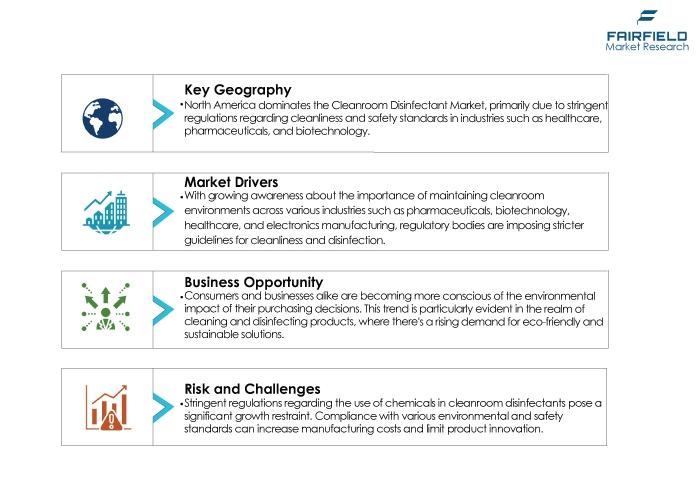
With growing awareness about the importance of maintaining cleanroom environments across various industries such as pharmaceuticals, biotechnology, healthcare, and electronics manufacturing, regulatory bodies are imposing stricter guidelines for cleanliness and disinfection. This drives the demand for high-quality cleanroom disinfectants that meet these standards, propelling market growth.
- Rising Focus on Healthcare-Associated Infections (HAIs)
Healthcare facilities are increasingly prioritizing infection prevention and control to mitigate the risk of HAIs. Cleanroom disinfectants play a crucial role in maintaining sterile environments in hospitals, clinics, and other healthcare settings, thereby reducing the incidence of HAIs. As healthcare providers strive to enhance patient safety and minimize healthcare costs associated with infections, the demand for effective cleanroom disinfectants continues to rise.
- Technological Advancements and Product Innovations
Manufacturers in the cleanroom disinfectant market are investing in research and development to introduce advanced disinfection solutions with improved efficacy, safety, and ease of use. Innovations such as novel formulations, automated disinfection systems, and environmentally friendly disinfectants are gaining traction among end-users, driving market expansion. Additionally, the integration of technologies like UV-C disinfection and hydrogen peroxide vapor systems further enhances the effectiveness of cleanroom disinfection, stimulating market growth.
Major Growth Barriers
- Regulatory Compliance
Stringent regulations regarding the use of chemicals in cleanroom disinfectants pose a significant growth restraint. Compliance with various environmental and safety standards can increase manufacturing costs and limit product innovation.
- Cost Constraints
The high cost associated with developing and manufacturing cleanroom disinfectants can hinder market expansion. Additionally, end users may opt for cheaper alternatives or reduce consumption to mitigate expenses, thereby slowing market growth.
- Limited Awareness
Lack of awareness among end-users about the importance of cleanroom disinfectants and their benefits can impede market growth. Inadequate understanding of the risks associated with contamination in cleanroom environments may lead to underutilisation of disinfection products, constraining market demand.
Key Trends and Opportunities to Look at -
- The Sustainability Wave
Consumers and businesses alike are becoming more conscious of the environmental impact of their purchasing decisions. This trend is particularly evident in the realm of cleaning and disinfecting products, where there is a rising demand for eco-friendly and sustainable solutions. Companies are responding by developing disinfectants that have minimal environmental impact, using biodegradable ingredients, reducing packaging waste, and implementing sustainable manufacturing practices.
- Development of Next-Generation Disinfectants
There is a growing demand for disinfectants that are not only effective against a wide range of pathogens but also safer for both humans and the environment. Cleanroom disinfectant market players can capitalize on this opportunity by investing in research and development to create next-generation disinfectant formulations.
- Expansion into Emerging Markets
The demand for cleanroom disinfectants is not limited to developed regions but is also increasing in emerging markets with expanding healthcare and pharmaceutical sectors. Cleanroom disinfectant market players can leverage this opportunity by expanding their presence in emerging markets through strategic partnerships, distribution agreements, and investments in local manufacturing facilities.
How Does the Regulatory Scenario Shape this Industry?
The regulatory landscape significantly impacts the cleanroom disinfectant market. Stringent regulations imposed by governing bodies like the Environmental Protection Agency (EPA) in the US and the European Chemicals Agency (ECHA) dictate the approval process for disinfectants. These agencies establish benchmarks for efficacy against specific microorganisms, ensure user safety through toxicity testing, and regulate environmental impact to minimize ecological harm.
Manufacturers must navigate this complex regulatory framework to ensure their disinfectants meet all safety and efficacy requirements. This can influence product innovation, as companies may prioritize formulations that comply with existing regulations rather than exploring entirely new chemistries. Additionally, the registration process itself can be lengthy and expensive, potentially hindering the entry of smaller players into the market.
On the other hand, regulations also foster a level of trust and credibility within the market. Stringent efficacy testing guarantees that approved disinfectants effectively eliminate contaminants, which is critical for maintaining sterile environments in cleanrooms. Similarly, regulations safeguard user health by restricting the use of harmful chemicals. This focus on safety is particularly important in cleanroom settings where sensitive products are manufactured or handled.
The regulatory scenario plays a dual role in shaping the cleanroom disinfectant market. While it can stifle innovation to an extent, it also ensures product efficacy, user safety, and environmental responsibility. As regulations evolve, the cleanroom disinfectant market will likely adapt by prioritizing the development of compliant and effective disinfectant solutions.
Fairfield’s Ranking Board
Top Segments
- Pharmaceutical Industry Continues to be at the Forefront of Adoption
The pharmaceutical industry demands stringent cleanliness standards due to the sensitive nature of drug manufacturing. Cleanroom disinfectants play a crucial role in maintaining sterile environments to prevent contamination and ensure product quality. With the increasing focus on research and development, pharmaceutical companies are investing heavily in cleanroom technologies and disinfectants. Moreover, stringent regulations regarding product safety and quality further drive the demand for effective disinfection solutions in this sector.
- Demand Remains Maximum Across Healthcare Facilities
Healthcare facilities, including hospitals, clinics, and laboratories, require stringent disinfection protocols to prevent the spread of infections and ensure patient safety. Cleanroom disinfectants are essential for maintaining sterile conditions in operating rooms, patient rooms, and other critical areas. With the increasing prevalence of healthcare-associated infections (HAIs), and the emergence of drug-resistant pathogens, healthcare facilities are increasingly prioritizing the use of effective disinfection products.
- Reliance of Biotechnology Industry on Disinfectants Highest
The biotechnology industry relies heavily on cleanroom environments for various research and manufacturing processes, such as cell culture, gene therapy, and vaccine production. Cleanroom disinfectants play a critical role in preventing microbial contamination and maintaining the integrity of biotechnological products. As the biotechnology sector continues to expand rapidly, driven by advancements in areas like personalised medicine and synthetic biology, the demand for cleanroom disinfectants is expected to increase significantly.
Regional Frontrunners
- Stringent Regulations, and Advanced Healthcare Infrastructure Solidify Dominance of North America
North America dominates the cleanroom disinfectant market, primarily due to stringent regulations regarding cleanliness and safety standards in industries such as healthcare, pharmaceuticals, and biotechnology. Additionally, the presence of major market players and advanced healthcare infrastructure further contributes to the region's market dominance. The US especially holds a substantial share in the North American market owing to its robust pharmaceutical and healthcare sectors.
- Europe Flourishes on the Back of Established Industries, and Favourable Regulatory Frameworks
Europe follows North America closely in terms of market share. The region's well-established pharmaceutical and biotechnology industries, coupled with stringent regulatory frameworks promoting cleanliness and hygiene, drive the demand for cleanroom disinfectants. Countries like Germany, France, and the UK are key contributors to the European market due to their advanced healthcare infrastructure and significant investments in research and development.
Fairfield’s Competitive Landscape Analysis
The cleanroom disinfectant market's competitive landscape is characterised by intense rivalry among key players striving to gain a significant market share. Leading companies such as Kimberly-Clark Corporation, Contec, Inc., and Ecolab dominate the market with their innovative products and extensive distribution networks. These industry giants employ various growth strategies to maintain their competitive edge, including product innovation, strategic partnerships, and mergers and acquisitions.
By continuously investing in research and development, these companies introduce advanced disinfectant solutions tailored to meet the evolving needs of cleanroom environments. Additionally, strategic collaborations with healthcare facilities and pharmaceutical companies enable them to expand their market reach and enhance brand visibility. Overall, the Cleanroom Disinfectant market is dynamic, driven by fierce competition and constant innovation aimed at delivering superior disinfection solutions to various industries.
Who are the Leaders in the Cleanroom Disinfectant Market Space?
- STERIS Corporation
- Berkshire Corporation
- Illinois Tool Works
- Cardinal Health
- Contec
- Texwipe
- Thermo Fischer Scientific
- Kimberly-Clark Worldwide
- Ecolab
- Bio-One Sciences
An Expert’s Eye
- Increasing Regulatory Standards: Stringent regulations and standards across industries such as healthcare, pharmaceuticals, and electronics are propelling the demand for cleanroom disinfectants. Compliance with these regulations necessitates the use of effective disinfection solutions to maintain sterile environments and ensure product safety. As regulatory scrutiny intensifies globally, the demand for cleanroom disinfectants is expected to witness steady growth.
- Technological Advancements and Innovation: Continuous technological advancements in disinfectant formulations and technologies are driving market growth. Manufacturers are focusing on developing more effective, efficient, and eco-friendly disinfectants to meet evolving industry needs. Innovations such as non-toxic and sustainable disinfectants are gaining prominence among end-users, further fuelling market expansion. With ongoing research and development efforts, the cleanroom disinfectant market is poised to benefit from novel solutions that offer improved efficacy and safety profiles, catering to the increasing demand for high-quality disinfection products worldwide.
The Global Cleanroom Disinfectant Market is Segmented as Below:
By Product:
- Oxidizing Disinfectants
- Non-Oxidizing Disinfectants
- Hand Sanitizers
By End-Use Industry:
- Hospitals/Healthcare Facilities
- Biotechnology Industry
- Pharmaceutical Industry
- Medical Devices Industry
By Region:
- North America
- Latin America
- Europe
- Asia Pacific
- Middle East and Africa
- Executive Summary
- Global Cleanroom Disinfectant Market Snapshot
- Future Projections
- Key Market Trends
- Regional Snapshot, by Value, 2026
- Analyst Recommendations
- Market Overview
- Market Definitions and Segmentations
- Market Dynamics
- Drivers
- Restraints
- Market Opportunities
- Value Chain Analysis
- COVID-19 Impact Analysis
- Porter's Five Forces Analysis
- Impact of Russia-Ukraine Conflict
- PESTLE Analysis
- Regulatory Analysis
- Price Trend Analysis
- Current Prices and Future Projections, 2025-2033
- Price Impact Factors
- Global Cleanroom Disinfectant Market Outlook, 2020 - 2033
- Global Cleanroom Disinfectant Market Outlook, by Product, Value (US$ Mn), 2020-2033
- Oxidizing Disinfectants
- Non-Oxidizing Disinfectants
- Hand Sanitizers
- Global Cleanroom Disinfectant Market Outlook, by End-Use Industry, Value (US$ Mn), 2020-2033
- Hospitals/Healthcare Facilities
- Biotechnology Industry
- Pharmaceutical Industry
- Medical Devices Industry
- Global Cleanroom Disinfectant Market Outlook, by Region, Value (US$ Mn), 2020-2033
- North America
- Europe
- Asia Pacific
- Latin America
- Middle East & Africa
- Global Cleanroom Disinfectant Market Outlook, by Product, Value (US$ Mn), 2020-2033
- North America Cleanroom Disinfectant Market Outlook, 2020 - 2033
- North America Cleanroom Disinfectant Market Outlook, by Product, Value (US$ Mn), 2020-2033
- Oxidizing Disinfectants
- Non-Oxidizing Disinfectants
- Hand Sanitizers
- North America Cleanroom Disinfectant Market Outlook, by End-Use Industry, Value (US$ Mn), 2020-2033
- Hospitals/Healthcare Facilities
- Biotechnology Industry
- Pharmaceutical Industry
- Medical Devices Industry
- North America Cleanroom Disinfectant Market Outlook, by Country, Value (US$ Mn), 2020-2033
- U.S. Cleanroom Disinfectant Market Outlook, by Product, 2020-2033
- U.S. Cleanroom Disinfectant Market Outlook, by End-Use Industry, 2020-2033
- Canada Cleanroom Disinfectant Market Outlook, by Product, 2020-2033
- Canada Cleanroom Disinfectant Market Outlook, by End-Use Industry, 2020-2033
- BPS Analysis/Market Attractiveness Analysis
- North America Cleanroom Disinfectant Market Outlook, by Product, Value (US$ Mn), 2020-2033
- Europe Cleanroom Disinfectant Market Outlook, 2020 - 2033
- Europe Cleanroom Disinfectant Market Outlook, by Product, Value (US$ Mn), 2020-2033
- Oxidizing Disinfectants
- Non-Oxidizing Disinfectants
- Hand Sanitizers
- Europe Cleanroom Disinfectant Market Outlook, by End-Use Industry, Value (US$ Mn), 2020-2033
- Hospitals/Healthcare Facilities
- Biotechnology Industry
- Pharmaceutical Industry
- Medical Devices Industry
- Europe Cleanroom Disinfectant Market Outlook, by Country, Value (US$ Mn), 2020-2033
- Germany Cleanroom Disinfectant Market Outlook, by Product, 2020-2033
- Germany Cleanroom Disinfectant Market Outlook, by End-Use Industry, 2020-2033
- Italy Cleanroom Disinfectant Market Outlook, by Product, 2020-2033
- Italy Cleanroom Disinfectant Market Outlook, by End-Use Industry, 2020-2033
- France Cleanroom Disinfectant Market Outlook, by Product, 2020-2033
- France Cleanroom Disinfectant Market Outlook, by End-Use Industry, 2020-2033
- U.K. Cleanroom Disinfectant Market Outlook, by Product, 2020-2033
- U.K. Cleanroom Disinfectant Market Outlook, by End-Use Industry, 2020-2033
- Spain Cleanroom Disinfectant Market Outlook, by Product, 2020-2033
- Spain Cleanroom Disinfectant Market Outlook, by End-Use Industry, 2020-2033
- Russia Cleanroom Disinfectant Market Outlook, by Product, 2020-2033
- Russia Cleanroom Disinfectant Market Outlook, by End-Use Industry, 2020-2033
- Rest of Europe Cleanroom Disinfectant Market Outlook, by Product, 2020-2033
- Rest of Europe Cleanroom Disinfectant Market Outlook, by End-Use Industry, 2020-2033
- BPS Analysis/Market Attractiveness Analysis
- Europe Cleanroom Disinfectant Market Outlook, by Product, Value (US$ Mn), 2020-2033
- Asia Pacific Cleanroom Disinfectant Market Outlook, 2020 - 2033
- Asia Pacific Cleanroom Disinfectant Market Outlook, by Product, Value (US$ Mn), 2020-2033
- Oxidizing Disinfectants
- Non-Oxidizing Disinfectants
- Hand Sanitizers
- Asia Pacific Cleanroom Disinfectant Market Outlook, by End-Use Industry, Value (US$ Mn), 2020-2033
- Hospitals/Healthcare Facilities
- Biotechnology Industry
- Pharmaceutical Industry
- Medical Devices Industry
- Asia Pacific Cleanroom Disinfectant Market Outlook, by Country, Value (US$ Mn), 2020-2033
- China Cleanroom Disinfectant Market Outlook, by Product, 2020-2033
- China Cleanroom Disinfectant Market Outlook, by End-Use Industry, 2020-2033
- Japan Cleanroom Disinfectant Market Outlook, by Product, 2020-2033
- Japan Cleanroom Disinfectant Market Outlook, by End-Use Industry, 2020-2033
- South Korea Cleanroom Disinfectant Market Outlook, by Product, 2020-2033
- South Korea Cleanroom Disinfectant Market Outlook, by End-Use Industry, 2020-2033
- India Cleanroom Disinfectant Market Outlook, by Product, 2020-2033
- India Cleanroom Disinfectant Market Outlook, by End-Use Industry, 2020-2033
- Southeast Asia Cleanroom Disinfectant Market Outlook, by Product, 2020-2033
- Southeast Asia Cleanroom Disinfectant Market Outlook, by End-Use Industry, 2020-2033
- Rest of SAO Cleanroom Disinfectant Market Outlook, by Product, 2020-2033
- Rest of SAO Cleanroom Disinfectant Market Outlook, by End-Use Industry, 2020-2033
- BPS Analysis/Market Attractiveness Analysis
- Asia Pacific Cleanroom Disinfectant Market Outlook, by Product, Value (US$ Mn), 2020-2033
- Latin America Cleanroom Disinfectant Market Outlook, 2020 - 2033
- Latin America Cleanroom Disinfectant Market Outlook, by Product, Value (US$ Mn), 2020-2033
- Oxidizing Disinfectants
- Non-Oxidizing Disinfectants
- Hand Sanitizers
- Latin America Cleanroom Disinfectant Market Outlook, by End-Use Industry, Value (US$ Mn), 2020-2033
- Hospitals/Healthcare Facilities
- Biotechnology Industry
- Pharmaceutical Industry
- Medical Devices Industry
- Latin America Cleanroom Disinfectant Market Outlook, by Country, Value (US$ Mn), 2020-2033
- Brazil Cleanroom Disinfectant Market Outlook, by Product, 2020-2033
- Brazil Cleanroom Disinfectant Market Outlook, by End-Use Industry, 2020-2033
- Mexico Cleanroom Disinfectant Market Outlook, by Product, 2020-2033
- Mexico Cleanroom Disinfectant Market Outlook, by End-Use Industry, 2020-2033
- Argentina Cleanroom Disinfectant Market Outlook, by Product, 2020-2033
- Argentina Cleanroom Disinfectant Market Outlook, by End-Use Industry, 2020-2033
- Rest of LATAM Cleanroom Disinfectant Market Outlook, by Product, 2020-2033
- Rest of LATAM Cleanroom Disinfectant Market Outlook, by End-Use Industry, 2020-2033
- BPS Analysis/Market Attractiveness Analysis
- Latin America Cleanroom Disinfectant Market Outlook, by Product, Value (US$ Mn), 2020-2033
- Middle East & Africa Cleanroom Disinfectant Market Outlook, 2020 - 2033
- Middle East & Africa Cleanroom Disinfectant Market Outlook, by Product, Value (US$ Mn), 2020-2033
- Oxidizing Disinfectants
- Non-Oxidizing Disinfectants
- Hand Sanitizers
- Middle East & Africa Cleanroom Disinfectant Market Outlook, by End-Use Industry, Value (US$ Mn), 2020-2033
- Hospitals/Healthcare Facilities
- Biotechnology Industry
- Pharmaceutical Industry
- Medical Devices Industry
- Middle East & Africa Cleanroom Disinfectant Market Outlook, by Country, Value (US$ Mn), 2020-2033
- GCC Cleanroom Disinfectant Market Outlook, by Product, 2020-2033
- GCC Cleanroom Disinfectant Market Outlook, by End-Use Industry, 2020-2033
- South Africa Cleanroom Disinfectant Market Outlook, by Product, 2020-2033
- South Africa Cleanroom Disinfectant Market Outlook, by End-Use Industry, 2020-2033
- Egypt Cleanroom Disinfectant Market Outlook, by Product, 2020-2033
- Egypt Cleanroom Disinfectant Market Outlook, by End-Use Industry, 2020-2033
- Nigeria Cleanroom Disinfectant Market Outlook, by Product, 2020-2033
- Nigeria Cleanroom Disinfectant Market Outlook, by End-Use Industry, 2020-2033
- Rest of Middle East Cleanroom Disinfectant Market Outlook, by Product, 2020-2033
- Rest of Middle East Cleanroom Disinfectant Market Outlook, by End-Use Industry, 2020-2033
- BPS Analysis/Market Attractiveness Analysis
- Middle East & Africa Cleanroom Disinfectant Market Outlook, by Product, Value (US$ Mn), 2020-2033
- Competitive Landscape
- Company Vs Segment Heatmap
- Company Market Share Analysis, 2025
- Competitive Dashboard
- Company Profiles
- STERIS Corporation
- Company Overview
- Product Portfolio
- Financial Overview
- Business Strategies and Developments
- Berkshire Corporation
- Illinois Tool Works
- Cardinal Health
- Contec
- Texwipe
- Thermo Fischer Scientific
- Kimberly-Clark Worldwide
- Ecolab
- Bio-One Sciences
- STERIS Corporation
- Appendix
- Research Methodology
- Report Assumptions
- Acronyms and Abbreviations
|
BASE YEAR |
HISTORICAL DATA |
FORECAST PERIOD |
UNITS |
|||
 |
2025 |
 |
2019 - 2024 |
 |
2026 - 2033 |
Value: US$ Billion |
|
REPORT FEATURES |
DETAILS |
|
Product Coverage |
|
|
End-use Industry Coverage |
|
|
Geographical Coverage |
|
|
Leading Companies |
|
|
Report Highlights |
Key Market Indicators, Macro-micro economic impact analysis, Technological Roadmap, Key Trends, Driver, Restraints, and Future Opportunities & Revenue Pockets, Porter’s 5 Forces Analysis, Historical Trend (2019-2021), Market Estimates and Forecast, Market Dynamics, Industry Trends, Competition Landscape, Category, Region, Country-wise Trends & Analysis, COVID-19 Impact Analysis (Demand and Supply Chain) |
Our Research Methodology
Considering the volatility of business today, traditional approaches to strategizing a game plan can be unfruitful if not detrimental. True ambiguity is no way to determine a forecast. A myriad of predetermined factors must be accounted for such as the degree of risk involved, the magnitude of circumstances, as well as conditions or consequences that are not known or unpredictable. To circumvent binary views that cast uncertainty, the application of market research intelligence to strategically posture, move, and enable actionable outcomes is necessary.
View Methodology
Quality Assured
Rigorous Validation Process

Confidentiality Assured
End-to-end Data Security

Custom Research Services
Tailored To Your Objectives
FAQs
Cleanroom disinfectants maintain sterile conditions critical for sensitive manufacturing processes, such as pharmaceuticals and electronics.
Increasing demand from industries like healthcare, pharmaceuticals, and semiconductor manufacturing, coupled with stringent regulatory standards.
Advancements lead to improved germicidal properties, compatibility with various surfaces, and reduced residue, ensuring optimal disinfection without compromising product integrity.
Adhering to strict regulatory requirements, addressing evolving pathogens and contaminants, and ensuring compatibility with cleanroom materials and equipment.
Innovation drives the development of eco-friendly formulations, automated dispensing systems, and comprehensive disinfection protocols, optimizing cleanroom operations while minimizing environmental impact.
Related Reports
Active Pharmaceutical Ingredients Market Insights, Competitive Landscape, and Market Forecast 2033
Dementia Care Market Analysis Market Insights, Competitive Landscape, and Market Forecast 2033
Dementia Care Market to reach US$46.60 Mn by 2033, growing at 5.9% CAGR, driven by ageing populations, home care, and specialized dementia services.
Drug Repurposing Market Insights, Competitive Landscape, and Market Forecast 2026–2033
Drug Repurposing Market to reach US$47.75 billion by 2033, growing at 4.2% CAGR, driven by AI-assisted screening, R&D investment, and clinical trials.
Precision Medicine Market Insights, Competitive Landscape, and Market Forecast 2033
Precision Medicine Market is projected to reach US$405.17 billion by 2033, driven by genomics, companion diagnostics, oncology, and personalized therapies.
Hollow Fiber Filtration Market Insights, Competitive Landscape, and Market Forecast 2026–2033
The hollow fiber filtration market will grow from US$1.10 Bn in 2026 to US$2.80 Bn by 2033 at a 14.3% CAGR, driven by biologics & single-use bioprocessing.
Orthopedic Biomaterials Market Insights, Competitive Landscape, and Market Forecast 2026–2033
The orthopedic biomaterials market will grow from US$28.50 Bn in 2026 to US$48.21 Bn by 2033 at a 7.8% CAGR, driven by rising musculoskeletal disorders.