



Dark Chocolate Market
Dark Chocolate Market Insights, Competitive Landscape, and Market Forecast - 2033
Dark Chocolate Market Growth and Industry Forecast
- The Dark Chocolate Market is valued at USD 56.2 Bn in 2026 and is projected to reach USD 92.3 Bn, growing at a CAGR of 6% by 2033.
- The dark chocolate market is experiencing robust growth due to increasing consumer preference for healthier indulgence options, with dark chocolate perceived as a rich source of flavonoids and antioxidants.
Dark Chocolate Market Summary Key Insights & Trends
- Bars are the leading form segment, contributing over 40% of global dark chocolate sales in 2024 due to their convenience and consumer preference for portion-controlled snacking.
- The 71% - 90% cocoa type segment is the fastest-growing, projected to expand at a CAGR of 8.6% through 2032 as demand for rich, high-cocoa products surges.
- Confectionery remains the dominant application, holding more than 40% market share, driven by innovation in filled bars, coated nuts, and artisanal chocolates.
- Health-conscious consumers are fueling demand for dark chocolate-based personal care & cosmetics, particularly in skincare and lip care products infused with antioxidants.
- The online retail segment is witnessing rapid growth, forecasted to grow at a CAGR of 8.2%, with consumers embracing digital platforms for premium and personalized chocolate offerings.
- Europe holds over 40% share, led by strong consumption in Germany, France, and the UK, where demand is high for sustainable chips & chunks and fair-trade products.
A Look Back and a Look Forward - Comparative Analysis
The dark chocolate market faced challenges during 2019–2025, particularly due to COVID-19 disruptions, which impacted supply chains and reduced cocoa production. Small-scale chocolate businesses struggled, as noted by the Fine Cacao and Chocolate Institute, with temporary closures affecting retail sales. However, demand for dark chocolate surged as consumers sought comfort foods with health benefits, leading to a steady recovery. E-commerce channels gained traction, offsetting losses from physical retail.
Rising health consciousness is driving increased consumption of dark chocolate, boosting demand for high-cocoa-content products. Emerging markets in the Asia Pacific and North America will contribute significantly due to the rise in disposable incomes and premiumization trends. Innovations in plant-based and organic dark chocolate, alongside strategic partnerships, will further propel. Online retail is expected to dominate sales channels, reflecting evolving consumer purchasing habits.
Key Growth Drivers
- Growing Awareness of Flavonoid Benefits Boosts Dark Chocolate Consumption
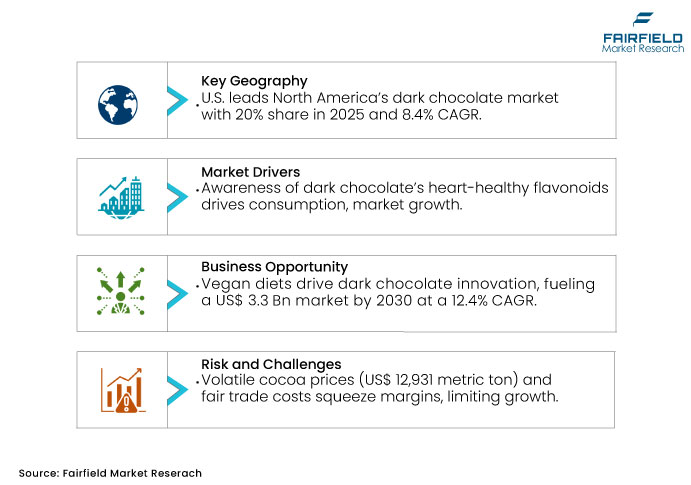
The growing consumer awareness of dark chocolate’s health benefits propels the market growth. Rich in flavonoids, dark chocolate is linked to improved heart health and antioxidant properties, appealing to health-conscious consumers. A 2023 study highlighted that around 60% of U.S. consumers prefer dark chocolate for its perceived health advantages over milk chocolate. The trend towards clean-label and organic products further boosts demand, with brands emphasizing ethically sourced cocoa. The rise in vegan diets also supports the dark chocolate market, as high-cocoa-content products align with plant-based lifestyles. Marketing campaigns emphasizing these benefits have increased consumption, particularly in North America and Europe, driving market growth.
- Premiumization Drives Demand for Artisanal and Ethically Sourced Chocolates
The benefits from the premiumization trend, with consumers seeking high-quality, artisanal, and ethically sourced products. In 2024, the premium chocolate segment was valued at USD 31.87 billion globally, with dark chocolate holding a significant share due to its rich flavor profile. Single-origin and organic dark chocolates are gaining popularity, especially in developed markets such as the U.S. and Europe, where consumers are willing to pay a premium for sustainability. Brands such as Lindt & Sprüngli emphasize craftsmanship, enhancing market appeal. This trend fuels growth by attracting affluent consumers and boosting profit margins.
Key Growth Restraints
- Cocoa Price Surge and Supply Issues Inflate Production Costs Significantly
The dark chocolate industry faces challenges from high production costs, driven by volatile cocoa prices and complex supply chains. After surging over 300% in 2024 due to a combination of supply shocks and speculative activity, cocoa prices reached a record high of US$12,931 per metric ton in early 2025. Small manufacturers struggle to maintain margins, limiting their ability to compete with larger players. Additionally, ethical sourcing requirements, such as fair-trade certifications, increase costs, which are often passed to consumers, potentially reducing demand in price-sensitive markets. These factors limit overall growth, particularly in developing regions where cost remains a barrier.
- Persistent Health Myths Limit Broader Acceptance of Dark Chocolate Products
Despite its benefits, misconceptions about dark chocolate’s high sugar and calorie content hinder the dark chocolate market. Some consumers associate all chocolate with unhealthy diets, overlooking dark chocolate’s antioxidant properties. A 2024 survey found 30% of consumers in Asia Pacific were unaware of dark chocolate’s health benefits, limiting adoption. Negative perceptions, coupled with competition from healthier snack alternatives such as nuts and protein bars, challenge market growth. Educating consumers remains critical to overcoming this restraint.
Dark Chocolate Market Trends and Opportunities
- Vegan and Dairy-Free Chocolate Options Fuel Innovation and Consumer Demand
The rising popularity of vegan and plant-based diets presents a significant opportunity for the dark chocolate market. The global vegan chocolate market is projected to reach US$ 3.3 billion by 2030, with a CAGR of 12.4%, driven by demand for dairy-free dark chocolate. Manufacturers are innovating with organic and sugar-free variants, appealing to health-conscious and environmentally aware consumers. Brands such as Hu Chocolate are capitalizing on this trend by offering vegan dark chocolate bars with clean-label ingredients. Strategic marketing focusing on sustainability and ethical sourcing can further enhance market penetration, particularly in Europe and North America.
- Emerging Economies Offer Vast Potential for Dark Chocolate Brand Expansion
Emerging markets, particularly in Asia Pacific and Latin America, offer substantial growth opportunities. Rising disposable incomes and urbanization in countries such as India and China drive demand for premium dark chocolate. The Asia Pacific chocolate market is expected to grow at a CAGR of 7.5% through 2032, with dark chocolate gaining traction. Local manufacturers are introducing affordable, high-cocoa-content products to cater to evolving tastes. Partnerships with regional retailers and e-commerce platforms can enhance market access. By focusing on cultural preferences and affordability, the dark chocolate can tap into these high-growth regions effectively.
Segment-wise Trends & Analysis
- Bars Remain Top Choice as Chips Gain Popularity in Baking
Bars dominate the dark chocolate market, holding over 50% market share in 2025 due to their convenience and widespread appeal. Their portability and variety, including single-origin and organic options, drive consumer preference. Chips & Chunks are the fastest-growing segment, with a projected CAGR of 7.7% through 2032, fueled by their versatility in baking and snacking. The rise in home baking, especially post-COVID, has boosted demand for dark chocolate chips in recipes such as cookies and muffins. Manufacturers are innovating with smaller, premium chunks for gourmet applications, further propelling this segment’s growth.
- Mid-Range Cocoa Leads While Ultra-High Cocoa Chocolates Grow Rapidly
The 50%-70% cocoa segment leads the market for dark chocolate, accounting for more than 40% of sales in 2025, as it balances rich flavor with accessibility for mainstream consumers. Its milder taste appeals to a broad audience. The 91% and above segment is the fastest growing, with a CAGR of 7.8%, driven by health-conscious consumers seeking high-antioxidant, low-sugar options. This segment caters to niche markets, including vegan and keto diets, with brands emphasizing organic and ethically sourced cocoa. The premiumization trend further supports this segment’s rapid expansion.
- Confectionery Products Dominate, with Beverages Emerging as Growth Segment
Confectionery leads the dark chocolate market, contributing 40% of revenue in 2025, driven by demand for premium truffles and pralines. Its dominance stems from consumer preference for indulgent treats. Beverages are the fastest-growing application, with a CAGR of 8.3%, fueled by the popularity of dark chocolate-based drinks such as hot cocoa and mocha. The rise in café culture and demand for plant-based beverages in Asia Pacific and North America drives this growth. Innovations in ready-to-drink formats further enhance this segment’s appeal.
- Modern Retail Channels Prevail, But Online Sales Show Fastest Growth
Modern Trade (supermarkets/hypermarkets) leads the market, holding over 30% of sales in 2025 due to widespread availability and consumer trust. These channels offer diverse product ranges, boosting accessibility. Online Retail is the fastest-growing channel, with a CAGR of 8.2%, driven by the convenience of e-commerce and targeted digital marketing. Post-COVID shifts in consumer behavior have accelerated online purchases, with platforms such as Amazon and brand websites offering premium dark chocolate. Subscription models and promotions further fuel this segment’s growth.
Regional Trends & Analysis
- Europe Dominates with Premium Ethical Chocolate Preferences
Europe leads the global dark chocolate market, with Germany, France, and the UK holding over 40% market share in 2025. Demand for premium and artisanal dark chocolate drives growth, supported by strong consumer preference for organic and fair-trade products. Germany’s focus on sustainable sourcing and France’s luxury chocolate culture are key drivers. The region’s market is expected to grow at a CAGR of 7.7%, with e-commerce and specialty stores boosting accessibility.
- North America, primarily, US, leads the Health-Driven Chocolate Demand
The U.S. dominates the North American Dark Chocolate Market, driven by health-conscious consumers and premiumization trends. In 2025, the region accounts for more than 20% of global market share. Demand for organic and vegan dark chocolate is rising, with brands such as Godiva emphasizing sustainable sourcing. E-commerce and specialty stores are key sales channels, reflecting changing consumer habits. The U.S. market is projected to grow at a CAGR of 8.4%, fueled by innovations in high-cocoa-content products and health-focused marketing.
- Asia Pacific Witnessed a Rapid Growth In Chocolate Products
Asia Pacific is a high-growth region for dark chocolate market, with China and India as key regions. Rising disposable incomes and urbanization drive demand for premium dark chocolate, with a projected CAGR of 8.2% during the forecast period. Health awareness and the popularity of vegan diets fuel consumption. Local brands are introducing affordable high-cocoa products, while e-commerce platforms enhance market reach. Cultural preferences for indulgent snacks further support growth.
Competitive Landscape
Major players in the dark chocolate market, including Ferrero, Mars, Mondelēz, Nestlé, and Hershey, focus on product innovation, sustainable sourcing, and digital marketing. They invest in vegan and organic offerings to capture health-conscious consumers and leverage e-commerce to expand reach.
Key Companies
- Patchi
- Mars Inc.
- Amul
- Ghirardelli Chocolate Co.
- Harry & David Holdings, Inc.
- Nestlé S.A.
- Lindt & Sprüngli AG
- The Hershey Company
- Mondelez International
- Barry Callebaut
- Godiva
Global Dark Chocolate Market Segmentation-
By Form
- Chips & Chunks
- Blocks
- Bars
- Powder
By Type
- 50% - 70%
- 71% - 90%
- 91% and above
By Application
- Bakery Products
- Beverages
- Ice Cream & Desserts
- Confectionery
- Snacks
- Personal Care & Cosmetics
- Others
By Sales Channel
- Specialty Stores
- Modern Trade
- Pharmaceutical & Confectionery Stores
- Departmental Store
- Online Retail
- Others
By Region
- North America
- Europe
- Asia Pacific
- Latin America
- Middle East and Africa
- Executive Summary
- Global Dark Chocolate Market Snapshot
- Future Projections
- Key Market Trends
- Regional Snapshot, by Value, 2026
- Analyst Recommendations
- Market Overview
- Market Definitions and Segmentations
- Market Dynamics
- Drivers
- Restraints
- Market Opportunities
- Value Chain Analysis
- COVID-19 Impact Analysis
- Porter's Five Forces Analysis
- Impact of Russia-Ukraine Conflict
- PESTLE Analysis
- Regulatory Analysis
- Price Trend Analysis
- Current Prices and Future Projections, 2025-2033
- Price Impact Factors
- Global Dark Chocolate Market Outlook, 2020 - 2033
- Global Dark Chocolate Market Outlook, by Form, Value (US$ Mn), 2020-2033
- Chips & Chunks
- Blocks
- Bars
- Powder
- Global Dark Chocolate Market Outlook, by Type, Value (US$ Mn), 2020-2033
- 50% - 70%
- 71% - 90%
- 91% and above
- Global Dark Chocolate Market Outlook, by Application, Value (US$ Mn), 2020-2033
- Bakery Products
- Beverages
- Ice Cream & Desserts
- Confectionery
- Snacks
- Personal Care & Cosmetics
- Others
- Global Dark Chocolate Market Outlook, by Sales Channel, Value (US$ Mn), 2020-2033
- Specialty Stores
- Modern Trade
- Pharmaceutical & Confectionery Stores
- Departmental Store
- Online Retail
- Others
- Global Dark Chocolate Market Outlook, by Region, Value (US$ Mn), 2020-2033
- North America
- Europe
- Asia Pacific
- Latin America
- Middle East & Africa
- Global Dark Chocolate Market Outlook, by Form, Value (US$ Mn), 2020-2033
- North America Dark Chocolate Market Outlook, 2020 - 2033
- North America Dark Chocolate Market Outlook, by Form, Value (US$ Mn), 2020-2033
- Chips & Chunks
- Blocks
- Bars
- Powder
- North America Dark Chocolate Market Outlook, by Type, Value (US$ Mn), 2020-2033
- 50% - 70%
- 71% - 90%
- 91% and above
- North America Dark Chocolate Market Outlook, by Application, Value (US$ Mn), 2020-2033
- Bakery Products
- Beverages
- Ice Cream & Desserts
- Confectionery
- Snacks
- Personal Care & Cosmetics
- Others
- North America Dark Chocolate Market Outlook, by Sales Channel, Value (US$ Mn), 2020-2033
- Specialty Stores
- Modern Trade
- Pharmaceutical & Confectionery Stores
- Departmental Store
- Online Retail
- Others
- North America Dark Chocolate Market Outlook, by Country, Value (US$ Mn), 2020-2033
- U.S. Dark Chocolate Market Outlook, by Form, 2020-2033
- U.S. Dark Chocolate Market Outlook, by Type, 2020-2033
- U.S. Dark Chocolate Market Outlook, by Application, 2020-2033
- U.S. Dark Chocolate Market Outlook, by Sales Channel, 2020-2033
- Canada Dark Chocolate Market Outlook, by Form, 2020-2033
- Canada Dark Chocolate Market Outlook, by Type, 2020-2033
- Canada Dark Chocolate Market Outlook, by Application, 2020-2033
- Canada Dark Chocolate Market Outlook, by Sales Channel, 2020-2033
- BPS Analysis/Market Attractiveness Analysis
- North America Dark Chocolate Market Outlook, by Form, Value (US$ Mn), 2020-2033
- Europe Dark Chocolate Market Outlook, 2020 - 2033
- Europe Dark Chocolate Market Outlook, by Form, Value (US$ Mn), 2020-2033
- Chips & Chunks
- Blocks
- Bars
- Powder
- Europe Dark Chocolate Market Outlook, by Type, Value (US$ Mn), 2020-2033
- 50% - 70%
- 71% - 90%
- 91% and above
- Europe Dark Chocolate Market Outlook, by Application, Value (US$ Mn), 2020-2033
- Bakery Products
- Beverages
- Ice Cream & Desserts
- Confectionery
- Snacks
- Personal Care & Cosmetics
- Others
- Europe Dark Chocolate Market Outlook, by Sales Channel, Value (US$ Mn), 2020-2033
- Specialty Stores
- Modern Trade
- Pharmaceutical & Confectionery Stores
- Departmental Store
- Online Retail
- Others
- Europe Dark Chocolate Market Outlook, by Country, Value (US$ Mn), 2020-2033
- Germany Dark Chocolate Market Outlook, by Form, 2020-2033
- Germany Dark Chocolate Market Outlook, by Type, 2020-2033
- Germany Dark Chocolate Market Outlook, by Application, 2020-2033
- Germany Dark Chocolate Market Outlook, by Sales Channel, 2020-2033
- Italy Dark Chocolate Market Outlook, by Form, 2020-2033
- Italy Dark Chocolate Market Outlook, by Type, 2020-2033
- Italy Dark Chocolate Market Outlook, by Application, 2020-2033
- Italy Dark Chocolate Market Outlook, by Sales Channel, 2020-2033
- France Dark Chocolate Market Outlook, by Form, 2020-2033
- France Dark Chocolate Market Outlook, by Type, 2020-2033
- France Dark Chocolate Market Outlook, by Application, 2020-2033
- France Dark Chocolate Market Outlook, by Sales Channel, 2020-2033
- U.K. Dark Chocolate Market Outlook, by Form, 2020-2033
- U.K. Dark Chocolate Market Outlook, by Type, 2020-2033
- U.K. Dark Chocolate Market Outlook, by Application, 2020-2033
- U.K. Dark Chocolate Market Outlook, by Sales Channel, 2020-2033
- Spain Dark Chocolate Market Outlook, by Form, 2020-2033
- Spain Dark Chocolate Market Outlook, by Type, 2020-2033
- Spain Dark Chocolate Market Outlook, by Application, 2020-2033
- Spain Dark Chocolate Market Outlook, by Sales Channel, 2020-2033
- Russia Dark Chocolate Market Outlook, by Form, 2020-2033
- Russia Dark Chocolate Market Outlook, by Type, 2020-2033
- Russia Dark Chocolate Market Outlook, by Application, 2020-2033
- Russia Dark Chocolate Market Outlook, by Sales Channel, 2020-2033
- Rest of Europe Dark Chocolate Market Outlook, by Form, 2020-2033
- Rest of Europe Dark Chocolate Market Outlook, by Type, 2020-2033
- Rest of Europe Dark Chocolate Market Outlook, by Application, 2020-2033
- Rest of Europe Dark Chocolate Market Outlook, by Sales Channel, 2020-2033
- BPS Analysis/Market Attractiveness Analysis
- Europe Dark Chocolate Market Outlook, by Form, Value (US$ Mn), 2020-2033
- Asia Pacific Dark Chocolate Market Outlook, 2020 - 2033
- Asia Pacific Dark Chocolate Market Outlook, by Form, Value (US$ Mn), 2020-2033
- Chips & Chunks
- Blocks
- Bars
- Powder
- Asia Pacific Dark Chocolate Market Outlook, by Type, Value (US$ Mn), 2020-2033
- 50% - 70%
- 71% - 90%
- 91% and above
- Asia Pacific Dark Chocolate Market Outlook, by Application, Value (US$ Mn), 2020-2033
- Bakery Products
- Beverages
- Ice Cream & Desserts
- Confectionery
- Snacks
- Personal Care & Cosmetics
- Others
- Asia Pacific Dark Chocolate Market Outlook, by Sales Channel, Value (US$ Mn), 2020-2033
- Specialty Stores
- Modern Trade
- Pharmaceutical & Confectionery Stores
- Departmental Store
- Online Retail
- Others
- Asia Pacific Dark Chocolate Market Outlook, by Country, Value (US$ Mn), 2020-2033
- China Dark Chocolate Market Outlook, by Form, 2020-2033
- China Dark Chocolate Market Outlook, by Type, 2020-2033
- China Dark Chocolate Market Outlook, by Application, 2020-2033
- China Dark Chocolate Market Outlook, by Sales Channel, 2020-2033
- Japan Dark Chocolate Market Outlook, by Form, 2020-2033
- Japan Dark Chocolate Market Outlook, by Type, 2020-2033
- Japan Dark Chocolate Market Outlook, by Application, 2020-2033
- Japan Dark Chocolate Market Outlook, by Sales Channel, 2020-2033
- South Korea Dark Chocolate Market Outlook, by Form, 2020-2033
- South Korea Dark Chocolate Market Outlook, by Type, 2020-2033
- South Korea Dark Chocolate Market Outlook, by Application, 2020-2033
- South Korea Dark Chocolate Market Outlook, by Sales Channel, 2020-2033
- India Dark Chocolate Market Outlook, by Form, 2020-2033
- India Dark Chocolate Market Outlook, by Type, 2020-2033
- India Dark Chocolate Market Outlook, by Application, 2020-2033
- India Dark Chocolate Market Outlook, by Sales Channel, 2020-2033
- Southeast Asia Dark Chocolate Market Outlook, by Form, 2020-2033
- Southeast Asia Dark Chocolate Market Outlook, by Type, 2020-2033
- Southeast Asia Dark Chocolate Market Outlook, by Application, 2020-2033
- Southeast Asia Dark Chocolate Market Outlook, by Sales Channel, 2020-2033
- Rest of SAO Dark Chocolate Market Outlook, by Form, 2020-2033
- Rest of SAO Dark Chocolate Market Outlook, by Type, 2020-2033
- Rest of SAO Dark Chocolate Market Outlook, by Application, 2020-2033
- Rest of SAO Dark Chocolate Market Outlook, by Sales Channel, 2020-2033
- BPS Analysis/Market Attractiveness Analysis
- Asia Pacific Dark Chocolate Market Outlook, by Form, Value (US$ Mn), 2020-2033
- Latin America Dark Chocolate Market Outlook, 2020 - 2033
- Latin America Dark Chocolate Market Outlook, by Form, Value (US$ Mn), 2020-2033
- Chips & Chunks
- Blocks
- Bars
- Powder
- Latin America Dark Chocolate Market Outlook, by Type, Value (US$ Mn), 2020-2033
- 50% - 70%
- 71% - 90%
- 91% and above
- Latin America Dark Chocolate Market Outlook, by Application, Value (US$ Mn), 2020-2033
- Bakery Products
- Beverages
- Ice Cream & Desserts
- Confectionery
- Snacks
- Personal Care & Cosmetics
- Others
- Latin America Dark Chocolate Market Outlook, by Sales Channel, Value (US$ Mn), 2020-2033
- Specialty Stores
- Modern Trade
- Pharmaceutical & Confectionery Stores
- Departmental Store
- Online Retail
- Others
- Latin America Dark Chocolate Market Outlook, by Country, Value (US$ Mn), 2020-2033
- Brazil Dark Chocolate Market Outlook, by Form, 2020-2033
- Brazil Dark Chocolate Market Outlook, by Type, 2020-2033
- Brazil Dark Chocolate Market Outlook, by Application, 2020-2033
- Brazil Dark Chocolate Market Outlook, by Sales Channel, 2020-2033
- Mexico Dark Chocolate Market Outlook, by Form, 2020-2033
- Mexico Dark Chocolate Market Outlook, by Type, 2020-2033
- Mexico Dark Chocolate Market Outlook, by Application, 2020-2033
- Mexico Dark Chocolate Market Outlook, by Sales Channel, 2020-2033
- Argentina Dark Chocolate Market Outlook, by Form, 2020-2033
- Argentina Dark Chocolate Market Outlook, by Type, 2020-2033
- Argentina Dark Chocolate Market Outlook, by Application, 2020-2033
- Argentina Dark Chocolate Market Outlook, by Sales Channel, 2020-2033
- Rest of LATAM Dark Chocolate Market Outlook, by Form, 2020-2033
- Rest of LATAM Dark Chocolate Market Outlook, by Type, 2020-2033
- Rest of LATAM Dark Chocolate Market Outlook, by Application, 2020-2033
- Rest of LATAM Dark Chocolate Market Outlook, by Sales Channel, 2020-2033
- BPS Analysis/Market Attractiveness Analysis
- Latin America Dark Chocolate Market Outlook, by Form, Value (US$ Mn), 2020-2033
- Middle East & Africa Dark Chocolate Market Outlook, 2020 - 2033
- Middle East & Africa Dark Chocolate Market Outlook, by Form, Value (US$ Mn), 2020-2033
- Chips & Chunks
- Blocks
- Bars
- Powder
- Middle East & Africa Dark Chocolate Market Outlook, by Type, Value (US$ Mn), 2020-2033
- 50% - 70%
- 71% - 90%
- 91% and above
- Middle East & Africa Dark Chocolate Market Outlook, by Application, Value (US$ Mn), 2020-2033
- Bakery Products
- Beverages
- Ice Cream & Desserts
- Confectionery
- Snacks
- Personal Care & Cosmetics
- Others
- Middle East & Africa Dark Chocolate Market Outlook, by Sales Channel, Value (US$ Mn), 2020-2033
- Specialty Stores
- Modern Trade
- Pharmaceutical & Confectionery Stores
- Departmental Store
- Online Retail
- Others
- Middle East & Africa Dark Chocolate Market Outlook, by Country, Value (US$ Mn), 2020-2033
- GCC Dark Chocolate Market Outlook, by Form, 2020-2033
- GCC Dark Chocolate Market Outlook, by Type, 2020-2033
- GCC Dark Chocolate Market Outlook, by Application, 2020-2033
- GCC Dark Chocolate Market Outlook, by Sales Channel, 2020-2033
- South Africa Dark Chocolate Market Outlook, by Form, 2020-2033
- South Africa Dark Chocolate Market Outlook, by Type, 2020-2033
- South Africa Dark Chocolate Market Outlook, by Application, 2020-2033
- South Africa Dark Chocolate Market Outlook, by Sales Channel, 2020-2033
- Egypt Dark Chocolate Market Outlook, by Form, 2020-2033
- Egypt Dark Chocolate Market Outlook, by Type, 2020-2033
- Egypt Dark Chocolate Market Outlook, by Application, 2020-2033
- Egypt Dark Chocolate Market Outlook, by Sales Channel, 2020-2033
- Nigeria Dark Chocolate Market Outlook, by Form, 2020-2033
- Nigeria Dark Chocolate Market Outlook, by Type, 2020-2033
- Nigeria Dark Chocolate Market Outlook, by Application, 2020-2033
- Nigeria Dark Chocolate Market Outlook, by Sales Channel, 2020-2033
- Rest of Middle East Dark Chocolate Market Outlook, by Form, 2020-2033
- Rest of Middle East Dark Chocolate Market Outlook, by Type, 2020-2033
- Rest of Middle East Dark Chocolate Market Outlook, by Application, 2020-2033
- Rest of Middle East Dark Chocolate Market Outlook, by Sales Channel, 2020-2033
- BPS Analysis/Market Attractiveness Analysis
- Middle East & Africa Dark Chocolate Market Outlook, by Form, Value (US$ Mn), 2020-2033
- Competitive Landscape
- Company Vs Segment Heatmap
- Company Market Share Analysis, 2025
- Competitive Dashboard
- Company Profiles
- Patchi
- Company Overview
- Product Portfolio
- Financial Overview
- Business Strategies and Developments
- Mars Inc.
- Amul
- Ghirardelli Chocolate Co.
- Harry & David Holdings, Inc.
- Nestlé S.A.
- Lindt & Sprüngli AG
- The Hershey Company
- Mondelez International
- Barry Callebaut
- Patchi
- Appendix
- Research Methodology
- Report Assumptions
- Acronyms and Abbreviations
|
BASE YEAR |
HISTORICAL DATA |
FORECAST PERIOD |
UNITS |
|||
 |
2025 |
 |
2019 - 2025 |
 |
2026 - 2033 |
Value: US$ Billion |
|
REPORT FEATURES |
DETAILS |
|
Form Coverage |
|
|
Type Coverage |
|
|
Application Coverage |
|
|
Sales Channel Coverage |
|
|
Geographical Coverage |
|
|
Leading Companies |
|
|
Report Highlights |
Key Market Indicators, Macro-micro economic impact analysis, Technological Roadmap, Key Trends, Driver, Restraints, and Future Opportunities & Revenue Pockets, Porter’s 5 Forces Analysis, Historical Trend (2019-2024), Market Estimates and Forecast, Market Dynamics, Industry Trends, Competition Landscape, Category, Region, Country-wise Trends & Analysis, COVID-19 Impact Analysis (Demand and Supply Chain) |
Our Research Methodology
Considering the volatility of business today, traditional approaches to strategizing a game plan can be unfruitful if not detrimental. True ambiguity is no way to determine a forecast. A myriad of predetermined factors must be accounted for such as the degree of risk involved, the magnitude of circumstances, as well as conditions or consequences that are not known or unpredictable. To circumvent binary views that cast uncertainty, the application of market research intelligence to strategically posture, move, and enable actionable outcomes is necessary.
View Methodology
Quality Assured
Rigorous Validation Process

Confidentiality Assured
End-to-end Data Security

Custom Research Services
Tailored To Your Objectives
FAQs
The global Dark Chocolate Market size is valued at USD 56.2 Bn in 2026.
The Dark Chocolate Market is projected to grow at a CAGR of 6% by 2033, reaching USD 92.3 Bn.
The Dark Chocolate Market growth drivers include rising health consciousness, premiumization trends, and expansion of online retail.
Europe is the dominating region for the Dark Chocolate Market, led by demand in Germany, France, and the UK.
Nestlé S.A., Lindt & Sprüngli AG, The Hershey Company, Barry Callebaut, and Mars Inc. are some leading industry players in the Dark Chocolate Market.
Related Reports
Grape Seed Extract In Pet Food Application Market Insights, Competitive Landscape, and Market Forecast - 2033
Grape seed extract in pet food application market is valued at USD 180.00 Million in 2026 and projected to reach USD 337.58 Million by 2033 at 9.4% CAGR.
Pet Veterinary Diet Market Insights, Competitive Landscape, and Market Forecast 2033
Pet Veterinary Diet Market to reach USD 10.73 Bn by 2033, growing at 7.9% CAGR, driven by pet humanization, chronic diseases, and weight management.
Feed Binders Market Insights, Competitive Landscape, and Market Forecast 2033
Feed Binders Market to reach USD 3.47 Bn by 2033, growing at 5.4% CAGR, driven by aquaculture, poultry feed, pellet quality, and feed waste reduction.
Feed Acidifiers Market Insights, Competitive Landscape, and Market Forecast 2033
Feed Acidifiers Market to reach USD 6.06 Bn by 2033, growing at 6.5% CAGR, driven by antibiotic-free production, gut health, and aquaculture demand.
Food Coating Ingredients Market Insights, Competitive Landscape, and Market Forecast - 2033
The global food coating ingredients market is set to reach US$ 5.04 Bn by 2033, growing at a 6.0% CAGR, driven by rising demand for processed foods
Poultry Probiotic Ingredients Market Insights, Competitive Landscape, and Market Forecast - 2033
Poultry Probiotic Ingredients Market to reach USD 1.42 Bn by 2033, growing at 8.9% CAGR, driven by antibiotic-free poultry and gut health demand.