



Digital Legacy Market
Digital Legacy Market Insights, Competitive Landscape, and Market Forecast - 2033
Global Digital Legacy Market Forecast
The Digital Legacy Market is expected to grow from USD 18.5 Billion in 2026 to USD 48 Billion by 2033, reflecting strong industry expansion and registering a CAGR of 14.6% during the forecast period from 2026 to 2033.
Quick Report Digest
A Look Back and a Look Forward - Comparative Analysis
The digital legacy market is growing due to increased awareness of the importance of managing one's digital presence after death. As more aspects of our lives become digital, individuals and families are seeking ways to preserve and pass on their online assets, memories, and wishes. This growing need has prompted the development of digital legacy services and platforms, driving the market's expansion.
The market witnessed staggered growth during the historical period 2018 - 2022. This is due to the substantial growth of the major end-use application sectors, such as entertainment and healthcare. The healthcare application in the digital legacy market is growing because individuals want to ensure the secure transfer of their medical records, advanced directives, and health-related information to trusted individuals or institutions, facilitating continuity of care and honoring their end-of-life healthcare preferences.
The future of the digital legacy market is promising as society continues to digitise various aspects of life. With an aging population and heightened awareness of digital inheritance, demand for solutions to manage and transfer digital assets, memories, and end-of-life preferences is expected to increase. The market will likely see technological advancements, innovative platforms, and evolving legal frameworks to accommodate this changing need.
Key Growth Factors
- Digital Footprint Expansion
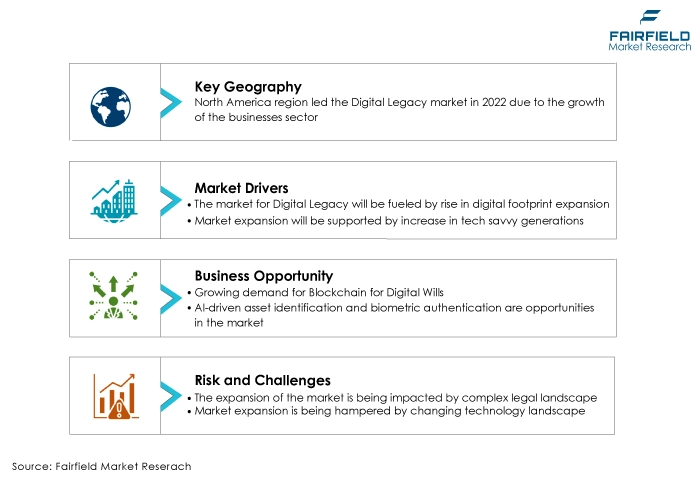
Digital Footprint Expansion is a significant driver of the digital legacy market due to the ever-increasing amount of personal and valuable digital assets created by individuals. People are leading more of their lives online, from social media accounts to financial support and personal documents stored in the cloud.
The expansion of the digital footprint creates a pressing need for individuals to plan for the management and transfer of these assets after their passing.
Families and beneficiaries must navigate complex and often ambiguous processes to access and manage a deceased person's digital legacy. This challenge, coupled with the desire to preserve memories and ensure data security, has led to a growing demand for digital legacy solutions.
Entrepreneurs and tech companies are capitalizing on this demand by offering services that help individuals organise and securely transfer their digital assets and online identities, thereby driving the growth of the digital legacy market.
- Expanding Consumer Demographics from Tech-savvy Generations
Tech-savvy generations, such as Millennials and Generation Z, are driving the digital legacy market because they are more aware of the digital footprint they create and are proactive about managing it. They recognise the importance of preserving memories and ensuring the secure transfer of digital assets.
This demographic's comfort with technology and digital tools makes them early adopters of digital legacy solutions, fueling market growth as they seek user-friendly platforms to plan and manage their digital legacies efficiently and effectively.
- Rise in Data Privacy Concerns
Data privacy concerns are driving the digital legacy market as individuals become increasingly cautious about how their personal information is handled, even after their passing.
Many people want to ensure that their digital assets and sensitive information are transferred securely and in accordance with their wishes. This concern has led to a demand for trusted digital legacy solutions that prioritise data privacy and security, thereby fueling the growth of the market as individuals seek ways to protect their posthumous digital presence.
Major Growth Barriers
- Complex Legal Landscape
The complex legal landscape is a challenge in the digital legacy market because laws and regulations regarding digital assets and inheritance vary widely across countries and regions. This legal ambiguity creates uncertainty for users and service providers, making it difficult to establish clear guidelines for the management and transfer of digital legacies.
It necessitates extensive legal expertise and often results in costly legal processes. Harmonising and clarifying digital asset laws and regulations is crucial for the market to operate smoothly and gain broader acceptance.
- Evolving Technology Landscape
The rapidly changing technology landscape presents a challenge to the digital legacy market because digital assets, platforms, and formats constantly evolve. Ensuring the long-term accessibility and compatibility of digital legacies amid these changes is complex.
Users need assurance that their legacy solutions will remain relevant and functional over time. Providers must adapt to new technologies and formats, necessitating continuous updates and investments. Balancing innovation with legacy preservation is an ongoing challenge in this dynamic market.
Key Trends and Opportunities to Look at
Blockchain for digital wills is a technology trend in the digital legacy market that leverages blockchain's decentralised and immutable ledger to create secure and transparent digital wills. It ensures the tamper-proof transfer of digital assets and directives, providing a trusted and verifiable way to manage digital legacies.
Blockchain's transparency and security features make it a promising tool for preserving and transferring digital assets in accordance with individuals' end-of-life preferences.
- AI-driven Asset Identification
- Biometric Authentication
- Up to 500 MB Storage Capacity Preferred over 5 GB to 10 GB Segments
- The Individuals Category will Surge Ahead
- Application in Entertainment Sector Maximum
AI-driven asset identification is a technology trend in the digital legacy market where artificial intelligence is used to identify and catalog digital assets automatically. AI algorithms scan and classify files, photos, documents, and other digital content, simplifying the process of managing and transferring digital legacies.
This technology streamlines legacy planning by making it easier for users to recognise and account for their digital assets, ensuring they are properly included in their digital inheritance plans.
The use of biometric information, such as fingerprints, face recognition, or iris scans, to confirm the identity of users using digital legacy platforms is known as biometric authentication in the market for digital legacy technology.
By guaranteeing that only persons with the proper permissions may handle or inherit digital assets, this technology improves security. Sensitive digital legacies gain an extra degree of security via biometric verification, which lowers the possibility of unauthorised access or manipulation.
How Does the Regulatory Scenario Shape this Industry?
The regulatory scenario significantly influences the digital legacy market as it deals with sensitive personal data and inheritance-related matters. However, the regulatory landscape varies across regions and is often evolving. Firstly, data privacy and protection regulations, such as the General Data Protection Regulation (GDPR) in Europe and various data privacy laws in the United States, impact how digital legacy service providers handle and store users' personal information and digital assets.
Compliance with these regulations is paramount to ensure users' data security and privacy. Secondly, estate planning laws and regulations play a crucial role in shaping the digital legacy market. These laws determine how digital assets are legally transferred after an individual's passing.
In many cases, existing laws may not comprehensively address digital inheritance, leading to a need for legal updates and clarifications. This can create uncertainty and legal challenges in managing digital legacies. Lastly, the regulatory environment may also affect the development and adoption of emerging technologies in the digital legacy market, such as blockchain-based solutions for digital wills and asset transfer.
To guarantee the legality and security of these technologies, regulatory organisations may need to develop rules and standards. Overall, the regulatory environment is still changing, and how it affects the market for digital legacy products will rely on the legal frameworks put in place to handle the particular problems and possibilities that digital inheritance and asset management provide.
Fairfield’s Ranking Board
Top Segments
Up to 500 MB storage capacity captures the largest market share in the Digital Legacy Market because it strikes a balance between practicality and affordability. It provides sufficient space to store critical digital assets, documents, photos, and videos without overwhelming users with excessive costs or complexity.
This capacity meets the needs of the majority of individuals for preserving essential digital legacies while remaining accessible and user-friendly, making it the preferred choice among consumers and driving its dominance in the market.
The storage capacity range of 5 GB to 10 GB will experience the fastest CAGR in the digital legacy market because it accommodates the evolving nature of digital assets. With the increasing size and complexity of multimedia files and the growing importance of preserving rich media content, users are seeking larger storage options.
This particular capacity range allows for more extensive and diverse digital legacies, driving its rapid adoption as users prioritise comprehensive and media-rich digital inheritance planning.
Individual end users capture the largest market share in the digital legacy market because the concept of digital legacy planning is often a personal and individualised endeavour. Many people, irrespective of age or profession, recognise the importance of preserving their digital assets, memories, and preferences for their loved ones.
The market caters to a broad demographic, offering user-friendly solutions that empower individuals to manage their digital inheritances, making it the dominant segment as people increasingly prioritise securing their digital legacies.
Group end users are likely to be experiencing the fastest value CAGR during the forecast period because of the rising interest in collaborative legacy planning. Families, friends, and organisations are recognising the benefits of collectively managing and preserving their digital legacies.
This collaborative approach ensures comprehensive legacy planning, shared access to assets, and coordinated efforts in maintaining digital memorials. As awareness grows, more groups are embracing digital legacy solutions, driving their rapid adoption and contributing to the market's accelerated growth.
Entertainment applications capture the largest market share in the digital legacy market due to their ability to engage and resonate emotionally with users. People often place high value on preserving and passing on their favourite media, such as movies, music, and photos, to future generations.
These applications facilitate the easy transfer of such content, making them a central part of digital legacy planning. Their widespread appeal and the emotional significance of entertainment content ensure their dominance in the market.
Healthcare applications are poised to witness the fastest CAGR in terms of value because of the increasing importance of preserving and transferring medical records, advanced directives, and health-related information.
With healthcare becoming more digital, individuals and families seek secure ways to ensure the seamless transfer of critical healthcare data and preferences to trusted parties, particularly in emergencies. The growing recognition of the significance of healthcare-related digital legacies is propelling the rapid adoption of healthcare applications in the market.
Regional Frontrunners
North America at the Forefront
North America is poised to capture the largest market share in the digital legacy market due to several key factors. The region boasts a highly digitised and tech-savvy population, with a significant portion of its residents using digital platforms extensively for various purposes.
North America has a robust tech industry, home to many digital legacy service providers and startups, driving innovation and accessibility. The region also has a well-developed legal and regulatory framework, providing clarity and support for digital legacy planning and asset transfer.
The cultural emphasis on individualism and personal expression aligns with the desire to preserve one's digital legacy, contributing to the region's leadership in the market.
Asia Pacific Grows Lucrative
Asia Pacific’s digital legacy market thrives on the back of several factors. Rapidly growing economies, increasing internet penetration, and a young and tech-savvy population are driving demand for digital legacy solutions.
Additionally, cultural values, such as the importance of family and ancestral heritage, promote the adoption of digital legacy planning. As awareness grows and access to technology expands, Asia Pacific is emerging as a hotbed for digital legacy innovation and adoption, contributing to its rapid market growth.
Fairfield’s Competitive Landscape Analysis
The global digital legacy market is a consolidated market with fewer major players present globally. The key players are introducing new products and working on the distribution channels to enhance their worldwide presence. Moreover, Fairfield Market Research expects more consolidation over the coming years.
Who are the Leaders in the Global Digital Legacy Market space?
- Apple Inc
- Backblaze
- ETER
- MEGA
- pCloud International AG
- Tresorit
- SpiderOak Inc.
- Secomba GmbH i.L.
- com, Inc.
- Tuta
Global Global Digital Legacy Market is Segmented as Below:
Storage Capacity Outlook
- upto 500 MB
- 500 MB to 5 GB
- 5 GB to 10 GB
- upto 30 GB
End-use Outlook
- Entertainment and Media
- Healthcare
- BFSI
- Retail
- Others
By Region
- North America
- Europe
- Asia Pacific
- Latin America
- Middle East & Africa
- Executive Summary
- Global Digital Legacy Market Snapshot
- Future Projections
- Key Market Trends
- Regional Snapshot, by Value, 2026
- Analyst Recommendations
- Market Overview
- Market Definitions and Segmentations
- Market Dynamics
- Drivers
- Restraints
- Market Opportunities
- Value Chain Analysis
- COVID-19 Impact Analysis
- Porter's Five Forces Analysis
- Impact of Russia-Ukraine Conflict
- PESTLE Analysis
- Regulatory Analysis
- Price Trend Analysis
- Current Prices and Future Projections, 2025-2033
- Price Impact Factors
- Global Digital Legacy Market Outlook, 2020 - 2033
- Global Digital Legacy Market Outlook, by Storage Capacity Outlook, Value (US$ Bn), 2020-2033
- upto 500 MB
- 500 MB to 5 GB
- 5 GB to 10 GB
- upto 30 GB
- Global Digital Legacy Market Outlook, by End-use Outlook , Value (US$ Bn), 2020-2033
- Entertainment and Media
- Healthcare
- BFSI
- Retail
- Global Digital Legacy Market Outlook, by Region, Value (US$ Bn), 2020-2033
- North America
- Europe
- Asia Pacific
- Latin America
- Middle East & Africa
- Global Digital Legacy Market Outlook, by Storage Capacity Outlook, Value (US$ Bn), 2020-2033
- North America Digital Legacy Market Outlook, 2020 - 2033
- North America Digital Legacy Market Outlook, by Storage Capacity Outlook, Value (US$ Bn), 2020-2033
- upto 500 MB
- 500 MB to 5 GB
- 5 GB to 10 GB
- upto 30 GB
- North America Digital Legacy Market Outlook, by End-use Outlook , Value (US$ Bn), 2020-2033
- Entertainment and Media
- Healthcare
- BFSI
- Retail
- North America Digital Legacy Market Outlook, by Country, Value (US$ Bn), 2020-2033
- U.S. Digital Legacy Market Outlook, by Storage Capacity Outlook, 2020-2033
- U.S. Digital Legacy Market Outlook, by End-use Outlook , 2020-2033
- Canada Digital Legacy Market Outlook, by Storage Capacity Outlook, 2020-2033
- Canada Digital Legacy Market Outlook, by End-use Outlook , 2020-2033
- BPS Analysis/Market Attractiveness Analysis
- North America Digital Legacy Market Outlook, by Storage Capacity Outlook, Value (US$ Bn), 2020-2033
- Europe Digital Legacy Market Outlook, 2020 - 2033
- Europe Digital Legacy Market Outlook, by Storage Capacity Outlook, Value (US$ Bn), 2020-2033
- upto 500 MB
- 500 MB to 5 GB
- 5 GB to 10 GB
- upto 30 GB
- Europe Digital Legacy Market Outlook, by End-use Outlook , Value (US$ Bn), 2020-2033
- Entertainment and Media
- Healthcare
- BFSI
- Retail
- Europe Digital Legacy Market Outlook, by Country, Value (US$ Bn), 2020-2033
- Germany Digital Legacy Market Outlook, by Storage Capacity Outlook, 2020-2033
- Germany Digital Legacy Market Outlook, by End-use Outlook , 2020-2033
- Italy Digital Legacy Market Outlook, by Storage Capacity Outlook, 2020-2033
- Italy Digital Legacy Market Outlook, by End-use Outlook , 2020-2033
- France Digital Legacy Market Outlook, by Storage Capacity Outlook, 2020-2033
- France Digital Legacy Market Outlook, by End-use Outlook , 2020-2033
- U.K. Digital Legacy Market Outlook, by Storage Capacity Outlook, 2020-2033
- U.K. Digital Legacy Market Outlook, by End-use Outlook , 2020-2033
- Spain Digital Legacy Market Outlook, by Storage Capacity Outlook, 2020-2033
- Spain Digital Legacy Market Outlook, by End-use Outlook , 2020-2033
- Russia Digital Legacy Market Outlook, by Storage Capacity Outlook, 2020-2033
- Russia Digital Legacy Market Outlook, by End-use Outlook , 2020-2033
- Rest of Europe Digital Legacy Market Outlook, by Storage Capacity Outlook, 2020-2033
- Rest of Europe Digital Legacy Market Outlook, by End-use Outlook , 2020-2033
- BPS Analysis/Market Attractiveness Analysis
- Europe Digital Legacy Market Outlook, by Storage Capacity Outlook, Value (US$ Bn), 2020-2033
- Asia Pacific Digital Legacy Market Outlook, 2020 - 2033
- Asia Pacific Digital Legacy Market Outlook, by Storage Capacity Outlook, Value (US$ Bn), 2020-2033
- upto 500 MB
- 500 MB to 5 GB
- 5 GB to 10 GB
- upto 30 GB
- Asia Pacific Digital Legacy Market Outlook, by End-use Outlook , Value (US$ Bn), 2020-2033
- Entertainment and Media
- Healthcare
- BFSI
- Retail
- Asia Pacific Digital Legacy Market Outlook, by Country, Value (US$ Bn), 2020-2033
- China Digital Legacy Market Outlook, by Storage Capacity Outlook, 2020-2033
- China Digital Legacy Market Outlook, by End-use Outlook , 2020-2033
- Japan Digital Legacy Market Outlook, by Storage Capacity Outlook, 2020-2033
- Japan Digital Legacy Market Outlook, by End-use Outlook , 2020-2033
- South Korea Digital Legacy Market Outlook, by Storage Capacity Outlook, 2020-2033
- South Korea Digital Legacy Market Outlook, by End-use Outlook , 2020-2033
- India Digital Legacy Market Outlook, by Storage Capacity Outlook, 2020-2033
- India Digital Legacy Market Outlook, by End-use Outlook , 2020-2033
- Southeast Asia Digital Legacy Market Outlook, by Storage Capacity Outlook, 2020-2033
- Southeast Asia Digital Legacy Market Outlook, by End-use Outlook , 2020-2033
- Rest of SAO Digital Legacy Market Outlook, by Storage Capacity Outlook, 2020-2033
- Rest of SAO Digital Legacy Market Outlook, by End-use Outlook , 2020-2033
- BPS Analysis/Market Attractiveness Analysis
- Asia Pacific Digital Legacy Market Outlook, by Storage Capacity Outlook, Value (US$ Bn), 2020-2033
- Latin America Digital Legacy Market Outlook, 2020 - 2033
- Latin America Digital Legacy Market Outlook, by Storage Capacity Outlook, Value (US$ Bn), 2020-2033
- upto 500 MB
- 500 MB to 5 GB
- 5 GB to 10 GB
- upto 30 GB
- Latin America Digital Legacy Market Outlook, by End-use Outlook , Value (US$ Bn), 2020-2033
- Entertainment and Media
- Healthcare
- BFSI
- Retail
- Latin America Digital Legacy Market Outlook, by Country, Value (US$ Bn), 2020-2033
- Brazil Digital Legacy Market Outlook, by Storage Capacity Outlook, 2020-2033
- Brazil Digital Legacy Market Outlook, by End-use Outlook , 2020-2033
- Mexico Digital Legacy Market Outlook, by Storage Capacity Outlook, 2020-2033
- Mexico Digital Legacy Market Outlook, by End-use Outlook , 2020-2033
- Argentina Digital Legacy Market Outlook, by Storage Capacity Outlook, 2020-2033
- Argentina Digital Legacy Market Outlook, by End-use Outlook , 2020-2033
- Rest of LATAM Digital Legacy Market Outlook, by Storage Capacity Outlook, 2020-2033
- Rest of LATAM Digital Legacy Market Outlook, by End-use Outlook , 2020-2033
- BPS Analysis/Market Attractiveness Analysis
- Latin America Digital Legacy Market Outlook, by Storage Capacity Outlook, Value (US$ Bn), 2020-2033
- Middle East & Africa Digital Legacy Market Outlook, 2020 - 2033
- Middle East & Africa Digital Legacy Market Outlook, by Storage Capacity Outlook, Value (US$ Bn), 2020-2033
- upto 500 MB
- 500 MB to 5 GB
- 5 GB to 10 GB
- upto 30 GB
- Middle East & Africa Digital Legacy Market Outlook, by End-use Outlook , Value (US$ Bn), 2020-2033
- Entertainment and Media
- Healthcare
- BFSI
- Retail
- Middle East & Africa Digital Legacy Market Outlook, by Country, Value (US$ Bn), 2020-2033
- GCC Digital Legacy Market Outlook, by Storage Capacity Outlook, 2020-2033
- GCC Digital Legacy Market Outlook, by End-use Outlook , 2020-2033
- South Africa Digital Legacy Market Outlook, by Storage Capacity Outlook, 2020-2033
- South Africa Digital Legacy Market Outlook, by End-use Outlook , 2020-2033
- Egypt Digital Legacy Market Outlook, by Storage Capacity Outlook, 2020-2033
- Egypt Digital Legacy Market Outlook, by End-use Outlook , 2020-2033
- Nigeria Digital Legacy Market Outlook, by Storage Capacity Outlook, 2020-2033
- Nigeria Digital Legacy Market Outlook, by End-use Outlook , 2020-2033
- Rest of Middle East Digital Legacy Market Outlook, by Storage Capacity Outlook, 2020-2033
- Rest of Middle East Digital Legacy Market Outlook, by End-use Outlook , 2020-2033
- BPS Analysis/Market Attractiveness Analysis
- Middle East & Africa Digital Legacy Market Outlook, by Storage Capacity Outlook, Value (US$ Bn), 2020-2033
- Competitive Landscape
- Company Vs Segment Heatmap
- Company Market Share Analysis, 2025
- Competitive Dashboard
- Company Profiles
- Apple Inc
- Company Overview
- Product Portfolio
- Financial Overview
- Business Strategies and Developments
- Backblaze
- ETER
- MEGA
- pCloud International AG
- Tresorit
- SpiderOak Inc.
- Secomba GmbH i.L.
- com, Inc.
- Tuta
- Apple Inc
- Appendix
- Research Methodology
- Report Assumptions
- Acronyms and Abbreviations
|
BASE YEAR |
HISTORICAL DATA |
FORECAST PERIOD |
UNITS |
|||
 |
2025 |
 |
2020 - 2025 |
 |
2026 - 2033 |
Value: US$ Million |
Our Research Methodology
Considering the volatility of business today, traditional approaches to strategizing a game plan can be unfruitful if not detrimental. True ambiguity is no way to determine a forecast. A myriad of predetermined factors must be accounted for such as the degree of risk involved, the magnitude of circumstances, as well as conditions or consequences that are not known or unpredictable. To circumvent binary views that cast uncertainty, the application of market research intelligence to strategically posture, move, and enable actionable outcomes is necessary.
View Methodology
Quality Assured
Rigorous Validation Process

Confidentiality Assured
End-to-end Data Security

Custom Research Services
Tailored To Your Objectives
FAQs
The Digital Legacy Market is valued at USD 18.5 Billion in 2026 and is expected to reach USD 48 Billion by 2033.
The Digital Legacy Market is projected to grow at a CAGR of 14.6% during the forecast period from 2026 to 2033.
The Digital Legacy Market growth is driven by increasing digital asset ownership, growing demand for secure data preservation, and rising awareness of digital inheritance planning.
North America is the dominant region in the Digital Legacy Market.
Apple Inc., Backblaze, MEGA, pCloud International AG, and Tresorit are some of the leading industry players in the Digital Legacy Market.
Related Reports
Perimeter Sensing Satellites Market Size, Share, Insights, Competitive Landscape, and Forecast 2026 to 2033
The blue GIS technologies market is projected to reach US$9.7592 billion by 2033, growing at a 12.8% CAGR from US$4.2 billion in 2026
Blue GIS Technologies Market Size, Share, Insights, Competitive Landscape, and Forecast 2026 to 2033
The blue GIS technologies market is projected to reach US$9.7592 billion by 2033, growing at a 12.8% CAGR from US$4.2 billion in 2026
Anti-Jamming MILSATCOM Systems Market Size, Share, Insights, Competitive Landscape, and Forecast 2026 to 2033
The anti-jamming MILSATCOM systems market is projected to reach US$19.04 billion by 2033, growing from US$8.4 billion in 2026 at a 12.4% CAGR
Micro-SaaS Marketplace Market Size, Share, Insights, Competitive Landscape, and Forecast 2026 to 2033
The micro-SaaS marketplace market is valued at US$0.4884 Bn in 2026 and projected to reach US$1.1139 Bn by 2033, growing at a 12.5% CAGR
Software-Defined Defence Satellites Market Size, Share, Insights, Competitive Landscape, and Forecast 2026 to 2033
Multi-Band Reflectarray Antennas Market to reach US$2.86 Bn by 2033, growing at 14.6% CAGR, driven by multi-band connectivity, and spacecraft demand.
Multi-Band Reflectarray Antennas Market Size, Share, Insights, Competitive Landscape, and Forecast 2026 to 2033
Software-Defined Defence Satellites Market to reach US$22.18 Bn by 2033, growing at 18.4% CAGR, driven by mission reconfiguration, onboard processing.