



e-Pharmacy Market
e-Pharmacy Market
e-Pharmacy Market Size, Share, Insights, Competitive Landscape, and Forecast 2026 to 2033
How Fast Is the e-Pharmacy Market Growing?
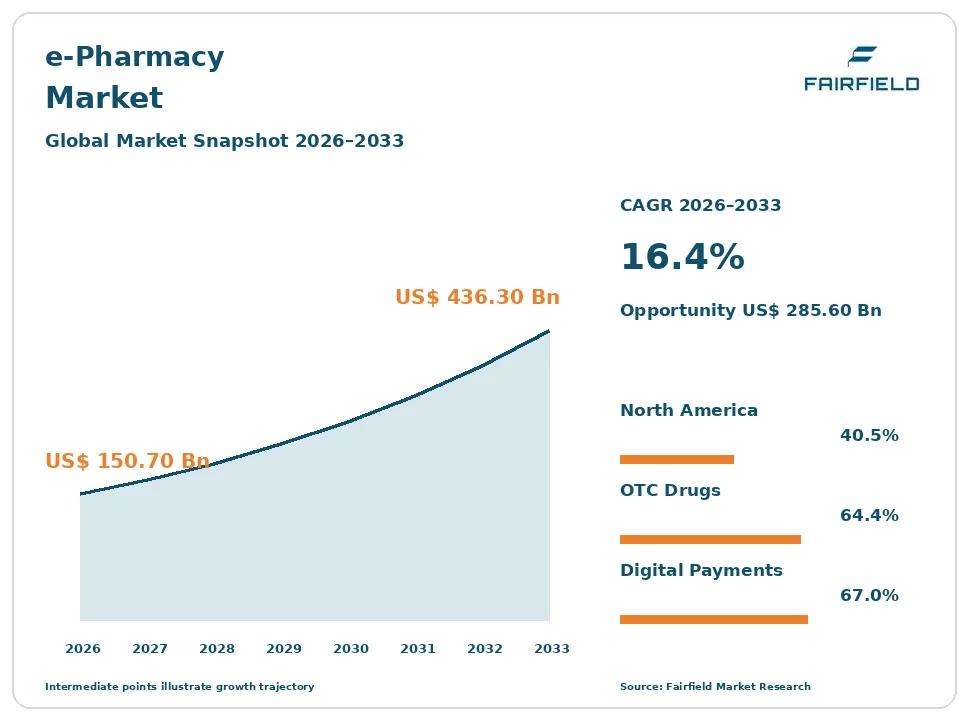
The global e-pharmacy market size is expected to be valued at US$ 150.70 billion in 2026 and projected to reach US$ 436.30 billion by 2033, growing at a CAGR of 16.4% between 2026 and 2033.
Between 2020 and 2025, the market grew at a CAGR of about 18.0%, as the pandemic pushed millions of people to order medicines online for the first time and many kept the habit. An e-pharmacy, or online pharmacy, sells prescription and over-the-counter medicines, health products, and wellness items through websites and apps, with home delivery or store pickup. Three factors now drive growth: the spread of telehealth visits that end with digital prescriptions, consumer demand for convenience and lower prices, and growing smartphone use in emerging economies. The market is shifting toward fast prescription delivery, quick commerce models that deliver medicines in minutes, and pharmacy services linked to digital health platforms and weight-loss programs. Moves in 2025, such as Amazon Pharmacy kiosks at One Medical clinics and Zepto’s 10-minute medicine delivery in India, show how fast the model is changing.
Key Report Takeaways
- By Drug Type: OTC Drugs held 64.4% share in 2026, while Prescription Drugs are projected to expand at a 17.9% CAGR through 2033, driven by e-prescriptions and telehealth links to online pharmacies.
- By Product Type: OTC Medications held 45.0% share in 2026, while Personal Care and Wellness Products are projected to expand at an 18.2% CAGR through 2033, driven by vitamins, supplements, and skincare sold online.
- By Payment Mode: Digital Payments held 67.0% share in 2026 and are projected to expand at a 17.8% CAGR through 2033, outpacing cash on delivery as wallets and UPI spread.
- By Region: North America held 40.5% share in 2026, while Asia Pacific is projected to expand at a 19.3% CAGR through 2033, driven by smartphone adoption and quick commerce in India and China.
Global e-Pharmacy Market Trends and Insights
Drivers Impact Analysis
| Driver | Impact on CAGR Forecast | Geographic Relevance | Impact Timeline |
| Growth of telehealth and e-prescriptions | High | North America, Europe, Asia Pacific | Medium term (2-4 years) |
| Consumer demand for convenience and lower prices | High | Global | Long term (≥4 years) |
Two drivers carry the strongest influence on e-pharmacy demand during the forecast period.
Telehealth Growth Is Driving the e-Pharmacy Market
The growth of telehealth and electronic prescriptions is the strongest driver of the e-pharmacy market. Online doctor visits naturally lead to online medicine orders.
The mechanism is a fully digital care path. After a video visit, a doctor sends an e-prescription directly to an online pharmacy, which ships the medicine to the patient’s home. This removes trips to the clinic and pharmacy. Telehealth firms such as Teladoc Health, LifeMD, Hims & Hers, and Ro now offer medicines for weight loss, mental health, skin care, and chronic conditions. In 2025, Teladoc Health and LifeMD partnered with Gifthealth to deliver the weight-loss drug Zepbound through virtual care. Health insurers and pharmacy benefit managers also push members toward mail-order pharmacies to cut costs. These factors increase prescription volume through online channels.
Convenience and Price Are Expanding the e-Pharmacy Market
Consumer demand for convenience and lower prices is expanding the e-pharmacy market. Shoppers want medicines delivered quickly and cheaply.
The cause is changing shopping habits. People already buy groceries, clothes, and electronics online, and they expect the same experience for health products. Online pharmacies offer price comparisons, discounts, automatic refills, and reminders. Amazon Pharmacy has expanded same-day delivery to more cities in the United States, and in 2025 it announced prescription kiosks at One Medical clinics. In India, quick commerce firms such as Zepto deliver medicines in about 10 minutes. Older adults, busy parents, and people with chronic diseases value home delivery. Price transparency tools such as GoodRx help buyers find cheaper options. These trends draw more customers online.
Restraints Impact Analysis
| Restraint | Impact on CAGR Forecast | Geographic Relevance | Impact Timeline |
| Strict and varied regulations | High | Global | Medium term (2-4 years) |
| Counterfeit drugs and safety concerns | Medium | Asia Pacific, Latin America, Middle East & Africa | Long term (≥4 years) |
Two restraints limit how quickly the e-pharmacy market grows.
Regulations Slow the e-Pharmacy Market
Strict and varied regulations slow the e-pharmacy market. Rules on selling medicines online differ widely by country.
The specific causes are patient safety and professional rules. Many countries require licensed pharmacists to check prescriptions, limit online sales of certain drugs, or ban them entirely. Controlled substances, such as some pain and attention medicines, face tight limits on telehealth prescribing and shipping. In India, draft e-pharmacy rules have been debated for years, creating uncertainty for companies. Some European countries allow online sales of only non-prescription drugs. Cross-border shipping of medicines is heavily restricted. Brick-and-mortar pharmacy groups lobby against online competitors. Data privacy laws add compliance costs for handling patient information. These factors slow expansion and raise costs.
Counterfeit Risks Restrict the e-Pharmacy Market
Counterfeit drugs and safety concerns restrict the e-pharmacy market. Illegal websites sell fake or unsafe medicines.
The underlying causes are weak enforcement and high demand for some drugs. The World Health Organization estimates that many medicines sold through illegal websites are falsified or substandard. Fake versions of popular weight-loss drugs have appeared online, harming patients and prompting warnings from regulators. Consumers may find it hard to tell legal pharmacies from illegal ones. Regulators in the United States, Europe, and other regions run verification programs, but awareness is low. Poor storage during shipping can damage temperature-sensitive drugs such as insulin. Data breaches at health websites also worry some consumers. These factors reduce trust and slow adoption among cautious and older buyers.
Market Opportunities
Weight-Loss and Chronic Care Programs Open a High-Value Revenue Pool
Weight-loss and chronic care programs open a high-value revenue pool in the e-pharmacy market. Patients on long-term treatment need regular refills.
Online pharmacies linked with telehealth providers can capture this opportunity. Demand for GLP-1 weight-loss drugs has surged, and many patients start treatment through online clinics. Programs for diabetes, high blood pressure, asthma, and mental health also rely on monthly refills. Subscription models combine doctor visits, medicines, and coaching for a fixed fee. Drug makers such as Eli Lilly and Novo Nordisk now sell some medicines directly through online platforms. Repeat orders give pharmacies steady revenue and strong customer loyalty. Adherence tools, such as refill reminders and pharmacist chat, improve outcomes and keep patients on treatment. Employers and insurers may pay for these programs to cut long-term costs.
Quick Commerce Creates a Fast-Delivery Revenue Pool
Quick commerce creates a fast-delivery revenue pool in the e-pharmacy market. Consumers want urgent medicines delivered in minutes, not days.
Delivery platforms and pharmacy chains with dense networks can capture this opportunity. In 2025, Zepto launched Zepto Pharmacy in several Indian cities, and Healthera partnered with Uber Eats to deliver medicines from local pharmacies in the United Kingdom. Fast delivery suits cold and flu medicines, baby care, first-aid products, and urgent refills. Partnerships between pharmacies and delivery apps reduce the need for new warehouses. Dark stores near customers enable rapid fulfillment. This model can expand to more countries as rules allow. Data from fast orders helps platforms stock the right products in each neighborhood. Late-night and weekend delivery fills gaps when local stores are closed.
Segment Analysis
By Drug Type: OTC Drugs Lead While Prescription Drugs Grow Fastest
OTC Drugs held 64.4% share in 2026. Over-the-counter medicines, such as pain relievers, cold and allergy remedies, and digestive products, can be sold online without prescriptions in most countries, making them easy to buy. Large retailers such as Amazon, Walmart, and CVS Health sell wide OTC ranges online at competitive prices.
Prescription Drugs are the fastest-growing drug type, expanding at a 17.9% CAGR through 2033. E-prescriptions, telehealth, and mail-order programs by pharmacy benefit managers such as OptumRx and Express Scripts drive growth. Chronic disease and weight-loss medicines add regular repeat orders. Specialty medicines that need cold-chain shipping are also moving online quickly. For the market, prescription growth raises order value.
By Product Type: OTC Medications Lead While Personal Care and Wellness Products Grow Fastest
OTC Medications held 45.0% share in 2026. Pain relief, cold and flu, allergy, and stomach remedies are the most common products bought online. Online pharmacies offer discounts and bundles that attract repeat buyers. Search tools and customer reviews help shoppers compare brands and prices quickly. Subscriptions for regular items, such as allergy tablets, add steady sales.
Personal Care and Wellness Products are the fastest-growing product type, expanding at an 18.2% CAGR through 2033. Vitamins, supplements, skincare, sexual health, and baby care products sell strongly online, especially among younger consumers. Influencer marketing, social media shopping, and subscription boxes support demand. Private-label products from online pharmacies offer higher margins. For the market, wellness growth widens the customer base.
By Payment Mode: Digital Payments Lead and Grow Fastest
Digital Payments held 67.0% share in 2026 and are projected to expand at a 17.8% CAGR through 2033. Credit and debit cards, digital wallets, UPI in India, and buy-now-pay-later options make online checkout fast and simple. Insurance-linked payments for prescriptions are also growing, and health savings accounts can be used at many online pharmacies in the United States.
Cash on Delivery holds about 20% to 30% of transactions today, mainly in India, Indonesia, and parts of Latin America and Middle East & Africa. Its share is declining as digital payment use grows. For the market, digital payment growth lowers costs and speeds delivery.
Geography Analysis
Which Region Is Leading the e-Pharmacy Market?
North America is leading the e-pharmacy market with a 40.5% share in 2026. The United States has the largest mail-order pharmacy market, driven by pharmacy benefit managers such as OptumRx, Express Scripts, and CVS Caremark. Amazon Pharmacy, Walmart, and Walgreens offer online ordering and fast delivery. Telehealth firms such as Hims & Hers and Ro sell medicines directly to consumers. Canada also has strong online pharmacy use. Drug makers have started selling some medicines directly to patients through online platforms at lower cash prices. Key barriers include rules on controlled substances. One change shaping the region is pharmacy kiosks and same-day delivery.
Europe Builds the e-Pharmacy Market Through Regulated Online Sales
Europe is a major e-pharmacy market. Germany has a large online pharmacy sector led by DocMorris and Redcare Pharmacy, and its electronic prescription system, launched nationwide in 2024, is moving prescription orders online. The United Kingdom, France, the Netherlands, and Spain also have growing online pharmacy use. The EU common logo helps consumers identify legal online pharmacies. Cross-border online sales within the EU remain limited by national rules. Key barriers include limits on prescription drug sales in some countries and strong lobbying by local pharmacies. One opportunity is e-prescription growth, which makes it easier to send prescriptions to online pharmacies.
Which Region Is Growing Fastest in the e-Pharmacy Market?
Asia Pacific is growing fastest in the e-pharmacy market at a 19.3% CAGR through 2033. China has huge online health platforms such as JD Health and Alibaba Health, and India has fast-growing players including Tata 1mg, PharmEasy, Apollo 24|7, and Netmeds. Japan and South Korea are easing rules on online sales. Indonesia and Vietnam are seeing rapid app adoption. Large populations, rising incomes, and limited pharmacy access in rural areas support online growth. Australia has mature online pharmacy chains such as Chemist Warehouse. Key barriers include regulatory uncertainty. One change shaping the region is quick commerce.
Latin America Grows the e-Pharmacy Market Through Retail Chains
Latin America is a growing e-pharmacy market. Brazil has large pharmacy chains, such as Raia Drogasil, that sell online with fast delivery, and Mexico has strong growth through Farmacias del Ahorro and delivery apps such as Rappi. Argentina, Chile, and Colombia are expanding online sales through chains and digital health apps. Telehealth use grew strongly in Brazil after the government allowed remote consultations. E-prescriptions are now accepted in several countries in the region. Key barriers include payment and logistics gaps, especially outside big cities. One opportunity is app-based delivery through partnerships with pharmacy chains.
Middle East & Africa Expands the e-Pharmacy Market Through Digital Adoption
Middle East & Africa is an emerging e-pharmacy market. The United Arab Emirates and Saudi Arabia have high smartphone use and are allowing licensed online pharmacies, often linked with telehealth apps. South Africa has large retail chains selling online. Nigeria, Kenya, and Egypt have startups delivering medicines in cities. Governments in the United Arab Emirates and Saudi Arabia have introduced e-prescription systems that link to licensed pharmacies. Startups in Nigeria and Kenya use mobile apps and motorcycle couriers to reach customers. Key barriers include counterfeit drugs and weak regulation. One opportunity is telehealth links that combine consultations and delivery.
Competitive Landscape
The e-pharmacy market is moderately concentrated. In North America, CVS Health, Amazon Pharmacy, Walgreens Boots Alliance, OptumRx, Express Scripts, Walmart, and Kroger lead, while GoodRx and telehealth firms add competition. DocMorris and Redcare Pharmacy lead in Europe, and JD Health, Alibaba Health, Tata 1mg, PharmEasy, and Apollo 24|7 lead in Asia Pacific.
Companies compete on price, delivery speed, product range, insurance coverage, app experience, data security, and pharmacist support. Pharmacy benefit managers have a strong advantage because insurers direct members to their mail-order services. Technology firms compete on convenience and logistics, while traditional chains use their stores for pickup and fast delivery. Telehealth companies increasingly run their own pharmacies to capture more value. Local players in India and China compete on discounts, and many are not yet profitable. Consolidation is likely as weaker players exit or merge.
Strategic moves show how competition is changing. In March 2025, Teladoc Health and LifeMD partnered with Gifthealth on Zepbound delivery. In August 2025, Zepto launched Zepto Pharmacy. In October 2025, Amazon Pharmacy announced kiosks at One Medical clinics. In December 2025, Healthera partnered with Uber Eats. These moves show competition shifting toward speed and telehealth links.
Three themes shape vendor strategy. First, companies are speeding up delivery with kiosks and quick commerce. Second, they are linking with telehealth and digital health platforms. Third, they are adding chronic care and weight-loss programs.
e-Pharmacy Market Industry Leaders
- CVS Health
- Amazon Pharmacy
- Walgreens Boots Alliance
- OptumRx
- Express Scripts
Recent Industry Developments
- December 2025: Healthera partnered with Uber Eats to deliver medicines from local pharmacies in the United Kingdom - brings quick commerce to community pharmacies.
- October 2025: Amazon Pharmacy announced self-service prescription kiosks at One Medical clinics in California, launching in December 2025 - combines digital ordering with in-clinic pickup.
- August 2025: Zepto launched Zepto Pharmacy for 10-minute medicine delivery in several Indian cities - shows rapid prescription delivery growth in India.
- March 2025: Teladoc Health and LifeMD partnered with Gifthealth to deliver Zepbound through virtual care platforms - links telehealth with online pharmacy for weight loss.
Companies Covered in the Report
- CVS Health
- Amazon Pharmacy
- Walgreens Boots Alliance
- OptumRx
- Express Scripts
- Walmart
- DocMorris
- Redcare Pharmacy
- JD Health
- Alibaba Health
- Tata 1mg
- GoodRx
e-Pharmacy Market Report Scope
This report covers online pharmacies selling prescription and over-the-counter drugs, OTC medications, personal care and wellness products, and other health items through websites and apps, with digital and cash payment modes. It includes mail-order, retail-linked, and marketplace models. The base year is 2025, and the forecast period runs from 2026 to 2033. All values are expressed in US$ Billion.
Drug Type
- OTC Drugs
- Prescription Drugs
Product Type
- OTC Medications
- Prescription Medications
- Personal Care and Wellness Products
- Others
Payment Mode
- Digital Payments
- Cash on Delivery
Regions
- North America
- Europe
- Asia Pacific
- Latin America
- Middle East & Africa
Key Questions Answered in the Report
How big is the e-pharmacy market in 2026?
The e-pharmacy market is valued at US$ 150.70 billion in 2026, led by OTC drugs and North America.
What is the e-pharmacy market forecast to 2033?
The market is projected to reach US$ 436.30 billion by 2033, growing at a 16.4% CAGR and adding US$ 285.60 billion.
Which drug type is growing fastest in the e-pharmacy market?
Prescription drugs are growing fastest at a 17.9% CAGR through 2033, driven by e-prescriptions and telehealth links to online pharmacies.
Which region is growing fastest in the e-pharmacy market?
Asia Pacific is growing fastest at a 19.3% CAGR through 2033, driven by smartphone adoption and quick commerce in India and China.
Which region holds the largest e-pharmacy market share?
North America holds the largest share at 40.5% in 2026, supported by mail-order pharmacy programs and fast home delivery.
1. Executive Summary
1.1. Global e-Pharmacy Market Snapshot
1.2. Future Projections
1.3. Key Report Takeaways
1.4. Regional Snapshot
2. Market Overview
2.1. Market Definition and Report Scope
2.2. Historical Trends 2020–2025
2.3. Market Dynamics
2.3.1. Drivers
2.3.1.1. Telehealth Growth Is Driving the e-Pharmacy Market
2.3.1.2. Convenience and Price Are Expanding the e-Pharmacy Market
2.3.2. Restraints
2.3.2.1. Regulations Slow the e-Pharmacy Market
2.3.2.2. Counterfeit Risks Restrict the e-Pharmacy Market
2.3.3. Market Opportunities
2.3.3.1. Weight-Loss and Chronic Care Programs Open a High-Value Revenue Pool
2.3.3.2. Quick Commerce Creates a Fast-Delivery Revenue Pool
3. Global e-Pharmacy Market Outlook, 2020-2033
3.1. Global e-Pharmacy Market Outlook, by Drug Type, Value (US$ Billion), 2020-2033
3.1.1. OTC Drugs
3.1.2. Prescription Drugs
3.2. Global e-Pharmacy Market Outlook, by Product Type, Value (US$ Billion), 2020-2033
3.2.1. OTC Medications
3.2.2. Prescription Medications
3.2.3. Personal Care and Wellness Products
3.2.4. Others
3.3. Global e-Pharmacy Market Outlook, by Payment Mode, Value (US$ Billion), 2020-2033
3.3.1. Digital Payments
3.3.2. Cash on Delivery
3.4. Global e-Pharmacy Market Outlook, by Region, Value (US$ Billion), 2020-2033
3.4.1. North America
3.4.2. Europe
3.4.3. Asia Pacific
3.4.4. Latin America
3.4.5. Middle East & Africa
4. North America e-Pharmacy Market Outlook, 2020-2033
4.1. North America e-Pharmacy Market Outlook, by Drug Type, Value (US$ Billion), 2020-2033
4.1.1. OTC Drugs
4.1.2. Prescription Drugs
4.2. North America e-Pharmacy Market Outlook, by Product Type, Value (US$ Billion), 2020-2033
4.2.1. OTC Medications
4.2.2. Prescription Medications
4.2.3. Personal Care and Wellness Products
4.2.4. Others
4.3. North America e-Pharmacy Market Outlook, by Payment Mode, Value (US$ Billion), 2020-2033
4.3.1. Digital Payments
4.3.2. Cash on Delivery
4.4. North America e-Pharmacy Market Outlook, by Country, Value (US$ Billion), 2020-2033
4.4.1. United States e-Pharmacy Market Outlook, by Drug Type, 2020-2033
4.4.2. United States e-Pharmacy Market Outlook, by Product Type, 2020-2033
4.4.3. United States e-Pharmacy Market Outlook, by Payment Mode, 2020-2033
4.4.4. Canada e-Pharmacy Market Outlook, by Drug Type, 2020-2033
4.4.5. Canada e-Pharmacy Market Outlook, by Product Type, 2020-2033
4.4.6. Canada e-Pharmacy Market Outlook, by Payment Mode, 2020-2033
5. Europe e-Pharmacy Market Outlook, 2020-2033
5.1. Europe e-Pharmacy Market Outlook, by Drug Type, Value (US$ Billion), 2020-2033
5.1.1. OTC Drugs
5.1.2. Prescription Drugs
5.2. Europe e-Pharmacy Market Outlook, by Product Type, Value (US$ Billion), 2020-2033
5.2.1. OTC Medications
5.2.2. Prescription Medications
5.2.3. Personal Care and Wellness Products
5.2.4. Others
5.3. Europe e-Pharmacy Market Outlook, by Payment Mode, Value (US$ Billion), 2020-2033
5.3.1. Digital Payments
5.3.2. Cash on Delivery
5.4. Europe e-Pharmacy Market Outlook, by Country, Value (US$ Billion), 2020-2033
5.4.1. Germany e-Pharmacy Market Outlook, by Drug Type, 2020-2033
5.4.2. Germany e-Pharmacy Market Outlook, by Product Type, 2020-2033
5.4.3. Germany e-Pharmacy Market Outlook, by Payment Mode, 2020-2033
5.4.4. United Kingdom e-Pharmacy Market Outlook, by Drug Type, 2020-2033
5.4.5. United Kingdom e-Pharmacy Market Outlook, by Product Type, 2020-2033
5.4.6. United Kingdom e-Pharmacy Market Outlook, by Payment Mode, 2020-2033
5.4.7. France e-Pharmacy Market Outlook, by Drug Type, 2020-2033
5.4.8. France e-Pharmacy Market Outlook, by Product Type, 2020-2033
5.4.9. France e-Pharmacy Market Outlook, by Payment Mode, 2020-2033
5.4.10. Netherlands e-Pharmacy Market Outlook, by Drug Type, 2020-2033
5.4.11. Netherlands e-Pharmacy Market Outlook, by Product Type, 2020-2033
5.4.12. Netherlands e-Pharmacy Market Outlook, by Payment Mode, 2020-2033
5.4.13. Spain e-Pharmacy Market Outlook, by Drug Type, 2020-2033
5.4.14. Spain e-Pharmacy Market Outlook, by Product Type, 2020-2033
5.4.15. Spain e-Pharmacy Market Outlook, by Payment Mode, 2020-2033
6. Asia Pacific e-Pharmacy Market Outlook, 2020-2033
6.1. Asia Pacific e-Pharmacy Market Outlook, by Drug Type, Value (US$ Billion), 2020-2033
6.1.1. OTC Drugs
6.1.2. Prescription Drugs
6.2. Asia Pacific e-Pharmacy Market Outlook, by Product Type, Value (US$ Billion), 2020-2033
6.2.1. OTC Medications
6.2.2. Prescription Medications
6.2.3. Personal Care and Wellness Products
6.2.4. Others
6.3. Asia Pacific e-Pharmacy Market Outlook, by Payment Mode, Value (US$ Billion), 2020-2033
6.3.1. Digital Payments
6.3.2. Cash on Delivery
6.4. Asia Pacific e-Pharmacy Market Outlook, by Country, Value (US$ Billion), 2020-2033
6.4.1. China e-Pharmacy Market Outlook, by Drug Type, 2020-2033
6.4.2. China e-Pharmacy Market Outlook, by Product Type, 2020-2033
6.4.3. China e-Pharmacy Market Outlook, by Payment Mode, 2020-2033
6.4.4. India e-Pharmacy Market Outlook, by Drug Type, 2020-2033
6.4.5. India e-Pharmacy Market Outlook, by Product Type, 2020-2033
6.4.6. India e-Pharmacy Market Outlook, by Payment Mode, 2020-2033
6.4.7. Japan e-Pharmacy Market Outlook, by Drug Type, 2020-2033
6.4.8. Japan e-Pharmacy Market Outlook, by Product Type, 2020-2033
6.4.9. Japan e-Pharmacy Market Outlook, by Payment Mode, 2020-2033
6.4.10. South Korea e-Pharmacy Market Outlook, by Drug Type, 2020-2033
6.4.11. South Korea e-Pharmacy Market Outlook, by Product Type, 2020-2033
6.4.12. South Korea e-Pharmacy Market Outlook, by Payment Mode, 2020-2033
6.4.13. Indonesia e-Pharmacy Market Outlook, by Drug Type, 2020-2033
6.4.14. Indonesia e-Pharmacy Market Outlook, by Product Type, 2020-2033
6.4.15. Indonesia e-Pharmacy Market Outlook, by Payment Mode, 2020-2033
6.4.16. Vietnam e-Pharmacy Market Outlook, by Drug Type, 2020-2033
6.4.17. Vietnam e-Pharmacy Market Outlook, by Product Type, 2020-2033
6.4.18. Vietnam e-Pharmacy Market Outlook, by Payment Mode, 2020-2033
6.4.19. Australia e-Pharmacy Market Outlook, by Drug Type, 2020-2033
6.4.20. Australia e-Pharmacy Market Outlook, by Product Type, 2020-2033
6.4.21. Australia e-Pharmacy Market Outlook, by Payment Mode, 2020-2033
7. Latin America e-Pharmacy Market Outlook, 2020-2033
7.1. Latin America e-Pharmacy Market Outlook, by Drug Type, Value (US$ Billion), 2020-2033
7.1.1. OTC Drugs
7.1.2. Prescription Drugs
7.2. Latin America e-Pharmacy Market Outlook, by Product Type, Value (US$ Billion), 2020-2033
7.2.1. OTC Medications
7.2.2. Prescription Medications
7.2.3. Personal Care and Wellness Products
7.2.4. Others
7.3. Latin America e-Pharmacy Market Outlook, by Payment Mode, Value (US$ Billion), 2020-2033
7.3.1. Digital Payments
7.3.2. Cash on Delivery
7.4. Latin America e-Pharmacy Market Outlook, by Country, Value (US$ Billion), 2020-2033
7.4.1. Brazil e-Pharmacy Market Outlook, by Drug Type, 2020-2033
7.4.2. Brazil e-Pharmacy Market Outlook, by Product Type, 2020-2033
7.4.3. Brazil e-Pharmacy Market Outlook, by Payment Mode, 2020-2033
7.4.4. Mexico e-Pharmacy Market Outlook, by Drug Type, 2020-2033
7.4.5. Mexico e-Pharmacy Market Outlook, by Product Type, 2020-2033
7.4.6. Mexico e-Pharmacy Market Outlook, by Payment Mode, 2020-2033
7.4.7. Argentina e-Pharmacy Market Outlook, by Drug Type, 2020-2033
7.4.8. Argentina e-Pharmacy Market Outlook, by Product Type, 2020-2033
7.4.9. Argentina e-Pharmacy Market Outlook, by Payment Mode, 2020-2033
7.4.10. Chile e-Pharmacy Market Outlook, by Drug Type, 2020-2033
7.4.11. Chile e-Pharmacy Market Outlook, by Product Type, 2020-2033
7.4.12. Chile e-Pharmacy Market Outlook, by Payment Mode, 2020-2033
7.4.13. Colombia e-Pharmacy Market Outlook, by Drug Type, 2020-2033
7.4.14. Colombia e-Pharmacy Market Outlook, by Product Type, 2020-2033
7.4.15. Colombia e-Pharmacy Market Outlook, by Payment Mode, 2020-2033
8. Middle East & Africa e-Pharmacy Market Outlook, 2020-2033
8.1. Middle East & Africa e-Pharmacy Market Outlook, by Drug Type, Value (US$ Billion), 2020-2033
8.1.1. OTC Drugs
8.1.2. Prescription Drugs
8.2. Middle East & Africa e-Pharmacy Market Outlook, by Product Type, Value (US$ Billion), 2020-2033
8.2.1. OTC Medications
8.2.2. Prescription Medications
8.2.3. Personal Care and Wellness Products
8.2.4. Others
8.3. Middle East & Africa e-Pharmacy Market Outlook, by Payment Mode, Value (US$ Billion), 2020-2033
8.3.1. Digital Payments
8.3.2. Cash on Delivery
8.4. Middle East & Africa e-Pharmacy Market Outlook, by Country, Value (US$ Billion), 2020-2033
8.4.1. United Arab Emirates e-Pharmacy Market Outlook, by Drug Type, 2020-2033
8.4.2. United Arab Emirates e-Pharmacy Market Outlook, by Product Type, 2020-2033
8.4.3. United Arab Emirates e-Pharmacy Market Outlook, by Payment Mode, 2020-2033
8.4.4. Saudi Arabia e-Pharmacy Market Outlook, by Drug Type, 2020-2033
8.4.5. Saudi Arabia e-Pharmacy Market Outlook, by Product Type, 2020-2033
8.4.6. Saudi Arabia e-Pharmacy Market Outlook, by Payment Mode, 2020-2033
8.4.7. South Africa e-Pharmacy Market Outlook, by Drug Type, 2020-2033
8.4.8. South Africa e-Pharmacy Market Outlook, by Product Type, 2020-2033
8.4.9. South Africa e-Pharmacy Market Outlook, by Payment Mode, 2020-2033
8.4.10. Nigeria e-Pharmacy Market Outlook, by Drug Type, 2020-2033
8.4.11. Nigeria e-Pharmacy Market Outlook, by Product Type, 2020-2033
8.4.12. Nigeria e-Pharmacy Market Outlook, by Payment Mode, 2020-2033
8.4.13. Kenya e-Pharmacy Market Outlook, by Drug Type, 2020-2033
8.4.14. Kenya e-Pharmacy Market Outlook, by Product Type, 2020-2033
8.4.15. Kenya e-Pharmacy Market Outlook, by Payment Mode, 2020-2033
8.4.16. Egypt e-Pharmacy Market Outlook, by Drug Type, 2020-2033
8.4.17. Egypt e-Pharmacy Market Outlook, by Product Type, 2020-2033
8.4.18. Egypt e-Pharmacy Market Outlook, by Payment Mode, 2020-2033
9. Competitive Landscape
9.1. Market Concentration and Industry Leaders
9.2. Competitive Differentiation
9.3. Strategic Moves and Market Direction
9.4. Recent Industry Developments
9.5. Company Profiles
9.5.1. CVS Health
9.5.2. Amazon Pharmacy
9.5.3. Walgreens Boots Alliance
9.5.4. OptumRx
9.5.5. Express Scripts
9.5.6. Walmart
9.5.7. DocMorris
9.5.8. Redcare Pharmacy
9.5.9. JD Health
9.5.10. Alibaba Health
9.5.11. Tata 1mg
9.5.12. GoodRx
10. Appendix
10.1. Research Methodology
10.2. Report Assumptions
10.3. Acronyms and Abbreviations
| Drug Type | OTC Drugs, Prescription Drugs |
| Product Type | OTC Medications, Prescription Medications, Personal Care and Wellness Products, Others |
| Payment Mode | Digital Payments, Cash on Delivery |
| Regions | North America, Europe, Asia Pacific, Latin America, Middle East & Africa |
Our Research Methodology
Considering the volatility of business today, traditional approaches to strategizing a game plan can be unfruitful if not detrimental. True ambiguity is no way to determine a forecast. A myriad of predetermined factors must be accounted for such as the degree of risk involved, the magnitude of circumstances, as well as conditions or consequences that are not known or unpredictable. To circumvent binary views that cast uncertainty, the application of market research intelligence to strategically posture, move, and enable actionable outcomes is necessary.
View Methodology
Quality Assured
Rigorous Validation Process

Confidentiality Assured
End-to-end Data Security

Custom Research Services
Tailored To Your Objectives
FAQs
The e-pharmacy market is valued at US$ 150.70 billion in 2026, led by OTC drugs and North America.
The market is projected to reach US$ 436.30 billion by 2033, growing at a 16.4% CAGR and adding US$ 285.60 billion.
Prescription drugs are growing fastest at a 17.9% CAGR through 2033, driven by e-prescriptions and telehealth links to online pharmacies.
Asia Pacific is growing fastest at a 19.3% CAGR through 2033, driven by smartphone adoption and quick commerce in India and China.
North America holds the largest share at 40.5% in 2026, supported by mail-order pharmacy programs and fast home delivery.
Related Reports
Varicose Vein Market Size, Share, Insights, Competitive Landscape, and Forecast 2026 to 2033
Explore the varicose vein market outlook for 2026–2033, covering treatments, products, end users, regional trends, and leading companies.
AI in Healthcare Market Size, Share, Insights, Competitive Landscape, and Forecast 2026 to 2033
Explore the AI in healthcare market outlook for 2026–2033, covering components, applications, end users, regional trends, and key companies.
Medical Case Management Market Size, Share, Insights, Competitive Landscape, and Forecast 2026 to 2033
The global medical case management market is valued at US$5.98 billion in 2026, reaching US$9.26 billion by 2033, growing at a 6.4% CAGR
Drug Discovery Informatics Market Size, Share, Insights, Competitive Landscape, and Forecast 2026 to 2033
Drug discovery informatics market is forecast to grow from US$ 3.7 billion in 2026 to US$ 6.9 billion by 2033 at 9.3% CAGR, driven by AI and cloud adoption.
Medical Device Security Market Size, Share, Insights, Competitive Landscape, and Forecast 2026 to 2033
The global medical device security market is valued at US$6.8 billion in 2026, reaching US$12.0 billion by 2033, growing at an 8.4% CAGR
Healthcare IT Integration Market Size, Share, Insights, Competitive Landscape, and Forecast 2026 to 2033
The global healthcare IT integration market is valued at US$4.9 billion in 2026, reaching US$10.6 billion by 2033, growing at an 11.7% CAGR