



Endoscopic Spinal Surgery Market
Endoscopic Spinal Surgery Market Insights, Competitive Landscape, and Market Forecast - 2033
Global Endoscopic Spinal Surgery Market Forecast
- The global endoscopic spinal surgery market is projected to reach a size of USD 1362.9 by 2033 showing significant growth from the USD 832.3 Bn achieved in 2026.
- The market is expected to reach a healthy rate of expansion, with an estimated CAGR of 7% during the forecast period from 2026 to 2033.
Endoscopic Spinal Surgery Market Insights
A Look Back and a Look Forward - Comparative Analysis
The endoscopic spinal surgery market analysis has shown significant growth trends both pre-2023 and is projected to continue expanding post-2024. The market growth is driven by several key factors and industry trends. The increasing prevalence of spinal cord injuries and degenerative diseases is a significant driver.
The World Health Organization estimates about 15.4 million are affected by spinal injuries, necessitating advanced surgical interventions. However, innovations in surgical techniques and equipment, including robotic-assisted surgeries, are enhancing the precision and effectiveness of spinal procedures, boosting market sales.
Another key trend in the market is the growing preference among healthcare providers and patients for minimally invasive surgeries. Additionally, the global demographic shift toward an older population is increasing the demand for spinal surgeries, fueling the industry growth. This growth is a testament to the industry's importance and the value it brings to the healthcare sector.
Key Growth Determinants
- Increasing Prevalence of Spinal Disorders
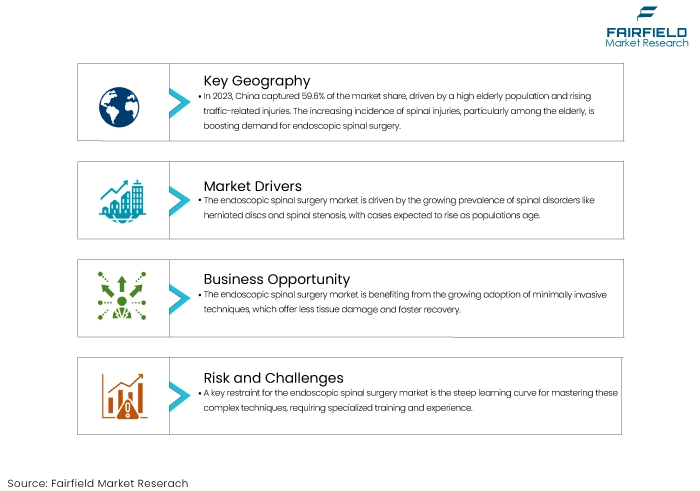
One of the primary drivers for the endoscopic spinal surgery market growth is the rising prevalence of spinal disorders including herniated discs, spinal stenosis, and degenerative disc disease. According to the World Health Organization, millions of individuals globally suffer from spinal issues, with numbers projected to increase as populations age.
The aging demographic is particularly susceptible to these disorders leading to great demand for effective surgical interventions. Endoscopic spinal surgery offers a minimally invasive alternative to traditional open surgeries, which can significantly reduce recovery times and postoperative complications. As healthcare providers seek to address the growing burden of spinal disorders, the adoption of endoscopic techniques is likely to expand, driving market growth.
- Technological Advancements in Surgical Techniques
Technological advancements in surgical techniques and equipment are pivotal in driving the growth of the endoscopic spinal surgery market expansion. Innovations such as high-definition imaging, robotic-assisted surgery, and advanced endoscopic instruments have significantly improved the precision and effectiveness of spinal procedures.
Technological developments enable surgeons to perform complex operations with minimal incisions, thereby reducing trauma to surrounding tissues and enhancing recovery outcomes. Additionally, the integration of augmented reality and 3D modeling in surgical planning is making endoscopic surgeries more accurate and safe.
- Growing Preference for Minimally Invasive Procedures
The increasing preference for minimally invasive procedures is a significant driver for the market growth in the endoscopic spinal surgery market. Patients and healthcare providers increasingly recognize the benefits of minimally invasive surgery including reduced pain, shorter recovery times, and lower complications rates.
Endoscopic techniques align perfectly with these preferences, offering practical solutions for spinal conditions while minimizing the physical impact on patients. As awareness of the advantages of minimally invasive approaches spreads, more patients are opting for surgeries that promise a quicker return to daily activities and reduced hospital stays. This shift in patient and provider attitudes is fostering an environment conducive to the growth of the market.
Key Growth Barriers
- Steep Learning Curve
Another critical restraint for the endoscopic spinal surgery market is the steep learning curve associated with mastering endoscopic techniques. While endoscopic spinal surgery offers numerous advantages such as reduced recovery times and less postoperative pain, the complexity of these procedures requires specialized training and experience.
Surgeons must develop a high level of skill to navigate the intricate anatomy of the spine using endoscopic tools effectively. This learning curve can be a significant barrier for many practitioners, particularly those accustomed to traditional open surgical methods. As a result, the reluctance to adopt these techniques can slow the growth of the market.
The need for ongoing education and training can strain resources within healthcare facilities further complicating the integration of endoscopic procedures into existing surgical practices.
- High Start-Up Costs
One of the significant restraints affecting the endoscopic spinal surgery market sales is the high start-up costs associated with implementing endoscopic surgical programs. Establishing a facility capable of performing endoscopic spinal surgeries requires substantial investment in specialized equipment. such as high-definition endoscopes and surgical instruments.
Training staff and surgeons to proficiently use these advanced tools adds to the financial burden. Many healthcare facilities, particularly small practices or those in rural areas may find it challenging to allocate the necessary resources for such investments. This financial barrier can limit the adoption of endoscopic techniques, slowing market growth.
Endoscopic Spinal Surgery Market Trends and Opportunities
Increasing Adoption of Minimally Invasive Techniques
Several endoscopic spinal surgery market opportunities are shaping the industry. Increasing adoption of minimally invasive surgical techniques is one of the key opportunities in the market. As healthcare providers and patients alike recognize the benefits of these approaches, there has been a marked shift towards procedures that minimize tissue damage and promote quicker recovery.
Endoscopic spinal surgery exemplifies this trend, offering a less invasive alternative to traditional open surgeries. This method not only reduces postoperative pain and complications but also shortens hospital stays making it an attractive option for both patients and surgeons.
The increasing incidence of spinal disorders, coupled with an aging population has further fueled the demand for such procedures. As more healthcare facilities invest in advanced endoscopic technologies and training, the market is projected to expand significantly.
The integration of innovative tools such as augmented reality and robotic assistance enhances the precision and effectiveness of these surgeries further driving their adoption. This trend reflects a broad movement in healthcare toward patient-centered care, emphasizing improved outcomes and quality of life.
How Does Regulatory Scenario Shape this Industry?
The regulatory landscape significantly influences the endoscopic spinal surgery market demand, impacting both the development and adoption of innovative surgical techniques. Regulatory bodies, such as the FDA in the United States and the EMA in Europe play a crucial role in ensuring the safety and efficacy of endoscopic devices and procedures.
Stringent regulatory requirements can delay the introduction of new technologies, which may hinder market growth. For instance, the high costs associated with compliance and the lengthy approval processes can deter small companies from entering the market limiting competition and innovation.
The reimbursement policies associated with endoscopic spinal surgeries also shape market dynamics. Low reimbursement rates for these procedures can discourage healthcare providers from adopting advanced endoscopic techniques despite their benefits. This situation is compounded by the steep learning curve associated with mastering endoscopic methods, which can further limit their uptake among surgeons.
Fairfield’s endoscopic spinal surgery market overview states that, as the demand for minimally invasive surgeries continues to rise, regulatory bodies increasingly recognize these techniques' importance. This shift may lead to more favorable regulations and reimbursement policies in the future, fostering growth in the market.
Segments Covered in the Report
- Endoscopic Devices Continues to Accumulate Significant Market Share
Endoscopic devices accounted for 66.9% of the market share in 2023 and utilized to examine various systems including the gastrointestinal, respiratory, ear, urinary, and female reproductive tracts.
The demand for minimally invasive medical devices is driven by their ease of use, reduced discomfort, and faster recovery times. Furthermore, the segment's rapid growth is supported by effective distribution networks, enhancing accessibility and adoption of these technologies in clinical settings.
- Transforaminal Endoscopic Procedures Lead Market with 35.9% Share
Transforaminal endoscopic procedures have established themselves as the standard for minimally invasive spine surgery and captured 35.9% of the endoscopic spinal surgery market share in 2023. This technique is particularly effective for treating highly migrated lumbar disc herniations (LDHs).
By employing a transforaminal endoscopic approach, surgeons can intuitively and effectively address disc herniation offering patients a less invasive option with improved recovery outcomes. The growing preference for this method highlights its significance in modern spine surgery practices.
Regional Analysis
- China Turns Highly Lucrative with Increasing Need for Endoscopic Spinal Surgery
In 2023, China captured 59.6% of the market share, The WHO reported that almost 176 million individuals in China were aged 65 and older in 2019 creating a significant demand for surgical interventions due to a high senior population and numerous traffic-related injuries.
In 2018, around 258,532 injuries from automobile accidents were reported with spinal cord injuries being the most prevalent. This increasing incidence of spinal injuries coupled with an aging population, is driving the endoscopic spinal surgery market.
- India Rules over South Asia Endoscopic Spinal Surgery Market
India holds a dominant 63.9% share of the South Asia endoscopic spinal surgery market and is expected to secure a CAGR of 8.6%. Increased healthcare spending is set to drive demand for these procedures.
Changing lifestyles including poor dietary habits and more desk jobs have led to a rise in spinal injuries among younger populations. A 2018 study revealed that 79% of spinal injuries occurred in rural areas, a significant demographic in India. Additionally, the NSO's 2021 report predicts a 41% increase in the elderly population (aged 60+) over the next decade, from 138 million in 2021 to nearly 194 million by 2031.
Fairfield’s Competitive Landscape Analysis
Key players are focusing on expanding their product lines to drive growth in developing nations. In the endoscopic spinal surgery market, manufacturers are investing in integrated software with advanced technology to enhance endoscopic spinal surgery. Companies are actively pursuing product development and strategic partnerships to strengthen their market presence. For example,
- In November 2020, Medtronic acquired Medicrea International, a pioneer in transforming spinal surgery through artificial intelligence (AI), predictive modeling, and the creation of patient-specific implants showcasing a commitment to innovation in this field.
Key Market Companies
An Expert’s Eye
- The increasing adoption of minimally invasive surgical techniques is shaping the industry.
- The complexity of these procedures requires specialized training and experience, which can be a significant barrier for many practitioners.
- The growing incidence of spinal disorders and an aging population have further fueled the demand for such procedures.
- 3D technology dominates the market with a healthy share of 59.8%, despite the challenges of reliance on 2D imaging.
- The U.S. leads the endoscopic spinal surgery market with 30.9% revenue share driven by the elderly population's vulnerability to traumatic spinal cord injuries and lifestyle changes.
Global Endoscopic Spinal Surgery Market is Segmented as-
By Product
- Endoscopes
- High-Definition Rigid Endoscope
- High-Definition Flexible Endoscope
- Robot-Assisted Endoscope
- Endoscopic Instruments Kits
- Endoscopic Decompression Systems
- Endoscopic Devices
- Endoscopic Visualization Systems
- Full HD Monitors
- HD Camera Systems
- Spinal Shaver systems
- Radiofrequency Surgical Systems
- Fluid Management Systems & Irrigation Pump Systems
By Technology
- 2D technology
- 3D technology
By Procedure
- Transforaminal Endoscopic Procedures
- Thoracic or lumbar discectomy
- Foraminoplasty
- Annuloplasty
- Epidural Infection Aspiration
- Spinal Fusion
- Interlaminar Endoscopic Procedures
- Discectomy
- Endoscopic Spine Decompression
- Endoscopic Posterior Foraminotomy and Cervical Discectomy
- Endoscopic Visualized Rhizotomy
By End User
- Hospitals
- Ambulatory Surgical Centers
- Specialty Spinal Clinics
By Region
- North America
- Latin America
- Europe
- Asia Pacific
- The Middle East & Africa
- Executive Summary
- Global Endoscopic Spinal Surgery Market Snapshot
- Future Projections
- Key Market Trends
- Regional Snapshot, by Value, 2026
- Analyst Recommendations
- Market Overview
- Market Definitions and Segmentations
- Market Dynamics
- Drivers
- Restraints
- Market Opportunities
- Value Chain Analysis
- COVID-19 Impact Analysis
- Porter's Five Forces Analysis
- Impact of Russia-Ukraine Conflict
- PESTLE Analysis
- Regulatory Analysis
- Price Trend Analysis
- Current Prices and Future Projections, 2025-2033
- Price Impact Factors
- Global Endoscopic Spinal Surgery Market Outlook, 2020 - 2033
- Global Endoscopic Spinal Surgery Market Outlook, by Product, Value (US$ Bn), 2020-2033
- Endoscopes
- High-Definition Rigid Endoscope
- High-Definition Flexible Endoscope
- Robot-Assisted Endoscope
- Endoscopic Instruments Kits
- Endoscopic Decompression Systems
- Endoscopic Devices
- Endoscopic Visualization Systems
- Full HD Monitors
- HD Camera Systems
- Spinal Shaver systems
- Radiofrequency Surgical Systems
- Fluid Management Systems & Irrigation Pump Systems
- Global Endoscopic Spinal Surgery Market Outlook, by Technology, Value (US$ Bn), 2020-2033
- 2D
- 3D
- Global Endoscopic Spinal Surgery Market Outlook, by Procedure, Value (US$ Bn), 2020-2033
- Transforaminal Endoscopic Procedures
- Interlaminar Endoscopic Procedures
- Global Endoscopic Spinal Surgery Market Outlook, by End User, Value (US$ Bn), 2020-2033
- Hospitals
- Ambulatory Surgical Centers
- Specialty Spinal Clinics
- Global Endoscopic Spinal Surgery Market Outlook, by Region, Value (US$ Bn), 2020-2033
- North America
- Europe
- Asia Pacific
- Latin America
- Middle East & Africa
- Endoscopes
- Global Endoscopic Spinal Surgery Market Outlook, by Product, Value (US$ Bn), 2020-2033
- North America Endoscopic Spinal Surgery Market Outlook, 2020 - 2033
- North America Endoscopic Spinal Surgery Market Outlook, by Product, Value (US$ Bn), 2020-2033
- Endoscopes
- High-Definition Rigid Endoscope
- High-Definition Flexible Endoscope
- Robot-Assisted Endoscope
- Endoscopic Instruments Kits
- Endoscopic Decompression Systems
- Endoscopic Devices
- Endoscopic Visualization Systems
- Full HD Monitors
- HD Camera Systems
- Spinal Shaver systems
- Radiofrequency Surgical Systems
- Fluid Management Systems & Irrigation Pump Systems
- North America Endoscopic Spinal Surgery Market Outlook, by Technology, Value (US$ Bn), 2020-2033
- 2D
- 3D
- North America Endoscopic Spinal Surgery Market Outlook, by Procedure, Value (US$ Bn), 2020-2033
- Transforaminal Endoscopic Procedures
- Interlaminar Endoscopic Procedures
- North America Endoscopic Spinal Surgery Market Outlook, by End User, Value (US$ Bn), 2020-2033
- Hospitals
- Ambulatory Surgical Centers
- Specialty Spinal Clinics
- North America Endoscopic Spinal Surgery Market Outlook, by Country, Value (US$ Bn), 2020-2033
- U.S. Endoscopic Spinal Surgery Market Outlook, by Product, 2020-2033
- U.S. Endoscopic Spinal Surgery Market Outlook, by Technology, 2020-2033
- U.S. Endoscopic Spinal Surgery Market Outlook, by Procedure, 2020-2033
- U.S. Endoscopic Spinal Surgery Market Outlook, by End User, 2020-2033
- Canada Endoscopic Spinal Surgery Market Outlook, by Product, 2020-2033
- Canada Endoscopic Spinal Surgery Market Outlook, by Technology, 2020-2033
- Canada Endoscopic Spinal Surgery Market Outlook, by Procedure, 2020-2033
- Canada Endoscopic Spinal Surgery Market Outlook, by End User, 2020-2033
- BPS Analysis/Market Attractiveness Analysis
- Endoscopes
- North America Endoscopic Spinal Surgery Market Outlook, by Product, Value (US$ Bn), 2020-2033
- Europe Endoscopic Spinal Surgery Market Outlook, 2020 - 2033
- Europe Endoscopic Spinal Surgery Market Outlook, by Product, Value (US$ Bn), 2020-2033
- Endoscopes
- High-Definition Rigid Endoscope
- High-Definition Flexible Endoscope
- Robot-Assisted Endoscope
- Endoscopic Instruments Kits
- Endoscopic Decompression Systems
- Endoscopic Devices
- Endoscopic Visualization Systems
- Full HD Monitors
- HD Camera Systems
- Spinal Shaver systems
- Radiofrequency Surgical Systems
- Fluid Management Systems & Irrigation Pump Systems
- Europe Endoscopic Spinal Surgery Market Outlook, by Technology, Value (US$ Bn), 2020-2033
- 2D
- 3D
- Europe Endoscopic Spinal Surgery Market Outlook, by Procedure, Value (US$ Bn), 2020-2033
- Transforaminal Endoscopic Procedures
- Interlaminar Endoscopic Procedures
- Europe Endoscopic Spinal Surgery Market Outlook, by End User, Value (US$ Bn), 2020-2033
- Hospitals
- Ambulatory Surgical Centers
- Specialty Spinal Clinics
- Europe Endoscopic Spinal Surgery Market Outlook, by Country, Value (US$ Bn), 2020-2033
- Germany Endoscopic Spinal Surgery Market Outlook, by Product, 2020-2033
- Germany Endoscopic Spinal Surgery Market Outlook, by Technology, 2020-2033
- Germany Endoscopic Spinal Surgery Market Outlook, by Procedure, 2020-2033
- Germany Endoscopic Spinal Surgery Market Outlook, by End User, 2020-2033
- Italy Endoscopic Spinal Surgery Market Outlook, by Product, 2020-2033
- Italy Endoscopic Spinal Surgery Market Outlook, by Technology, 2020-2033
- Italy Endoscopic Spinal Surgery Market Outlook, by Procedure, 2020-2033
- Italy Endoscopic Spinal Surgery Market Outlook, by End User, 2020-2033
- France Endoscopic Spinal Surgery Market Outlook, by Product, 2020-2033
- France Endoscopic Spinal Surgery Market Outlook, by Technology, 2020-2033
- France Endoscopic Spinal Surgery Market Outlook, by Procedure, 2020-2033
- France Endoscopic Spinal Surgery Market Outlook, by End User, 2020-2033
- U.K. Endoscopic Spinal Surgery Market Outlook, by Product, 2020-2033
- U.K. Endoscopic Spinal Surgery Market Outlook, by Technology, 2020-2033
- U.K. Endoscopic Spinal Surgery Market Outlook, by Procedure, 2020-2033
- U.K. Endoscopic Spinal Surgery Market Outlook, by End User, 2020-2033
- Spain Endoscopic Spinal Surgery Market Outlook, by Product, 2020-2033
- Spain Endoscopic Spinal Surgery Market Outlook, by Technology, 2020-2033
- Spain Endoscopic Spinal Surgery Market Outlook, by Procedure, 2020-2033
- Spain Endoscopic Spinal Surgery Market Outlook, by End User, 2020-2033
- Russia Endoscopic Spinal Surgery Market Outlook, by Product, 2020-2033
- Russia Endoscopic Spinal Surgery Market Outlook, by Technology, 2020-2033
- Russia Endoscopic Spinal Surgery Market Outlook, by Procedure, 2020-2033
- Russia Endoscopic Spinal Surgery Market Outlook, by End User, 2020-2033
- Rest of Europe Endoscopic Spinal Surgery Market Outlook, by Product, 2020-2033
- Rest of Europe Endoscopic Spinal Surgery Market Outlook, by Technology, 2020-2033
- Rest of Europe Endoscopic Spinal Surgery Market Outlook, by Procedure, 2020-2033
- Rest of Europe Endoscopic Spinal Surgery Market Outlook, by End User, 2020-2033
- BPS Analysis/Market Attractiveness Analysis
- Endoscopes
- Europe Endoscopic Spinal Surgery Market Outlook, by Product, Value (US$ Bn), 2020-2033
- Asia Pacific Endoscopic Spinal Surgery Market Outlook, 2020 - 2033
- Asia Pacific Endoscopic Spinal Surgery Market Outlook, by Product, Value (US$ Bn), 2020-2033
- Endoscopes
- High-Definition Rigid Endoscope
- High-Definition Flexible Endoscope
- Robot-Assisted Endoscope
- Endoscopic Instruments Kits
- Endoscopic Decompression Systems
- Endoscopic Devices
- Endoscopic Visualization Systems
- Full HD Monitors
- HD Camera Systems
- Spinal Shaver systems
- Radiofrequency Surgical Systems
- Fluid Management Systems & Irrigation Pump Systems
- Asia Pacific Endoscopic Spinal Surgery Market Outlook, by Technology, Value (US$ Bn), 2020-2033
- 2D
- 3D
- Asia Pacific Endoscopic Spinal Surgery Market Outlook, by Procedure, Value (US$ Bn), 2020-2033
- Transforaminal Endoscopic Procedures
- Interlaminar Endoscopic Procedures
- Asia Pacific Endoscopic Spinal Surgery Market Outlook, by End User, Value (US$ Bn), 2020-2033
- Hospitals
- Ambulatory Surgical Centers
- Specialty Spinal Clinics
- Asia Pacific Endoscopic Spinal Surgery Market Outlook, by Country, Value (US$ Bn), 2020-2033
- China Endoscopic Spinal Surgery Market Outlook, by Product, 2020-2033
- China Endoscopic Spinal Surgery Market Outlook, by Technology, 2020-2033
- China Endoscopic Spinal Surgery Market Outlook, by Procedure, 2020-2033
- China Endoscopic Spinal Surgery Market Outlook, by End User, 2020-2033
- Japan Endoscopic Spinal Surgery Market Outlook, by Product, 2020-2033
- Japan Endoscopic Spinal Surgery Market Outlook, by Technology, 2020-2033
- Japan Endoscopic Spinal Surgery Market Outlook, by Procedure, 2020-2033
- Japan Endoscopic Spinal Surgery Market Outlook, by End User, 2020-2033
- South Korea Endoscopic Spinal Surgery Market Outlook, by Product, 2020-2033
- South Korea Endoscopic Spinal Surgery Market Outlook, by Technology, 2020-2033
- South Korea Endoscopic Spinal Surgery Market Outlook, by Procedure, 2020-2033
- South Korea Endoscopic Spinal Surgery Market Outlook, by End User, 2020-2033
- India Endoscopic Spinal Surgery Market Outlook, by Product, 2020-2033
- India Endoscopic Spinal Surgery Market Outlook, by Technology, 2020-2033
- India Endoscopic Spinal Surgery Market Outlook, by Procedure, 2020-2033
- India Endoscopic Spinal Surgery Market Outlook, by End User, 2020-2033
- Southeast Asia Endoscopic Spinal Surgery Market Outlook, by Product, 2020-2033
- Southeast Asia Endoscopic Spinal Surgery Market Outlook, by Technology, 2020-2033
- Southeast Asia Endoscopic Spinal Surgery Market Outlook, by Procedure, 2020-2033
- Southeast Asia Endoscopic Spinal Surgery Market Outlook, by End User, 2020-2033
- Rest of SAO Endoscopic Spinal Surgery Market Outlook, by Product, 2020-2033
- Rest of SAO Endoscopic Spinal Surgery Market Outlook, by Technology, 2020-2033
- Rest of SAO Endoscopic Spinal Surgery Market Outlook, by Procedure, 2020-2033
- Rest of SAO Endoscopic Spinal Surgery Market Outlook, by End User, 2020-2033
- BPS Analysis/Market Attractiveness Analysis
- Endoscopes
- Asia Pacific Endoscopic Spinal Surgery Market Outlook, by Product, Value (US$ Bn), 2020-2033
- Latin America Endoscopic Spinal Surgery Market Outlook, 2020 - 2033
- Latin America Endoscopic Spinal Surgery Market Outlook, by Product, Value (US$ Bn), 2020-2033
- Endoscopes
- High-Definition Rigid Endoscope
- High-Definition Flexible Endoscope
- Robot-Assisted Endoscope
- Endoscopic Instruments Kits
- Endoscopic Decompression Systems
- Endoscopic Devices
- Endoscopic Visualization Systems
- Full HD Monitors
- HD Camera Systems
- Spinal Shaver systems
- Radiofrequency Surgical Systems
- Fluid Management Systems & Irrigation Pump Systems
- Latin America Endoscopic Spinal Surgery Market Outlook, by Technology, Value (US$ Bn), 2020-2033
- 2D
- 3D
- Latin America Endoscopic Spinal Surgery Market Outlook, by Procedure, Value (US$ Bn), 2020-2033
- Transforaminal Endoscopic Procedures
- Interlaminar Endoscopic Procedures
- Latin America Endoscopic Spinal Surgery Market Outlook, by End User, Value (US$ Bn), 2020-2033
- Hospitals
- Ambulatory Surgical Centers
- Specialty Spinal Clinics
- Latin America Endoscopic Spinal Surgery Market Outlook, by Country, Value (US$ Bn), 2020-2033
- Brazil Endoscopic Spinal Surgery Market Outlook, by Product, 2020-2033
- Brazil Endoscopic Spinal Surgery Market Outlook, by Technology, 2020-2033
- Brazil Endoscopic Spinal Surgery Market Outlook, by Procedure, 2020-2033
- Brazil Endoscopic Spinal Surgery Market Outlook, by End User, 2020-2033
- Mexico Endoscopic Spinal Surgery Market Outlook, by Product, 2020-2033
- Mexico Endoscopic Spinal Surgery Market Outlook, by Technology, 2020-2033
- Mexico Endoscopic Spinal Surgery Market Outlook, by Procedure, 2020-2033
- Mexico Endoscopic Spinal Surgery Market Outlook, by End User, 2020-2033
- Argentina Endoscopic Spinal Surgery Market Outlook, by Product, 2020-2033
- Argentina Endoscopic Spinal Surgery Market Outlook, by Technology, 2020-2033
- Argentina Endoscopic Spinal Surgery Market Outlook, by Procedure, 2020-2033
- Argentina Endoscopic Spinal Surgery Market Outlook, by End User, 2020-2033
- Rest of LATAM Endoscopic Spinal Surgery Market Outlook, by Product, 2020-2033
- Rest of LATAM Endoscopic Spinal Surgery Market Outlook, by Technology, 2020-2033
- Rest of LATAM Endoscopic Spinal Surgery Market Outlook, by Procedure, 2020-2033
- Rest of LATAM Endoscopic Spinal Surgery Market Outlook, by End User, 2020-2033
- BPS Analysis/Market Attractiveness Analysis
- Endoscopes
- Latin America Endoscopic Spinal Surgery Market Outlook, by Product, Value (US$ Bn), 2020-2033
- Middle East & Africa Endoscopic Spinal Surgery Market Outlook, 2020 - 2033
- Middle East & Africa Endoscopic Spinal Surgery Market Outlook, by Product, Value (US$ Bn), 2020-2033
- Endoscopes
- High-Definition Rigid Endoscope
- High-Definition Flexible Endoscope
- Robot-Assisted Endoscope
- Endoscopic Instruments Kits
- Endoscopic Decompression Systems
- Endoscopic Devices
- Endoscopic Visualization Systems
- Full HD Monitors
- HD Camera Systems
- Spinal Shaver systems
- Radiofrequency Surgical Systems
- Fluid Management Systems & Irrigation Pump Systems
- Middle East & Africa Endoscopic Spinal Surgery Market Outlook, by Technology, Value (US$ Bn), 2020-2033
- 2D
- 3D
- Middle East & Africa Endoscopic Spinal Surgery Market Outlook, by Procedure, Value (US$ Bn), 2020-2033
- Transforaminal Endoscopic Procedures
- Interlaminar Endoscopic Procedures
- Middle East & Africa Endoscopic Spinal Surgery Market Outlook, by End User, Value (US$ Bn), 2020-2033
- Hospitals
- Ambulatory Surgical Centers
- Specialty Spinal Clinics
- Middle East & Africa Endoscopic Spinal Surgery Market Outlook, by Country, Value (US$ Bn), 2020-2033
- GCC Endoscopic Spinal Surgery Market Outlook, by Product, 2020-2033
- GCC Endoscopic Spinal Surgery Market Outlook, by Technology, 2020-2033
- GCC Endoscopic Spinal Surgery Market Outlook, by Procedure, 2020-2033
- GCC Endoscopic Spinal Surgery Market Outlook, by End User, 2020-2033
- South Africa Endoscopic Spinal Surgery Market Outlook, by Product, 2020-2033
- South Africa Endoscopic Spinal Surgery Market Outlook, by Technology, 2020-2033
- South Africa Endoscopic Spinal Surgery Market Outlook, by Procedure, 2020-2033
- South Africa Endoscopic Spinal Surgery Market Outlook, by End User, 2020-2033
- Egypt Endoscopic Spinal Surgery Market Outlook, by Product, 2020-2033
- Egypt Endoscopic Spinal Surgery Market Outlook, by Technology, 2020-2033
- Egypt Endoscopic Spinal Surgery Market Outlook, by Procedure, 2020-2033
- Egypt Endoscopic Spinal Surgery Market Outlook, by End User, 2020-2033
- Nigeria Endoscopic Spinal Surgery Market Outlook, by Product, 2020-2033
- Nigeria Endoscopic Spinal Surgery Market Outlook, by Technology, 2020-2033
- Nigeria Endoscopic Spinal Surgery Market Outlook, by Procedure, 2020-2033
- Nigeria Endoscopic Spinal Surgery Market Outlook, by End User, 2020-2033
- Rest of Middle East Endoscopic Spinal Surgery Market Outlook, by Product, 2020-2033
- Rest of Middle East Endoscopic Spinal Surgery Market Outlook, by Technology, 2020-2033
- Rest of Middle East Endoscopic Spinal Surgery Market Outlook, by Procedure, 2020-2033
- Rest of Middle East Endoscopic Spinal Surgery Market Outlook, by End User, 2020-2033
- BPS Analysis/Market Attractiveness Analysis
- Endoscopes
- Middle East & Africa Endoscopic Spinal Surgery Market Outlook, by Product, Value (US$ Bn), 2020-2033
- Competitive Landscape
- Company Vs Segment Heatmap
- Company Market Share Analysis, 2025
- Competitive Dashboard
- Company Profiles
- Depuy Synthes Spine, Inc.
- Company Overview
- Product Portfolio
- Financial Overview
- Business Strategies and Developments
- Medtronic PLC
- MedicalTek Co., Ltd.
- Schölly Fiberoptic GmbH
- Stryker Corporation
- Zimmer Holdings, Inc
- Richard Wolf (RIWOSpine)
- Joimax GmbH
- Aesculap Implant Systems
- Olympus Corporation
- Depuy Synthes Spine, Inc.
- Appendix
- Research Methodology
- Report Assumptions
- Acronyms and Abbreviations
|
BASE YEAR |
HISTORICAL DATA |
FORECAST PERIOD |
UNITS |
|||
 |
2025 |
 |
2020 - 2025 |
 |
2026 - 2033 |
Value: US$ Billion |
|
REPORT FEATURES |
DETAILS |
|
Product Coverage |
|
|
Technology Coverage |
|
|
Procedure Coverage |
|
|
End User Coverage |
|
|
Geographical Coverage |
|
|
Leading Companies |
|
|
Report Highlights |
Key Market Indicators, Macro-micro economic impact analysis, Technological Roadmap, Key Trends, Driver, Restraints, and Future Opportunities & Revenue Pockets, Porter’s 5 Forces Analysis, Historical Trend (2019-2021), Market Estimates and Forecast, Market Dynamics, Industry Trends, Competition Landscape, Category, Region, Country-wise Trends & Analysis, COVID-19 Impact Analysis (Demand and Supply Chain) |
Our Research Methodology
Considering the volatility of business today, traditional approaches to strategizing a game plan can be unfruitful if not detrimental. True ambiguity is no way to determine a forecast. A myriad of predetermined factors must be accounted for such as the degree of risk involved, the magnitude of circumstances, as well as conditions or consequences that are not known or unpredictable. To circumvent binary views that cast uncertainty, the application of market research intelligence to strategically posture, move, and enable actionable outcomes is necessary.
View Methodology
Quality Assured
Rigorous Validation Process

Confidentiality Assured
End-to-end Data Security

Custom Research Services
Tailored To Your Objectives
FAQs
The market is predicted to rise from USD 832.3 Bn in 2026 to USD 1362.9 Bn by 2033.
growing preference for minimally invasive procedures is a key driver for market growth.
A few of the leading players in the market are Depuy Synthes Spine, Inc. (Johnson & Johnson), Medtronic PLC, and MedicalTek Co., Ltd.
Challenges like steep learning curve and high start-up costs for these surgeries are restraining market expansion.
Increasing adoption of minimally invasive surgical techniques is a key factor creates opportunities in the market.
Related Reports
Diagnostic Ultrasound Market Insights, Competitive Landscape, and Market Forecast - 2033
Diagnostic Ultrasound Market is valued at USD 9.70 Billion in 2026 and projected to reach USD 14.78 Billion by 2033, growing at a 6.2% CAGR.
Infection Control Supplies Market Forecast - 2033
The global infection control supplies market is set to reach US$ 19.76 Bn by 2033, growing at a 6.4% CAGR, driven by infection prevention demand
Home Sleep Apnea Testing Devices Market Insights, Competitive Landscape, and Market Forecast - 2033
Home sleep apnea testing devices market to reach USD 2.18 billion by 2033, growing at an 8.9% CAGR through 2033, driven by rising sleep apnea diagnosis rates.
Outpatient Oncology Infusion Market Insights, Competitive Landscape, and Market Forecast - 2033
Outpatient Oncology Infusion Market to reach USD 16.37 Bn by 2033, growing at 9.1% CAGR, driven by cancer incidence, immunotherapy, and outpatient care.
Cardiac Arrhythmia Monitoring Devices Market Insights, Competitive Landscape, and Market Forecast - 2033
The cardiac arrhythmia monitoring devices market to reach USD 9.79 Bn by 2033 from USD 5.60 Bn in 2026, driven by wearables and cloud monitoring
Medical Suction Devices Market Research Report Insights, Competitive Landscape, and Market Forecast 2033
The medical suction devices market is projected to grow from USD 1.90 billion in 2026 to USD 2.88 billion by 2033, at a CAGR of 6.1%