



Europe Dental Imaging Equipment Market
Europe Dental Imaging Equipment Market Insights, Competitive Landscape, and Market Forecast - 2033
Europe Dental Imaging Equipment Market Forecast
The Europe Dental Imaging Equipment Market is valued at USD 1.2 Bn in 2026 and is projected to reach USD 1.9 Bn, growing at a CAGR of 6% by 2033.
Europe Dental Imaging Equipment Market Insights
A Look Back and a Look Forward - Comparative Analysis
Europe dental imaging equipment market went through significant transformation over the past decade, driven by the adoption of digital technologies and advancements in diagnostic tools. The market dominated by conventional 2D imaging systems such as panoramic and intraoral X-rays, which were essential for basic dental diagnostics. However, the limitations of these systems in terms of image resolution and comprehensive anatomical visualization spurred a shift toward advanced solutions.
The market has seen a transition to 3D imaging technologies in recent years particularly Cone Beam Computed Tomography (CBCT). These systems offer detailed 3D images, allowing for better treatment planning, especially for orthodontics, dental implants, and maxillofacial surgeries.
The increasing preference for minimally invasive procedures and enhanced patient care has further accelerated the adoption of digital solutions like intraoral scanners and digital radiography systems.
The market is expected to benefit from growing investments in artificial intelligence (AI) and cloud-based dental imaging platforms. AI-driven software is increasingly being integrated to assist in image interpretation, improving diagnostic accuracy and workflow efficiency for dental practices. Additionally, the trend toward personalized dental care is driving demand for imaging systems that enable precise treatment customization.
Demographic shifts such as Europe’s aging population are expected to sustain demand for dental services particularly in implantology and prosthodontics. Countries like Germany and France will likely continue to lead the market owing to well-developed healthcare infrastructure and high patient awareness.
Key Growth Determinants
- Technological Advancements in Cone-Beam Computed Tomography and AI Integration
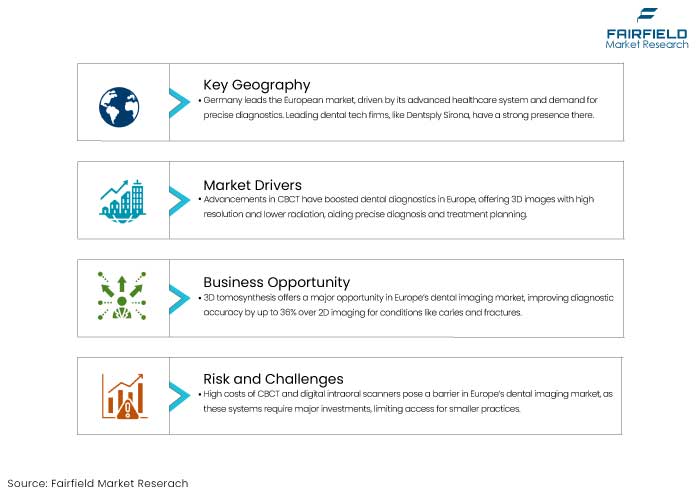
Technological advancements in Cone-Beam Computed Tomography (CBCT) have significantly enhanced diagnostic capabilities in dental and maxillofacial imaging. This factor remains a key driver for the Europe dental imaging equipment market. CBCT provides three-dimensional images with high resolution and lower radiation doses compared to traditional CT scans. This technology has revolutionized the way dental professionals diagnose and plan treatments, offering detailed views of bone structures, teeth, and soft tissues.
The integration of Artificial Intelligence (AI) with CBCT has propelled its utility. AI algorithms can now assist in the automatic detection and diagnosis of dental pathologies, such as caries, periodontal disease, and even tumors. These algorithms analyze CBCT images with remarkable accuracy, reducing the time required for diagnosis and increasing the precision of treatment plans.
Manufacturer leading in this field is Planmeca, a company known for its innovative dental imaging solutions. Planmeca’s CBCT systems, such as the Planmeca Viso™, incorporate advanced AI features that enhance image quality and diagnostic capabilities. The AI integration in these systems aids in the automatic segmentation of anatomical structures, making the diagnostic process efficient and reliable.
Key Growth Barriers
- Expensive Setup Costs for High-End Dental Imaging Technologies
Cone beam computed tomography (CBCT) and digital intraoral scanners are the substantial upfront costs associated with their installation and maintenance. This factor remains a key barrier for the Europe dental imaging equipment market. These advanced systems require significant financial investment in equipment, infrastructure, and training, making them less accessible for small practices.
The initial capital outlay, coupled with ongoing expenses like software upgrades, calibration, and technical support can strain budgets particularly for independent dental clinics or practitioners in developing markets.
The cost of specialized training for staff to operate these machines effectively further escalates expenses. Many dental professionals may hesitate to adopt these technologies due to concerns over return on investment (ROI), particularly when patient demand for such high-end diagnostics may not justify the expense in all regions.
Financial barrier limits widespread adoption and could slow advancements in dental diagnostics. As a result, clinics that cannot afford these systems may rely on traditional imaging methods, potentially compromising the quality of care and delaying the diagnosis of dental conditions. Addressing these cost-related challenges is crucial for enabling broader access to high-end dental imaging technology.
Dental Imaging Equipment Market Trends and Opportunities
- 3D Tomosynthesis Technology Transforms Dental Diagnostics and Patient Care
The emergence of 3D tomosynthesis presents a significant opportunity in the Europe dental imaging equipment market. This innovative technology enhances diagnostic capabilities by providing volumetric images, allowing dental professionals to detect conditions such as caries and fractures with up to 36% more accuracy than traditional 2D imaging.
A notable example is the PORTRAY™ System from Surround Medical Systems, which recently received FDA 510(k) clearance. Utilizing a novel carbon nanotube (CNT) x-ray source array developed by researchers at the University of North Carolina at Chapel Hill, this system enables high-resolution imaging without increasing patient radiation exposure or imaging time.
The 3D intraoral imaging device is designed to fit seamlessly into the same space as conventional 2D intraoral imaging systems, making it a practical upgrade for dental practices. Its compatibility with existing patient management systems facilitates easy file sharing and enhances workflow efficiency.
Practitioners can quickly realize improved diagnostic outcomes by eliminating the learning curve typically associated with new technologies. As dental care increasingly prioritizes precise diagnosis and treatment planning, integrating 3D tomosynthesis into imaging equipment positions practices to deliver higher-quality care. This advancement not only underscores the potential for growth in the sector but also aligns with the industry's ongoing commitment to patient safety and comfort.
-
The Surge in CBCT Scanner Adoption and Its Benefits for Patient Care
Cone Beam Computed Tomography (CBCT) scanners are at the forefront of a significant transformation in dental imaging, marking a notable trend in the Europe dental imaging equipment market. The increasing adoption of CBCT technology is primarily driven by its ability to deliver high-resolution, three-dimensional images, which provide dental professionals with critical insights into complex anatomical structures. This technology enhances diagnostic accuracy and facilitates more effective treatment planning across various dental specialties.
One of the key reasons for the rising popularity of CBCT scanners is their versatility. Unlike traditional 2D imaging methods, CBCT offers a comprehensive view of the patient's oral and maxillofacial regions in a single scan. This capability allows for precise assessments of conditions such as dental abscesses, impacted teeth, and periodontal disease, leading to earlier detection and improved treatment outcomes.
CBCT systems can capture detailed images of bone quality, nerve pathways, and tooth orientation, all of which are essential for planning complex procedures like implants and orthodontics.
CBCT systems prioritize patient safety by minimizing radiation exposure, making them a preferred choice in modern dentistry. Notable examples include the CS 9600 from Carestream Dental, which features AI-powered positioning and a scalable 5-in-1 configuration, and the Planmeca ProMax 3D, known for its exceptional image quality and user-friendly interface. Both systems exemplify how technological advancements in CBCT scanners are reshaping the dental landscape, reflecting the industry's commitment to improving patient care and operational efficiency.
How Does Regulatory Scenario Shape this Industry?
The regulatory scenario profoundly shapes the dental imaging equipment market by establishing safety, efficacy, and quality standards that manufacturers must adhere to.
The Medical Device Regulation (MDR) sets rigorous requirements for product approval in Europe, necessitating comprehensive clinical evaluations and compliance with stringent manufacturing processes. This impacts not only the time and cost involved in bringing new imaging technologies to market but also influences the design and functionality of the equipment to meet regulatory expectations.
Regulatory frameworks affect market dynamics by determining the classification of dental imaging devices, which influences reimbursement policies and adoption rates among dental professionals. Clear guidelines on radiation safety and patient data protection further drive innovation, as manufacturers must develop technologies that enhance diagnostic capabilities while ensuring patient safety and privacy. Consequently, a well-defined regulatory environment can foster growth and innovation in the dental imaging sector, while overly complex regulations may hinder Europe dental imaging equipment market expansion.
Segments Covered in the Report
- Intraoral Dental Imaging Equipment Takes the Lead
Intraoral dental imaging equipment is the most widely used product in the Europe market because of its importance in everyday dental exams and treatment planning. This category includes tools like intraoral X-ray machines, digital sensors, and phosphor storage plates, which help capture clear, detailed images of teeth and nearby tissues. These high-resolution images are essential for spotting issues such as cavities, infections, and bone conditions early on, ensuring better outcomes.
The popularity of intraoral imaging tools is growing as more clinics prefer minimally invasive procedures and emphasize preventive care. Many practices across Europe are shifting from traditional film-based imaging to digital intraoral sensors and phosphor plate systems, which provide quicker image processing and easier storage.
Intraoral equipment supports the movement toward digital dentistry, helping clinics streamline operations and improve patient care. In countries like Germany, France, and the United Kingdom, insurance providers encourage routine dental visits, further boosting the need for reliable diagnostic tools.
As awareness about oral health increases and new technologies like wireless scanners become available, intraoral equipment is expected to remain the most popular product type in the Europe dental imaging equipment market.
- Highest Sales Contribution Comes from Independent Dental Clinics
Independent dental clinics are the leading end user of dental imaging equipment in the Europe market due to their ability to significantly adopt new technologies and respond to patient demands for advanced care. These clinics invest significantly in modern imaging tools such as intraoral scanners, digital X-rays, and Cone-Beam Computed Tomography (CBCT) systems to enhance diagnostic accuracy and streamline treatment workflows.
The shift toward digital dentistry also plays a crucial role, as independent practices seek to differentiate themselves by offering more precise and faster diagnostics, leading to better patient outcomes.
Many countries in Europe including Germany and France offer reimbursement programs and insurance coverage that support regular dental check-ups, driving consistent usage of imaging equipment in independent practices. With the increasing need for patient-centric care and personalized treatment plans, independent dental clinics are expected to maintain their leading position in the Europe dental imaging equipment market.
Regional Analysis
- Germany’s Dominance Prevails in the Europe Dental Imaging Equipment Market
Germany holds the largest share of the market in Europe, fueled by its advanced healthcare system and growing need for high-precision diagnostics. The country is recognized as a leader in dental technology with leading manufacturers like Dentsply Sirona operating significant business units there.
Clinics and Hospitals in Germany are early adopters of cutting-edge products such as CBCT (cone-beam computed tomography) systems, digital intraoral scanners, and 3D imaging technologies.
Preventive care is a key focus in Germany, with government and insurance programs supporting regular dental check-ups. This proactive approach drives the adoption of diagnostic tools, increasing the demand for advanced imaging solutions.
Germany’s aging population, which requires frequent dental care adds to the demand for innovative diagnostic tools. With continuous innovations and a shift toward digital dentistry, Germany is well-positioned to maintain its leadership in the market.
Fairfield’s Competitive Landscape Analysis
The competitive landscape of the Europe dental imaging equipment market is moderately consolidated, with several leading players driving technological advancements and market share growth. Key companies operating in this space include, Carestream Dental LLC, Dentsply Sirona, Planmeca Oy, and Vatech Co. Ltd.
Leading companies are at the forefront of developing innovative imaging technologies such as intraoral scanners, dental cone-beam computed tomography (CBCT), and 3D imaging systems to meet the growing demand for precision diagnostics.
Some companies like Dentsply Sirona, emphasize streamlined digital workflows, while others, such as Carestream and Planmeca focus on expanding product portfolios through advanced 3D imaging technologies.
The market has also seen strategic developments, such as mergers, product launches, and regional expansions, aimed at strengthening market positions. For example, Dentsply Sirona has rolled out digital solutions to enhance clinical outcomes, while Vatech is focusing on affordable dental X-ray systems to tap into price-sensitive markets.
Key Market Companies
- Dentsply Sirona
- Align Technology, Inc.
- Planmeca Oy (KaVo Dental)
- VATECH
- Midmark Corporation
- CEFLA
- LargeV Instrument Corporation Limited
- Air Techniques
- DÜRR DENTAL
- Trident S.r.l
- Owandy Radiology
- Carestream Dental LLC.
- Merz Dental GmbH
- Acteon
An Expert’s Eye
- The Europe dental imaging equipment market is evolving significantly, driven by the rising demand for accurate diagnostics, preventive care, and the shift toward digital dentistry.
- Germany plays a pivotal role, accounting for the notable share in Europe. This leadership is attributed to robust healthcare infrastructure, a large aging population with increasing dental care needs, and government-backed insurance policies that encourage regular dental check-ups.
- As digital sensors and 3D CBCT imaging technologies become more accessible, clinics are moving away from traditional film-based diagnostics to fast and efficient solutions.
Europe Dental Imaging Equipment Market is Segmented as-
By Product Type
- Intraoral Dental Imaging Equipment
- Intraoral X-ray Systems
- Wall/Floor Mounted Intraoral X-ray Systems
- Hand-Held Intraoral X-ray Systems
- Intraoral Plate Scanners
- Intraoral Sensors
- Intraoral Phosphor Storage Plates
- Intraoral Cameras
- Intraoral X-ray Systems
- Extraoral Dental Imaging Equipment
- Extra-oral X-ray Systems
- Panoramic X-ray Systems
- Cephalometric Projection Systems
- Extraoral Scanners
- Extra-oral X-ray Systems
- Cone-Beam Computed Tomography (CBCT) Imaging
By Dimension
- 2D Dental Imaging Equipment
- 3D Dental Imaging Equipment
By End User
- Hospitals
- Independent Dental Clinics
- Ambulatory Surgical Centres
- Forensic Laboratories
By Country
- Germany
- France
- UK
- Italy
- Spain
- Rest of Europe
- Executive Summary
- Global Europe Dental Imaging Equipment Market Snapshot
- Future Projections
- Key Market Trends
- Regional Snapshot, by Value, 2026
- Analyst Recommendations
- Market Overview
- Market Definitions and Segmentations
- Market Dynamics
- Drivers
- Restraints
- Market Opportunities
- Value Chain Analysis
- COVID-19 Impact Analysis
- Porter's Five Forces Analysis
- Impact of Russia-Ukraine Conflict
- PESTLE Analysis
- Regulatory Analysis
- Price Trend Analysis
- Current Prices and Future Projections, 2025-2033
- Price Impact Factors
- Global Europe Dental Imaging Equipment Market Outlook, 2020 - 2033
- Global Europe Dental Imaging Equipment Market Outlook, by Product Type, Value (US$ Mn), 2020-2033
- Intraoral Dental Imaging Equipment
- Intraoral X-ray Systems
- Intraoral Plate Scanners
- Intraoral Sensors
- Intraoral Phosphor Storage Plates
- Intraoral Cameras
- Extraoral Dental Imaging Equipment
- Cone-Beam Computed Tomography (CBCT) Imaging
- Intraoral Dental Imaging Equipment
- Global Europe Dental Imaging Equipment Market Outlook, by Dimension, Value (US$ Mn), 2020-2033
- 2D Dental Imaging Equipment
- 3D Dental Imaging Equipment
- Global Europe Dental Imaging Equipment Market Outlook, by End User, Value (US$ Mn), 2020-2033
- Hospitals
- Independent Dental Clinics
- Ambulatory Surgical Centres
- Forensic Laboratories
- Global Europe Dental Imaging Equipment Market Outlook, by Region, Value (US$ Mn), 2020-2033
- North America
- Europe
- Asia Pacific
- Latin America
- Middle East & Africa
- Global Europe Dental Imaging Equipment Market Outlook, by Product Type, Value (US$ Mn), 2020-2033
- North America Europe Dental Imaging Equipment Market Outlook, 2020 - 2033
- North America Europe Dental Imaging Equipment Market Outlook, by Product Type, Value (US$ Mn), 2020-2033
- Intraoral Dental Imaging Equipment
- Intraoral X-ray Systems
- Intraoral Plate Scanners
- Intraoral Sensors
- Intraoral Phosphor Storage Plates
- Intraoral Cameras
- Extraoral Dental Imaging Equipment
- Cone-Beam Computed Tomography (CBCT) Imaging
- Intraoral Dental Imaging Equipment
- North America Europe Dental Imaging Equipment Market Outlook, by Dimension, Value (US$ Mn), 2020-2033
- 2D Dental Imaging Equipment
- 3D Dental Imaging Equipment
- North America Europe Dental Imaging Equipment Market Outlook, by End User, Value (US$ Mn), 2020-2033
- Hospitals
- Independent Dental Clinics
- Ambulatory Surgical Centres
- Forensic Laboratories
- North America Europe Dental Imaging Equipment Market Outlook, by Country, Value (US$ Mn), 2020-2033
- U.S. Europe Dental Imaging Equipment Market Outlook, by Product Type, 2020-2033
- U.S. Europe Dental Imaging Equipment Market Outlook, by Dimension, 2020-2033
- U.S. Europe Dental Imaging Equipment Market Outlook, by End User, 2020-2033
- Canada Europe Dental Imaging Equipment Market Outlook, by Product Type, 2020-2033
- Canada Europe Dental Imaging Equipment Market Outlook, by Dimension, 2020-2033
- Canada Europe Dental Imaging Equipment Market Outlook, by End User, 2020-2033
- BPS Analysis/Market Attractiveness Analysis
- North America Europe Dental Imaging Equipment Market Outlook, by Product Type, Value (US$ Mn), 2020-2033
- Europe Europe Dental Imaging Equipment Market Outlook, 2020 - 2033
- Europe Europe Dental Imaging Equipment Market Outlook, by Product Type, Value (US$ Mn), 2020-2033
- Intraoral Dental Imaging Equipment
- Intraoral X-ray Systems
- Intraoral Plate Scanners
- Intraoral Sensors
- Intraoral Phosphor Storage Plates
- Intraoral Cameras
- Extraoral Dental Imaging Equipment
- Cone-Beam Computed Tomography (CBCT) Imaging
- Intraoral Dental Imaging Equipment
- Europe Europe Dental Imaging Equipment Market Outlook, by Dimension, Value (US$ Mn), 2020-2033
- 2D Dental Imaging Equipment
- 3D Dental Imaging Equipment
- Europe Europe Dental Imaging Equipment Market Outlook, by End User, Value (US$ Mn), 2020-2033
- Hospitals
- Independent Dental Clinics
- Ambulatory Surgical Centres
- Forensic Laboratories
- Europe Europe Dental Imaging Equipment Market Outlook, by Country, Value (US$ Mn), 2020-2033
- Germany Europe Dental Imaging Equipment Market Outlook, by Product Type, 2020-2033
- Germany Europe Dental Imaging Equipment Market Outlook, by Dimension, 2020-2033
- Germany Europe Dental Imaging Equipment Market Outlook, by End User, 2020-2033
- Italy Europe Dental Imaging Equipment Market Outlook, by Product Type, 2020-2033
- Italy Europe Dental Imaging Equipment Market Outlook, by Dimension, 2020-2033
- Italy Europe Dental Imaging Equipment Market Outlook, by End User, 2020-2033
- France Europe Dental Imaging Equipment Market Outlook, by Product Type, 2020-2033
- France Europe Dental Imaging Equipment Market Outlook, by Dimension, 2020-2033
- France Europe Dental Imaging Equipment Market Outlook, by End User, 2020-2033
- U.K. Europe Dental Imaging Equipment Market Outlook, by Product Type, 2020-2033
- U.K. Europe Dental Imaging Equipment Market Outlook, by Dimension, 2020-2033
- U.K. Europe Dental Imaging Equipment Market Outlook, by End User, 2020-2033
- Spain Europe Dental Imaging Equipment Market Outlook, by Product Type, 2020-2033
- Spain Europe Dental Imaging Equipment Market Outlook, by Dimension, 2020-2033
- Spain Europe Dental Imaging Equipment Market Outlook, by End User, 2020-2033
- Russia Europe Dental Imaging Equipment Market Outlook, by Product Type, 2020-2033
- Russia Europe Dental Imaging Equipment Market Outlook, by Dimension, 2020-2033
- Russia Europe Dental Imaging Equipment Market Outlook, by End User, 2020-2033
- Rest of Europe Europe Dental Imaging Equipment Market Outlook, by Product Type, 2020-2033
- Rest of Europe Europe Dental Imaging Equipment Market Outlook, by Dimension, 2020-2033
- Rest of Europe Europe Dental Imaging Equipment Market Outlook, by End User, 2020-2033
- BPS Analysis/Market Attractiveness Analysis
- Europe Europe Dental Imaging Equipment Market Outlook, by Product Type, Value (US$ Mn), 2020-2033
- Asia Pacific Europe Dental Imaging Equipment Market Outlook, 2020 - 2033
- Asia Pacific Europe Dental Imaging Equipment Market Outlook, by Product Type, Value (US$ Mn), 2020-2033
- Intraoral Dental Imaging Equipment
- Intraoral X-ray Systems
- Intraoral Plate Scanners
- Intraoral Sensors
- Intraoral Phosphor Storage Plates
- Intraoral Cameras
- Extraoral Dental Imaging Equipment
- Cone-Beam Computed Tomography (CBCT) Imaging
- Intraoral Dental Imaging Equipment
- Asia Pacific Europe Dental Imaging Equipment Market Outlook, by Dimension, Value (US$ Mn), 2020-2033
- 2D Dental Imaging Equipment
- 3D Dental Imaging Equipment
- Asia Pacific Europe Dental Imaging Equipment Market Outlook, by End User, Value (US$ Mn), 2020-2033
- Hospitals
- Independent Dental Clinics
- Ambulatory Surgical Centres
- Forensic Laboratories
- Asia Pacific Europe Dental Imaging Equipment Market Outlook, by Country, Value (US$ Mn), 2020-2033
- China Europe Dental Imaging Equipment Market Outlook, by Product Type, 2020-2033
- China Europe Dental Imaging Equipment Market Outlook, by Dimension, 2020-2033
- China Europe Dental Imaging Equipment Market Outlook, by End User, 2020-2033
- Japan Europe Dental Imaging Equipment Market Outlook, by Product Type, 2020-2033
- Japan Europe Dental Imaging Equipment Market Outlook, by Dimension, 2020-2033
- Japan Europe Dental Imaging Equipment Market Outlook, by End User, 2020-2033
- South Korea Europe Dental Imaging Equipment Market Outlook, by Product Type, 2020-2033
- South Korea Europe Dental Imaging Equipment Market Outlook, by Dimension, 2020-2033
- South Korea Europe Dental Imaging Equipment Market Outlook, by End User, 2020-2033
- India Europe Dental Imaging Equipment Market Outlook, by Product Type, 2020-2033
- India Europe Dental Imaging Equipment Market Outlook, by Dimension, 2020-2033
- India Europe Dental Imaging Equipment Market Outlook, by End User, 2020-2033
- Southeast Asia Europe Dental Imaging Equipment Market Outlook, by Product Type, 2020-2033
- Southeast Asia Europe Dental Imaging Equipment Market Outlook, by Dimension, 2020-2033
- Southeast Asia Europe Dental Imaging Equipment Market Outlook, by End User, 2020-2033
- Rest of SAO Europe Dental Imaging Equipment Market Outlook, by Product Type, 2020-2033
- Rest of SAO Europe Dental Imaging Equipment Market Outlook, by Dimension, 2020-2033
- Rest of SAO Europe Dental Imaging Equipment Market Outlook, by End User, 2020-2033
- BPS Analysis/Market Attractiveness Analysis
- Asia Pacific Europe Dental Imaging Equipment Market Outlook, by Product Type, Value (US$ Mn), 2020-2033
- Latin America Europe Dental Imaging Equipment Market Outlook, 2020 - 2033
- Latin America Europe Dental Imaging Equipment Market Outlook, by Product Type, Value (US$ Mn), 2020-2033
- Intraoral Dental Imaging Equipment
- Intraoral X-ray Systems
- Intraoral Plate Scanners
- Intraoral Sensors
- Intraoral Phosphor Storage Plates
- Intraoral Cameras
- Extraoral Dental Imaging Equipment
- Cone-Beam Computed Tomography (CBCT) Imaging
- Intraoral Dental Imaging Equipment
- Latin America Europe Dental Imaging Equipment Market Outlook, by Dimension, Value (US$ Mn), 2020-2033
- 2D Dental Imaging Equipment
- 3D Dental Imaging Equipment
- Latin America Europe Dental Imaging Equipment Market Outlook, by End User, Value (US$ Mn), 2020-2033
- Hospitals
- Independent Dental Clinics
- Ambulatory Surgical Centres
- Forensic Laboratories
- Latin America Europe Dental Imaging Equipment Market Outlook, by Country, Value (US$ Mn), 2020-2033
- Brazil Europe Dental Imaging Equipment Market Outlook, by Product Type, 2020-2033
- Brazil Europe Dental Imaging Equipment Market Outlook, by Dimension, 2020-2033
- Brazil Europe Dental Imaging Equipment Market Outlook, by End User, 2020-2033
- Mexico Europe Dental Imaging Equipment Market Outlook, by Product Type, 2020-2033
- Mexico Europe Dental Imaging Equipment Market Outlook, by Dimension, 2020-2033
- Mexico Europe Dental Imaging Equipment Market Outlook, by End User, 2020-2033
- Argentina Europe Dental Imaging Equipment Market Outlook, by Product Type, 2020-2033
- Argentina Europe Dental Imaging Equipment Market Outlook, by Dimension, 2020-2033
- Argentina Europe Dental Imaging Equipment Market Outlook, by End User, 2020-2033
- Rest of LATAM Europe Dental Imaging Equipment Market Outlook, by Product Type, 2020-2033
- Rest of LATAM Europe Dental Imaging Equipment Market Outlook, by Dimension, 2020-2033
- Rest of LATAM Europe Dental Imaging Equipment Market Outlook, by End User, 2020-2033
- BPS Analysis/Market Attractiveness Analysis
- Latin America Europe Dental Imaging Equipment Market Outlook, by Product Type, Value (US$ Mn), 2020-2033
- Middle East & Africa Europe Dental Imaging Equipment Market Outlook, 2020 - 2033
- Middle East & Africa Europe Dental Imaging Equipment Market Outlook, by Product Type, Value (US$ Mn), 2020-2033
- Intraoral Dental Imaging Equipment
- Intraoral X-ray Systems
- Intraoral Plate Scanners
- Intraoral Sensors
- Intraoral Phosphor Storage Plates
- Intraoral Cameras
- Extraoral Dental Imaging Equipment
- Cone-Beam Computed Tomography (CBCT) Imaging
- Intraoral Dental Imaging Equipment
- Middle East & Africa Europe Dental Imaging Equipment Market Outlook, by Dimension, Value (US$ Mn), 2020-2033
- 2D Dental Imaging Equipment
- 3D Dental Imaging Equipment
- Middle East & Africa Europe Dental Imaging Equipment Market Outlook, by End User, Value (US$ Mn), 2020-2033
- Hospitals
- Independent Dental Clinics
- Ambulatory Surgical Centres
- Forensic Laboratories
- Middle East & Africa Europe Dental Imaging Equipment Market Outlook, by Country, Value (US$ Mn), 2020-2033
- GCC Europe Dental Imaging Equipment Market Outlook, by Product Type, 2020-2033
- GCC Europe Dental Imaging Equipment Market Outlook, by Dimension, 2020-2033
- GCC Europe Dental Imaging Equipment Market Outlook, by End User, 2020-2033
- South Africa Europe Dental Imaging Equipment Market Outlook, by Product Type, 2020-2033
- South Africa Europe Dental Imaging Equipment Market Outlook, by Dimension, 2020-2033
- South Africa Europe Dental Imaging Equipment Market Outlook, by End User, 2020-2033
- Egypt Europe Dental Imaging Equipment Market Outlook, by Product Type, 2020-2033
- Egypt Europe Dental Imaging Equipment Market Outlook, by Dimension, 2020-2033
- Egypt Europe Dental Imaging Equipment Market Outlook, by End User, 2020-2033
- Nigeria Europe Dental Imaging Equipment Market Outlook, by Product Type, 2020-2033
- Nigeria Europe Dental Imaging Equipment Market Outlook, by Dimension, 2020-2033
- Nigeria Europe Dental Imaging Equipment Market Outlook, by End User, 2020-2033
- Rest of Middle East Europe Dental Imaging Equipment Market Outlook, by Product Type, 2020-2033
- Rest of Middle East Europe Dental Imaging Equipment Market Outlook, by Dimension, 2020-2033
- Rest of Middle East Europe Dental Imaging Equipment Market Outlook, by End User, 2020-2033
- BPS Analysis/Market Attractiveness Analysis
- Middle East & Africa Europe Dental Imaging Equipment Market Outlook, by Product Type, Value (US$ Mn), 2020-2033
- Competitive Landscape
- Company Vs Segment Heatmap
- Company Market Share Analysis, 2025
- Competitive Dashboard
- Company Profiles
- Dentsply Sirona
- Company Overview
- Product Portfolio
- Financial Overview
- Business Strategies and Developments
- Align Technology, Inc.
- Planmeca Oy (KaVo Dental)
- VATECH
- Midmark Corporation
- CEFLA
- LargeV Instrument Corporation Limited
- Air Techniques
- DÜRR DENTAL
- Trident S.r.l
- Owandy Radiology
- Carestream Dental LLC.
- Merz Dental GmbH
- Acteon
- Dentsply Sirona
- Appendix
- Research Methodology
- Report Assumptions
- Acronyms and Abbreviations
|
BASE YEAR |
HISTORICAL DATA |
FORECAST PERIOD |
UNITS |
|||
 |
2025 |
 |
2020 - 2025 |
 |
2026 - 2033 |
Value: US$ Billion |
|
REPORT FEATURES |
DETAILS |
|
Product Type Coverage |
|
|
Dimension Coverage |
|
|
End User Coverage |
|
|
Country Coverage |
|
|
Leading Companies |
|
|
Report Highlights |
Key Market Indicators, Macro-micro economic impact analysis, Technological Roadmap, Key Trends, Driver, Restraints, and Future Opportunities & Revenue Pockets, Porter’s 5 Forces Analysis, Historical Trend (2019-2021), Market Estimates and Forecast, Market Dynamics, Industry Trends, Competition Landscape, Category, Region, Country-wise Trends & Analysis, COVID-19 Impact Analysis (Demand and Supply Chain) |
Our Research Methodology
Considering the volatility of business today, traditional approaches to strategizing a game plan can be unfruitful if not detrimental. True ambiguity is no way to determine a forecast. A myriad of predetermined factors must be accounted for such as the degree of risk involved, the magnitude of circumstances, as well as conditions or consequences that are not known or unpredictable. To circumvent binary views that cast uncertainty, the application of market research intelligence to strategically posture, move, and enable actionable outcomes is necessary.
View Methodology
Quality Assured
Rigorous Validation Process

Confidentiality Assured
End-to-end Data Security

Custom Research Services
Tailored To Your Objectives
FAQs
The market is expected to be valued at USD 1.2 Bn in 2026.
The market is projected to exhibit a remarkable CAGR of 6% through 2033.
A few of the prominent industry players in the market are Dentsply Sirona, Align Technology, Inc., Planmeca Oy (KaVo Dental), VATECH, Midmark Corporation, CEFLA.
Germany dominates the Europe market for dental imaging equipment.
The 3D dental imaging equipment is leading the market.
Related Reports
Oral Care Market Insights, Competitive Landscape, and Market Forecast 2033
The oral care market is forecast to reach US$49.32 Bn by 2033 from US$36.00 Bn in 2026 at a 4.6% CAGR, driven by persistent oral health needs worldwide.
Veterinary Eye Care Market Insights, Competitive Landscape, and Market Forecast 2033
The veterinary eye care market will grow from US$8.70 Bn in 2026 to US$12.66 Bn by 2033 at a 5.5% CAGR, driven by premium veterinary & ophthalmic care.
Healthcare Gamification Market Insights, Competitive Landscape, and Market Forecast 2033
Healthcare Gamification Market is projected to reach US$29.39 billion by 2033, driven by digital health adoption and patient engagement.
Veterinary Telehealth Market Insights, Competitive Landscape, and Market Forecast 2026–2033
Veterinary Telehealth Market is projected to reach US$1.67 billion by 2033, driven by pet humanization, vet shortages, and growing demand for remote care.
Pet Insurance Market Insights, Competitive Landscape, and Market Forecast 2033
Pet Insurance Market to reach US$28.68 Bn by 2033, driven by rising veterinary costs, pet humanization, comprehensive coverage, and embedded insurance.
Digital Health Market Insights, Competitive Landscape, and Market Forecast 2033
Digital Health Market to reach US$372.44 Bn by 2033, driven by telehealth, AI analytics, remote monitoring, and connected healthcare infrastructure.