



Medical Case Management Market
Medical Case Management Market Size, Share, Insights, Competitive Landscape, and Forecast 2026 to 2033
Medical Case Management Market Size and Trend Analysis
How Fast Is the Medical Case Management Market Growing?
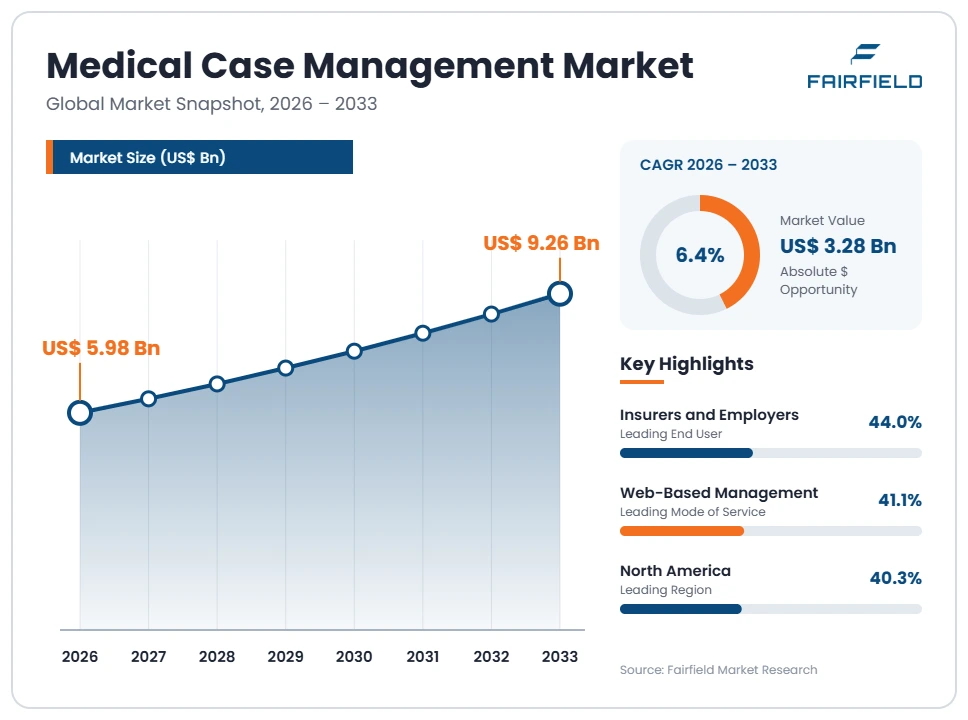
The global medical case management market size is expected to be valued at US$ 5.98 billion in 2026 and projected to reach US$ 9.26 billion by 2033, growing at a CAGR of 6.4% between 2026 and 2033.
Between 2020 and 2025, the market grew at a CAGR of about 5.7%, as the pandemic disrupted in-person reviews in 2020, then telephonic and web-based services, rising chronic disease, and pressure to control injury and disability costs lifted demand. The medical case management market covers services that coordinate care for patients with serious injuries, chronic illness, or complex medical needs, so they get the right treatment at the right time and cost. Nurse case managers, physicians, and care coordinators assess patients, plan treatment, arrange services, review bills, and help patients return to work or daily life. Services include workers’ compensation case management, disability and catastrophic injury management, chronic disease care coordination, and international assistance for travelers. They are delivered on-site, by telephone, and through web-based platforms. Growth comes from rising healthcare costs, aging populations, and digital tools. In April 2026, CorVel launched an AI suite for claims and case management.
Key Report Takeaways
- By Mode of Service: Web-Based Management held about 41.1% share in 2025 and is projected to expand at a 7.6% CAGR through 2033, the fastest pace, driven by telehealth, remote monitoring, AI-assisted summaries, and patient portals that connect case managers with patients and providers.
- By Case Type: Workers’ Compensation held about 36% share in 2025, while Chronic and Complex Conditions is projected to expand at a 7.6% CAGR through 2033, driven by aging populations, multiple chronic illnesses, and value-based care programs.
- By End User: Insurers and Employers held about 44% share in 2025, while Hospitals and Clinics is projected to expand at a 7.1% CAGR through 2033, driven by discharge planning, readmission penalties, and care transitions for high-risk patients.
- By Region: North America held about 40.3% share in 2025, while Asia Pacific is projected to expand at a 7.8% CAGR through 2033, driven by growing private insurance, rising chronic disease, and new care coordination programs in China, India, and Australia.
Global Medical Case Management Market Trends and Insights
Drivers Impact Analysis
Two drivers carry the strongest influence on medical case management market demand during the forecast period.
| Driver | Impact on CAGR Forecast | Geographic Relevance | Impact Timeline |
| Rising healthcare costs and chronic disease burden | High | Global | Long term (≥4 years) |
| Digital platforms, telehealth, and AI tools | Medium | North America, Europe, Asia Pacific | Medium term (2-4 years) |
Rising Costs Are Driving the Medical Case Management Market
Rising healthcare costs and chronic disease burden are the strongest driver of the medical case management market. Payers want to control spending.
The mechanism is the high cost of complex cases. A small share of patients with serious injuries, multiple chronic diseases, or catastrophic illness accounts for a large share of healthcare spending. Insurers, employers, and governments use case management to coordinate care, avoid unnecessary tests and hospital stays, and help patients recover faster. In workers’ compensation, case managers help injured workers get timely treatment and return to work, reducing wage replacement and medical costs. Aging populations in North America, Europe, and Asia Pacific are increasing the number of people with heart disease, diabetes, cancer, and dementia who need coordinated care. Value-based payment models reward providers for better outcomes and lower costs, encouraging investment in care coordination. These trends support long-term demand.
Digital Tools Are Expanding the Medical Case Management Market
Digital platforms, telehealth, and AI tools are expanding the medical case management market. Technology is changing how care is coordinated.
The cause is the shift to remote and data-driven services. Web-based platforms let case managers track patients, share plans with doctors, and communicate through portals and apps, while telehealth visits reduce travel. Artificial intelligence can summarize long medical records, predict which cases will become costly, and recommend next steps. In April 2026, CorVel launched CorVel Connected, adding AI summaries and predictions to its claims platform, and One Call completed its acquisition of Data Dimensions to link care coordination with payments. These tools allow each case manager to handle more cases with better results, which helps offset staff shortages. Payers increasingly ask vendors for dashboards that show savings and outcomes in real time. These trends expand sales.
Restraints Impact Analysis
Two restraints limit how quickly the medical case management market grows.
| Restraint | Impact on CAGR Forecast | Geographic Relevance | Impact Timeline |
| Shortage of qualified nurse case managers | High | North America, Europe | Long term (≥4 years) |
| Data privacy rules and fragmented health records | Medium | Global | Medium term (2-4 years) |
Staff Shortages Slow the Medical Case Management Market
A shortage of qualified nurse case managers slows the medical case management market. Skilled staff are hard to find.
The specific causes are nursing shortages and the experience required. Medical case management relies on registered nurses and other clinicians with years of experience and special certification, and hospitals compete for the same workers. Many experienced case managers are approaching retirement, and burnout after the pandemic pushed some nurses out of the profession. Higher salaries raise service costs for providers and payers. Training new case managers takes time, and caseloads can become too high, reducing quality. In Asia Pacific and Latin America, case management is a newer field with few trained professionals. These factors limit how quickly service providers can grow, even as demand from insurers, employers, and hospitals continues to rise.
Privacy Rules Restrict the Medical Case Management Market
Data privacy rules and fragmented health records restrict the medical case management market. Sharing patient data is complex.
The underlying causes are strict laws and incompatible systems. Case managers need access to medical records from many providers, but privacy laws such as HIPAA in the United States and the GDPR in Europe limit how data can be shared. Many hospitals and clinics use different record systems that do not connect easily, so case managers spend time requesting and reviewing faxed or scanned documents. Cybersecurity risks rise as more patient data moves to cloud platforms, and breaches can lead to fines and loss of trust. Patients may also be reluctant to share information with insurer-appointed case managers. Rules on AI use in health decisions are still developing. These factors restrict growth.
Market Opportunities
Chronic and Complex Care Opens a Fast-Growth Revenue Pool
Chronic and complex care opens a fast-growth revenue pool in the medical case management market. Many patients need ongoing help.
Providers can capture this opportunity. People with several chronic diseases, such as diabetes, heart failure, kidney disease, and cancer, often see many doctors and take many medicines, which raises the risk of errors and hospital readmissions. Health plans and government programs in the United States, such as Medicare Advantage, and national health systems in Europe and Asia Pacific are paying for care coordination to reduce costs. Remote monitoring devices and apps allow case managers to spot problems early. Programs for behavioral health and social needs, such as transport and housing, are also growing. Companies offering integrated chronic care management can win long-term contracts with payers and providers.
International and Travel Assistance Creates a Growth Revenue Pool
International and travel assistance creates a growth revenue pool in the medical case management market. More people travel and work abroad.
Providers can capture this opportunity as travel grows. Travelers, expatriate workers, students, and medical tourists need help when they fall ill or are injured abroad, including finding hospitals, arranging payments, and organizing medical evacuation. Companies such as Europ Assistance, Allianz Partners, and International SOS coordinate this care for insurers, employers, and universities. Travel recovery since 2022 has lifted demand, and international medical tourism for surgery, fertility treatment, and dental care is growing. Global employers with staff in remote locations need round-the-clock support, and insurers want partners who can manage costs in foreign hospitals. Companies with global networks, multilingual teams, and strong hospital relationships can grow.
Segment Analysis
- By Mode of Service: Web-Based Management Leads and Grows Fastest
Web-Based Management held about 41.1% share in 2025 and is projected to expand at a 7.6% CAGR through 2033, the fastest pace. Online platforms allow case managers to share care plans, track progress, schedule services, and communicate with patients and providers in real time. Patient portals and mobile apps improve engagement, and AI tools that summarize records and predict outcomes are being added quickly. Payers prefer web-based services because they are scalable and provide data for reporting.
Telephonic management forms the second-largest segment, offering regular check-ins and support for patients at lower cost than in-person visits. On-site case management remains important for catastrophic injuries, complex surgeries, and hospital discharge planning, where face-to-face visits help coordinate care. For the market, web-based growth supports efficiency.
- By Case Type: Workers’ Compensation Leads While Chronic and Complex Conditions Grow Fastest
Workers’ Compensation held about 36% share in 2025. Employers and insurers in the United States, Canada, and Australia rely on workers’ compensation case management to coordinate treatment for injured workers and help them return to work safely. Case managers work with doctors, therapists, employers, and claims adjusters, and early intervention can greatly reduce claim costs. Catastrophic injury cases, such as spinal cord and brain injuries, need intensive long-term management.
Chronic and Complex Conditions is the fastest-growing case type, expanding at a 7.6% CAGR through 2033. Aging populations and value-based care programs are increasing demand for coordinating care for patients with many health problems. Disability management, auto injury, and international assistance form other segments. For the market, chronic care growth widens the client base.
- By End User: Insurers and Employers Lead While Hospitals and Clinics Grow Fastest
Insurers and Employers held about 44% share in 2025. Health insurers, workers’ compensation carriers, auto insurers, self-insured employers, and third-party administrators buy case management services to control claim costs and improve outcomes. Large employers also use case management to support employees with serious illness and reduce absence.
Hospitals and Clinics is the fastest-growing end user, expanding at a 7.1% CAGR through 2033. Hospitals use case managers to plan discharges, prevent readmissions, and coordinate care transitions, driven by penalties for avoidable readmissions. Ambulatory surgical centers, specialty clinics, and government agencies form other end users. Government programs for veterans, disability, and public health also buy case management services, and some hospitals outsource case management to specialist firms to manage costs. For the market, hospital growth adds demand.
Geography Analysis
- Which Region Is Leading the Medical Case Management Market?
North America is leading the medical case management market with about 40.3% share in 2025. The United States has a large workers’ compensation system, high healthcare costs, many private health plans, and Medicare programs that pay for care coordination. Major providers such as CorVel, Enlyte’s Genex Services, One Call, and Sedgwick serve insurers and employers across the country, and AI-powered platforms are being adopted quickly. Hospitals employ large numbers of case managers to reduce readmissions. Canada adds workers’ compensation and disability management demand. Key barriers include nurse shortages and privacy rules. One change shaping the region is AI-assisted case management.
- Europe Shapes the Medical Case Management Market Through Public Health Systems
Europe is a major medical case management market. Germany, the United Kingdom, France, the Netherlands, and Italy use case management in public health systems, rehabilitation, and disability insurance, and the United Kingdom has a strong market for injury case management linked to personal injury claims. Europ Assistance and Allianz Partners lead international assistance. Aging populations are raising demand for chronic care coordination, and rehabilitation services help injured workers return to their jobs. Key barriers include strict data privacy rules under the GDPR and fragmented record systems across countries. One opportunity is digital care coordination for older adults.
- Which Region Is Growing Fastest in the Medical Case Management Market?
Asia Pacific is growing fastest in the medical case management market, expanding at a 7.8% CAGR through 2033, from about 17.5% share in 2025. Australia has an established workers’ compensation and injury management system, while China, India, Japan, and South Korea are expanding private health insurance and chronic disease programs. Rising medical tourism in Thailand, Singapore, and Malaysia adds demand for international case coordination. Governments are investing in digital health records, and insurers in China and India are piloting chronic care programs. Key barriers include few trained case managers and limited payer adoption. One change shaping the region is growing private insurance.
- Latin America Grows the Medical Case Management Market Through Private Insurance
Latin America is a growing medical case management market. Brazil, Mexico, Chile, Colombia, and Argentina have growing private health insurance markets and occupational injury insurance systems, and insurers are adopting case management to control costs. Medical tourism to Mexico and Costa Rica requires care coordination for foreign patients from North America. Telehealth use grew sharply after 2020, and insurers are adding digital care coordination for members with chronic diseases. Key barriers include limited trained staff, economic swings, fragmented health systems, and limited data sharing. One opportunity is chronic care programs offered by private insurers.
- Middle East & Africa Builds the Medical Case Management Market Through Health Insurance Growth
Middle East & Africa is an emerging medical case management market. Saudi Arabia and the United Arab Emirates have made health insurance mandatory for many residents, creating demand for care coordination, and large expatriate populations need international assistance services and multilingual support. South Africa has a developed private insurance market with case management programs for chronic disease and hospital care. Israel has strong digital health systems. International assistance companies serve travelers and workers in the region. Key barriers include limited trained professionals, uneven health systems, and data privacy concerns. One opportunity is case management for insurers in fast-growing markets.
Competitive Landscape
The medical case management market is highly fragmented. CorVel, Enlyte (Genex Services), One Call, Sedgwick, and Europ Assistance are leading players, while Allianz Partners, International SOS, EK Health Services, Paradigm, Axiom Medical, CareCloud, and Innovaccer compete strongly. Large national firms serve insurers and employers in workers’ compensation and disability, while thousands of small regional firms, independent nurse case managers, and hospital teams provide local services.
Companies compete on clinical expertise, outcomes such as return-to-work rates and cost savings, network coverage, technology platforms, reporting, and price. Insurers and employers favor providers that can show measurable results and connect case management with bill review, pharmacy, and network services. Technology investment is now a key difference, as AI tools and integrated platforms help case managers handle more cases with better outcomes.
Strategic moves show how competition is changing. In February 2025, Innovaccer launched AI agents to automate care coordination tasks. In April 2026, CorVel launched CorVel Connected, adding AI summaries and predictions to its claims platform. Also in April 2026, One Call completed its acquisition of Data Dimensions to link care coordination with data exchange and payments. These moves show competition shifting toward AI-powered, integrated platforms.
Three themes shape vendor strategy. First, companies are adding AI to summarize records and predict costly cases. Second, they are combining case management with claims, billing, and payments. Third, they are growing in chronic care and in Asia Pacific, where insurance coverage is expanding.
Medical Case Management Market Industry Leaders
CorVel Enlyte (Genex Services) One Call Sedgwick Europ Assistance
Recent Industry Developments
- April 2026: CorVel launched CorVel Connected, an AI suite adding claim summaries, natural-language questions, reserve predictions, and recommended next actions to its claims platform - advances digital tools in the medical case management market.
- April 2026: One Call completed its acquisition of Data Dimensions, adding data exchange and payment capabilities to its care coordination platform - links clinical workflows and payments across claims.
- February 2025: Innovaccer launched its Agents of Care suite of AI agents to automate repetitive care coordination tasks - supports efficiency for case managers and health systems.
Companies Covered in the Report
- CorVel
- Enlyte (Genex Services)
- One Call
- Sedgwick
- Europ Assistance
- Allianz Partners
- International SOS
- EK Health Services
- Paradigm
- Axiom Medical
- CareCloud
- Innovaccer
Medical Case Management Market Report Scope
| Metric | Value |
| Study Period | 2020-2033 |
| Market Size 2026 | US$ 5.98 Billion |
| Market Size 2033 | US$ 9.26 Billion |
| CAGR 2026-2033 | 6.4% |
| Absolute Dollar Opportunity | US$ 3.28 Billion |
| Largest Market | North America |
| Fastest-Growing Market | Asia Pacific |
| Market Concentration | Highly Fragmented |
| Major Players | CorVel, Enlyte (Genex Services), One Call, Sedgwick, Europ Assistance |
Medical Case Management Market Segmentation
- Executive Summary
- Global Medical Case Management Market Snapshot
- Future Projections, 2026–2033
- Key Industry Highlights
- Regional Snapshot
- Market Overview
- Market Definition and Report Scope
- Historical Market Trends
- Market Dynamics
- Drivers
- Rising Costs Are Driving the Medical Case Management Market
- Digital Tools Are Expanding the Medical Case Management Market
- Restraints
- Staff Shortages Slow the Medical Case Management Market
- Privacy Rules Restrict the Medical Case Management Market
- Market Opportunities
- Chronic and Complex Care Opens a Fast-Growth Revenue Pool
- International and Travel Assistance Creates a Growth Revenue Pool
- Drivers
- Global Medical Case Management Market Outlook, 2020–2033
- Global Medical Case Management Market Outlook, by Mode of Service, Value (US$ Billion), 2020–2033
- On-Site Management
- Telephonic Management
- Web-Based Management
- Global Medical Case Management Market Outlook, by Case Type, Value (US$ Billion), 2020–2033
- Workers' Compensation
- Chronic and Complex Conditions
- Disability and Catastrophic Injury
- International Assistance
- Others
- Global Medical Case Management Market Outlook, by End User, Value (US$ Billion), 2020–2033
- Insurers and Employers
- Hospitals and Clinics
- Ambulatory Surgical Centers
- Government Agencies
- Global Medical Case Management Market Outlook, by Region, Value (US$ Billion), 2020–2033
- North America
- Europe
- Asia Pacific
- Latin America
- Middle East & Africa
- Global Medical Case Management Market Outlook, by Mode of Service, Value (US$ Billion), 2020–2033
- North America Medical Case Management Market Outlook, 2020–2033
- North America Medical Case Management Market Outlook, by Mode of Service, Value (US$ Billion), 2020–2033
- On-Site Management
- Telephonic Management
- Web-Based Management
- North America Medical Case Management Market Outlook, by Case Type, Value (US$ Billion), 2020–2033
- Workers' Compensation
- Chronic and Complex Conditions
- Disability and Catastrophic Injury
- International Assistance
- Others
- North America Medical Case Management Market Outlook, by End User, Value (US$ Billion), 2020–2033
- Insurers and Employers
- Hospitals and Clinics
- Ambulatory Surgical Centers
- Government Agencies
- North America Medical Case Management Market Outlook, by Country, Value (US$ Billion), 2020–2033
- United States Medical Case Management Market Outlook, by Mode of Service, 2020–2033
- United States Medical Case Management Market Outlook, by Case Type, 2020–2033
- United States Medical Case Management Market Outlook, by End User, 2020–2033
- Canada Medical Case Management Market Outlook, by Mode of Service, 2020–2033
- Canada Medical Case Management Market Outlook, by Case Type, 2020–2033
- Canada Medical Case Management Market Outlook, by End User, 2020–2033
- North America Medical Case Management Market Outlook, by Mode of Service, Value (US$ Billion), 2020–2033
- Europe Medical Case Management Market Outlook, 2020–2033
- Europe Medical Case Management Market Outlook, by Mode of Service, Value (US$ Billion), 2020–2033
- On-Site Management
- Telephonic Management
- Web-Based Management
- Europe Medical Case Management Market Outlook, by Case Type, Value (US$ Billion), 2020–2033
- Workers' Compensation
- Chronic and Complex Conditions
- Disability and Catastrophic Injury
- International Assistance
- Others
- Europe Medical Case Management Market Outlook, by End User, Value (US$ Billion), 2020–2033
- Insurers and Employers
- Hospitals and Clinics
- Ambulatory Surgical Centers
- Government Agencies
- Europe Medical Case Management Market Outlook, by Country, Value (US$ Billion), 2020–2033
- Germany Medical Case Management Market Outlook, by Mode of Service, 2020–2033
- Germany Medical Case Management Market Outlook, by Case Type, 2020–2033
- Germany Medical Case Management Market Outlook, by End User, 2020–2033
- United Kingdom Medical Case Management Market Outlook, by Mode of Service, 2020–2033
- United Kingdom Medical Case Management Market Outlook, by Case Type, 2020–2033
- United Kingdom Medical Case Management Market Outlook, by End User, 2020–2033
- France Medical Case Management Market Outlook, by Mode of Service, 2020–2033
- France Medical Case Management Market Outlook, by Case Type, 2020–2033
- France Medical Case Management Market Outlook, by End User, 2020–2033
- Netherlands Medical Case Management Market Outlook, by Mode of Service, 2020–2033
- Netherlands Medical Case Management Market Outlook, by Case Type, 2020–2033
- Netherlands Medical Case Management Market Outlook, by End User, 2020–2033
- Italy Medical Case Management Market Outlook, by Mode of Service, 2020–2033
- Italy Medical Case Management Market Outlook, by Case Type, 2020–2033
- Italy Medical Case Management Market Outlook, by End User, 2020–2033
- Europe Medical Case Management Market Outlook, by Mode of Service, Value (US$ Billion), 2020–2033
- Asia Pacific Medical Case Management Market Outlook, 2020–2033
- Asia Pacific Medical Case Management Market Outlook, by Mode of Service, Value (US$ Billion), 2020–2033
- On-Site Management
- Telephonic Management
- Web-Based Management
- Asia Pacific Medical Case Management Market Outlook, by Case Type, Value (US$ Billion), 2020–2033
- Workers' Compensation
- Chronic and Complex Conditions
- Disability and Catastrophic Injury
- International Assistance
- Others
- Asia Pacific Medical Case Management Market Outlook, by End User, Value (US$ Billion), 2020–2033
- Insurers and Employers
- Hospitals and Clinics
- Ambulatory Surgical Centers
- Government Agencies
- Asia Pacific Medical Case Management Market Outlook, by Country, Value (US$ Billion), 2020–2033
- Australia Medical Case Management Market Outlook, by Mode of Service, 2020–2033
- Australia Medical Case Management Market Outlook, by Case Type, 2020–2033
- Australia Medical Case Management Market Outlook, by End User, 2020–2033
- China Medical Case Management Market Outlook, by Mode of Service, 2020–2033
- China Medical Case Management Market Outlook, by Case Type, 2020–2033
- China Medical Case Management Market Outlook, by End User, 2020–2033
- India Medical Case Management Market Outlook, by Mode of Service, 2020–2033
- India Medical Case Management Market Outlook, by Case Type, 2020–2033
- India Medical Case Management Market Outlook, by End User, 2020–2033
- Japan Medical Case Management Market Outlook, by Mode of Service, 2020–2033
- Japan Medical Case Management Market Outlook, by Case Type, 2020–2033
- Japan Medical Case Management Market Outlook, by End User, 2020–2033
- South Korea Medical Case Management Market Outlook, by Mode of Service, 2020–2033
- South Korea Medical Case Management Market Outlook, by Case Type, 2020–2033
- South Korea Medical Case Management Market Outlook, by End User, 2020–2033
- Thailand Medical Case Management Market Outlook, by Mode of Service, 2020–2033
- Thailand Medical Case Management Market Outlook, by Case Type, 2020–2033
- Thailand Medical Case Management Market Outlook, by End User, 2020–2033
- Singapore Medical Case Management Market Outlook, by Mode of Service, 2020–2033
- Singapore Medical Case Management Market Outlook, by Case Type, 2020–2033
- Singapore Medical Case Management Market Outlook, by End User, 2020–2033
- Malaysia Medical Case Management Market Outlook, by Mode of Service, 2020–2033
- Malaysia Medical Case Management Market Outlook, by Case Type, 2020–2033
- Malaysia Medical Case Management Market Outlook, by End User, 2020–2033
- Asia Pacific Medical Case Management Market Outlook, by Mode of Service, Value (US$ Billion), 2020–2033
- Latin America Medical Case Management Market Outlook, 2020–2033
- Latin America Medical Case Management Market Outlook, by Mode of Service, Value (US$ Billion), 2020–2033
- On-Site Management
- Telephonic Management
- Web-Based Management
- Latin America Medical Case Management Market Outlook, by Case Type, Value (US$ Billion), 2020–2033
- Workers' Compensation
- Chronic and Complex Conditions
- Disability and Catastrophic Injury
- International Assistance
- Others
- Latin America Medical Case Management Market Outlook, by End User, Value (US$ Billion), 2020–2033
- Insurers and Employers
- Hospitals and Clinics
- Ambulatory Surgical Centers
- Government Agencies
- Latin America Medical Case Management Market Outlook, by Country, Value (US$ Billion), 2020–2033
- Brazil Medical Case Management Market Outlook, by Mode of Service, 2020–2033
- Brazil Medical Case Management Market Outlook, by Case Type, 2020–2033
- Brazil Medical Case Management Market Outlook, by End User, 2020–2033
- Mexico Medical Case Management Market Outlook, by Mode of Service, 2020–2033
- Mexico Medical Case Management Market Outlook, by Case Type, 2020–2033
- Mexico Medical Case Management Market Outlook, by End User, 2020–2033
- Chile Medical Case Management Market Outlook, by Mode of Service, 2020–2033
- Chile Medical Case Management Market Outlook, by Case Type, 2020–2033
- Chile Medical Case Management Market Outlook, by End User, 2020–2033
- Colombia Medical Case Management Market Outlook, by Mode of Service, 2020–2033
- Colombia Medical Case Management Market Outlook, by Case Type, 2020–2033
- Colombia Medical Case Management Market Outlook, by End User, 2020–2033
- Argentina Medical Case Management Market Outlook, by Mode of Service, 2020–2033
- Argentina Medical Case Management Market Outlook, by Case Type, 2020–2033
- Argentina Medical Case Management Market Outlook, by End User, 2020–2033
- Costa Rica Medical Case Management Market Outlook, by Mode of Service, 2020–2033
- Costa Rica Medical Case Management Market Outlook, by Case Type, 2020–2033
- Costa Rica Medical Case Management Market Outlook, by End User, 2020–2033
- Latin America Medical Case Management Market Outlook, by Mode of Service, Value (US$ Billion), 2020–2033
- Middle East & Africa Medical Case Management Market Outlook, 2020–2033
- Middle East & Africa Medical Case Management Market Outlook, by Mode of Service, Value (US$ Billion), 2020–2033
- On-Site Management
- Telephonic Management
- Web-Based Management
- Middle East & Africa Medical Case Management Market Outlook, by Case Type, Value (US$ Billion), 2020–2033
- Workers' Compensation
- Chronic and Complex Conditions
- Disability and Catastrophic Injury
- International Assistance
- Others
- Middle East & Africa Medical Case Management Market Outlook, by End User, Value (US$ Billion), 2020–2033
- Insurers and Employers
- Hospitals and Clinics
- Ambulatory Surgical Centers
- Government Agencies
- Middle East & Africa Medical Case Management Market Outlook, by Country, Value (US$ Billion), 2020–2033
- Saudi Arabia Medical Case Management Market Outlook, by Mode of Service, 2020–2033
- Saudi Arabia Medical Case Management Market Outlook, by Case Type, 2020–2033
- Saudi Arabia Medical Case Management Market Outlook, by End User, 2020–2033
- United Arab Emirates Medical Case Management Market Outlook, by Mode of Service, 2020–2033
- United Arab Emirates Medical Case Management Market Outlook, by Case Type, 2020–2033
- United Arab Emirates Medical Case Management Market Outlook, by End User, 2020–2033
- South Africa Medical Case Management Market Outlook, by Mode of Service, 2020–2033
- South Africa Medical Case Management Market Outlook, by Case Type, 2020–2033
- South Africa Medical Case Management Market Outlook, by End User, 2020–2033
- Israel Medical Case Management Market Outlook, by Mode of Service, 2020–2033
- Israel Medical Case Management Market Outlook, by Case Type, 2020–2033
- Israel Medical Case Management Market Outlook, by End User, 2020–2033
- Middle East & Africa Medical Case Management Market Outlook, by Mode of Service, Value (US$ Billion), 2020–2033
- Competitive Landscape
- Industry Leaders
- Recent Industry Developments
- Company Profiles
- CorVel
- Enlyte (Genex Services)
- One Call
- Sedgwick
- Europ Assistance
- Allianz Partners
- International SOS
- EK Health Services
- Paradigm
- Axiom Medical
- CareCloud
- Innovaccer
- Appendix
- Research Methodology
- Report Assumptions
- Acronyms and Abbreviations
Mode of Service
- On-Site Management
- Telephonic Management
- Web-Based Management
Case Type
- Workers’ Compensation
- Chronic and Complex Conditions
- Disability and Catastrophic Injury
- International Assistance
- Others
End User
- Insurers and Employers
- Hospitals and Clinics
- Ambulatory Surgical Centers
- Government Agencies
Regions
- North America
- Europe
- Asia Pacific
- Latin America
- Middle East & Africa
Our Research Methodology
Considering the volatility of business today, traditional approaches to strategizing a game plan can be unfruitful if not detrimental. True ambiguity is no way to determine a forecast. A myriad of predetermined factors must be accounted for such as the degree of risk involved, the magnitude of circumstances, as well as conditions or consequences that are not known or unpredictable. To circumvent binary views that cast uncertainty, the application of market research intelligence to strategically posture, move, and enable actionable outcomes is necessary.
View Methodology
Quality Assured
Rigorous Validation Process

Confidentiality Assured
End-to-end Data Security

Custom Research Services
Tailored To Your Objectives
FAQs
The medical case management market is valued at US$ 5.98 billion in 2026, led by web-based services and North America.
The market is projected to reach US$ 9.26 billion by 2033, growing at a 6.4% CAGR and adding US$ 3.28 billion.
Web-based management leads with about 41.1% share in 2025 and grows fastest at 7.6%, driven by telehealth and AI tools.
Asia Pacific is growing fastest at a 7.8% CAGR through 2033, driven by growing private insurance and chronic care programs in China.
North America holds the largest share at about 40.3% in 2025, supported by large workers’ compensation systems and leading providers.
Related Reports
Drug Discovery Informatics Market Size, Share, Insights, Competitive Landscape, and Forecast 2026 to 2033
Drug discovery informatics market is forecast to grow from US$ 3.7 billion in 2026 to US$ 6.9 billion by 2033 at 9.3% CAGR, driven by AI and cloud adoption.
Medical Device Security Market Size, Share, Insights, Competitive Landscape, and Forecast 2026 to 2033
The global medical device security market is valued at US$6.8 billion in 2026, reaching US$12.0 billion by 2033, growing at an 8.4% CAGR
Healthcare IT Integration Market Size, Share, Insights, Competitive Landscape, and Forecast 2026 to 2033
The global healthcare IT integration market is valued at US$4.9 billion in 2026, reaching US$10.6 billion by 2033, growing at an 11.7% CAGR
Veterinary Telehealth Market Size, Share, Insights, Competitive Landscape, and Forecast 2026 to 2033
Veterinary telehealth market to grow from US$ 0.6 billion in 2026 to US$ 1.5 billion by 2033 at a 14.0% CAGR. Explore services, segments and regional insights.
Chemical Peel Market Size, Share, Insights, Competitive Landscape, and Forecast 2026 to 2033
The chemical peel market is projected to grow from US$2.4 billion in 2026 to US$4.3 billion by 2033, at an 8.7% CAGR. Explore segments and regional trends.
Smart Home Health Market Size, Share, Insights, Competitive Landscape, and Forecast 2026 to 2033
The smart home health market is projected to grow from US$5.80 billion in 2026 to US$9.90 billion by 2033, at a 7.9% CAGR, driven by aging and home monitoring.