



Farm Animal Healthcare Market
Farm Animal Healthcare Market Insights, Competitive Landscape, and Market Forecast - 2033
Global Farm Animal Healthcare Market Forecast
- Global farm animal healthcare market revenue to reach USD 34.6 Bn in 2033, up from USD 24.34 Bn recorded in 2026
- Farm animal healthcare market size poised to expand at a CAGR of 5% between 2026 and 2033
Quick Report Digest
A Look Back and a Look Forward - Comparative Analysis
The worldwide market for farm animal healthcare is presently undergoing substantial expansion, propelled by technological progress, mounting apprehensions regarding animal welfare, and an expanding emphasis on preventative healthcare protocols. Innovative technologies such as digital health monitoring and precision agriculture are transforming treatment methodologies, resulting in enhanced productivity and disease control. An increasing number of businesses are adopting organic and sustainable agricultural methods, which reflects a worldwide trend toward environmentally responsible farming.
The market for farm animal healthcare has experienced significant changes over the last decade. An examination of the historical context unveils a shift from traditional treatment modalities to one that is more technologically advanced and integrated. The pervasive implementation of medical feed additives, vaccines, and parasiticides reflects a transition from reactive to proactive healthcare strategies for farm animals.
The market for farm animal healthcare is anticipated to continue expanding in the coming years. As the demand for livestock and dairy products continues to be propelled by a growing global population, preventive healthcare measures and the incorporation of big data analytics will remain focal points. Anticipated developments in treatment modalities include a continued emphasis on sustainability and the implementation of cutting-edge technologies to optimise farm management.
Key Growth Factors
- Technological Advancements in Precision Farming
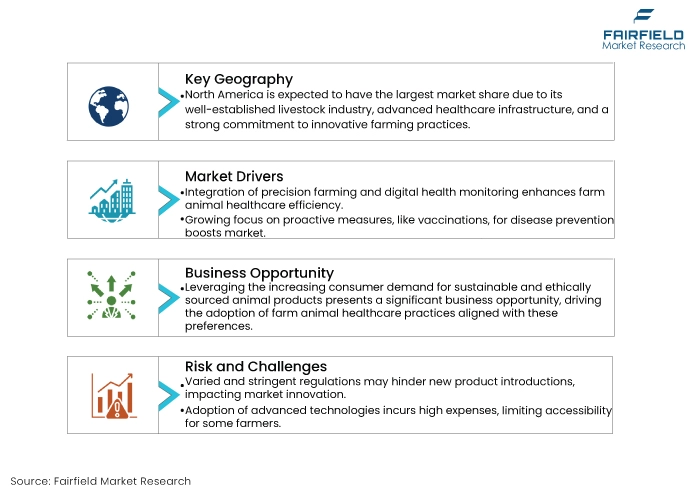
The exponential expansion of precision agricultural technologies is a critical factor propelling the worldwide farm animal healthcare industry. Precision agriculture employs data analytics, IoT devices, and sensors to monitor and manage animal health in real time.
By integrating this technology, producers proactively detect health concerns, optimise their feeding methods, and execute focused treatment strategies. In addition to increasing farm output, the implementation of precision farming reduces the likelihood of disease outbreaks, thereby stimulating the market for advanced healthcare solutions.
- Growing Focus on Preventive Healthcare
The increasing focus on preventive healthcare measures is a substantial factor influencing the market for agricultural animal healthcare. There is an increasing global awareness among farmers regarding the economic advantages that can be derived from proactive disease prevention as opposed to reactive treatment.
The increased adoption of early disease detection technologies, vaccines, and biosecurity measures is a direct result of this mentality shift. Preventive healthcare serves to safeguard the welfare of farm animals while simultaneously promoting sustainable farming methods, which is in line with the increasing consumer inclination towards animal products that are sourced ethically and are healthy in nature.
- Growing Demand for Animal-Based Products
The increasing global desire for animal products such as flesh and dairy is a significant factor supporting the growth of the farm animal healthcare industry. As the world's population increases, there is a corresponding demand for a reliable and secure provision of sustenance derived from animals.
Farmers are under considerable pressure to preserve the health and productivity of their livestock in response to this demand. As a result, there is an increased emphasis on sophisticated healthcare solutions, such as medical feed additives and vaccines, in order to facilitate optimal growth, avert diseases, and satisfy the growing demands of the worldwide food supply chain.
Major Growth Barriers
- Regulatory Challenges and Compliance-Related Challenges
The market for agricultural animal healthcare is hampered by regionally diverse and complex regulatory frameworks. Market participants encounter difficulties in adhering to a variety of compliance standards, which has repercussions on the introduction and certification of new products. This complexity may restrict the market's development potential and impede innovation.
- Higher Costs
Although advantageous, the implementation of state-of-the-art technologies in farm animal healthcare is accompanied by substantial financial investments. Particularly for farmers in developing regions, the costs associated with precision farming instruments, digital health monitoring systems, and advanced diagnostics may be prohibitive. Market accessibility may be restricted and widespread adoption may be impeded by this cost barrier.
Key Trends and Opportunities to Look at
The farm animal healthcare industry is experiencing a significant increase in the adoption of digital health monitoring, expanding at a rate of 15% per year. This phenomenon is acquiring traction in North America, Europe, and Asia Pacific.
Merck Animal Health, and Zoetis are among the companies investing in intelligent devices for real-time health monitoring. It is probable that brands will capitalise on this trend by providing integrated solutions that enable producers to obtain practical insights for proactive healthcare management and enhanced productivity.
- Sustainable and Organic Practices
- Integration of Precision Farming Technologies
The adoption of sustainable and organic farm animal healthcare practices is experiencing substantial expansion, increasing at a rate of 20% per annum. Cargill and Bayer, well-known in Europe, North America, and Latin America, are placing an emphasis on environmentally sustainable solutions.
Brands are positioned to leverage this trend by introducing herbal supplements and organic therapies, catering to consumer inclinations towards animal products that are environmentally sustainable and ethically sourced.
The implementation of precision agricultural technologies is experiencing substantial annual growth, amounting to 18%, and is particularly prevalent in the regions of North America, Europe, and Asia Pacific. Boehringer Ingelheim, and Elanco are among the major firms investing in IoT-based solutions.
It is anticipated that brands will capitalise on this trend by providing integrated platforms, optimising farm management, and strengthening disease prevention measures; this will ultimately result in increased profitability, and efficiency.
How Does the Regulatory Scenario Shape this Industry?
The worldwide market for farm animal healthcare functions within an intricate regulatory structure, wherein numerous regulatory bodies establish rigorous criteria. Animal health products are regulated by the FDA in the United States in accordance with the Federal Food, Drug, and Cosmetic Act. In the European Union, the European Medicines Agency (EMA) regulates veterinary medicines in a vital capacity. These governing bodies enforce protocols that guarantee the quality, safety, and effectiveness of animal healthcare products.
The Veterinary Medicines Regulation of the European Union, which went into effect in 2022, is an example of a recent region-specific regulatory change that prioritises greater efficacy and transparency in the approval of veterinary medicines. Regulatory changes have a significant impact on market dynamics, which in turn affects the schedules for product development and the ability to enter a market. Adhering to these dynamic standards becomes critical for participants in the market, influencing their approaches to manoeuvre through the perpetually shifting regulatory environment.
Fairfield’s Ranking Board
Top Segments
It is anticipated that the vaccines category will hold the largest market share among the segments enumerated. Vaccines are positioned as an essential component of the farm animal healthcare market as a whole due to the growing awareness of the advantages of vaccination in disease control and the increasing emphasis on preventive healthcare practices for farm animals. Vaccine demand is primarily motivated by the imperative to safeguard the welfare of livestock and preserve a productive and robust animal population.
The market segment referred to as medical feed additives is anticipated to witness the most rapid expansion within the farm animal healthcare industry. In light of the increasing emphasis on improving the nutritional value of animal feed to enhance health outcomes, medical feed additives assume a critical function. The expansion of this sector is driven by the growing awareness of the significance of nutrition in promoting animal health, which in turn contributes to improved growth rates, disease prevention, and overall productivity on farms. In the future years, this increased awareness is anticipated to fuel the medical feed additives market's explosive growth.
- Poultry Continues to be at the Leadership Position
It is anticipated that, of the animal species enumerated, the poultry segment will hold the most substantial market share in the worldwide farm animal healthcare market. Large-scale operations characterise poultry farming, which is propelled by the rising global demand for poultry products. As a result, comprehensive healthcare measures, such as vaccinations and disease prevention strategies, are required. The prevailing market dominance of the poultry industry can be attributed to its substantial scale and economic importance.
The segment referred to as other animal types is anticipated to witness the most rapid expansion within the farm animal healthcare industry. This broad classification includes an assortment of creatures that extend beyond the primary classifications of bovine, porcine, avian, and sheep. As agricultural practices become more diversified and the public becomes more cognizant of the healthcare requirements of less conventional livestock, such as rabbits, goats, and exotic animals, this market segment expands. The market is anticipated to expand at a rapid rate due to the increased demand for healthcare solutions specifically designed for other animal types as farmers investigate novel approaches.
Regional Frontrunners
North America to Occupy the Largest Market Share
With the highest potential market share, North America is positioned to dominate the global farm animal healthcare industry. The supremacy can be ascribed to the region's firmly established livestock sector, which is bolstered by a sophisticated healthcare infrastructure and a robust emphasis on research and development.
The market dynamics are significantly influenced by the US, primarily due to its strong regulatory framework and considerable investments in technological progress. A key contributor to the industry as a whole, the farm animal healthcare market in North America is characterised by its advanced and mature status. It possesses the largest market share owing to its enduring dedication to pioneering and effective farming methodologies.
Asia Pacific to Register the Fastest CAGR Through 2030
It is anticipated that the Asia Pacific region will witness the most rapid expansion in market penetration within the worldwide farm animal healthcare industry. Increasing disposable income, a growing population, and shifting dietary preferences all contribute to the region's expanding demand for animal products. At a CAGR that surpasses that of other regions, the Asia Pacific offers substantial prospects for the expansion of markets.
A growing need for sustainable farming practices, improved economic conditions, and increased awareness of animal welfare are all contributing to the accelerated growth of the farm animal healthcare market in Asia-Pacific nations. The exponential growth of Asia Pacific establishes the region as a significant contributor to the evolution of the worldwide market.
Who are the Leaders in the Global Farm Animal Healthcare Space?
- Boehringer Ingelheim International GmbH
- Ceva Animal Health Inc.
- Elanco
- Hester Biosciences Limited
- Merck & Co. Inc.
- Phibro Animal Health
- Vetoquinol
- Zoetis Inc.
- Norbrook
- Alivira Animal Health Limited
An Expert’s Eye
Demand and Future Growth
Anticipated future expansion of the worldwide farm animal healthcare market is contingent upon a number of critical factors. The anticipated growth of the middle class and the expanding global population are factors that will propel the demand for animal products, thereby consistently underscoring the importance of effective and morally sound farm management.
Increasing consumer consciousness regarding food quality and safety will stimulate the demand for sophisticated healthcare solutions that guarantee disease-free and healthy livestock. Furthermore, it is expected that the rising prevalence of sustainable and organic agricultural methods will propel the market's expansion in the long run, as consumers seek animal products that are responsibly sourced.
Supply Side of the Market
Despite robust demand, industry participants encounter difficulties with regard to supply. The progress of innovation can be hindered by the timely introduction of new products due to regulatory obstacles and compliance complexities.
In developing regions, the high costs associated with the implementation of advanced healthcare technologies also present a barrier for some producers. It is imperative for market participants to strike a balance between cost-effective and efficient solutions in order to promote accessibility and inclusivity, thereby facilitating the worldwide implementation of farm animal healthcare practices.
Global Farm Animal Healthcare Market is Segmented as Below:
By Product:
- Vaccines
- Parasiticides
- Anti-infectives
- Medical Feed Additives
- Other Products
By Animal Type:
- Cattle
- Swine
- Poultry
- Sheep
- Other Animal Types
By Geographic Coverage:
- North America
- Europe
- Asia Pacific
- Latin America
- Middle East & Africa
- Executive Summary
- Global Farm Animal Healthcare Market Snapshot
- Future Projections
- Key Market Trends
- Regional Snapshot, by Value, 2026
- Analyst Recommendations
- Market Overview
- Market Definitions and Segmentations
- Market Dynamics
- Drivers
- Restraints
- Market Opportunities
- Value Chain Analysis
- COVID-19 Impact Analysis
- Porter's Five Forces Analysis
- Impact of Russia-Ukraine Conflict
- PESTLE Analysis
- Regulatory Analysis
- Price Trend Analysis
- Current Prices and Future Projections, 2025-2033
- Price Impact Factors
- Global Farm Animal Healthcare Market Outlook, 2020 - 2033
- Global Farm Animal Healthcare Market Outlook, by Product, Value (US$ Bn), 2020-2033
- Vaccines
- Parasiticides
- Anti-infectives
- Medical Feed Additives
- Other Products
- Global Farm Animal Healthcare Market Outlook, by Animal Type, Value (US$ Bn), 2020-2033
- Cattle
- Swine
- Poultry
- Sheep
- Other Animal Types
- Global Farm Animal Healthcare Market Outlook, by Region, Value (US$ Bn), 2020-2033
- North America
- Europe
- Asia Pacific
- Latin America
- Middle East & Africa
- Global Farm Animal Healthcare Market Outlook, by Product, Value (US$ Bn), 2020-2033
- North America Farm Animal Healthcare Market Outlook, 2020 - 2033
- North America Farm Animal Healthcare Market Outlook, by Product, Value (US$ Bn), 2020-2033
- Vaccines
- Parasiticides
- Anti-infectives
- Medical Feed Additives
- Other Products
- North America Farm Animal Healthcare Market Outlook, by Animal Type, Value (US$ Bn), 2020-2033
- Cattle
- Swine
- Poultry
- Sheep
- Other Animal Types
- North America Farm Animal Healthcare Market Outlook, by Country, Value (US$ Bn), 2020-2033
- U.S. Farm Animal Healthcare Market Outlook, by Product, 2020-2033
- U.S. Farm Animal Healthcare Market Outlook, by Animal Type, 2020-2033
- Canada Farm Animal Healthcare Market Outlook, by Product, 2020-2033
- Canada Farm Animal Healthcare Market Outlook, by Animal Type, 2020-2033
- BPS Analysis/Market Attractiveness Analysis
- North America Farm Animal Healthcare Market Outlook, by Product, Value (US$ Bn), 2020-2033
- Europe Farm Animal Healthcare Market Outlook, 2020 - 2033
- Europe Farm Animal Healthcare Market Outlook, by Product, Value (US$ Bn), 2020-2033
- Vaccines
- Parasiticides
- Anti-infectives
- Medical Feed Additives
- Other Products
- Europe Farm Animal Healthcare Market Outlook, by Animal Type, Value (US$ Bn), 2020-2033
- Cattle
- Swine
- Poultry
- Sheep
- Other Animal Types
- Europe Farm Animal Healthcare Market Outlook, by Country, Value (US$ Bn), 2020-2033
- Germany Farm Animal Healthcare Market Outlook, by Product, 2020-2033
- Germany Farm Animal Healthcare Market Outlook, by Animal Type, 2020-2033
- Italy Farm Animal Healthcare Market Outlook, by Product, 2020-2033
- Italy Farm Animal Healthcare Market Outlook, by Animal Type, 2020-2033
- France Farm Animal Healthcare Market Outlook, by Product, 2020-2033
- France Farm Animal Healthcare Market Outlook, by Animal Type, 2020-2033
- U.K. Farm Animal Healthcare Market Outlook, by Product, 2020-2033
- U.K. Farm Animal Healthcare Market Outlook, by Animal Type, 2020-2033
- Spain Farm Animal Healthcare Market Outlook, by Product, 2020-2033
- Spain Farm Animal Healthcare Market Outlook, by Animal Type, 2020-2033
- Russia Farm Animal Healthcare Market Outlook, by Product, 2020-2033
- Russia Farm Animal Healthcare Market Outlook, by Animal Type, 2020-2033
- Rest of Europe Farm Animal Healthcare Market Outlook, by Product, 2020-2033
- Rest of Europe Farm Animal Healthcare Market Outlook, by Animal Type, 2020-2033
- BPS Analysis/Market Attractiveness Analysis
- Europe Farm Animal Healthcare Market Outlook, by Product, Value (US$ Bn), 2020-2033
- Asia Pacific Farm Animal Healthcare Market Outlook, 2020 - 2033
- Asia Pacific Farm Animal Healthcare Market Outlook, by Product, Value (US$ Bn), 2020-2033
- Vaccines
- Parasiticides
- Anti-infectives
- Medical Feed Additives
- Other Products
- Asia Pacific Farm Animal Healthcare Market Outlook, by Animal Type, Value (US$ Bn), 2020-2033
- Cattle
- Swine
- Poultry
- Sheep
- Other Animal Types
- Asia Pacific Farm Animal Healthcare Market Outlook, by Country, Value (US$ Bn), 2020-2033
- China Farm Animal Healthcare Market Outlook, by Product, 2020-2033
- China Farm Animal Healthcare Market Outlook, by Animal Type, 2020-2033
- Japan Farm Animal Healthcare Market Outlook, by Product, 2020-2033
- Japan Farm Animal Healthcare Market Outlook, by Animal Type, 2020-2033
- South Korea Farm Animal Healthcare Market Outlook, by Product, 2020-2033
- South Korea Farm Animal Healthcare Market Outlook, by Animal Type, 2020-2033
- India Farm Animal Healthcare Market Outlook, by Product, 2020-2033
- India Farm Animal Healthcare Market Outlook, by Animal Type, 2020-2033
- Southeast Asia Farm Animal Healthcare Market Outlook, by Product, 2020-2033
- Southeast Asia Farm Animal Healthcare Market Outlook, by Animal Type, 2020-2033
- Rest of SAO Farm Animal Healthcare Market Outlook, by Product, 2020-2033
- Rest of SAO Farm Animal Healthcare Market Outlook, by Animal Type, 2020-2033
- BPS Analysis/Market Attractiveness Analysis
- Asia Pacific Farm Animal Healthcare Market Outlook, by Product, Value (US$ Bn), 2020-2033
- Latin America Farm Animal Healthcare Market Outlook, 2020 - 2033
- Latin America Farm Animal Healthcare Market Outlook, by Product, Value (US$ Bn), 2020-2033
- Vaccines
- Parasiticides
- Anti-infectives
- Medical Feed Additives
- Other Products
- Latin America Farm Animal Healthcare Market Outlook, by Animal Type, Value (US$ Bn), 2020-2033
- Cattle
- Swine
- Poultry
- Sheep
- Other Animal Types
- Latin America Farm Animal Healthcare Market Outlook, by Country, Value (US$ Bn), 2020-2033
- Brazil Farm Animal Healthcare Market Outlook, by Product, 2020-2033
- Brazil Farm Animal Healthcare Market Outlook, by Animal Type, 2020-2033
- Mexico Farm Animal Healthcare Market Outlook, by Product, 2020-2033
- Mexico Farm Animal Healthcare Market Outlook, by Animal Type, 2020-2033
- Argentina Farm Animal Healthcare Market Outlook, by Product, 2020-2033
- Argentina Farm Animal Healthcare Market Outlook, by Animal Type, 2020-2033
- Rest of LATAM Farm Animal Healthcare Market Outlook, by Product, 2020-2033
- Rest of LATAM Farm Animal Healthcare Market Outlook, by Animal Type, 2020-2033
- BPS Analysis/Market Attractiveness Analysis
- Latin America Farm Animal Healthcare Market Outlook, by Product, Value (US$ Bn), 2020-2033
- Middle East & Africa Farm Animal Healthcare Market Outlook, 2020 - 2033
- Middle East & Africa Farm Animal Healthcare Market Outlook, by Product, Value (US$ Bn), 2020-2033
- Vaccines
- Parasiticides
- Anti-infectives
- Medical Feed Additives
- Other Products
- Middle East & Africa Farm Animal Healthcare Market Outlook, by Animal Type, Value (US$ Bn), 2020-2033
- Cattle
- Swine
- Poultry
- Sheep
- Other Animal Types
- Middle East & Africa Farm Animal Healthcare Market Outlook, by Country, Value (US$ Bn), 2020-2033
- GCC Farm Animal Healthcare Market Outlook, by Product, 2020-2033
- GCC Farm Animal Healthcare Market Outlook, by Animal Type, 2020-2033
- South Africa Farm Animal Healthcare Market Outlook, by Product, 2020-2033
- South Africa Farm Animal Healthcare Market Outlook, by Animal Type, 2020-2033
- Egypt Farm Animal Healthcare Market Outlook, by Product, 2020-2033
- Egypt Farm Animal Healthcare Market Outlook, by Animal Type, 2020-2033
- Nigeria Farm Animal Healthcare Market Outlook, by Product, 2020-2033
- Nigeria Farm Animal Healthcare Market Outlook, by Animal Type, 2020-2033
- Rest of Middle East Farm Animal Healthcare Market Outlook, by Product, 2020-2033
- Rest of Middle East Farm Animal Healthcare Market Outlook, by Animal Type, 2020-2033
- BPS Analysis/Market Attractiveness Analysis
- Middle East & Africa Farm Animal Healthcare Market Outlook, by Product, Value (US$ Bn), 2020-2033
- Competitive Landscape
- Company Vs Segment Heatmap
- Company Market Share Analysis, 2025
- Competitive Dashboard
- Company Profiles
- Boehringer Ingelheim International GmbH
- Company Overview
- Product Portfolio
- Financial Overview
- Business Strategies and Developments
- Ceva Animal Health Inc.
- Elanco
- Hester Biosciences Limited
- Merck & Co. Inc.
- Phibro Animal Health
- Vetoquinol
- Zoetis Inc.
- Norbrook
- Alivira Animal Health Limited
- Boehringer Ingelheim International GmbH
- Appendix
- Research Methodology
- Report Assumptions
- Acronyms and Abbreviations
|
BASE YEAR |
HISTORICAL DATA |
FORECAST PERIOD |
UNITS |
|||
 |
2025 |
 |
2020- 2025 |
 |
2026 - 2033 |
Value: US$ Million |
|
REPORT FEATURES |
DETAILS |
|
Product Coverage |
|
|
Animal Type Coverage |
|
|
Geographical Coverage |
|
|
Leading Companies |
|
|
Report Highlights |
Key Market Indicators, Macro-micro economic impact analysis, Technological Roadmap, Key Trends, Driver, Restraints, and Future Opportunities & Revenue Pockets, Porter’s 5 Forces Analysis, Historical Trend (2019-2021), Market Estimates and Forecast, Market Dynamics, Industry Trends, Competition Landscape, Category, Region, Country-wise Trends & Analysis, COVID-19 Impact Analysis (Demand and Supply Chain) |
Our Research Methodology
Considering the volatility of business today, traditional approaches to strategizing a game plan can be unfruitful if not detrimental. True ambiguity is no way to determine a forecast. A myriad of predetermined factors must be accounted for such as the degree of risk involved, the magnitude of circumstances, as well as conditions or consequences that are not known or unpredictable. To circumvent binary views that cast uncertainty, the application of market research intelligence to strategically posture, move, and enable actionable outcomes is necessary.
View Methodology
Quality Assured
Rigorous Validation Process

Confidentiality Assured
End-to-end Data Security

Custom Research Services
Tailored To Your Objectives
FAQs
The global farm animal healthcare market size was around USD 24.34 Bn in 2026.
North America holds the largest share of the global farm animal healthcare market.
The primary factor projected to drive the farm animal healthcare market expansion is the convergence of precision agriculture, and digital health monitoring improves the efficacy of healthcare for farm animals.
In 2025, the vaccines category held a significant share of the global market.
The poultry segment constitutes a major share of the global farm animal healthcare market.
Related Reports
Oral Cancer Rapid Test Kit Market
The oral cancer rapid test kits market will grow from USD 240.00 Mn in 2026 to USD 550.80 Mn by 2033, driven by early detection and point-of-care screening.
Non-Hodgkin Lymphoma Therapeutics Market Insights, Competitive Landscape, and Market Forecast 2033
The non-Hodgkin lymphoma therapeutics market will expand from USD 16.80 billion in 2026 to USD 28.98 billion by 2033, driven by targeted therapies.
In Vitro Toxicology Testing Market Insights, Competitive Landscape, and Market Forecast 2033
The in vitro toxicology testing market is expected to grow from USD 8.60 billion in 2026 to USD 16.03 billion by 2033, driven by animal testing alternatives.
Healthcare Fintech Market Insights, Competitive Landscape, and Market Forecast 2033
Healthcare Fintech Market to reach USD 26.40 Bn by 2033, growing at 16.8% CAGR, driven by digital billing, patient payments, and claims automation.
Diagnostic Ultrasound Market Insights, Competitive Landscape, and Market Forecast - 2033
Diagnostic Ultrasound Market is valued at USD 9.70 Billion in 2026 and projected to reach USD 14.78 Billion by 2033, growing at a 6.2% CAGR.
Infection Control Supplies Market Forecast - 2033
The global infection control supplies market is set to reach US$ 19.76 Bn by 2033, growing at a 6.4% CAGR, driven by infection prevention demand