



Flooring Market
Flooring Market Insights, Competitive Landscape, and Market Forecast - 2033
Flooring Market Outlook
Ceramic Tiles, Vinyl, and Wooden Flooring to Remain Popular Floor Choices
The Flooring Market is valued at USD 364.4 Bn in 2026 and is projected to reach USD 573.8 Bn, growing at a CAGR of 7% by 2033.Flooring amounts to 10% of the total project cost in building and construction activities, thus indicating a solid ground for the global market. An important part of any interior design across residential, commercial, and industrial, its usage is both functional and fashionable. Flooring is an important element that requires key attention as it sets the tone in a given space.
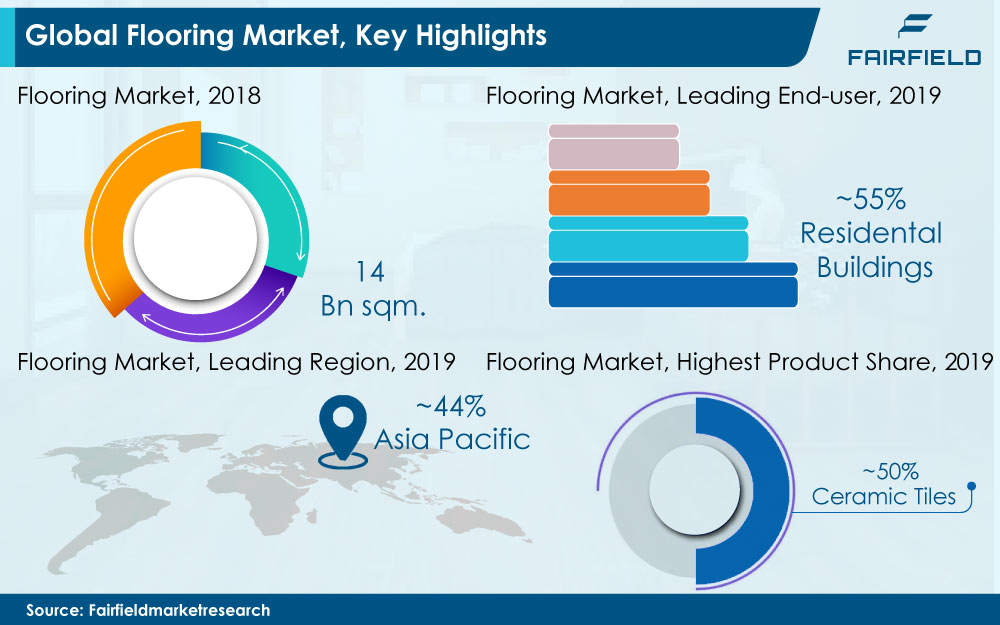
The global flooring market is estimated to be around 14 billion sqm. in 2018. Flooring is majorly categorized into carpets and rugs and resilient and non-resilient. Resilient floorings are manufactured from elastic materials. They are firm but have some give or bounce back to it. Resilient flooring is a middle ground between soft and hard floors. This type of flooring suits both residential and commercial spaces. Adhesives are used to ensure adherence of these flooring materials to the underlayment or subfloor.
Vinyl flooring is one of the major categories of resilient floors. In the past few years, luxury vinyl tiles (LVT), a category of vinyl flooring segment has outgrown in popularity compared to its flooring counterparts, owing to its excellent features such as durability, hard wearing, waterproof, long timespans, and design freedom. Luxury vinyl tiles are anticipated to exhibit double digit growths, even in established markets such as North America and Europe.
Non-resilient flooring on the other hand has no give or bounce back. It is made up of hard-surfaced, inflexible, and organic materials. Major non-resilient flooring materials include ceramic tile, engineered wood flooring, marble, terrazzo, and concrete. Ceramic tile is the most popular flooring material, which accounted for more than 50% of the total flooring market in terms of volume in 2019. Meanwhile, the carpets and rugs category has gained popularity in spaces wherein comfort, noise vreduction, and warmth are priority.
According to the Fairfield’s latest research report, the global flooring market is expected to be worth US$285.5 Bn by 2025 from US$208.8 Bn in 2017, registering a CAGR of 6.9% during the forecast period 2021-2025.
Residential Spaces to Retain Dominance across Global Flooring Market
Residential buildings dominated the global flooring market and accounted for more than 55% of the total flooring market value market in 2019. Rising disposable income and an increase in the number of single-family homes are likely to be key driving factors in emerging countries. Rapidly expanding construction projects, both residential and commercial along with urban development projects are expected to create a surge in demand for flooring. Furthermore, renovation, replacement, and refurbishment in residential spaces are projected to stoke the vinyl flooring, carpets and rugs, wood flooring, and ceramic tiles market in the forthcoming years.
Trends and tastes in floor coverings are changing at a rapid pace. Urbanization and the need for sustainable flooring materials have had a huge impact on the industry. Consumers are looking for products with low maintenance and flatter floors. Both commercial and industrial spaces have shown inclination towards greener technologies as energy conservation in buildings has acquired prime importance globally. Though flooring looks like a small factor in designing sustainable buildings, it plays a considerable role as it covers a large surface area. Thus, the right choice of flooring material is important to keep rooms heated in harsh winters and cool in scorching summers.
Asia Pacific to Lead, the Middle East and Africa to be the Fastest-growing Markets
In 2019, Asia Pacific accounted for more than 44% of the total global flooring market. China and India are the dominant forces in the region. Rapid industrialization, urbanization, and the booming development of housing projects are the key influencing factors in the region. Increasing per capita income, leading to improved standard of living, in the countries such as India, Malaysia, Indonesia, Vietnam, and China have given the regional flooring market exponential business.
The level of investment in housing, whether its new construction or renovation, has increased leaps and bounds. Flooring demand has increased substantially in the Middle East & Africa. Urban development and construction projects are in upswing, boosting the demand for various flooring materials such as ceramic tiles, vinyl, and concrete floorings in the region.
Trends in North America are different as compared to other regions wherein, carpets and rugs is the major category. North America accounted for more than 45% of the total carpet production. However, due to the increase in competition from other flooring materials, the carpets and rugs category has observed sluggish growth in the past few years. The market for the high-end carpets and rugs segment remains upbeat, especially with wool and its blends as they are the best fibers in terms of performance and sustainability.
Flooring Competition Is Not a Race to the Bottom
The global flooring market is highly competitive. The market is dominated by global as well as regional players. The competitive landscape includes hundreds of small-sized enterprises and imports, a lot from cost competitive emerging countries, thus adding pressure on the margins. Every region has its own floor cover preferences, thus making competition fiercer. Technological innovation is at center stage and has become key for sustainable business. Companies are developing a blend of flooring materials with technologically inspired unique designs and formats. Laminate floorings can now convincingly mimic everything, from stone to marble to wood. The technical advances have helped the manufacturers to create flooring with raised textures with intricate designs for higher aesthetic appeal.
In 2020, Welspun Flooring Limited, a flooring vertical of Welspun Group launched its US$ 145 million manufacturing facility in Telangana, India. The facility is equipped with a wide range of innovative flooring materials such as carpet tiles, broadloom carpets, and greens. It also includes a patented and technologically advanced product ‘Click N Lock® tiles’, manufactured from stone & polymer composites.
The Global Flooring Market is Segmented as Below:
Product Coverage
- Ceramic Tiles
- Carpets & Rugs
- Vinyl Tiles, Linoleum and Rubber
- Wood & Laminate
- Misc. (Slate, Marble, Concrete, etc.)
Application Coverage
- Residential
- Commercial
- Industrial
Geographical Coverage
- North America
- U.S.
- Canada
- Europe
- Germany
- France
- UK
- Italy
- Turkey
- Spain
- Russia
- Rest of Europe
- Asia Pacific
- China
- Japan
- South Korea
- India
- Southeast Asia
- Rest of Asia Pacific
- Latin America
- Brazil
- Mexico
- Rest of Latin America
- Middle East & Africa
- GCC
- Egypt
- Rest of Middle East & Africa
Leading Companies
- Mohawk Industries
- Shaw Industries Group, Inc.
- Tarkett S.A.
- Beaulieu lnternational Group N.V.
- Forbo Holding AG
- Interface Inc.
- Gerflor SAS
- Grupo Lamosa
- RAK Ceramics P.J.S.C
- Mannington Mills Inc.
- Balta Industries N.V.
- Armstrong Flooring
- Pamesa Ceramica
- Kajaria Ceramics
Inside This Report You Will Find:
1. Executive Summary
2. Market Overview
3. Production Output and Trade Statistics
4. Price Trends Analysis and Future Projects 2017 - 2025
5. Global Flooring Market Outlook 2017 - 2025
6. North America Flooring Market Outlook 2017 - 2025
7. Europe Flooring Market Outlook 2017 - 2025
8. Asia Pacific Flooring Market Outlook 2017 - 2025
9. Latin America Flooring Market Outlook 2017 - 2025
10. Middle East & Africa Flooring Market Outlook 2017 - 2025
11. Competitive Landscape
12. Appendix
Post Sale Support, Research Updates & Offerings:
We value the trust shown by our customers in Fairfield Market Research. We support our clients through our post sale support, research updates and offerings.
- The report will be prepared in a PPT format and will be delivered in a PDF format.
- Additionally, Market Estimation and Forecast numbers will be shared in Excel Workbook.
- If a report being sold was published over a year ago, we will offer a complimentary copy of the updated research report along with Market Estimation and Forecast numbers within 2-3 weeks’ time of the sale.
- If we update this research study within the next 2 quarters, post purchase of the report, we will offer a Complimentary copy of the updated Market Estimation and Forecast numbers in Excel Workbook.
- If there is a geopolitical conflict, pandemic, recession, and the like which can impact global economic scenario and business activity, which might entirely alter the market dynamics or future projections in the industry, we will create a Research Update upon your request at a nominal charge.
- Executive Summary
- Global Flooring Market Snapshot
- Future Projections
- Key Market Trends
- Regional Snapshot, by Value, 2026
- Analyst Recommendations
- Market Overview
- Market Definitions and Segmentations
- Market Dynamics
- Drivers
- Restraints
- Market Opportunities
- Value Chain Analysis
- COVID-19 Impact Analysis
- Porter's Fiver Forces Analysis
- Impact of Russia-Ukraine Conflict
- PESTLE Analysis
- Regulatory Analysis
- Price Trend Analysis
- Current Prices and Future Projections, 2025-2033
- Price Impact Factors
- Global Flooring Market Outlook, 2020 - 2033
- Global Flooring Market Outlook, by Product Coverage, Value (US$ Mn), 2020-2033
- Ceramic Tiles
- Carpets & Rugs
- Vinyl Tiles, Linoleum and Rubber
- Wood & Laminate
- (Slate, Marble, Concrete, etc.)
- Global Flooring Market Outlook, by Application Coverage, Value (US$ Mn), 2020-2033
- Residential
- Commercial
- Industrial
- Global Flooring Market Outlook, by Region, Value (US$ Mn), 2020-2033
- North America
- Europe
- Asia Pacific
- Latin America
- Middle East & Africa
- Global Flooring Market Outlook, by Product Coverage, Value (US$ Mn), 2020-2033
- North America Flooring Market Outlook, 2020 - 2033
- North America Flooring Market Outlook, by Product Coverage, Value (US$ Mn), 2020-2033
- Ceramic Tiles
- Carpets & Rugs
- Vinyl Tiles, Linoleum and Rubber
- Wood & Laminate
- (Slate, Marble, Concrete, etc.)
- North America Flooring Market Outlook, by Application Coverage, Value (US$ Mn), 2020-2033
- Residential
- Commercial
- Industrial
- North America Flooring Market Outlook, by Country, Value (US$ Mn), 2020-2033
- S. Flooring Market Outlook, by Product Coverage, 2020-2033
- S. Flooring Market Outlook, by Application Coverage, 2020-2033
- Canada Flooring Market Outlook, by Product Coverage, 2020-2033
- Canada Flooring Market Outlook, by Application Coverage, 2020-2033
- BPS Analysis/Market Attractiveness Analysis
- North America Flooring Market Outlook, by Product Coverage, Value (US$ Mn), 2020-2033
- Europe Flooring Market Outlook, 2020 - 2033
- Europe Flooring Market Outlook, by Product Coverage, Value (US$ Mn), 2020-2033
- Ceramic Tiles
- Carpets & Rugs
- Vinyl Tiles, Linoleum and Rubber
- Wood & Laminate
- (Slate, Marble, Concrete, etc.)
- Europe Flooring Market Outlook, by Application Coverage, Value (US$ Mn), 2020-2033
- Residential
- Commercial
- Industrial
- Europe Flooring Market Outlook, by Country, Value (US$ Mn), 2020-2033
- Germany Flooring Market Outlook, by Product Coverage, 2020-2033
- Germany Flooring Market Outlook, by Application Coverage, 2020-2033
- Italy Flooring Market Outlook, by Product Coverage, 2020-2033
- Italy Flooring Market Outlook, by Application Coverage, 2020-2033
- France Flooring Market Outlook, by Product Coverage, 2020-2033
- France Flooring Market Outlook, by Application Coverage, 2020-2033
- K. Flooring Market Outlook, by Product Coverage, 2020-2033
- K. Flooring Market Outlook, by Application Coverage, 2020-2033
- Spain Flooring Market Outlook, by Product Coverage, 2020-2033
- Spain Flooring Market Outlook, by Application Coverage, 2020-2033
- Russia Flooring Market Outlook, by Product Coverage, 2020-2033
- Russia Flooring Market Outlook, by Application Coverage, 2020-2033
- Rest of Europe Flooring Market Outlook, by Product Coverage, 2020-2033
- Rest of Europe Flooring Market Outlook, by Application Coverage, 2020-2033
- BPS Analysis/Market Attractiveness Analysis
- Europe Flooring Market Outlook, by Product Coverage, Value (US$ Mn), 2020-2033
- Asia Pacific Flooring Market Outlook, 2020 - 2033
- Asia Pacific Flooring Market Outlook, by Product Coverage, Value (US$ Mn), 2020-2033
- Ceramic Tiles
- Carpets & Rugs
- Vinyl Tiles, Linoleum and Rubber
- Wood & Laminate
- (Slate, Marble, Concrete, etc.)
- Asia Pacific Flooring Market Outlook, by Application Coverage, Value (US$ Mn), 2020-2033
- Residential
- Commercial
- Industrial
- Asia Pacific Flooring Market Outlook, by Country, Value (US$ Mn), 2020-2033
- China Flooring Market Outlook, by Product Coverage, 2020-2033
- China Flooring Market Outlook, by Application Coverage, 2020-2033
- Japan Flooring Market Outlook, by Product Coverage, 2020-2033
- Japan Flooring Market Outlook, by Application Coverage, 2020-2033
- South Korea Flooring Market Outlook, by Product Coverage, 2020-2033
- South Korea Flooring Market Outlook, by Application Coverage, 2020-2033
- India Flooring Market Outlook, by Product Coverage, 2020-2033
- India Flooring Market Outlook, by Application Coverage, 2020-2033
- Southeast Asia Flooring Market Outlook, by Product Coverage, 2020-2033
- Southeast Asia Flooring Market Outlook, by Application Coverage, 2020-2033
- Rest of SAO Flooring Market Outlook, by Product Coverage, 2020-2033
- Rest of SAO Flooring Market Outlook, by Application Coverage, 2020-2033
- BPS Analysis/Market Attractiveness Analysis
- Asia Pacific Flooring Market Outlook, by Product Coverage, Value (US$ Mn), 2020-2033
- Latin America Flooring Market Outlook, 2020 - 2033
- Latin America Flooring Market Outlook, by Product Coverage, Value (US$ Mn), 2020-2033
- Ceramic Tiles
- Carpets & Rugs
- Vinyl Tiles, Linoleum and Rubber
- Wood & Laminate
- (Slate, Marble, Concrete, etc.)
- Latin America Flooring Market Outlook, by Application Coverage, Value (US$ Mn), 2020-2033
- Residential
- Commercial
- Industrial
- Latin America Flooring Market Outlook, by Country, Value (US$ Mn), 2020-2033
- Brazil Flooring Market Outlook, by Product Coverage, 2020-2033
- Brazil Flooring Market Outlook, by Application Coverage, 2020-2033
- Mexico Flooring Market Outlook, by Product Coverage, 2020-2033
- Mexico Flooring Market Outlook, by Application Coverage, 2020-2033
- Argentina Flooring Market Outlook, by Product Coverage, 2020-2033
- Argentina Flooring Market Outlook, by Application Coverage, 2020-2033
- Rest of LATAM Flooring Market Outlook, by Product Coverage, 2020-2033
- Rest of LATAM Flooring Market Outlook, by Application Coverage, 2020-2033
- BPS Analysis/Market Attractiveness Analysis
- Latin America Flooring Market Outlook, by Product Coverage, Value (US$ Mn), 2020-2033
- Middle East & Africa Flooring Market Outlook, 2020 - 2033
- Middle East & Africa Flooring Market Outlook, by Product Coverage, Value (US$ Mn), 2020-2033
- Ceramic Tiles
- Carpets & Rugs
- Vinyl Tiles, Linoleum and Rubber
- Wood & Laminate
- (Slate, Marble, Concrete, etc.)
- Middle East & Africa Flooring Market Outlook, by Application Coverage, Value (US$ Mn), 2020-2033
- Residential
- Commercial
- Industrial
- Middle East & Africa Flooring Market Outlook, by Country, Value (US$ Mn), 2020-2033
- GCC Flooring Market Outlook, by Product Coverage, 2020-2033
- GCC Flooring Market Outlook, by Application Coverage, 2020-2033
- South Africa Flooring Market Outlook, by Product Coverage, 2020-2033
- South Africa Flooring Market Outlook, by Application Coverage, 2020-2033
- Egypt Flooring Market Outlook, by Product Coverage, 2020-2033
- Egypt Flooring Market Outlook, by Application Coverage, 2020-2033
- Nigeria Flooring Market Outlook, by Product Coverage, 2020-2033
- Nigeria Flooring Market Outlook, by Application Coverage, 2020-2033
- Rest of Middle East Flooring Market Outlook, by Product Coverage, 2020-2033
- Rest of Middle East Flooring Market Outlook, by Application Coverage, 2020-2033
- BPS Analysis/Market Attractiveness Analysis
- Middle East & Africa Flooring Market Outlook, by Product Coverage, Value (US$ Mn), 2020-2033
- Competitive Landscape
- Company Vs Segment Heatmap
- Company Market Share Analysis, 2025
- Competitive Dashboard
- Company Profiles
- Mohawk Industries
- Company Overview
- Product Portfolio
- Financial Overview
- Business Strategies and Developments
- Shaw Industries Group, Inc.
- Tarkett S.A.
- Beaulieu lnternational Group N.V.
- Forbo Holding AG
- Interface Inc.
- Gerflor SAS
- Grupo Lamosa
- RAK Ceramics P.J.S.C
- Mannington Mills Inc.
- Mohawk Industries
- Appendix
- Research Methodology
- Report Assumptions
- Acronyms and Abbreviations
|
BASE YEAR |
HISTORICAL DATA |
FORECAST PERIOD |
UNITS |
|||
 |
2025 |
 |
2019 - 2014 |
 |
2026 - 2033 |
Value: US$ Billion |
|
REPORT FEATURES |
DETAILS |
|
Product Coverage |
|
|
Application Coverage |
|
|
Geographical Coverage |
|
|
Leading Companies |
|
|
Report Highlights |
Market Estimates and Forecast, Market Dynamics, Industry Trends, Competition Landscape, Product-, Application-, Region-, Country-wise Trends & Analysis, COVID-19 Impact Analysis (Demand and Supply Chain), Key Trends |
Our Research Methodology
Considering the volatility of business today, traditional approaches to strategizing a game plan can be unfruitful if not detrimental. True ambiguity is no way to determine a forecast. A myriad of predetermined factors must be accounted for such as the degree of risk involved, the magnitude of circumstances, as well as conditions or consequences that are not known or unpredictable. To circumvent binary views that cast uncertainty, the application of market research intelligence to strategically posture, move, and enable actionable outcomes is necessary.
View Methodology
Quality Assured
Rigorous Validation Process

Confidentiality Assured
End-to-end Data Security

Custom Research Services
Tailored To Your Objectives
FAQs
Rise in new residential activities, especially single-family home coupled with sustained growth in residential renovation activities will drive growth of flooring products. The renovation wave in Europe and pandemic home-remodeling activities in the U.S. is anticipated to play integral part.
The flooring market size is USD 364.4 Bn in 2026.
Asia Pacific currently accounts for more than 45% of the global demand and will hold the highest volume share by 2025. Sustained residential and commercial construction projects, notably in India, Southeast Asia, and China will flourish the flooring market.
With growing consumer awareness towards eco-friendly and sustainable products, companies are expanding their product lines with innovative and environmentally sustainable flooring solutions, with some adding recycled elements into their flooring products.
The flooring market growth is driven by rapid urbanization, rising construction and renovation activities, increasing disposable income, and demand for durable and sustainable flooring materials.
Related Reports
Microalgae in Fertilizers Market Insights, Competitive Landscape, and Market Forecast - 2033
Microalgae in fertilizers market is valued at USD 480.00 million in 2026 and is projected to reach USD 1,171.92 million by 2033, growing at a CAGR of 13.6%.
Smart Seed Coatings Market Insights, Competitive Landscape, and Market Forecast 2033
The smart seed coatings market is valued at USD 1.50 billion in 2026 and is projected to reach USD 3.19 billion by 2033, growing at 11.4% CAGR
Vegan Clothing Market Insights, Competitive Landscape, and Market Forecast - 2033
The global vegan clothing market is valued at USD 4.80 billion in 2026 and is projected to reach USD 11.02 billion by 2033, at a CAGR of 12.6%.
Foam Glass Granulate Market
Foam Glass Granulate Market is valued at USD 380.00 Million in 2026 and projected to reach USD 677.05 Million by 2033, growing at 8.6% CAGR during 2026–2033
Textile Colors Market
Textile Colors Market is valued at USD 9.20 Billion in 2026 and projected to reach USD 13.47 Billion by 2033, growing at a 5.6% CAGR.
Microfiber Synthetic Leather Market Insights, Competitive Landscape, and Market Forecast 2033
Microfiber Synthetic Leather Market to reach USD 32.12 Bn by 2033, driven by footwear, automotive demand, sustainability, and bio-based innovation.