



Golf Club Market
Golf Club Market Insights, Competitive Landscape, and Market Forecast - 2033
The Golf Club Market is valued at USD 4.5 Bn in 2026 and is projected to reach USD 5.8 Bn, growing at a CAGR of 4% by 2033.
Quick Report Digest
- The golf market is driven by the growing popularity of golf as an active sport.
- Premium resorts and hotels are incorporating golf into their hospitality facilities.
- The number of golf enthusiasts has been growing significantly, including people who enjoy golf as a recreational pursuit.
- Topgolf has introduced millennial-friendly innovations to make golf more engaging and fun.
- Young consumers prefer trendy equipment, while experienced players focus on technical specifications.
A Look Back and a Look Forward - Comparative Analysis
The golf club market has experienced significant growth in recent years and is expected to continue growing in the future. The demand for golf clubs is expected to increase, driven by consumer preferences for customized and varied clubs. Manufacturers have been innovating in club design, introducing features such as hybrid iron clubs and clubs made of higher-lofted wood, which have gained popularity
Looking ahead, the golf club market value is projected to reach USD 5.8 Bn by 2033, growing at a CAGR of 4% from 2026 to 2033. This growth can be attributed to the rising demand for golf clubs and the increasing popularity of golf among both amateur and professional players. The market offers a wide variety of options for players of all levels, including different types of clubs (drivers, putters, etc.), and materials (steel, graphite, titanium, etc.)
How Does Regulatory Scenario Shape this Industry?
The regulatory scenario plays a crucial role in shaping the golf club market. Regulations can impact various aspects of the industry, including manufacturing standards, safety requirements, environmental considerations, and market competition. One important regulatory aspect is related to product safety and quality standards. Golf clubs need to meet certain specifications and standards to ensure their performance and safety.
Regulatory bodies, such as the United States Golf Association (USGA), and the Royal and Ancient Golf Club of St Andrews (R&A), set rules and regulations regarding club design, dimensions, and performance characteristics. These regulations aim to maintain fairness and integrity in the game of golf and ensure that clubs meet certain performance standards.
Another regulatory factor that can shape the golf club industry is trade policies and import/export regulations. Additionally, environmental regulations and sustainability initiatives can influence the golf club industry. Golf courses and clubs are increasingly adopting sustainable practices to minimize their environmental impact. This includes using eco-friendly materials, implementing water conservation measures, and adopting renewable energy solutions.
Key Growth Determinants
Growing Popularity and Adoption of Golf as an Active Sport
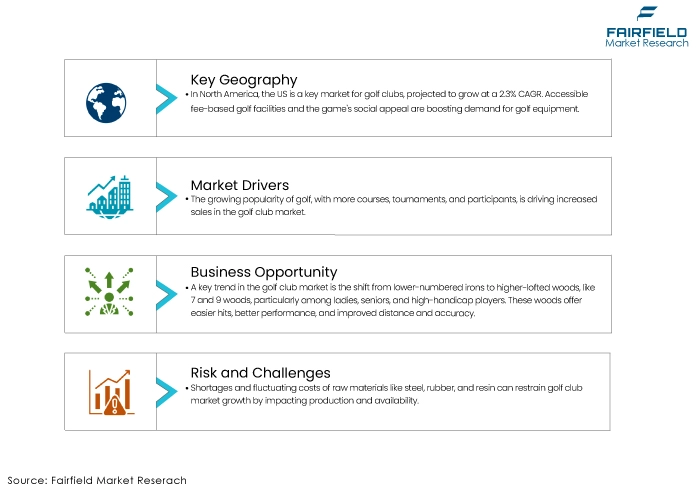
The increasing popularity of golf as a recreational and competitive sport is a major driver for the golf club market. Golf is enjoyed by people of all ages and skill levels, and its appeal has been growing globally. The market has witnessed a rise in the number of golf courses, golf tournaments, and participants, which has incaresed the golf club market sales.
Rising Disposable Income, and Middle-Class Population
The growth of the middle-class population, particularly in regions like Asia Pacific and India, has contributed to the golf club market expansion. As disposable incomes increase, more individuals have the financial means to participate in golf and invest in golf clubs. The middle-class population's growing interest in recreational activities and leisure sports has created a significant growth potential for the golf club industry.
Technological Advancements, and Customization Trend
Technological advancements in golf club manufacturing have played a crucial role in driving the market. Manufacturers have introduced innovative designs and materials, such as hybrid clubs made of higher-lofted woods and irons. These advancements have improved the performance, accuracy, and distance of golf clubs, attracting both amateur and professional players. Additionally, the use of 3D printing technology has enabled the customization of golf clubs, catering to the specific needs and preferences of individual golfers.
Key Growth Barriers
Fluctuating Cost and Shortage of Raw Materials
The shortage and fluctuating cost of raw materials used in the manufacturing of golf clubs can pose a significant restraint on the market. Golf clubs require various materials such as steel for shafts, rubber for grips, and resin for golf balls. Any disruption in the supply chain or increase in the cost of these raw materials can impact the production and availability of golf clubs, potentially affecting the golf club market growth.
Competition from Indoor Golf Simulators
The rise of indoor golf simulators is another factor that can restrain the growth of the golf club market shares. Golf simulators provide a virtual golfing experience, allowing players to practice and play golf indoors. These simulators offer convenience and accessibility, eliminating the need for outdoor golf courses. As the technology and realism of golf simulators improve, some individuals may opt for this alternative over traditional outdoor golf activities. This shift in preference towards indoor golf simulators can create a restraint for the golf club market value, as it may impact the demand for physical golf clubs.
Golf Club Market Trends and Opportunities
Shift to Higher Numbered Woods, and Modified Standard Sets
One of the notable golf club market trends is the shift towards higher numbered woods and the adoption of modified standard sets. Traditionally, golfers would carry lower numbered irons, such as the 3 and 4 irons, in their golf club sets. However, there has been a growing trend among golfers, especially ladies, seniors, and higher handicap players, to replace these lower numbered irons with higher lofted woods like the 7 and 9 woods.
This trend is driven by the desire for easier-to-hit clubs that provide better performance and results. These clubs offer increased loft and higher launch angles, allowing players to achieve better distance and accuracy on their shots.
The shift towards higher numbered woods and modified standard sets is seen as a sensible trend, particularly for beginning golfers. This trend reflects the industry's focus on providing golfers with comfort, enjoyment and performance on the golf course.
Enhanced Driving Range Experience, and Off-Course Golf
An opportunity for the golf club market growth lies in the enhancement of the driving range experience and the growing interest in off-course golf activities. Golf course operators can capitalize on this opportunity by offering new services and scaling their operations to cater to the changing preferences of golfers.
Furthermore, the growing interest in off-course golf activities presents an opportunity for golf course operators to expand their offerings beyond traditional rounds of golf. Partnering with groups and organizations that promote off-course golf, such as indoor golf simulators or community events, can help facilities attract new golfers and create a social and fun atmosphere for all players.
Golf Club Market Segmentation
Irons to be the Primary Product Category on Account of Versatility, and Precision
The irons segment of golf clubs emerged as a major contributor, accounting for 41% of the product type segment in 2022. Irons are typically sold in sets ranging from three-iron to nine-iron or pitching wedge. While some irons feature hollow heads, the majority have solid heads.
The angled faces of irons, known as the loft, are designed with grooves that aid in holding the golf ball and providing spin. These clubs are commonly used for tee shots on short holes or strokes from the fairway, offering versatility and precision. They are highly boosting the golf club market demand.
Professional Golfers' Strategic Club Selection Dominates Market Share
Professional golfers meticulously consider the clubs they use, exploring the latest models from various brands and embracing new technology. They constantly adjust their club selection based on the weather conditions and course settings.
In contrast, amateur golfers often play at whatever clubs are available, as they primarily engage in golf for leisure. Some amateurs even opt to rent clubs instead of making a purchase. As a result, the professional segment holds about 92.9% of golf club market shares and is expected to maintain its dominance in the foreseeable future.
Convenient Comparison, and Increased Sales Boost Appeal for Golf Club Market Shops
Customers are drawn to purchasing golf clubs from these shops due to the convenience of quickly comparing prices and features, as well as the availability of multiple brands in one location. The presence of these companies within golf courses often leads to increased sales. To further entice customers, discounts are often offered in exchange for club membership.
Meanwhile, the online retailer segment is expected to experience the highest CAGR of approximately 7.6% during the projected timeframe. Golf equipment, including golf balls, helmets, gloves, and carts, are among the items regularly purchased online due to the familiarity with their technical specifications.
Regional Analysis
US Becomes a Prominent Market for Golf Clubs with Growing Accessibility, and Demand
In the North America region, the US stands out as a prominent ground for golf club market expansion, expecting to grow at a CAGR value of 2.3%. Unlike private facilities and clubs, golf facilities in the US are accessible to fee-paying golfers on a per-round basis. This accessibility factor has contributed to an increase in the number of people playing golf, subsequently driving the demand for golf clubs and other equipment in the area. The social aspects of the game also play a significant role in the popularity of golf among Americans.
Ireland Stands as a Golfing Haven with Public Accessibility, and Growing Market
While golf was developed in Scotland, it is in Ireland where the sport is most widely practiced. Ireland boasts renowned golfing destinations such as the Royal Dublin Golf Club, Cruit Island Golf Club, Adare Manor, and Hogs Head Golf Club. The country's abundance of stunning golf courses makes it nearly impossible to visit Ireland without considering a round of golf.
Unlike Scotland and England, where the majority of courses are private, almost all of Ireland's courses are open to the public. This accessibility undoubtedly adds to the appeal of golf in Ireland and contributes to the country's top-ranked status globally. The golf club market shares in Ireland is expected to grow at a CAGR of 3.8%.
India Boosts the Market with Promising Potential for Golf Clubs
India has emerged as a prominent market for the golf club industry in the South Asia region, with an expected growth rate of approximately 4.3% in the market. The country's growing number of golfers, combined with the increasing disposable income of the middle-class population, presents significant growth potential for golf clubs in India.
The rise in golf tournaments and the growing number of players are key factors driving the increased sales of golf equipment in the country. While men have traditionally been more frequent golfers, there has been a recent increase in the number of female golfers, contributing to the overall growth of the market. These factors are expected to drive sales for golf clubs in India in the coming years.
Fairfield’s Competitive Landscape Analysis
Several leading companies in golf club market are offering a wide range of high-quality golf clubs to cater to the needs of golfers at different skill levels. They have established their presence through product innovation, strategic partnerships, and a strong distribution network. These companies bring its unique offerings and features to the market, providing golfers with options that suit their preferences and playing style.
Key Market Companies
- TaylorMade Golf Company, Inc.
- Callaway Golf Company
- The Acushnet Holdings Company (Titleist)
- Mizuno USA, Inc.
- Rock Bottom Golf
- Cleveland Golf Company, Inc.
- Bridgestone Sports Ltd.
- Cobra Golf
- Henry Griffitts
- Bettinardi
- PING
- Sub 70
Golf Club Market Segmentation
By Product Type
- Drivers
- Fairways
- Hybrids
- Irons
- Wedges
- Putters
By End Use
- Amateur
- Professionals
By Distribution Channel
- Direct
- Indirect
- Modern Trade
- Exclusive Stores
- Specialty Stores
- Sports Chain Outlets
- Online Retailers
- Others
By Region:
- North America
- Latin America
- Europe
- East Asia
- South Asia & Pacific
- Middle East & Africa
- Executive Summary
- Global Golf Club Market Snapshot
- Future Projections
- Key Market Trends
- Regional Snapshot, by Value, 2026
- Analyst Recommendations
- Market Overview
- Market Definitions and Segmentations
- Market Dynamics
- Drivers
- Restraints
- Market Opportunities
- Value Chain Analysis
- COVID-19 Impact Analysis
- Porter's Five Forces Analysis
- Impact of Russia-Ukraine Conflict
- PESTLE Analysis
- Regulatory Analysis
- Price Trend Analysis
- Current Prices and Future Projections, 2025-2033
- Price Impact Factors
- Global Golf Club Market Outlook, 2020 - 2033
- Global Golf Club Market Outlook, by Product Type, Value (US$ Mn), 2020-2033
- Drivers
- Fairways
- Hybrids
- Irons
- Global Golf Club Market Outlook, by End Use, Value (US$ Mn), 2020-2033
- Amateur
- Professionals
- Global Golf Club Market Outlook, by Distribution Channel, Value (US$ Mn), 2020-2033
- Direct
- Indirect
- Global Golf Club Market Outlook, by Region, Value (US$ Mn), 2020-2033
- North America
- Europe
- Asia Pacific
- Latin America
- Middle East & Africa
- Global Golf Club Market Outlook, by Product Type, Value (US$ Mn), 2020-2033
- North America Golf Club Market Outlook, 2020 - 2033
- North America Golf Club Market Outlook, by Product Type, Value (US$ Mn), 2020-2033
- Drivers
- Fairways
- Hybrids
- Irons
- North America Golf Club Market Outlook, by End Use, Value (US$ Mn), 2020-2033
- Amateur
- Professionals
- North America Golf Club Market Outlook, by Distribution Channel, Value (US$ Mn), 2020-2033
- Direct
- Indirect
- North America Golf Club Market Outlook, by Country, Value (US$ Mn), 2020-2033
- U.S. Golf Club Market Outlook, by Product Type, 2020-2033
- U.S. Golf Club Market Outlook, by End Use, 2020-2033
- U.S. Golf Club Market Outlook, by Distribution Channel, 2020-2033
- Canada Golf Club Market Outlook, by Product Type, 2020-2033
- Canada Golf Club Market Outlook, by End Use, 2020-2033
- Canada Golf Club Market Outlook, by Distribution Channel, 2020-2033
- BPS Analysis/Market Attractiveness Analysis
- North America Golf Club Market Outlook, by Product Type, Value (US$ Mn), 2020-2033
- Europe Golf Club Market Outlook, 2020 - 2033
- Europe Golf Club Market Outlook, by Product Type, Value (US$ Mn), 2020-2033
- Drivers
- Fairways
- Hybrids
- Irons
- Europe Golf Club Market Outlook, by End Use, Value (US$ Mn), 2020-2033
- Amateur
- Professionals
- Europe Golf Club Market Outlook, by Distribution Channel, Value (US$ Mn), 2020-2033
- Direct
- Indirect
- Europe Golf Club Market Outlook, by Country, Value (US$ Mn), 2020-2033
- Germany Golf Club Market Outlook, by Product Type, 2020-2033
- Germany Golf Club Market Outlook, by End Use, 2020-2033
- Germany Golf Club Market Outlook, by Distribution Channel, 2020-2033
- Italy Golf Club Market Outlook, by Product Type, 2020-2033
- Italy Golf Club Market Outlook, by End Use, 2020-2033
- Italy Golf Club Market Outlook, by Distribution Channel, 2020-2033
- France Golf Club Market Outlook, by Product Type, 2020-2033
- France Golf Club Market Outlook, by End Use, 2020-2033
- France Golf Club Market Outlook, by Distribution Channel, 2020-2033
- U.K. Golf Club Market Outlook, by Product Type, 2020-2033
- U.K. Golf Club Market Outlook, by End Use, 2020-2033
- U.K. Golf Club Market Outlook, by Distribution Channel, 2020-2033
- Spain Golf Club Market Outlook, by Product Type, 2020-2033
- Spain Golf Club Market Outlook, by End Use, 2020-2033
- Spain Golf Club Market Outlook, by Distribution Channel, 2020-2033
- Russia Golf Club Market Outlook, by Product Type, 2020-2033
- Russia Golf Club Market Outlook, by End Use, 2020-2033
- Russia Golf Club Market Outlook, by Distribution Channel, 2020-2033
- Rest of Europe Golf Club Market Outlook, by Product Type, 2020-2033
- Rest of Europe Golf Club Market Outlook, by End Use, 2020-2033
- Rest of Europe Golf Club Market Outlook, by Distribution Channel, 2020-2033
- BPS Analysis/Market Attractiveness Analysis
- Europe Golf Club Market Outlook, by Product Type, Value (US$ Mn), 2020-2033
- Asia Pacific Golf Club Market Outlook, 2020 - 2033
- Asia Pacific Golf Club Market Outlook, by Product Type, Value (US$ Mn), 2020-2033
- Drivers
- Fairways
- Hybrids
- Irons
- Asia Pacific Golf Club Market Outlook, by End Use, Value (US$ Mn), 2020-2033
- Amateur
- Professionals
- Asia Pacific Golf Club Market Outlook, by Distribution Channel, Value (US$ Mn), 2020-2033
- Direct
- Indirect
- Asia Pacific Golf Club Market Outlook, by Country, Value (US$ Mn), 2020-2033
- China Golf Club Market Outlook, by Product Type, 2020-2033
- China Golf Club Market Outlook, by End Use, 2020-2033
- China Golf Club Market Outlook, by Distribution Channel, 2020-2033
- Japan Golf Club Market Outlook, by Product Type, 2020-2033
- Japan Golf Club Market Outlook, by End Use, 2020-2033
- Japan Golf Club Market Outlook, by Distribution Channel, 2020-2033
- South Korea Golf Club Market Outlook, by Product Type, 2020-2033
- South Korea Golf Club Market Outlook, by End Use, 2020-2033
- South Korea Golf Club Market Outlook, by Distribution Channel, 2020-2033
- India Golf Club Market Outlook, by Product Type, 2020-2033
- India Golf Club Market Outlook, by End Use, 2020-2033
- India Golf Club Market Outlook, by Distribution Channel, 2020-2033
- Southeast Asia Golf Club Market Outlook, by Product Type, 2020-2033
- Southeast Asia Golf Club Market Outlook, by End Use, 2020-2033
- Southeast Asia Golf Club Market Outlook, by Distribution Channel, 2020-2033
- Rest of SAO Golf Club Market Outlook, by Product Type, 2020-2033
- Rest of SAO Golf Club Market Outlook, by End Use, 2020-2033
- Rest of SAO Golf Club Market Outlook, by Distribution Channel, 2020-2033
- BPS Analysis/Market Attractiveness Analysis
- Asia Pacific Golf Club Market Outlook, by Product Type, Value (US$ Mn), 2020-2033
- Latin America Golf Club Market Outlook, 2020 - 2033
- Latin America Golf Club Market Outlook, by Product Type, Value (US$ Mn), 2020-2033
- Drivers
- Fairways
- Hybrids
- Irons
- Latin America Golf Club Market Outlook, by End Use, Value (US$ Mn), 2020-2033
- Amateur
- Professionals
- Latin America Golf Club Market Outlook, by Distribution Channel, Value (US$ Mn), 2020-2033
- Direct
- Indirect
- Latin America Golf Club Market Outlook, by Country, Value (US$ Mn), 2020-2033
- Brazil Golf Club Market Outlook, by Product Type, 2020-2033
- Brazil Golf Club Market Outlook, by End Use, 2020-2033
- Brazil Golf Club Market Outlook, by Distribution Channel, 2020-2033
- Mexico Golf Club Market Outlook, by Product Type, 2020-2033
- Mexico Golf Club Market Outlook, by End Use, 2020-2033
- Mexico Golf Club Market Outlook, by Distribution Channel, 2020-2033
- Argentina Golf Club Market Outlook, by Product Type, 2020-2033
- Argentina Golf Club Market Outlook, by End Use, 2020-2033
- Argentina Golf Club Market Outlook, by Distribution Channel, 2020-2033
- Rest of LATAM Golf Club Market Outlook, by Product Type, 2020-2033
- Rest of LATAM Golf Club Market Outlook, by End Use, 2020-2033
- Rest of LATAM Golf Club Market Outlook, by Distribution Channel, 2020-2033
- BPS Analysis/Market Attractiveness Analysis
- Latin America Golf Club Market Outlook, by Product Type, Value (US$ Mn), 2020-2033
- Middle East & Africa Golf Club Market Outlook, 2020 - 2033
- Middle East & Africa Golf Club Market Outlook, by Product Type, Value (US$ Mn), 2020-2033
- Drivers
- Fairways
- Hybrids
- Irons
- Middle East & Africa Golf Club Market Outlook, by End Use, Value (US$ Mn), 2020-2033
- Amateur
- Professionals
- Middle East & Africa Golf Club Market Outlook, by Distribution Channel, Value (US$ Mn), 2020-2033
- Direct
- Indirect
- Middle East & Africa Golf Club Market Outlook, by Country, Value (US$ Mn), 2020-2033
- GCC Golf Club Market Outlook, by Product Type, 2020-2033
- GCC Golf Club Market Outlook, by End Use, 2020-2033
- GCC Golf Club Market Outlook, by Distribution Channel, 2020-2033
- South Africa Golf Club Market Outlook, by Product Type, 2020-2033
- South Africa Golf Club Market Outlook, by End Use, 2020-2033
- South Africa Golf Club Market Outlook, by Distribution Channel, 2020-2033
- Egypt Golf Club Market Outlook, by Product Type, 2020-2033
- Egypt Golf Club Market Outlook, by End Use, 2020-2033
- Egypt Golf Club Market Outlook, by Distribution Channel, 2020-2033
- Nigeria Golf Club Market Outlook, by Product Type, 2020-2033
- Nigeria Golf Club Market Outlook, by End Use, 2020-2033
- Nigeria Golf Club Market Outlook, by Distribution Channel, 2020-2033
- Rest of Middle East Golf Club Market Outlook, by Product Type, 2020-2033
- Rest of Middle East Golf Club Market Outlook, by End Use, 2020-2033
- Rest of Middle East Golf Club Market Outlook, by Distribution Channel, 2020-2033
- BPS Analysis/Market Attractiveness Analysis
- Middle East & Africa Golf Club Market Outlook, by Product Type, Value (US$ Mn), 2020-2033
- Competitive Landscape
- Company Vs Segment Heatmap
- Company Market Share Analysis, 2025
- Competitive Dashboard
- Company Profiles
- TaylorMade Golf Company, Inc.
- Company Overview
- Product Portfolio
- Financial Overview
- Business Strategies and Developments
- Callaway Golf Company
- The Acushnet Holdings Company (Titleist)
- Mizuno USA, Inc.
- Rock Bottom Golf
- Cleveland Golf Company, Inc.
- Bridgestone Sports Ltd.
- Cobra Golf
- Henry Griffitts
- Bettinardi
- TaylorMade Golf Company, Inc.
- Appendix
- Research Methodology
- Report Assumptions
- Acronyms and Abbreviations
|
BASE YEAR |
HISTORICAL DATA |
FORECAST PERIOD |
UNITS |
|||
 |
2025 |
 |
2019 - 2024 |
 |
2026 - 2033 |
Value: US$ Billion |
|
REPORT FEATURES |
DETAILS |
|
Product Type Coverage |
|
|
End Use Coverage |
|
|
Distribution Channel Coverage |
|
|
Geographical Coverage |
|
|
Leading Companies |
|
|
Report Highlights |
Key Market Indicators, Macro-micro economic impact analysis, Technological Roadmap, Key Trends, Driver, Restraints, and Future Opportunities & Revenue Pockets, Porter’s 5 Forces Analysis, Historical Trend (2019-2021), Market Estimates and Forecast, Market Dynamics, Industry Trends, Competition Landscape, Category, Region, Country-wise Trends & Analysis, COVID-19 Impact Analysis (Demand and Supply Chain) |
Our Research Methodology
Considering the volatility of business today, traditional approaches to strategizing a game plan can be unfruitful if not detrimental. True ambiguity is no way to determine a forecast. A myriad of predetermined factors must be accounted for such as the degree of risk involved, the magnitude of circumstances, as well as conditions or consequences that are not known or unpredictable. To circumvent binary views that cast uncertainty, the application of market research intelligence to strategically posture, move, and enable actionable outcomes is necessary.
View Methodology
Quality Assured
Rigorous Validation Process

Confidentiality Assured
End-to-end Data Security

Custom Research Services
Tailored To Your Objectives
FAQs
The market is predicted to rise from USD 4.5 Bn 2026 to USD 5.8 Bn by 2033.
Rise due to consumer preferences, innovations in customized and varied clubs, and rising popularity of golf are propelling market growth.
Rock Bottom Golf, Cleveland Golf Company, Inc., Bridgestone Sports Ltd., Cobra Golf, and Henry Griffitts are some pivotal industry players.
Challenges like the shortage and fluctuating cost of raw materials and rise of indoor golf simulators are restraining market expansion.
Shift towards higher numbered woods, the adoption of modified standard sets, and growing interest in off-course golf activities are the major factors creating opportunities in the market.
Related Reports
Beauty Subscription Market Insights, Competitive Landscape, and Market Forecast - 2033
The beauty subscription market reaches USD 7.25 Bn by 2033, up from USD 3.20 Bn in 2026, expanding at a 12.4% CAGR through 2033 as beauty demand grows
Pet Cosmetics Market Insights, Competitive Landscape, and Market Forecast 2033
Pet Cosmetics Market to reach USD 2.58 Bn by 2033, growing at 9.7% CAGR, driven by pet humanization, premium grooming, and product innovation trends.
Die Cast Toys Market Insights, Competitive Landscape, and Market Forecast - 2033
The global die cast toys market is valued at USD 3.60 Bn in 2026 and is projected to reach USD 5.31 Bn by 2033, growing at a CAGR of 5.7% during 2026-2033
High Abuse Shrink Bags Market Insights, Competitive Landscape, and Market Forecast - 2033
The high abuse shrink bags market reaches USD 2.47 Bn by 2033, growing at 6.4% CAGR from 2026, driven by demand for durable packaging solutions in industry
Baby Bath and Shower Products Market Insights, Competitive Landscape, and Market Forecast 2033
Baby Bath and Shower Products Market to reach USD 6.96 Bn by 2033, growing at 6.1% CAGR, driven by safety, gentle formulations, and online retail.
Cosmetic Nanoencapsulation Market
The global cosmetic nanoencapsulation market will reach US$ 3.04 Bn by 2033, growing at a 12.9% CAGR, driven by rising demand for advanced cosmetic formulations