



High Voltage Hybrid Cars, Buses and Trucks Market
High Voltage Hybrid Cars, Buses and Trucks Market Insights, Competitive Landscape, and Market Forecast - 2033
Global High Voltage Hybrid Cars, Buses and Trucks Market Forecast
- The High Voltage Hybrid Cars, Buses and Trucks Market is valued at USD 114 Bn in 2026 and is projected to reach USD 342.1 Bn, growing at a CAGR of 17% by 2033.
Market Analysis in Brief
High-voltage hybrid cars, buses and trucks are with operating voltage ranges greater than 60V. A traditional IC engine and an electric drive system with a large operational range are used to power high voltage hybrid automobiles. Cars, buses and trucks with high-voltage hybrid systems are created as either complete hybrids or plug-in hybrids. While high-voltage plug-in hybrid vehicles with larger batteries can be recharged using the external electric power grid, high-voltage full hybrid vehicles do so through their internal systems. High-voltage hybrid cars, buses and trucks primarily focus on reduced carbon emissions and efficient operations.
The high voltage hybrid cars, buses and trucks market is anticipated to expand as a result of factors including the falling cost of batteries per KWH and the rise in the use of fuel-efficient mobility solutions. However, it is anticipated that a decline in vehicle production and sales as well as a rise in the demand for qualified labor to carry out maintenance and repair tasks will impede market expansion. On the other hand, it is anticipated that government policies, regulations, and subsidies as well as economic growth in developing countries will provide market participants with profitable expansion opportunities.
Key Report Findings
- The high voltage hybrid cars, buses and trucks market will demonstrate more than 4x expansion in revenue toward the end of the decade.
- Due to a number of variables, such as the declining cost of batteries per kWh and the rise in the usage of fuel-efficient mobility solutions, it is projected that the market for high voltage cars, buses, and trucks would experience noteworthy growth in the years to come.
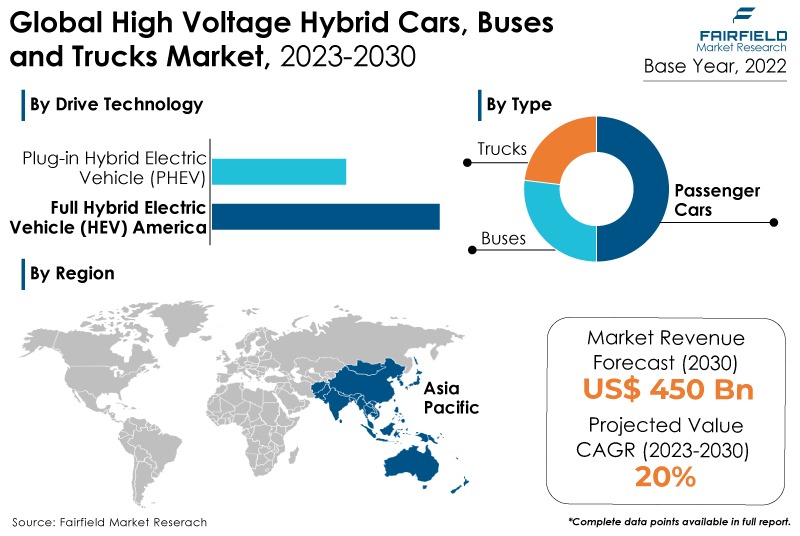
- In 2022, passenger cars held the highest share of the global high voltage hybrid cars, buses and trucks market size.
- The full hybrid electric vehicle (HEV) category held the largest revenue share in 2022.
- On the basis of voltage, the less than 340 volts category led the market in 2022.
- Asia Pacific will continue to lead its way, whereas North America’s high voltage hybrid cars, buses and trucks market will experience the strongest growth till 2030.
Growth Drivers
Increasing Preference for Fuel-efficient Mobility
The automotive sector has undergone a significant transformation in terms of technological advancement in recent years. Due to their output efficiency and lightweight nature, electrical components are being used by OEMs to meet evolving consumer needs, making vehicle electrification a fuel-efficient option.
Additionally, electrification is the next stage since the majority of automakers are moving toward the creation of hybrid-driven vehicles to meet the changing needs of end users and policymakers to meet green mobility criteria. In addition, compared to gasoline-powered vehicles, high voltage hybrid cars, buses and trucks are a more fuel-efficient transportation option. For instance, Groupe Renault plans to sell 35% of hybrid vehicles by 2025 and 30% of completely electric vehicles under the Renault brand.
Since hazardous greenhouse gases are emitted by car emissions, raising environmental and health issues, this is a significant factor. As a result, governments all over the world are enforcing automobile emission standards to limit greenhouse gas emissions and preserve the ecological balance. These rules must be followed by manufacturers if they want to regulate the emission level.
The Government of India established the BS6 emission standard in April 2020 to curb vehicle emissions of air pollutants. As a result, the demand for high-voltage hybrid high voltage hybrid cars, buses and trucks is expected to increase due to a combination of all these factors.
Falling Battery Prices Per KWH
The important component of the cars, buses and trucks that provides the electricity input to the numerous electrical parts that are needed for efficient operation is the battery. The need for automotive batteries is anticipated to increase as electrical systems and components become more widely used in the vehicle industry.
Additionally, as green technologies like hybrid and all-electric drive systems become more prevalent, the demand for cars, buses and trucks batteries rises. Furthermore, the cost of automobile batteries is falling dramatically. For instance, according to a research study on car batteries released by Bloomberg New Energy Finance (BNEF), the cost of a vehicle battery in 2010 was $1,100 per Kwh, however it will cost $137 per Kwh in 2020.
Moreover, it is predicted that these prices would decline in the next years at the same speed. The high voltage hybrid cars, buses and trucks batteries are a key component, which helps the market for high-voltage hybrid cars, buses and trucks grow. Moreover, in developing nations like India, Mexico, Brazil, and Morocco, both the production and sales outlooks have changed substantially, altering both the outlook for the automotive sector.
In addition, the bulk of the top automakers have facilities in these nations due to the availability of reliable raw materials, pro-manufacturing regulations, and a labor force that is affordable. Thus, this is driving the high voltage hybrid cars, buses and trucks market.
Overview of Key Segments
Passenger Cars Hold a Dominant Share
The passenger cars category held the largest share in the market in 2022. In contrast to conventional gasoline or diesel-powered cars, passenger cars use a combination of an internal combustion engine (often gasoline) and an electric motor, as well as a high voltage battery pack, to give higher fuel efficiency and lower emissions.
Furthermore, regenerative braking systems, which absorb and store energy often lost while braking, are frequently used in high voltage hybrid cars, buses and trucks. The high voltage battery is subsequently recharged using this energy, which raises the vehicle's total efficiency.
High voltage hybrid passenger cars' increased fuel efficiency is its main advantage. They utilize less fuel than conventional vehicles, which lowers greenhouse gas emissions and drivers' fuel expenses.
Additionally, the increased demand for high voltage hybrid passenger cars has also been influenced by growing environmental concerns, rising fuel costs, and government subsidies for environmentally friendly automobiles. The overall performance and driving experience of high voltage hybrid passenger cars have been enhanced by developments in battery technology, electric motors, and power electronics.
Full HEVs Account for the Largest Market Share
The fully hybrid electric vehicle (HEV) category led the market in 2022. HEVs are automobiles with a high voltage battery, an electric motor, and an internal combustion engine (typically running on gasoline). These vehicles run on a combination of both power sources to improve fuel efficiency and lower pollution.
Depending on the driving situation, HEVs can operate either independently or in combination with their internal combustion engine. To decide when to switch between the two power sources for maximum efficiency, the system uses sophisticated control algorithms.
Moreover, HEVs do not require external charging, in contrast to plug-in hybrid electric vehicles (PHEVs). Regenerative braking and the extra power of the internal combustion engine are used to charge the battery.
Additionally, HEVs have better fuel efficiency than regular gasoline or diesel cars. In low-load and acceleration situations, the electric motor helps the engine, which lowers fuel consumption. HEVs emit fewer emissions than conventional cars since they primarily use their electric motor in some driving situations, which helps to reduce greenhouse gas emissions.
Growth Opportunities Across Regions
Asia Pacific Spearheads
The high voltage hybrid cars, buses and trucks market will continue to dominate in Asia Pacific due to growing government support in the form of incentives and strict emission regulations in the area, the industry grew over the projection period.
Furthermore, major corporations like Toyota, Honda, Mitsubishi, Nissan, and Panasonic have their headquarters in Japan. Japan therefore represented a sizeable portion of the sales in 2022. This is a result of how widely used high voltage hybrid cars, buses and trucks are across the nation. The country has a high penetration of these cars as a result of growing government initiatives in the form of tax reductions and subsidies on purchases.
Furthermore, the dominance of the technology's forerunners, Toyota and Honda, has aided in the spread of high voltage hybrid cars, buses and trucks in the nation. In addition, with the rise in popularity of Toyota's Levin and Corolla models and the local production of essential auto parts, China has experienced substantial growth over the past several years.
North America Grows Highly Profitable
The market for high voltage hybrid cars, buses and trucks across North America will display a significant CAGR over the forecast period due to an increase in government policies and investments encouraging low-carbon footprints in the region's various nations. The popularity of high voltage hybrid cars, buses and trucks has also increased in North America due to factors including environmental concerns and fuel efficiency.
Additionally, due to growing environmental awareness and the desire for better fuel economy, consumer interest in hybrid automobiles has surged in this region. In order to meet this demand, automakers have released a variety of high volatage hybrid cars, buses and trucks.
Furthermore, incentives and rules put in place by the government with the intention of decreasing emissions and fostering cleaner transportation have also significantly contributed to the uptake of high voltage hybrid cars, buses and trucks in the United States. Tax credits, refunds, and access to carpool lanes are a few examples of these incentives.
However, high voltage hybrid cars, buses and trucks are produced by well-known automakers in North America as Toyota, Ford, General Motors, and Honda. To advance hybrid technology and broaden their selection of hybrid vehicles, they make investments in research and development.
High Voltage Hybrid cars, Buses and Trucks Market: Competitive Landscape
Some of the leading players at the forefront in the high voltage hybrid cars, buses and trucks market space include Volkswagen AG, Honda Motor Co., Ltd., BYD Company Limited, Ford Motor Company, Groupe Renault, Toyota Motor Corporation, Volvo Car Corporation, Daimler AG, BMW Group, and Kia Corporation.
Global High Voltage Hybrid Cars, Buses and Trucks Market is Segmented as Below:
By Type
- Passenger Cars
- Buses
- Trucks
By Drive Technology
- Full Hybrid Electric Vehicle (HEV)
- Plug-in Hybrid Electric Vehicle (PHEV)
By Voltage
- Less than 340 Volts
- 350 to 650 Volts
- 650 Volts and Above
By Geographic Coverage
- North America
- U.S.
- Canada
- Europe
- U.K.
- Germany
- France
- Italy
- Spain
- Rest of Europe
- Asia Pacific
- Japan
- China
- India
- Australia
- Rest of Asia Pacific
- Rest of the World
- Latin America
- Middle East and Africa
- Executive Summary
- Global High Voltage Hybrid Cars, Buses and Trucks Market Snapshot
- Future Projections
- Key Market Trends
- Regional Snapshot, by Value, 2026
- Analyst Recommendations
- Market Overview
- Market Definitions and Segmentations
- Market Dynamics
- Drivers
- Restraints
- Market Opportunities
- Value Chain Analysis
- COVID-19 Impact Analysis
- Porter's Fiver Forces Analysis
- Impact of Russia-Ukraine Conflict
- PESTLE Analysis
- Regulatory Analysis
- Price Trend Analysis
- Current Prices and Future Projections, 2025-2033
- Price Impact Factors
- Global High Voltage Hybrid Cars, Buses and Trucks Market Outlook, 2020 - 2033
- Global High Voltage Hybrid Cars, Buses and Trucks Market Outlook, by Type, Value (US$ Bn), 2020-2033
- Passenger Cars
- Buses
- Trucks
- Global High Voltage Hybrid Cars, Buses and Trucks Market Outlook, by Drive Technology, Value (US$ Bn), 2020-2033
- Full Hybrid Electric Vehicle (HEV)
- Plug-in Hybrid Electric Vehicle (PHEV)
- Global High Voltage Hybrid Cars, Buses and Trucks Market Outlook, by Voltage, Value (US$ Bn), 2020-2033
- Less than 340 Volts
- 350 to 650 Volts
- Global High Voltage Hybrid Cars, Buses and Trucks Market Outlook, by Region, Value (US$ Bn), 2020-2033
- North America
- Europe
- Asia Pacific
- Latin America
- Middle East & Africa
- Global High Voltage Hybrid Cars, Buses and Trucks Market Outlook, by Type, Value (US$ Bn), 2020-2033
- North America High Voltage Hybrid Cars, Buses and Trucks Market Outlook, 2020 - 2033
- North America High Voltage Hybrid Cars, Buses and Trucks Market Outlook, by Type, Value (US$ Bn), 2020-2033
- Passenger Cars
- Buses
- Trucks
- North America High Voltage Hybrid Cars, Buses and Trucks Market Outlook, by Drive Technology, Value (US$ Bn), 2020-2033
- Full Hybrid Electric Vehicle (HEV)
- Plug-in Hybrid Electric Vehicle (PHEV)
- North America High Voltage Hybrid Cars, Buses and Trucks Market Outlook, by Voltage, Value (US$ Bn), 2020-2033
- Less than 340 Volts
- 350 to 650 Volts
- North America High Voltage Hybrid Cars, Buses and Trucks Market Outlook, by Country, Value (US$ Bn), 2020-2033
- S. High Voltage Hybrid Cars, Buses and Trucks Market Outlook, by Type, 2020-2033
- S. High Voltage Hybrid Cars, Buses and Trucks Market Outlook, by Drive Technology, 2020-2033
- S. High Voltage Hybrid Cars, Buses and Trucks Market Outlook, by Voltage, 2020-2033
- Canada High Voltage Hybrid Cars, Buses and Trucks Market Outlook, by Type, 2020-2033
- Canada High Voltage Hybrid Cars, Buses and Trucks Market Outlook, by Drive Technology, 2020-2033
- Canada High Voltage Hybrid Cars, Buses and Trucks Market Outlook, by Voltage, 2020-2033
- BPS Analysis/Market Attractiveness Analysis
- North America High Voltage Hybrid Cars, Buses and Trucks Market Outlook, by Type, Value (US$ Bn), 2020-2033
- Europe High Voltage Hybrid Cars, Buses and Trucks Market Outlook, 2020 - 2033
- Europe High Voltage Hybrid Cars, Buses and Trucks Market Outlook, by Type, Value (US$ Bn), 2020-2033
- Passenger Cars
- Buses
- Trucks
- Europe High Voltage Hybrid Cars, Buses and Trucks Market Outlook, by Drive Technology, Value (US$ Bn), 2020-2033
- Full Hybrid Electric Vehicle (HEV)
- Plug-in Hybrid Electric Vehicle (PHEV)
- Europe High Voltage Hybrid Cars, Buses and Trucks Market Outlook, by Voltage, Value (US$ Bn), 2020-2033
- Less than 340 Volts
- 350 to 650 Volts
- Europe High Voltage Hybrid Cars, Buses and Trucks Market Outlook, by Country, Value (US$ Bn), 2020-2033
- Germany High Voltage Hybrid Cars, Buses and Trucks Market Outlook, by Type, 2020-2033
- Germany High Voltage Hybrid Cars, Buses and Trucks Market Outlook, by Drive Technology, 2020-2033
- Germany High Voltage Hybrid Cars, Buses and Trucks Market Outlook, by Voltage, 2020-2033
- Italy High Voltage Hybrid Cars, Buses and Trucks Market Outlook, by Type, 2020-2033
- Italy High Voltage Hybrid Cars, Buses and Trucks Market Outlook, by Drive Technology, 2020-2033
- Italy High Voltage Hybrid Cars, Buses and Trucks Market Outlook, by Voltage, 2020-2033
- France High Voltage Hybrid Cars, Buses and Trucks Market Outlook, by Type, 2020-2033
- France High Voltage Hybrid Cars, Buses and Trucks Market Outlook, by Drive Technology, 2020-2033
- France High Voltage Hybrid Cars, Buses and Trucks Market Outlook, by Voltage, 2020-2033
- K. High Voltage Hybrid Cars, Buses and Trucks Market Outlook, by Type, 2020-2033
- K. High Voltage Hybrid Cars, Buses and Trucks Market Outlook, by Drive Technology, 2020-2033
- K. High Voltage Hybrid Cars, Buses and Trucks Market Outlook, by Voltage, 2020-2033
- Spain High Voltage Hybrid Cars, Buses and Trucks Market Outlook, by Type, 2020-2033
- Spain High Voltage Hybrid Cars, Buses and Trucks Market Outlook, by Drive Technology, 2020-2033
- Spain High Voltage Hybrid Cars, Buses and Trucks Market Outlook, by Voltage, 2020-2033
- Russia High Voltage Hybrid Cars, Buses and Trucks Market Outlook, by Type, 2020-2033
- Russia High Voltage Hybrid Cars, Buses and Trucks Market Outlook, by Drive Technology, 2020-2033
- Russia High Voltage Hybrid Cars, Buses and Trucks Market Outlook, by Voltage, 2020-2033
- Rest of Europe High Voltage Hybrid Cars, Buses and Trucks Market Outlook, by Type, 2020-2033
- Rest of Europe High Voltage Hybrid Cars, Buses and Trucks Market Outlook, by Drive Technology, 2020-2033
- Rest of Europe High Voltage Hybrid Cars, Buses and Trucks Market Outlook, by Voltage, 2020-2033
- BPS Analysis/Market Attractiveness Analysis
- Europe High Voltage Hybrid Cars, Buses and Trucks Market Outlook, by Type, Value (US$ Bn), 2020-2033
- Asia Pacific High Voltage Hybrid Cars, Buses and Trucks Market Outlook, 2020 - 2033
- Asia Pacific High Voltage Hybrid Cars, Buses and Trucks Market Outlook, by Type, Value (US$ Bn), 2020-2033
- Passenger Cars
- Buses
- Trucks
- Asia Pacific High Voltage Hybrid Cars, Buses and Trucks Market Outlook, by Drive Technology, Value (US$ Bn), 2020-2033
- Full Hybrid Electric Vehicle (HEV)
- Plug-in Hybrid Electric Vehicle (PHEV)
- Asia Pacific High Voltage Hybrid Cars, Buses and Trucks Market Outlook, by Voltage, Value (US$ Bn), 2020-2033
- Less than 340 Volts
- 350 to 650 Volts
- Asia Pacific High Voltage Hybrid Cars, Buses and Trucks Market Outlook, by Country, Value (US$ Bn), 2020-2033
- China High Voltage Hybrid Cars, Buses and Trucks Market Outlook, by Type, 2020-2033
- China High Voltage Hybrid Cars, Buses and Trucks Market Outlook, by Drive Technology, 2020-2033
- China High Voltage Hybrid Cars, Buses and Trucks Market Outlook, by Voltage, 2020-2033
- Japan High Voltage Hybrid Cars, Buses and Trucks Market Outlook, by Type, 2020-2033
- Japan High Voltage Hybrid Cars, Buses and Trucks Market Outlook, by Drive Technology, 2020-2033
- Japan High Voltage Hybrid Cars, Buses and Trucks Market Outlook, by Voltage, 2020-2033
- South Korea High Voltage Hybrid Cars, Buses and Trucks Market Outlook, by Type, 2020-2033
- South Korea High Voltage Hybrid Cars, Buses and Trucks Market Outlook, by Drive Technology, 2020-2033
- South Korea High Voltage Hybrid Cars, Buses and Trucks Market Outlook, by Voltage, 2020-2033
- India High Voltage Hybrid Cars, Buses and Trucks Market Outlook, by Type, 2020-2033
- India High Voltage Hybrid Cars, Buses and Trucks Market Outlook, by Drive Technology, 2020-2033
- India High Voltage Hybrid Cars, Buses and Trucks Market Outlook, by Voltage, 2020-2033
- Southeast Asia High Voltage Hybrid Cars, Buses and Trucks Market Outlook, by Type, 2020-2033
- Southeast Asia High Voltage Hybrid Cars, Buses and Trucks Market Outlook, by Drive Technology, 2020-2033
- Southeast Asia High Voltage Hybrid Cars, Buses and Trucks Market Outlook, by Voltage, 2020-2033
- Rest of SAO High Voltage Hybrid Cars, Buses and Trucks Market Outlook, by Type, 2020-2033
- Rest of SAO High Voltage Hybrid Cars, Buses and Trucks Market Outlook, by Drive Technology, 2020-2033
- Rest of SAO High Voltage Hybrid Cars, Buses and Trucks Market Outlook, by Voltage, 2020-2033
- BPS Analysis/Market Attractiveness Analysis
- Asia Pacific High Voltage Hybrid Cars, Buses and Trucks Market Outlook, by Type, Value (US$ Bn), 2020-2033
- Latin America High Voltage Hybrid Cars, Buses and Trucks Market Outlook, 2020 - 2033
- Latin America High Voltage Hybrid Cars, Buses and Trucks Market Outlook, by Type, Value (US$ Bn), 2020-2033
- Passenger Cars
- Buses
- Trucks
- Latin America High Voltage Hybrid Cars, Buses and Trucks Market Outlook, by Drive Technology, Value (US$ Bn), 2020-2033
- Full Hybrid Electric Vehicle (HEV)
- Plug-in Hybrid Electric Vehicle (PHEV)
- Latin America High Voltage Hybrid Cars, Buses and Trucks Market Outlook, by Voltage, Value (US$ Bn), 2020-2033
- Less than 340 Volts
- 350 to 650 Volts
- Latin America High Voltage Hybrid Cars, Buses and Trucks Market Outlook, by Country, Value (US$ Bn), 2020-2033
- Brazil High Voltage Hybrid Cars, Buses and Trucks Market Outlook, by Type, 2020-2033
- Brazil High Voltage Hybrid Cars, Buses and Trucks Market Outlook, by Drive Technology, 2020-2033
- Brazil High Voltage Hybrid Cars, Buses and Trucks Market Outlook, by Voltage, 2020-2033
- Mexico High Voltage Hybrid Cars, Buses and Trucks Market Outlook, by Type, 2020-2033
- Mexico High Voltage Hybrid Cars, Buses and Trucks Market Outlook, by Drive Technology, 2020-2033
- Mexico High Voltage Hybrid Cars, Buses and Trucks Market Outlook, by Voltage, 2020-2033
- Argentina High Voltage Hybrid Cars, Buses and Trucks Market Outlook, by Type, 2020-2033
- Argentina High Voltage Hybrid Cars, Buses and Trucks Market Outlook, by Drive Technology, 2020-2033
- Argentina High Voltage Hybrid Cars, Buses and Trucks Market Outlook, by Voltage, 2020-2033
- Rest of LATAM High Voltage Hybrid Cars, Buses and Trucks Market Outlook, by Type, 2020-2033
- Rest of LATAM High Voltage Hybrid Cars, Buses and Trucks Market Outlook, by Drive Technology, 2020-2033
- Rest of LATAM High Voltage Hybrid Cars, Buses and Trucks Market Outlook, by Voltage, 2020-2033
- BPS Analysis/Market Attractiveness Analysis
- Latin America High Voltage Hybrid Cars, Buses and Trucks Market Outlook, by Type, Value (US$ Bn), 2020-2033
- Middle East & Africa High Voltage Hybrid Cars, Buses and Trucks Market Outlook, 2020 - 2033
- Middle East & Africa High Voltage Hybrid Cars, Buses and Trucks Market Outlook, by Type, Value (US$ Bn), 2020-2033
- Passenger Cars
- Buses
- Trucks
- Middle East & Africa High Voltage Hybrid Cars, Buses and Trucks Market Outlook, by Drive Technology, Value (US$ Bn), 2020-2033
- Full Hybrid Electric Vehicle (HEV)
- Plug-in Hybrid Electric Vehicle (PHEV)
- Middle East & Africa High Voltage Hybrid Cars, Buses and Trucks Market Outlook, by Voltage, Value (US$ Bn), 2020-2033
- Less than 340 Volts
- 350 to 650 Volts
- Middle East & Africa High Voltage Hybrid Cars, Buses and Trucks Market Outlook, by Country, Value (US$ Bn), 2020-2033
- GCC High Voltage Hybrid Cars, Buses and Trucks Market Outlook, by Type, 2020-2033
- GCC High Voltage Hybrid Cars, Buses and Trucks Market Outlook, by Drive Technology, 2020-2033
- GCC High Voltage Hybrid Cars, Buses and Trucks Market Outlook, by Voltage, 2020-2033
- South Africa High Voltage Hybrid Cars, Buses and Trucks Market Outlook, by Type, 2020-2033
- South Africa High Voltage Hybrid Cars, Buses and Trucks Market Outlook, by Drive Technology, 2020-2033
- South Africa High Voltage Hybrid Cars, Buses and Trucks Market Outlook, by Voltage, 2020-2033
- Egypt High Voltage Hybrid Cars, Buses and Trucks Market Outlook, by Type, 2020-2033
- Egypt High Voltage Hybrid Cars, Buses and Trucks Market Outlook, by Drive Technology, 2020-2033
- Egypt High Voltage Hybrid Cars, Buses and Trucks Market Outlook, by Voltage, 2020-2033
- Nigeria High Voltage Hybrid Cars, Buses and Trucks Market Outlook, by Type, 2020-2033
- Nigeria High Voltage Hybrid Cars, Buses and Trucks Market Outlook, by Drive Technology, 2020-2033
- Nigeria High Voltage Hybrid Cars, Buses and Trucks Market Outlook, by Voltage, 2020-2033
- Rest of Middle East High Voltage Hybrid Cars, Buses and Trucks Market Outlook, by Type, 2020-2033
- Rest of Middle East High Voltage Hybrid Cars, Buses and Trucks Market Outlook, by Drive Technology, 2020-2033
- Rest of Middle East High Voltage Hybrid Cars, Buses and Trucks Market Outlook, by Voltage, 2020-2033
- BPS Analysis/Market Attractiveness Analysis
- Middle East & Africa High Voltage Hybrid Cars, Buses and Trucks Market Outlook, by Type, Value (US$ Bn), 2020-2033
- Competitive Landscape
- Company Vs Segment Heatmap
- Company Market Share Analysis, 2025
- Competitive Dashboard
- Company Profiles
- Volkswagen AG
- Company Overview
- Product Portfolio
- Financial Overview
- Business Strategies and Developments
- Honda Motor Co., Ltd.
- BYD Company Limited
- Ford Motor Company
- Groupe Renault
- Toyota Motor Corporation
- Volvo Car Corporation
- Daimler AG
- BMW Group
- Kia Corporation
- Volkswagen AG
- 4.11.
- Appendix
- Research Methodology
- Report Assumptions
- Acronyms and Abbreviations
|
BASE YEAR |
HISTORICAL DATA |
FORECAST PERIOD |
UNITS |
|||
 |
2025 |
 |
2019 - 2024 |
 |
2026 - 2033 |
Value: US$ Billion |
|
REPORT FEATURES |
DETAILS |
|
Type Coverage |
|
|
Drive Technology Coverage |
|
|
Voltage Coverage |
|
|
Geographical Coverage |
|
|
Leading Companies |
|
|
Report Highlights |
Key Market Indicators, Macro-micro economic impact analysis, Technological Roadmap, Key Trends, Driver, Restraints, and Future Opportunities & Revenue Pockets, Porter’s 5 Forces Analysis, Historical Trend (2019-2021), Market Estimates and Forecast, Market Dynamics, Industry Trends, Competition Landscape, Category, Region, Country- wise Trends & Analysis, COVID-19 Impact Analysis (Demand and Supply Chain) |
Our Research Methodology
Considering the volatility of business today, traditional approaches to strategizing a game plan can be unfruitful if not detrimental. True ambiguity is no way to determine a forecast. A myriad of predetermined factors must be accounted for such as the degree of risk involved, the magnitude of circumstances, as well as conditions or consequences that are not known or unpredictable. To circumvent binary views that cast uncertainty, the application of market research intelligence to strategically posture, move, and enable actionable outcomes is necessary.
View Methodology
Quality Assured
Rigorous Validation Process

Confidentiality Assured
End-to-end Data Security

Custom Research Services
Tailored To Your Objectives
FAQs
High voltage hybrid vehicles are automobiles, buses, and trucks that combine a conventional internal combustion engine (usually gasoline or diesel) with an electric propulsion system powered by a high-voltage battery. This hybridization reduces fuel consumption and emissions. High voltage hybrid vehicles offer benefits such as improved fuel efficiency, reduced emissions, lower operating costs, and often quieter operation. They can also serve as a bridge technology toward full electrification in future.
High voltage hybrid technology is applied to various vehicle types, including hybrid cars, hybrid buses, and hybrid trucks. These vehicles are presently available and are specifically designed to meet different transportation needs, from personal commuting to public transit and freight transport.
The market for high voltage hybrid vehicles has been steadily growing in line with the increasing environmental concerns and government incentives for cleaner transportation.
Passenger cars held the highest share of the global high voltage hybrid cars, buses and trucks market size. The full hybrid electric vehicle (HEV) category held the largest revenue share the same year. Based on voltage, the less than 340 volts category leads the market.
Volkswagen AG, BYD Company Limited, BMW Group, Honda Motor Co., Ltd., Ford Motor Company, Groupe Renault, Volvo Car Corporation, Toyota Motor Corporation, Daimler AG, and Kia Corporation are the leading names in this industry.
Related Reports
Fire Truck Market Insights, Competitive Landscape, and Market Forecast - 2033
The global fire truck market is set to reach US$ 9.08 Bn by 2033, growing at a 5.6% CAGR, driven by rising demand for emergency response vehicles
Vehicle as a Service Market Insights, Competitive Landscape, and Market Forecast - 2033
Thr vehicle as a service market is valued at USD 6.80 Bn in 2026 and projected to reach USD 20.17 Bn by 2033, growing at a 16.8% CAGR in key market
Airport Cabin Baggage Scanner Market Insights, Competitive Landscape, and Market Forecast 2033
Airport Cabin Baggage Scanner Market to grow from USD 1.35 Billion in 2026 to USD 2.28 Billion by 2033, expanding at a 7.8% CAGR during the forecast period.
Smart Elevator Market Insights, Competitive Landscape, and Market Forecast 2033
Smart Elevator Market to reach US$52.96 Bn by 2033, growing at 6.9% CAGR, driven by urbanization, IoT integration, AI dispatch, and smart city projects.
Vehicle Anti-theft System Market Insights, Competitive Landscape, and Market Forecast 2026–2033
Vehicle Anti-Theft System Market to reach US$19.44 Bn by 2033, growing at 5.8% CAGR, driven by OEM integration, and connected security systems.
Crane Market Insights, Competitive Landscape, and Market Forecast 2033
Crane Market is projected to reach US$59.26 billion by 2033, driven by infrastructure investment, industrial demand, and renewable energy projects.