



Hydration Supplement Market
Global Hydration Supplement Industry Analysis, Size, Share, Growth, Trends, and Forecast 2026-2033 – (By Product Type, By Application, By Sales Channel, By Geographic Coverage and By Company)
Hydration Supplement Market Size, Share, and Growth Forecast 2026 - 2033
Key Market Highlights
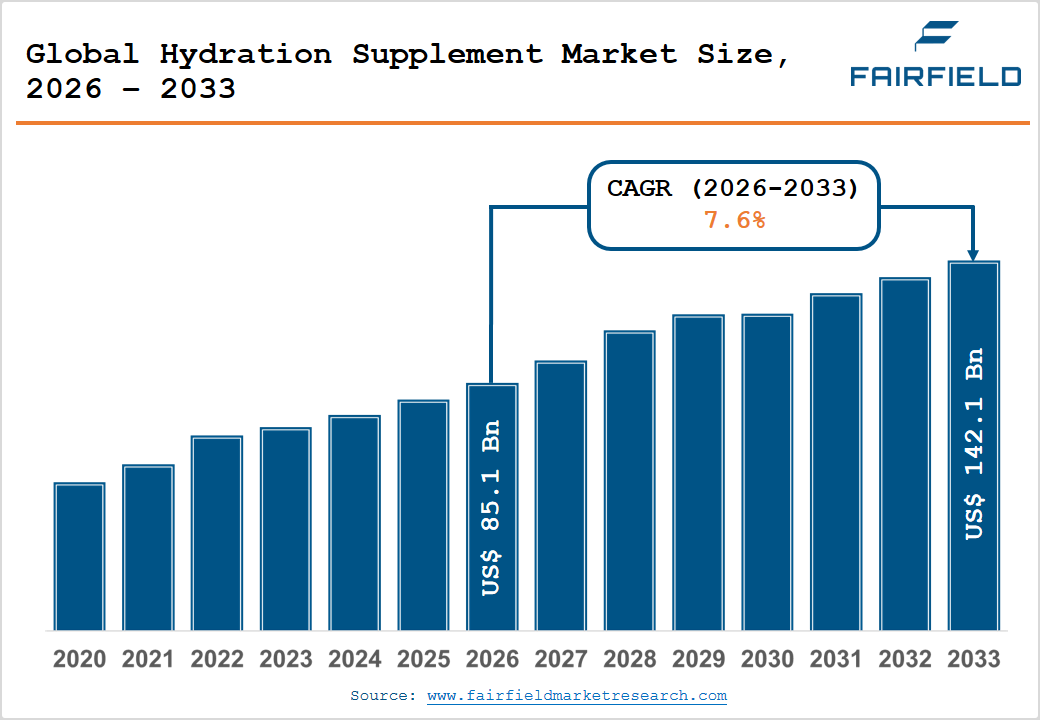
- The global Hydration Supplement Market size is likely to be valued at US$ 85.1 Billion in 2026 and is expected to reach US$ 142.1 Billion by 2033, growing at a CAGR of 7.60% during the forecast period from 2026 to 2033.
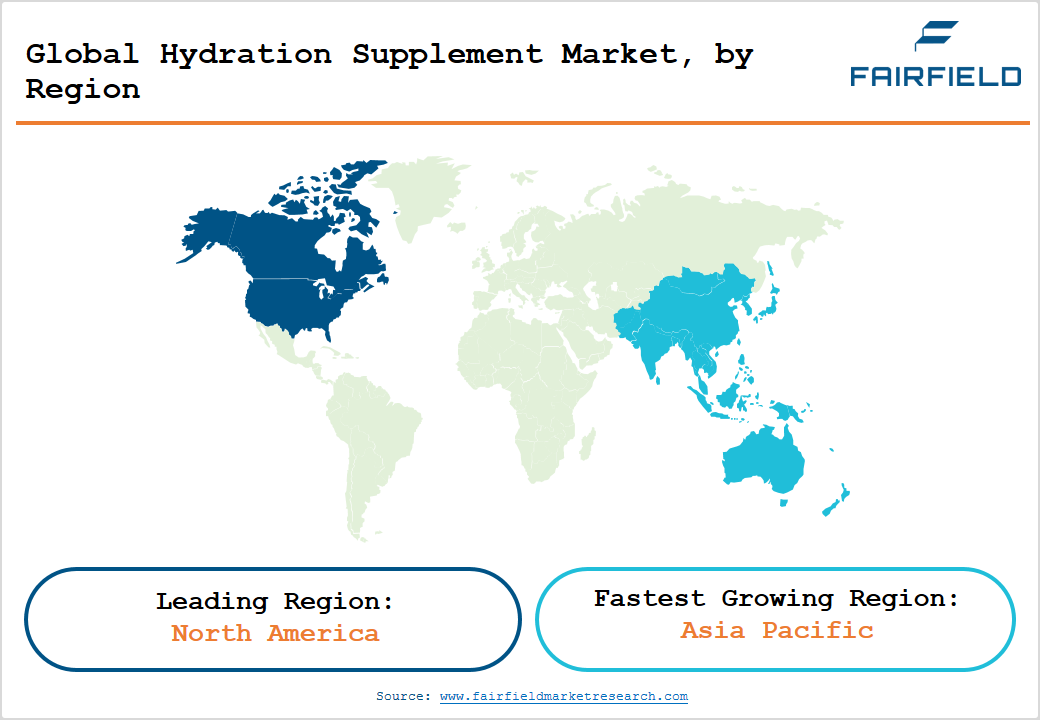
- North America leads the global hydration supplement market with approximately 42% revenue share in 2026, anchored by the United States' robust sports nutrition infrastructure, high fitness participation, and leading brands including Gatorade and Liquid I.V.
- Asia Pacific is the fastest-growing regional market, driven by China's "Healthy China 2030" initiative, India's fitness boom under the Fit India Movement, and rising middle-class health spending across Japan, South Korea, and ASEAN
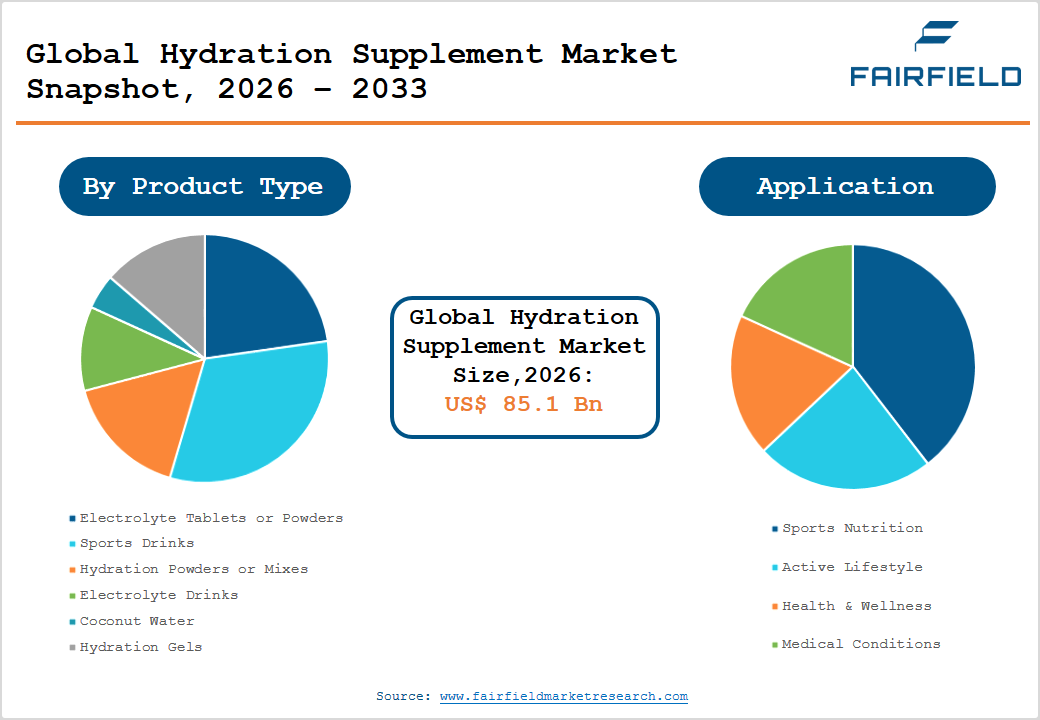
- Sports Drinks dominate the product type segment with approximately 35% market share in 2026, supported by strong brand equity from PepsiCo's Gatorade and The Coca-Cola Company's Powerade, wide retail availability, and convenient ready-to-drink formats.
- The Online Pharmacies and e-commerce sales channel is the fastest-growing distribution segment, driven by direct-to-consumer brand models, subscription purchasing, and expanding digital retail ecosystems across North America, Europe, and Asia Pacific.
- Clean-label and medical-grade hydration innovation targeting chronic disease patients-including over 500 million diabetics globally per the International Diabetes Federation (IDF)-represents a high-value strategic opportunity for market participants investing in functional formulation R&D.
Market Dynamics
Market Growth Drivers
- Surging Global Sports and Fitness Participation
The accelerating rise in sports participation and gym memberships globally has emerged as a pivotal growth driver for the hydration supplement market. According to data published by the The International Health, Racquet & Sportsclub Association (IHRSA) represents the global health club industry, with membership recovery and sustained growth continuing through 2023 and beyond. Furthe rmore, the International Olympic Committee (IOC) estimates that over 1 billion people engage in regular physical activity globally. Athletes and fitness enthusiasts require consistent electrolyte replenishment to sustain performance and accelerate post-exercise recovery, directly fueling demand for sports drinks, hydration powders, and electrolyte tablets. The proliferation of endurance events such as marathons, triathlons, and CrossFit competitions has further intensified per capita consumption of hydration supplements across North America, Europe, and Asia Pacific.
- Growing Awareness of Dehydration-Related Health Risks
Heightened consumer awareness regarding the adverse health consequences of dehydration is substantially driving the hydration supplement market. The U.S. National Academies of Sciences, Engineering, and Medicine recommends a daily fluid intake of approximately 3.7 liters for men and 2.7 liters for women, underscoring the physiological importance of consistent hydration. Peer-reviewed clinical studies published in the “Journal of the American College of Nutrition” have demonstrated that even mild dehydration representing as little as 1-2% of body weight fluid loss can meaningfully impair cognitive function, physical performance, and metabolic efficiency. This expanding body of scientific evidence, amplified by healthcare professionals, registered dietitians, and digital wellness platforms, is prompting consumers across all age groups to proactively integrate hydration supplements into their daily wellness routines, thereby sustaining consistent market demand.
Market Restraints
- High Sugar Content and Increasing Regulatory Scrutiny
A significant restraint for the hydration supplement market is the growing regulatory and consumer backlash against high-sugar formulations prevalent in conventional sports drinks. Many standard hydration beverages contain sugar levels exceeding 30 grams per serving well above the 25 grams daily added sugar limit recommended by the World Health Organization (WHO) for adults. Regulatory bodies including the U.S. Food and Drug Administration (FDA) and the European Food Safety Authority (EFSA) have tightened labeling requirements and scrutinized health claims on hydration products, raising compliance costs for manufacturers. This regulatory environment, combined with rising health literacy among consumers, is driving skepticism toward traditional formulations and constraining market penetration among health-aware consumer segments.
- Intense Market Competition and Price Sensitivity
The hydration supplement market is characterized by intense competition among established multinationals and emerging niche brands, resulting in significant pricing pressure across key segments. The entry of private-label products from major retailers has commoditized basic electrolyte powders and sports drinks, making premium pricing increasingly difficult to sustain. In price-sensitive markets across Latin America, Southeast Asia, and Sub-Saharan Africa, affordability constraints substantially limit consumer uptake of premium hydration solutions. According to the Food and Agriculture Organization (FAO), over 700 million people globally still face food and nutrition insecurity, reflecting structural spending constraints that hinder premium supplement adoption in lower-income populations and geographies.
Market Opportunities
- Quick Growth in High-Potential and Developing Markets
Emerging markets represents one of the most compelling growth opportunities for the global hydration supplement market. The region's rapidly expanding middle class, accelerating urbanization, and intensifying health consciousness are creating fertile ground for hydration products. According to the Asian Development Bank (ADB), the middle class in emerging markets is projected to grow dramatically by 2030, expanding the consumer base for health and wellness products. In China, the government's landmark "Healthy China 2030" initiative has catalyzed investment in sports nutrition, while India's fitness industry is projected to grow at double-digit rates according to the Confederation of Indian Industry (CII). The underpenetrated retail channels for hydration supplements across Southeast Asia and South Asia further amplify the opportunity for both global incumbents and regional challenger brands to capture first-mover advantage in these high-growth markets.
- Product Innovation in Clean-Label, Functional, and Medical-Grade Hydration
The accelerating shift toward clean-label, functional, and medically targeted hydration products presents a significant commercial opportunity for manufacturers. Consumers are increasingly demanding hydration supplements free from artificial colors, synthetic sweeteners, and preservatives a trend validated by the International Food Information Council (IFIC), whose consumer surveys reveal that over 60% of U.S. consumers actively scrutinize ingredient labels when purchasing health supplements. The growing global prevalence of chronic conditions such as diabetes, chronic kidney disease, and cardiovascular disorders affecting over 500 million adults globally according to the International Diabetes Federation (IDF) is generating robust demand for medical-grade, low-sugar, and electrolyte-optimized hydration solutions. Brands investing in clinically validated formulations, sustainable packaging innovation, and personalized hydration platforms leveraging digital health technology are well-positioned to capture significant premium market share.
Segmental Insights
- Product Type Analysis
Sports Drinks dominate the hydration supplement market by product type, accounting for an estimated 35% market share in 2026. This leadership is underpinned by decades of brand equity built by global market leaders including Gatorade (owned by PepsiCo Inc.) and Powerade (owned by The Coca-Cola Company), which have established expansive distribution networks spanning retail, foodservice, and e-commerce channels. The ready-to-drink format of sports beverages offers unmatched convenience for on-the-go consumers. Data from the Beverage Marketing Corporation confirms that the sports drinks category has consistently recorded year-on-year volume growth, supported by substantial advertising investments and high-profile sports sponsorships at events including the FIFA World Cup and the Olympic Games. The rapid proliferation of low-sugar and zero-calorie variants within this segment is further consolidating its leading market position.
- Application Analysis
The Sports Nutrition segment leads the hydration supplement market by application, representing approximately 40% of total market share in 2026. This dominance reflects the deep integration of hydration science into athletic training and recovery protocols adopted by both professional and amateur athletes. The American College of Sports Medicine (ACSM) recommends individualized fluid intake strategies for athletes, with electrolyte supplementation specifically advocated for exercise sessions exceeding 60 minutes in duration. The global proliferation of organized sports leagues, international fitness competitions, and mass-participation endurance events continues to cement the Sports Nutrition segment's market leadership. Furthermore, the increasing adoption of evidence-based sports nutrition practices by professional coaches, sports dietitians, and performance nutritionists amplifies demand for specialized hydration products targeting competitive athletes.
- Sales Channel Analysis
Store-based retail channels represent the leading sales channel for hydration supplements, commanding approximately 65% market share in 2026. The dominance of physical retail is attributable to high product visibility, immediate availability, and impulse purchasing behaviour particularly for ready-to-drink formats in supermarkets, hypermarkets, pharmacies, and specialty sports stores. Major global retailers including Walmart, Target, Tesco, and Carrefour dedicate substantial shelf space to hydration and sports nutrition categories, providing significant mainstream consumer exposure. However, the Online Pharmacies and e-commerce segment is rapidly gaining market traction, driven by subscription-based purchasing models, direct-to-consumer (DTC) brand strategies, and growing consumer comfort with digital health retail. Platforms such as Amazon and brand-owned DTC websites have become critical omnichannel touchpoints for hydration supplement brands.
Regional Insights
- North America Hydration Supplement Trends
North America maintains its position as the dominant regional market for hydration supplements, accounting for approximately 42% market share in 2026. The United States is the epicenter of this leadership, driven by a deeply embedded fitness culture, widespread participation in organized sports, and a highly developed sports nutrition retail and e-commerce infrastructure. The U.S. Sports & Fitness Industry Association (SFIA) reported that over 230 million Americans participated in at least one fitness activity in 2022, underscoring the vast addressable consumer base.
The regulatory framework administered by the U.S. Food and Drug Administration (FDA) governs hydration supplement labeling and health claims, providing product quality standards that bolster consumer trust. Innovation continues to thrive in the U.S. market, with brands such as Liquid I.V. (owned by Unilever PLC), LMNT, and Nuun introducing science-backed electrolyte formulations leveraging Cellular Transport Technology and clinically studied electrolyte ratios. Canada's growing multicultural fitness community and rising government investment in recreational sports infrastructure further reinforce North America's market leadership position.
- Europe Hydration Supplement Trends
Europe represents the second-largest regional market for hydration supplements, with Germany, the United Kingdom, France, and Spain serving as the primary growth engines. The region's deeply embedded sports culture characterized by high participation in football, cycling, and athletics drives sustained demand for electrolyte-based hydration products. The European Commission's revised EU Regulation No. 609/2013 on foods for specific groups, including sports foods, provides a harmonized regulatory framework facilitating cross-border market entry and product standardization across member states.
In the United Kingdom, post-Brexit regulatory adjustments by the Food Standards Agency (FSA) have created both compliance challenges and market differentiation opportunities for hydration supplement brands. Germany's stringent product quality standards, enforced by the Bundesamt für Verbraucherschutz und Lebensmittelsicherheit (BVL), have cultivated a consumer base that strongly prioritizes clinically validated and transparently labeled hydration products. The enduring popularity of major endurance events such as the Tour de France and mass participation running initiatives like Parkrun across Europe continues to deepen consumer engagement with hydration supplements.
- Asia Pacific Hydration Supplement Trends
Asia Pacific is the fastest-growing regional market for hydration supplements, propelled by rapid urbanization, rising disposable incomes, and an expanding health-conscious middle class across China, Japan, India, and ASEAN nations. In China, the landmark "Healthy China 2030" strategic plan has directed substantial public investment toward national health and wellness infrastructure, directly stimulating demand for functional and sports nutrition products. China's sports industry is targeted to reach RMB 5 trillion (approximately US$ 700 billion) by 2025 according to the State Council of China.
In Japan, the functional beverage market is highly mature, with Otsuka Group (makers of Pocari Sweat) commanding strong consumer loyalty in the hydration category. India's emerging fitness economy buoyed by a young demographic and the Fit India Movement launched under the Ministry of Youth Affairs and Sports is accelerating adoption of sports nutrition and hydration products. The region's significant manufacturing capabilities, particularly in China and India, also provide meaningful cost advantages for regional and global brands scaling production of hydration supplements to serve both domestic and export markets.
Competitive Landscape
The global hydration supplement market exhibits a moderately consolidated competitive structure. Leading multinational corporations including The Coca-Cola Company, PepsiCo Inc., Nestlé S.A., and Unilever PLC command significant market share through established hydration brands, extensive global distribution networks, and large-scale marketing investments. Simultaneously, a dynamic tier of mid-sized and specialty players such as GU Energy Labs, Ultima Health Products, Hammer Nutrition, and Glanbia plc differentiate through clean-label formulations, sport-specific targeting, and direct-to-consumer digital strategies. Key competitive differentiators include product innovation in zero-sugar and functional electrolyte blends, sustainability credentials, and clinical substantiation of health claims. Mergers, acquisitions, and strategic licensing partnerships remain prominent growth strategies employed by market leaders to expand their product portfolios and geographic reach.
Key Market Developments
- January 2025: Unilever PLC expanded its hydration portfolio through enhanced distribution of Liquid I.V. products across additional international markets including select Asia Pacific territories, reinforcing its commitment to the premium hydration supplement segment.
- March 2024: PepsiCo Inc. announced the launch of new Gatorade Zero Sugar variants fortified with added B vitamins and amino acids, targeting endurance athletes and health-conscious consumers seeking low-calorie electrolyte options.
- November 2023: Haleon Group introduced a reformulated Emergen-C Hydration+ line featuring enhanced electrolyte profiles and vitamin C fortification, aligned with growing consumer demand for multifunctional immunity and hydration supplements.
Companies Covered in Hydration Supplement Market
- The Coca-Cola Company
- PepsiCo Inc.
- Nestlé S.A.
- Abbott Nutrition
- Unilever PLC
- GlaxoSmithKline plc
- Otsuka Group
- Haleon Group
- Glanbia plc
- Ultima Health Products
- MyProtein
- MuscleBlaze
- Hammer Nutrition
- GU Energy Labs
- Liquid I.V. (Unilever PLC)
- Nuun (Nestle S.A.)
- LMNT (Elemental Labs)
- Skratch Labs
- Science in Sport (SiS)
- Electrolit
Market Segmentation
By Product Type
- Electrolyte Tablets or Powders
- Sports Drinks
- Hydration Powders or Mixes
- Electrolyte Drinks
- Coconut Water
- Hydration Gels
By Application
- Sports Nutrition
- Active Lifestyle
- Health & Wellness
- Medical Conditions
By Sales Channel
- Store-based
- Online Pharmacies
By Region
- North America
- Europe
- Asia Pacific
- Latin America
- Middle East & Africa
- Executive Summary
- Global Hydration Supplement Market Snapshot
- Future Projections
- Key Market Trends
- Regional Snapshot, by Value, 2026
- Analyst Recommendations
- Market Overview
- Market Definitions and Segmentations
- Market Dynamics
- Drivers
- Restraints
- Market Opportunities
- Value Chain Analysis
- COVID-19 Impact Analysis
- Porter's Five Forces Analysis
- Impact of Russia-Ukraine Conflict
- PESTLE Analysis
- Regulatory Analysis
- Price Trend Analysis
- Current Prices and Future Projections, 2025-2033
- Price Impact Factors
- Global Hydration Supplement Market Outlook, 2020 - 2033
- Global Hydration Supplement Market Outlook, by Product Type, Value (US$ Bn), 2020-2033
- Electrolyte Tablets or Powders
- Sports Drinks
- Hydration Powders or Mixes
- Electrolyte Drinks
- Coconut Water
- Hydration Gels
- Global Hydration Supplement Market Outlook, by Application, Value (US$ Bn), 2020-2033
- Sports Nutrition
- Active Lifestyle
- Health & Wellness
- Medical Conditions
- Global Hydration Supplement Market Outlook, by Sales Channel, Value (US$ Bn), 2020-2033
- Store-based
- Online Pharmacies
- Global Hydration Supplement Market Outlook, by Region, Value (US$ Bn), 2020-2033
- North America
- Europe
- Asia Pacific
- Latin America
- Middle East & Africa
- Global Hydration Supplement Market Outlook, by Product Type, Value (US$ Bn), 2020-2033
- North America Hydration Supplement Market Outlook, 2020 - 2033
- North America Hydration Supplement Market Outlook, by Product Type, Value (US$ Bn), 2020-2033
- Electrolyte Tablets or Powders
- Sports Drinks
- Hydration Powders or Mixes
- Electrolyte Drinks
- Coconut Water
- Hydration Gels
- North America Hydration Supplement Market Outlook, by Application, Value (US$ Bn), 2020-2033
- Sports Nutrition
- Active Lifestyle
- Health & Wellness
- Medical Conditions
- North America Hydration Supplement Market Outlook, by Sales Channel, Value (US$ Bn), 2020-2033
- Store-based
- Online Pharmacies
- North America Hydration Supplement Market Outlook, by Country, Value (US$ Bn), 2020-2033
- S. Hydration Supplement Market Outlook, by Product Type, 2020-2033
- S. Hydration Supplement Market Outlook, by Application, 2020-2033
- S. Hydration Supplement Market Outlook, by Sales Channel, 2020-2033
- Canada Hydration Supplement Market Outlook, by Product Type, 2020-2033
- Canada Hydration Supplement Market Outlook, by Application, 2020-2033
- Canada Hydration Supplement Market Outlook, by Sales Channel, 2020-2033
- BPS Analysis/Market Attractiveness Analysis
- North America Hydration Supplement Market Outlook, by Product Type, Value (US$ Bn), 2020-2033
- Europe Hydration Supplement Market Outlook, 2020 - 2033
- Europe Hydration Supplement Market Outlook, by Product Type, Value (US$ Bn), 2020-2033
- Electrolyte Tablets or Powders
- Sports Drinks
- Hydration Powders or Mixes
- Electrolyte Drinks
- Coconut Water
- Hydration Gels
- Europe Hydration Supplement Market Outlook, by Application, Value (US$ Bn), 2020-2033
- Sports Nutrition
- Active Lifestyle
- Health & Wellness
- Medical Conditions
- Europe Hydration Supplement Market Outlook, by Sales Channel, Value (US$ Bn), 2020-2033
- Store-based
- Online Pharmacies
- Europe Hydration Supplement Market Outlook, by Country, Value (US$ Bn), 2020-2033
- Germany Hydration Supplement Market Outlook, by Product Type, 2020-2033
- Germany Hydration Supplement Market Outlook, by Application, 2020-2033
- Germany Hydration Supplement Market Outlook, by Sales Channel, 2020-2033
- Italy Hydration Supplement Market Outlook, by Product Type, 2020-2033
- Italy Hydration Supplement Market Outlook, by Application, 2020-2033
- Italy Hydration Supplement Market Outlook, by Sales Channel, 2020-2033
- France Hydration Supplement Market Outlook, by Product Type, 2020-2033
- France Hydration Supplement Market Outlook, by Application, 2020-2033
- France Hydration Supplement Market Outlook, by Sales Channel, 2020-2033
- K. Hydration Supplement Market Outlook, by Product Type, 2020-2033
- K. Hydration Supplement Market Outlook, by Application, 2020-2033
- K. Hydration Supplement Market Outlook, by Sales Channel, 2020-2033
- Spain Hydration Supplement Market Outlook, by Product Type, 2020-2033
- Spain Hydration Supplement Market Outlook, by Application, 2020-2033
- Spain Hydration Supplement Market Outlook, by Sales Channel, 2020-2033
- Russia Hydration Supplement Market Outlook, by Product Type, 2020-2033
- Russia Hydration Supplement Market Outlook, by Application, 2020-2033
- Russia Hydration Supplement Market Outlook, by Sales Channel, 2020-2033
- Rest of Europe Hydration Supplement Market Outlook, by Product Type, 2020-2033
- Rest of Europe Hydration Supplement Market Outlook, by Application, 2020-2033
- Rest of Europe Hydration Supplement Market Outlook, by Sales Channel, 2020-2033
- BPS Analysis/Market Attractiveness Analysis
- Europe Hydration Supplement Market Outlook, by Product Type, Value (US$ Bn), 2020-2033
- Asia Pacific Hydration Supplement Market Outlook, 2020 - 2033
- Asia Pacific Hydration Supplement Market Outlook, by Product Type, Value (US$ Bn), 2020-2033
- Electrolyte Tablets or Powders
- Sports Drinks
- Hydration Powders or Mixes
- Electrolyte Drinks
- Coconut Water
- Hydration Gels
- Asia Pacific Hydration Supplement Market Outlook, by Application, Value (US$ Bn), 2020-2033
- Sports Nutrition
- Active Lifestyle
- Health & Wellness
- Medical Conditions
- Asia Pacific Hydration Supplement Market Outlook, by Sales Channel, Value (US$ Bn), 2020-2033
- Store-based
- Online Pharmacies
- Asia Pacific Hydration Supplement Market Outlook, by Country, Value (US$ Bn), 2020-2033
- China Hydration Supplement Market Outlook, by Product Type, 2020-2033
- China Hydration Supplement Market Outlook, by Application, 2020-2033
- China Hydration Supplement Market Outlook, by Sales Channel, 2020-2033
- Japan Hydration Supplement Market Outlook, by Product Type, 2020-2033
- Japan Hydration Supplement Market Outlook, by Application, 2020-2033
- Japan Hydration Supplement Market Outlook, by Sales Channel, 2020-2033
- South Korea Hydration Supplement Market Outlook, by Product Type, 2020-2033
- South Korea Hydration Supplement Market Outlook, by Application, 2020-2033
- South Korea Hydration Supplement Market Outlook, by Sales Channel, 2020-2033
- India Hydration Supplement Market Outlook, by Product Type, 2020-2033
- India Hydration Supplement Market Outlook, by Application, 2020-2033
- India Hydration Supplement Market Outlook, by Sales Channel, 2020-2033
- Southeast Asia Hydration Supplement Market Outlook, by Product Type, 2020-2033
- Southeast Asia Hydration Supplement Market Outlook, by Application, 2020-2033
- Southeast Asia Hydration Supplement Market Outlook, by Sales Channel, 2020-2033
- Rest of SAO Hydration Supplement Market Outlook, by Product Type, 2020-2033
- Rest of SAO Hydration Supplement Market Outlook, by Application, 2020-2033
- Rest of SAO Hydration Supplement Market Outlook, by Sales Channel, 2020-2033
- BPS Analysis/Market Attractiveness Analysis
- Asia Pacific Hydration Supplement Market Outlook, by Product Type, Value (US$ Bn), 2020-2033
- Latin America Hydration Supplement Market Outlook, 2020 - 2033
- Latin America Hydration Supplement Market Outlook, by Product Type, Value (US$ Bn), 2020-2033
- Electrolyte Tablets or Powders
- Sports Drinks
- Hydration Powders or Mixes
- Electrolyte Drinks
- Coconut Water
- Hydration Gels
- Latin America Hydration Supplement Market Outlook, by Application, Value (US$ Bn), 2020-2033
- Sports Nutrition
- Active Lifestyle
- Health & Wellness
- Medical Conditions
- Latin America Hydration Supplement Market Outlook, by Sales Channel, Value (US$ Bn), 2020-2033
- Store-based
- Online Pharmacies
- Latin America Hydration Supplement Market Outlook, by Country, Value (US$ Bn), 2020-2033
- Brazil Hydration Supplement Market Outlook, by Product Type, 2020-2033
- Brazil Hydration Supplement Market Outlook, by Application, 2020-2033
- Brazil Hydration Supplement Market Outlook, by Sales Channel, 2020-2033
- Mexico Hydration Supplement Market Outlook, by Product Type, 2020-2033
- Mexico Hydration Supplement Market Outlook, by Application, 2020-2033
- Mexico Hydration Supplement Market Outlook, by Sales Channel, 2020-2033
- Argentina Hydration Supplement Market Outlook, by Product Type, 2020-2033
- Argentina Hydration Supplement Market Outlook, by Application, 2020-2033
- Argentina Hydration Supplement Market Outlook, by Sales Channel, 2020-2033
- Rest of LATAM Hydration Supplement Market Outlook, by Product Type, 2020-2033
- Rest of LATAM Hydration Supplement Market Outlook, by Application, 2020-2033
- Rest of LATAM Hydration Supplement Market Outlook, by Sales Channel, 2020-2033
- BPS Analysis/Market Attractiveness Analysis
- Latin America Hydration Supplement Market Outlook, by Product Type, Value (US$ Bn), 2020-2033
- Middle East & Africa Hydration Supplement Market Outlook, 2020 - 2033
- Middle East & Africa Hydration Supplement Market Outlook, by Product Type, Value (US$ Bn), 2020-2033
- Electrolyte Tablets or Powders
- Sports Drinks
- Hydration Powders or Mixes
- Electrolyte Drinks
- Coconut Water
- Hydration Gels
- Middle East & Africa Hydration Supplement Market Outlook, by Application, Value (US$ Bn), 2020-2033
- Sports Nutrition
- Active Lifestyle
- Health & Wellness
- Medical Conditions
- Middle East & Africa Hydration Supplement Market Outlook, by Sales Channel, Value (US$ Bn), 2020-2033
- Store-based
- Online Pharmacies
- Middle East & Africa Hydration Supplement Market Outlook, by Country, Value (US$ Bn), 2020-2033
- GCC Hydration Supplement Market Outlook, by Product Type, 2020-2033
- GCC Hydration Supplement Market Outlook, by Application, 2020-2033
- GCC Hydration Supplement Market Outlook, by Sales Channel, 2020-2033
- South Africa Hydration Supplement Market Outlook, by Product Type, 2020-2033
- South Africa Hydration Supplement Market Outlook, by Application, 2020-2033
- South Africa Hydration Supplement Market Outlook, by Sales Channel, 2020-2033
- Egypt Hydration Supplement Market Outlook, by Product Type, 2020-2033
- Egypt Hydration Supplement Market Outlook, by Application, 2020-2033
- Egypt Hydration Supplement Market Outlook, by Sales Channel, 2020-2033
- Nigeria Hydration Supplement Market Outlook, by Product Type, 2020-2033
- Nigeria Hydration Supplement Market Outlook, by Application, 2020-2033
- Nigeria Hydration Supplement Market Outlook, by Sales Channel, 2020-2033
- Rest of Middle East Hydration Supplement Market Outlook, by Product Type, 2020-2033
- Rest of Middle East Hydration Supplement Market Outlook, by Application, 2020-2033
- Rest of Middle East Hydration Supplement Market Outlook, by Sales Channel, 2020-2033
- BPS Analysis/Market Attractiveness Analysis
- Middle East & Africa Hydration Supplement Market Outlook, by Product Type, Value (US$ Bn), 2020-2033
- Competitive Landscape
- Company Vs Segment Heatmap
- Company Market Share Analysis, 2025
- Competitive Dashboard
- Company Profiles
- The Coca-Cola Company
- Company Overview
- Product Portfolio
- Financial Overview
- Business Strategies and Developments
- PepsiCo Inc.
- Nestle S.A.
- Abbott Nutrition
- Unilever PLC
- GlaxoSmithKline plc
- Otsuka Group
- Haleon Group
- Glanbia plc
- Ultima Health Products
- MyProtein
- MuscleBlaze
- Hammer Nutrition
- GU Energy Labs
- The Coca-Cola Company
- Appendix
- Research Methodology
- Report Assumptions
- Acronyms and Abbreviations
|
BASE YEAR |
HISTORICAL DATA |
FORECAST PERIOD |
UNITS |
|||
 |
2025 |
 |
2019 - 2024 |
 |
2026 - 2033 |
Value: US$ Million |
|
REPORT FEATURES |
DETAILS |
|
By Product Type Coverage |
|
|
By Application Coverage |
|
|
Geographical Coverage |
|
|
Leading Companies |
|
|
Report Highlights |
Key Market Indicators, Macro-micro economic impact analysis, Technological Roadmap, Key Trends, Driver, Restraints, and Future Opportunities & Revenue Pockets, Porter’s 5 Forces Analysis, Historical Trend (2019-2024), Market Estimates and Forecast, Market Dynamics, Industry Trends, Competition Landscape, Category, Region, Country-wise Trends & Analysis, COVID-19 Impact Analysis (Demand and Supply Chain) |
Our Research Methodology
Considering the volatility of business today, traditional approaches to strategizing a game plan can be unfruitful if not detrimental. True ambiguity is no way to determine a forecast. A myriad of predetermined factors must be accounted for such as the degree of risk involved, the magnitude of circumstances, as well as conditions or consequences that are not known or unpredictable. To circumvent binary views that cast uncertainty, the application of market research intelligence to strategically posture, move, and enable actionable outcomes is necessary.
View Methodology
Quality Assured
Rigorous Validation Process

Confidentiality Assured
End-to-end Data Security

Custom Research Services
Tailored To Your Objectives
FAQs
The hydration supplement market size is US$ 85.1 Billion in 2026.
The hydration supplement market is projected to grow at a CAGR of 7.60% by 2033.
The hydration supplement market growth drivers include rising sports participation, increasing awareness of dehydration risks, and expanding fitness culture globally.
North America is the dominating region for the hydration supplement market.
The Coca-Cola Company, PepsiCo Inc., Nestlé S.A., Unilever PLC, and Glanbia plc are some leading industry players in the hydration supplement market.
Related Reports
Bio-Based Extrusion Aids Market Size, Share, Insights, Competitive Landscape, and Forecast 2026 to 2033
Bio-Based Extrusion Aids Market is valued at US$1.42 Bn in 2026 and projected to reach US$2.72 Bn by 2033, growing at a 9.73% CAGR.
Halogen-Free Process Aids Market Size, Share, Insights, Competitive Landscape, and Forecast 2026 to 2033
Halogen-Free Process Aids Market is valued at US$2.38 Bn in 2026 and projected to reach US$4.28 Bn by 2033, growing at a CAGR of 8.75%.
Particle-Engineered Probiotic Stabilizers Market Size, Share, Insights, Competitive Landscape, and Forecast 2026 to 2033
The global particle-engineered probiotic stabilizers market is projected to reach US$ 2.98 Billion by 2033, growing at an 11.4% CAGR during 2026–2033
Probiotic Stability Excipients Market Size, Share, Insights, Competitive Landscape, and Forecast 2026 to 2033
The global probiotic stability excipients market is projected to reach US$ 2.8 Bn by 2033, growing at an 11.6% CAGR , driven by stable probiotic formulations
GLP-1 Telehealth Platforms Market Size, Share, Insights, Competitive Landscape, and Forecast 2026 to 2033
GLP-1 Telehealth Platforms Market is valued at US$0.7638 Billion in 2026 and projected to reach US$2.1199 Billion by 2033, growing at 15.7% CAGR.
GLP-1 Nutrition Coaching Market Size, Share, Insights, Competitive Landscape, and Forecast 2026 to 2033
GLP-1 Nutrition Coaching Market is projected to reach US$0.4095 billion by 2033 from US$0.1248 billion in 2026, growing at a CAGR of 18.5%.