



Industrial Electrification Market
Industrial Electrification Market Size, Share, Insights, Competitive Landscape, and Forecast 2026 to 2033
Industrial Electrification Market Size and Trend Analysis
How Fast Is the Industrial Electrification Market Growing?
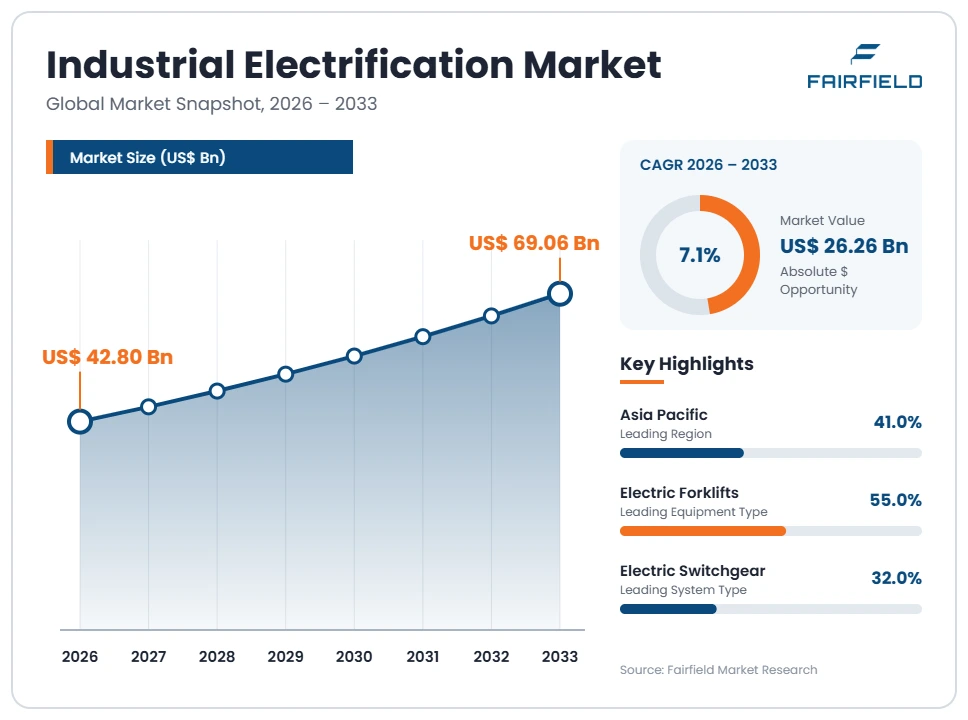
The global industrial electrification market size is expected to be valued at US$ 42.80 billion in 2026 and projected to reach US$ 69.06 billion by 2033, growing at a CAGR of 7.1% between 2026 and 2033.
Between 2020 and 2025, the market grew at a CAGR of about 6.2%, as factory projects paused in 2020, then climate targets, high fuel prices, and government incentives sped up the shift from fossil fuel equipment to electric systems. The industrial electrification market covers equipment and systems that replace fuel-burning machines and heat sources with electric versions in factories, mines, warehouses, ports, and construction sites. It includes electric motors and electric drives, actuators, switchgear, power distribution units, electric air-conditioning, industrial heat pumps, electric boilers and furnaces, and electric excavators, loaders, and forklifts, along with controls and software. Process heat electrification is a major focus, since most industrial heat still comes from fossil fuels. Growth comes from carbon targets, cheaper renewable power, and lower operating costs. In September 2026, Shell, Schneider Electric, and Axens started Europe’s first industrial-scale electric process heater.
Key Report Takeaways
- By Device and System Type: Electric Switchgear held about 32% share in 2025, while Power Distribution Units is projected to expand at an 8.3% CAGR through 2033, driven by electrified factories, data-heavy automation, and new loads from heat pumps and charging systems.
- By Equipment Type: Electric Forklifts held about 55% share in 2025, while Electric Excavators is projected to expand at a 12.4% CAGR through 2033, driven by zero-emission construction sites, city noise rules, and falling battery costs.
- By Industry Vertical: Logistics and Transportation held about 22% share in 2025, while Mining is projected to expand at a 9.1% CAGR through 2033, driven by diesel costs, underground air quality, and battery-electric haul trucks and loaders.
- By Region: Asia Pacific held about 41% share in 2025, while India is projected to expand at a 9.4% CAGR through 2033, driven by new factories, renewable power growth, industrial incentive programs, and rising electric equipment adoption.
Global Industrial Electrification Market Trends and Insights
Drivers Impact Analysis
Two drivers carry the strongest influence on industrial electrification market demand during the forecast period.
| Driver | Impact on CAGR Forecast | Geographic Relevance | Impact Timeline |
| Carbon reduction targets and climate policies | High | Europe, North America, Asia Pacific | Long term (≥4 years) |
| Lower operating costs and cheaper renewable power | Medium | Global | Medium term (2-4 years) |
Climate Policies Are Driving the Industrial Electrification Market
Carbon reduction targets and climate policies are the strongest driver of the industrial electrification market. Industry must cut emissions.
The mechanism is the large share of emissions from industrial fuel use. Factories burn coal, oil, and gas for heat, steam, and machines, making industry one of the biggest sources of carbon emissions. Governments are setting net-zero goals, carbon prices, and emission rules, such as the European Union Emissions Trading System and carbon border tax, and incentives under the U.S. Inflation Reduction Act and programs in Japan, South Korea, and India. Many large companies have pledged to cut emissions from their own operations. Replacing fossil-fired boilers, furnaces, and diesel machines with electric heat pumps, electric boilers, and battery equipment is one of the fastest ways to reduce these emissions, especially when power comes from renewables. These pressures create steady, long-term demand.
Cost Savings Are Expanding the Industrial Electrification Market
Lower operating costs and cheaper renewable power are expanding the industrial electrification market. Electric equipment can be cheaper to run.
The cause is the efficiency of electric technology. Electric motors with electric drives use less energy than older fixed-speed systems, and industrial heat pumps can deliver several units of heat for each unit of electricity, far more efficient than burning fuel. Battery-electric forklifts, loaders, and excavators have fewer moving parts and need less maintenance than diesel machines. Solar and wind power costs have fallen sharply, and companies can sign long-term power deals that lock in prices. Fuel price spikes in 2022 showed the risk of depending on gas and diesel. Electric equipment also improves air quality and lowers noise in factories, warehouses, and mines. These benefits expand sales.
Restraints Impact Analysis
Two restraints limit how quickly the industrial electrification market grows.
| Restraint | Impact on CAGR Forecast | Geographic Relevance | Impact Timeline |
| High upfront costs and long payback periods | High | Global | Medium term (2-4 years) |
| Grid capacity limits and electricity prices | Medium | Europe, North America, Asia Pacific | Long term (≥4 years) |
High Upfront Costs Slow the Industrial Electrification Market
High upfront costs and long payback periods slow the industrial electrification market. Electric equipment often costs more to buy.
The specific causes are expensive technology and existing assets. Industrial heat pumps, electric furnaces, large battery machines, and new switchgear often cost more than fossil fuel equipment, and installing them may require new wiring, transformers, and control systems. Many factories have boilers, furnaces, and diesel fleets with years of useful life left, so replacing them early is hard to justify. Small and mid-sized manufacturers may lack capital or engineering staff to plan projects. High interest rates in recent years raised financing costs, and some subsidy programs have changed or been delayed. Payback depends on fuel and power prices, which are uncertain. These factors slow adoption, especially for high-temperature processes where electric options are still developing.
Grid Limits Restrict the Industrial Electrification Market
Grid capacity limits and electricity prices restrict the industrial electrification market. Factories need much more power to electrify.
The underlying causes are slow grid upgrades and high power costs in some regions. Electrifying a large plant can double or triple its power demand, but grid connections in Germany, the Netherlands, the United Kingdom, and parts of the United States face long waiting times. Electricity prices in Europe are often higher than gas prices per unit of energy, making the economics harder unless heat pumps deliver high efficiency. Power outages in some emerging markets add risk, and factories need backup systems or storage to stay running. Utilities may charge high fees for new connections and peak demand. Planning permits for new substations can take years. These factors restrict growth.
Market Opportunities
Industrial Heat Electrification Opens a Fast-Growth Revenue Pool
Industrial heat electrification opens a fast-growth revenue pool in the industrial electrification market. Heat is the largest untapped opportunity.
Suppliers can capture this opportunity. More than two-thirds of industrial process heat still comes from fossil fuels, and much of it is used at low and medium temperatures that heat pumps, electric boilers, and thermal storage can supply. Food, beverage, paper, chemical, and pharmaceutical plants are early adopters. In April 2026, Innomotics highlighted its motors and drives for a large BASF heat pump project in Ludwigshafen, Germany, designed to produce up to 500,000 tonnes of steam a year. Electric furnaces and heaters are moving into refining and chemicals. Companies offering complete heat solutions with financing can grow quickly.
Electric Mining and Construction Equipment Creates a Growth Revenue Pool
Electric mining and construction equipment creates a growth revenue pool in the industrial electrification market. Heavy machines are going electric.
Suppliers can capture this opportunity in mining and construction. Mines face high diesel costs and must ventilate underground tunnels to remove exhaust, so battery-electric loaders and trucks cut both fuel and ventilation costs. Cities in Europe are requiring zero-emission construction sites, boosting electric excavators and loaders. Mining companies in Australia, Canada, Chile, and Sweden are testing large electric haul trucks, trolley lines, and fast charging systems. Charging and battery swapping systems for large machines are a new area of competition. Equipment makers such as Komatsu, Volvo CE, and Epiroc are launching electric models. Companies offering machines, chargers, and power systems together can win large fleet contracts.
Segment Analysis
- By Device and System Type: Electric Switchgear Leads While Power Distribution Units Grow Fastest
Electric Switchgear held about 32% share in 2025. Switchgear protects and controls electrical circuits in factories, mines, and plants, and every electrification project needs new or upgraded switchgear to handle higher power loads. Medium-voltage switchgear free of sulfur hexafluoride gas is gaining share as rules tighten in Europe.
Power Distribution Units is the fastest-growing segment, expanding at an 8.3% CAGR through 2033. These units distribute power safely to machines, automation systems, heat pumps, and charging stations, and smart versions monitor energy use in real time. Electric actuators replace hydraulic and pneumatic systems for better control and lower energy use, while electric air-conditioning and other systems form further segments. Motors and drives form the base of many systems. For the market, distribution growth supports smarter factories.
- By Equipment Type: Electric Forklifts Lead While Electric Excavators Grow Fastest
Electric Forklifts held about 55% share in 2025. Warehouses, factories, ports, and retail distribution centers have used electric forklifts for years because they produce no exhaust indoors, run quietly, and cost less to maintain. Lithium-ion batteries now allow fast charging and longer shifts, replacing lead-acid batteries. Online shopping growth adds demand for warehouse equipment in every region.
Electric Excavators is the fastest-growing equipment type, expanding at a 12.4% CAGR through 2033. Construction companies in Europe and China are adopting electric excavators for city projects with noise and emission limits. Electric wheel loaders and other machines form further segments, with growing use in mining and recycling yards. For the market, excavator growth opens heavy equipment demand.
- By Industry Vertical: Logistics and Transportation Leads While Mining Grows Fastest
Logistics and Transportation held about 22% share in 2025. Warehouses, ports, airports, and rail yards use electric forklifts, cranes, tugs, and conveyors, and many are electrifying yard trucks and port equipment. Chemicals, food and beverages, pharmaceuticals and healthcare, and oil and gas use electric heat, motors, and drives in their processes.
Mining is the fastest-growing vertical, expanding at a 9.1% CAGR through 2033. Battery-electric loaders, drills, and trucks cut diesel costs and improve air quality underground, and mines in Canada, Australia, Chile, and Sweden are leading adoption. Construction, agriculture and forestry, and other verticals form further segments, with electric tractors and forestry machines still at early stages. For the market, mining growth adds large-scale equipment demand.
Geography Analysis
- Why Is North America Important to the Industrial Electrification Market?
North America is important to the industrial electrification market because of strong incentives, large industrial investment, and leading technology companies. The United States offers tax credits and grants for clean manufacturing, heat pumps, and electric equipment, and new battery, chip, and clean energy factories are being built across the country. Eaton, Rockwell Automation, Emerson, GE, and Honeywell are based in the region. Canada has large mines adopting battery-electric equipment, and Mexico’s factories serve the North America market. Key barriers include grid connection delays and policy uncertainty. One change shaping the region is factory building linked to reshoring.
- Europe Shapes the Industrial Electrification Market Through Climate Rules
Europe is a major industrial electrification market. Germany, France, the Netherlands, Sweden, Denmark, and Italy have strict climate targets, carbon prices, and funding for industrial decarbonization. Siemens, ABB, and Schneider Electric are based in the region, and chemical, food, and paper companies are installing heat pumps and electric heaters. In September 2026, Shell, Schneider Electric, and Axens started an industrial-scale electric heater at a Shell site in Germany. Battery-electric construction machines are common on city sites in Norway and the Netherlands. Key barriers include high electricity prices and grid limits. One opportunity is heat electrification in chemicals and food processing.
- Which Region Is Leading the Industrial Electrification Market?
Asia Pacific is leading the industrial electrification market with about 41% share in 2025, and India is the fastest-growing country, expanding at a 9.4% CAGR through 2033. China is the largest manufacturing country and a leader in electric forklifts, excavators, motors, and heat pumps, supported by government targets to cut coal use. India is building new factories under incentive programs, along with large solar and wind capacity. Japan, South Korea, and Australia add advanced manufacturing and mining demand. Mitsubishi Electric, Hitachi, and Toshiba are major suppliers. Key barriers include coal-heavy power grids in some countries. One change shaping the region is cheap renewable power.
- Latin America Grows the Industrial Electrification Market Through Mining and Clean Power
Latin America is a growing industrial electrification market. Chile and Peru have large copper mines adopting electric equipment and renewable power, while Brazil has a power grid largely supplied by hydropower, making electrification attractive for factories. Mexico has large automotive and electronics plants serving the North America market. Argentina and Colombia add mining and food processing demand. Food processors in Brazil and Argentina use large amounts of process heat that could be electrified. Key barriers include high financing costs, currency swings, and grid limits in remote areas far from main power lines. One opportunity is electric mining equipment powered by solar and wind.
- Middle East & Africa Builds the Industrial Electrification Market Through Diversification Programs
Middle East & Africa is an emerging industrial electrification market. Saudi Arabia, the United Arab Emirates, and Qatar are building new industrial cities, manufacturing plants, and renewable power capacity under economic diversification plans. South Africa has large mines and factories, though power shortages have slowed projects. Morocco and Egypt are growing solar and wind power and attracting factories. Key barriers include cheap fossil fuels in oil-rich countries and unreliable grids in some countries. One opportunity is electrified industrial zones powered by solar energy.
Competitive Landscape
The industrial electrification market is moderately consolidated. Siemens, ABB, Schneider Electric, Eaton, and Mitsubishi Electric are leading players, while Rockwell Automation, Emerson Electric, Honeywell, GE Vernova, Hitachi, Toshiba, and Innomotics compete strongly. The leaders offer broad portfolios covering motors, drives, switchgear, power distribution, automation, and software, while equipment makers, heat pump specialists, and battery machine makers compete in specific segments.
Companies compete on energy efficiency, reliability, digital monitoring, project engineering, service networks, and total cost of ownership. Large industrial customers want partners that can plan and deliver complete electrification projects, from grid connection and substations to controls, and many now ask for financing and performance guarantees. Software that tracks energy use and emissions helps suppliers prove savings and win repeat business.
Strategic moves show how competition is changing. In December 2025, ABB completed its acquisition of Gamesa Electric’s power electronics business, strengthening its converters and drives. In April 2026, Innomotics highlighted its role in a large BASF heat pump project in Germany. In September 2026, Shell, Schneider Electric, and Axens started an industrial-scale electric heater in Germany. These moves show competition shifting toward complete heat and power solutions.
Three themes shape vendor strategy. First, companies are expanding into industrial heat electrification through heat pumps, electric boilers, and heaters. Second, they are combining hardware with digital energy management. Third, they are growing in Asia Pacific and North America, where new factories and incentives support demand.
Industrial Electrification Market Industry Leaders
Siemens ABB Schneider Electric Eaton Mitsubishi Electric
Recent Industry Developments
- September 2026: Shell, Schneider Electric, and Axens started Europe’s first industrial-scale electric tubular heater at a Shell site in Germany, replacing fired heating with zero direct emissions - advances process heat electrification in the industrial electrification market.
- April 2026: Innomotics highlighted its high-voltage motors and converters for a BASF heat pump in Ludwigshafen designed to produce up to 500,000 tonnes of steam a year - shows large-scale heat pumps entering chemicals.
- December 2025: ABB completed its acquisition of the power electronics business of Gamesa Electric - strengthens its converters and electric drives for renewable and industrial applications.
Companies Covered in the Report
- Siemens
- ABB
- Schneider Electric
- Eaton
- Mitsubishi Electric
- Rockwell Automation
- Emerson Electric
- Honeywell
- GE Vernova
- Hitachi
- Toshiba
- Innomotics
Industrial Electrification Market Report Scope
| Metric | Value |
| Study Period | 2020-2033 |
| Market Size 2026 | US$ 42.80 Billion |
| Market Size 2033 | US$ 69.06 Billion |
| CAGR 2026-2033 | 7.1% |
| Absolute Dollar Opportunity | US$ 26.26 Billion |
| Largest Market | Asia Pacific |
| Fastest-Growing Market | India |
| Market Concentration | Moderately Consolidated |
| Major Players | Siemens, ABB, Schneider Electric, Eaton, Mitsubishi Electric |
Industrial Electrification Market Segmentation
- Executive Summary
- Global Industrial Electrification Market Snapshot
- Future Projections, 2026-2033
- Key Market Trends
- Regional Snapshot
- Market Overview
- Market Definition and Report Scope
- Historical Market Trends
- Market Dynamics
- Drivers Impact Analysis
- Climate Policies Are Driving the Industrial Electrification Market
- Cost Savings Are Expanding the Industrial Electrification Market
- Restraints Impact Analysis
- High Upfront Costs Slow the Industrial Electrification Market
- Grid Limits Restrict the Industrial Electrification Market
- Market Opportunities
- Industrial Heat Electrification Opens a Fast-Growth Revenue Pool
- Electric Mining and Construction Equipment Creates a Growth Revenue Pool
- Drivers Impact Analysis
- Global Industrial Electrification Market Outlook, 2020-2033
- Global Industrial Electrification Market Outlook, by Device and System Type, Value (US$ Billion), 2020-2033
- Electric Actuators
- Electric Switchgear
- Electric Air-Conditioning Systems
- Power Distribution Units
- Others
- Global Industrial Electrification Market Outlook, by Equipment Type, Value (US$ Billion), 2020-2033
- Electric Excavators
- Electric Wheel Loaders
- Electric Forklifts
- Others
- Global Industrial Electrification Market Outlook, by Industry Vertical, Value (US$ Billion), 2020-2033
- Logistics and Transportation
- Mining
- Chemicals
- Construction
- Food and Beverages
- Pharmaceuticals and Healthcare
- Oil and Gas
- Others
- Global Industrial Electrification Market Outlook, by Region, Value (US$ Billion), 2020-2033
- North America
- Europe
- Asia Pacific
- Latin America
- Middle East & Africa
- Global Industrial Electrification Market Outlook, by Device and System Type, Value (US$ Billion), 2020-2033
- North America Industrial Electrification Market Outlook, 2020-2033
- North America Industrial Electrification Market Outlook, by Device and System Type, Value (US$ Billion), 2020-2033
- Electric Actuators
- Electric Switchgear
- Electric Air-Conditioning Systems
- Power Distribution Units
- Others
- North America Industrial Electrification Market Outlook, by Equipment Type, Value (US$ Billion), 2020-2033
- Electric Excavators
- Electric Wheel Loaders
- Electric Forklifts
- Others
- North America Industrial Electrification Market Outlook, by Industry Vertical, Value (US$ Billion), 2020-2033
- Logistics and Transportation
- Mining
- Chemicals
- Construction
- Food and Beverages
- Pharmaceuticals and Healthcare
- Oil and Gas
- Others
- North America Industrial Electrification Market Outlook, by Country, Value (US$ Billion), 2020-2033
- United States Industrial Electrification Market Outlook, by Device and System Type, 2020-2033
- United States Industrial Electrification Market Outlook, by Equipment Type, 2020-2033
- United States Industrial Electrification Market Outlook, by Industry Vertical, 2020-2033
- Canada Industrial Electrification Market Outlook, by Device and System Type, 2020-2033
- Canada Industrial Electrification Market Outlook, by Equipment Type, 2020-2033
- Canada Industrial Electrification Market Outlook, by Industry Vertical, 2020-2033
- Mexico Industrial Electrification Market Outlook, by Device and System Type, 2020-2033
- Mexico Industrial Electrification Market Outlook, by Equipment Type, 2020-2033
- Mexico Industrial Electrification Market Outlook, by Industry Vertical, 2020-2033
- North America Industrial Electrification Market Outlook, by Device and System Type, Value (US$ Billion), 2020-2033
- Europe Industrial Electrification Market Outlook, 2020-2033
- Europe Industrial Electrification Market Outlook, by Device and System Type, Value (US$ Billion), 2020-2033
- Electric Actuators
- Electric Switchgear
- Electric Air-Conditioning Systems
- Power Distribution Units
- Others
- Europe Industrial Electrification Market Outlook, by Equipment Type, Value (US$ Billion), 2020-2033
- Electric Excavators
- Electric Wheel Loaders
- Electric Forklifts
- Others
- Europe Industrial Electrification Market Outlook, by Industry Vertical, Value (US$ Billion), 2020-2033
- Logistics and Transportation
- Mining
- Chemicals
- Construction
- Food and Beverages
- Pharmaceuticals and Healthcare
- Oil and Gas
- Others
- Europe Industrial Electrification Market Outlook, by Country, Value (US$ Billion), 2020-2033
- Germany Industrial Electrification Market Outlook, by Device and System Type, 2020-2033
- Germany Industrial Electrification Market Outlook, by Equipment Type, 2020-2033
- Germany Industrial Electrification Market Outlook, by Industry Vertical, 2020-2033
- France Industrial Electrification Market Outlook, by Device and System Type, 2020-2033
- France Industrial Electrification Market Outlook, by Equipment Type, 2020-2033
- France Industrial Electrification Market Outlook, by Industry Vertical, 2020-2033
- Netherlands Industrial Electrification Market Outlook, by Device and System Type, 2020-2033
- Netherlands Industrial Electrification Market Outlook, by Equipment Type, 2020-2033
- Netherlands Industrial Electrification Market Outlook, by Industry Vertical, 2020-2033
- Sweden Industrial Electrification Market Outlook, by Device and System Type, 2020-2033
- Sweden Industrial Electrification Market Outlook, by Equipment Type, 2020-2033
- Sweden Industrial Electrification Market Outlook, by Industry Vertical, 2020-2033
- Denmark Industrial Electrification Market Outlook, by Device and System Type, 2020-2033
- Denmark Industrial Electrification Market Outlook, by Equipment Type, 2020-2033
- Denmark Industrial Electrification Market Outlook, by Industry Vertical, 2020-2033
- Italy Industrial Electrification Market Outlook, by Device and System Type, 2020-2033
- Italy Industrial Electrification Market Outlook, by Equipment Type, 2020-2033
- Italy Industrial Electrification Market Outlook, by Industry Vertical, 2020-2033
- Norway Industrial Electrification Market Outlook, by Device and System Type, 2020-2033
- Norway Industrial Electrification Market Outlook, by Equipment Type, 2020-2033
- Norway Industrial Electrification Market Outlook, by Industry Vertical, 2020-2033
- Europe Industrial Electrification Market Outlook, by Device and System Type, Value (US$ Billion), 2020-2033
- Asia Pacific Industrial Electrification Market Outlook, 2020-2033
- Asia Pacific Industrial Electrification Market Outlook, by Device and System Type, Value (US$ Billion), 2020-2033
- Electric Actuators
- Electric Switchgear
- Electric Air-Conditioning Systems
- Power Distribution Units
- Others
- Asia Pacific Industrial Electrification Market Outlook, by Equipment Type, Value (US$ Billion), 2020-2033
- Electric Excavators
- Electric Wheel Loaders
- Electric Forklifts
- Others
- Asia Pacific Industrial Electrification Market Outlook, by Industry Vertical, Value (US$ Billion), 2020-2033
- Logistics and Transportation
- Mining
- Chemicals
- Construction
- Food and Beverages
- Pharmaceuticals and Healthcare
- Oil and Gas
- Others
- Asia Pacific Industrial Electrification Market Outlook, by Country, Value (US$ Billion), 2020-2033
- India Industrial Electrification Market Outlook, by Device and System Type, 2020-2033
- India Industrial Electrification Market Outlook, by Equipment Type, 2020-2033
- India Industrial Electrification Market Outlook, by Industry Vertical, 2020-2033
- China Industrial Electrification Market Outlook, by Device and System Type, 2020-2033
- China Industrial Electrification Market Outlook, by Equipment Type, 2020-2033
- China Industrial Electrification Market Outlook, by Industry Vertical, 2020-2033
- Japan Industrial Electrification Market Outlook, by Device and System Type, 2020-2033
- Japan Industrial Electrification Market Outlook, by Equipment Type, 2020-2033
- Japan Industrial Electrification Market Outlook, by Industry Vertical, 2020-2033
- South Korea Industrial Electrification Market Outlook, by Device and System Type, 2020-2033
- South Korea Industrial Electrification Market Outlook, by Equipment Type, 2020-2033
- South Korea Industrial Electrification Market Outlook, by Industry Vertical, 2020-2033
- Australia Industrial Electrification Market Outlook, by Device and System Type, 2020-2033
- Australia Industrial Electrification Market Outlook, by Equipment Type, 2020-2033
- Australia Industrial Electrification Market Outlook, by Industry Vertical, 2020-2033
- Asia Pacific Industrial Electrification Market Outlook, by Device and System Type, Value (US$ Billion), 2020-2033
- Latin America Industrial Electrification Market Outlook, 2020-2033
- Latin America Industrial Electrification Market Outlook, by Device and System Type, Value (US$ Billion), 2020-2033
- Electric Actuators
- Electric Switchgear
- Electric Air-Conditioning Systems
- Power Distribution Units
- Others
- Latin America Industrial Electrification Market Outlook, by Equipment Type, Value (US$ Billion), 2020-2033
- Electric Excavators
- Electric Wheel Loaders
- Electric Forklifts
- Others
- Latin America Industrial Electrification Market Outlook, by Industry Vertical, Value (US$ Billion), 2020-2033
- Logistics and Transportation
- Mining
- Chemicals
- Construction
- Food and Beverages
- Pharmaceuticals and Healthcare
- Oil and Gas
- Others
- Latin America Industrial Electrification Market Outlook, by Country, Value (US$ Billion), 2020-2033
- Chile Industrial Electrification Market Outlook, by Device and System Type, 2020-2033
- Chile Industrial Electrification Market Outlook, by Equipment Type, 2020-2033
- Chile Industrial Electrification Market Outlook, by Industry Vertical, 2020-2033
- Peru Industrial Electrification Market Outlook, by Device and System Type, 2020-2033
- Peru Industrial Electrification Market Outlook, by Equipment Type, 2020-2033
- Peru Industrial Electrification Market Outlook, by Industry Vertical, 2020-2033
- Brazil Industrial Electrification Market Outlook, by Device and System Type, 2020-2033
- Brazil Industrial Electrification Market Outlook, by Equipment Type, 2020-2033
- Brazil Industrial Electrification Market Outlook, by Industry Vertical, 2020-2033
- Mexico Industrial Electrification Market Outlook, by Device and System Type, 2020-2033
- Mexico Industrial Electrification Market Outlook, by Equipment Type, 2020-2033
- Mexico Industrial Electrification Market Outlook, by Industry Vertical, 2020-2033
- Argentina Industrial Electrification Market Outlook, by Device and System Type, 2020-2033
- Argentina Industrial Electrification Market Outlook, by Equipment Type, 2020-2033
- Argentina Industrial Electrification Market Outlook, by Industry Vertical, 2020-2033
- Colombia Industrial Electrification Market Outlook, by Device and System Type, 2020-2033
- Colombia Industrial Electrification Market Outlook, by Equipment Type, 2020-2033
- Colombia Industrial Electrification Market Outlook, by Industry Vertical, 2020-2033
- Latin America Industrial Electrification Market Outlook, by Device and System Type, Value (US$ Billion), 2020-2033
- Middle East & Africa Industrial Electrification Market Outlook, 2020-2033
- Middle East & Africa Industrial Electrification Market Outlook, by Device and System Type, Value (US$ Billion), 2020-2033
- Electric Actuators
- Electric Switchgear
- Electric Air-Conditioning Systems
- Power Distribution Units
- Others
- Middle East & Africa Industrial Electrification Market Outlook, by Equipment Type, Value (US$ Billion), 2020-2033
- Electric Excavators
- Electric Wheel Loaders
- Electric Forklifts
- Others
- Middle East & Africa Industrial Electrification Market Outlook, by Industry Vertical, Value (US$ Billion), 2020-2033
- Logistics and Transportation
- Mining
- Chemicals
- Construction
- Food and Beverages
- Pharmaceuticals and Healthcare
- Oil and Gas
- Others
- Middle East & Africa Industrial Electrification Market Outlook, by Country, Value (US$ Billion), 2020-2033
- Saudi Arabia Industrial Electrification Market Outlook, by Device and System Type, 2020-2033
- Saudi Arabia Industrial Electrification Market Outlook, by Equipment Type, 2020-2033
- Saudi Arabia Industrial Electrification Market Outlook, by Industry Vertical, 2020-2033
- United Arab Emirates Industrial Electrification Market Outlook, by Device and System Type, 2020-2033
- United Arab Emirates Industrial Electrification Market Outlook, by Equipment Type, 2020-2033
- United Arab Emirates Industrial Electrification Market Outlook, by Industry Vertical, 2020-2033
- Qatar Industrial Electrification Market Outlook, by Device and System Type, 2020-2033
- Qatar Industrial Electrification Market Outlook, by Equipment Type, 2020-2033
- Qatar Industrial Electrification Market Outlook, by Industry Vertical, 2020-2033
- South Africa Industrial Electrification Market Outlook, by Device and System Type, 2020-2033
- South Africa Industrial Electrification Market Outlook, by Equipment Type, 2020-2033
- South Africa Industrial Electrification Market Outlook, by Industry Vertical, 2020-2033
- Morocco Industrial Electrification Market Outlook, by Device and System Type, 2020-2033
- Morocco Industrial Electrification Market Outlook, by Equipment Type, 2020-2033
- Morocco Industrial Electrification Market Outlook, by Industry Vertical, 2020-2033
- Egypt Industrial Electrification Market Outlook, by Device and System Type, 2020-2033
- Egypt Industrial Electrification Market Outlook, by Equipment Type, 2020-2033
- Egypt Industrial Electrification Market Outlook, by Industry Vertical, 2020-2033
- Middle East & Africa Industrial Electrification Market Outlook, by Device and System Type, Value (US$ Billion), 2020-2033
- Competitive Landscape
- Industry Leaders
- Recent Industry Developments
- Company Profiles
- Siemens
- ABB
- Schneider Electric
- Eaton
- Mitsubishi Electric
- Rockwell Automation
- Emerson Electric
- Honeywell
- GE Vernova
- Hitachi
- Toshiba
- Innomotics
- Appendix
- Research Methodology
- Report Assumptions
- Acronyms and Abbreviations
Device and System Type
- Electric Actuators
- Electric Switchgear
- Electric Air-Conditioning Systems
- Power Distribution Units
- Others
Equipment Type
- Electric Excavators
- Electric Wheel Loaders
- Electric Forklifts
- Others
Industry Vertical
- Logistics and Transportation
- Mining
- Chemicals
- Construction
- Food and Beverages
- Pharmaceuticals and Healthcare
- Oil and Gas
- Others
Regions
- North America
- Europe
- Asia Pacific
- Latin America
- Middle East & Africa
Our Research Methodology
Considering the volatility of business today, traditional approaches to strategizing a game plan can be unfruitful if not detrimental. True ambiguity is no way to determine a forecast. A myriad of predetermined factors must be accounted for such as the degree of risk involved, the magnitude of circumstances, as well as conditions or consequences that are not known or unpredictable. To circumvent binary views that cast uncertainty, the application of market research intelligence to strategically posture, move, and enable actionable outcomes is necessary.
View Methodology
Quality Assured
Rigorous Validation Process

Confidentiality Assured
End-to-end Data Security

Custom Research Services
Tailored To Your Objectives
FAQs
The industrial electrification market is valued at US$ 42.80 billion in 2026, led by switchgear, electric forklifts, and Asia Pacific.
The market is projected to reach US$ 69.06 billion by 2033, growing at a 7.1% CAGR and adding US$ 26.26 billion.
Electric excavators are growing fastest at a 12.4% CAGR through 2033, driven by zero-emission construction sites and falling battery costs.
India is growing fastest at a 9.4% CAGR through 2033, driven by new factories, renewable power growth, and industrial incentive programs.
Asia Pacific holds the largest share at about 41% in 2025, supported by manufacturing scale and electric equipment production in China.
Related Reports
Lawn Mowers Market Size, Share, Insights, Competitive Landscape, and Forecast 2026 to 2033
The lawn mowers market is projected to reach US$47.0 billion by 2033. Explore demand for riding, robotic, and battery-powered mowers across key regions.
Laser Cladding Market Size, Share, Insights, Competitive Landscape, and Forecast 2026 to 2033
The laser cladding market is projected to reach US$2.0 billion by 2033. Explore powder-fed and wire-fed processes, repair services, and demand by industry.
Industrial Valves Market Size, Share, Insights, Competitive Landscape, and Forecast 2026 to 2033
The global industrial valves market is valued at US$82.50 billion in 2026, reaching US$116.03 billion by 2033, growing at a 5.0% CAGR
Industrial Fasteners Market Size, Share, Insights, Competitive Landscape, and Forecast 2026 to 2033
The global industrial fasteners market is valued at US$94.21 billion in 2026, reaching US$119.70 billion by 2033, growing at a 3.5% CAGR
Piping and Fittings Market Size, Share, Insights, Competitive Landscape, and Forecast 2026 to 2033
The global piping and fittings market is valued at US$186.0 billion in 2026, reaching US$258.0 billion by 2033, growing at a 4.8% CAGR
Laser Retroreflector Array Market Size, Share, Insights, Competitive Landscape, and Forecast 2026 to 2033
The laser retroreflector array market is forecast to grow from US$ 818.1 million in 2026 to US$ 1,505.3 million by 2033 at a 9.1% CAGR.