



Laser Retroreflector Array Market
Laser Retroreflector Array Market Size, Share, Insights, Competitive Landscape, and Forecast 2026 to 2033
How Fast Is the Laser Retroreflector Array Market Growing?
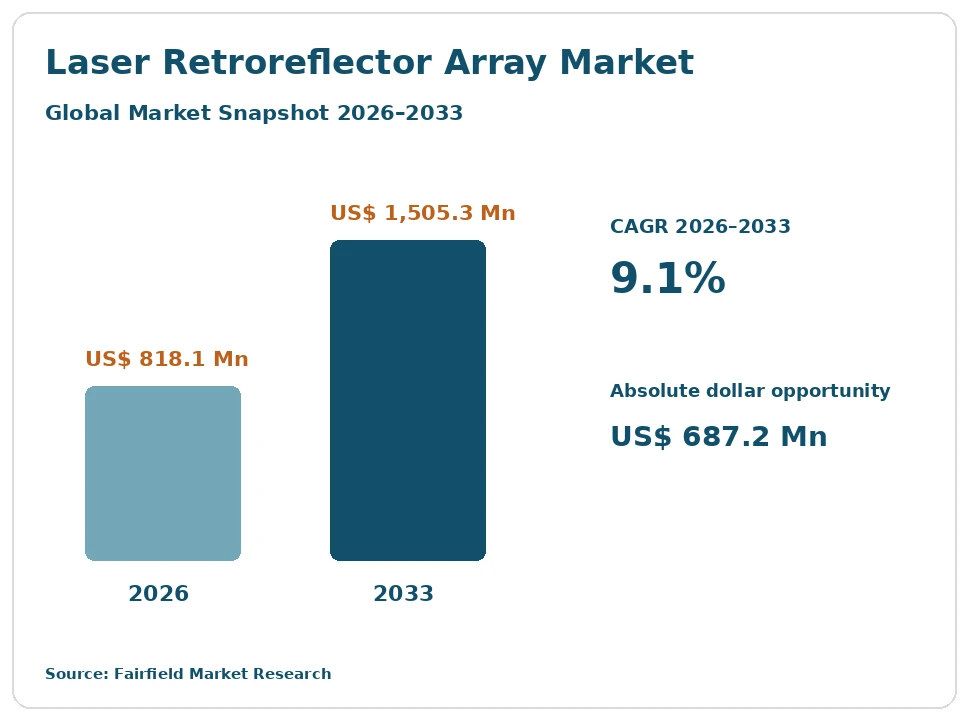
The global laser retroreflector array market size is expected to be valued at US$ 818.1 million in 2026 and projected to reach US$ 1,505.3 million by 2033, growing at a CAGR of 9.1% between 2026 and 2033.
Between 2020 and 2025, the market grew at a CAGR of about 8.2%, as navigation satellite constellations were modernized, lunar missions returned under the Artemis program, and new satellite laser ranging stations came online despite pandemic-related launch delays in 2020. The laser retroreflector array market covers arrays of corner-cube prisms and hollow reflectors that return laser beams precisely to their source, used on navigation satellites, Earth observation and geodesy satellites, lunar landers, spacecraft docking systems, and ground and vehicle sensing systems. Satellite laser ranging stations fire laser pulses at these arrays to measure distance to within millimeters, improving satellite orbits, Earth reference frames, and timing. Growth comes from new GPS, Galileo, BeiDou, and GLONASS satellites, the lunar retroreflector revival, small satellite constellations, and space situational awareness needs. The market is shifting toward lightweight, compact arrays for small satellites. In March 2025, Firefly Aerospace’s Blue Ghost lander delivered a next-generation retroreflector to the Moon.
Key Report Takeaways
- By Type: Single Mode held about 58% share in 2025, while Multimode is projected to expand at a 10.4% CAGR through 2033, driven by wider-angle coverage, lower cost per unit, and growing use in small satellites, drones, and ground-based vehicle sensing systems.
- By Application: Satellite Navigation held about 44% share in 2025, while Vehicles and Transportation is projected to expand at a 11.8% CAGR through 2033, driven by autonomous docking, rendezvous systems, rail and road sensing, and precision positioning for autonomous vehicles.
- By End User: Government and Defense held about 63% share in 2025, while Commercial is projected to expand at a 11.5% CAGR through 2033, driven by commercial satellite constellations, private lunar landers, and space traffic management services.
- By Region: North America held about 41% share in 2025, while Asia Pacific is projected to expand at a 11.2% CAGR through 2033, driven by BeiDou expansion, Indian navigation satellites, Japanese lunar missions, and new laser ranging stations across China and Australia.
Global Laser Retroreflector Array Market Trends and Insights
Drivers Impact Analysis
Two drivers carry the strongest influence on laser retroreflector array market demand during the forecast period.
| Driver | Impact on CAGR Forecast | Geographic Relevance | Impact Timeline |
| Navigation satellite modernization | High | North America, Europe, Asia Pacific | Long term (≥4 years) |
| Lunar exploration and deep space missions | Medium | North America, Asia Pacific, Europe | Medium term (2-4 years) |
Navigation Satellite Upgrades Are Driving the Laser Retroreflector Array Market
Navigation satellite modernization is the strongest driver of the laser retroreflector array market. New satellites carry reflector arrays.
The mechanism is the need for precise orbit data in navigation systems. Global navigation satellite systems such as GPS, Galileo, BeiDou, GLONASS, and India’s NavIC depend on exact knowledge of each satellite’s position. Laser ranging to retroreflector arrays gives an independent, millimeter-level check on radio-based orbit estimates, improving positioning accuracy for billions of users. The U.S. Space Force has added arrays to GPS III satellites, starting with SV9 and SV10, and Galileo, BeiDou, and GLONASS satellites carry arrays as standard. Replacement and expansion of these constellations will continue through the 2030s. Geodesy satellites that measure sea level, ice sheets, and Earth’s shape also use arrays. These programs provide steady, long-term demand for space-qualified reflector arrays across regions.
Lunar Missions Are Expanding the Laser Retroreflector Array Market
Lunar exploration and deep space missions are expanding the laser retroreflector array market. New reflectors are going to the Moon.
The cause is the return of lunar exploration by space agencies and private companies. NASA’s Commercial Lunar Payload Services program sends instruments on private landers, and Firefly Aerospace’s Blue Ghost delivered the Next Generation Lunar Retroreflector in March 2025, allowing ranging to within about 1 millimeter. China’s Chang’e missions, India’s Chandrayaan-3, and Japan’s SLIM also carried reflectors. Artemis missions plan more. Lunar ranging tests general relativity, measures the Moon’s orbit and interior, and supports navigation for future crewed missions. Older reflectors left by the Apollo and Soviet Lunokhod missions are degrading, so scientists want new, more accurate designs. Planned landers and rovers in 2026 and 2027 will carry more reflectors. These missions add steady demand for advanced arrays.
Restraints Impact Analysis
Two restraints limit how quickly the laser retroreflector array market grows.
| Restraint | Impact on CAGR Forecast | Geographic Relevance | Impact Timeline |
| High development and space qualification costs | High | Global | Long term (≥4 years) |
| Limited ground laser ranging infrastructure | Medium | Latin America, Middle East & Africa, Asia Pacific | Medium term (2-4 years) |
High Costs Slow the Laser Retroreflector Array Market
High development and space qualification costs slow the laser retroreflector array market. Space hardware must pass tough tests.
The specific causes are demanding space environments and small production volumes. Arrays must survive launch vibration, extreme temperatures, radiation, and vacuum for many years while keeping optical accuracy. Fused silica prisms, special coatings, and precision mounts are costly to make and test. Each mission often needs a custom design, limiting economies of scale. Government budgets and program delays, such as slips in Artemis schedules, can postpone orders. Small satellite makers may skip arrays to save mass and cost. Few suppliers have flight heritage, which limits competition and raises prices. Export controls on space optics, such as ITAR rules in the United States, restrict sales across borders. These factors slow adoption and keep prices high for buyers.
Limited Infrastructure Restricts the Laser Retroreflector Array Market
Limited ground laser ranging infrastructure restricts the laser retroreflector array market. Few stations can use the arrays.
The underlying causes are the cost and complexity of laser ranging stations. The International Laser Ranging Service network has only about 40 stations, concentrated in North America, Europe, China, and Australia. Weather limits observations, and stations need skilled staff. Gaps in Middle East & Africa and Latin America reduce coverage. Building new stations takes years and costs millions of dollars, and many existing stations use aging lasers and telescopes that need upgrades. Tracking thousands of small satellites would require far more stations than exist today. Coordination of observation schedules across countries is complex. Some operators rely on radio tracking alone because it is cheaper. These factors restrict how much value arrays can deliver and slow demand.
Market Opportunities
Small Satellite Constellations Open a Fast-Growth Revenue Pool
Small satellite constellations open a fast-growth revenue pool in the laser retroreflector array market. Thousands of satellites need tracking.
Array makers can capture this opportunity. Low Earth orbit constellations for communications, Earth observation, and navigation are adding thousands of satellites, and regulators want better tracking to avoid collisions and manage debris. Small, light retroreflectors let ground stations track satellites precisely even after they fail. Compact arrays for CubeSats are being developed by universities and companies. Space situational awareness firms add laser tracking services. Regulators such as the U.S. Federal Communications Commission have tightened deorbit rules, increasing interest in reliable tracking. Laser ranging can also measure satellite spin and attitude. New automated ranging stations in Australia and Europe can track more objects. Companies offering low-cost, lightweight arrays can win large-volume orders.
Lunar and Planetary Navigation Creates a Growth Revenue Pool
Lunar and planetary navigation creates a growth revenue pool in the laser retroreflector array market. Future Moon bases need precise positioning.
Suppliers can capture this opportunity. Agencies plan lunar navigation networks, and landers and rovers can carry reflectors as fixed markers. NASA, ESA, JAXA, ISRO, and CNSA have lunar plans. Commercial landers from Firefly, Intuitive Machines, and ispace carry payloads. Retroreflectors also support docking for lunar gateways. ESA’s Moonlight program plans lunar navigation and communication services, and NASA is developing LunaNet standards. Mars and asteroid missions may also carry reflectors for ranging and landing. Retroreflectors need no power, so they work for decades. Universities such as the University of Maryland develop new designs with agency funding. Companies with flight heritage, partnerships with landers, and lightweight designs can grow.
Segment Analysis
By Type: Single Mode Leads While Multimode Grows Fastest
Single Mode held about 58% share in 2025. Single mode arrays return highly focused beams with excellent accuracy, which suits navigation and geodesy satellites in medium and high orbits. They are the standard choice for GPS, Galileo, and BeiDou satellites and for lunar reflectors, where precision matters most. High performance supports premium prices, and long satellite lifetimes of 15 years require stable optics.
Multimode is the fastest-growing type, expanding at a 10.4% CAGR through 2033. Multimode arrays accept and return light over wider angles and cost less, making them suitable for small satellites, drones, test ranges, and vehicle sensing systems. New designs reduce weight for CubeSats. For the market, multimode growth broadens use beyond large government satellites.
By Application: Satellite Navigation Leads While Vehicles and Transportation Grows Fastest
Satellite Navigation held about 44% share in 2025. Navigation constellations carry arrays on nearly every satellite, and laser ranging improves orbit accuracy for global positioning. Earth observation and geodesy satellites form another major application, supporting sea level, ice, and gravity measurements used in climate research. Missions such as Sentinel-6 and ICESat-2 use laser ranging to confirm their orbits. Navigation remains the largest application because constellations are large and regularly replaced.
Vehicles and Transportation is the fastest-growing application, expanding at a 11.8% CAGR through 2033. Spacecraft docking and rendezvous systems use retroreflectors as optical targets, and rail, road, and autonomous vehicle sensing systems use them for positioning. Lunar exploration and scientific research form other applications. For the market, transportation growth adds commercial demand.
By End User: Government and Defense Leads While Commercial Grows Fastest
Government and Defense held about 63% share in 2025. Space agencies, defense ministries, and military navigation programs buy most arrays, and national programs such as GPS III, Galileo, BeiDou, and GLONASS drive large orders. Defense agencies also use retroreflectors for missile testing, target tracking, and range calibration. Long procurement cycles make demand predictable.
Commercial is the fastest-growing end user, expanding at a 11.5% CAGR through 2033. Private satellite operators, lunar lander companies, and space tracking firms are adding arrays. Research institutes form another end user, using arrays for physics experiments and geodesy. Commercial lunar landers from Firefly, Intuitive Machines, and ispace carry agency payloads, and commercial constellations want tracking. Falling launch costs make it easier for private firms to fly instruments. For the market, commercial growth diversifies demand.
Geography Analysis
Which Region Is Leading the Laser Retroreflector Array Market?
North America is leading the laser retroreflector array market with about 41% share in 2025. The United States runs GPS, NASA lunar programs, and large defense space budgets, and Lockheed Martin, Northrop Grumman, L3Harris Technologies, and Thorlabs supply arrays and optics. NASA stations and the Apache Point Observatory perform laser ranging. Private lunar landers such as Firefly’s Blue Ghost add demand. Canada adds space research through the Canadian Space Agency. The U.S. Space Force budget for navigation and space awareness is rising. Key barriers include program delays. One change shaping the region is commercial lunar missions.
Europe Shapes the Laser Retroreflector Array Market Through Galileo and ESA
Europe is a major laser retroreflector array market. Galileo satellites carry arrays, and ESA geodesy missions rely on laser ranging. Italy’s space agency built reflectors for lunar landers, and Germany, France, the United Kingdom, and Austria operate laser ranging stations. BAE Systems and Surrey Satellite Technology are based in the United Kingdom. The Wettzell station in Germany and Matera in Italy are key sites in the global network, and ESA’s Moonlight program supports lunar navigation. Second-generation Galileo satellites will need new arrays. Key barriers include budget limits. One opportunity is new Galileo satellites.
Which Region Is Growing Fastest in the Laser Retroreflector Array Market?
Asia Pacific is growing fastest in the laser retroreflector array market, expanding at a 11.2% CAGR through 2033. China operates BeiDou and runs active lunar and deep space programs, India is expanding NavIC, and Japan runs QZSS and lunar missions. Australia hosts major laser ranging stations at Yarragadee and Mount Stromlo, which also track space debris. China has built several laser ranging stations and placed reflectors on its Chang’e landers, and India’s ISRO flew a reflector on Chandrayaan-3. South Korea and Japan are expanding space budgets. Key barriers include export controls. One change shaping the region is lunar exploration growth.
Latin America Grows the Laser Retroreflector Array Market Through Ground Stations
Latin America is a small laser retroreflector array market. Brazil, Argentina, and Chile host satellite tracking and astronomy facilities, and international laser ranging stations operate in Argentina and Chile through partnerships with China and Europe. Brazil is developing its own satellite programs through INPE and the Brazilian Space Agency. Clear skies in the Atacama Desert make Chile a strong location for astronomy and laser ranging. Regional universities take part in international geodesy projects. Most arrays and ranging equipment are imported from Europe and China. Key barriers include limited budgets and small domestic satellite programs. One opportunity is international partnerships.
Middle East & Africa Develops the Laser Retroreflector Array Market Through Space Programs
Middle East & Africa is a developing laser retroreflector array market. The United Arab Emirates and Saudi Arabia are building space programs, including lunar and Mars missions, while South Africa hosts the Hartebeesthoek laser ranging station. Egypt is expanding satellite capability through its national space agency. The United Arab Emirates is building a lunar rover and works with partners on lunar missions, while Saudi Arabia has a national space strategy. Most countries rely on foreign partners and stations for laser ranging services. Key barriers include limited infrastructure and few skilled specialists. One change shaping the region is national space investment.
Competitive Landscape
The laser retroreflector array market is moderately consolidated. Lockheed Martin, Northrop Grumman, L3Harris Technologies, BAE Systems, and Surrey Satellite Technology are leading players, while Thorlabs, Newport, Cobham, PLX, Edmund Optics, Ball Aerospace, now part of BAE Systems, and Excelitas Technologies compete strongly. Space agencies, universities, and national laboratories such as the University of Maryland, Italy’s INFN, and China’s research institutes also design arrays for specific missions. Prime contractors often integrate arrays from specialist optics suppliers.
Companies compete on optical accuracy, flight heritage, mass, thermal stability, radiation resistance, delivery time, and price. Flight heritage is a strong advantage because space agencies prefer proven designs. Specialist optics companies supply corner-cube prisms and coatings, while satellite primes handle integration and testing. Lightweight designs for small satellites are becoming a key area of competition.
Strategic moves show how competition is changing. In July 2024, the U.S. Space Force delivered two laser retroreflector arrays to Lockheed Martin for GPS III SV9 and SV10. In March 2025, Firefly’s Blue Ghost lander placed the Next Generation Lunar Retroreflector on the Moon, and ranging began weeks later. In July 2025, NASA awarded Firefly a further US$ 176.7 million lunar delivery contract. These moves show competition shifting toward commercial lunar missions and navigation upgrades.
Three themes shape vendor strategy. First, companies are developing lighter arrays for small satellites and CubeSats. Second, they are partnering with commercial lander companies. Third, they are supporting new navigation and lunar programs in Asia Pacific and Europe.
Laser Retroreflector Array Market Industry Leaders
- Lockheed Martin
- Northrop Grumman
- L3Harris Technologies
- BAE Systems
- Surrey Satellite Technology
Recent Industry Developments
- July 2025: NASA awarded Firefly Aerospace about US$ 176.7 million to deliver rovers and scientific instruments to the lunar surface under its Commercial Lunar Payload Services initiative - adds future lunar payload opportunities for the laser retroreflector array market.
- March 2025: Firefly Aerospace’s Blue Ghost Mission 1 landed in Mare Crisium carrying the Next Generation Lunar Retroreflector, which Apache Point Observatory detected on March 20, ranging to within about 1 millimeter - revives lunar retroreflector science.
- July 2024: The U.S. Space Force GPS III program office, with NASA and the National Geospatial-Intelligence Agency, delivered two laser retroreflector arrays to Lockheed Martin for GPS III SV9 and SV10 - extends satellite laser ranging to the GPS constellation.
Companies Covered in the Report
- Lockheed Martin
- Northrop Grumman
- L3Harris Technologies
- BAE Systems
- Surrey Satellite Technology
- Thorlabs
- Newport (MKS Instruments)
- Cobham
- PLX
- Edmund Optics
- Excelitas Technologies
- Firefly Aerospace
Laser Retroreflector Array Market Scope
This report covers the laser retroreflector array market, including single mode and multimode retroreflector arrays used in satellite navigation, Earth observation and geodesy, lunar exploration, vehicles and transportation, scientific research, and other applications, for government and defense, commercial, and research end users, across space-based and ground-based systems. The base year is 2025, and the forecast period runs from 2026 to 2033. All values are expressed in US$ Million.
| Metric | Value |
| Study Period | 2020-2033 |
| Market Size 2026 | US$ 818.1 Million |
| Market Size 2033 | US$ 1,505.3 Million |
| CAGR 2026-2033 | 9.1% |
| Absolute Dollar Opportunity | US$ 687.2 Million |
| Largest Market | North America |
| Fastest-Growing Market | Asia Pacific |
| Market Concentration | Moderately Consolidated |
| Major Players | Lockheed Martin, Northrop Grumman, L3Harris Technologies, BAE Systems, Surrey Satellite Technology |
Type
- Single Mode
- Multimode
Application
- Satellite Navigation
- Earth Observation and Geodesy
- Lunar Exploration
- Vehicles and Transportation
- Scientific Research
- Others
End User
- Government and Defense
- Commercial
- Research Institutes
Regions
- North America
- Europe
- Asia Pacific
- Latin America
- Middle East & Africa
1. Executive Summary
1.1. Global Laser Retroreflector Array Market Snapshot
1.2. Future Projections, 2026-2033
1.3. Key Market Trends
1.4. Regional Snapshot
2. Market Overview
2.1. Market Definition and Scope
2.2. Historical Market Trends, 2020-2025
2.3. Market Dynamics
2.3.1. Drivers Impact Analysis
2.3.1.1. Navigation Satellite Upgrades Are Driving the Laser Retroreflector Array Market
2.3.1.2. Lunar Missions Are Expanding the Laser Retroreflector Array Market
2.3.2. Restraints Impact Analysis
2.3.2.1. High Costs Slow the Laser Retroreflector Array Market
2.3.2.2. Limited Infrastructure Restricts the Laser Retroreflector Array Market
2.3.3. Market Opportunities
2.3.3.1. Small Satellite Constellations Open a Fast-Growth Revenue Pool
2.3.3.2. Lunar and Planetary Navigation Creates a Growth Revenue Pool
3. Global Laser Retroreflector Array Market Outlook, 2020-2033
3.1. Global Laser Retroreflector Array Market Outlook, by Type, Value (US$ Million), 2020-2033
3.1.1. Single Mode
3.1.2. Multimode
3.2. Global Laser Retroreflector Array Market Outlook, by Application, Value (US$ Million), 2020-2033
3.2.1. Satellite Navigation
3.2.2. Earth Observation and Geodesy
3.2.3. Lunar Exploration
3.2.4. Vehicles and Transportation
3.2.5. Scientific Research
3.2.6. Others
3.3. Global Laser Retroreflector Array Market Outlook, by End User, Value (US$ Million), 2020-2033
3.3.1. Government and Defense
3.3.2. Commercial
3.3.3. Research Institutes
3.4. Global Laser Retroreflector Array Market Outlook, by Region, Value (US$ Million), 2020-2033
3.4.1. North America
3.4.2. Europe
3.4.3. Asia Pacific
3.4.4. Latin America
3.4.5. Middle East & Africa
4. North America Laser Retroreflector Array Market Outlook, 2020-2033
4.1. North America Laser Retroreflector Array Market Outlook, by Type, Value (US$ Million), 2020-2033
4.1.1. Single Mode
4.1.2. Multimode
4.2. North America Laser Retroreflector Array Market Outlook, by Application, Value (US$ Million), 2020-2033
4.2.1. Satellite Navigation
4.2.2. Earth Observation and Geodesy
4.2.3. Lunar Exploration
4.2.4. Vehicles and Transportation
4.2.5. Scientific Research
4.2.6. Others
4.3. North America Laser Retroreflector Array Market Outlook, by End User, Value (US$ Million), 2020-2033
4.3.1. Government and Defense
4.3.2. Commercial
4.3.3. Research Institutes
4.4. North America Laser Retroreflector Array Market Outlook, by Country, Value (US$ Million), 2020-2033
4.4.1. United States Laser Retroreflector Array Market Outlook, by Type, 2020-2033
4.4.2. United States Laser Retroreflector Array Market Outlook, by Application, 2020-2033
4.4.3. United States Laser Retroreflector Array Market Outlook, by End User, 2020-2033
4.4.4. Canada Laser Retroreflector Array Market Outlook, by Type, 2020-2033
4.4.5. Canada Laser Retroreflector Array Market Outlook, by Application, 2020-2033
4.4.6. Canada Laser Retroreflector Array Market Outlook, by End User, 2020-2033
5. Europe Laser Retroreflector Array Market Outlook, 2020-2033
5.1. Europe Laser Retroreflector Array Market Outlook, by Type, Value (US$ Million), 2020-2033
5.1.1. Single Mode
5.1.2. Multimode
5.2. Europe Laser Retroreflector Array Market Outlook, by Application, Value (US$ Million), 2020-2033
5.2.1. Satellite Navigation
5.2.2. Earth Observation and Geodesy
5.2.3. Lunar Exploration
5.2.4. Vehicles and Transportation
5.2.5. Scientific Research
5.2.6. Others
5.3. Europe Laser Retroreflector Array Market Outlook, by End User, Value (US$ Million), 2020-2033
5.3.1. Government and Defense
5.3.2. Commercial
5.3.3. Research Institutes
5.4. Europe Laser Retroreflector Array Market Outlook, by Country, Value (US$ Million), 2020-2033
5.4.1. Italy Laser Retroreflector Array Market Outlook, by Type, 2020-2033
5.4.2. Italy Laser Retroreflector Array Market Outlook, by Application, 2020-2033
5.4.3. Italy Laser Retroreflector Array Market Outlook, by End User, 2020-2033
5.4.4. Germany Laser Retroreflector Array Market Outlook, by Type, 2020-2033
5.4.5. Germany Laser Retroreflector Array Market Outlook, by Application, 2020-2033
5.4.6. Germany Laser Retroreflector Array Market Outlook, by End User, 2020-2033
5.4.7. France Laser Retroreflector Array Market Outlook, by Type, 2020-2033
5.4.8. France Laser Retroreflector Array Market Outlook, by Application, 2020-2033
5.4.9. France Laser Retroreflector Array Market Outlook, by End User, 2020-2033
5.4.10. United Kingdom Laser Retroreflector Array Market Outlook, by Type, 2020-2033
5.4.11. United Kingdom Laser Retroreflector Array Market Outlook, by Application, 2020-2033
5.4.12. United Kingdom Laser Retroreflector Array Market Outlook, by End User, 2020-2033
5.4.13. Austria Laser Retroreflector Array Market Outlook, by Type, 2020-2033
5.4.14. Austria Laser Retroreflector Array Market Outlook, by Application, 2020-2033
5.4.15. Austria Laser Retroreflector Array Market Outlook, by End User, 2020-2033
6. Asia Pacific Laser Retroreflector Array Market Outlook, 2020-2033
6.1. Asia Pacific Laser Retroreflector Array Market Outlook, by Type, Value (US$ Million), 2020-2033
6.1.1. Single Mode
6.1.2. Multimode
6.2. Asia Pacific Laser Retroreflector Array Market Outlook, by Application, Value (US$ Million), 2020-2033
6.2.1. Satellite Navigation
6.2.2. Earth Observation and Geodesy
6.2.3. Lunar Exploration
6.2.4. Vehicles and Transportation
6.2.5. Scientific Research
6.2.6. Others
6.3. Asia Pacific Laser Retroreflector Array Market Outlook, by End User, Value (US$ Million), 2020-2033
6.3.1. Government and Defense
6.3.2. Commercial
6.3.3. Research Institutes
6.4. Asia Pacific Laser Retroreflector Array Market Outlook, by Country, Value (US$ Million), 2020-2033
6.4.1. China Laser Retroreflector Array Market Outlook, by Type, 2020-2033
6.4.2. China Laser Retroreflector Array Market Outlook, by Application, 2020-2033
6.4.3. China Laser Retroreflector Array Market Outlook, by End User, 2020-2033
6.4.4. India Laser Retroreflector Array Market Outlook, by Type, 2020-2033
6.4.5. India Laser Retroreflector Array Market Outlook, by Application, 2020-2033
6.4.6. India Laser Retroreflector Array Market Outlook, by End User, 2020-2033
6.4.7. Japan Laser Retroreflector Array Market Outlook, by Type, 2020-2033
6.4.8. Japan Laser Retroreflector Array Market Outlook, by Application, 2020-2033
6.4.9. Japan Laser Retroreflector Array Market Outlook, by End User, 2020-2033
6.4.10. Australia Laser Retroreflector Array Market Outlook, by Type, 2020-2033
6.4.11. Australia Laser Retroreflector Array Market Outlook, by Application, 2020-2033
6.4.12. Australia Laser Retroreflector Array Market Outlook, by End User, 2020-2033
6.4.13. South Korea Laser Retroreflector Array Market Outlook, by Type, 2020-2033
6.4.14. South Korea Laser Retroreflector Array Market Outlook, by Application, 2020-2033
6.4.15. South Korea Laser Retroreflector Array Market Outlook, by End User, 2020-2033
7. Latin America Laser Retroreflector Array Market Outlook, 2020-2033
7.1. Latin America Laser Retroreflector Array Market Outlook, by Type, Value (US$ Million), 2020-2033
7.1.1. Single Mode
7.1.2. Multimode
7.2. Latin America Laser Retroreflector Array Market Outlook, by Application, Value (US$ Million), 2020-2033
7.2.1. Satellite Navigation
7.2.2. Earth Observation and Geodesy
7.2.3. Lunar Exploration
7.2.4. Vehicles and Transportation
7.2.5. Scientific Research
7.2.6. Others
7.3. Latin America Laser Retroreflector Array Market Outlook, by End User, Value (US$ Million), 2020-2033
7.3.1. Government and Defense
7.3.2. Commercial
7.3.3. Research Institutes
7.4. Latin America Laser Retroreflector Array Market Outlook, by Country, Value (US$ Million), 2020-2033
7.4.1. Brazil Laser Retroreflector Array Market Outlook, by Type, 2020-2033
7.4.2. Brazil Laser Retroreflector Array Market Outlook, by Application, 2020-2033
7.4.3. Brazil Laser Retroreflector Array Market Outlook, by End User, 2020-2033
7.4.4. Argentina Laser Retroreflector Array Market Outlook, by Type, 2020-2033
7.4.5. Argentina Laser Retroreflector Array Market Outlook, by Application, 2020-2033
7.4.6. Argentina Laser Retroreflector Array Market Outlook, by End User, 2020-2033
7.4.7. Chile Laser Retroreflector Array Market Outlook, by Type, 2020-2033
7.4.8. Chile Laser Retroreflector Array Market Outlook, by Application, 2020-2033
7.4.9. Chile Laser Retroreflector Array Market Outlook, by End User, 2020-2033
8. Middle East & Africa Laser Retroreflector Array Market Outlook, 2020-2033
8.1. Middle East & Africa Laser Retroreflector Array Market Outlook, by Type, Value (US$ Million), 2020-2033
8.1.1. Single Mode
8.1.2. Multimode
8.2. Middle East & Africa Laser Retroreflector Array Market Outlook, by Application, Value (US$ Million), 2020-2033
8.2.1. Satellite Navigation
8.2.2. Earth Observation and Geodesy
8.2.3. Lunar Exploration
8.2.4. Vehicles and Transportation
8.2.5. Scientific Research
8.2.6. Others
8.3. Middle East & Africa Laser Retroreflector Array Market Outlook, by End User, Value (US$ Million), 2020-2033
8.3.1. Government and Defense
8.3.2. Commercial
8.3.3. Research Institutes
8.4. Middle East & Africa Laser Retroreflector Array Market Outlook, by Country, Value (US$ Million), 2020-2033
8.4.1. United Arab Emirates Laser Retroreflector Array Market Outlook, by Type, 2020-2033
8.4.2. United Arab Emirates Laser Retroreflector Array Market Outlook, by Application, 2020-2033
8.4.3. United Arab Emirates Laser Retroreflector Array Market Outlook, by End User, 2020-2033
8.4.4. Saudi Arabia Laser Retroreflector Array Market Outlook, by Type, 2020-2033
8.4.5. Saudi Arabia Laser Retroreflector Array Market Outlook, by Application, 2020-2033
8.4.6. Saudi Arabia Laser Retroreflector Array Market Outlook, by End User, 2020-2033
8.4.7. South Africa Laser Retroreflector Array Market Outlook, by Type, 2020-2033
8.4.8. South Africa Laser Retroreflector Array Market Outlook, by Application, 2020-2033
8.4.9. South Africa Laser Retroreflector Array Market Outlook, by End User, 2020-2033
8.4.10. Egypt Laser Retroreflector Array Market Outlook, by Type, 2020-2033
8.4.11. Egypt Laser Retroreflector Array Market Outlook, by Application, 2020-2033
8.4.12. Egypt Laser Retroreflector Array Market Outlook, by End User, 2020-2033
9. Competitive Landscape
9.1. Industry Leaders
9.2. Recent Industry Developments
9.3. Company Profiles
9.3.1. Lockheed Martin
9.3.2. Northrop Grumman
9.3.3. L3Harris Technologies
9.3.4. BAE Systems
9.3.5. Surrey Satellite Technology
9.3.6. Thorlabs
9.3.7. Newport (MKS Instruments)
9.3.8. Cobham
9.3.9. PLX
9.3.10. Edmund Optics
9.3.11. Excelitas Technologies
9.3.12. Firefly Aerospace
10. Appendix
10.1. Research Methodology
10.2. Report Assumptions
10.3. Acronyms and Abbreviations
| Segment | Categories |
| Type | Single Mode, Multimode |
| Application | Satellite Navigation, Earth Observation and Geodesy, Lunar Exploration, Vehicles and Transportation, Scientific Research, Others |
| End User | Government and Defense, Commercial, Research Institutes |
| Regions | North America, Europe, Asia Pacific, Latin America, Middle East & Africa |
Our Research Methodology
Considering the volatility of business today, traditional approaches to strategizing a game plan can be unfruitful if not detrimental. True ambiguity is no way to determine a forecast. A myriad of predetermined factors must be accounted for such as the degree of risk involved, the magnitude of circumstances, as well as conditions or consequences that are not known or unpredictable. To circumvent binary views that cast uncertainty, the application of market research intelligence to strategically posture, move, and enable actionable outcomes is necessary.
View Methodology
Quality Assured
Rigorous Validation Process

Confidentiality Assured
End-to-end Data Security

Custom Research Services
Tailored To Your Objectives
FAQs
The laser retroreflector array market is valued at US$ 818.1 million in 2026, led by satellite navigation and North America.
The market is projected to reach US$ 1,505.3 million by 2033, growing at a 9.1% CAGR and adding US$ 687.2 million.
Vehicles and transportation is growing fastest at an 11.8% CAGR through 2033, driven by docking systems and autonomous vehicle positioning.
Asia Pacific is growing fastest at an 11.2% CAGR through 2033, driven by BeiDou, NavIC, and expanding lunar exploration programs.
North America holds the largest share at about 41% in 2025, supported by GPS, NASA lunar programs, and large defense space budgets.
Related Reports
Electromagnetic Weapons Market Size, Share, Insights, Competitive Landscape, and Forecast 2026 to 2033
The electromagnetic weapons market is forecast to grow from US$ 1.30 billion in 2026 to US$ 5.11 billion by 2033 at a 21.6% CAGR.
Agricultural Pumps Market Size, Share, Insights, Competitive Landscape, and Forecast 2026 to 2033
The global agricultural pumps market is valued at US$12.22 billion in 2026, reaching US$18.26 billion by 2033, growing at a 5.9% CAGR
Spinning Machinery Market Size, Share, Insights, Competitive Landscape, and Forecast 2026 to 2033
The global spinning machinery market is valued at US$6.8 billion in 2026, reaching US$8.6 billion by 2033, growing at a 3.4% CAGR
Plastic Injection Molding Machine Market Size, Share, Insights, Competitive Landscape, and Forecast 2026 to 2033
The global plastic injection molding machine market is valued at US$13.4 billion in 2026, reaching US$18.2 billion by 2033, growing at a 4.5% CAGR
Physical Vapor Deposition (PVD) Market Size, Share, Insights, Competitive Landscape, and Forecast 2026 to 2033
The global physical vapor deposition (PVD) market is valued at US$28.4 billion in 2026, reaching US$48.6 billion by 2033, growing at an 8.0% CAGR
Automated Truck Loading System Market Size, Share, Insights, Competitive Landscape, and Forecast 2026 to 2033
The automated truck loading system market is projected to grow from US$ 1.4 billion in 2026 to US$ 2.4 billion by 2033 at an 8.0% CAGR.