



Plastic Injection Molding Machine Market
Plastic Injection Molding Machine Market Size, Share, Insights, Competitive Landscape, and Forecast 2026 to 2033
Plastic Injection Molding Machine Market Size and Trend Analysis
How Big Is the Injection Moulding Machine Market in 2026?
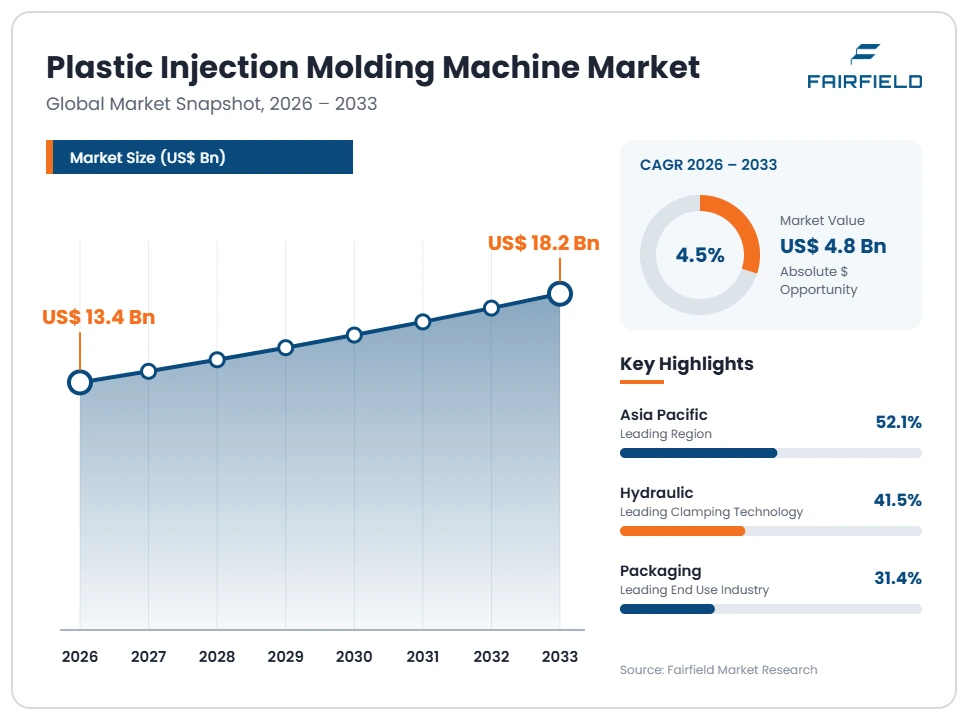
The global Plastic Injection Molding Machine market size is expected to be valued at US$ 13.4 billion in 2026 and projected to reach US$ 18.2 billion by 2033, growing at a CAGR of 4.5% between 2026 and 2033.
Between 2020 and 2025 the installed value of new machine shipments grew at about 3.1% a year, a modest pace typical of cyclical capital goods. Three factors set the 2026 to 2033 path. First, electricity prices have made all-electric clamping units cheaper to own than hydraulic ones in most high-wage economies, pulling forward replacement decisions. Second, packaging converters keep adding thin-wall and preform capacity to serve food, beverage and household goods output. Third, buyers increasingly purchase the machine as a cell, with robots, dryers and mould temperature control attached. Direction is steady rather than steep: order books track moulders’ credit and confidence, and the long life of existing presses allows replacement to be deferred when cash is tight.
Key Report Takeaways
- By Clamping Technology: Hydraulic machines held 41.5% share in 2026, while all-electric machines are projected to expand at a 6.8% CAGR through 2033, as energy tariffs make drive efficiency the dominant ownership cost in Europe and Japan.
- By Tonnage Range: The 201 to 500 Tons band held 34.6% share in 2026, while the Up to 200 Tons band is projected to grow at a 5.6% CAGR, driven by connector, housing and small precision part moulding.
- By Machine Configuration: General purpose machines held 57.3% share in 2026, while thin-wall packaging machines are projected to advance at a 7.1% CAGR, supported by recycled-content rules that favour newer processing control.
- By End Use Industry: Packaging held 31.4% share in 2026, while electrical and electronics is projected to rise at a 6.3% CAGR, reflecting connector, busbar housing and power electronics component volumes.
- By Geography: Asia Pacific held 52.1% share in 2026, while Middle East & Africa is projected to grow at a 6.3% CAGR, as polymer-integrated converting capacity is built close to feedstock.
Global Plastic Injection Molding Machine Market Trends and Insights
Drivers Impact Analysis
Two forces carry most of the forecast growth, and both are cost arguments rather than volume arguments.
| Driver | Impact on CAGR Forecast | Geographic Relevance | Impact Timeline |
| Electricity cost and the switch from hydraulic to all-electric clamping | High | Europe, Asia Pacific, North America | Medium term 2–4 years |
| Packaging and thin-wall capacity additions near consumption | Medium | Asia Pacific, Middle East & Africa | Long term ≥4 years |
Electricity Tariffs Make All-Electric Clamping the Default Replacement Choice
Energy is now the largest controllable cost in a moulding shop, and it is the single strongest reason machines are replaced before they fail. An all-electric press typically consumes 30% to 60% less electricity than a comparable hydraulic machine on the same part, because servo drives draw power only during motion instead of running a pump continuously. On a two-shift schedule that difference alone can repay the price premium within a few years wherever industrial tariffs are high.
The mechanism is arithmetic, not preference. Servo-driven toggle and direct-drive clamps remove hydraulic losses, cut cooling water demand and avoid oil changes and leak repair. European energy audit obligations and industrial energy efficiency duties push moulders to document consumption, which exposes old presses. Motor and drive efficiency requirements under IEC 61800-9 reinforce the same direction by raising the baseline for power train components fitted to new machines.
Thin-Wall Packaging and Preform Capacity Keeps Order Books Filled
Packaging converters are the most consistent buyers of new moulding capacity, and they buy complete high-output systems rather than bare presses. Thin-wall containers, closures and PET preforms run at cycle times measured in single-digit seconds, so output per machine is high and replacement is driven by cycle gains rather than breakdown. That keeps a steady flow of orders even when automotive and appliance investment pauses.
The causal chain runs from packaging regulation to machine specification. Recycled content requirements in packaging legislation push converters toward tighter process control, because recyclate varies in melt behaviour and demands better shot repeatability and screw design. Lightweighting targets reduce wall thickness, which raises injection speed and clamp rigidity requirements. Converters answer both with newer high-speed systems that include integrated take-out robots, in-mould labelling and stack moulds supplied as one cell.
Restraints Impact Analysis
Both restraints are structural features of the industry rather than temporary conditions.
| Restraint | Impact on CAGR Forecast | Geographic Relevance | Impact Timeline |
| Capital cycle and credit access among small and medium moulders | High | Europe, North America, Latin America | Short term ≤2 years |
| Price competition from Chinese machine builders compressing margins | Medium | Asia Pacific, Latin America, Middle East & Africa | Long term ≥4 years |
Capital Cycles at Small Moulders Delay Purchases and Flatten Growth
Most buyers are small and medium custom moulders with thin balance sheets, so orders follow their confidence and their borrowing cost rather than end-market consumption. A packaging line may run at full output while the moulder that supplies it postpones a press purchase for two years. That disconnect explains why shipment value can fall sharply in a single year even when polymer processing volumes are stable.
The underlying cause is financing structure. A mid-size press with auxiliaries represents a large outlay against modest annual profit, and the cost is usually carried through bank lending or equipment leasing tied to prevailing interest rates. Moulders also work to short contract terms with their own customers, which makes them reluctant to commit to multi-year repayment. Because a well-maintained press lasts 15 to 25 years, deferral is genuinely possible, and maintenance spending substitutes for capital spending through downturns.
Price Competition from Chinese Builders Compresses Margins Across the Industry
Aggressive pricing from large volume manufacturers has reset expectations for what a general purpose machine should cost, and it has compressed margins for every builder selling into price-sensitive segments. The effect is sharpest in standard hydraulic and servo-hydraulic machines below 500 tons, where specification differences are small and buyers compare quoted price and delivery time first.
The cause is scale combined with a deep domestic supply base. Volume producers source castings, platens, screws, barrels and control hardware locally at high throughput, which lowers unit cost well below what lower-volume European and Japanese plants achieve. Export financing and freight advantages extend that gap into emerging markets. Established builders respond by moving up into multi-component, cleanroom, micro-moulding and large-tonnage configurations, and by selling process expertise and service, but that narrows the revenue base they can defend on price alone.
Market Opportunities
Recyclate-Capable Machines Open an Upgrade Pool Among Packaging Converters
Machines specified to process recycled and bio-based resin represent a distinct upgrade pool, separate from ordinary replacement demand. Converters committing to recycled content need presses that tolerate variable melt viscosity, contamination and inconsistent bulk density. That means revised screw geometry, upgraded feed sections, more capable drying and closed-loop process control, and it creates a reason to buy that did not exist a decade ago.
Builders with strong process engineering capture this best, because the sale is technical rather than transactional. Demand comes from food and beverage packaging converters, household goods moulders and building product makers responding to recycled content duties and brand owner commitments. Material handling and drying suppliers benefit alongside machine builders, since recyclate handling raises dryer and dosing requirements. EUROMAP interface recommendations help by letting process data from the cell feed quality records that converters must now keep.
Service, Retrofit and Spare Parts Build Recurring Revenue Against the Cycle
Aftermarket work is the most reliable revenue pool in this industry, and it grows even when new machine orders fall. A long-lived installed base needs screws, barrels, seals, heater bands, control retrofits and preventive maintenance contracts. Converting part of a fleet to servo-hydraulic pumps, or replacing obsolete controllers, delivers measurable energy savings at a fraction of new machine cost.
Builders with dense regional service networks capture most of this, and independent specialists take the rest. The customer group is the mid-size moulder that cannot justify new capital but must improve energy and quality performance. Connectivity standards support the shift: EUROMAP 77 and EUROMAP 83, together with OPC UA companion specifications, let older machines report to plant systems after a controller upgrade. Remote diagnostics then turn service from a reactive call-out into a contracted recurring stream.
Segment Analysis
- By Clamping Technology: Hydraulic Machines Still Lead While All-Electric Takes the Growth
Hydraulic machines held 41.5% of value in 2026, because they remain the economical choice at very large tonnage and wherever capital cost outweighs running cost. Large structural parts, thick-wall industrial components and building products still favour hydraulic clamping for its force density and lower purchase price. All-electric machines are the fastest-growing segment at a 6.8% CAGR to 2033, driven by energy savings, cleaner operation and shot-to-shot repeatability that hydraulic systems cannot match without compensation. Hybrid machines sit between the two at 20.3% share, pairing an electric screw drive with hydraulic clamping for buyers unwilling to pay the full electric premium. Safety requirements under EN 201 and ISO 20430 apply identically across all three, so the choice is decided on energy, precision and price rather than compliance. For builders, the implication is a gradual revenue shift toward servo drive content and away from hydraulic componentry.
- By Tonnage Range: Mid-Range Presses Dominate as Small Tonnage Accelerates
The 201 to 500 Tons band held 34.6% share in 2026, the workhorse range for automotive interior parts, appliance housings, crates and general custom moulding. Its breadth of application gives it the largest installed base and the steadiest replacement flow. The Up to 200 Tons band grows fastest at a 5.6% CAGR, pulled by electrical connectors, electronics housings, small precision components and micro-moulding, where all-electric clamping is standard. The 501 to 1,000 Tons band tracks automotive module production, while Above 1,000 Tons serves bumpers, pallets, bins and large building components and remains firmly hydraulic. Test specimen standards under ISO 294 keep material qualification consistent across these bands, which matters when a part moves between machines. The practical implication is that growth favours builders with credible small-tonnage electric ranges rather than those strongest in heavy clamping.
- By Machine Configuration: General Purpose Machines Anchor Volume While Thin-Wall Systems Climb
General purpose machines held 57.3% share in 2026, since most moulded parts need nothing more than reliable clamping, a stable screw and a competent controller. Thin-wall packaging machines are the fastest-growing configuration at a 7.1% CAGR, because container and closure converters compete on cycle time and material use. Multi-component and two-shot machines follow, serving automotive lighting, soft-touch grips and sealed housings. PET preform systems hold a concentrated niche with very high cavitation. Liquid silicone rubber machines and micro-moulding machines remain small but technically demanding, and insert and overmoulding, gas assist and water assist configurations are supplied as options across several of these families. Because specialised configurations carry higher content and better margins, builders increasingly design a common platform and sell configuration as the differentiator, which also simplifies spare parts and service coverage.
- By End Use Industry: Packaging Leads Volume While Electrical and Electronics Grows Quickest
Packaging held 31.4% share in 2026 and is the most resilient buyer, because container, closure and preform demand follows food and household consumption rather than industrial investment. Electrical and electronics is the fastest-growing end use at a 6.3% CAGR, driven by connectors, switchgear housings, busbar insulation and power electronics components that require tight tolerance and clean processing. Automotive remains a large but cyclical buyer, shifting toward electrical architecture parts as powertrain content changes. Consumer goods and appliances provide steady mid-tonnage demand, while building products favour large hydraulic presses for pipe fittings, profiles and bins. Medical moulding is a demanding adjacent buyer with its own validation requirements, examined separately. The implication for builders is that electrical and electronics growth rewards small and mid-tonnage electric platforms with repeatable process documentation.
Geography Analysis
- North America Buys Precision and Automation to Offset Labour Scarcity
North America accounts for 17.8% share in 2026, growing at 3.6% to 2033. The United States dominates regional demand, with Mexico supplying automotive and appliance components and Canada contributing packaging and industrial moulding. Reshoring of selected component production has supported orders, but the stronger driver is labour scarcity, which pushes buyers toward machines sold with take-out robots, conveyors and automated quality checking so a single operator can supervise several cells. Automotive electrification is changing the parts mix toward connectors, housings and battery components. Imported machines carry tariff and freight exposure, which can shift sourcing decisions between suppliers at short notice. Converters here also show strong interest in retrofit, since upgrading controllers and drives on an existing fleet avoids a large capital request.
- Europe Sets the Energy and Precision Benchmark for Moulding Machine Specification
Europe holds 21.6% share in 2026 with a steadier 3.2% CAGR, and its influence exceeds its volume because it sets specification norms. Germany, Italy, Austria and Switzerland host the builders that define machine safety, interface and energy practice, supported by EUROMAP recommendations. High industrial electricity tariffs have made all-electric and servo-hydraulic conversion an operating necessity rather than a preference, and energy audit obligations oblige larger moulders to document consumption and act on it. Packaging converters across the region are reconfiguring lines for recycled content, which supports demand for better process control. The barrier is cost: elevated energy and labour costs have pushed some commodity moulding to lower-cost locations, so European machine demand skews toward technically complex work rather than high-volume general purpose output.
- Which Region Is Leading the Plastic Injection Molding Machine Market?
Asia Pacific leads with 52.1% share in 2026 and is expected to grow at a 4.8% CAGR to 2033, because it is both the largest consumer of moulded parts and the largest producer of the machines themselves. China accounts for most regional volume across packaging, appliances, electronics and automotive moulding, and hosts the highest-volume machine builders. India adds a fast-expanding base of custom moulders serving packaging, two-wheeler components and electrical goods. Japan and Korea contribute precision demand for electronics and optical parts, where all-electric clamping is already the default. Regional advantages include a deep component supply chain, short delivery lead times and local service. The main change under way is a gradual quality upgrade, as domestic converters serving exports adopt better process control and higher-specification machines instead of competing on lowest installed cost.
- Latin America Depends on Packaging Demand and Affordable Replacement Machines
Latin America represents 4.8% share in 2026 with a 4.4% CAGR. Brazil and Mexico supply most demand, with Argentina, Colombia and Chile adding smaller converter bases serving food packaging, household goods and construction products. Buyers are highly price-sensitive, so general purpose hydraulic and servo-hydraulic machines dominate, and used equipment competes seriously with new. Barriers are familiar: expensive credit, currency volatility against machines priced in hard currency, and import duties that raise the delivered cost of a press. Industrial electricity costs are rising in several markets, which slowly improves the case for electric clamping. The clearest opportunity lies in packaging, where regional converters supplying multinational brand owners must meet tighter quality and recycled content expectations and therefore need better machines.
- Which Region Is Growing Fastest in the Plastic Injection Molding Machine Market?
Middle East & Africa is the fastest-growing geography at a 6.3% CAGR to 2033, from a small 3.7% share in 2026. Growth comes from converting capacity built close to polymer feedstock in Saudi Arabia and the United Arab Emirates, where petrochemical producers want more value added locally instead of exporting resin. Egypt, Morocco and Turkey add packaging, pipe fitting and automotive component moulding serving regional and export customers. South Africa supports appliance and container production. Barriers remain real: shallow local service networks, limited toolmaking capability and dependence on imported moulds all slow adoption. The change worth watching is industrial policy, since localisation targets and industrial zone incentives are directing investment toward converting plants that need complete moulding cells rather than individual presses.
Competitive Landscape
The injection moulding machine industry is moderately concentrated, and concentration differs sharply by segment. A small group of builders controls high-specification work in multi-component, preform, cleanroom and large-tonnage machines, while the general purpose segment below 500 tons is crowded and contested. Haitian International Holdings Limited ships the largest unit volumes globally, whereas European and Japanese builders hold a larger share of value because their machines carry more automation and control content. Ownership has consolidated steadily, with auxiliary equipment, robot and mould temperature control businesses absorbed into machine groups so a single supplier can quote a complete cell.
Competition turns on energy consumption per part, cycle time, shot repeatability, delivery lead time and service coverage, not on clamping force alone. Buyers increasingly evaluate total cost of ownership over a decade, which favours builders able to document energy use and uptime. Controller openness matters too, because converters want machine data in their own plant systems through EUROMAP and OPC UA interfaces rather than through proprietary software. New entrants rarely appear in machine building itself; instead, automation integrators, robot suppliers and process monitoring specialists enter the cell around the press.
Strategic activity concentrates on broadening all-electric ranges, extending automation and auxiliary portfolios, and deepening regional service and spare parts networks. Builders have also moved manufacturing closer to demand to shorten lead times and reduce tariff exposure on a heavy, bulky product. Margin pressure in commodity ranges has pushed established groups toward specialised configurations where process knowledge is defensible.
Strategic direction is consistent across the industry: sell a configured production cell rather than a machine, make energy performance measurable, and grow recurring revenue from service, retrofit and spares so results depend less on the capital cycle.
Recent Industry Developments
- July 2024: The European Union Ecodesign for Sustainable Products Regulation entered into force, extending durability, repairability and recycled content requirements to a wide range of manufactured goods – it shifts converter specification toward machines that process recyclate reliably.
- February 2025: The European Union Packaging and Packaging Waste Regulation entered into force, setting recyclability and recycled content obligations for packaging placed on the market – it strengthens the case for thin-wall and preform systems with tighter process control.
- April 2025: India began applying minimum recycled content obligations to rigid plastic packaging under its extended producer responsibility framework – it pushes domestic converters toward machines able to handle variable recyclate.
- October 2025: The transposition deadline for the recast European Union Energy Efficiency Directive passed, widening mandatory energy management and audit duties across industrial sites – it exposes the running cost of ageing hydraulic presses and accelerates electric conversion.
Companies Covered in the Report
- Engel Austria GmbH
- Arburg GmbH + Co KG
- Haitian International Holdings Limited
- Sumitomo (SHI) Demag Plastics Machinery GmbH
- KraussMaffei Group GmbH
- Milacron LLC
- Nissei Plastic Industrial Co., Ltd.
- The Japan Steel Works, Ltd.
- Shibaura Machine Co., Ltd.
- Fanuc Corporation
- Husky Technologies
- Wittmann Group
- Chen Hsong Holdings Limited
- Negri Bossi S.p.A.
Plastic Injection Molding Machine Market Report Scope
| Metric | Value |
| Study Period | 2020–2033 |
| Market Size 2026 | US$ 13.4 Billion |
| Market Size 2033 | US$ 18.2 Billion |
| CAGR 2026–2033 | 4.5% |
| Absolute Dollar Opportunity | US$ 4.8 Billion |
| Largest Market | Asia Pacific (52.1% share in 2026) |
| Fastest-Growing Market | Middle East & Africa (6.3% CAGR) |
| Market Concentration | Medium |
| Major Players | Engel Austria GmbH, Arburg GmbH + Co KG, Haitian International Holdings Limited, Sumitomo (SHI) Demag Plastics Machinery GmbH, Husky Technologies |
Plastic Injection Molding Machine Market Segmentation
Clamping Technology
- Hydraulic
- All-Electric
- Hybrid
Tonnage Range
- Up to 200 Tons
- 201 to 500 Tons
- 501 to 1,000 Tons
- Above 1,000 Tons
Machine Configuration
- General Purpose Machines
- Multi-Component and Two-Shot Machines
- Insert and Overmoulding Machines
- Gas Assist and Water Assist Machines
- Thin-Wall Packaging Machines
- PET Preform Systems
- Liquid Silicone Rubber Machines
- Micro-Moulding Machines
End Use Industry
- Packaging
- Automotive
- Consumer Goods and Appliances
- Electrical and Electronics
- Medical
- Building Products
Regions
- North America
- Europe
- Asia Pacific
- Latin America
- Middle East & Africa
- Executive Summary
- Global Plastic Injection Molding Machine Market Snapshot
- Future Projections, 2026-2033
- Key Market Trends
- Regional Snapshot
- Market Overview
- Market Definition and Report Scope
- Historical Market Trends, 2020-2025
- Market Dynamics
- Drivers Impact Analysis
- Electricity Tariffs Make All-Electric Clamping the Default Replacement Choice
- Thin-Wall Packaging and Preform Capacity Keeps Order Books Filled
- Restraints Impact Analysis
- Capital Cycles at Small Moulders Delay Purchases and Flatten Growth
- Price Competition from Chinese Builders Compresses Margins Across the Industry
- Market Opportunities
- Recyclate-Capable Machines Open an Upgrade Pool Among Packaging Converters
- Service, Retrofit and Spare Parts Build Recurring Revenue Against the Cycle
- Drivers Impact Analysis
- Global Plastic Injection Molding Machine Market Outlook, 2020-2033
- Global Plastic Injection Molding Machine Market Outlook, by Clamping Technology, Value (US$ Billion), 2020-2033
- Hydraulic
- All-Electric
- Hybrid
- Global Plastic Injection Molding Machine Market Outlook, by Tonnage Range, Value (US$ Billion), 2020-2033
- Up to 200 Tons
- 201 to 500 Tons
- 501 to 1,000 Tons
- Above 1,000 Tons
- Global Plastic Injection Molding Machine Market Outlook, by Machine Configuration, Value (US$ Billion), 2020-2033
- General Purpose Machines
- Multi-Component and Two-Shot Machines
- Insert and Overmoulding Machines
- Gas Assist and Water Assist Machines
- Thin-Wall Packaging Machines
- PET Preform Systems
- Liquid Silicone Rubber Machines
- Micro-Moulding Machines
- Global Plastic Injection Molding Machine Market Outlook, by End Use Industry, Value (US$ Billion), 2020-2033
- Packaging
- Automotive
- Consumer Goods and Appliances
- Electrical and Electronics
- Medical
- Building Products
- Global Plastic Injection Molding Machine Market Outlook, by Region, Value (US$ Billion), 2020-2033
- North America
- Europe
- Asia Pacific
- Latin America
- Middle East & Africa
- Global Plastic Injection Molding Machine Market Outlook, by Clamping Technology, Value (US$ Billion), 2020-2033
- North America Plastic Injection Molding Machine Market Outlook, 2020-2033
- North America Plastic Injection Molding Machine Market Outlook, by Clamping Technology, Value (US$ Billion), 2020-2033
- Hydraulic
- All-Electric
- Hybrid
- North America Plastic Injection Molding Machine Market Outlook, by Tonnage Range, Value (US$ Billion), 2020-2033
- Up to 200 Tons
- 201 to 500 Tons
- 501 to 1,000 Tons
- Above 1,000 Tons
- North America Plastic Injection Molding Machine Market Outlook, by Machine Configuration, Value (US$ Billion), 2020-2033
- General Purpose Machines
- Multi-Component and Two-Shot Machines
- Insert and Overmoulding Machines
- Gas Assist and Water Assist Machines
- Thin-Wall Packaging Machines
- PET Preform Systems
- Liquid Silicone Rubber Machines
- Micro-Moulding Machines
- North America Plastic Injection Molding Machine Market Outlook, by End Use Industry, Value (US$ Billion), 2020-2033
- Packaging
- Automotive
- Consumer Goods and Appliances
- Electrical and Electronics
- Medical
- Building Products
- North America Plastic Injection Molding Machine Market Outlook, by Country, Value (US$ Billion), 2020-2033
- United States Plastic Injection Molding Machine Market Outlook, by Clamping Technology, 2020-2033
- United States Plastic Injection Molding Machine Market Outlook, by Tonnage Range, 2020-2033
- United States Plastic Injection Molding Machine Market Outlook, by Machine Configuration, 2020-2033
- United States Plastic Injection Molding Machine Market Outlook, by End Use Industry, 2020-2033
- Mexico Plastic Injection Molding Machine Market Outlook, by Clamping Technology, 2020-2033
- Mexico Plastic Injection Molding Machine Market Outlook, by Tonnage Range, 2020-2033
- Mexico Plastic Injection Molding Machine Market Outlook, by Machine Configuration, 2020-2033
- Mexico Plastic Injection Molding Machine Market Outlook, by End Use Industry, 2020-2033
- Canada Plastic Injection Molding Machine Market Outlook, by Clamping Technology, 2020-2033
- Canada Plastic Injection Molding Machine Market Outlook, by Tonnage Range, 2020-2033
- Canada Plastic Injection Molding Machine Market Outlook, by Machine Configuration, 2020-2033
- Canada Plastic Injection Molding Machine Market Outlook, by End Use Industry, 2020-2033
- North America Plastic Injection Molding Machine Market Outlook, by Clamping Technology, Value (US$ Billion), 2020-2033
- Europe Plastic Injection Molding Machine Market Outlook, 2020-2033
- Europe Plastic Injection Molding Machine Market Outlook, by Clamping Technology, Value (US$ Billion), 2020-2033
- Hydraulic
- All-Electric
- Hybrid
- Europe Plastic Injection Molding Machine Market Outlook, by Tonnage Range, Value (US$ Billion), 2020-2033
- Up to 200 Tons
- 201 to 500 Tons
- 501 to 1,000 Tons
- Above 1,000 Tons
- Europe Plastic Injection Molding Machine Market Outlook, by Machine Configuration, Value (US$ Billion), 2020-2033
- General Purpose Machines
- Multi-Component and Two-Shot Machines
- Insert and Overmoulding Machines
- Gas Assist and Water Assist Machines
- Thin-Wall Packaging Machines
- PET Preform Systems
- Liquid Silicone Rubber Machines
- Micro-Moulding Machines
- Europe Plastic Injection Molding Machine Market Outlook, by End Use Industry, Value (US$ Billion), 2020-2033
- Packaging
- Automotive
- Consumer Goods and Appliances
- Electrical and Electronics
- Medical
- Building Products
- Europe Plastic Injection Molding Machine Market Outlook, by Country, Value (US$ Billion), 2020-2033
- Germany Plastic Injection Molding Machine Market Outlook, by Clamping Technology, 2020-2033
- Germany Plastic Injection Molding Machine Market Outlook, by Tonnage Range, 2020-2033
- Germany Plastic Injection Molding Machine Market Outlook, by Machine Configuration, 2020-2033
- Germany Plastic Injection Molding Machine Market Outlook, by End Use Industry, 2020-2033
- Italy Plastic Injection Molding Machine Market Outlook, by Clamping Technology, 2020-2033
- Italy Plastic Injection Molding Machine Market Outlook, by Tonnage Range, 2020-2033
- Italy Plastic Injection Molding Machine Market Outlook, by Machine Configuration, 2020-2033
- Italy Plastic Injection Molding Machine Market Outlook, by End Use Industry, 2020-2033
- Austria Plastic Injection Molding Machine Market Outlook, by Clamping Technology, 2020-2033
- Austria Plastic Injection Molding Machine Market Outlook, by Tonnage Range, 2020-2033
- Austria Plastic Injection Molding Machine Market Outlook, by Machine Configuration, 2020-2033
- Austria Plastic Injection Molding Machine Market Outlook, by End Use Industry, 2020-2033
- Switzerland Plastic Injection Molding Machine Market Outlook, by Clamping Technology, 2020-2033
- Switzerland Plastic Injection Molding Machine Market Outlook, by Tonnage Range, 2020-2033
- Switzerland Plastic Injection Molding Machine Market Outlook, by Machine Configuration, 2020-2033
- Switzerland Plastic Injection Molding Machine Market Outlook, by End Use Industry, 2020-2033
- Europe Plastic Injection Molding Machine Market Outlook, by Clamping Technology, Value (US$ Billion), 2020-2033
- Asia Pacific Plastic Injection Molding Machine Market Outlook, 2020-2033
- Asia Pacific Plastic Injection Molding Machine Market Outlook, by Clamping Technology, Value (US$ Billion), 2020-2033
- Hydraulic
- All-Electric
- Hybrid
- Asia Pacific Plastic Injection Molding Machine Market Outlook, by Tonnage Range, Value (US$ Billion), 2020-2033
- Up to 200 Tons
- 201 to 500 Tons
- 501 to 1,000 Tons
- Above 1,000 Tons
- Asia Pacific Plastic Injection Molding Machine Market Outlook, by Machine Configuration, Value (US$ Billion), 2020-2033
- General Purpose Machines
- Multi-Component and Two-Shot Machines
- Insert and Overmoulding Machines
- Gas Assist and Water Assist Machines
- Thin-Wall Packaging Machines
- PET Preform Systems
- Liquid Silicone Rubber Machines
- Micro-Moulding Machines
- Asia Pacific Plastic Injection Molding Machine Market Outlook, by End Use Industry, Value (US$ Billion), 2020-2033
- Packaging
- Automotive
- Consumer Goods and Appliances
- Electrical and Electronics
- Medical
- Building Products
- Asia Pacific Plastic Injection Molding Machine Market Outlook, by Country, Value (US$ Billion), 2020-2033
- China Plastic Injection Molding Machine Market Outlook, by Clamping Technology, 2020-2033
- China Plastic Injection Molding Machine Market Outlook, by Tonnage Range, 2020-2033
- China Plastic Injection Molding Machine Market Outlook, by Machine Configuration, 2020-2033
- China Plastic Injection Molding Machine Market Outlook, by End Use Industry, 2020-2033
- India Plastic Injection Molding Machine Market Outlook, by Clamping Technology, 2020-2033
- India Plastic Injection Molding Machine Market Outlook, by Tonnage Range, 2020-2033
- India Plastic Injection Molding Machine Market Outlook, by Machine Configuration, 2020-2033
- India Plastic Injection Molding Machine Market Outlook, by End Use Industry, 2020-2033
- Japan Plastic Injection Molding Machine Market Outlook, by Clamping Technology, 2020-2033
- Japan Plastic Injection Molding Machine Market Outlook, by Tonnage Range, 2020-2033
- Japan Plastic Injection Molding Machine Market Outlook, by Machine Configuration, 2020-2033
- Japan Plastic Injection Molding Machine Market Outlook, by End Use Industry, 2020-2033
- Korea Plastic Injection Molding Machine Market Outlook, by Clamping Technology, 2020-2033
- Korea Plastic Injection Molding Machine Market Outlook, by Tonnage Range, 2020-2033
- Korea Plastic Injection Molding Machine Market Outlook, by Machine Configuration, 2020-2033
- Korea Plastic Injection Molding Machine Market Outlook, by End Use Industry, 2020-2033
- Asia Pacific Plastic Injection Molding Machine Market Outlook, by Clamping Technology, Value (US$ Billion), 2020-2033
- Latin America Plastic Injection Molding Machine Market Outlook, 2020-2033
- Latin America Plastic Injection Molding Machine Market Outlook, by Clamping Technology, Value (US$ Billion), 2020-2033
- Hydraulic
- All-Electric
- Hybrid
- Latin America Plastic Injection Molding Machine Market Outlook, by Tonnage Range, Value (US$ Billion), 2020-2033
- Up to 200 Tons
- 201 to 500 Tons
- 501 to 1,000 Tons
- Above 1,000 Tons
- Latin America Plastic Injection Molding Machine Market Outlook, by Machine Configuration, Value (US$ Billion), 2020-2033
- General Purpose Machines
- Multi-Component and Two-Shot Machines
- Insert and Overmoulding Machines
- Gas Assist and Water Assist Machines
- Thin-Wall Packaging Machines
- PET Preform Systems
- Liquid Silicone Rubber Machines
- Micro-Moulding Machines
- Latin America Plastic Injection Molding Machine Market Outlook, by End Use Industry, Value (US$ Billion), 2020-2033
- Packaging
- Automotive
- Consumer Goods and Appliances
- Electrical and Electronics
- Medical
- Building Products
- Latin America Plastic Injection Molding Machine Market Outlook, by Country, Value (US$ Billion), 2020-2033
- Brazil Plastic Injection Molding Machine Market Outlook, by Clamping Technology, 2020-2033
- Brazil Plastic Injection Molding Machine Market Outlook, by Tonnage Range, 2020-2033
- Brazil Plastic Injection Molding Machine Market Outlook, by Machine Configuration, 2020-2033
- Brazil Plastic Injection Molding Machine Market Outlook, by End Use Industry, 2020-2033
- Mexico Plastic Injection Molding Machine Market Outlook, by Clamping Technology, 2020-2033
- Mexico Plastic Injection Molding Machine Market Outlook, by Tonnage Range, 2020-2033
- Mexico Plastic Injection Molding Machine Market Outlook, by Machine Configuration, 2020-2033
- Mexico Plastic Injection Molding Machine Market Outlook, by End Use Industry, 2020-2033
- Argentina Plastic Injection Molding Machine Market Outlook, by Clamping Technology, 2020-2033
- Argentina Plastic Injection Molding Machine Market Outlook, by Tonnage Range, 2020-2033
- Argentina Plastic Injection Molding Machine Market Outlook, by Machine Configuration, 2020-2033
- Argentina Plastic Injection Molding Machine Market Outlook, by End Use Industry, 2020-2033
- Colombia Plastic Injection Molding Machine Market Outlook, by Clamping Technology, 2020-2033
- Colombia Plastic Injection Molding Machine Market Outlook, by Tonnage Range, 2020-2033
- Colombia Plastic Injection Molding Machine Market Outlook, by Machine Configuration, 2020-2033
- Colombia Plastic Injection Molding Machine Market Outlook, by End Use Industry, 2020-2033
- Chile Plastic Injection Molding Machine Market Outlook, by Clamping Technology, 2020-2033
- Chile Plastic Injection Molding Machine Market Outlook, by Tonnage Range, 2020-2033
- Chile Plastic Injection Molding Machine Market Outlook, by Machine Configuration, 2020-2033
- Chile Plastic Injection Molding Machine Market Outlook, by End Use Industry, 2020-2033
- Latin America Plastic Injection Molding Machine Market Outlook, by Clamping Technology, Value (US$ Billion), 2020-2033
- Middle East & Africa Plastic Injection Molding Machine Market Outlook, 2020-2033
- Middle East & Africa Plastic Injection Molding Machine Market Outlook, by Clamping Technology, Value (US$ Billion), 2020-2033
- Hydraulic
- All-Electric
- Hybrid
- Middle East & Africa Plastic Injection Molding Machine Market Outlook, by Tonnage Range, Value (US$ Billion), 2020-2033
- Up to 200 Tons
- 201 to 500 Tons
- 501 to 1,000 Tons
- Above 1,000 Tons
- Middle East & Africa Plastic Injection Molding Machine Market Outlook, by Machine Configuration, Value (US$ Billion), 2020-2033
- General Purpose Machines
- Multi-Component and Two-Shot Machines
- Insert and Overmoulding Machines
- Gas Assist and Water Assist Machines
- Thin-Wall Packaging Machines
- PET Preform Systems
- Liquid Silicone Rubber Machines
- Micro-Moulding Machines
- Middle East & Africa Plastic Injection Molding Machine Market Outlook, by End Use Industry, Value (US$ Billion), 2020-2033
- Packaging
- Automotive
- Consumer Goods and Appliances
- Electrical and Electronics
- Medical
- Building Products
- Middle East & Africa Plastic Injection Molding Machine Market Outlook, by Country, Value (US$ Billion), 2020-2033
- Saudi Arabia Plastic Injection Molding Machine Market Outlook, by Clamping Technology, 2020-2033
- Saudi Arabia Plastic Injection Molding Machine Market Outlook, by Tonnage Range, 2020-2033
- Saudi Arabia Plastic Injection Molding Machine Market Outlook, by Machine Configuration, 2020-2033
- Saudi Arabia Plastic Injection Molding Machine Market Outlook, by End Use Industry, 2020-2033
- United Arab Emirates Plastic Injection Molding Machine Market Outlook, by Clamping Technology, 2020-2033
- United Arab Emirates Plastic Injection Molding Machine Market Outlook, by Tonnage Range, 2020-2033
- United Arab Emirates Plastic Injection Molding Machine Market Outlook, by Machine Configuration, 2020-2033
- United Arab Emirates Plastic Injection Molding Machine Market Outlook, by End Use Industry, 2020-2033
- Egypt Plastic Injection Molding Machine Market Outlook, by Clamping Technology, 2020-2033
- Egypt Plastic Injection Molding Machine Market Outlook, by Tonnage Range, 2020-2033
- Egypt Plastic Injection Molding Machine Market Outlook, by Machine Configuration, 2020-2033
- Egypt Plastic Injection Molding Machine Market Outlook, by End Use Industry, 2020-2033
- Morocco Plastic Injection Molding Machine Market Outlook, by Clamping Technology, 2020-2033
- Morocco Plastic Injection Molding Machine Market Outlook, by Tonnage Range, 2020-2033
- Morocco Plastic Injection Molding Machine Market Outlook, by Machine Configuration, 2020-2033
- Morocco Plastic Injection Molding Machine Market Outlook, by End Use Industry, 2020-2033
- Turkey Plastic Injection Molding Machine Market Outlook, by Clamping Technology, 2020-2033
- Turkey Plastic Injection Molding Machine Market Outlook, by Tonnage Range, 2020-2033
- Turkey Plastic Injection Molding Machine Market Outlook, by Machine Configuration, 2020-2033
- Turkey Plastic Injection Molding Machine Market Outlook, by End Use Industry, 2020-2033
- South Africa Plastic Injection Molding Machine Market Outlook, by Clamping Technology, 2020-2033
- South Africa Plastic Injection Molding Machine Market Outlook, by Tonnage Range, 2020-2033
- South Africa Plastic Injection Molding Machine Market Outlook, by Machine Configuration, 2020-2033
- South Africa Plastic Injection Molding Machine Market Outlook, by End Use Industry, 2020-2033
- Middle East & Africa Plastic Injection Molding Machine Market Outlook, by Clamping Technology, Value (US$ Billion), 2020-2033
- Competitive Landscape
- Market Concentration and Industry Leaders
- Competitive Differentiation
- Strategic Initiatives
- Recent Industry Developments
- Company Profiles
- Engel Austria GmbH
- Arburg GmbH + Co KG
- Haitian International Holdings Limited
- Sumitomo (SHI) Demag Plastics Machinery GmbH
- KraussMaffei Group GmbH
- Milacron LLC
- Nissei Plastic Industrial Co., Ltd.
- The Japan Steel Works, Ltd.
- Shibaura Machine Co., Ltd.
- Fanuc Corporation
- Husky Technologies
- Wittmann Group
- Chen Hsong Holdings Limited
- Negri Bossi S.p.A.
- Appendix
- Research Methodology
- Report Assumptions
- Acronyms and Abbreviations
Clamping Technology
- Hydraulic
- All-Electric
- Hybrid
Tonnage Range
- Up to 200 Tons
- 201 to 500 Tons
- 501 to 1,000 Tons
- Above 1,000 Tons
Machine Configuration
- General Purpose Machines
- Multi-Component and Two-Shot Machines
- Insert and Overmoulding Machines
- Gas Assist and Water Assist Machines
- Thin-Wall Packaging Machines
- PET Preform Systems
- Liquid Silicone Rubber Machines
- Micro-Moulding Machines
End Use Industry
- Packaging
- Automotive
- Consumer Goods and Appliances
- Electrical and Electronics
- Medical
- Building Products
Regions
- North America
- Europe
- Asia Pacific
- Latin America
- Middle East & Africa
Our Research Methodology
Considering the volatility of business today, traditional approaches to strategizing a game plan can be unfruitful if not detrimental. True ambiguity is no way to determine a forecast. A myriad of predetermined factors must be accounted for such as the degree of risk involved, the magnitude of circumstances, as well as conditions or consequences that are not known or unpredictable. To circumvent binary views that cast uncertainty, the application of market research intelligence to strategically posture, move, and enable actionable outcomes is necessary.
View Methodology
Quality Assured
Rigorous Validation Process

Confidentiality Assured
End-to-end Data Security

Custom Research Services
Tailored To Your Objectives
FAQs
The market is valued at US$ 13.4 billion in 2026, covering machines together with the controllers, robots and auxiliary equipment supplied as part of the cell.
Revenue is projected to reach US$ 18.2 billion by 2033, a 4.5% CAGR and an absolute opportunity of US$ 4.8 billion over the period.
Hydraulic machines lead with 41.5% share in 2026, retaining strength at very large tonnage and wherever purchase price outweighs running cost.
All-electric machines grow fastest at a 6.8% CAGR, because servo drives cut electricity consumption sharply and improve shot-to-shot repeatability.
Asia Pacific leads with 52.1% share in 2026, and concentration is Medium, with crowded competition in general purpose machines below 500 tons.
Related Reports
Spinning Machinery Market Size, Share, Insights, Competitive Landscape, and Forecast 2026 to 2033
The global spinning machinery market is valued at US$6.8 billion in 2026, reaching US$8.6 billion by 2033, growing at a 3.4% CAGR
Physical Vapor Deposition (PVD) Market Size, Share, Insights, Competitive Landscape, and Forecast 2026 to 2033
The global physical vapor deposition (PVD) market is valued at US$28.4 billion in 2026, reaching US$48.6 billion by 2033, growing at an 8.0% CAGR
Automated Truck Loading System Market Size, Share, Insights, Competitive Landscape, and Forecast 2026 to 2033
The automated truck loading system market is projected to grow from US$ 1.4 billion in 2026 to US$ 2.4 billion by 2033 at an 8.0% CAGR.
Air Purifying Escape Respirator Market Size, Share, Insights, Competitive Landscape, and Forecast 2026 to 2033
The air purifying escape respirator market is projected to grow from US$ 0.5 billion in 2026 to US$ 0.8 billion by 2033 at a 6.9% CAGR.
Rigid Mine Dumper Market Size, Share, Insights, Competitive Landscape, and Forecast 2026 to 2033
The global rigid mine dumper market is valued at US$9.8 billion in 2026, reaching US$14.6 billion by 2033, growing at a 5.9% CAGR
Product-as-a-Service Market Size, Share, Insights, Competitive Landscape, and Forecast 2026 to 2033
The global product-as-a-service market is valued at US$96.0 billion in 2026, reaching US$204.5 billion by 2033, growing at an 11.4% CAGR