



Physical Vapor Deposition (PVD) Market
Physical Vapor Deposition (PVD) Market Size, Share, Insights, Competitive Landscape, and Forecast 2026 to 2033
Physical Vapor Deposition (PVD) Market Size and Trend Analysis
What Is the Outlook for Physical Vapor Deposition Growth?
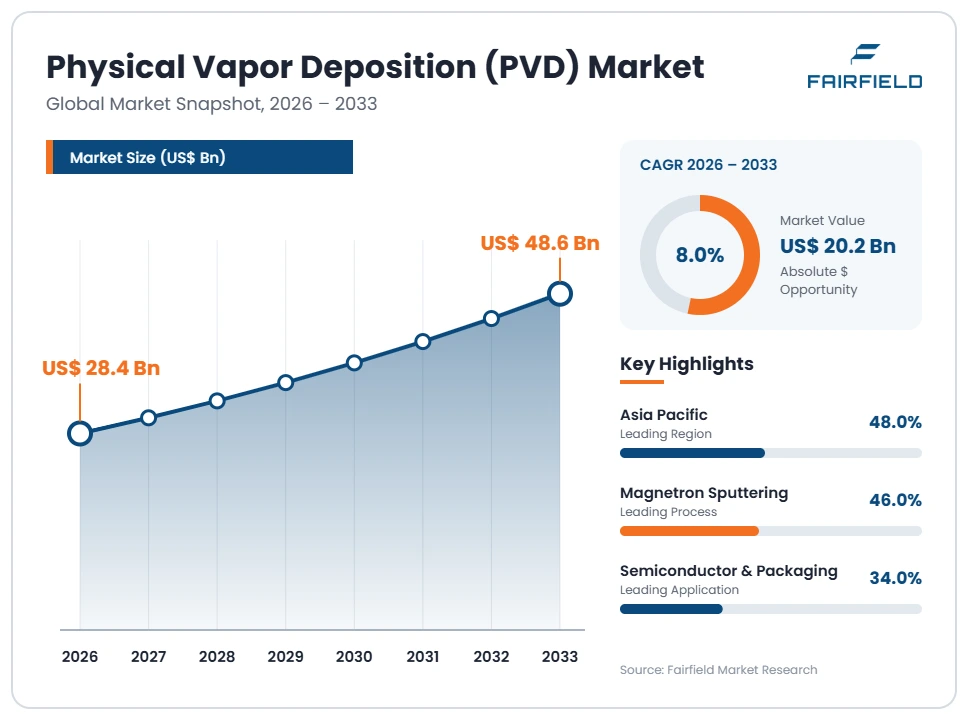
The global Physical Vapor Deposition (PVD) market size is expected to be valued at US$ 28.4 billion in 2026 and projected to reach US$ 48.6 billion by 2033, growing at a CAGR of 8.0% between 2026 and 2033.
Between 2020 and 2025 the market grew at roughly a 7% CAGR, with sharp swings in equipment orders set against steady consumable demand. Growth now rests on three foundations. Advanced packaging adds metallisation steps that each require a deposition pass. Tool life has become a measurable cost lever in machining, which sustains hard coating volumes. Display, optical and medical coatings keep broadening the application base. Underneath sits one commercial fact that shapes the whole industry: tools are bought in cycles, but targets are bought every week, and the consumable stream is where predictable revenue lives.
Key Report Takeaways
- By Process: Magnetron and Reactive Sputtering held 46% share in 2026, while High-Power Impulse Magnetron Sputtering is projected to expand at an 11.2% CAGR through 2033, driven by denser, smoother hard coatings on cutting tools.
- By Offering: Deposition Equipment held 41% share in 2026, while Targets and Consumables are projected to expand at a 9.8% CAGR through 2033, because consumption scales with installed chambers rather than with new orders.
- By Application: Semiconductor and Advanced Packaging held 34% share in 2026, while Medical Devices are projected to expand at a 10.6% CAGR through 2033, supported by wear and surface specifications on implants and instruments.
- By Coating Material: Metals and Alloys held 39% share in 2026, while Diamond-Like Carbon and Multilayer Coatings are projected to expand at a 10.9% CAGR through 2033, as friction reduction becomes an efficiency requirement.
- By Geography: Asia Pacific held 48% share in 2026, while North America is projected to expand at a 9.4% CAGR through 2033, supported by new fabrication and packaging capacity in the United States.
Global Physical Vapor Deposition (PVD) Market Trends and Insights
Drivers Impact Analysis
The two forces below explain most incremental demand across vacuum coating equipment, consumables and job shop services.
| Driver | Impact on CAGR Forecast | Geographic Relevance | Impact Timeline |
| Advanced packaging metallisation adding deposition steps per device | High | Asia Pacific, North America | Short term ≤2 years |
| Tool life and friction reduction as measurable manufacturing cost levers | Medium | Europe, Asia Pacific | Medium term 2–4 years |
Advanced Packaging Metallisation Adds Deposition Steps to Every Finished Device
Packaging has become the fastest source of new vacuum coating demand in electronics. Redistribution layers, under-bump metallisation, through-silicon via seed layers and hybrid bonding surfaces each need a sputtered barrier and seed film before any plating takes place. As devices move from single die to stacked and chiplet assemblies, the number of metallisation passes per finished part rises, so deposition demand grows faster than wafer starts do.
The mechanism is a change in where performance is won. With monolithic scaling slowing, more electrical improvement now comes from interconnect density between dies rather than inside them. That shifts spending toward packaging lines, which buy dedicated sputtering platforms rather than inheriting front-end tools. SEMI equipment and automation standards governing interfaces and handling make those platforms easier to integrate, while ISO 14644 cleanroom classification sets the environment they must operate in.
Tool Life and Friction Reduction Turn Hard Coatings Into a Cost Calculation
Industrial coating demand is driven by arithmetic rather than fashion. A coated carbide drill or end mill lasts several times longer than an uncoated one, so coating cost is recovered in reduced tool spend, fewer changeovers and better surface finish. Machine shops that measure cost per part therefore specify nitride, carbonitride and diamond-like carbon coatings as standard, which keeps thousands of small chambers and job coating lines busy.
The same calculation now reaches moving parts rather than only cutting edges. Engine components, transmission parts, hydraulic elements and compressor surfaces are coated to cut friction and wear, because efficiency requirements make parasitic losses expensive. Hard coating performance is assessed against published adhesion and thickness methods, including ISO 26443 for scratch testing of ceramic coatings and ISO 20502 adhesion determination, which gives buyers a common language for specifying what they want.
Restraints Impact Analysis
The restraints below are structural features of the industry rather than temporary conditions.
| Restraint | Impact on CAGR Forecast | Geographic Relevance | Impact Timeline |
| Lumpy semiconductor capital spending cycles | High | Global | Medium term 2–4 years |
| Export controls and target metal cost and availability | Medium | North America, Europe, Asia Pacific | Long term ≥4 years |
Semiconductor Capital Cycles Make Deposition Equipment Orders Unpredictable
Equipment revenue is lumpy in a way that caps the sector’s growth quality. A fabrication plant buys deposition platforms in a concentrated burst during fit-out and then buys almost none for years. When memory pricing weakens or a logic node is delayed, those bursts are postponed together, and suppliers see order books fall sharply even while installed chambers keep running. Display capital spending follows a similar pattern with its own timing.
The cause is the economics of the customer, not of the supplier. Fabrication plants are financed against expected device pricing, so capital release is tied to a volatile commodity cycle. Long tool qualification periods mean a deferred decision cannot be recovered within the year. Suppliers respond by building consumable, spare part and service revenue, because those streams follow installed capacity. That cushions the cycle but does not remove it, and it limits what equipment makers will invest between peaks.
Export Controls and Target Metal Costs Constrain Where and How Tools and Films Are Sold
Two cost and access constraints sit on top of the cycle. National export control authorities and the multilateral control lists now restrict the sale of advanced semiconductor manufacturing equipment, including capable deposition platforms, to specified destinations and end users. Licensing adds time and uncertainty to deals, and in some cases removes a market entirely. Suppliers must also control service and spare parts flows, which raises compliance costs well beyond the sale itself.
Materials are the second constraint. Target cost passes directly to the customer, and many targets use precious or critical metals such as gold, platinum group elements, tantalum, ruthenium, cobalt and rare earth containing alloys. Supply is concentrated, prices move, and REACH and RoHS obligations limit some chemistries outright. Cleanroom and vacuum infrastructure requirements, informed by ISO 14644, keep the capital barrier to entry high.
Market Opportunities
Two revenue pools sit outside conventional chamber sales and routine job shop coating.
Spent Target Reclaim and Material Recycling Open a Durable Consumable Annuity
Reclaim and recycling of spent targets is the most under-exploited pool in vacuum coating. Only part of a target is consumed before it must be replaced, so considerable value remains in the backing plate assembly and the residual material. Services that recover precious and critical metals, re-bond material to backing plates and return qualified assemblies convert a disposal cost into a managed supply loop, and customers increasingly want that loop documented.
Target manufacturers, specialist refiners and the larger job coaters can all capture it, often in partnership. Demand comes from semiconductor and display fabrication plants with large, steady target consumption and from architectural glass coaters running long rotary targets. European Union critical raw material policy, which sets processing and recycling benchmarks for strategic materials, gives the activity policy support and makes documented recovery a procurement question rather than only a cost saving.
Advanced Packaging and Optical Coating Lines Create a Second Equipment Pool
A second equipment pool is forming around packaging and precision optics, distinct from front-end fabrication. Packaging lines need platforms tuned for thick seed layers, warped and reconstituted wafers, panel formats and lower particle budgets rather than leading-edge node performance. Optical coating lines need precise layer thickness control over large areas for displays, camera modules, augmented reality waveguides and architectural glass. Both buy on different cycles from logic and memory.
Equipment suppliers with flexible chamber architectures, and job coaters willing to invest in qualified capacity, are positioned to capture this. Demand comes from outsourced assembly and test providers, panel makers, optics manufacturers and medical device producers. Surface and thickness specifications assessed against methods including ISO 4287 profile parameters give customers a defensible basis for acceptance, which matters when the coating is the product rather than a step within one.
Segment Analysis
- By Process: Magnetron Sputtering Leads While High-Power Impulse Variants Gain Ground
Magnetron and Reactive Sputtering holds 46% share in 2026, the dominant position by a wide margin. It deposits metals, alloys, nitrides and oxides with good uniformity, scales from small toolroom chambers to large architectural glass lines, and supports rotary targets that use material efficiently. Thermal and electron beam evaporation remains strong in optical coatings and packaging metallisation where deposition rate matters more than film density.
High-Power Impulse Magnetron Sputtering grows fastest at an 11.2% CAGR through 2033. Its very high peak power produces dense, smooth, well-adhered films without the droplets that arc processes leave, which suits precision cutting tools and medical components. Cathodic arc and ion plating remain the volume workhorses for thick hard coatings, while pulsed laser and molecular beam deposition stay confined to research scale. The implication is steady premiumisation within an established process base.
- By Offering: Equipment Leads Revenue While Targets and Consumables Grow Faster
Deposition Equipment accounts for 41% of revenue in 2026. Chambers, handling systems and integration work carry high ticket values, and a single semiconductor or display platform can cost more than a small job coater’s entire plant. Vacuum, power supply and process control subsystems form a further layer, sold both into new tools and as upgrades to extend the life of older chambers.
Targets and Consumables expand fastest at a 9.8% CAGR through 2033. Consumption follows installed chambers and utilisation rather than new orders, and target material cost passes straight through, so the segment grows with production volumes and metal prices together. Coating services provided by job coaters complete the picture and grow steadily with industrial output. The business implication is that suppliers without a consumable attachment carry far more cyclical risk.
- By Application: Semiconductor Work Leads While Medical Device Coating Rises Fastest
Semiconductor and Advanced Packaging leads with 34% share in 2026. Barrier and seed layers, redistribution metallisation and electrode films are unavoidable process steps, and the sector buys both the most expensive tools and the highest-purity targets. Cutting tools and wear-resistant industrial coatings follow closely by volume, with display and optical coatings, data storage, decorative and architectural work, solar and thin-film photovoltaics and packaging metallisation making up the balance.
Medical Devices grow fastest at a 10.6% CAGR through 2033 from a modest base. Orthopaedic implants, dental components, surgical instruments and delivery devices use titanium nitride, zirconium nitride and diamond-like carbon films for wear resistance, and manufacturers must demonstrate surface conformance during regulatory submission. For suppliers, the implication is that validated, documented processes matter more than throughput in this application.
- By Coating Material: Metals and Alloys Dominate While Carbon Based Films Expand Quickest
Metals and Alloys hold 39% share in 2026. Aluminium, copper, titanium, tantalum, molybdenum, silver and their alloys cover semiconductor interconnect, display electrodes, mirror coatings and packaging metallisation, and they consume the largest tonnage of target material. Nitrides, carbides and carbonitrides follow, supplying the bulk of cutting tool and wear coating volume, with oxides serving optical and barrier applications and precious metals concentrated in contacts and decorative finishes.
Diamond-Like Carbon and Multilayer Coatings grow fastest at a 10.9% CAGR through 2033. Low friction coefficients make them valuable wherever parasitic losses cost energy, and graded multilayer architectures give designers control over hardness, toughness and residual stress that a single layer cannot. Automotive powertrain, hydraulics and medical components are the main pull. The implication is that process control capability, not raw material cost, increasingly determines coating value.
Geography Analysis
- Which Region Is Growing Fastest in the Physical Vapor Deposition (PVD) Market?
North America grows fastest at a 9.4% CAGR between 2026 and 2033, rising from 21% share in 2026, led by the United States with contributions from Canada and Mexico. New fabrication and advanced packaging capacity is being built across Arizona, Texas, Ohio and New York, and each site buys deposition platforms during fit-out and targets thereafter. The region also hosts a deep aerospace, defence and medical device manufacturing base that uses hard and functional coatings heavily. Export control administration sits here, which shapes how the most capable tools are sold worldwide. Target material supply and reclaim capability is a recognised vulnerability, since several critical metals are imported. The main change ahead is the conversion of construction spending into sustained consumable demand as new plants reach volume production.
- Europe Anchors Hard Coating Technology and Job Coating Capacity
Europe accounts for 23% of the market in 2026, with Germany, Switzerland, Austria, Italy, France and the United Kingdom leading. The region’s strength is industrial rather than electronic. Dense machine tool, automotive, watchmaking, medical device and architectural glass industries sustain a large population of coating chambers, and much of the foundational work on arc, magnetron and impulse hard coating processes was done here. Several of the largest job coating networks operate from the region, giving small manufacturers access to processes they could not own. REACH and RoHS obligations push substitution of restricted chemistries, and critical raw material policy is tightening around target metals. The constraint is weak automotive capital spending. The opportunity lies in low-friction coatings for efficiency-driven component redesign.
- Which Region Is Leading the Physical Vapor Deposition (PVD) Market?
Asia Pacific leads with 48% share in 2026, driven by China, Taiwan, South Korea, Japan and Singapore, with growing activity in India and Malaysia. The concentration follows manufacturing: the majority of semiconductor fabrication, display panel production, data storage assembly and consumer electronics finishing sits in the region, and each consumes deposition capacity continuously. Japan supplies a large share of the world’s high-purity sputtering targets and several established tool platforms. China is expanding domestic equipment and target manufacturing quickly, partly in response to restrictions on imported advanced tools. Taiwan and South Korea concentrate the most demanding packaging and memory metallisation work. The constraint is exposure to the capital cycle. The opportunity is decorative and architectural coating growth across India, Vietnam and Thailand.
- Latin America Builds Coating Capacity Around Automotive and Tooling Suppliers
Latin America represents 4% of the market in 2026, concentrated in Mexico, Brazil, Argentina and Chile. Demand is almost entirely industrial: tool coating for machining operations serving automotive and aerospace export customers, decorative finishing for sanitary ware and hardware, and a small amount of optical work. Barriers are real. Chambers are imported with duties and currency exposure, target material must be shipped in, trained process engineers are scarce, and service response times are long, so many manufacturers send parts abroad for coating rather than invest locally. Electricity cost and reliability affect vacuum plant economics. The clearest opportunity is in northern Mexico, where tier-one automotive suppliers facing customer audits increasingly want qualified coating capability inside their own plants.
- Middle East & Africa Adds Decorative and Industrial Coating Capacity From a Small Base
Middle East & Africa holds 4% of the market in 2026, with activity centred on Turkey, Israel, the United Arab Emirates, Saudi Arabia and South Africa. Turkey is the largest single contributor, with a substantial tooling, hardware, sanitary ware and architectural glass industry that uses decorative and wear coatings at scale. Israel adds advanced demand from semiconductor, optics and medical device manufacturing. Gulf industrial diversification programmes are funding tooling, oilfield component and defence manufacturing that specify hard coatings. Barriers include small installed bases, dependence on distributors for process support, limited local target supply and a shortage of coating engineers. South Africa retains mining equipment and automotive component coating. The opportunity lies in architectural glass, where regional construction volumes support large-area sputtering lines.
Competitive Landscape
This is two businesses sharing a name, and concentration differs sharply between them. Semiconductor and display deposition equipment is highly concentrated: a handful of suppliers hold most revenue, because a production platform must meet particle, uniformity and integration requirements that take years and large engineering teams to achieve. Industrial and decorative coating is fragmented, with equipment builders, regional chamber makers and thousands of independent job coaters competing locally. The target and consumable business sits between the two, dominated by a small number of materials groups with refining, bonding and purity capability. Consolidation has mostly taken the form of materials and industrial groups acquiring coating service networks and target producers.
The basis of competition differs just as sharply. Fab customers buy on particle performance, uniformity at the wafer edge, chamber matching, uptime and integration with upstream and downstream steps, and they weigh the cost of qualification heavily. Toolroom and job shop customers buy on cost per part, turnaround time, coating consistency and the breadth of recipes offered. New entrants are appearing from two directions: regional equipment builders serving domestic fabrication programmes, and coating service networks expanding geographically to follow manufacturing customers.
Strategic activity has centred on securing target material supply and reclaim capability, extending equipment platforms toward packaging and panel formats, building service and recipe libraries that lock in job coating accounts, and localising manufacture in response to export licensing. Each move protects recurring revenue against the capital cycle.
Strategic direction is converging on three themes: consumables and services as the stable earnings base, process control software as a differentiator, and compliance with export and materials regulation as a precondition for competing at all.
Recent Industry Developments
- October 2022: The United States introduced export controls restricting the supply of advanced semiconductor manufacturing equipment, including capable deposition platforms, to specified destinations and end users.
- July 2023: Japan added categories of advanced semiconductor manufacturing equipment to its export control list, bringing licensing requirements to a further group of deposition and related process tools.
- September 2023: The Netherlands brought national export licensing requirements for advanced semiconductor manufacturing equipment into effect, extending controls beyond lithography to adjacent process technologies.
- May 2024: The European Union Critical Raw Materials Act entered into force, setting extraction, processing and recycling benchmarks for strategic materials used in sputtering targets and backing assemblies.
Companies Covered in the Report
- Applied Materials, Inc.
- ULVAC, Inc.
- Evatec AG
- Oerlikon Surface Solutions AG
- IHI Hauzer Techno Coating B.V.
- Bühler AG
- Veeco Instruments Inc.
- Kurt J. Lesker Company
- Materion Corporation
- Plansee SE
- Angstrom Engineering Inc.
- VON ARDENNE GmbH
- Platit AG
Physical Vapor Deposition (PVD) Market Report Scope
| Metric | Value |
| Study Period | 2020–2033 |
| Market Size 2026 | US$ 28.4 Billion |
| Market Size 2033 | US$ 48.6 Billion |
| CAGR 2026–2033 | 8.0% |
| Absolute Dollar Opportunity | US$ 20.2 Billion |
| Largest Market | Asia Pacific, 48% share in 2026 |
| Fastest-Growing Market | North America, 9.4% CAGR 2026–2033 |
| Market Concentration | Medium |
| Major Players | Applied Materials, Inc., ULVAC, Inc., Oerlikon Surface Solutions AG, Evatec AG, Veeco Instruments Inc. |
Physical Vapor Deposition (PVD) Market Segmentation
Process
- Magnetron and Reactive Sputtering
- High-Power Impulse Magnetron Sputtering
- Thermal and Electron Beam Evaporation
- Cathodic Arc and Ion Plating
- Pulsed Laser and Molecular Beam Deposition
Offering
- Deposition Equipment
- Targets and Consumables
- Vacuum, Power and Process Control Subsystems
- Coating Services
Application
- Semiconductor and Advanced Packaging
- Display and Optical Coatings
- Cutting Tools and Wear-Resistant Industrial Coatings
- Decorative and Architectural Coatings
- Data Storage
- Solar and Thin-Film Photovoltaics
- Medical Devices
- Packaging Metallisation
Coating Material
- Metals and Alloys
- Nitrides, Carbides and Carbonitrides
- Oxides
- Precious Metals
- Diamond-Like Carbon and Multilayer Coatings
Regions
- North America
- Europe
- Asia Pacific
- Latin America
- Middle East & Africa
- Executive Summary
- Global Physical Vapor Deposition (PVD) Market Snapshot
- Future Projections, 2026-2033
- Key Market Trends
- Regional Snapshot
- Market Overview
- Market Definition and Report Scope
- Historical Market Trends, 2020-2025
- Market Dynamics
- Drivers Impact Analysis
- Advanced Packaging Metallisation Adds Deposition Steps to Every Finished Device
- Tool Life and Friction Reduction Turn Hard Coatings Into a Cost Calculation
- Restraints Impact Analysis
- Semiconductor Capital Cycles Make Deposition Equipment Orders Unpredictable
- Export Controls and Target Metal Costs Constrain Where and How Tools and Films Are Sold
- Market Opportunities
- Spent Target Reclaim and Material Recycling Open a Durable Consumable Annuity
- Advanced Packaging and Optical Coating Lines Create a Second Equipment Pool
- Drivers Impact Analysis
- Global Physical Vapor Deposition (PVD) Market Outlook, 2020-2033
- Global Physical Vapor Deposition (PVD) Market Outlook, by Process, Value (US$ Billion), 2020-2033
- Magnetron and Reactive Sputtering
- High-Power Impulse Magnetron Sputtering
- Thermal and Electron Beam Evaporation
- Cathodic Arc and Ion Plating
- Pulsed Laser and Molecular Beam Deposition
- Global Physical Vapor Deposition (PVD) Market Outlook, by Offering, Value (US$ Billion), 2020-2033
- Deposition Equipment
- Targets and Consumables
- Vacuum, Power and Process Control Subsystems
- Coating Services
- Global Physical Vapor Deposition (PVD) Market Outlook, by Application, Value (US$ Billion), 2020-2033
- Semiconductor and Advanced Packaging
- Display and Optical Coatings
- Cutting Tools and Wear-Resistant Industrial Coatings
- Decorative and Architectural Coatings
- Data Storage
- Solar and Thin-Film Photovoltaics
- Medical Devices
- Packaging Metallisation
- Global Physical Vapor Deposition (PVD) Market Outlook, by Coating Material, Value (US$ Billion), 2020-2033
- Metals and Alloys
- Nitrides, Carbides and Carbonitrides
- Oxides
- Precious Metals
- Diamond-Like Carbon and Multilayer Coatings
- Global Physical Vapor Deposition (PVD) Market Outlook, by Region, Value (US$ Billion), 2020-2033
- North America
- Europe
- Asia Pacific
- Latin America
- Middle East & Africa
- Global Physical Vapor Deposition (PVD) Market Outlook, by Process, Value (US$ Billion), 2020-2033
- North America Physical Vapor Deposition (PVD) Market Outlook, 2020-2033
- North America Physical Vapor Deposition (PVD) Market Outlook, by Process, Value (US$ Billion), 2020-2033
- Magnetron and Reactive Sputtering
- High-Power Impulse Magnetron Sputtering
- Thermal and Electron Beam Evaporation
- Cathodic Arc and Ion Plating
- Pulsed Laser and Molecular Beam Deposition
- North America Physical Vapor Deposition (PVD) Market Outlook, by Offering, Value (US$ Billion), 2020-2033
- Deposition Equipment
- Targets and Consumables
- Vacuum, Power and Process Control Subsystems
- Coating Services
- North America Physical Vapor Deposition (PVD) Market Outlook, by Application, Value (US$ Billion), 2020-2033
- Semiconductor and Advanced Packaging
- Display and Optical Coatings
- Cutting Tools and Wear-Resistant Industrial Coatings
- Decorative and Architectural Coatings
- Data Storage
- Solar and Thin-Film Photovoltaics
- Medical Devices
- Packaging Metallisation
- North America Physical Vapor Deposition (PVD) Market Outlook, by Coating Material, Value (US$ Billion), 2020-2033
- Metals and Alloys
- Nitrides, Carbides and Carbonitrides
- Oxides
- Precious Metals
- Diamond-Like Carbon and Multilayer Coatings
- North America Physical Vapor Deposition (PVD) Market Outlook, by Country, Value (US$ Billion), 2020-2033
- United States Physical Vapor Deposition (PVD) Market Outlook, by Process, 2020-2033
- United States Physical Vapor Deposition (PVD) Market Outlook, by Offering, 2020-2033
- United States Physical Vapor Deposition (PVD) Market Outlook, by Application, 2020-2033
- United States Physical Vapor Deposition (PVD) Market Outlook, by Coating Material, 2020-2033
- Canada Physical Vapor Deposition (PVD) Market Outlook, by Process, 2020-2033
- Canada Physical Vapor Deposition (PVD) Market Outlook, by Offering, 2020-2033
- Canada Physical Vapor Deposition (PVD) Market Outlook, by Application, 2020-2033
- Canada Physical Vapor Deposition (PVD) Market Outlook, by Coating Material, 2020-2033
- Mexico Physical Vapor Deposition (PVD) Market Outlook, by Process, 2020-2033
- Mexico Physical Vapor Deposition (PVD) Market Outlook, by Offering, 2020-2033
- Mexico Physical Vapor Deposition (PVD) Market Outlook, by Application, 2020-2033
- Mexico Physical Vapor Deposition (PVD) Market Outlook, by Coating Material, 2020-2033
- North America Physical Vapor Deposition (PVD) Market Outlook, by Process, Value (US$ Billion), 2020-2033
- Europe Physical Vapor Deposition (PVD) Market Outlook, 2020-2033
- Europe Physical Vapor Deposition (PVD) Market Outlook, by Process, Value (US$ Billion), 2020-2033
- Magnetron and Reactive Sputtering
- High-Power Impulse Magnetron Sputtering
- Thermal and Electron Beam Evaporation
- Cathodic Arc and Ion Plating
- Pulsed Laser and Molecular Beam Deposition
- Europe Physical Vapor Deposition (PVD) Market Outlook, by Offering, Value (US$ Billion), 2020-2033
- Deposition Equipment
- Targets and Consumables
- Vacuum, Power and Process Control Subsystems
- Coating Services
- Europe Physical Vapor Deposition (PVD) Market Outlook, by Application, Value (US$ Billion), 2020-2033
- Semiconductor and Advanced Packaging
- Display and Optical Coatings
- Cutting Tools and Wear-Resistant Industrial Coatings
- Decorative and Architectural Coatings
- Data Storage
- Solar and Thin-Film Photovoltaics
- Medical Devices
- Packaging Metallisation
- Europe Physical Vapor Deposition (PVD) Market Outlook, by Coating Material, Value (US$ Billion), 2020-2033
- Metals and Alloys
- Nitrides, Carbides and Carbonitrides
- Oxides
- Precious Metals
- Diamond-Like Carbon and Multilayer Coatings
- Europe Physical Vapor Deposition (PVD) Market Outlook, by Country, Value (US$ Billion), 2020-2033
- Germany Physical Vapor Deposition (PVD) Market Outlook, by Process, 2020-2033
- Germany Physical Vapor Deposition (PVD) Market Outlook, by Offering, 2020-2033
- Germany Physical Vapor Deposition (PVD) Market Outlook, by Application, 2020-2033
- Germany Physical Vapor Deposition (PVD) Market Outlook, by Coating Material, 2020-2033
- Switzerland Physical Vapor Deposition (PVD) Market Outlook, by Process, 2020-2033
- Switzerland Physical Vapor Deposition (PVD) Market Outlook, by Offering, 2020-2033
- Switzerland Physical Vapor Deposition (PVD) Market Outlook, by Application, 2020-2033
- Switzerland Physical Vapor Deposition (PVD) Market Outlook, by Coating Material, 2020-2033
- Austria Physical Vapor Deposition (PVD) Market Outlook, by Process, 2020-2033
- Austria Physical Vapor Deposition (PVD) Market Outlook, by Offering, 2020-2033
- Austria Physical Vapor Deposition (PVD) Market Outlook, by Application, 2020-2033
- Austria Physical Vapor Deposition (PVD) Market Outlook, by Coating Material, 2020-2033
- Italy Physical Vapor Deposition (PVD) Market Outlook, by Process, 2020-2033
- Italy Physical Vapor Deposition (PVD) Market Outlook, by Offering, 2020-2033
- Italy Physical Vapor Deposition (PVD) Market Outlook, by Application, 2020-2033
- Italy Physical Vapor Deposition (PVD) Market Outlook, by Coating Material, 2020-2033
- France Physical Vapor Deposition (PVD) Market Outlook, by Process, 2020-2033
- France Physical Vapor Deposition (PVD) Market Outlook, by Offering, 2020-2033
- France Physical Vapor Deposition (PVD) Market Outlook, by Application, 2020-2033
- France Physical Vapor Deposition (PVD) Market Outlook, by Coating Material, 2020-2033
- United Kingdom Physical Vapor Deposition (PVD) Market Outlook, by Process, 2020-2033
- United Kingdom Physical Vapor Deposition (PVD) Market Outlook, by Offering, 2020-2033
- United Kingdom Physical Vapor Deposition (PVD) Market Outlook, by Application, 2020-2033
- United Kingdom Physical Vapor Deposition (PVD) Market Outlook, by Coating Material, 2020-2033
- Europe Physical Vapor Deposition (PVD) Market Outlook, by Process, Value (US$ Billion), 2020-2033
- Asia Pacific Physical Vapor Deposition (PVD) Market Outlook, 2020-2033
- Asia Pacific Physical Vapor Deposition (PVD) Market Outlook, by Process, Value (US$ Billion), 2020-2033
- Magnetron and Reactive Sputtering
- High-Power Impulse Magnetron Sputtering
- Thermal and Electron Beam Evaporation
- Cathodic Arc and Ion Plating
- Pulsed Laser and Molecular Beam Deposition
- Asia Pacific Physical Vapor Deposition (PVD) Market Outlook, by Offering, Value (US$ Billion), 2020-2033
- Deposition Equipment
- Targets and Consumables
- Vacuum, Power and Process Control Subsystems
- Coating Services
- Asia Pacific Physical Vapor Deposition (PVD) Market Outlook, by Application, Value (US$ Billion), 2020-2033
- Semiconductor and Advanced Packaging
- Display and Optical Coatings
- Cutting Tools and Wear-Resistant Industrial Coatings
- Decorative and Architectural Coatings
- Data Storage
- Solar and Thin-Film Photovoltaics
- Medical Devices
- Packaging Metallisation
- Asia Pacific Physical Vapor Deposition (PVD) Market Outlook, by Coating Material, Value (US$ Billion), 2020-2033
- Metals and Alloys
- Nitrides, Carbides and Carbonitrides
- Oxides
- Precious Metals
- Diamond-Like Carbon and Multilayer Coatings
- Asia Pacific Physical Vapor Deposition (PVD) Market Outlook, by Country, Value (US$ Billion), 2020-2033
- China Physical Vapor Deposition (PVD) Market Outlook, by Process, 2020-2033
- China Physical Vapor Deposition (PVD) Market Outlook, by Offering, 2020-2033
- China Physical Vapor Deposition (PVD) Market Outlook, by Application, 2020-2033
- China Physical Vapor Deposition (PVD) Market Outlook, by Coating Material, 2020-2033
- Taiwan Physical Vapor Deposition (PVD) Market Outlook, by Process, 2020-2033
- Taiwan Physical Vapor Deposition (PVD) Market Outlook, by Offering, 2020-2033
- Taiwan Physical Vapor Deposition (PVD) Market Outlook, by Application, 2020-2033
- Taiwan Physical Vapor Deposition (PVD) Market Outlook, by Coating Material, 2020-2033
- South Korea Physical Vapor Deposition (PVD) Market Outlook, by Process, 2020-2033
- South Korea Physical Vapor Deposition (PVD) Market Outlook, by Offering, 2020-2033
- South Korea Physical Vapor Deposition (PVD) Market Outlook, by Application, 2020-2033
- South Korea Physical Vapor Deposition (PVD) Market Outlook, by Coating Material, 2020-2033
- Japan Physical Vapor Deposition (PVD) Market Outlook, by Process, 2020-2033
- Japan Physical Vapor Deposition (PVD) Market Outlook, by Offering, 2020-2033
- Japan Physical Vapor Deposition (PVD) Market Outlook, by Application, 2020-2033
- Japan Physical Vapor Deposition (PVD) Market Outlook, by Coating Material, 2020-2033
- Singapore Physical Vapor Deposition (PVD) Market Outlook, by Process, 2020-2033
- Singapore Physical Vapor Deposition (PVD) Market Outlook, by Offering, 2020-2033
- Singapore Physical Vapor Deposition (PVD) Market Outlook, by Application, 2020-2033
- Singapore Physical Vapor Deposition (PVD) Market Outlook, by Coating Material, 2020-2033
- India Physical Vapor Deposition (PVD) Market Outlook, by Process, 2020-2033
- India Physical Vapor Deposition (PVD) Market Outlook, by Offering, 2020-2033
- India Physical Vapor Deposition (PVD) Market Outlook, by Application, 2020-2033
- India Physical Vapor Deposition (PVD) Market Outlook, by Coating Material, 2020-2033
- Malaysia Physical Vapor Deposition (PVD) Market Outlook, by Process, 2020-2033
- Malaysia Physical Vapor Deposition (PVD) Market Outlook, by Offering, 2020-2033
- Malaysia Physical Vapor Deposition (PVD) Market Outlook, by Application, 2020-2033
- Malaysia Physical Vapor Deposition (PVD) Market Outlook, by Coating Material, 2020-2033
- Vietnam Physical Vapor Deposition (PVD) Market Outlook, by Process, 2020-2033
- Vietnam Physical Vapor Deposition (PVD) Market Outlook, by Offering, 2020-2033
- Vietnam Physical Vapor Deposition (PVD) Market Outlook, by Application, 2020-2033
- Vietnam Physical Vapor Deposition (PVD) Market Outlook, by Coating Material, 2020-2033
- Thailand Physical Vapor Deposition (PVD) Market Outlook, by Process, 2020-2033
- Thailand Physical Vapor Deposition (PVD) Market Outlook, by Offering, 2020-2033
- Thailand Physical Vapor Deposition (PVD) Market Outlook, by Application, 2020-2033
- Thailand Physical Vapor Deposition (PVD) Market Outlook, by Coating Material, 2020-2033
- Asia Pacific Physical Vapor Deposition (PVD) Market Outlook, by Process, Value (US$ Billion), 2020-2033
- Latin America Physical Vapor Deposition (PVD) Market Outlook, 2020-2033
- Latin America Physical Vapor Deposition (PVD) Market Outlook, by Process, Value (US$ Billion), 2020-2033
- Magnetron and Reactive Sputtering
- High-Power Impulse Magnetron Sputtering
- Thermal and Electron Beam Evaporation
- Cathodic Arc and Ion Plating
- Pulsed Laser and Molecular Beam Deposition
- Latin America Physical Vapor Deposition (PVD) Market Outlook, by Offering, Value (US$ Billion), 2020-2033
- Deposition Equipment
- Targets and Consumables
- Vacuum, Power and Process Control Subsystems
- Coating Services
- Latin America Physical Vapor Deposition (PVD) Market Outlook, by Application, Value (US$ Billion), 2020-2033
- Semiconductor and Advanced Packaging
- Display and Optical Coatings
- Cutting Tools and Wear-Resistant Industrial Coatings
- Decorative and Architectural Coatings
- Data Storage
- Solar and Thin-Film Photovoltaics
- Medical Devices
- Packaging Metallisation
- Latin America Physical Vapor Deposition (PVD) Market Outlook, by Coating Material, Value (US$ Billion), 2020-2033
- Metals and Alloys
- Nitrides, Carbides and Carbonitrides
- Oxides
- Precious Metals
- Diamond-Like Carbon and Multilayer Coatings
- Latin America Physical Vapor Deposition (PVD) Market Outlook, by Country, Value (US$ Billion), 2020-2033
- Mexico Physical Vapor Deposition (PVD) Market Outlook, by Process, 2020-2033
- Mexico Physical Vapor Deposition (PVD) Market Outlook, by Offering, 2020-2033
- Mexico Physical Vapor Deposition (PVD) Market Outlook, by Application, 2020-2033
- Mexico Physical Vapor Deposition (PVD) Market Outlook, by Coating Material, 2020-2033
- Brazil Physical Vapor Deposition (PVD) Market Outlook, by Process, 2020-2033
- Brazil Physical Vapor Deposition (PVD) Market Outlook, by Offering, 2020-2033
- Brazil Physical Vapor Deposition (PVD) Market Outlook, by Application, 2020-2033
- Brazil Physical Vapor Deposition (PVD) Market Outlook, by Coating Material, 2020-2033
- Argentina Physical Vapor Deposition (PVD) Market Outlook, by Process, 2020-2033
- Argentina Physical Vapor Deposition (PVD) Market Outlook, by Offering, 2020-2033
- Argentina Physical Vapor Deposition (PVD) Market Outlook, by Application, 2020-2033
- Argentina Physical Vapor Deposition (PVD) Market Outlook, by Coating Material, 2020-2033
- Chile Physical Vapor Deposition (PVD) Market Outlook, by Process, 2020-2033
- Chile Physical Vapor Deposition (PVD) Market Outlook, by Offering, 2020-2033
- Chile Physical Vapor Deposition (PVD) Market Outlook, by Application, 2020-2033
- Chile Physical Vapor Deposition (PVD) Market Outlook, by Coating Material, 2020-2033
- Latin America Physical Vapor Deposition (PVD) Market Outlook, by Process, Value (US$ Billion), 2020-2033
- Middle East & Africa Physical Vapor Deposition (PVD) Market Outlook, 2020-2033
- Middle East & Africa Physical Vapor Deposition (PVD) Market Outlook, by Process, Value (US$ Billion), 2020-2033
- Magnetron and Reactive Sputtering
- High-Power Impulse Magnetron Sputtering
- Thermal and Electron Beam Evaporation
- Cathodic Arc and Ion Plating
- Pulsed Laser and Molecular Beam Deposition
- Middle East & Africa Physical Vapor Deposition (PVD) Market Outlook, by Offering, Value (US$ Billion), 2020-2033
- Deposition Equipment
- Targets and Consumables
- Vacuum, Power and Process Control Subsystems
- Coating Services
- Middle East & Africa Physical Vapor Deposition (PVD) Market Outlook, by Application, Value (US$ Billion), 2020-2033
- Semiconductor and Advanced Packaging
- Display and Optical Coatings
- Cutting Tools and Wear-Resistant Industrial Coatings
- Decorative and Architectural Coatings
- Data Storage
- Solar and Thin-Film Photovoltaics
- Medical Devices
- Packaging Metallisation
- Middle East & Africa Physical Vapor Deposition (PVD) Market Outlook, by Coating Material, Value (US$ Billion), 2020-2033
- Metals and Alloys
- Nitrides, Carbides and Carbonitrides
- Oxides
- Precious Metals
- Diamond-Like Carbon and Multilayer Coatings
- Middle East & Africa Physical Vapor Deposition (PVD) Market Outlook, by Country and Subregion, Value (US$ Billion), 2020-2033
- Turkey Physical Vapor Deposition (PVD) Market Outlook, by Process, 2020-2033
- Turkey Physical Vapor Deposition (PVD) Market Outlook, by Offering, 2020-2033
- Turkey Physical Vapor Deposition (PVD) Market Outlook, by Application, 2020-2033
- Turkey Physical Vapor Deposition (PVD) Market Outlook, by Coating Material, 2020-2033
- Israel Physical Vapor Deposition (PVD) Market Outlook, by Process, 2020-2033
- Israel Physical Vapor Deposition (PVD) Market Outlook, by Offering, 2020-2033
- Israel Physical Vapor Deposition (PVD) Market Outlook, by Application, 2020-2033
- Israel Physical Vapor Deposition (PVD) Market Outlook, by Coating Material, 2020-2033
- United Arab Emirates Physical Vapor Deposition (PVD) Market Outlook, by Process, 2020-2033
- United Arab Emirates Physical Vapor Deposition (PVD) Market Outlook, by Offering, 2020-2033
- United Arab Emirates Physical Vapor Deposition (PVD) Market Outlook, by Application, 2020-2033
- United Arab Emirates Physical Vapor Deposition (PVD) Market Outlook, by Coating Material, 2020-2033
- Saudi Arabia Physical Vapor Deposition (PVD) Market Outlook, by Process, 2020-2033
- Saudi Arabia Physical Vapor Deposition (PVD) Market Outlook, by Offering, 2020-2033
- Saudi Arabia Physical Vapor Deposition (PVD) Market Outlook, by Application, 2020-2033
- Saudi Arabia Physical Vapor Deposition (PVD) Market Outlook, by Coating Material, 2020-2033
- South Africa Physical Vapor Deposition (PVD) Market Outlook, by Process, 2020-2033
- South Africa Physical Vapor Deposition (PVD) Market Outlook, by Offering, 2020-2033
- South Africa Physical Vapor Deposition (PVD) Market Outlook, by Application, 2020-2033
- South Africa Physical Vapor Deposition (PVD) Market Outlook, by Coating Material, 2020-2033
- Gulf Physical Vapor Deposition (PVD) Market Outlook, by Process, 2020-2033
- Gulf Physical Vapor Deposition (PVD) Market Outlook, by Offering, 2020-2033
- Gulf Physical Vapor Deposition (PVD) Market Outlook, by Application, 2020-2033
- Gulf Physical Vapor Deposition (PVD) Market Outlook, by Coating Material, 2020-2033
- Middle East & Africa Physical Vapor Deposition (PVD) Market Outlook, by Process, Value (US$ Billion), 2020-2033
- Competitive Landscape
- Market Concentration and Industry Leaders
- Competitive Differentiation
- Strategic Initiatives
- Recent Industry Developments
- Company Profiles
- Applied Materials, Inc.
- ULVAC, Inc.
- Evatec AG
- Oerlikon Surface Solutions AG
- IHI Hauzer Techno Coating B.V.
- Bühler AG
- Veeco Instruments Inc.
- Kurt J. Lesker Company
- Materion Corporation
- Plansee SE
- Angstrom Engineering Inc.
- VON ARDENNE GmbH
- Platit AG
- Appendix
- Research Methodology
- Report Assumptions
- Acronyms and Abbreviations
Process
- Magnetron and Reactive Sputtering
- High-Power Impulse Magnetron Sputtering
- Thermal and Electron Beam Evaporation
- Cathodic Arc and Ion Plating
- Pulsed Laser and Molecular Beam Deposition
Offering
- Deposition Equipment
- Targets and Consumables
- Vacuum, Power and Process Control Subsystems
- Coating Services
Application
- Semiconductor and Advanced Packaging
- Display and Optical Coatings
- Cutting Tools and Wear-Resistant Industrial Coatings
- Decorative and Architectural Coatings
- Data Storage
- Solar and Thin-Film Photovoltaics
- Medical Devices
- Packaging Metallisation
Coating Material
- Metals and Alloys
- Nitrides, Carbides and Carbonitrides
- Oxides
- Precious Metals
- Diamond-Like Carbon and Multilayer Coatings
Regions
- North America
- Europe
- Asia Pacific
- Latin America
- Middle East & Africa
Our Research Methodology
Considering the volatility of business today, traditional approaches to strategizing a game plan can be unfruitful if not detrimental. True ambiguity is no way to determine a forecast. A myriad of predetermined factors must be accounted for such as the degree of risk involved, the magnitude of circumstances, as well as conditions or consequences that are not known or unpredictable. To circumvent binary views that cast uncertainty, the application of market research intelligence to strategically posture, move, and enable actionable outcomes is necessary.
View Methodology
Quality Assured
Rigorous Validation Process

Confidentiality Assured
End-to-end Data Security

Custom Research Services
Tailored To Your Objectives
FAQs
The market is valued at US$ 28.4 billion in 2026, covering deposition equipment, targets and consumables, subsystems and job coating services worldwide.
The market is projected to reach US$ 48.6 billion by 2033, growing at an 8.0% CAGR and adding US$ 20.2 billion in absolute opportunity.
Magnetron and Reactive Sputtering leads with 46% share in 2026, because it deposits a wide material range uniformly and scales across chamber sizes.
Targets and Consumables grow fastest at a 9.8% CAGR, while North America expands at a 9.4% CAGR on new fabrication and packaging capacity.
Asia Pacific holds 48% share in 2026, and concentration is mixed: fab equipment is highly concentrated while industrial and decorative coating remains fragmented.
Related Reports
Spinning Machinery Market Size, Share, Insights, Competitive Landscape, and Forecast 2026 to 2033
The global spinning machinery market is valued at US$6.8 billion in 2026, reaching US$8.6 billion by 2033, growing at a 3.4% CAGR
Plastic Injection Molding Machine Market Size, Share, Insights, Competitive Landscape, and Forecast 2026 to 2033
The global plastic injection molding machine market is valued at US$13.4 billion in 2026, reaching US$18.2 billion by 2033, growing at a 4.5% CAGR
Automated Truck Loading System Market Size, Share, Insights, Competitive Landscape, and Forecast 2026 to 2033
The automated truck loading system market is projected to grow from US$ 1.4 billion in 2026 to US$ 2.4 billion by 2033 at an 8.0% CAGR.
Air Purifying Escape Respirator Market Size, Share, Insights, Competitive Landscape, and Forecast 2026 to 2033
The air purifying escape respirator market is projected to grow from US$ 0.5 billion in 2026 to US$ 0.8 billion by 2033 at a 6.9% CAGR.
Rigid Mine Dumper Market Size, Share, Insights, Competitive Landscape, and Forecast 2026 to 2033
The global rigid mine dumper market is valued at US$9.8 billion in 2026, reaching US$14.6 billion by 2033, growing at a 5.9% CAGR
Product-as-a-Service Market Size, Share, Insights, Competitive Landscape, and Forecast 2026 to 2033
The global product-as-a-service market is valued at US$96.0 billion in 2026, reaching US$204.5 billion by 2033, growing at an 11.4% CAGR