



Automated Truck Loading System Market
Automated Truck Loading System Market Size, Share, Insights, Competitive Landscape, and Forecast 2026 to 2033
How Large Is the Automated Truck Loading Market?
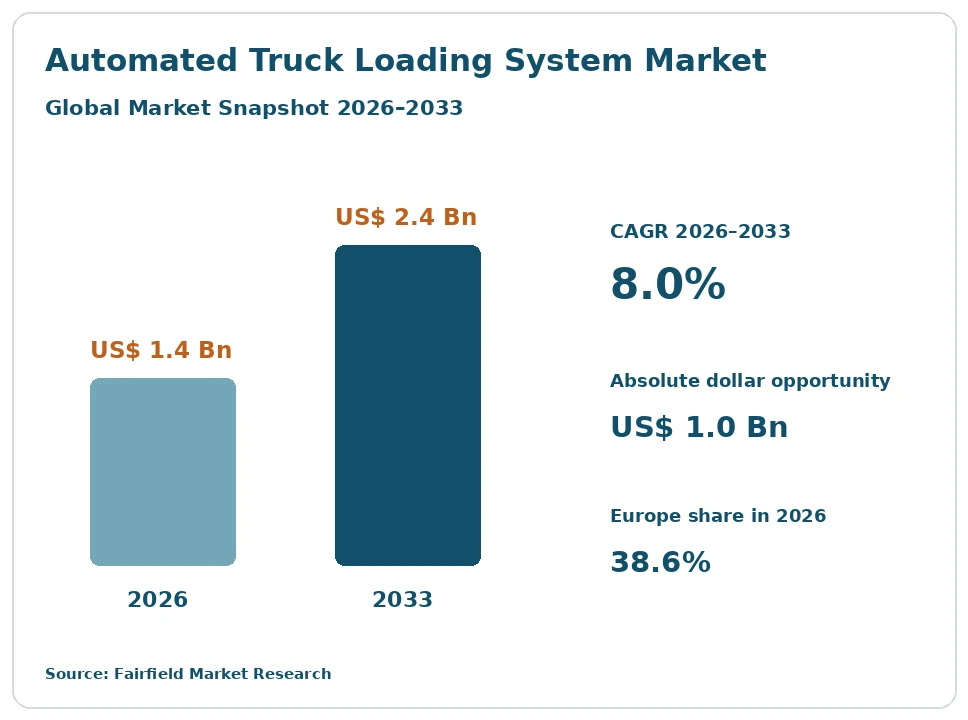
The global Automated Truck Loading System market size is expected to be valued at US$ 1.4 billion in 2026 and projected to reach US$ 2.4 billion by 2033, growing at a CAGR of 8.0% between 2026 and 2033.
Between 2020 and 2025 installed value grew at roughly 7.0% a year from a very small base, as warehouse operators struggled to staff dock positions. This remains a niche within materials handling, and the reasons for that are structural. Growth is carried by three factors. First, loading and unloading trailers by hand is physically punishing work with high turnover, so labour scarcity rather than throughput justifies the investment. Second, occupational safety and ergonomics enforcement raises the cost of manual handling injuries. Third, robotic unloading has improved enough to attract parcel operators. Adoption stays narrow because the equipment needs compatible trailers, consistent load patterns and steady high volume through a single dock door to pay back.
Key Report Takeaways
- By System Type: Chain and slat conveyor systems held 26.8% share in 2026, while robotic unloading arms are projected to expand at an 11.8% CAGR through 2033, as perception systems improve enough to handle stacked cartons.
- By Operation Mode: Automated loading held 52.6% share in 2026, while automated unloading is projected to grow at a 10.4% CAGR, because inbound trailers are where injury rates and staffing shortfalls are worst.
- By Load Unit Type: Palletised loads held 61.5% share in 2026, while floor-loaded freight is projected to advance at an 11.2% CAGR, reflecting parcel and carton handling investment.
- By End Use Industry: Beverage held 22.4% share in 2026, while parcel and express is projected to rise at a 10.6% CAGR, supported by sustained package volumes and acute dock staffing pressure.
- By Geography: Europe held 38.6% share in 2026, helped by dense shuttle networks and standardised pallet pools, while Asia Pacific is projected to grow at a 10.3% CAGR as wages climb in established logistics hubs.
Global Automated Truck Loading System Market Trends and Insights
Drivers Impact Analysis
Both drivers concern people rather than throughput, which is unusual for materials handling equipment.
Dock Labour Scarcity and Injury Costs Justify Automated Loading Investment
Trailer loading is the job warehouses struggle hardest to fill, and that shortage, not throughput, is what sells this equipment. Workers stack and destack freight inside a metal box that is freezing in winter and extremely hot in summer, with no mechanical assistance for much of the task. Turnover at these positions is persistently high, overtime and agency cover are expensive, and injury claims add a cost that finance teams can quantify precisely.
The mechanism is a straightforward labour substitution calculation. A chain or slat conveyor floor can transfer a full trailer load in a few minutes, replacing a crew working with pallet trucks for the better part of an hour. Once a site cannot reliably staff its dock, the comparison stops being equipment cost against wages and becomes equipment cost against trailers sitting unloaded. Detention charges and missed delivery windows then enter the business case alongside wages.
Occupational Safety and Ergonomics Obligations Push Manual Handling Off the Dock
Safety regulation converts an ergonomic problem into a documented legal duty, and that is what moves projects from discussion to approval. The European Union manual handling directive and its national equivalents require employers to assess manual handling risk and to avoid it where reasonably practicable. Regulators in several jurisdictions have added injury reduction programme duties and indoor heat exposure rules that apply directly to dock and trailer work areas.
The causal chain runs from documented risk assessment to capital approval. Once a site formally records that trailer loading carries unacceptable lifting, twisting and heat exposure risk, it must show what it did about it. Automated loading removes the worker from inside the trailer entirely, which is the only complete answer. Equipment safety requirements under EN 1398 for dock levellers, ISO 3691-4 for driverless industrial trucks and ISO 10218 with ISO/TS 15066 for collaborative robots then govern how the replacement system is built.
| Driver | Impact on CAGR Forecast | Geographic Relevance | Impact Timeline |
| Dock labour scarcity, turnover and the cost of handling injuries | High | Europe, North America, Asia Pacific | Short term ≤2 years |
| Enforcement of ergonomics and manual handling obligations | Medium | Europe, North America | Medium term 2–4 years |
Restraints Impact Analysis
Both restraints explain why adoption stays far narrower than interest in the technology suggests.
Mixed Trailer Fleets Limit Where Automated Loading Can Physically Be Installed
Most automated loading systems need the trailer to cooperate, and in mixed fleets it usually does not. Chain, slat, roller track and skate systems generally require matching trailer-side equipment, a reinforced and level floor, consistent internal height and a compatible dock interface. An operator who controls its own trailers can specify all of that. An operator receiving third-party or spot-market vehicles cannot, and the system stands idle whenever an incompatible trailer arrives.
The cost structure makes this decisive. Fitting trailer-side conveyors or roller tracks adds capital to every vehicle in the loop, and it reduces payload slightly, which matters on weight-limited loads. Dock-side investment alone is therefore insufficient. Load securing requirements under EN 12195 and pallet dimension standards such as ISO 6780 add further constraints, because the system only works where pallet footprint, load height and restraint method are consistent across every inbound and outbound movement.
Unstructured Floor-Loaded Freight Remains the Hard Case for Robotic Unloading
Floor-loaded trailers packed with mixed cartons are the freight that automation has struggled with for years, and they represent a large share of inbound volume. Cartons vary in size, weight, surface and stability, they shift in transit, and they often arrive leaning or interlocked. A robotic unloading arm must identify and extract items from an unstable stacked face in poor light, without crushing contents or causing a collapse.
The technical cause is perception and grip under variable conditions. Vision systems must segment touching cartons of similar colour, estimate pose and judge which item can be removed safely, while vacuum or clamp end effectors must handle shrink-wrapped, dusty, damp or deformable packages. Throughput also has to beat an experienced crew to justify the cost. Progress is real but incremental, so most operators restrict robotic unloading to a few high-volume lanes with reasonably predictable freight.
| Restraint | Impact on CAGR Forecast | Geographic Relevance | Impact Timeline |
| Mixed trailer fleets and the need for trailer-side equipment | High | North America, Asia Pacific, Latin America | Long term ≥4 years |
| Floor-loaded and mixed-carton freight that robotic unloading handles poorly | Medium | Europe, North America | Medium term 2–4 years |
Market Opportunities
Closed-Loop Shuttle Networks Offer the Clearest Payback Available
Fixed shuttle routes between two controlled sites are where this equipment works best, and that is a defined, winnable revenue pool. When a company owns both the origin dock, the destination dock and the trailers running between them, it can standardise trailer fitment, pallet pattern and load height, and run the same movement many times a day. Payback then rests on predictable cycle counts rather than optimistic assumptions.
Suppliers with strong trailer-side engineering capture this best, since the sale covers both ends of the loop. Demand comes from beverage producers moving between brewery and distribution centre, paper and packaging plants feeding converting sites, and automotive parts logistics running timed deliveries to assembly plants. Packaging line safety requirements under EN 415 apply where the loading system sits directly behind palletising, so integration with existing end-of-line equipment is part of the offer.
Retrofitting Existing Docks Widens the Addressable Installed Base
Retrofit projects open a much larger pool than new-build warehouses, because the great majority of dock doors already exist and will not be replaced. Telescopic conveyors, boom loaders and mobile systems can be installed at a conventional dock without rebuilding the pit or the apron, and they do not require trailer-side fitment. That makes them the realistic entry point for operators who cannot justify a full chain floor installation.
Equipment suppliers and systems integrators share this opportunity, and the customer group is broad: third-party logistics providers, grocery and retail distribution operators and parcel depots handling floor-loaded cartons. Because retrofits must connect to existing sortation and warehouse control systems, integration software is a significant part of project value. Demonstrated reductions in manual handling exposure also help operators evidence compliance with injury reduction programme requirements now appearing in several jurisdictions.
Segment Analysis
By System Type: Chain and Slat Floors Lead While Robotic Arms Grow Quickest
Chain and slat conveyor systems held 26.8% share in 2026, because they move a complete trailer load in a single controlled transfer and suit the high-volume shuttle runs that justify this equipment. Roller track and skate loading systems follow at 21.4%, favoured where trailer-side cost must stay lower. Belt-based and moving floor systems account for 18.6% and handle bulk and non-palletised loads well. Telescopic conveyors and boom loaders hold 17.2% and dominate retrofit work. Robotic unloading arms are the fastest-growing type at an 11.8% CAGR, despite a small 6.6% share, as vision and grip capability improve on stacked carton faces. Automated guided vehicle based systems take the remainder, governed by ISO 3691-4 requirements. The implication is a barbell market: proven mechanical floors generate the revenue while robotics generates the growth rate.
By Operation Mode: Outbound Loading Dominates While Unloading Accelerates
Automated loading held 52.6% share in 2026, simply because outbound flow is easier to control. A shipper decides the pallet pattern, the load height and the sequence, so the system can be designed around a known load. Automated unloading is the fastest-growing mode at a 10.4% CAGR, since inbound trailers are where staffing shortfalls and injury rates are most severe and where arriving freight is least predictable. Combined loading and unloading installations account for 24.3% and appear mainly in closed-loop operations where the same trailer is emptied and refilled at one door. Growth in unloading depends directly on perception technology maturing, because the system must cope with whatever arrives rather than with what was planned. For suppliers, unloading is the harder engineering problem and the larger eventual prize.
By Load Unit Type: Palletised Freight Carries Volume While Floor-Loaded Gains Speed
Palletised loads held 61.5% share in 2026, reflecting that nearly all proven automated loading depends on a uniform, rigid, predictable load unit. Standard pallet footprints defined under ISO 6780 and the regional pallet pools make this possible, since the system is engineered around a known base dimension. Containers and swap bodies account for 15.6%, important in intermodal and European distribution. Slip sheets and slave boards hold 14.2%, used where payload weight or pallet cost matters. Floor-loaded freight is the fastest-growing category at an 11.2% CAGR from an 8.7% base, driven by parcel and carton operations that never palletise at all. The business implication is clear: load unit discipline determines feasibility, so operators who standardise pallets and load patterns expand the range of docks they can automate.
By End Use Industry: Beverage Proves the Case While Parcel Operations Scale Fastest
Beverage held 22.4% share in 2026 and remains the reference application, because brewery and bottling plants run heavy, uniform palletised loads on fixed shuttle routes with very high daily trailer counts. Parcel and express is the fastest-growing end use at a 10.6% CAGR, pushed by sustained package volumes, severe dock staffing difficulty and heavy investment in robotic unloading for floor-loaded trailers. Paper and packaging accounts for 18.3%, with similar load uniformity to beverage. Grocery and retail distribution holds 17.6%, where mixed pallets complicate automation. Automotive parts logistics takes 12.8%, driven by timed delivery discipline. Third-party logistics providers represent 9.2% and adopt least readily, because they cannot control trailer fitment or load patterns across changing customer contracts. The implication is that adoption follows load discipline and route stability far more closely than it follows sector size.
Geography Analysis
North America Buys Automated Docks to Solve a Persistent Staffing Problem
North America holds 27.4% share in 2026 and grows at 8.2% to 2033, with the United States accounting for most demand and Canada and Mexico contributing smaller volumes. Dock staffing has been the binding constraint for warehouse operators for several years, and wage inflation in distribution work has made the equipment comparison far more favourable. Parcel operators, beverage producers and large retailers lead adoption. Regulatory pressure is building through state-level warehouse injury reduction requirements and indoor heat exposure rules that apply to trailer interiors. The main barrier is trailer heterogeneity, since long-haul fleets are mixed and much inbound freight arrives floor-loaded in third-party equipment. Retrofit-friendly telescopic conveyors and robotic unloading therefore attract more interest here than full trailer-side chain floor installations.
Which Region Is Leading the Automated Truck Loading System Market?
Europe leads with 38.6% share in 2026, growing at 6.8% to 2033, because the technology was developed there and the operating conditions suit it. Germany, the Netherlands, Belgium, the United Kingdom and the Nordic countries host both the specialist suppliers and the dense shuttle networks the equipment needs. High labour costs, strong works council attention to ergonomics and long-established manual handling duties made removing workers from trailers a priority far earlier than elsewhere. Standardised pallet pools and widespread use of swap bodies give loads the consistency automated systems require. Growth is steadier rather than spectacular because many of the obvious closed-loop applications are already converted. The next phase is retrofit of conventional docks and extension into grocery distribution, where mixed pallets have so far limited adoption.
Which Region Is Growing Fastest in the Automated Truck Loading System Market?
Asia Pacific is the fastest-growing geography at a 10.3% CAGR to 2033, from a 24.8% share in 2026. China drives most volume through large beverage, appliance and electronics distribution networks where wages have risen sharply and dock labour is harder to retain. Japan and Korea adopt readily because labour shortage is acute and logistics operators are already highly automated. Australia contributes a smaller but consistent stream of grocery and beverage projects. India is at an earlier stage, where low wages still favour manual crews, although large distribution operators are beginning to evaluate the equipment. Growth is rapid partly because the base is low. Barriers include varied trailer and container specification and a shortage of local integration and service capability outside major hubs.
Latin America Adopts Selectively in Beverage and Export Logistics
Latin America represents 4.6% share in 2026 with a 6.4% CAGR. Brazil and Mexico supply almost all demand, mainly through beverage producers, large consumer goods manufacturers and export-oriented automotive parts logistics operating fixed shuttle routes. Elsewhere in the region adoption is minimal. The barriers are straightforward: labour costs remain low enough that manual crews are cheaper than capital equipment, credit is expensive, and imported systems carry duty and freight costs that lengthen payback well beyond what finance committees accept. Trailer fleets are highly varied, which rules out trailer-side fitment for most operators. The opportunity sits with multinational manufacturers applying global engineering standards to regional plants, where a closed-loop route between a factory and its distribution centre can meet the same payback test used elsewhere.
Middle East & Africa Sees Early Projects in New Distribution Infrastructure
Middle East & Africa accounts for 4.6% share in 2026, growing at 6.6% to 2033. Demand concentrates in the United Arab Emirates, Saudi Arabia and South Africa, where new distribution centres are being built to modern specification and can design automated loading in from the start rather than retrofitting it. Beverage, consumer goods and logistics hub operators account for most projects. Barriers are significant: labour remains comparatively inexpensive across much of the region, trailer fleets are mixed, and local service and spare parts support for specialist equipment is thin, which worries operators facing long downtime if a system fails. The opportunity lies in large greenfield logistics parks, where developers specify high-throughput dock equipment as part of the original building design.
Competitive Landscape
This is a fragmented industry, and its concentration is low by materials handling standards. A small group of specialists built the category and still holds the strongest positions in trailer-side technology, while large intralogistics integrators supply truck loading and unloading as one module inside much bigger warehouse automation contracts. Many projects are also delivered by regional conveyor builders and systems integrators working to a customer specification, which keeps the long tail populated. Joloda Hydraroll Limited, Ancra Systems B.V., Actiw Oy and Cargo Floor B.V. are recognised specialists in loading technology, while BEUMER Group GmbH & Co. KG, Vanderlande Industries B.V., Honeywell Intelligrated and Daifuku Co., Ltd. approach the dock from the parcel and warehouse automation side.
Competition is decided on whether the proposed system actually suits the customer’s trailers and freight, on cycle time per trailer, on reliability in a harsh and dirty environment, and on local service response. Price matters, but a failed installation at a dock door stops an entire site, so proven references carry disproportionate weight. Software integration with warehouse and transport management systems has become a differentiator, because the loading sequence has to match the order release. New entrants arrive mainly from robotics, bringing vision-guided unloading arms and mobile robots rather than conveyor engineering.
Strategic activity focuses on assembling a complete dock offer, pairing trailer-side loading technology with dock equipment, controls and integration software. Suppliers have also extended service and spare parts coverage into the regions where projects are now being specified, since serviceability is a purchase criterion.
Strategic direction across the industry is consistent: widen the range of freight the equipment can handle, lower the volume threshold at which it pays back, and make retrofit installation simpler.
Automated Truck Loading System Industry Leaders
- Joloda Hydraroll Limited
- Ancra Systems B.V.
- Actiw Oy
- Caljan A/S
- BEUMER Group GmbH & Co. KG
Recent Industry Developments
- July 2024: California brought its indoor heat illness prevention standard into effect, covering warehouse and dock work areas where temperatures rise – it makes trailer interiors a documented exposure risk that operators must control.
- August 2024: The United States Occupational Safety and Health Administration published a proposed heat injury and illness prevention standard for indoor and outdoor work – it signals a national duty that would apply directly to trailer loading crews.
- December 2024: New York State enacted warehouse worker injury reduction legislation requiring formal injury prevention programmes at qualifying facilities – it obliges operators to document and act on manual handling risk at the dock.
- February 2025: Revised editions of ISO 10218 parts one and two were published, updating safety requirements for industrial robots and their integration – it clarifies how robotic unloading cells must be designed and guarded.
Companies Covered in the Report
- Joloda Hydraroll Limited
- Ancra Systems B.V.
- Cargo Floor B.V.
- Actiw Oy
- Caljan A/S
- BEUMER Group GmbH & Co. KG
- Vanderlande Industries B.V.
- Honeywell Intelligrated
- Körber Supply Chain
- Daifuku Co., Ltd.
- Dematic GmbH
- Fives Group
Automated Truck Loading System Market Report Scope
This study covers equipment that loads and unloads trailers, containers and swap bodies without manual handling, together with trailer-side fittings, dock equipment, controls and integration software. The wider conveying equipment market is examined separately; this report addresses the dock-and-trailer loading function only. Forklifts and general warehouse conveyors are excluded. The base year is 2025, with a 2026 to 2033 forecast expressed in US$ Billion.
| Metric | Value |
| Study Period | 2020–2033 |
| Market Size 2026 | US$ 1.4 Billion |
| Market Size 2033 | US$ 2.4 Billion |
| CAGR 2026–2033 | 8.0% |
| Absolute Dollar Opportunity | US$ 1.0 Billion |
| Largest Market | Europe (38.6% share in 2026) |
| Fastest-Growing Market | Asia Pacific (10.3% CAGR) |
| Market Concentration | Low |
| Major Players | Joloda Hydraroll Limited, Ancra Systems B.V., Actiw Oy, Caljan A/S, BEUMER Group GmbH & Co. KG |
System Type
- Chain and Slat Conveyor Systems
- Roller Track and Skate Loading Systems
- Belt and Moving Floor Systems
- Telescopic Conveyors and Boom Loaders
- Automated Guided Vehicle Based Systems
- Robotic Unloading Arms
Operation Mode
- Automated Loading
- Automated Unloading
- Combined Loading and Unloading
Load Unit Type
- Palletised Loads
- Slip Sheets and Slave Boards
- Containers and Swap Bodies
- Floor-Loaded Freight
End Use Industry
- Beverage
- Paper and Packaging
- Parcel and Express
- Grocery and Retail Distribution
- Automotive Parts Logistics
- Third-Party Logistics
Regions
- North America
- Europe
- Asia Pacific
- Latin America
- Middle East & Africa
1. Executive Summary
1.1. Global Automated Truck Loading System Market Snapshot
1.2. Future Projections, 2026-2033
1.3. Key Market Trends
1.4. Regional Snapshot
2. Market Overview
2.1. Market Definition and Report Scope
2.2. Historical Market Trends, 2020-2025
2.3. Market Dynamics
2.3.1. Drivers Impact Analysis
2.3.1.1. Dock Labour Scarcity and Injury Costs Justify Automated Loading Investment
2.3.1.2. Occupational Safety and Ergonomics Obligations Push Manual Handling Off the Dock
2.3.2. Restraints Impact Analysis
2.3.2.1. Mixed Trailer Fleets Limit Where Automated Loading Can Physically Be Installed
2.3.2.2. Unstructured Floor-Loaded Freight Remains the Hard Case for Robotic Unloading
2.3.3. Market Opportunities
2.3.3.1. Closed-Loop Shuttle Networks Offer the Clearest Payback Available
2.3.3.2. Retrofitting Existing Docks Widens the Addressable Installed Base
3. Global Automated Truck Loading System Market Outlook, 2020-2033
3.1. Global Automated Truck Loading System Market Outlook, by System Type, Value (US$ Billion), 2020-2033
3.1.1. Chain and Slat Conveyor Systems
3.1.2. Roller Track and Skate Loading Systems
3.1.3. Belt and Moving Floor Systems
3.1.4. Telescopic Conveyors and Boom Loaders
3.1.5. Automated Guided Vehicle Based Systems
3.1.6. Robotic Unloading Arms
3.2. Global Automated Truck Loading System Market Outlook, by Operation Mode, Value (US$ Billion), 2020-2033
3.2.1. Automated Loading
3.2.2. Automated Unloading
3.2.3. Combined Loading and Unloading
3.3. Global Automated Truck Loading System Market Outlook, by Load Unit Type, Value (US$ Billion), 2020-2033
3.3.1. Palletised Loads
3.3.2. Slip Sheets and Slave Boards
3.3.3. Containers and Swap Bodies
3.3.4. Floor-Loaded Freight
3.4. Global Automated Truck Loading System Market Outlook, by End Use Industry, Value (US$ Billion), 2020-2033
3.4.1. Beverage
3.4.2. Paper and Packaging
3.4.3. Parcel and Express
3.4.4. Grocery and Retail Distribution
3.4.5. Automotive Parts Logistics
3.4.6. Third-Party Logistics
3.5. Global Automated Truck Loading System Market Outlook, by Region, Value (US$ Billion), 2020-2033
3.5.1. North America
3.5.2. Europe
3.5.3. Asia Pacific
3.5.4. Latin America
3.5.5. Middle East & Africa
4. North America Automated Truck Loading System Market Outlook, 2020-2033
4.1. North America Automated Truck Loading System Market Outlook, by System Type, Value (US$ Billion), 2020-2033
4.1.1. Chain and Slat Conveyor Systems
4.1.2. Roller Track and Skate Loading Systems
4.1.3. Belt and Moving Floor Systems
4.1.4. Telescopic Conveyors and Boom Loaders
4.1.5. Automated Guided Vehicle Based Systems
4.1.6. Robotic Unloading Arms
4.2. North America Automated Truck Loading System Market Outlook, by Operation Mode, Value (US$ Billion), 2020-2033
4.2.1. Automated Loading
4.2.2. Automated Unloading
4.2.3. Combined Loading and Unloading
4.3. North America Automated Truck Loading System Market Outlook, by Load Unit Type, Value (US$ Billion), 2020-2033
4.3.1. Palletised Loads
4.3.2. Slip Sheets and Slave Boards
4.3.3. Containers and Swap Bodies
4.3.4. Floor-Loaded Freight
4.4. North America Automated Truck Loading System Market Outlook, by End Use Industry, Value (US$ Billion), 2020-2033
4.4.1. Beverage
4.4.2. Paper and Packaging
4.4.3. Parcel and Express
4.4.4. Grocery and Retail Distribution
4.4.5. Automotive Parts Logistics
4.4.6. Third-Party Logistics
4.5. North America Automated Truck Loading System Market Outlook, by Country, Value (US$ Billion), 2020-2033
4.5.1. United States Automated Truck Loading System Market Outlook, by System Type, 2020-2033
4.5.2. United States Automated Truck Loading System Market Outlook, by Operation Mode, 2020-2033
4.5.3. United States Automated Truck Loading System Market Outlook, by Load Unit Type, 2020-2033
4.5.4. United States Automated Truck Loading System Market Outlook, by End Use Industry, 2020-2033
4.5.5. Canada Automated Truck Loading System Market Outlook, by System Type, 2020-2033
4.5.6. Canada Automated Truck Loading System Market Outlook, by Operation Mode, 2020-2033
4.5.7. Canada Automated Truck Loading System Market Outlook, by Load Unit Type, 2020-2033
4.5.8. Canada Automated Truck Loading System Market Outlook, by End Use Industry, 2020-2033
4.5.9. Mexico Automated Truck Loading System Market Outlook, by System Type, 2020-2033
4.5.10. Mexico Automated Truck Loading System Market Outlook, by Operation Mode, 2020-2033
4.5.11. Mexico Automated Truck Loading System Market Outlook, by Load Unit Type, 2020-2033
4.5.12. Mexico Automated Truck Loading System Market Outlook, by End Use Industry, 2020-2033
5. Europe Automated Truck Loading System Market Outlook, 2020-2033
5.1. Europe Automated Truck Loading System Market Outlook, by System Type, Value (US$ Billion), 2020-2033
5.1.1. Chain and Slat Conveyor Systems
5.1.2. Roller Track and Skate Loading Systems
5.1.3. Belt and Moving Floor Systems
5.1.4. Telescopic Conveyors and Boom Loaders
5.1.5. Automated Guided Vehicle Based Systems
5.1.6. Robotic Unloading Arms
5.2. Europe Automated Truck Loading System Market Outlook, by Operation Mode, Value (US$ Billion), 2020-2033
5.2.1. Automated Loading
5.2.2. Automated Unloading
5.2.3. Combined Loading and Unloading
5.3. Europe Automated Truck Loading System Market Outlook, by Load Unit Type, Value (US$ Billion), 2020-2033
5.3.1. Palletised Loads
5.3.2. Slip Sheets and Slave Boards
5.3.3. Containers and Swap Bodies
5.3.4. Floor-Loaded Freight
5.4. Europe Automated Truck Loading System Market Outlook, by End Use Industry, Value (US$ Billion), 2020-2033
5.4.1. Beverage
5.4.2. Paper and Packaging
5.4.3. Parcel and Express
5.4.4. Grocery and Retail Distribution
5.4.5. Automotive Parts Logistics
5.4.6. Third-Party Logistics
5.5. Europe Automated Truck Loading System Market Outlook, by Country and Subregion, Value (US$ Billion), 2020-2033
5.5.1. Germany Automated Truck Loading System Market Outlook, by System Type, 2020-2033
5.5.2. Germany Automated Truck Loading System Market Outlook, by Operation Mode, 2020-2033
5.5.3. Germany Automated Truck Loading System Market Outlook, by Load Unit Type, 2020-2033
5.5.4. Germany Automated Truck Loading System Market Outlook, by End Use Industry, 2020-2033
5.5.5. Netherlands Automated Truck Loading System Market Outlook, by System Type, 2020-2033
5.5.6. Netherlands Automated Truck Loading System Market Outlook, by Operation Mode, 2020-2033
5.5.7. Netherlands Automated Truck Loading System Market Outlook, by Load Unit Type, 2020-2033
5.5.8. Netherlands Automated Truck Loading System Market Outlook, by End Use Industry, 2020-2033
5.5.9. Belgium Automated Truck Loading System Market Outlook, by System Type, 2020-2033
5.5.10. Belgium Automated Truck Loading System Market Outlook, by Operation Mode, 2020-2033
5.5.11. Belgium Automated Truck Loading System Market Outlook, by Load Unit Type, 2020-2033
5.5.12. Belgium Automated Truck Loading System Market Outlook, by End Use Industry, 2020-2033
5.5.13. United Kingdom Automated Truck Loading System Market Outlook, by System Type, 2020-2033
5.5.14. United Kingdom Automated Truck Loading System Market Outlook, by Operation Mode, 2020-2033
5.5.15. United Kingdom Automated Truck Loading System Market Outlook, by Load Unit Type, 2020-2033
5.5.16. United Kingdom Automated Truck Loading System Market Outlook, by End Use Industry, 2020-2033
5.5.17. Nordic countries Automated Truck Loading System Market Outlook, by System Type, 2020-2033
5.5.18. Nordic countries Automated Truck Loading System Market Outlook, by Operation Mode, 2020-2033
5.5.19. Nordic countries Automated Truck Loading System Market Outlook, by Load Unit Type, 2020-2033
5.5.20. Nordic countries Automated Truck Loading System Market Outlook, by End Use Industry, 2020-2033
6. Asia Pacific Automated Truck Loading System Market Outlook, 2020-2033
6.1. Asia Pacific Automated Truck Loading System Market Outlook, by System Type, Value (US$ Billion), 2020-2033
6.1.1. Chain and Slat Conveyor Systems
6.1.2. Roller Track and Skate Loading Systems
6.1.3. Belt and Moving Floor Systems
6.1.4. Telescopic Conveyors and Boom Loaders
6.1.5. Automated Guided Vehicle Based Systems
6.1.6. Robotic Unloading Arms
6.2. Asia Pacific Automated Truck Loading System Market Outlook, by Operation Mode, Value (US$ Billion), 2020-2033
6.2.1. Automated Loading
6.2.2. Automated Unloading
6.2.3. Combined Loading and Unloading
6.3. Asia Pacific Automated Truck Loading System Market Outlook, by Load Unit Type, Value (US$ Billion), 2020-2033
6.3.1. Palletised Loads
6.3.2. Slip Sheets and Slave Boards
6.3.3. Containers and Swap Bodies
6.3.4. Floor-Loaded Freight
6.4. Asia Pacific Automated Truck Loading System Market Outlook, by End Use Industry, Value (US$ Billion), 2020-2033
6.4.1. Beverage
6.4.2. Paper and Packaging
6.4.3. Parcel and Express
6.4.4. Grocery and Retail Distribution
6.4.5. Automotive Parts Logistics
6.4.6. Third-Party Logistics
6.5. Asia Pacific Automated Truck Loading System Market Outlook, by Country, Value (US$ Billion), 2020-2033
6.5.1. China Automated Truck Loading System Market Outlook, by System Type, 2020-2033
6.5.2. China Automated Truck Loading System Market Outlook, by Operation Mode, 2020-2033
6.5.3. China Automated Truck Loading System Market Outlook, by Load Unit Type, 2020-2033
6.5.4. China Automated Truck Loading System Market Outlook, by End Use Industry, 2020-2033
6.5.5. Japan Automated Truck Loading System Market Outlook, by System Type, 2020-2033
6.5.6. Japan Automated Truck Loading System Market Outlook, by Operation Mode, 2020-2033
6.5.7. Japan Automated Truck Loading System Market Outlook, by Load Unit Type, 2020-2033
6.5.8. Japan Automated Truck Loading System Market Outlook, by End Use Industry, 2020-2033
6.5.9. Korea Automated Truck Loading System Market Outlook, by System Type, 2020-2033
6.5.10. Korea Automated Truck Loading System Market Outlook, by Operation Mode, 2020-2033
6.5.11. Korea Automated Truck Loading System Market Outlook, by Load Unit Type, 2020-2033
6.5.12. Korea Automated Truck Loading System Market Outlook, by End Use Industry, 2020-2033
6.5.13. Australia Automated Truck Loading System Market Outlook, by System Type, 2020-2033
6.5.14. Australia Automated Truck Loading System Market Outlook, by Operation Mode, 2020-2033
6.5.15. Australia Automated Truck Loading System Market Outlook, by Load Unit Type, 2020-2033
6.5.16. Australia Automated Truck Loading System Market Outlook, by End Use Industry, 2020-2033
6.5.17. India Automated Truck Loading System Market Outlook, by System Type, 2020-2033
6.5.18. India Automated Truck Loading System Market Outlook, by Operation Mode, 2020-2033
6.5.19. India Automated Truck Loading System Market Outlook, by Load Unit Type, 2020-2033
6.5.20. India Automated Truck Loading System Market Outlook, by End Use Industry, 2020-2033
7. Latin America Automated Truck Loading System Market Outlook, 2020-2033
7.1. Latin America Automated Truck Loading System Market Outlook, by System Type, Value (US$ Billion), 2020-2033
7.1.1. Chain and Slat Conveyor Systems
7.1.2. Roller Track and Skate Loading Systems
7.1.3. Belt and Moving Floor Systems
7.1.4. Telescopic Conveyors and Boom Loaders
7.1.5. Automated Guided Vehicle Based Systems
7.1.6. Robotic Unloading Arms
7.2. Latin America Automated Truck Loading System Market Outlook, by Operation Mode, Value (US$ Billion), 2020-2033
7.2.1. Automated Loading
7.2.2. Automated Unloading
7.2.3. Combined Loading and Unloading
7.3. Latin America Automated Truck Loading System Market Outlook, by Load Unit Type, Value (US$ Billion), 2020-2033
7.3.1. Palletised Loads
7.3.2. Slip Sheets and Slave Boards
7.3.3. Containers and Swap Bodies
7.3.4. Floor-Loaded Freight
7.4. Latin America Automated Truck Loading System Market Outlook, by End Use Industry, Value (US$ Billion), 2020-2033
7.4.1. Beverage
7.4.2. Paper and Packaging
7.4.3. Parcel and Express
7.4.4. Grocery and Retail Distribution
7.4.5. Automotive Parts Logistics
7.4.6. Third-Party Logistics
7.5. Latin America Automated Truck Loading System Market Outlook, by Country, Value (US$ Billion), 2020-2033
7.5.1. Brazil Automated Truck Loading System Market Outlook, by System Type, 2020-2033
7.5.2. Brazil Automated Truck Loading System Market Outlook, by Operation Mode, 2020-2033
7.5.3. Brazil Automated Truck Loading System Market Outlook, by Load Unit Type, 2020-2033
7.5.4. Brazil Automated Truck Loading System Market Outlook, by End Use Industry, 2020-2033
7.5.5. Mexico Automated Truck Loading System Market Outlook, by System Type, 2020-2033
7.5.6. Mexico Automated Truck Loading System Market Outlook, by Operation Mode, 2020-2033
7.5.7. Mexico Automated Truck Loading System Market Outlook, by Load Unit Type, 2020-2033
7.5.8. Mexico Automated Truck Loading System Market Outlook, by End Use Industry, 2020-2033
8. Middle East & Africa Automated Truck Loading System Market Outlook, 2020-2033
8.1. Middle East & Africa Automated Truck Loading System Market Outlook, by System Type, Value (US$ Billion), 2020-2033
8.1.1. Chain and Slat Conveyor Systems
8.1.2. Roller Track and Skate Loading Systems
8.1.3. Belt and Moving Floor Systems
8.1.4. Telescopic Conveyors and Boom Loaders
8.1.5. Automated Guided Vehicle Based Systems
8.1.6. Robotic Unloading Arms
8.2. Middle East & Africa Automated Truck Loading System Market Outlook, by Operation Mode, Value (US$ Billion), 2020-2033
8.2.1. Automated Loading
8.2.2. Automated Unloading
8.2.3. Combined Loading and Unloading
8.3. Middle East & Africa Automated Truck Loading System Market Outlook, by Load Unit Type, Value (US$ Billion), 2020-2033
8.3.1. Palletised Loads
8.3.2. Slip Sheets and Slave Boards
8.3.3. Containers and Swap Bodies
8.3.4. Floor-Loaded Freight
8.4. Middle East & Africa Automated Truck Loading System Market Outlook, by End Use Industry, Value (US$ Billion), 2020-2033
8.4.1. Beverage
8.4.2. Paper and Packaging
8.4.3. Parcel and Express
8.4.4. Grocery and Retail Distribution
8.4.5. Automotive Parts Logistics
8.4.6. Third-Party Logistics
8.5. Middle East & Africa Automated Truck Loading System Market Outlook, by Country, Value (US$ Billion), 2020-2033
8.5.1. United Arab Emirates Automated Truck Loading System Market Outlook, by System Type, 2020-2033
8.5.2. United Arab Emirates Automated Truck Loading System Market Outlook, by Operation Mode, 2020-2033
8.5.3. United Arab Emirates Automated Truck Loading System Market Outlook, by Load Unit Type, 2020-2033
8.5.4. United Arab Emirates Automated Truck Loading System Market Outlook, by End Use Industry, 2020-2033
8.5.5. Saudi Arabia Automated Truck Loading System Market Outlook, by System Type, 2020-2033
8.5.6. Saudi Arabia Automated Truck Loading System Market Outlook, by Operation Mode, 2020-2033
8.5.7. Saudi Arabia Automated Truck Loading System Market Outlook, by Load Unit Type, 2020-2033
8.5.8. Saudi Arabia Automated Truck Loading System Market Outlook, by End Use Industry, 2020-2033
8.5.9. South Africa Automated Truck Loading System Market Outlook, by System Type, 2020-2033
8.5.10. South Africa Automated Truck Loading System Market Outlook, by Operation Mode, 2020-2033
8.5.11. South Africa Automated Truck Loading System Market Outlook, by Load Unit Type, 2020-2033
8.5.12. South Africa Automated Truck Loading System Market Outlook, by End Use Industry, 2020-2033
9. Competitive Landscape
9.1. Market Concentration and Industry Leaders
9.2. Competitive Differentiation
9.3. Strategic Initiatives
9.4. Recent Industry Developments
9.5. Company Profiles
9.5.1. Joloda Hydraroll Limited
9.5.2. Ancra Systems B.V.
9.5.3. Cargo Floor B.V.
9.5.4. Actiw Oy
9.5.5. Caljan A/S
9.5.6. BEUMER Group GmbH & Co. KG
9.5.7. Vanderlande Industries B.V.
9.5.8. Honeywell Intelligrated
9.5.9. Körber Supply Chain
9.5.10. Daifuku Co., Ltd.
9.5.11. Dematic GmbH
9.5.12. Fives Group
10. Appendix
10.1. Research Methodology
10.2. Report Assumptions
10.3. Acronyms and Abbreviations
| Segment | Categories |
|---|---|
| System Type | Chain and Slat Conveyor Systems, Roller Track and Skate Loading Systems, Belt and Moving Floor Systems, Telescopic Conveyors and Boom Loaders, Automated Guided Vehicle Based Systems, Robotic Unloading Arms |
| Operation Mode | Automated Loading, Automated Unloading, Combined Loading and Unloading |
| Load Unit Type | Palletised Loads, Slip Sheets and Slave Boards, Containers and Swap Bodies, Floor-Loaded Freight |
| End Use Industry | Beverage, Paper and Packaging, Parcel and Express, Grocery and Retail Distribution, Automotive Parts Logistics, Third-Party Logistics |
| Regions | North America, Europe, Asia Pacific, Latin America, Middle East & Africa |
Our Research Methodology
Considering the volatility of business today, traditional approaches to strategizing a game plan can be unfruitful if not detrimental. True ambiguity is no way to determine a forecast. A myriad of predetermined factors must be accounted for such as the degree of risk involved, the magnitude of circumstances, as well as conditions or consequences that are not known or unpredictable. To circumvent binary views that cast uncertainty, the application of market research intelligence to strategically posture, move, and enable actionable outcomes is necessary.
View Methodology
Quality Assured
Rigorous Validation Process

Confidentiality Assured
End-to-end Data Security

Custom Research Services
Tailored To Your Objectives
FAQs
The market is valued at US$ 1.4 billion in 2026, covering dock and trailer loading equipment, trailer-side fittings, controls and integration software.
Revenue is projected to reach US$ 2.4 billion by 2033, an 8.0% CAGR and an absolute dollar opportunity of US$ 1.0 billion.
Chain and slat conveyor systems lead with 26.8% share in 2026, because they transfer a full trailer load in one controlled movement.
Robotic unloading arms grow fastest at an 11.8% CAGR, as vision and gripping capability improve on stacked, floor-loaded carton faces.
Europe leads with 38.6% share in 2026, and concentration is Low, with specialists competing alongside large intralogistics integrators and regional builders.
Related Reports
Air Purifying Escape Respirator Market Size, Share, Insights, Competitive Landscape, and Forecast 2026 to 2033
The air purifying escape respirator market is projected to grow from US$ 0.5 billion in 2026 to US$ 0.8 billion by 2033 at a 6.9% CAGR.
Rigid Mine Dumper Market Size, Share, Insights, Competitive Landscape, and Forecast 2026 to 2033
The global rigid mine dumper market is valued at US$9.8 billion in 2026, reaching US$14.6 billion by 2033, growing at a 5.9% CAGR
Product-as-a-Service Market Size, Share, Insights, Competitive Landscape, and Forecast 2026 to 2033
The global product-as-a-service market is valued at US$96.0 billion in 2026, reaching US$204.5 billion by 2033, growing at an 11.4% CAGR
Precision Hand Tools Market Size, Share, Insights, Competitive Landscape, and Forecast 2026 to 2033
The global precision hand tools market is valued at US$9.8 billion in 2026, reaching US$14.2 billion by 2033, growing at a 5.4% CAGR
Weather RADAR Market Size, Share, Insights, Competitive Landscape, and Forecast 2026 to 2033
The Weather RADAR Market is projected to rise from US$ 297.2 million in 2026 to US$ 401.8 million by 2033 at a 4.4% CAGR. Explore key segments.
Scroll and Absorption Chillers Market Size, Share, Insights, Competitive Landscape, and Forecast 2026 to 2033
Scroll and Absorption Chillers Market grows from US$ 14.27 billion in 2026 to US$ 19.31 billion by 2033 at a 4.4% CAGR. Explore key segments and trends.