



Precision Hand Tools Market
Precision Hand Tools Market Size, Share, Insights, Competitive Landscape, and Forecast 2026 to 2033
Precision Hand Tools Market Size and Trend Analysis
How Big Is the Precision Hand Tools Market Expected to Get?
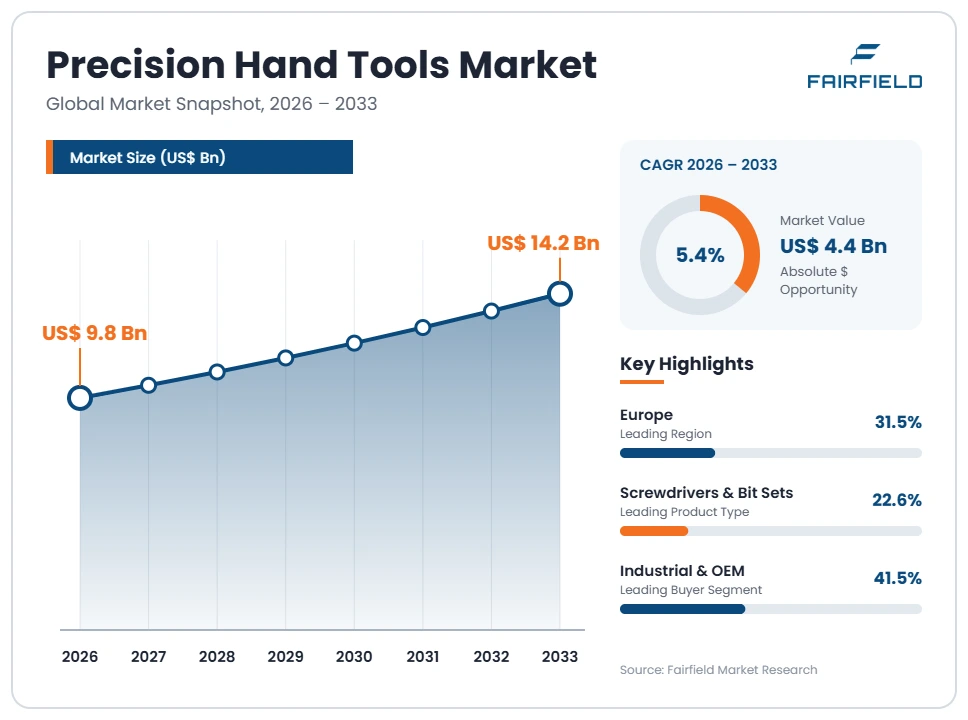
The global precision hand tools market size is expected to be valued at US$ 9.8 billion in 2026 and projected to reach US$ 14.2 billion by 2033, growing at a CAGR of 5.4% between 2026 and 2033.
Sales grew at a 4.0% CAGR between 2020 and 2025, held back by a long replacement cycle on well-made tools. Three forces lift the outlook. High-voltage work on vehicles, batteries and grid equipment requires certified insulated tools and drives a genuine step change in demand. Documented torque in regulated assembly pulls buyers toward calibrated tools and scheduled recalibration. Electronics and medical device assembly keep adding electrostatic discharge safe and cleanroom-grade instruments. Growth stays in mid single digits because a quality hand tool lasts for years and the consumer tier competes almost entirely on price. Value gains come from certification, calibration service and mix shift toward specified professional grades rather than from unit volume.
Key Report Takeaways
- By Product Type: Precision screwdrivers and bit sets held 22.6% share in 2026, while insulated and voltage-rated tools are projected to expand at an 8.2% CAGR through 2033, because live electrical work demands individually tested and certified tools.
- By End Use Industry: Electronics assembly and repair held 24.8% share in 2026, while medical device assembly is projected to grow at a 7.3% CAGR through 2033, as cleanroom build and validated process controls widen across device plants.
- By Buyer Segment: Industrial and original equipment buyers held 41.5% share in 2026, while professional trades and service technicians are projected to grow at a 6.6% CAGR through 2033, driven by electrical installation and vehicle service work.
- By Distribution Channel: Industrial distributors and maintenance suppliers held 46.0% share in 2026, while e-commerce is projected to grow at a 7.6% CAGR through 2033, as technicians buy individual certified items rather than full kits.
- By Region: Europe held 31.5% share in 2026, while Asia Pacific is projected to grow at a 7.1% CAGR through 2033, driven by electronics and battery assembly across China, Vietnam and India.
Global Precision Hand Tools Market Trends and Insights
Drivers Impact Analysis
Two forces explain most of the value growth behind the forecast.
| Driver | Impact on CAGR Forecast | Geographic Relevance | Impact Timeline |
| Certification and scheduled calibration in professional tool use | High | Europe, North America, Asia Pacific | Long term ≥4 years |
| High-voltage work on vehicles, batteries and grid equipment | High | Europe, Asia Pacific | Medium term 2–4 years |
Certification and Scheduled Calibration Protect Price in Professional Precision Tooling
Certification turns a hand tool from a purchase into a managed asset, and that is what defends price in this market. A torque tool used in controlled assembly must be calibrated against a traceable reference and recalibrated on a schedule. An insulated driver used on live circuits must be individually tested and marked. A tool used on electronics must meet a measurable resistance specification. None of those claims can be made by an uncertified product at any price.
The mechanism is auditability. ISO 6789 sets requirements for torque tools and separates the calibration and conformance procedures a laboratory must follow, while ISO/IEC 17025 accreditation makes the resulting certificate acceptable to a customer’s quality system. IEC 60900 defines testing for live working tools up to 1000 volts, and IEC 61340-5-1 governs electrostatic discharge control. Each standard creates recurring service revenue alongside the tool.
High-Voltage Work on Vehicles and Grid Equipment Expands Certified Insulated Tool Demand
Electrification has created a large new population of technicians who legally cannot work without certified insulated tools. Battery electric vehicles operate at several hundred volts, charging infrastructure and battery storage sites run higher still, and grid reinforcement work is expanding across most developed markets. Every workshop, installer and utility crew taking on that work must buy a full insulated set, and the tools must be replaced whenever the coating is damaged.
The mechanism is a safety rule rather than a preference. Live working practice requires tools tested and marked to the voltage standard, and insurers and site operators verify compliance. IEC 60900 certification covers screwdrivers, pliers, cutters, spanners and socket tools individually, so a complete kit is a substantial order. Damage rules also shorten life sharply: a nicked insulation layer condemns the tool, which converts a durable product into a consumable one.
Restraints Impact Analysis
Two structural pressures limit volume growth and supplier margins.
| Restraint | Impact on CAGR Forecast | Geographic Relevance | Impact Timeline |
| Counterfeit and falsely marked tools in certified categories | High | Asia Pacific, Latin America, Middle East & Africa | Medium term 2–4 years |
| Long service life and distribution consolidation | Medium | North America, Europe | Long term ≥4 years |
Counterfeit and Falsely Marked Tools Undermine the Certified Precision Tool Segment
Counterfeit and falsely marked tools are a documented safety problem in this industry, not merely a revenue leak. A fake insulated screwdriver carrying a voltage marking it never earned can injure the person using it, and a torque wrench sold with an unearned conformance claim quietly produces out-of-specification joints. Because the defect is invisible until failure, buyers cannot police it by inspection, and legitimate makers lose sales to products that look identical on a listing page.
The cause is the low barrier to copying a mark. Printing a standard number, a voltage symbol or a conformity mark on a tool costs nothing, while the testing behind the claim is expensive and slow. Online marketplaces and informal distribution move these goods across borders quickly. Market surveillance authorities run enforcement sweeps and recall campaigns, but detection relies on sampling, so a share of non-compliant product always reaches users.
Long Tool Life and Distribution Consolidation Compress Replacement Demand and Margins
A well-made precision hand tool lasts for years, which caps the replacement volume any supplier can count on. A quality driver, plier or micrometer can serve a working career with routine care, and many carry long or lifetime warranties that remove the usual upgrade trigger. Growth instead depends on new technicians entering trades, on new tool categories and on certified products with mandated replacement rules, rather than on normal wear.
The second pressure is commercial. Industrial distribution has consolidated into a smaller number of large maintenance and repair suppliers that negotiate across whole catalogues, demand rebates and stocking support, and increasingly promote their own private-label ranges. That shifts bargaining power away from tool makers. E-commerce adds price transparency on identical catalogue numbers, which erodes the regional price differences suppliers previously held.
Market Opportunities
Calibration and Tool Management Services Build a Recurring Revenue Stream
Calibration converts a one-time tool sale into a subscription, and it is the clearest new revenue pool here. A torque tool in a regulated assembly process must be recalibrated at a defined interval or after a set number of cycles, and the certificate is an audit record rather than a convenience. Suppliers that operate accredited laboratories can sell scheduled recalibration, loaner pools, repair and asset tracking across a customer’s entire tool population.
The demand comes from vehicle plants, aerospace maintenance organisations, medical device manufacturers and energy contractors whose quality systems require traceability. ISO/IEC 17025 accreditation is the entry ticket, since an unaccredited certificate will not satisfy an auditor. Digital tool management, where usage and due dates are logged automatically, deepens the relationship further. Service revenue carries higher margin than hardware and makes supplier switching considerably harder.
Electrostatic Discharge and Cleanroom Grade Tools Open an Electronics and Medical Pool
Tools qualified for electronics and cleanroom work command a premium that general industrial product cannot, which makes this the richest specification-led pool in the market. An electrostatic discharge safe plier or tweezer must deliver measurable dissipative resistance in its handle and body, and a cleanroom instrument must be supplied with controlled packaging, documented materials and particle-shedding limits. Both requirements are written into process documents and audited.
Buyers are semiconductor and electronics assemblers, display and module plants, medical device manufacturers and laboratory operators, concentrated in Asia Pacific but growing wherever device production is being localised. IEC 61340-5-1 gives the electrostatic control framework, and medical device quality systems impose the documentation. Suppliers able to provide certified resistance data, cleanroom-compatible finishes and lot traceability can sell kitted, validated sets rather than individual items.
Segment Analysis
- By Product Type: Precision Drivers Lead While Certified Insulated Tools Climb Fastest
Precision screwdrivers and bit sets held 22.6% of the market in 2026. They are the most universally required item across electronics repair, instrument work, appliance service and assembly, and they sell in sets that are replaced more often than larger tools. Bit wear, tip geometry variety and the sheer number of fastener standards in modern devices keep repurchase frequency high.
Insulated and voltage-rated tools are the fastest-growing product type at an 8.2% CAGR through 2033, because high-voltage work legally requires certified items that must be condemned when damaged. Torque screwdrivers and wrenches grow steadily on documented-assembly demand, while pliers, cutters and tweezers, precision spanners and socket sets, files, punches and deburring tools, and measuring and marking instruments fill established professional niches. The portfolio is tilting toward products sold against a written standard.
- By End Use Industry: Electronics Work Leads While Medical Device Assembly Advances Quickest
Electronics assembly and repair accounted for 24.8% of precision hand tool demand in 2026. The category covers board rework, connector and harness work, device repair networks and laboratory benches, all of which consume drivers, tweezers, cutters and electrostatic discharge safe instruments in volume. High tool turnover in repair operations and the fine tolerances of modern assemblies keep this the largest single industry.
Medical device assembly is the fastest-growing end use at a 7.3% CAGR through 2033, as cleanroom production and validated process controls spread across device manufacturing. Automotive service, aerospace and defence maintenance, telecommunications, laboratory and scientific work, watchmaking and jewellery, and professional trades make up the balance with distinct tool preferences. The common thread is that regulated industries buy to a specification and document the purchase, which supports price.
- By Buyer Segment: Industrial Accounts Hold Scale While Service Technicians Grow Faster
Industrial and original equipment buyers held 41.5% share in 2026. Assembly plants and manufacturers purchase in volume against engineering specifications, standardise tooling across lines, and sustain the calibration and replacement programmes that make this the most predictable part of the market. Procurement is centralised, contracts run for years, and qualification protects incumbent suppliers.
Professional trades and service technicians are the fastest-growing buyer segment at a 6.6% CAGR through 2033, lifted by electrical installation, charging infrastructure work and vehicle service. These buyers purchase individually, upgrade in response to new certification requirements and show strong brand attachment. Institutional and laboratory buyers add steady tendered volume, while consumer and enthusiast demand remains a price-led commodity tier. The professional tiers are where margin is defended.
- By Distribution Channel: Industrial Distributors Dominate While Online Channels Expand Fastest
Industrial distributors and maintenance suppliers held 46.0% of sales in 2026. Plants and large service organisations buy through them because a single account covers thousands of catalogue lines, with stocking agreements, vending systems, credit terms and calibration logistics included. That bundle is difficult for a manufacturer to replicate directly, so distribution remains the main route to industrial accounts.
E-commerce is the fastest-growing channel at a 7.6% CAGR through 2033, as technicians buy individual certified items, replacement bits and specialist instruments without a distributor account. Specialty tool dealers hold loyal positions in watchmaking, electronics and precision measurement, while direct supply to original equipment manufacturers serves line tooling. The online shift raises price transparency and makes counterfeit screening a genuine channel management problem.
Geography Analysis
- North America Buys Certified Tools for Maintenance, Aerospace and Vehicle Service
North America held 27.0% of the precision hand tools market in 2026, with demand weighted toward maintenance, repair and overhaul work. Aerospace maintenance organisations, defence depots, vehicle service networks and industrial plants across the United States and Canada buy calibrated torque tools and documented precision instruments, and ASME B107 standards define much of the dimensional and performance specification used locally.
Vehicle service is the active growth area. Electrified platforms are spreading through dealer networks and independent workshops, each of which must equip technicians with certified insulated sets before taking on high-voltage repairs. Tool management and calibration services are well established, giving suppliers a recurring revenue base. The regional change to watch is semiconductor and battery plant construction, which is creating new demand for electrostatic discharge safe and cleanroom-grade instruments.
- Which Region Is Leading the Precision Hand Tools Market?
Europe leads the precision hand tools market with 31.5% share in 2026, because the region both manufactures and specifies the highest-value product. Germany and Switzerland host long-established makers of precision drivers, pliers, torque instruments and watchmaking tools, and those firms set the dimensional and quality benchmarks that buyers elsewhere reference.
Regulation reinforces the position. Live working practice across member states requires tools certified to the 1000 volt standard, and strong vehicle, aerospace and machinery manufacturing bases sustain documented torque and calibration programmes. DIN and ISO dimensional standards for drivers, spanners and sockets originate largely here, which keeps regional products specification-defining rather than specification-following. The opportunity lies in grid reinforcement and charging infrastructure work, which is expanding certified insulated tool demand across every member state.
- Which Region Is Growing Fastest in the Precision Hand Tools Market?
Asia Pacific is the fastest-growing geography in precision hand tools at a 7.1% CAGR through 2033, from a 29.0% share in 2026, driven by the concentration of electronics, battery and device assembly. China, Vietnam, Thailand, Malaysia and India continue to add assembly and repair capacity, and each new plant equips benches with drivers, tweezers, cutters and electrostatic discharge safe instruments to a written specification.
Japan and South Korea contribute high-value demand through semiconductor, display and precision instrument manufacturing, where tolerance and cleanliness requirements are strictest. Domestic tool manufacturing is extensive, which keeps prices competitive but also makes counterfeit and falsely marked product a persistent problem in certified categories. The main change underway is the spread of formal quality systems into local supplier bases, which converts informal tool buying into specified, auditable procurement.
- Latin America Equips Vehicle Service and Industrial Maintenance Networks
Latin America accounted for 6.5% of global demand in 2026, concentrated in Mexico, Brazil, Argentina and Colombia. Vehicle assembly and service, appliance manufacturing, mining maintenance and oilfield work generate steady demand for torque tools, precision drivers and measuring instruments, with Mexico’s export manufacturing corridor the single largest cluster.
Barriers are commercial and institutional. Imported tools are dollar-priced against volatile currencies, accredited calibration capacity is thin outside the largest industrial centres, and uncertified imports compete heavily in electrical and torque categories where the safety risk is real. Distribution outside major cities is fragmented. The clearest regional change is the arrival of electrified vehicle service work, which is forcing workshop networks to invest in certified insulated tool sets for the first time.
- Middle East & Africa Builds Tool Demand Around Energy and Infrastructure Maintenance
Middle East & Africa held 6.0% of the market in 2026, with demand tied to energy, utilities and infrastructure rather than to manufacturing. Oil and gas maintenance, power transmission work, aviation servicing and large construction programmes across Saudi Arabia, the United Arab Emirates, Qatar, Egypt and South Africa sustain purchases of torque tools, insulated sets and precision measuring instruments.
Barriers include a limited accredited calibration network, dependence on imported product with long lead times, and weak enforcement against falsely marked tools in several markets. Technician training capacity constrains how quickly certified practices spread. The opportunity sits in solar, grid and battery storage construction, where high-voltage installation work requires certified insulated tools and creates a new professional buyer group with recurring replacement needs.
Competitive Landscape
The precision hand tools market is moderately concentrated and splits cleanly along certification lines. A few diversified groups hold broad positions across professional and industrial catalogues, while specialist German, Swiss and Japanese manufacturers dominate individual high-value categories such as insulated tools, precision pliers, torque instruments, watchmaking tools and measurement. Below them sit many regional and private-label producers competing in uncertified consumer and light trade products. Consolidation occurs mainly where a group wants a certified category it cannot build organically, because the testing infrastructure, tooling and brand recognition behind a voltage-rated or torque product take years to establish.
Competition in the professional tier runs on compliance evidence rather than on brand sentiment. Buyers compare certification scope, individual test marking, calibration accreditation, measurement uncertainty, service turnaround and availability of loaner pools. Steel grade, heat treatment, tip geometry and handle ergonomics still matter, but they are judged against a written specification rather than on feel. In the consumer tier the contest is purely on price and warranty, and imported product dominates. New entrants appear mostly as online-native brands in uncertified categories, and as calibration and tool management service providers that sell no hardware at all.
Strategic activity follows three themes. Manufacturers are extending insulated and voltage-rated ranges to cover complete high-voltage work kits. They are building or accrediting calibration laboratories so recalibration revenue stays in house. They are also adding digital tool identification and asset management so customers can evidence that every tool in a controlled process is in date.
Vendor strategy is consolidating around proof of conformity. Suppliers increasingly sell certification, traceability and service continuity alongside the tool, which raises switching costs and shields professional pricing.
Recent Industry Developments
- 2017: ISO 6789 was restructured into two parts, separating requirements for hand torque tools from the calibration and conformance procedures applied to them – it introduced declarations of conformance and measurement uncertainty into routine torque tool certification.
- November 2017: ISO/IEC 17025 was revised, updating the general requirements for the competence of testing and calibration laboratories – it set the accreditation basis that makes a torque or insulated tool certificate acceptable inside a customer’s quality system.
- July 2021: The European Union market surveillance and product compliance rules became applicable, strengthening checks on goods entering the single market, including those sold online – it gave authorities firmer grounds to act against falsely marked insulated and torque tools.
- December 2024: The European Union General Product Safety Regulation became applicable, extending safety obligations to online marketplaces and distance sales – it raised the traceability burden on sellers of uncertified hand tools reaching consumers and trades through digital channels.
Companies Covered in the Report
- Stanley Black & Decker, Inc.
- Snap-on Incorporated
- Apex Tool Group, LLC
- Wiha Werkzeuge GmbH
- Wera Werkzeuge GmbH
- Knipex-Werk C. Gustav Putsch KG
- Klein Tools, Inc.
- Techtronic Industries Company Limited
- PB Swiss Tools GmbH
- Bergeon SA
- Mitutoyo Corporation
- Hozan Tool Industrial Co., Ltd.
- Excelta Corporation
- Mountz, Inc.
Precision Hand Tools Market Report Scope
| Metric | Value |
| Study Period | 2020–2033 |
| Market Size 2026 | US$ 9.8 Billion |
| Market Size 2033 | US$ 14.2 Billion |
| CAGR 2026–2033 | 5.4% |
| Absolute Dollar Opportunity | US$ 4.4 Billion |
| Largest Market | Europe (31.5% share in 2026) |
| Fastest-Growing Market | Asia Pacific (7.1% CAGR) |
| Market Concentration | Medium |
| Major Players | Stanley Black & Decker, Inc., Snap-on Incorporated, Apex Tool Group, LLC, Wiha Werkzeuge GmbH, Knipex-Werk C. Gustav Putsch KG |
Precision Hand Tools Market Segmentation
Product Type
- Precision Screwdrivers and Bit Sets
- Torque Screwdrivers and Torque Wrenches
- Pliers, Cutters and Tweezers
- Precision Spanners and Socket Sets
- Files, Punches and Deburring Tools
- Measuring and Marking Tools
- Insulated and Voltage-Rated Tools
End Use Industry
- Electronics Assembly and Repair
- Automotive Service
- Aerospace and Defence Maintenance
- Medical Device Assembly
- Laboratory and Scientific
- Telecommunications
- Watchmaking and Jewellery
- Professional Trades and Construction
Buyer Segment
- Industrial and Original Equipment
- Professional Trades and Service Technicians
- Institutional and Laboratory
- Consumer and Enthusiast
Distribution Channel
- Industrial Distributors and Maintenance Suppliers
- Specialty Tool Dealers
- E-Commerce
- Direct Supply to Original Equipment Manufacturers
Regions
- North America
- Europe
- Asia Pacific
- Latin America
- Middle East & Africa
- Executive Summary
- Global Precision Hand Tools Market Snapshot
- Future Projections, 2026-2033
- Key Market Trends
- Regional Snapshot
- Market Overview
- Market Definition and Report Scope
- Historical Market Trends, 2020-2025
- Market Dynamics
- Drivers Impact Analysis
- Certification and Scheduled Calibration Protect Price in Professional Precision Tooling
- High-Voltage Work on Vehicles and Grid Equipment Expands Certified Insulated Tool Demand
- Restraints Impact Analysis
- Counterfeit and Falsely Marked Tools Undermine the Certified Precision Tool Segment
- Long Tool Life and Distribution Consolidation Compress Replacement Demand and Margins
- Market Opportunities
- Calibration and Tool Management Services Build a Recurring Revenue Stream
- Electrostatic Discharge and Cleanroom Grade Tools Open an Electronics and Medical Pool
- Drivers Impact Analysis
- Global Precision Hand Tools Market Outlook, 2020-2033
- Global Precision Hand Tools Market Outlook, by Product Type, Value (US$ Billion), 2020-2033
- Precision Screwdrivers and Bit Sets
- Torque Screwdrivers and Torque Wrenches
- Pliers, Cutters and Tweezers
- Precision Spanners and Socket Sets
- Files, Punches and Deburring Tools
- Measuring and Marking Tools
- Insulated and Voltage-Rated Tools
- Global Precision Hand Tools Market Outlook, by End Use Industry, Value (US$ Billion), 2020-2033
- Electronics Assembly and Repair
- Automotive Service
- Aerospace and Defence Maintenance
- Medical Device Assembly
- Laboratory and Scientific
- Telecommunications
- Watchmaking and Jewellery
- Professional Trades and Construction
- Global Precision Hand Tools Market Outlook, by Buyer Segment, Value (US$ Billion), 2020-2033
- Industrial and Original Equipment
- Professional Trades and Service Technicians
- Institutional and Laboratory
- Consumer and Enthusiast
- Global Precision Hand Tools Market Outlook, by Distribution Channel, Value (US$ Billion), 2020-2033
- Industrial Distributors and Maintenance Suppliers
- Specialty Tool Dealers
- E-Commerce
- Direct Supply to Original Equipment Manufacturers
- Global Precision Hand Tools Market Outlook, by Region, Value (US$ Billion), 2020-2033
- North America
- Europe
- Asia Pacific
- Latin America
- Middle East & Africa
- Global Precision Hand Tools Market Outlook, by Product Type, Value (US$ Billion), 2020-2033
- North America Precision Hand Tools Market Outlook, 2020-2033
- North America Precision Hand Tools Market Outlook, by Product Type, Value (US$ Billion), 2020-2033
- Precision Screwdrivers and Bit Sets
- Torque Screwdrivers and Torque Wrenches
- Pliers, Cutters and Tweezers
- Precision Spanners and Socket Sets
- Files, Punches and Deburring Tools
- Measuring and Marking Tools
- Insulated and Voltage-Rated Tools
- North America Precision Hand Tools Market Outlook, by End Use Industry, Value (US$ Billion), 2020-2033
- Electronics Assembly and Repair
- Automotive Service
- Aerospace and Defence Maintenance
- Medical Device Assembly
- Laboratory and Scientific
- Telecommunications
- Watchmaking and Jewellery
- Professional Trades and Construction
- North America Precision Hand Tools Market Outlook, by Buyer Segment, Value (US$ Billion), 2020-2033
- Industrial and Original Equipment
- Professional Trades and Service Technicians
- Institutional and Laboratory
- Consumer and Enthusiast
- North America Precision Hand Tools Market Outlook, by Distribution Channel, Value (US$ Billion), 2020-2033
- Industrial Distributors and Maintenance Suppliers
- Specialty Tool Dealers
- E-Commerce
- Direct Supply to Original Equipment Manufacturers
- North America Precision Hand Tools Market Outlook, by Country, Value (US$ Billion), 2020-2033
- United States Precision Hand Tools Market Outlook, by Product Type, 2020-2033
- United States Precision Hand Tools Market Outlook, by End Use Industry, 2020-2033
- United States Precision Hand Tools Market Outlook, by Buyer Segment, 2020-2033
- United States Precision Hand Tools Market Outlook, by Distribution Channel, 2020-2033
- Canada Precision Hand Tools Market Outlook, by Product Type, 2020-2033
- Canada Precision Hand Tools Market Outlook, by End Use Industry, 2020-2033
- Canada Precision Hand Tools Market Outlook, by Buyer Segment, 2020-2033
- Canada Precision Hand Tools Market Outlook, by Distribution Channel, 2020-2033
- North America Precision Hand Tools Market Outlook, by Product Type, Value (US$ Billion), 2020-2033
- Europe Precision Hand Tools Market Outlook, 2020-2033
- Europe Precision Hand Tools Market Outlook, by Product Type, Value (US$ Billion), 2020-2033
- Precision Screwdrivers and Bit Sets
- Torque Screwdrivers and Torque Wrenches
- Pliers, Cutters and Tweezers
- Precision Spanners and Socket Sets
- Files, Punches and Deburring Tools
- Measuring and Marking Tools
- Insulated and Voltage-Rated Tools
- Europe Precision Hand Tools Market Outlook, by End Use Industry, Value (US$ Billion), 2020-2033
- Electronics Assembly and Repair
- Automotive Service
- Aerospace and Defence Maintenance
- Medical Device Assembly
- Laboratory and Scientific
- Telecommunications
- Watchmaking and Jewellery
- Professional Trades and Construction
- Europe Precision Hand Tools Market Outlook, by Buyer Segment, Value (US$ Billion), 2020-2033
- Industrial and Original Equipment
- Professional Trades and Service Technicians
- Institutional and Laboratory
- Consumer and Enthusiast
- Europe Precision Hand Tools Market Outlook, by Distribution Channel, Value (US$ Billion), 2020-2033
- Industrial Distributors and Maintenance Suppliers
- Specialty Tool Dealers
- E-Commerce
- Direct Supply to Original Equipment Manufacturers
- Europe Precision Hand Tools Market Outlook, by Country, Value (US$ Billion), 2020-2033
- Germany Precision Hand Tools Market Outlook, by Product Type, 2020-2033
- Germany Precision Hand Tools Market Outlook, by End Use Industry, 2020-2033
- Germany Precision Hand Tools Market Outlook, by Buyer Segment, 2020-2033
- Germany Precision Hand Tools Market Outlook, by Distribution Channel, 2020-2033
- Switzerland Precision Hand Tools Market Outlook, by Product Type, 2020-2033
- Switzerland Precision Hand Tools Market Outlook, by End Use Industry, 2020-2033
- Switzerland Precision Hand Tools Market Outlook, by Buyer Segment, 2020-2033
- Switzerland Precision Hand Tools Market Outlook, by Distribution Channel, 2020-2033
- Europe Precision Hand Tools Market Outlook, by Product Type, Value (US$ Billion), 2020-2033
- Asia Pacific Precision Hand Tools Market Outlook, 2020-2033
- Asia Pacific Precision Hand Tools Market Outlook, by Product Type, Value (US$ Billion), 2020-2033
- Precision Screwdrivers and Bit Sets
- Torque Screwdrivers and Torque Wrenches
- Pliers, Cutters and Tweezers
- Precision Spanners and Socket Sets
- Files, Punches and Deburring Tools
- Measuring and Marking Tools
- Insulated and Voltage-Rated Tools
- Asia Pacific Precision Hand Tools Market Outlook, by End Use Industry, Value (US$ Billion), 2020-2033
- Electronics Assembly and Repair
- Automotive Service
- Aerospace and Defence Maintenance
- Medical Device Assembly
- Laboratory and Scientific
- Telecommunications
- Watchmaking and Jewellery
- Professional Trades and Construction
- Asia Pacific Precision Hand Tools Market Outlook, by Buyer Segment, Value (US$ Billion), 2020-2033
- Industrial and Original Equipment
- Professional Trades and Service Technicians
- Institutional and Laboratory
- Consumer and Enthusiast
- Asia Pacific Precision Hand Tools Market Outlook, by Distribution Channel, Value (US$ Billion), 2020-2033
- Industrial Distributors and Maintenance Suppliers
- Specialty Tool Dealers
- E-Commerce
- Direct Supply to Original Equipment Manufacturers
- Asia Pacific Precision Hand Tools Market Outlook, by Country, Value (US$ Billion), 2020-2033
- China Precision Hand Tools Market Outlook, by Product Type, 2020-2033
- China Precision Hand Tools Market Outlook, by End Use Industry, 2020-2033
- China Precision Hand Tools Market Outlook, by Buyer Segment, 2020-2033
- China Precision Hand Tools Market Outlook, by Distribution Channel, 2020-2033
- Vietnam Precision Hand Tools Market Outlook, by Product Type, 2020-2033
- Vietnam Precision Hand Tools Market Outlook, by End Use Industry, 2020-2033
- Vietnam Precision Hand Tools Market Outlook, by Buyer Segment, 2020-2033
- Vietnam Precision Hand Tools Market Outlook, by Distribution Channel, 2020-2033
- Thailand Precision Hand Tools Market Outlook, by Product Type, 2020-2033
- Thailand Precision Hand Tools Market Outlook, by End Use Industry, 2020-2033
- Thailand Precision Hand Tools Market Outlook, by Buyer Segment, 2020-2033
- Thailand Precision Hand Tools Market Outlook, by Distribution Channel, 2020-2033
- Malaysia Precision Hand Tools Market Outlook, by Product Type, 2020-2033
- Malaysia Precision Hand Tools Market Outlook, by End Use Industry, 2020-2033
- Malaysia Precision Hand Tools Market Outlook, by Buyer Segment, 2020-2033
- Malaysia Precision Hand Tools Market Outlook, by Distribution Channel, 2020-2033
- India Precision Hand Tools Market Outlook, by Product Type, 2020-2033
- India Precision Hand Tools Market Outlook, by End Use Industry, 2020-2033
- India Precision Hand Tools Market Outlook, by Buyer Segment, 2020-2033
- India Precision Hand Tools Market Outlook, by Distribution Channel, 2020-2033
- Japan Precision Hand Tools Market Outlook, by Product Type, 2020-2033
- Japan Precision Hand Tools Market Outlook, by End Use Industry, 2020-2033
- Japan Precision Hand Tools Market Outlook, by Buyer Segment, 2020-2033
- Japan Precision Hand Tools Market Outlook, by Distribution Channel, 2020-2033
- South Korea Precision Hand Tools Market Outlook, by Product Type, 2020-2033
- South Korea Precision Hand Tools Market Outlook, by End Use Industry, 2020-2033
- South Korea Precision Hand Tools Market Outlook, by Buyer Segment, 2020-2033
- South Korea Precision Hand Tools Market Outlook, by Distribution Channel, 2020-2033
- Asia Pacific Precision Hand Tools Market Outlook, by Product Type, Value (US$ Billion), 2020-2033
- Latin America Precision Hand Tools Market Outlook, 2020-2033
- Latin America Precision Hand Tools Market Outlook, by Product Type, Value (US$ Billion), 2020-2033
- Precision Screwdrivers and Bit Sets
- Torque Screwdrivers and Torque Wrenches
- Pliers, Cutters and Tweezers
- Precision Spanners and Socket Sets
- Files, Punches and Deburring Tools
- Measuring and Marking Tools
- Insulated and Voltage-Rated Tools
- Latin America Precision Hand Tools Market Outlook, by End Use Industry, Value (US$ Billion), 2020-2033
- Electronics Assembly and Repair
- Automotive Service
- Aerospace and Defence Maintenance
- Medical Device Assembly
- Laboratory and Scientific
- Telecommunications
- Watchmaking and Jewellery
- Professional Trades and Construction
- Latin America Precision Hand Tools Market Outlook, by Buyer Segment, Value (US$ Billion), 2020-2033
- Industrial and Original Equipment
- Professional Trades and Service Technicians
- Institutional and Laboratory
- Consumer and Enthusiast
- Latin America Precision Hand Tools Market Outlook, by Distribution Channel, Value (US$ Billion), 2020-2033
- Industrial Distributors and Maintenance Suppliers
- Specialty Tool Dealers
- E-Commerce
- Direct Supply to Original Equipment Manufacturers
- Latin America Precision Hand Tools Market Outlook, by Country, Value (US$ Billion), 2020-2033
- Mexico Precision Hand Tools Market Outlook, by Product Type, 2020-2033
- Mexico Precision Hand Tools Market Outlook, by End Use Industry, 2020-2033
- Mexico Precision Hand Tools Market Outlook, by Buyer Segment, 2020-2033
- Mexico Precision Hand Tools Market Outlook, by Distribution Channel, 2020-2033
- Brazil Precision Hand Tools Market Outlook, by Product Type, 2020-2033
- Brazil Precision Hand Tools Market Outlook, by End Use Industry, 2020-2033
- Brazil Precision Hand Tools Market Outlook, by Buyer Segment, 2020-2033
- Brazil Precision Hand Tools Market Outlook, by Distribution Channel, 2020-2033
- Argentina Precision Hand Tools Market Outlook, by Product Type, 2020-2033
- Argentina Precision Hand Tools Market Outlook, by End Use Industry, 2020-2033
- Argentina Precision Hand Tools Market Outlook, by Buyer Segment, 2020-2033
- Argentina Precision Hand Tools Market Outlook, by Distribution Channel, 2020-2033
- Colombia Precision Hand Tools Market Outlook, by Product Type, 2020-2033
- Colombia Precision Hand Tools Market Outlook, by End Use Industry, 2020-2033
- Colombia Precision Hand Tools Market Outlook, by Buyer Segment, 2020-2033
- Colombia Precision Hand Tools Market Outlook, by Distribution Channel, 2020-2033
- Latin America Precision Hand Tools Market Outlook, by Product Type, Value (US$ Billion), 2020-2033
- Middle East & Africa Precision Hand Tools Market Outlook, 2020-2033
- Middle East & Africa Precision Hand Tools Market Outlook, by Product Type, Value (US$ Billion), 2020-2033
- Precision Screwdrivers and Bit Sets
- Torque Screwdrivers and Torque Wrenches
- Pliers, Cutters and Tweezers
- Precision Spanners and Socket Sets
- Files, Punches and Deburring Tools
- Measuring and Marking Tools
- Insulated and Voltage-Rated Tools
- Middle East & Africa Precision Hand Tools Market Outlook, by End Use Industry, Value (US$ Billion), 2020-2033
- Electronics Assembly and Repair
- Automotive Service
- Aerospace and Defence Maintenance
- Medical Device Assembly
- Laboratory and Scientific
- Telecommunications
- Watchmaking and Jewellery
- Professional Trades and Construction
- Middle East & Africa Precision Hand Tools Market Outlook, by Buyer Segment, Value (US$ Billion), 2020-2033
- Industrial and Original Equipment
- Professional Trades and Service Technicians
- Institutional and Laboratory
- Consumer and Enthusiast
- Middle East & Africa Precision Hand Tools Market Outlook, by Distribution Channel, Value (US$ Billion), 2020-2033
- Industrial Distributors and Maintenance Suppliers
- Specialty Tool Dealers
- E-Commerce
- Direct Supply to Original Equipment Manufacturers
- Middle East & Africa Precision Hand Tools Market Outlook, by Country, Value (US$ Billion), 2020-2033
- Saudi Arabia Precision Hand Tools Market Outlook, by Product Type, 2020-2033
- Saudi Arabia Precision Hand Tools Market Outlook, by End Use Industry, 2020-2033
- Saudi Arabia Precision Hand Tools Market Outlook, by Buyer Segment, 2020-2033
- Saudi Arabia Precision Hand Tools Market Outlook, by Distribution Channel, 2020-2033
- United Arab Emirates Precision Hand Tools Market Outlook, by Product Type, 2020-2033
- United Arab Emirates Precision Hand Tools Market Outlook, by End Use Industry, 2020-2033
- United Arab Emirates Precision Hand Tools Market Outlook, by Buyer Segment, 2020-2033
- United Arab Emirates Precision Hand Tools Market Outlook, by Distribution Channel, 2020-2033
- Qatar Precision Hand Tools Market Outlook, by Product Type, 2020-2033
- Qatar Precision Hand Tools Market Outlook, by End Use Industry, 2020-2033
- Qatar Precision Hand Tools Market Outlook, by Buyer Segment, 2020-2033
- Qatar Precision Hand Tools Market Outlook, by Distribution Channel, 2020-2033
- Egypt Precision Hand Tools Market Outlook, by Product Type, 2020-2033
- Egypt Precision Hand Tools Market Outlook, by End Use Industry, 2020-2033
- Egypt Precision Hand Tools Market Outlook, by Buyer Segment, 2020-2033
- Egypt Precision Hand Tools Market Outlook, by Distribution Channel, 2020-2033
- South Africa Precision Hand Tools Market Outlook, by Product Type, 2020-2033
- South Africa Precision Hand Tools Market Outlook, by End Use Industry, 2020-2033
- South Africa Precision Hand Tools Market Outlook, by Buyer Segment, 2020-2033
- South Africa Precision Hand Tools Market Outlook, by Distribution Channel, 2020-2033
- Middle East & Africa Precision Hand Tools Market Outlook, by Product Type, Value (US$ Billion), 2020-2033
- Competitive Landscape
- Market Concentration and Industry Leaders
- Competitive Differentiation
- Strategic Initiatives
- Recent Industry Developments
- Company Profiles
- Stanley Black & Decker, Inc.
- Snap-on Incorporated
- Apex Tool Group, LLC
- Wiha Werkzeuge GmbH
- Wera Werkzeuge GmbH
- Knipex-Werk C. Gustav Putsch KG
- Klein Tools, Inc.
- Techtronic Industries Company Limited
- PB Swiss Tools GmbH
- Bergeon SA
- Mitutoyo Corporation
- Hozan Tool Industrial Co., Ltd.
- Excelta Corporation
- Mountz, Inc.
- Appendix
- Research Methodology
- Report Assumptions
- Acronyms and Abbreviations
Product Type
- Precision Screwdrivers and Bit Sets
- Torque Screwdrivers and Torque Wrenches
- Pliers, Cutters and Tweezers
- Precision Spanners and Socket Sets
- Files, Punches and Deburring Tools
- Measuring and Marking Tools
- Insulated and Voltage-Rated Tools
End Use Industry
- Electronics Assembly and Repair
- Automotive Service
- Aerospace and Defence Maintenance
- Medical Device Assembly
- Laboratory and Scientific
- Telecommunications
- Watchmaking and Jewellery
- Professional Trades and Construction
Buyer Segment
- Industrial and Original Equipment
- Professional Trades and Service Technicians
- Institutional and Laboratory
- Consumer and Enthusiast
Distribution Channel
- Industrial Distributors and Maintenance Suppliers
- Specialty Tool Dealers
- E-Commerce
- Direct Supply to Original Equipment Manufacturers
Regions
- North America
- Europe
- Asia Pacific
- Latin America
- Middle East & Africa
Our Research Methodology
Considering the volatility of business today, traditional approaches to strategizing a game plan can be unfruitful if not detrimental. True ambiguity is no way to determine a forecast. A myriad of predetermined factors must be accounted for such as the degree of risk involved, the magnitude of circumstances, as well as conditions or consequences that are not known or unpredictable. To circumvent binary views that cast uncertainty, the application of market research intelligence to strategically posture, move, and enable actionable outcomes is necessary.
View Methodology
Quality Assured
Rigorous Validation Process

Confidentiality Assured
End-to-end Data Security

Custom Research Services
Tailored To Your Objectives
FAQs
The market is valued at US$ 9.8 billion in 2026, covering non-powered precision tools for assembly, maintenance, measurement and live electrical work worldwide.
The market is projected to reach US$ 14.2 billion by 2033, growing at a 5.4% CAGR and adding US$ 4.4 billion in absolute dollar opportunity.
Precision screwdrivers and bit sets lead with 22.6% share in 2026, because they are needed across electronics, instrument, appliance and assembly work everywhere.
Insulated and voltage-rated tools grow fastest among product types at an 8.2% CAGR, while Asia Pacific is the fastest-growing geography at a 7.1% CAGR.
Europe holds 31.5% share in 2026, supported by German and Swiss precision tool manufacturing and live working certification requirements across member states.
Related Reports
Rigid Mine Dumper Market Size, Share, Insights, Competitive Landscape, and Forecast 2026 to 2033
The global rigid mine dumper market is valued at US$9.8 billion in 2026, reaching US$14.6 billion by 2033, growing at a 5.9% CAGR
Product-as-a-Service Market Size, Share, Insights, Competitive Landscape, and Forecast 2026 to 2033
The global product-as-a-service market is valued at US$96.0 billion in 2026, reaching US$204.5 billion by 2033, growing at an 11.4% CAGR
Weather RADAR Market Size, Share, Insights, Competitive Landscape, and Forecast 2026 to 2033
The Weather RADAR Market is projected to rise from US$ 297.2 million in 2026 to US$ 401.8 million by 2033 at a 4.4% CAGR. Explore key segments.
Scroll and Absorption Chillers Market Size, Share, Insights, Competitive Landscape, and Forecast 2026 to 2033
Scroll and Absorption Chillers Market grows from US$ 14.27 billion in 2026 to US$ 19.31 billion by 2033 at a 4.4% CAGR. Explore key segments and trends.
Laser Technologies in Manufacturing Market Size, Share, Insights, Competitive Landscape, and Forecast 2026 to 2033
Explore the laser technologies in manufacturing market, valued at US$ 23.6 billion in 2026 and forecast to reach US$ 38.4 billion by 2033 at 7.2% CAGR.
High Torque Stepper Motor Market Size, Share, Insights, Competitive Landscape, and Forecast 2026 to 2033
Explore the high torque stepper motor market, projected to reach US$ 3.6 billion by 2033 at a 6.6% CAGR, with product and regional insights.