



Rigid Mine Dumper Market
Rigid Mine Dumper Market Size, Share, Insights, Competitive Landscape, and Forecast 2026 to 2033
Rigid Mine Dumper Market Size and Trend Analysis
How Fast Will Mining Haul Truck Demand Grow to 2033?
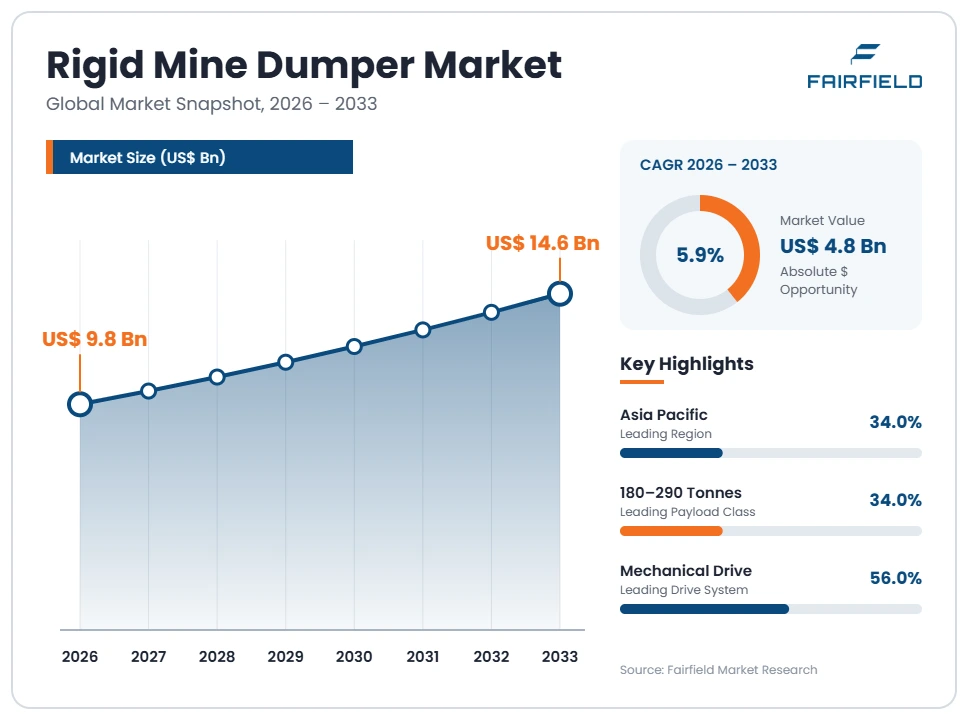
The global rigid mine dumper market size is expected to be valued at US$ 9.8 billion in 2026 and projected to reach US$ 14.6 billion by 2033, growing at a CAGR of 5.9% between 2026 and 2033.
The figure covers new rigid-frame off-highway haul trucks sold to surface mines and large quarries. Between 2020 and 2025 the market grew at a CAGR of about 4.3%, with order volumes swinging sharply between years as commodity prices moved. Three factors support the forecast: copper and battery metal mine development, fleet renewal where rebuilds have reached their limit, and higher content value per truck from autonomy and electric drive systems. Demand stays lumpy because a single large fleet order can move annual volumes, and because mine operators defer purchases quickly when commodity prices weaken. Growth is therefore uneven year to year around a rising long-term trend.
Key Report Takeaways
- By Payload Class: Trucks of 180–290 tonnes held 34% share in 2026, while ultra-class machines above 290 tonnes are projected to expand at a 7.3% CAGR through 2033, as large copper and iron ore pits chase lower cost per tonne hauled.
- By Drive System: Mechanical drive held 56% share in 2026, while diesel-electric drive is projected to grow at a 6.9% CAGR through 2033, since electric drive is the practical base for trolley-assist and regenerative retarding on long ramps.
- By Propulsion and Energy Source: Conventional diesel held 91% share in 2026, while trolley-assist is projected to advance at a 12.6% CAGR through 2033, because overhead power on fixed ramps cuts fuel burn without sacrificing payload.
- By Autonomy Level: Manned operation held 78% share in 2026, while fully autonomous haulage is projected to rise at a 13.8% CAGR through 2033, as operators extend proven systems from flagship pits to second-tier sites.
- By Geography: Asia Pacific held 34% share in 2026, while Latin America is projected to record a 7.4% CAGR through 2033, driven by copper mine development and fleet replacement in Chile and Peru.
Global Rigid Mine Dumper Market Trends and Insights
Drivers Impact Analysis
Both drivers reduce to the same calculation that governs every open pit: cost per tonne hauled.
| Driver | Impact on CAGR Forecast | Geographic Relevance | Impact Timeline |
| Cost per tonne hauled favours larger, higher-availability trucks | High | Global | Long term (≥4 years) |
| Measurable payback from removing operators and shift changes from the haul cycle | High | Asia Pacific, Latin America, North America | Medium term (2–4 years) |
Haulage Cost Per Tonne Decides Every Rigid Haul Truck Purchase
Haulage is the largest single operating cost in an open pit, which makes every truck purchase a cost-per-tonne calculation rather than a capital preference. Fleet decisions turn on fuel burn per tonne-kilometre, tyre cost, mechanical availability and operator labour per tonne moved. A machine that hauls more per unit of cost wins the order even at a far higher purchase price.
The mechanism is arithmetic applied over a long asset life. Moving to a larger payload class spreads fixed costs per cycle across more tonnes, and fewer trucks reduce the number of operators, tyres and service bays required. Mine plans with deeper pits and longer hauls strengthen that logic further. Machine design standards such as ISO 3450 braking and ISO 5006 visibility set the safety baseline that larger machines must still meet.
Removing the Operator Pays Back Faster in Mining Than in Other Heavy Sectors
Autonomous haulage has been adopted faster in mining than in almost any other industry because the payback is measurable on the same cost-per-tonne basis. An autonomous truck keeps working through shift changes and breaks, accelerates and brakes consistently, follows the optimal line and holds speed on ramp, which raises utilisation and cuts tyre and drivetrain wear. Operators report productivity gains they can audit directly against the mine plan and the haulage budget.
The mechanism is removing variability rather than removing wages alone. Human performance differs between operators and across shifts, and that spread shows up directly in cycle times and fuel burn. Fenced private sites with repetitive routes and no public traffic suit the technology. ISO 17757 on autonomous and semi-autonomous machine system safety provides the governing framework that operators and regulators use to assess these deployments.
Restraints Impact Analysis
Both restraints suppress new unit volumes rather than the value of the installed fleet.
| Restraint | Impact on CAGR Forecast | Geographic Relevance | Impact Timeline |
| Commodity price cycles govern mine capital spending and make orders lumpy | High | Global | Short term (≤2 years) |
| Long machine life, rebuild culture and constrained ultra-class tyre supply | Medium | Global | Long term (≥4 years) |
Commodity Price Cycles Make Haul Truck Orders Extremely Lumpy
Mine capital spending follows the commodity cycle, so haul truck orders arrive in bursts and then stop. When prices fall, operators defer fleet replacement first because an existing truck can usually be kept running for another season, and because deferral protects cash without reducing output immediately. Manufacturers see order books swing far more sharply than mine production does.
The cause is how mining capital is approved. Fleet purchases compete with development capital inside budgets set against price assumptions, and board approval for a large fleet order often requires a multi-year price view that is unavailable during a downturn. Lead times then amplify the swing, since machines ordered at the top of a cycle arrive after it has turned. Financing conditions and country risk add further timing uncertainty to large orders.
Long Machine Life, Rebuild Culture and Tyre Supply Limit New Deliveries
These machines are rebuilt rather than replaced, which suppresses new unit demand throughout the forecast period. A rigid haul truck frame can support two or more major rebuilds, with engine, drivetrain and body replaced at intervals set by hours rather than years. A rebuilt truck costs a fraction of a new one and keeps the existing training, spares holdings and service routines at the mine unchanged.
Supply constraints work in the same direction. Ultra-class tyres have repeatedly been scarce, since few plants worldwide produce the largest sizes and capacity additions take years. Operators facing tyre allocation limits hold fleet size steady rather than expand it, whatever the mine plan calls for. Autonomy carries its own barrier: the capital and integration cost suits large, long-life pits with stable mine plans, and cannot be justified at smaller operations.
Market Opportunities
Two revenue pools sit alongside new machine sales and are less exposed to the order cycle.
Retrofit of Existing Fleets Opens a Large Installed-Base Revenue Pool
Converting trucks already in service to autonomous or semi-autonomous operation is a revenue pool that does not require a new machine purchase. The installed base of relatively young, electronically controlled trucks is far larger than annual new deliveries, and retrofit lets an operator extend autonomy across a mixed fleet without waiting for the replacement cycle to turn the whole fleet over.
Original equipment manufacturers, their dealer networks and independent fleet technology suppliers can capture this work, with mid-tier producers forming the customer group, since the largest miners have already converted flagship sites. Demand is created by the need to standardise haulage practice across several pits at once, and by pressure to match the productivity of neighbouring operations. Safety assessment under ISO 17757 and site-level approval by national mine safety authorities shape how these conversions are specified and commissioned.
Trolley-Assist and Electric Drive Open a Pit Electrification Revenue Pool
Trolley-assist is the pragmatic interim step toward lower-emission haulage, and it opens a revenue pool covering electric-drive trucks, pantograph systems, overhead line on fixed ramps and the substations behind them. Fuel burn on a loaded climb is where most diesel is consumed, so electrifying only the ramp captures a large part of the benefit without touching the rest of the haul cycle or the truck’s payload.
Truck manufacturers, electrification suppliers and engineering contractors can capture it, with operators under emissions reporting obligations and corporate decarbonisation commitments forming the customer group. Mine site greenhouse gas reporting requirements make diesel consumption visible and comparable year to year. Battery and hydrogen haulage remain at trial stage, since battery mass displaces payload and charging a moving pit is awkward, which keeps trolley-assist the only widely deployable option today.
Segment Analysis
- By Payload Class: Mid-Large Trucks Lead While Ultra-Class Machines Expand Fastest
Trucks in the 180–290 tonne class held 34% share in 2026, the largest group, because this class matches the shovel sizes used across most large copper, iron ore and coal operations. Loading efficiency governs the choice: a truck should be filled in three to five passes, so payload is selected against the shovel bucket already on site.
Ultra-class machines above 290 tonnes are the fastest-growing class at a 7.3% CAGR through 2033, as very large pits pursue lower cost per tonne by moving the same material with fewer trucks, operators and service events.
Classes between 40 and 180 tonnes serve smaller pits, large quarries and selective mining where fleet flexibility matters more than scale. The implication is that payload class follows mine plan and shovel selection rather than operator preference, so demand moves with the type of deposits entering development.
- By Drive System: Mechanical Drive Holds Share While Electric Drive Gains Ground
Mechanical drive held 56% share in 2026, supported by proven reliability, familiar maintenance practice and strong performance on flat or rolling hauls. Many operators keep mechanical fleets because their technicians, spares holdings and rebuild procedures are built around them, and changing drive type carries retraining cost across the whole site.
Diesel-electric drive is the faster-growing system at a 6.9% CAGR through 2033, since alternating current drive delivers high torque at low speed, provides powerful electrical retarding on descent and offers fewer mechanical wear parts in the driveline.
The decisive factor is that electric drive is the practical starting point for trolley-assist and for any later battery or hybrid configuration, which makes it a strategic choice as much as a technical one. The implication is that drive system selection now carries a decarbonisation option value it did not previously have.
- By Propulsion and Energy Source: Diesel Dominates While Trolley-Assist Grows Quickest
Conventional diesel held 91% share in 2026 and will remain dominant throughout the forecast period, because diesel delivers the energy density needed to move a loaded truck out of a deep pit and refuelling infrastructure already exists at every mine site.
Trolley-assist is the fastest-growing energy source at a 12.6% CAGR through 2033. Overhead line on fixed ramps powers the truck electrically on the loaded climb, cutting fuel burn and engine hours at the point of highest consumption, without the payload penalty that battery mass imposes.
Hybrid and battery-electric trucks hold a small share and remain at trial stage rather than in scale deployment. Charging arrangements in a pit that changes shape each year are unresolved. The implication is that decarbonising haulage is genuinely difficult, and no credible transition date can be set from current evidence.
- By Autonomy Level: Manned Fleets Still Lead While Full Autonomy Advances Rapidly
Manned operation held 78% share in 2026, since most pits worldwide are too small, too short-lived or too irregular in layout to justify the capital and integration cost of an autonomous system. Conversion also requires changes to traffic management, communications coverage and site procedures that take time to embed.
Fully autonomous haulage is the fastest-growing level at a 13.8% CAGR through 2033, and mining has adopted it faster than most heavy industries because the payback is directly measurable in tonnes moved per dollar spent.
Semi-autonomous functions such as assisted steering, collision avoidance and automated spotting hold the middle ground and often serve as a first step. Fleet management and payload optimisation software underpins all three levels. The implication is that autonomy now influences truck selection, since compatibility with an existing system can outweigh machine specification.
Geography Analysis
- North America Runs Large Long-Life Pits That Suit Ultra-Class Fleets
North America held 19% share in 2026, supported by oil sands operations, large copper and gold mines and extensive coal mining. Canada contributes the heaviest concentration of ultra-class trucks anywhere, since oil sands mines run continuous, high-volume haulage over long distances where the largest machines earn their cost.
The United States adds copper, gold, aggregates and coal demand, with fleets typically rebuilt on long cycles rather than replaced early. Safety regulation is a visible cost factor: the Mine Safety and Health Administration sets dust, braking, visibility and traffic management requirements that affect cab specification and site rules. Growth comes from replacement and autonomy retrofit more than from new mine development. The main barrier is permitting timelines, which delay the new pits that would otherwise generate fleet orders.
- Europe Holds a Small Fleet Base Concentrated in Nordic and Central Operations
Europe held 9% share in 2026, the smallest regional position, because few large open pit mines operate within the region and most extraction is underground or in quarrying that uses smaller machines. Sweden, Finland, Poland and Serbia account for much of the installed rigid truck base.
Regulation shapes specification more than volume. Non-road mobile machinery emission stages govern engine certification for machines sold into the region, with the very largest engines falling into power categories subject to looser limits than smaller units. Machinery safety and terminology standards including ISO 6165 apply to equipment definitions and documentation. The opportunity is electrification trials, since relatively low power prices and strong emissions reporting pressure make trolley-assist and electric drive easier to justify here than elsewhere.
- Which Region Is Leading the Rigid Mine Dumper Market?
Asia Pacific leads with 34% share in 2026, because China, Australia, Indonesia and India together operate the largest concentration of surface mining capacity in the world. China combines vast domestic coal and metal output with a local manufacturing base that supplies trucks across several payload classes at competitive cost.
Australia drives the premium end of the regional market through iron ore and coal operations that pioneered large-scale autonomous haulage and continue to expand it. Indonesia sustains high volumes in coal and nickel, while India expands coal and iron ore output with growing mechanisation. Fleet renewal, autonomy rollout and emissions reporting obligations shape purchasing. The change worth watching is nickel and battery metal development, which adds new pits and new haulage demand across the region.
- Which Region Is Growing Fastest in the Rigid Mine Dumper Market?
Latin America is the fastest-growing region at a 7.4% CAGR through 2033, from 22% share in 2026, because copper development dominates the regional pipeline. Chile and Peru account for most of this activity, with Brazil adding iron ore and bauxite demand and Mexico contributing copper, silver and gold operations.
Falling ore grades push operators to move more material for the same metal output, which raises haulage intensity per tonne of product and supports larger fleets. Deepening pits favour ultra-class trucks and electric drive with strong retarding. The barriers are water and community permitting, altitude derating of engines in high Andean mines, and exposure to copper price swings. The opportunity is autonomy retrofit, which several large regional operations are extending beyond initial sites.
- Middle East & Africa Combines Deep Pits With Long Rebuild Cycles
Middle East & Africa held 16% share in 2026, with South Africa the largest single contributor through platinum group metals, coal, iron ore and chrome operations. Guinea adds substantial bauxite haulage, while copper and cobalt mining in central Africa and phosphate and gold operations elsewhere complete the picture.
Deep pits and long haul profiles favour large payload classes with strong retarding capability. The barriers are power supply reliability, which complicates electrification, extended parts lead times that lengthen downtime, and skills availability for maintaining advanced drive and autonomy systems. Operators respond by rebuilding machines well beyond typical replacement points. The opportunity is component exchange and rebuild services, where manufacturers can capture revenue from an ageing fleet that will not be replaced quickly.
Competitive Landscape
The market is highly concentrated. A small group of global manufacturers accounts for most ultra-class and large-class deliveries, and the barriers to entry are severe: proven frame and drivetrain designs validated over tens of thousands of operating hours, a global parts and service network close to remote mine sites, and the balance sheet to support rebuild programmes across decades. A second tier of regional manufacturers competes mainly in smaller payload classes and in domestic markets where price and local service matter more than fleet standardisation.
Competition is decided on cost per tonne hauled, machine availability and the quality of dealer support, not on purchase price alone. Buyers scrutinise fuel burn, tyre life, payload accuracy, rebuild intervals and parts availability at remote locations. Autonomy compatibility has become a differentiator, since a site committed to one fleet management system faces real cost in introducing trucks that do not integrate with it. New competitive pressure comes from regional manufacturers moving up the payload range, and from technology suppliers offering autonomy and fleet optimisation independently of the machine maker.
Strategic activity concentrates on electric drive portfolios, trolley-assist capability, autonomy platforms extended across mixed fleets, and expansion of rebuild and component exchange capacity near major mining districts. Rebuild capacity matters competitively because it captures revenue during downturns when new machine orders stop. Partnerships between equipment makers and mining operators on electrification trials are the main route by which new propulsion options are tested.
Vendor strategy is moving toward selling haulage capability rather than machines, bundling trucks with autonomy, payload optimisation software and long-term service agreements that stabilise revenue across the commodity cycle.
Recent Industry Developments
- April 2024: The Mine Safety and Health Administration issued a final rule lowering the permissible exposure limit for respirable crystalline silica at mines – tightening dust control and cab filtration expectations for haulage fleets operating in the United States.
- May 2024: The European Union’s Critical Raw Materials Act entered into force, setting benchmarks for domestic extraction, processing and recycling of strategic minerals – supporting the surface mine development that generates haul fleet demand.
- January 2025: Australia’s mandatory climate-related financial disclosure regime began applying to the largest reporting entities, requiring reported scope 1 emissions – which for surface miners are dominated by diesel burned in haulage.
Companies Covered in the Report
- Caterpillar Inc.
- Komatsu Ltd.
- Hitachi Construction Machinery Co., Ltd.
- Liebherr Group
- BelAZ
- SANY Group
- XCMG Group
- Inner Mongolia North Hauler Joint Stock Co., Ltd.
- Tonly Heavy Industries
- Wabtec Corporation
- ABB Ltd
- Hexagon AB
Rigid Mine Dumper Market Report Scope
| Metric | Value |
| Study Period | 2020–2033 |
| Market Size 2026 | US$ 9.8 Billion |
| Market Size 2033 | US$ 14.6 Billion |
| CAGR 2026–2033 | 5.9% |
| Absolute Dollar Opportunity | US$ 4.8 Billion |
| Largest Market | Asia Pacific (34% share in 2026) |
| Fastest-Growing Market | Latin America (7.4% CAGR) |
| Market Concentration | High |
| Major Players | Caterpillar Inc., Komatsu Ltd., Liebherr Group, Hitachi Construction Machinery Co., Ltd., BelAZ |
Rigid Mine Dumper Market Segmentation
Payload Class
- 40–100 Tonnes
- 100–180 Tonnes
- 180–290 Tonnes
- Above 290 Tonnes (Ultra-Class)
Drive System
- Mechanical Drive
- Diesel-Electric Drive
Propulsion and Energy Source
- Conventional Diesel
- Trolley-Assist
- Hybrid and Battery-Electric
Autonomy Level
- Manned
- Semi-Autonomous
- Fully Autonomous
Regions
- North America
- Europe
- Asia Pacific
- Latin America
- Middle East & Africa
- Executive Summary
- Global Rigid Mine Dumper Market Snapshot
- Future Projections, 2026-2033
- Key Market Trends
- Regional Snapshot
- Market Overview
- Market Definition and Report Scope
- Historical Market Trends, 2020-2025
- Market Dynamics
- Drivers Impact Analysis
- Haulage Cost Per Tonne Decides Every Rigid Haul Truck Purchase
- Removing the Operator Pays Back Faster in Mining Than in Other Heavy Sectors
- Restraints Impact Analysis
- Commodity Price Cycles Make Haul Truck Orders Extremely Lumpy
- Long Machine Life, Rebuild Culture and Tyre Supply Limit New Deliveries
- Market Opportunities
- Retrofit of Existing Fleets Opens a Large Installed-Base Revenue Pool
- Trolley-Assist and Electric Drive Open a Pit Electrification Revenue Pool
- Drivers Impact Analysis
- Global Rigid Mine Dumper Market Outlook, 2020-2033
- Global Rigid Mine Dumper Market Outlook, by Payload Class, Value (US$ Billion), 2020-2033
- 40–100 Tonnes
- 100–180 Tonnes
- 180–290 Tonnes
- Above 290 Tonnes (Ultra-Class)
- Global Rigid Mine Dumper Market Outlook, by Drive System, Value (US$ Billion), 2020-2033
- Mechanical Drive
- Diesel-Electric Drive
- Global Rigid Mine Dumper Market Outlook, by Propulsion and Energy Source, Value (US$ Billion), 2020-2033
- Conventional Diesel
- Trolley-Assist
- Hybrid and Battery-Electric
- Global Rigid Mine Dumper Market Outlook, by Autonomy Level, Value (US$ Billion), 2020-2033
- Manned
- Semi-Autonomous
- Fully Autonomous
- Global Rigid Mine Dumper Market Outlook, by Region, Value (US$ Billion), 2020-2033
- North America
- Europe
- Asia Pacific
- Latin America
- Middle East & Africa
- Global Rigid Mine Dumper Market Outlook, by Payload Class, Value (US$ Billion), 2020-2033
- North America Rigid Mine Dumper Market Outlook, 2020-2033
- North America Rigid Mine Dumper Market Outlook, by Payload Class, Value (US$ Billion), 2020-2033
- 40–100 Tonnes
- 100–180 Tonnes
- 180–290 Tonnes
- Above 290 Tonnes (Ultra-Class)
- North America Rigid Mine Dumper Market Outlook, by Drive System, Value (US$ Billion), 2020-2033
- Mechanical Drive
- Diesel-Electric Drive
- North America Rigid Mine Dumper Market Outlook, by Propulsion and Energy Source, Value (US$ Billion), 2020-2033
- Conventional Diesel
- Trolley-Assist
- Hybrid and Battery-Electric
- North America Rigid Mine Dumper Market Outlook, by Autonomy Level, Value (US$ Billion), 2020-2033
- Manned
- Semi-Autonomous
- Fully Autonomous
- North America Rigid Mine Dumper Market Outlook, by Country, Value (US$ Billion), 2020-2033
- Canada Rigid Mine Dumper Market Outlook, by Payload Class, 2020-2033
- Canada Rigid Mine Dumper Market Outlook, by Drive System, 2020-2033
- Canada Rigid Mine Dumper Market Outlook, by Propulsion and Energy Source, 2020-2033
- Canada Rigid Mine Dumper Market Outlook, by Autonomy Level, 2020-2033
- United States Rigid Mine Dumper Market Outlook, by Payload Class, 2020-2033
- United States Rigid Mine Dumper Market Outlook, by Drive System, 2020-2033
- United States Rigid Mine Dumper Market Outlook, by Propulsion and Energy Source, 2020-2033
- United States Rigid Mine Dumper Market Outlook, by Autonomy Level, 2020-2033
- North America Rigid Mine Dumper Market Outlook, by Payload Class, Value (US$ Billion), 2020-2033
- Europe Rigid Mine Dumper Market Outlook, 2020-2033
- Europe Rigid Mine Dumper Market Outlook, by Payload Class, Value (US$ Billion), 2020-2033
- 40–100 Tonnes
- 100–180 Tonnes
- 180–290 Tonnes
- Above 290 Tonnes (Ultra-Class)
- Europe Rigid Mine Dumper Market Outlook, by Drive System, Value (US$ Billion), 2020-2033
- Mechanical Drive
- Diesel-Electric Drive
- Europe Rigid Mine Dumper Market Outlook, by Propulsion and Energy Source, Value (US$ Billion), 2020-2033
- Conventional Diesel
- Trolley-Assist
- Hybrid and Battery-Electric
- Europe Rigid Mine Dumper Market Outlook, by Autonomy Level, Value (US$ Billion), 2020-2033
- Manned
- Semi-Autonomous
- Fully Autonomous
- Europe Rigid Mine Dumper Market Outlook, by Country, Value (US$ Billion), 2020-2033
- Sweden Rigid Mine Dumper Market Outlook, by Payload Class, 2020-2033
- Sweden Rigid Mine Dumper Market Outlook, by Drive System, 2020-2033
- Sweden Rigid Mine Dumper Market Outlook, by Propulsion and Energy Source, 2020-2033
- Sweden Rigid Mine Dumper Market Outlook, by Autonomy Level, 2020-2033
- Finland Rigid Mine Dumper Market Outlook, by Payload Class, 2020-2033
- Finland Rigid Mine Dumper Market Outlook, by Drive System, 2020-2033
- Finland Rigid Mine Dumper Market Outlook, by Propulsion and Energy Source, 2020-2033
- Finland Rigid Mine Dumper Market Outlook, by Autonomy Level, 2020-2033
- Poland Rigid Mine Dumper Market Outlook, by Payload Class, 2020-2033
- Poland Rigid Mine Dumper Market Outlook, by Drive System, 2020-2033
- Poland Rigid Mine Dumper Market Outlook, by Propulsion and Energy Source, 2020-2033
- Poland Rigid Mine Dumper Market Outlook, by Autonomy Level, 2020-2033
- Serbia Rigid Mine Dumper Market Outlook, by Payload Class, 2020-2033
- Serbia Rigid Mine Dumper Market Outlook, by Drive System, 2020-2033
- Serbia Rigid Mine Dumper Market Outlook, by Propulsion and Energy Source, 2020-2033
- Serbia Rigid Mine Dumper Market Outlook, by Autonomy Level, 2020-2033
- Europe Rigid Mine Dumper Market Outlook, by Payload Class, Value (US$ Billion), 2020-2033
- Asia Pacific Rigid Mine Dumper Market Outlook, 2020-2033
- Asia Pacific Rigid Mine Dumper Market Outlook, by Payload Class, Value (US$ Billion), 2020-2033
- 40–100 Tonnes
- 100–180 Tonnes
- 180–290 Tonnes
- Above 290 Tonnes (Ultra-Class)
- Asia Pacific Rigid Mine Dumper Market Outlook, by Drive System, Value (US$ Billion), 2020-2033
- Mechanical Drive
- Diesel-Electric Drive
- Asia Pacific Rigid Mine Dumper Market Outlook, by Propulsion and Energy Source, Value (US$ Billion), 2020-2033
- Conventional Diesel
- Trolley-Assist
- Hybrid and Battery-Electric
- Asia Pacific Rigid Mine Dumper Market Outlook, by Autonomy Level, Value (US$ Billion), 2020-2033
- Manned
- Semi-Autonomous
- Fully Autonomous
- Asia Pacific Rigid Mine Dumper Market Outlook, by Country, Value (US$ Billion), 2020-2033
- China Rigid Mine Dumper Market Outlook, by Payload Class, 2020-2033
- China Rigid Mine Dumper Market Outlook, by Drive System, 2020-2033
- China Rigid Mine Dumper Market Outlook, by Propulsion and Energy Source, 2020-2033
- China Rigid Mine Dumper Market Outlook, by Autonomy Level, 2020-2033
- Australia Rigid Mine Dumper Market Outlook, by Payload Class, 2020-2033
- Australia Rigid Mine Dumper Market Outlook, by Drive System, 2020-2033
- Australia Rigid Mine Dumper Market Outlook, by Propulsion and Energy Source, 2020-2033
- Australia Rigid Mine Dumper Market Outlook, by Autonomy Level, 2020-2033
- Indonesia Rigid Mine Dumper Market Outlook, by Payload Class, 2020-2033
- Indonesia Rigid Mine Dumper Market Outlook, by Drive System, 2020-2033
- Indonesia Rigid Mine Dumper Market Outlook, by Propulsion and Energy Source, 2020-2033
- Indonesia Rigid Mine Dumper Market Outlook, by Autonomy Level, 2020-2033
- India Rigid Mine Dumper Market Outlook, by Payload Class, 2020-2033
- India Rigid Mine Dumper Market Outlook, by Drive System, 2020-2033
- India Rigid Mine Dumper Market Outlook, by Propulsion and Energy Source, 2020-2033
- India Rigid Mine Dumper Market Outlook, by Autonomy Level, 2020-2033
- Asia Pacific Rigid Mine Dumper Market Outlook, by Payload Class, Value (US$ Billion), 2020-2033
- Latin America Rigid Mine Dumper Market Outlook, 2020-2033
- Latin America Rigid Mine Dumper Market Outlook, by Payload Class, Value (US$ Billion), 2020-2033
- 40–100 Tonnes
- 100–180 Tonnes
- 180–290 Tonnes
- Above 290 Tonnes (Ultra-Class)
- Latin America Rigid Mine Dumper Market Outlook, by Drive System, Value (US$ Billion), 2020-2033
- Mechanical Drive
- Diesel-Electric Drive
- Latin America Rigid Mine Dumper Market Outlook, by Propulsion and Energy Source, Value (US$ Billion), 2020-2033
- Conventional Diesel
- Trolley-Assist
- Hybrid and Battery-Electric
- Latin America Rigid Mine Dumper Market Outlook, by Autonomy Level, Value (US$ Billion), 2020-2033
- Manned
- Semi-Autonomous
- Fully Autonomous
- Latin America Rigid Mine Dumper Market Outlook, by Country, Value (US$ Billion), 2020-2033
- Chile Rigid Mine Dumper Market Outlook, by Payload Class, 2020-2033
- Chile Rigid Mine Dumper Market Outlook, by Drive System, 2020-2033
- Chile Rigid Mine Dumper Market Outlook, by Propulsion and Energy Source, 2020-2033
- Chile Rigid Mine Dumper Market Outlook, by Autonomy Level, 2020-2033
- Peru Rigid Mine Dumper Market Outlook, by Payload Class, 2020-2033
- Peru Rigid Mine Dumper Market Outlook, by Drive System, 2020-2033
- Peru Rigid Mine Dumper Market Outlook, by Propulsion and Energy Source, 2020-2033
- Peru Rigid Mine Dumper Market Outlook, by Autonomy Level, 2020-2033
- Brazil Rigid Mine Dumper Market Outlook, by Payload Class, 2020-2033
- Brazil Rigid Mine Dumper Market Outlook, by Drive System, 2020-2033
- Brazil Rigid Mine Dumper Market Outlook, by Propulsion and Energy Source, 2020-2033
- Brazil Rigid Mine Dumper Market Outlook, by Autonomy Level, 2020-2033
- Mexico Rigid Mine Dumper Market Outlook, by Payload Class, 2020-2033
- Mexico Rigid Mine Dumper Market Outlook, by Drive System, 2020-2033
- Mexico Rigid Mine Dumper Market Outlook, by Propulsion and Energy Source, 2020-2033
- Mexico Rigid Mine Dumper Market Outlook, by Autonomy Level, 2020-2033
- Latin America Rigid Mine Dumper Market Outlook, by Payload Class, Value (US$ Billion), 2020-2033
- Middle East & Africa Rigid Mine Dumper Market Outlook, 2020-2033
- Middle East & Africa Rigid Mine Dumper Market Outlook, by Payload Class, Value (US$ Billion), 2020-2033
- 40–100 Tonnes
- 100–180 Tonnes
- 180–290 Tonnes
- Above 290 Tonnes (Ultra-Class)
- Middle East & Africa Rigid Mine Dumper Market Outlook, by Drive System, Value (US$ Billion), 2020-2033
- Mechanical Drive
- Diesel-Electric Drive
- Middle East & Africa Rigid Mine Dumper Market Outlook, by Propulsion and Energy Source, Value (US$ Billion), 2020-2033
- Conventional Diesel
- Trolley-Assist
- Hybrid and Battery-Electric
- Middle East & Africa Rigid Mine Dumper Market Outlook, by Autonomy Level, Value (US$ Billion), 2020-2033
- Manned
- Semi-Autonomous
- Fully Autonomous
- Middle East & Africa Rigid Mine Dumper Market Outlook, by Country, Value (US$ Billion), 2020-2033
- South Africa Rigid Mine Dumper Market Outlook, by Payload Class, 2020-2033
- South Africa Rigid Mine Dumper Market Outlook, by Drive System, 2020-2033
- South Africa Rigid Mine Dumper Market Outlook, by Propulsion and Energy Source, 2020-2033
- South Africa Rigid Mine Dumper Market Outlook, by Autonomy Level, 2020-2033
- Guinea Rigid Mine Dumper Market Outlook, by Payload Class, 2020-2033
- Guinea Rigid Mine Dumper Market Outlook, by Drive System, 2020-2033
- Guinea Rigid Mine Dumper Market Outlook, by Propulsion and Energy Source, 2020-2033
- Guinea Rigid Mine Dumper Market Outlook, by Autonomy Level, 2020-2033
- Middle East & Africa Rigid Mine Dumper Market Outlook, by Payload Class, Value (US$ Billion), 2020-2033
- Competitive Landscape
- Market Concentration and Industry Leaders
- Competitive Differentiation
- Strategic Initiatives
- Recent Industry Developments
- Company Profiles
- Caterpillar Inc.
- Komatsu Ltd.
- Hitachi Construction Machinery Co., Ltd.
- Liebherr Group
- BelAZ
- SANY Group
- XCMG Group
- Inner Mongolia North Hauler Joint Stock Co., Ltd.
- Tonly Heavy Industries
- Wabtec Corporation
- ABB Ltd
- Hexagon AB
- Appendix
- Research Methodology
- Report Assumptions
- Acronyms and Abbreviations
Payload Class
- 40–100 Tonnes
- 100–180 Tonnes
- 180–290 Tonnes
- Above 290 Tonnes (Ultra-Class)
Drive System
- Mechanical Drive
- Diesel-Electric Drive
Propulsion and Energy Source
- Conventional Diesel
- Trolley-Assist
- Hybrid and Battery-Electric
Autonomy Level
- Manned
- Semi-Autonomous
- Fully Autonomous
Regions
- North America
- Europe
- Asia Pacific
- Latin America
- Middle East & Africa
Our Research Methodology
Considering the volatility of business today, traditional approaches to strategizing a game plan can be unfruitful if not detrimental. True ambiguity is no way to determine a forecast. A myriad of predetermined factors must be accounted for such as the degree of risk involved, the magnitude of circumstances, as well as conditions or consequences that are not known or unpredictable. To circumvent binary views that cast uncertainty, the application of market research intelligence to strategically posture, move, and enable actionable outcomes is necessary.
View Methodology
Quality Assured
Rigorous Validation Process

Confidentiality Assured
End-to-end Data Security

Custom Research Services
Tailored To Your Objectives
FAQs
The market is valued at US$ 9.8 billion in 2026, covering new rigid-frame haul trucks delivered to surface mines and large quarries.
The market is projected to reach US$ 14.6 billion by 2033 at a 5.9% CAGR, an absolute opportunity of US$ 4.8 billion.
Trucks of 180–290 tonnes hold 34% share in 2026, because this class matches the shovel sizes used at most large operations.
Trolley-assist grows fastest among energy sources at 12.6%, while Latin America leads regional growth at a 7.4% CAGR through 2033.
Asia Pacific leads with 34% share in 2026, and supply is highly concentrated among a small group of global manufacturers.
Related Reports
Product-as-a-Service Market Size, Share, Insights, Competitive Landscape, and Forecast 2026 to 2033
The global product-as-a-service market is valued at US$96.0 billion in 2026, reaching US$204.5 billion by 2033, growing at an 11.4% CAGR
Precision Hand Tools Market Size, Share, Insights, Competitive Landscape, and Forecast 2026 to 2033
The global precision hand tools market is valued at US$9.8 billion in 2026, reaching US$14.2 billion by 2033, growing at a 5.4% CAGR
Weather RADAR Market Size, Share, Insights, Competitive Landscape, and Forecast 2026 to 2033
The Weather RADAR Market is projected to rise from US$ 297.2 million in 2026 to US$ 401.8 million by 2033 at a 4.4% CAGR. Explore key segments.
Scroll and Absorption Chillers Market Size, Share, Insights, Competitive Landscape, and Forecast 2026 to 2033
Scroll and Absorption Chillers Market grows from US$ 14.27 billion in 2026 to US$ 19.31 billion by 2033 at a 4.4% CAGR. Explore key segments and trends.
Laser Technologies in Manufacturing Market Size, Share, Insights, Competitive Landscape, and Forecast 2026 to 2033
Explore the laser technologies in manufacturing market, valued at US$ 23.6 billion in 2026 and forecast to reach US$ 38.4 billion by 2033 at 7.2% CAGR.
High Torque Stepper Motor Market Size, Share, Insights, Competitive Landscape, and Forecast 2026 to 2033
Explore the high torque stepper motor market, projected to reach US$ 3.6 billion by 2033 at a 6.6% CAGR, with product and regional insights.