



Scroll and Absorption Chillers Market
Scroll and Absorption Chillers Market Size, Share, Insights, Competitive Landscape, and Forecast 2026 to 2033
How Fast Is the Scroll and Absorption Chillers Market Growing?
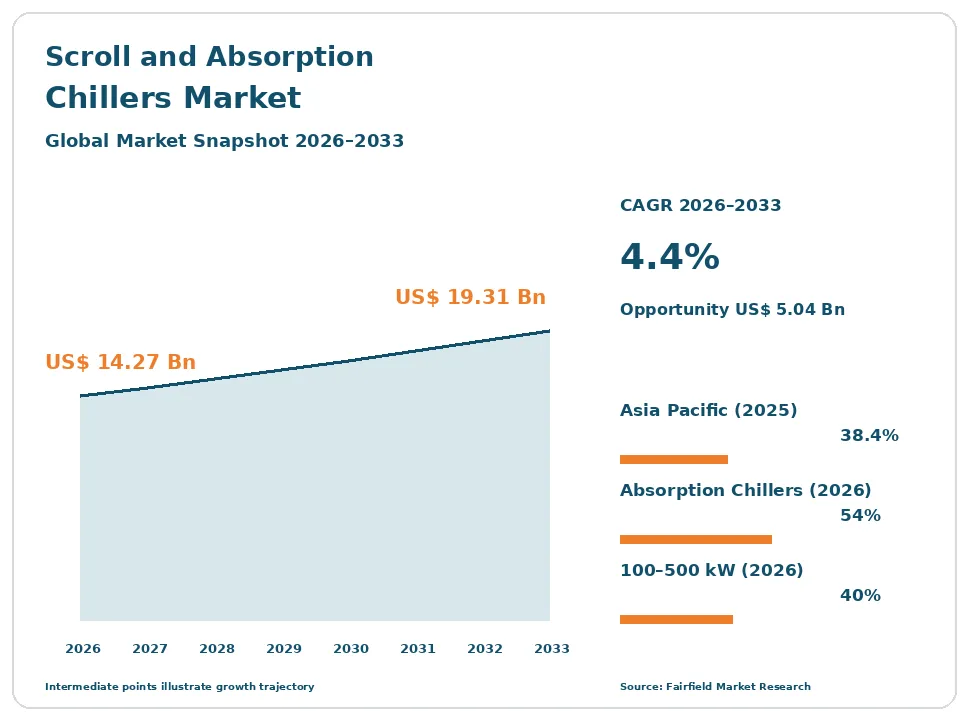
The global scroll and absorption chillers market size is expected to be valued at US$ 14.27 billion in 2026 and projected to reach US$ 19.31 billion by 2033, growing at a CAGR of 4.4% between 2026 and 2033.
Between 2020 and 2025, the market grew at a CAGR of about 3.8%, slowing when building projects paused during the pandemic, then recovering with new offices, hospitals, data centers, factories, and district cooling networks. Chillers remove heat from water or another fluid that then cools buildings and industrial processes. Scroll chillers use compact scroll compressors driven by electricity and are popular for small and medium buildings because they are quiet, modular, and efficient at part load. Absorption chillers use heat, such as waste heat, steam, hot water, or natural gas, instead of a compressor, which makes them attractive where heat is cheap or electricity is expensive. Growth comes from rising cooling demand in hot climates, data centers, energy efficiency rules, and waste heat recovery. The market is shifting toward low-global-warming refrigerants, heat pumps, and smart controls. In June 2025, Trane introduced scroll chillers using natural refrigerant R-290.
Key Report Takeaways
- By Chiller Type: Absorption Chillers held 54.0% share in 2026 and are projected to expand at the fastest 4.9% CAGR through 2033, driven by waste heat recovery, combined heat and power plants, and district cooling in hot climates with high electricity costs.
- By Cooling Capacity: 100-500 kW held 40.0% share in 2026, while Above 500 kW is projected to expand at a 4.9% CAGR through 2033, driven by large commercial complexes, hospitals, campuses, and industrial process cooling.
- By Application: Commercial Buildings held 35.0% share in 2026, while Data Centers are projected to expand at a 6.8% CAGR through 2033, driven by AI and cloud computing growth that requires reliable, efficient cooling.
- By Region: Asia Pacific held 38.4% share in 2025, while Middle East & Africa is projected to expand at a 5.3% CAGR through 2033, driven by district cooling, giga-projects, and extreme heat in Saudi Arabia, the United Arab Emirates, and Qatar.
Global Scroll and Absorption Chillers Market Trends and Insights
Drivers Impact Analysis
Two drivers carry the strongest influence on scroll and absorption chillers demand during the forecast period.
Rising Cooling Demand Is Driving the Scroll and Absorption Chillers Market
Rising cooling demand from buildings and data centers is the strongest driver of the scroll and absorption chillers market. The world needs much more cooling.
The mechanism is urban growth, hotter weather, and digital infrastructure. Cities in Asia Pacific, Middle East & Africa, and Latin America are adding offices, malls, hotels, hospitals, airports, and apartments, all of which need air conditioning. Heat waves are becoming more frequent and intense, increasing cooling loads. Data centers that support artificial intelligence and cloud services generate large amounts of heat and need reliable chilled water systems around the clock. Factories for pharmaceuticals, food, plastics, and electronics need process cooling. Scroll chillers suit small and medium buildings, while absorption chillers serve large sites with available heat. These trends create steady demand for commercial chillers across many sectors.
Energy Efficiency Rules Are Expanding the Scroll and Absorption Chillers Market
Energy efficiency rules and waste heat recovery are expanding the scroll and absorption chillers market. Buildings must use less energy.
The cause is government regulation and rising energy costs. Building codes and minimum efficiency standards in the United States, the European Union, China, and India push owners to replace old chillers with efficient models. Absorption chillers can turn waste heat from factories, power plants, and combined heat and power systems into cooling, cutting electricity use. India’s Cooling Action Plan encourages efficient cooling. Smart controls optimize chiller performance. Building owners also want lower operating costs and better ratings under green building programs such as LEED. Many chillers installed in the 2000s are reaching the end of their lives, creating a large replacement cycle. Utilities offer rebates for efficient equipment in some markets. These rules accelerate replacement demand.
| Driver | Impact on CAGR Forecast | Geographic Relevance | Impact Timeline |
| Rising cooling demand from buildings and data centers | High | Global | Long term (≥4 years) |
| Energy efficiency rules and waste heat recovery | Medium | Europe, Asia Pacific, North America | Medium term (2-4 years) |
Restraints Impact Analysis
Two restraints limit how quickly the scroll and absorption chillers market grows.
High Upfront Costs Slow the Scroll and Absorption Chillers Market
High upfront cost of absorption systems slows the scroll and absorption chillers market. Absorption chillers cost more to buy and install.
The specific causes are large equipment and complex integration. Absorption chillers are bigger and heavier than electric chillers of similar capacity and need cooling towers, heat sources, and piping, which raise installation costs. Their efficiency depends on a cheap and reliable heat supply, so they are not suitable for every site. Maintenance requires specialized skills. Payback periods can be long when electricity is cheap. In price-sensitive markets, owners often choose lower-cost electric chillers or split air conditioners. Absorption chillers also have lower efficiency than electric chillers when measured only by cooling output per unit of energy, so owners need careful analysis to see the benefits. Fewer contractors know how to design and service them. These factors limit adoption.
Refrigerant Rules Restrict the Scroll and Absorption Chillers Market
Refrigerant regulations and competition from other technologies restrict the scroll and absorption chillers market. Rules and alternatives are changing designs.
The underlying causes are climate rules and new technologies. The European Union F-Gas Regulation and the U.S. AIM Act are phasing down high-global-warming refrigerants, forcing scroll chiller makers to redesign products for new refrigerants such as R-290, R-454B, and R-32. Larger screw, centrifugal, and magnetic bearing chillers compete for bigger loads, and heat pumps can provide both heating and cooling. Some low-global-warming refrigerants are mildly flammable, which requires new safety rules, training, and equipment design. Supply of new refrigerants has at times been tight, and prices have risen. Customers may delay purchases while waiting for clear rules. These shifts add cost and uncertainty.
| Restraint | Impact on CAGR Forecast | Geographic Relevance | Impact Timeline |
| High upfront cost of absorption systems | High | Global | Long term (≥4 years) |
| Refrigerant regulations and competition from other technologies | Medium | Europe, North America | Medium term (2-4 years) |
Market Opportunities
Data Center Cooling Opens a Fast-Growth Revenue Pool
Data center cooling opens a fast-growth revenue pool in the scroll and absorption chillers market. Data centers need huge, reliable cooling around the clock.
Chiller makers can capture this opportunity. Hyperscale and colocation data centers built for artificial intelligence and cloud services consume large amounts of power and release heat that must be removed continuously, and they use chilled water systems with high redundancy. Modular scroll chillers suit edge data centers and smaller computer rooms because they can be added step by step as demand grows. Absorption chillers can use waste heat from on-site gas turbines, fuel cells, or combined heat and power plants to provide cooling, improving overall energy efficiency. Liquid cooling of servers is changing designs, but chilled water remains essential for heat rejection. Companies with efficient, reliable data center products and fast delivery can win large, repeat orders.
District Cooling and Waste Heat Create a Sustainability Revenue Pool
District cooling and waste heat recovery create a sustainability revenue pool in the scroll and absorption chillers market. Shared cooling networks save energy and space.
Absorption chiller makers and service providers can capture this opportunity. District cooling plants produce chilled water centrally and pipe it to many buildings, which is far more efficient than separate systems in each building. Such networks are widespread in Dubai, Abu Dhabi, Doha, and Riyadh, and are growing in Singapore, India, China, and Europe. Absorption chillers in these plants can use waste heat from power stations, industry, or solar thermal collectors. Factories with spare steam or hot water can cut cooling costs sharply. Governments promote heat recovery to meet climate goals. Companies with large, efficient absorption units, such as Thermax, Broad Group, and Johnson Controls, can win long-term supply and service contracts.
Segment Analysis
By Chiller Type: Absorption Chillers Lead and Grow Fastest
Absorption Chillers held 54.0% share in 2026 and are the fastest-growing type, expanding at a 4.9% CAGR through 2033. Absorption chillers use lithium bromide and water or ammonia and water to produce cooling from heat, and large units are common in district cooling, industrial plants, hospitals, campuses, and combined heat and power systems. Their high unit value and growing use of waste heat support their large revenue share. Thermax, Broad Group, Johnson Controls, and Robur are key suppliers.
Scroll chillers use electric scroll compressors and are compact, quiet, and modular, making them popular for small and medium offices, schools, retail stores, and edge data centers. Air-cooled modular scroll units can be installed on rooftops without cooling towers. New models use low-global-warming refrigerants such as R-290 and R-32. Carrier, Trane, Daikin, and Midea lead scroll chillers. For the market, absorption growth reflects energy efficiency and heat recovery goals.
By Cooling Capacity: 100-500 kW Leads While Above 500 kW Grows Fastest
100-500 kW held 40.0% share in 2026. This range covers many offices, hotels, schools, hospitals, and light industrial buildings, where modular scroll chillers and small absorption units are common. It offers a good balance between capacity, cost, and flexibility, and many buildings use two or more units for backup.
Above 500 kW is the fastest-growing capacity, expanding at a 4.9% CAGR through 2033. Large commercial complexes, airports, campuses, data centers, district cooling plants, and factories need high-capacity units, often absorption chillers or multiple modular scroll units working together. Units below 100 kW serve small buildings, shops, and homes, often as air-cooled modular scroll chillers. For the market, large-capacity growth reflects big infrastructure projects.
By Application: Commercial Buildings Lead While Data Centers Grow Fastest
Commercial Buildings held 35.0% share in 2026. Offices, malls, hotels, airports, and retail centers are the largest users of chillers, and green building certifications encourage efficient models. Replacement of older chillers in existing buildings is a steady source of demand.
Data Centers are the fastest-growing application, expanding at a 6.8% CAGR through 2033, as operators race to add capacity. Artificial intelligence and cloud computing are driving record data center construction, each needing reliable, redundant chilled water systems. Industrial, healthcare, district cooling, and residential uses form other applications, with healthcare requiring very reliable cooling for operating rooms and medical equipment, and pharmaceutical and food plants needing precise process temperatures. For the market, data center growth adds high-value demand.
Geography Analysis
North America Advances the Scroll and Absorption Chillers Market Through Data Centers
North America is a major scroll and absorption chillers market. The United States has strong demand from data centers in Virginia, Texas, Arizona, and other states, along with replacement of aging chillers in offices, hospitals, and universities. Carrier, Trane Technologies, and Johnson Controls are headquartered in the region, and federal efficiency standards and refrigerant rules under the AIM Act drive upgrades. Combined heat and power systems at campuses and hospitals use absorption chillers. Canada and Mexico add commercial and industrial demand. Key barriers include high labor costs. One change shaping the region is the data center construction boom.
Europe Shapes the Scroll and Absorption Chillers Market Through Refrigerant Rules
Europe is a major scroll and absorption chillers market. Germany, France, Italy, the United Kingdom, and Spain have strict efficiency rules and the F-Gas Regulation, which push the shift to natural and low-global-warming refrigerants. Daikin, Carrier, Trane, and specialist firms such as EAW Energieanlagenbau and Robur serve the region. Hotter summers increase cooling needs in southern parts of the region, and waste heat recovery and district energy networks are encouraged by climate policy. Key barriers include high energy costs and regulatory complexity. One opportunity is natural refrigerant scroll chillers for offices and schools.
Which Region Is Leading the Scroll and Absorption Chillers Market?
Asia Pacific is leading the scroll and absorption chillers market with a 38.4% share in 2025. China is the largest market and home to producers such as Midea, Gree, and Broad Group, which pioneered absorption chillers. India has fast-growing commercial construction, data centers, and pharmaceutical and food factories, and Thermax is a leading absorption chiller maker there. Japan and South Korea have long histories of gas-fired absorption chillers, while Singapore and Indonesia add district cooling and data center demand. Key barriers include price competition. One change shaping the region is fast data center growth in India and Japan.
Latin America Grows the Scroll and Absorption Chillers Market Through Commercial Construction
Latin America is a growing scroll and absorption chillers market. Brazil, Mexico, Chile, and Colombia are adding shopping centers, hospitals, hotels, and data centers, especially in São Paulo, Querétaro, and Santiago, which need modern chilled water systems. Food processing and beverage plants use industrial cooling. Sugar and ethanol mills in Brazil could use waste heat for absorption cooling. Hot, humid climates in many cities increase cooling hours each year. Key barriers include economic volatility, import duties, and high financing costs. One opportunity is data center construction in Mexico, Brazil, and Chile.
Which Region Is Growing Fastest in the Scroll and Absorption Chillers Market?
Middle East & Africa is growing fastest in the scroll and absorption chillers market at a 5.3% CAGR through 2033. Saudi Arabia, the United Arab Emirates, and Qatar have some of the world’s largest district cooling networks, serving giga-projects, airports, malls, and new cities, and cooling accounts for most summer electricity use. Absorption chillers can use waste heat from power and desalination plants, reducing peak electricity demand. Egypt and South Africa add commercial and industrial demand. Key barriers include water use for cooling towers in dry regions. One change shaping the region is district cooling expansion.
Competitive Landscape
The scroll and absorption chillers market is moderately consolidated. Daikin, Carrier, Trane Technologies, Johnson Controls, and Thermax are leading players, while Midea, Mitsubishi Electric, LG Electronics, Gree, Broad Group, Robur, and EAW Energieanlagenbau compete strongly. Global HVAC groups lead scroll chillers, while specialists are strong in absorption. Chinese manufacturers compete strongly on price in Asia Pacific and are expanding exports to Middle East & Africa and Latin America. Consolidation continues as large groups reshape portfolios.
Companies compete on energy efficiency, refrigerant choice, reliability, footprint, noise, digital controls, price, and service networks. Service and maintenance contracts provide recurring revenue and long-term customer relationships for the major brands. Large HVAC companies offer complete building systems, including chillers, air handlers, and controls, while absorption specialists win projects where waste heat is available.
Strategic moves show how competition is changing. In May 2024, Carrier India launched a locally made modular scroll chiller. In June 2025, Trane introduced R-290 scroll chillers. In August 2025, Johnson Controls completed the sale of its residential and light commercial HVAC business to Bosch to focus on commercial systems. These moves show competition shifting toward low-emission refrigerants, local manufacturing, and a sharper focus on commercial and industrial customers.
Three themes shape vendor strategy. First, companies are redesigning chillers for natural and low-global-warming refrigerants. Second, they are targeting data centers and district cooling. Third, they are adding smart controls and service offerings.
Scroll and Absorption Chillers Market Industry Leaders
- Daikin
- Carrier
- Trane Technologies
- Johnson Controls
- Thermax
Recent Industry Developments
- August 2025: Johnson Controls completed the sale of its residential and light commercial HVAC business to Bosch for US$ 8.1 billion - sharpens its focus on commercial chillers and building solutions.
- June 2025: Trane introduced the next generation of its ARIES N air-cooled scroll chillers using natural refrigerant R-290 in Europe, Australia, and New Zealand - supports low-emission commercial chillers.
- May 2024: Carrier India launched the locally made 30RB air-cooled modular scroll chiller for railways, metro, and other segments - expands scroll chillers in India.
Companies Covered in the Report
- Daikin
- Carrier
- Trane Technologies
- Johnson Controls
- Thermax
- Midea
- Mitsubishi Electric
- LG Electronics
- Gree
- Broad Group
- Robur
- EAW Energieanlagenbau
Scroll and Absorption Chillers Market Report Scope
This report covers scroll chillers and absorption chillers, including air-cooled and water-cooled scroll units and single-effect, double-effect, and direct-fired absorption units, in capacities below 100 kW, 100 to 500 kW, and above 500 kW, for commercial buildings, industrial facilities, data centers, healthcare, district cooling, and residential applications. The base year is 2025, and the forecast period runs from 2026 to 2033. All values are expressed in US$ Billion.
Chiller Type
- Scroll Chillers
- Absorption Chillers
Cooling Capacity
- Below 100 kW
- 100-500 kW
- Above 500 kW
Application
- Commercial Buildings
- Industrial
- Data Centers
- Healthcare
- District Cooling & Others
Regions
- North America
- Europe
- Asia Pacific
- Latin America
- Middle East & Africa
- 1. Executive Summary
- 1.1. Global Scroll and Absorption Chillers Market Snapshot
- 1.2. Future Projections, 2026-2033
- 1.3. Key Market Trends
- 1.4. Regional Snapshot
- 2. Market Overview
- 2.1. Market Definition and Report Scope
- 2.2. Historical Market Trends, 2020-2025
- 2.3. Market Dynamics
- 2.3.1. Drivers Impact Analysis
- 2.3.1.1. Rising Cooling Demand Is Driving the Scroll and Absorption Chillers Market
- 2.3.1.2. Energy Efficiency Rules Are Expanding the Scroll and Absorption Chillers Market
- 2.3.2. Restraints Impact Analysis
- 2.3.2.1. High Upfront Costs Slow the Scroll and Absorption Chillers Market
- 2.3.2.2. Refrigerant Rules Restrict the Scroll and Absorption Chillers Market
- 2.3.3. Market Opportunities
- 2.3.3.1. Data Center Cooling Opens a Fast-Growth Revenue Pool
- 2.3.3.2. District Cooling and Waste Heat Create a Sustainability Revenue Pool
- 2.3.1. Drivers Impact Analysis
- 3. Global Scroll and Absorption Chillers Market Outlook, 2020-2033
- 3.1. Global Scroll and Absorption Chillers Market Outlook, by Chiller Type, Value (US$ Billion), 2020-2033
- 3.1.1. Scroll Chillers
- 3.1.2. Absorption Chillers
- 3.2. Global Scroll and Absorption Chillers Market Outlook, by Cooling Capacity, Value (US$ Billion), 2020-2033
- 3.2.1. Below 100 kW
- 3.2.2. 100-500 kW
- 3.2.3. Above 500 kW
- 3.3. Global Scroll and Absorption Chillers Market Outlook, by Application, Value (US$ Billion), 2020-2033
- 3.3.1. Commercial Buildings
- 3.3.2. Industrial
- 3.3.3. Data Centers
- 3.3.4. Healthcare
- 3.3.5. District Cooling & Others
- 3.4. Global Scroll and Absorption Chillers Market Outlook, by Region, Value (US$ Billion), 2020-2033
- 3.4.1. North America
- 3.4.2. Europe
- 3.4.3. Asia Pacific
- 3.4.4. Latin America
- 3.4.5. Middle East & Africa
- 3.1. Global Scroll and Absorption Chillers Market Outlook, by Chiller Type, Value (US$ Billion), 2020-2033
- 4. North America Scroll and Absorption Chillers Market Outlook, 2020-2033
- 4.1. North America Scroll and Absorption Chillers Market Outlook, by Chiller Type, Value (US$ Billion), 2020-2033
- 4.1.1. Scroll Chillers
- 4.1.2. Absorption Chillers
- 4.2. North America Scroll and Absorption Chillers Market Outlook, by Cooling Capacity, Value (US$ Billion), 2020-2033
- 4.2.1. Below 100 kW
- 4.2.2. 100-500 kW
- 4.2.3. Above 500 kW
- 4.3. North America Scroll and Absorption Chillers Market Outlook, by Application, Value (US$ Billion), 2020-2033
- 4.3.1. Commercial Buildings
- 4.3.2. Industrial
- 4.3.3. Data Centers
- 4.3.4. Healthcare
- 4.3.5. District Cooling & Others
- 4.4. North America Scroll and Absorption Chillers Market Outlook, by Country, Value (US$ Billion), 2020-2033
- 4.4.1. United States Scroll and Absorption Chillers Market Outlook, by Chiller Type, 2020-2033
- 4.4.2. United States Scroll and Absorption Chillers Market Outlook, by Cooling Capacity, 2020-2033
- 4.4.3. United States Scroll and Absorption Chillers Market Outlook, by Application, 2020-2033
- 4.4.4. Canada Scroll and Absorption Chillers Market Outlook, by Chiller Type, 2020-2033
- 4.4.5. Canada Scroll and Absorption Chillers Market Outlook, by Cooling Capacity, 2020-2033
- 4.4.6. Canada Scroll and Absorption Chillers Market Outlook, by Application, 2020-2033
- 4.4.7. Mexico Scroll and Absorption Chillers Market Outlook, by Chiller Type, 2020-2033
- 4.4.8. Mexico Scroll and Absorption Chillers Market Outlook, by Cooling Capacity, 2020-2033
- 4.4.9. Mexico Scroll and Absorption Chillers Market Outlook, by Application, 2020-2033
- 4.1. North America Scroll and Absorption Chillers Market Outlook, by Chiller Type, Value (US$ Billion), 2020-2033
- 5. Europe Scroll and Absorption Chillers Market Outlook, 2020-2033
- 5.1. Europe Scroll and Absorption Chillers Market Outlook, by Chiller Type, Value (US$ Billion), 2020-2033
- 5.1.1. Scroll Chillers
- 5.1.2. Absorption Chillers
- 5.2. Europe Scroll and Absorption Chillers Market Outlook, by Cooling Capacity, Value (US$ Billion), 2020-2033
- 5.2.1. Below 100 kW
- 5.2.2. 100-500 kW
- 5.2.3. Above 500 kW
- 5.3. Europe Scroll and Absorption Chillers Market Outlook, by Application, Value (US$ Billion), 2020-2033
- 5.3.1. Commercial Buildings
- 5.3.2. Industrial
- 5.3.3. Data Centers
- 5.3.4. Healthcare
- 5.3.5. District Cooling & Others
- 5.4. Europe Scroll and Absorption Chillers Market Outlook, by Country, Value (US$ Billion), 2020-2033
- 5.4.1. Germany Scroll and Absorption Chillers Market Outlook, by Chiller Type, 2020-2033
- 5.4.2. Germany Scroll and Absorption Chillers Market Outlook, by Cooling Capacity, 2020-2033
- 5.4.3. Germany Scroll and Absorption Chillers Market Outlook, by Application, 2020-2033
- 5.4.4. France Scroll and Absorption Chillers Market Outlook, by Chiller Type, 2020-2033
- 5.4.5. France Scroll and Absorption Chillers Market Outlook, by Cooling Capacity, 2020-2033
- 5.4.6. France Scroll and Absorption Chillers Market Outlook, by Application, 2020-2033
- 5.4.7. Italy Scroll and Absorption Chillers Market Outlook, by Chiller Type, 2020-2033
- 5.4.8. Italy Scroll and Absorption Chillers Market Outlook, by Cooling Capacity, 2020-2033
- 5.4.9. Italy Scroll and Absorption Chillers Market Outlook, by Application, 2020-2033
- 5.4.10. United Kingdom Scroll and Absorption Chillers Market Outlook, by Chiller Type, 2020-2033
- 5.4.11. United Kingdom Scroll and Absorption Chillers Market Outlook, by Cooling Capacity, 2020-2033
- 5.4.12. United Kingdom Scroll and Absorption Chillers Market Outlook, by Application, 2020-2033
- 5.4.13. Spain Scroll and Absorption Chillers Market Outlook, by Chiller Type, 2020-2033
- 5.4.14. Spain Scroll and Absorption Chillers Market Outlook, by Cooling Capacity, 2020-2033
- 5.4.15. Spain Scroll and Absorption Chillers Market Outlook, by Application, 2020-2033
- 5.1. Europe Scroll and Absorption Chillers Market Outlook, by Chiller Type, Value (US$ Billion), 2020-2033
- 6. Asia Pacific Scroll and Absorption Chillers Market Outlook, 2020-2033
- 6.1. Asia Pacific Scroll and Absorption Chillers Market Outlook, by Chiller Type, Value (US$ Billion), 2020-2033
- 6.1.1. Scroll Chillers
- 6.1.2. Absorption Chillers
- 6.2. Asia Pacific Scroll and Absorption Chillers Market Outlook, by Cooling Capacity, Value (US$ Billion), 2020-2033
- 6.2.1. Below 100 kW
- 6.2.2. 100-500 kW
- 6.2.3. Above 500 kW
- 6.3. Asia Pacific Scroll and Absorption Chillers Market Outlook, by Application, Value (US$ Billion), 2020-2033
- 6.3.1. Commercial Buildings
- 6.3.2. Industrial
- 6.3.3. Data Centers
- 6.3.4. Healthcare
- 6.3.5. District Cooling & Others
- 6.4. Asia Pacific Scroll and Absorption Chillers Market Outlook, by Country, Value (US$ Billion), 2020-2033
- 6.4.1. China Scroll and Absorption Chillers Market Outlook, by Chiller Type, 2020-2033
- 6.4.2. China Scroll and Absorption Chillers Market Outlook, by Cooling Capacity, 2020-2033
- 6.4.3. China Scroll and Absorption Chillers Market Outlook, by Application, 2020-2033
- 6.4.4. India Scroll and Absorption Chillers Market Outlook, by Chiller Type, 2020-2033
- 6.4.5. India Scroll and Absorption Chillers Market Outlook, by Cooling Capacity, 2020-2033
- 6.4.6. India Scroll and Absorption Chillers Market Outlook, by Application, 2020-2033
- 6.4.7. Japan Scroll and Absorption Chillers Market Outlook, by Chiller Type, 2020-2033
- 6.4.8. Japan Scroll and Absorption Chillers Market Outlook, by Cooling Capacity, 2020-2033
- 6.4.9. Japan Scroll and Absorption Chillers Market Outlook, by Application, 2020-2033
- 6.4.10. South Korea Scroll and Absorption Chillers Market Outlook, by Chiller Type, 2020-2033
- 6.4.11. South Korea Scroll and Absorption Chillers Market Outlook, by Cooling Capacity, 2020-2033
- 6.4.12. South Korea Scroll and Absorption Chillers Market Outlook, by Application, 2020-2033
- 6.4.13. Singapore Scroll and Absorption Chillers Market Outlook, by Chiller Type, 2020-2033
- 6.4.14. Singapore Scroll and Absorption Chillers Market Outlook, by Cooling Capacity, 2020-2033
- 6.4.15. Singapore Scroll and Absorption Chillers Market Outlook, by Application, 2020-2033
- 6.4.16. Indonesia Scroll and Absorption Chillers Market Outlook, by Chiller Type, 2020-2033
- 6.4.17. Indonesia Scroll and Absorption Chillers Market Outlook, by Cooling Capacity, 2020-2033
- 6.4.18. Indonesia Scroll and Absorption Chillers Market Outlook, by Application, 2020-2033
- 6.1. Asia Pacific Scroll and Absorption Chillers Market Outlook, by Chiller Type, Value (US$ Billion), 2020-2033
- 7. Latin America Scroll and Absorption Chillers Market Outlook, 2020-2033
- 7.1. Latin America Scroll and Absorption Chillers Market Outlook, by Chiller Type, Value (US$ Billion), 2020-2033
- 7.1.1. Scroll Chillers
- 7.1.2. Absorption Chillers
- 7.2. Latin America Scroll and Absorption Chillers Market Outlook, by Cooling Capacity, Value (US$ Billion), 2020-2033
- 7.2.1. Below 100 kW
- 7.2.2. 100-500 kW
- 7.2.3. Above 500 kW
- 7.3. Latin America Scroll and Absorption Chillers Market Outlook, by Application, Value (US$ Billion), 2020-2033
- 7.3.1. Commercial Buildings
- 7.3.2. Industrial
- 7.3.3. Data Centers
- 7.3.4. Healthcare
- 7.3.5. District Cooling & Others
- 7.4. Latin America Scroll and Absorption Chillers Market Outlook, by Country, Value (US$ Billion), 2020-2033
- 7.4.1. Brazil Scroll and Absorption Chillers Market Outlook, by Chiller Type, 2020-2033
- 7.4.2. Brazil Scroll and Absorption Chillers Market Outlook, by Cooling Capacity, 2020-2033
- 7.4.3. Brazil Scroll and Absorption Chillers Market Outlook, by Application, 2020-2033
- 7.4.4. Mexico Scroll and Absorption Chillers Market Outlook, by Chiller Type, 2020-2033
- 7.4.5. Mexico Scroll and Absorption Chillers Market Outlook, by Cooling Capacity, 2020-2033
- 7.4.6. Mexico Scroll and Absorption Chillers Market Outlook, by Application, 2020-2033
- 7.4.7. Chile Scroll and Absorption Chillers Market Outlook, by Chiller Type, 2020-2033
- 7.4.8. Chile Scroll and Absorption Chillers Market Outlook, by Cooling Capacity, 2020-2033
- 7.4.9. Chile Scroll and Absorption Chillers Market Outlook, by Application, 2020-2033
- 7.4.10. Colombia Scroll and Absorption Chillers Market Outlook, by Chiller Type, 2020-2033
- 7.4.11. Colombia Scroll and Absorption Chillers Market Outlook, by Cooling Capacity, 2020-2033
- 7.4.12. Colombia Scroll and Absorption Chillers Market Outlook, by Application, 2020-2033
- 7.1. Latin America Scroll and Absorption Chillers Market Outlook, by Chiller Type, Value (US$ Billion), 2020-2033
- 8. Middle East & Africa Scroll and Absorption Chillers Market Outlook, 2020-2033
- 8.1. Middle East & Africa Scroll and Absorption Chillers Market Outlook, by Chiller Type, Value (US$ Billion), 2020-2033
- 8.1.1. Scroll Chillers
- 8.1.2. Absorption Chillers
- 8.2. Middle East & Africa Scroll and Absorption Chillers Market Outlook, by Cooling Capacity, Value (US$ Billion), 2020-2033
- 8.2.1. Below 100 kW
- 8.2.2. 100-500 kW
- 8.2.3. Above 500 kW
- 8.3. Middle East & Africa Scroll and Absorption Chillers Market Outlook, by Application, Value (US$ Billion), 2020-2033
- 8.3.1. Commercial Buildings
- 8.3.2. Industrial
- 8.3.3. Data Centers
- 8.3.4. Healthcare
- 8.3.5. District Cooling & Others
- 8.4. Middle East & Africa Scroll and Absorption Chillers Market Outlook, by Country, Value (US$ Billion), 2020-2033
- 8.4.1. Saudi Arabia Scroll and Absorption Chillers Market Outlook, by Chiller Type, 2020-2033
- 8.4.2. Saudi Arabia Scroll and Absorption Chillers Market Outlook, by Cooling Capacity, 2020-2033
- 8.4.3. Saudi Arabia Scroll and Absorption Chillers Market Outlook, by Application, 2020-2033
- 8.4.4. United Arab Emirates Scroll and Absorption Chillers Market Outlook, by Chiller Type, 2020-2033
- 8.4.5. United Arab Emirates Scroll and Absorption Chillers Market Outlook, by Cooling Capacity, 2020-2033
- 8.4.6. United Arab Emirates Scroll and Absorption Chillers Market Outlook, by Application, 2020-2033
- 8.4.7. Qatar Scroll and Absorption Chillers Market Outlook, by Chiller Type, 2020-2033
- 8.4.8. Qatar Scroll and Absorption Chillers Market Outlook, by Cooling Capacity, 2020-2033
- 8.4.9. Qatar Scroll and Absorption Chillers Market Outlook, by Application, 2020-2033
- 8.4.10. Egypt Scroll and Absorption Chillers Market Outlook, by Chiller Type, 2020-2033
- 8.4.11. Egypt Scroll and Absorption Chillers Market Outlook, by Cooling Capacity, 2020-2033
- 8.4.12. Egypt Scroll and Absorption Chillers Market Outlook, by Application, 2020-2033
- 8.4.13. South Africa Scroll and Absorption Chillers Market Outlook, by Chiller Type, 2020-2033
- 8.4.14. South Africa Scroll and Absorption Chillers Market Outlook, by Cooling Capacity, 2020-2033
- 8.4.15. South Africa Scroll and Absorption Chillers Market Outlook, by Application, 2020-2033
- 8.1. Middle East & Africa Scroll and Absorption Chillers Market Outlook, by Chiller Type, Value (US$ Billion), 2020-2033
- 9. Competitive Landscape
- 9.1. Market Concentration and Industry Leaders
- 9.2. Competitive Differentiation
- 9.3. Strategic Initiatives
- 9.4. Recent Industry Developments
- 9.5. Company Profiles
- 9.5.1. Daikin
- 9.5.2. Carrier
- 9.5.3. Trane Technologies
- 9.5.4. Johnson Controls
- 9.5.5. Thermax
- 9.5.6. Midea
- 9.5.7. Mitsubishi Electric
- 9.5.8. LG Electronics
- 9.5.9. Gree
- 9.5.10. Broad Group
- 9.5.11. Robur
- 9.5.12. EAW Energieanlagenbau
- 10. Appendix
- 10.1. Research Methodology
- 10.2. Report Assumptions
- 10.3. Acronyms and Abbreviations
| Chiller Type | Scroll Chillers, Absorption Chillers |
| Cooling Capacity | Below 100 kW, 100-500 kW, Above 500 kW |
| Application | Commercial Buildings, Industrial, Data Centers, Healthcare, District Cooling & Others |
| Regions | North America, Europe, Asia Pacific, Latin America, Middle East & Africa |
Our Research Methodology
Considering the volatility of business today, traditional approaches to strategizing a game plan can be unfruitful if not detrimental. True ambiguity is no way to determine a forecast. A myriad of predetermined factors must be accounted for such as the degree of risk involved, the magnitude of circumstances, as well as conditions or consequences that are not known or unpredictable. To circumvent binary views that cast uncertainty, the application of market research intelligence to strategically posture, move, and enable actionable outcomes is necessary.
View Methodology
Quality Assured
Rigorous Validation Process

Confidentiality Assured
End-to-end Data Security

Custom Research Services
Tailored To Your Objectives
FAQs
The scroll and absorption chillers market is valued at US$ 14.27 billion in 2026, led by absorption chillers and Asia Pacific.
The market is projected to reach US$ 19.31 billion by 2033, growing at a 4.4% CAGR and adding US$ 5.04 billion.
Data centers are growing fastest at a 6.8% CAGR through 2033, driven by AI and cloud computing cooling needs.
Middle East & Africa is growing fastest at a 5.3% CAGR through 2033, driven by district cooling and extreme heat in Saudi Arabia.
Asia Pacific holds the largest share at 38.4% in 2025, supported by rapid construction and industrial growth in China and India.
Related Reports
Laser Technologies in Manufacturing Market Size, Share, Insights, Competitive Landscape, and Forecast 2026 to 2033
Explore the laser technologies in manufacturing market, valued at US$ 23.6 billion in 2026 and forecast to reach US$ 38.4 billion by 2033 at 7.2% CAGR.
High Torque Stepper Motor Market Size, Share, Insights, Competitive Landscape, and Forecast 2026 to 2033
Explore the high torque stepper motor market, projected to reach US$ 3.6 billion by 2033 at a 6.6% CAGR, with product and regional insights.
FBG Interrogator Market Size, Share, Insights, Competitive Landscape, and Forecast 2026 to 2033
Explore the FBG interrogator market, projected to reach US$ 316.7 million by 2033 at an 8.5% CAGR, with technology, application and regional insights.
Conveying Equipment Market Size, Share, Insights, Competitive Landscape, and Forecast 2026 to 2033
Explore the conveying equipment market, projected to reach US$ 56.9 billion by 2033 at a 4.5% CAGR, with equipment, services and regional insights.
Bakery Packaging Machine Market Size, Share, Insights, Competitive Landscape, and Forecast 2026 to 2033
Explore the bakery packaging machine market, projected to reach US$ 4.44 billion by 2033 at a 4.6% CAGR, with automation, machine and regional insights.
EPC Construction Market Size, Share, Insights, Competitive Landscape, and Forecast 2026 to 2033
EPC construction market to grow from US$ 331.5 billion in 2026 to US$ 424.6 billion by 2033 at a 3.6% CAGR. Explore services, contracts and regional trends.