



FBG Interrogator Market
FBG Interrogator Market Size, Share, Insights, Competitive Landscape, and Forecast 2026 to 2033
FBG Interrogator Market Size, Share, Insights, Competitive Landscape, and Forecast 2026 to 2033
How Fast Is the FBG Interrogator Market Growing?
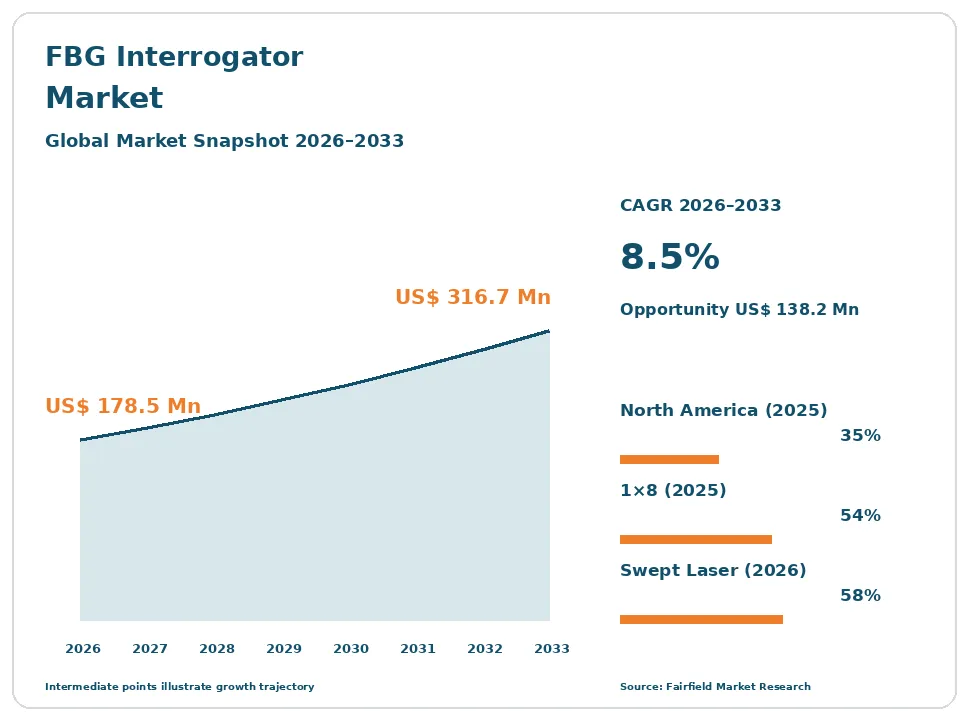
The global FBG interrogator market size is expected to be valued at US$ 178.5 million in 2026 and projected to reach US$ 316.7 million by 2033, growing at a CAGR of 8.5% between 2026 and 2033.
Between 2020 and 2025, the market grew at a CAGR of about 7.6%, as fiber optic sensing moved from research labs into aerospace testing, energy, civil engineering, and medical devices. A fiber Bragg grating is a short section of optical fiber with a pattern that reflects one wavelength of light, and that wavelength shifts when the fiber is stretched or heated. An FBG interrogator sends light into the fiber, reads the reflected wavelengths, and converts the shifts into strain, temperature, pressure, or vibration measurements. One fiber can carry dozens of sensors, which are immune to electromagnetic interference, lightweight, and safe in explosive areas. Growth comes from structural health monitoring of bridges, tunnels, wind turbines, and aircraft, plus power grid, oil and gas, and medical shape-sensing uses. The market is shifting toward compact, faster, lower-cost interrogators based on photonic chips. In May 2026, Coher Sense received European Space Agency support to develop a low-cost interrogator.
Key Report Takeaways
- By Channel Type: 1×8 held 54.0% share in 2025, while 1×4 is projected to expand at a 9.3% CAGR through 2033, driven by compact, lower-cost units for embedded systems, medical devices, and smaller monitoring projects that need fewer channels.
- By Application: Industrial held 30.0% share in 2025, while Medical Treatment is projected to expand at a 10.4% CAGR through 2033, driven by shape-sensing catheters, robotic surgery tools, and temperature monitoring during thermal therapies.
- By Interrogation Technology: Swept Laser held 58.0% share in 2026, while Spectrometer-Based is projected to expand at a 9.6% CAGR through 2033, driven by solid-state, high-speed designs with no moving parts and lower cost per channel.
- By Region: North America held 35.0% share in 2025, while Asia Pacific is projected to expand at a 10.1% CAGR through 2033, driven by infrastructure projects, power grid expansion, rail networks, and growing photonics manufacturing in China, Japan, and India.
Global FBG Interrogator Market Trends and Insights
Drivers Impact Analysis
| Driver | Impact on CAGR Forecast | Geographic Relevance | Impact Timeline |
| Structural health monitoring of infrastructure and energy assets | High | Global | Long term (≥4 years) |
| Aerospace, defense, and medical sensing demand | High | North America, Europe | Medium term (2-4 years) |
Two drivers carry the strongest influence on FBG interrogator demand during the forecast period.
Structural Health Monitoring Is Driving the FBG Interrogator Market
Structural health monitoring of infrastructure and energy assets is the strongest driver of the FBG interrogator market. Asset owners want continuous data on condition.
The mechanism is the need to watch aging and new structures in real time. Many bridges, tunnels, dams, and buildings in North America, Europe, and Asia Pacific are decades old, and owners use embedded fiber sensors to track strain, cracks, and temperature instead of relying only on visual inspections. Wind turbine blades, offshore platforms, pipelines, and subsea cables also use fiber sensors because they work over long distances and in harsh, electrically noisy environments. Utilities monitor transformers and cables, and rail operators measure track loads. Governments invest in infrastructure resilience, and Optics11 raised funding in May 2025 to scale fiber optic sensing for infrastructure. Each monitoring system needs one or more optical sensing interrogator units. These trends create steady demand.
Aerospace and Medical Uses Are Expanding the FBG Interrogator Market
Aerospace, defense, and medical sensing demand is expanding the FBG interrogator market. High-value applications need precise, lightweight sensors.
The cause is the unique benefits of fiber sensing. Aircraft and spacecraft makers use FBG sensors to test wings, fuselages, rotor blades, and landing gear because hundreds of sensors can run on a few thin fibers. PhotonFirst launched interrogators qualified for aerospace use in 2025. Defense programs use fiber sensors in ships, submarines, and vehicles. In medicine, fiber sensors guide catheters and robotic surgery tools by measuring shape and force inside the body without interference from MRI scanners. Space agencies test fiber sensors for satellites and launch vehicles, where weight savings matter greatly. Flight test programs need interrogators that sample thousands of times per second. These applications pay premium prices for speed, accuracy, and certified reliability.
Restraints Impact Analysis
| Restraint | Impact on CAGR Forecast | Geographic Relevance | Impact Timeline |
| High cost compared with electrical sensors | High | Global | Long term (≥4 years) |
| Lack of standards and installation expertise | Medium | Global | Medium term (2-4 years) |
Two restraints limit how quickly the FBG interrogator market grows.
High Costs Slow the FBG Interrogator Market
High cost compared with electrical sensors slows the FBG interrogator market. Interrogators remain expensive.
The specific causes are precision optics and small volumes. High-performance interrogators use tunable lasers, spectrometers, and precise wavelength references, and production volumes are small, so prices are often thousands to tens of thousands of dollars per unit. Electrical strain gauges and thermocouples, with simple data loggers, cost much less for small projects. Buyers must also pay for specialized fibers, connectors, installation, and software. For projects with only a few sensors, the per-point cost of fiber sensing is high. Budget-conscious buyers in civil engineering often choose vibrating wire or electrical sensors they already know. Long payback periods for monitoring systems make owners cautious. These cost barriers limit use to projects where fiber sensing’s unique benefits justify the price.
Lack of Standards Restricts the FBG Interrogator Market
Lack of standards and installation expertise restricts the FBG interrogator market. Many engineers are unfamiliar with fiber sensing.
The underlying causes are a young industry and specialized skills. Interrogators, sensors, connectors, and software from different vendors may not work together easily, and data formats and calibration methods vary between suppliers. Installing fiber sensors in concrete, composites, or rotating machinery requires careful handling, bonding, and routing to avoid breakage, and repairs can be difficult once sensors are embedded. Civil engineers, plant operators, and asset owners may lack experience setting alarm limits and interpreting large volumes of fiber sensing data. Design codes and inspection rules rarely mention fiber sensors, so owners hesitate to rely on them for safety decisions. Training and long-term support add to project costs. These gaps slow adoption and lengthen sales cycles.
Market Opportunities
Low-Cost Photonic Chip Interrogators Open a Fast-Growth Revenue Pool
Low-cost photonic chip interrogators open a fast-growth revenue pool in the FBG interrogator market. Cheaper units can unlock mass markets.
Photonics companies can capture this opportunity. Integrated photonic chips shrink interrogators to a fraction of their former size, weight, power use, and cost, enabling embedded sensing in vehicles, battery packs, consumer products, drones, and smart buildings. PhotonFirst’s chip-based Nexus-100 supports up to 100 sensors on one channel at high speed. Coher Sense is developing an LED-based design that aims to cut costs by one to two orders of magnitude, targeting automotive-level pricing. Government photonics programs in Europe and North America support these developments. Startups and established firms are racing to commercialize these designs. Companies that achieve mass-market pricing, reliable packaging, and simple software can open large new applications.
Energy Transition and Smart Grids Create a Growth Revenue Pool
The energy transition and smart grids create a growth revenue pool in the FBG interrogator market. New energy assets need continuous monitoring.
Interrogator makers can capture this opportunity. Wind turbine blades, battery storage systems, hydrogen tanks, subsea power cables, solar plants, and high-voltage transformers benefit from fiber sensors that measure strain and temperature safely inside electrical equipment, where metal sensors can cause problems. Offshore wind farms need long-life monitoring with minimal maintenance visits by boat or helicopter. Grid operators want early warning of overheating to prevent costly outages. Nuclear and geothermal plants use radiation- and heat-tolerant fiber sensors. Battery makers are testing embedded fiber sensors to detect cell swelling and hot spots early, improving safety. Companies with rugged, certified products and strong analytics can win long-term energy contracts.
Segment Analysis
By Channel Type: 1×8 Leads While 1×4 Grows Fastest
1×8 held 54.0% share in 2025. Eight-channel interrogators offer a good balance of capacity, speed, and cost for structural monitoring, aerospace testing, and industrial systems, and many standard products from leading suppliers use this layout. Each channel can read many sensors, so one unit can cover a bridge span, a turbine blade set, or a test article.
1×4 is the fastest-growing channel type, expanding at a 9.3% CAGR through 2033. Smaller four-channel and single-channel units are cheaper, lighter, and easier to embed in medical devices, drones, vehicles, and small monitoring projects. Chip-based designs favor fewer channels. 1×16 and higher channel units serve large systems such as pipelines, tunnels, and full-scale aircraft tests. For the market, smaller units widen access to new users.
By Application: Industrial Leads While Medical Treatment Grows Fastest
Industrial held 30.0% share in 2025. Manufacturing plants, process industries, power utilities, and oil and gas facilities use fiber sensors to monitor equipment temperature, strain, and vibration in harsh or explosive environments. Fiber sensing is valued where electrical sensors face interference or safety limits. Aircraft and wind blade composite part makers use fiber sensors to monitor curing and quality during production.
Medical Treatment is the fastest-growing application, expanding at a 10.4% CAGR through 2033. Fiber sensors measure catheter shape and force during heart procedures, guide robotic surgery tools, and track temperature during thermal ablation and MRI-guided therapies. Civil engineering, aerospace and defense, energy, and other applications form other segments. For the market, medical growth adds premium, high-volume demand.
By Interrogation Technology: Swept Laser Leads While Spectrometer-Based Grows Fastest
Swept Laser held 58.0% share in 2026. Tunable laser interrogators offer high accuracy, wide wavelength range, strong signal power, and the ability to read many sensors per channel, making them standard for structural and long-range monitoring. HBK, Luna Innovations, and Micronor offer leading swept laser systems.
Spectrometer-Based is the fastest-growing technology, expanding at a 9.6% CAGR through 2033. Solid-state spectrometer designs have no moving parts, run at very high speeds, and suit dynamic measurements such as vibration and aerospace testing. They also fit chip-based integration, reducing size and cost for embedded uses. Other technologies, including LED-based and interferometric methods, are emerging for low-cost applications. For the market, this growth supports high-speed dynamic sensing and new mass-market uses.
Geography Analysis
Which Region Is Leading the FBG Interrogator Market?
North America is leading the FBG interrogator market with a 35.0% share in 2025. The United States has strong aerospace, defense, oil and gas, power, and medical device industries that use fiber sensing for testing and monitoring. Luna Innovations and Micronor are based in the region, and research programs at national laboratories and universities support new sensing methods. Federal infrastructure funding supports bridge and tunnel monitoring. Canada adds demand from mining, pipelines, and civil projects. Key barriers include high costs and long project approvals. One change shaping the region is wider use of permanent sensors for bridge, tunnel, and pipeline monitoring.
Europe Advances the FBG Interrogator Market Through Photonics Innovation
Europe is a major FBG interrogator market. Germany, the Netherlands, the United Kingdom, and Portugal host leading suppliers including HBK, PhotonFirst, FBGS, Optics11, and Smartfiber, and the Netherlands has a strong integrated photonics ecosystem. Aerospace makers such as Airbus, wind energy companies, and rail operators are key users, and European Space Agency programs support new designs. Research institutes and universities across the region drive innovation and spin-off companies. Key barriers include fragmented demand across many small projects. One opportunity is offshore wind, subsea cable, and rail infrastructure monitoring across the region.
Which Region Is Growing Fastest in the FBG Interrogator Market?
Asia Pacific is growing fastest in the FBG interrogator market at a 10.1% CAGR through 2033. China is investing heavily in bridges, tunnels, high-speed rail, power grids, and photonics manufacturing, and local suppliers offer lower-cost interrogators. Japan and South Korea use fiber sensing in shipbuilding, aerospace, and nuclear facilities, while India is expanding metro rail and highway projects. Government programs for smart cities and safety monitoring of major structures are increasing demand. Key barriers include strong price competition from low-cost local suppliers. One change shaping the region is growing use of rail, bridge, and tunnel monitoring.
Latin America Grows the FBG Interrogator Market Through Energy and Mining
Latin America is a growing FBG interrogator market. Brazil uses fiber sensing in offshore oil and gas fields and pipelines, while Chile and Peru apply it to mining structures, tailings dams, and slope stability. Mexico has aerospace manufacturing that uses test sensing. Research universities support local projects. Hydropower dams and long-distance power lines in Brazil are also candidates for fiber monitoring, and energy companies in the region increasingly specify fiber sensing for safety and reliability. Key barriers include limited budgets, few local suppliers, and import costs. One opportunity is safety monitoring of tailings dams, slopes, and underground works in mining.
Middle East & Africa Develops the FBG Interrogator Market Through Oil and Gas
Middle East & Africa is a developing FBG interrogator market. Saudi Arabia and the United Arab Emirates use fiber sensing in oil and gas wells, pipelines, and large construction projects, where high temperatures and explosive atmospheres favor optical sensors. South Africa applies fiber sensing in deep gold and platinum mines and power plants. Large new cities, stadiums, and transport links being built in the region create opportunities for long-term structural monitoring. Key barriers include limited technical skills, small local markets, and reliance on international integrators. One change shaping the region is permanent monitoring of large infrastructure mega-projects and new cities.
Competitive Landscape
The FBG interrogator market is fragmented. HBK, Luna Innovations, PhotonFirst, FBGS, and Micronor are leading players, while Optics11, Smartfiber, Polytec, Sylex, Smart Fibres, DK Photonics, and Bestech compete strongly. Many small photonics firms and university spin-offs offer specialized products, often focused on a single application such as medical shape sensing, rail monitoring, or aerospace testing. Chinese suppliers are growing quickly with lower-cost interrogators for domestic infrastructure projects and export markets.
Companies compete on accuracy, sampling speed, number of channels, ruggedness, software, certifications, and price. Suppliers that sell complete turnkey systems, including sensors, interrogators, installation services, and analytics software, have an advantage with customers who lack fiber expertise. Aerospace and medical customers require long qualification and strong quality systems, which create loyal relationships. Partnerships with system integrators, engineering firms, and test laboratories help suppliers reach new users in many countries.
Strategic moves show how competition is changing. In May 2025, PhotonFirst launched new aerospace and chip-based interrogators. In May 2025, Optics11 raised about €17 million. In May 2026, Coher Sense won European Space Agency support for a low-cost design. These moves show competition shifting toward compact, low-cost designs that can reach much larger markets.
Three themes shape vendor strategy. First, companies are shrinking interrogators using photonic chips. Second, they are targeting aerospace, medical, and energy uses. Third, they are raising capital from investors and public programs to scale production and enter new markets.
FBG Interrogator Market Industry Leaders
- HBK
- Luna Innovations
- PhotonFirst
- FBGS
- Micronor
Recent Industry Developments
- May 2026: Coher Sense was selected for European Space Agency Spark funding to develop a compact, low-cost FBG interrogator using an RGB-LED light source and interferometric detection - targets mass-deployable fiber Bragg grating sensing.
- May 2025: Optics11 raised about €17 million to scale its fiber optic sensing technology for infrastructure and security monitoring - supports structural health monitoring of critical assets.
- May 2025: PhotonFirst launched the AGTR-NEO and chip-based Nexus-100 interrogators for aerospace, defense, and quasi-distributed sensing - expands compact optical sensing interrogator options.
Companies Covered in the Report
- HBK
- Luna Innovations
- PhotonFirst
- FBGS
- Micronor
- Optics11
- Smartfiber
- Polytec
- Sylex
- Smart Fibres
- DK Photonics
- Bestech
FBG Interrogator Market Report Scope
This report covers fiber Bragg grating interrogators, including 1×4, 1×8, 1×16, and higher channel units based on swept laser, spectrometer, and other interrogation technologies, for industrial, civil engineering, aerospace and defense, energy, medical treatment, and other applications. The base year is 2025, and the forecast period runs from 2026 to 2033. All values are expressed in US$ Million.
Channel Type
- 1×4
- 1×8
- 1×16 and Above
Application
- Industrial
- Civil Engineering
- Aerospace & Defense
- Energy
- Medical Treatment
- Others
Interrogation Technology
- Swept Laser
- Spectrometer-Based
- Others
Regions
- North America
- Europe
- Asia Pacific
- Latin America
- Middle East & Africa
Key Questions Answered in the Report
How big is the FBG interrogator market in 2026?
The FBG interrogator market is valued at US$ 178.5 million in 2026, led by 1×8 interrogators and North America.
What is the FBG interrogator market forecast to 2033?
The market is projected to reach US$ 316.7 million by 2033, growing at an 8.5% CAGR and adding US$ 138.2 million.
Which application is growing fastest in the FBG interrogator market?
Medical treatment is growing fastest at a 10.4% CAGR through 2033, driven by shape-sensing catheters and robotic surgery tools.
Which region is growing fastest in the FBG interrogator market?
Asia Pacific is growing fastest at a 10.1% CAGR through 2033, driven by infrastructure, grid, and rail investment in China and India.
Which region holds the largest FBG interrogator market share?
North America holds the largest share at 35.0% in 2025, supported by aerospace, defense, energy, and medical device industries.
1. Executive Summary
1.1. Global FBG Interrogator Market Snapshot
1.2. Future Projections, 2026-2033
1.3. Key Market Trends
1.4. Regional Snapshot
2. Market Overview
2.1. Market Definition and Report Scope
2.2. Historical Market Trends, 2020-2025
2.3. Market Dynamics
2.3.1. Drivers Impact Analysis
2.3.1.1. Structural Health Monitoring Is Driving the FBG Interrogator Market
2.3.1.2. Aerospace and Medical Uses Are Expanding the FBG Interrogator Market
2.3.2. Restraints Impact Analysis
2.3.2.1. High Costs Slow the FBG Interrogator Market
2.3.2.2. Lack of Standards Restricts the FBG Interrogator Market
2.3.3. Market Opportunities
2.3.3.1. Low-Cost Photonic Chip Interrogators Open a Fast-Growth Revenue Pool
2.3.3.2. Energy Transition and Smart Grids Create a Growth Revenue Pool
3. Global FBG Interrogator Market Outlook, 2020-2033
3.1. Global FBG Interrogator Market Outlook, by Channel Type, Value (US$ Million), 2020-2033
3.1.1. 1×4
3.1.2. 1×8
3.1.3. 1×16 and Above
3.2. Global FBG Interrogator Market Outlook, by Application, Value (US$ Million), 2020-2033
3.2.1. Industrial
3.2.2. Civil Engineering
3.2.3. Aerospace & Defense
3.2.4. Energy
3.2.5. Medical Treatment
3.2.6. Others
3.3. Global FBG Interrogator Market Outlook, by Interrogation Technology, Value (US$ Million), 2020-2033
3.3.1. Swept Laser
3.3.2. Spectrometer-Based
3.3.3. Others
3.4. Global FBG Interrogator Market Outlook, by Region, Value (US$ Million), 2020-2033
3.4.1. North America
3.4.2. Europe
3.4.3. Asia Pacific
3.4.4. Latin America
3.4.5. Middle East & Africa
4. North America FBG Interrogator Market Outlook, 2020-2033
4.1. North America FBG Interrogator Market Outlook, by Channel Type, Value (US$ Million), 2020-2033
4.1.1. 1×4
4.1.2. 1×8
4.1.3. 1×16 and Above
4.2. North America FBG Interrogator Market Outlook, by Application, Value (US$ Million), 2020-2033
4.2.1. Industrial
4.2.2. Civil Engineering
4.2.3. Aerospace & Defense
4.2.4. Energy
4.2.5. Medical Treatment
4.2.6. Others
4.3. North America FBG Interrogator Market Outlook, by Interrogation Technology, Value (US$ Million), 2020-2033
4.3.1. Swept Laser
4.3.2. Spectrometer-Based
4.3.3. Others
4.4. North America FBG Interrogator Market Outlook, by Country, Value (US$ Million), 2020-2033
4.4.1. United States FBG Interrogator Market Outlook, by Channel Type, 2020-2033
4.4.2. United States FBG Interrogator Market Outlook, by Application, 2020-2033
4.4.3. United States FBG Interrogator Market Outlook, by Interrogation Technology, 2020-2033
4.4.4. Canada FBG Interrogator Market Outlook, by Channel Type, 2020-2033
4.4.5. Canada FBG Interrogator Market Outlook, by Application, 2020-2033
4.4.6. Canada FBG Interrogator Market Outlook, by Interrogation Technology, 2020-2033
5. Europe FBG Interrogator Market Outlook, 2020-2033
5.1. Europe FBG Interrogator Market Outlook, by Channel Type, Value (US$ Million), 2020-2033
5.1.1. 1×4
5.1.2. 1×8
5.1.3. 1×16 and Above
5.2. Europe FBG Interrogator Market Outlook, by Application, Value (US$ Million), 2020-2033
5.2.1. Industrial
5.2.2. Civil Engineering
5.2.3. Aerospace & Defense
5.2.4. Energy
5.2.5. Medical Treatment
5.2.6. Others
5.3. Europe FBG Interrogator Market Outlook, by Interrogation Technology, Value (US$ Million), 2020-2033
5.3.1. Swept Laser
5.3.2. Spectrometer-Based
5.3.3. Others
5.4. Europe FBG Interrogator Market Outlook, by Country, Value (US$ Million), 2020-2033
5.4.1. Germany FBG Interrogator Market Outlook, by Channel Type, 2020-2033
5.4.2. Germany FBG Interrogator Market Outlook, by Application, 2020-2033
5.4.3. Germany FBG Interrogator Market Outlook, by Interrogation Technology, 2020-2033
5.4.4. Netherlands FBG Interrogator Market Outlook, by Channel Type, 2020-2033
5.4.5. Netherlands FBG Interrogator Market Outlook, by Application, 2020-2033
5.4.6. Netherlands FBG Interrogator Market Outlook, by Interrogation Technology, 2020-2033
5.4.7. United Kingdom FBG Interrogator Market Outlook, by Channel Type, 2020-2033
5.4.8. United Kingdom FBG Interrogator Market Outlook, by Application, 2020-2033
5.4.9. United Kingdom FBG Interrogator Market Outlook, by Interrogation Technology, 2020-2033
5.4.10. Portugal FBG Interrogator Market Outlook, by Channel Type, 2020-2033
5.4.11. Portugal FBG Interrogator Market Outlook, by Application, 2020-2033
5.4.12. Portugal FBG Interrogator Market Outlook, by Interrogation Technology, 2020-2033
6. Asia Pacific FBG Interrogator Market Outlook, 2020-2033
6.1. Asia Pacific FBG Interrogator Market Outlook, by Channel Type, Value (US$ Million), 2020-2033
6.1.1. 1×4
6.1.2. 1×8
6.1.3. 1×16 and Above
6.2. Asia Pacific FBG Interrogator Market Outlook, by Application, Value (US$ Million), 2020-2033
6.2.1. Industrial
6.2.2. Civil Engineering
6.2.3. Aerospace & Defense
6.2.4. Energy
6.2.5. Medical Treatment
6.2.6. Others
6.3. Asia Pacific FBG Interrogator Market Outlook, by Interrogation Technology, Value (US$ Million), 2020-2033
6.3.1. Swept Laser
6.3.2. Spectrometer-Based
6.3.3. Others
6.4. Asia Pacific FBG Interrogator Market Outlook, by Country, Value (US$ Million), 2020-2033
6.4.1. China FBG Interrogator Market Outlook, by Channel Type, 2020-2033
6.4.2. China FBG Interrogator Market Outlook, by Application, 2020-2033
6.4.3. China FBG Interrogator Market Outlook, by Interrogation Technology, 2020-2033
6.4.4. Japan FBG Interrogator Market Outlook, by Channel Type, 2020-2033
6.4.5. Japan FBG Interrogator Market Outlook, by Application, 2020-2033
6.4.6. Japan FBG Interrogator Market Outlook, by Interrogation Technology, 2020-2033
6.4.7. South Korea FBG Interrogator Market Outlook, by Channel Type, 2020-2033
6.4.8. South Korea FBG Interrogator Market Outlook, by Application, 2020-2033
6.4.9. South Korea FBG Interrogator Market Outlook, by Interrogation Technology, 2020-2033
6.4.10. India FBG Interrogator Market Outlook, by Channel Type, 2020-2033
6.4.11. India FBG Interrogator Market Outlook, by Application, 2020-2033
6.4.12. India FBG Interrogator Market Outlook, by Interrogation Technology, 2020-2033
7. Latin America FBG Interrogator Market Outlook, 2020-2033
7.1. Latin America FBG Interrogator Market Outlook, by Channel Type, Value (US$ Million), 2020-2033
7.1.1. 1×4
7.1.2. 1×8
7.1.3. 1×16 and Above
7.2. Latin America FBG Interrogator Market Outlook, by Application, Value (US$ Million), 2020-2033
7.2.1. Industrial
7.2.2. Civil Engineering
7.2.3. Aerospace & Defense
7.2.4. Energy
7.2.5. Medical Treatment
7.2.6. Others
7.3. Latin America FBG Interrogator Market Outlook, by Interrogation Technology, Value (US$ Million), 2020-2033
7.3.1. Swept Laser
7.3.2. Spectrometer-Based
7.3.3. Others
7.4. Latin America FBG Interrogator Market Outlook, by Country, Value (US$ Million), 2020-2033
7.4.1. Brazil FBG Interrogator Market Outlook, by Channel Type, 2020-2033
7.4.2. Brazil FBG Interrogator Market Outlook, by Application, 2020-2033
7.4.3. Brazil FBG Interrogator Market Outlook, by Interrogation Technology, 2020-2033
7.4.4. Chile FBG Interrogator Market Outlook, by Channel Type, 2020-2033
7.4.5. Chile FBG Interrogator Market Outlook, by Application, 2020-2033
7.4.6. Chile FBG Interrogator Market Outlook, by Interrogation Technology, 2020-2033
7.4.7. Peru FBG Interrogator Market Outlook, by Channel Type, 2020-2033
7.4.8. Peru FBG Interrogator Market Outlook, by Application, 2020-2033
7.4.9. Peru FBG Interrogator Market Outlook, by Interrogation Technology, 2020-2033
7.4.10. Mexico FBG Interrogator Market Outlook, by Channel Type, 2020-2033
7.4.11. Mexico FBG Interrogator Market Outlook, by Application, 2020-2033
7.4.12. Mexico FBG Interrogator Market Outlook, by Interrogation Technology, 2020-2033
8. Middle East & Africa FBG Interrogator Market Outlook, 2020-2033
8.1. Middle East & Africa FBG Interrogator Market Outlook, by Channel Type, Value (US$ Million), 2020-2033
8.1.1. 1×4
8.1.2. 1×8
8.1.3. 1×16 and Above
8.2. Middle East & Africa FBG Interrogator Market Outlook, by Application, Value (US$ Million), 2020-2033
8.2.1. Industrial
8.2.2. Civil Engineering
8.2.3. Aerospace & Defense
8.2.4. Energy
8.2.5. Medical Treatment
8.2.6. Others
8.3. Middle East & Africa FBG Interrogator Market Outlook, by Interrogation Technology, Value (US$ Million), 2020-2033
8.3.1. Swept Laser
8.3.2. Spectrometer-Based
8.3.3. Others
8.4. Middle East & Africa FBG Interrogator Market Outlook, by Country, Value (US$ Million), 2020-2033
8.4.1. Saudi Arabia FBG Interrogator Market Outlook, by Channel Type, 2020-2033
8.4.2. Saudi Arabia FBG Interrogator Market Outlook, by Application, 2020-2033
8.4.3. Saudi Arabia FBG Interrogator Market Outlook, by Interrogation Technology, 2020-2033
8.4.4. United Arab Emirates FBG Interrogator Market Outlook, by Channel Type, 2020-2033
8.4.5. United Arab Emirates FBG Interrogator Market Outlook, by Application, 2020-2033
8.4.6. United Arab Emirates FBG Interrogator Market Outlook, by Interrogation Technology, 2020-2033
8.4.7. South Africa FBG Interrogator Market Outlook, by Channel Type, 2020-2033
8.4.8. South Africa FBG Interrogator Market Outlook, by Application, 2020-2033
8.4.9. South Africa FBG Interrogator Market Outlook, by Interrogation Technology, 2020-2033
9. Competitive Landscape
9.1. Market Concentration and Industry Leaders
9.2. Competitive Differentiation
9.3. Strategic Initiatives
9.4. Recent Industry Developments
9.5. Company Profiles
9.5.1. HBK
9.5.2. Luna Innovations
9.5.3. PhotonFirst
9.5.4. FBGS
9.5.5. Micronor
9.5.6. Optics11
9.5.7. Smartfiber
9.5.8. Polytec
9.5.9. Sylex
9.5.10. Smart Fibres
9.5.11. DK Photonics
9.5.12. Bestech
10. Appendix
10.1. Research Methodology
10.2. Report Assumptions
10.3. Acronyms and Abbreviations
| Channel Type | 1×4, 1×8, 1×16 and Above |
| Application | Industrial, Civil Engineering, Aerospace & Defense, Energy, Medical Treatment, Others |
| Interrogation Technology | Swept Laser, Spectrometer-Based, Others |
| Regions | North America, Europe, Asia Pacific, Latin America, Middle East & Africa |
Our Research Methodology
Considering the volatility of business today, traditional approaches to strategizing a game plan can be unfruitful if not detrimental. True ambiguity is no way to determine a forecast. A myriad of predetermined factors must be accounted for such as the degree of risk involved, the magnitude of circumstances, as well as conditions or consequences that are not known or unpredictable. To circumvent binary views that cast uncertainty, the application of market research intelligence to strategically posture, move, and enable actionable outcomes is necessary.
View Methodology
Quality Assured
Rigorous Validation Process

Confidentiality Assured
End-to-end Data Security

Custom Research Services
Tailored To Your Objectives
FAQs
The FBG interrogator market is valued at US$ 178.5 million in 2026, led by 1×8 interrogators and North America.
The market is projected to reach US$ 316.7 million by 2033, growing at an 8.5% CAGR and adding US$ 138.2 million.
Medical treatment is growing fastest at a 10.4% CAGR through 2033, driven by shape-sensing catheters and robotic surgery tools.
Asia Pacific is growing fastest at a 10.1% CAGR through 2033, driven by infrastructure, grid, and rail investment in China and India.
North America holds the largest share at 35.0% in 2025, supported by aerospace, defense, energy, and medical device industries.
Related Reports
Laser Technologies in Manufacturing Market Size, Share, Insights, Competitive Landscape, and Forecast 2026 to 2033
Explore the laser technologies in manufacturing market, valued at US$ 23.6 billion in 2026 and forecast to reach US$ 38.4 billion by 2033 at 7.2% CAGR.
High Torque Stepper Motor Market Size, Share, Insights, Competitive Landscape, and Forecast 2026 to 2033
Explore the high torque stepper motor market, projected to reach US$ 3.6 billion by 2033 at a 6.6% CAGR, with product and regional insights.
Conveying Equipment Market Size, Share, Insights, Competitive Landscape, and Forecast 2026 to 2033
Explore the conveying equipment market, projected to reach US$ 56.9 billion by 2033 at a 4.5% CAGR, with equipment, services and regional insights.
Bakery Packaging Machine Market Size, Share, Insights, Competitive Landscape, and Forecast 2026 to 2033
Explore the bakery packaging machine market, projected to reach US$ 4.44 billion by 2033 at a 4.6% CAGR, with automation, machine and regional insights.
EPC Construction Market Size, Share, Insights, Competitive Landscape, and Forecast 2026 to 2033
EPC construction market to grow from US$ 331.5 billion in 2026 to US$ 424.6 billion by 2033 at a 3.6% CAGR. Explore services, contracts and regional trends.
Hydraulic Manifold Market Size, Share, Insights, Competitive Landscape, and Forecast 2026 to 2033
Hydraulic manifold market to grow from US$ 750.0 million in 2026 to US$ 947.8 million by 2033 at a 3.4% CAGR. Explore types, applications and regional trends.