



Hydraulic Manifold Market
Hydraulic Manifold Market Size, Share, Insights, Competitive Landscape, and Forecast 2026 to 2033
Hydraulic Manifold Market Size and Trend Analysis
How Fast Is the Hydraulic Manifold Market Growing?
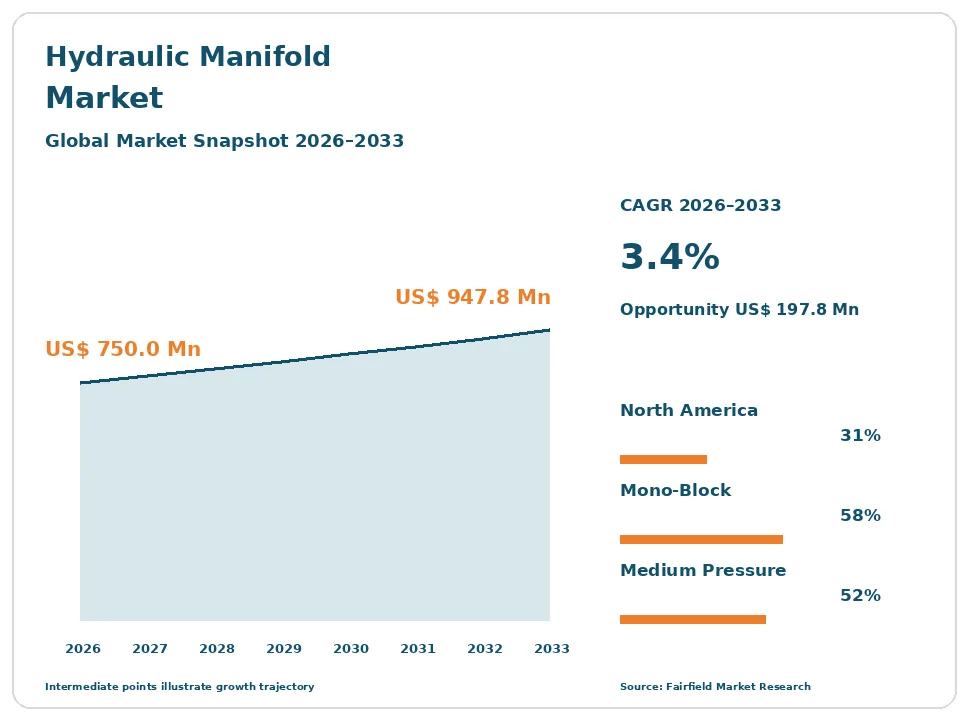
The global hydraulic manifold market size is expected to be valued at US$ 750.0 million in 2026 and projected to reach US$ 947.8 million by 2033, growing at a CAGR of 3.4% between 2026 and 2033.
Between 2020 and 2025, the market grew at a CAGR of about 3.0%, as construction and agricultural machinery output fell during the pandemic, rebounded strongly in 2021 and 2022, and then softened as interest rates rose. A hydraulic manifold is a machined block, usually of aluminum, steel, or ductile iron, that routes pressurized fluid between pumps, valves, and actuators, replacing many separate pipes and hoses. Manifolds hold cartridge valves and control functions in compact, leak-resistant packages. Three factors now drive growth: demand for compact, efficient mobile hydraulics in construction, agricultural, and material handling machines, industrial automation in presses, machine tools, and plastics machinery, and electrification of off-highway equipment that requires smarter hydraulic control. The market is shifting toward modular manifolds, integrated electronics, 3D-printed designs, and custom blocks engineered for each machine. In April 2025, Bosch Rexroth introduced a compact directional valve with onboard electronics at bauma 2025, showing how fluid power systems are becoming more digital.
Key Report Takeaways
- By Type: Mono-Block Manifolds held 58.0% share in 2026, while Modular Manifolds are projected to expand at a 4.1% CAGR through 2033, driven by flexible designs that are easy to change, repair, and expand.
- By Application: Heavy Construction Machines held 34.0% share in 2026, while Off-Highway Equipment is projected to expand at a 4.0% CAGR through 2033, driven by agricultural, forestry, and material handling machines adopting compact, electrified hydraulics.
- By Pressure Range: Medium Pressure held 52.0% share in 2026, while High Pressure is projected to expand at a 4.3% CAGR through 2033, driven by more power-dense machines and heavy-duty industrial presses.
- By Region: North America held 31.0% share in 2026, while Asia Pacific is projected to expand at a 4.6% CAGR through 2033, driven by construction machinery output and industrial automation in China and India.
Global Hydraulic Manifold Market Trends and Insights
Drivers Impact Analysis
| Driver | Impact on CAGR Forecast | Geographic Relevance | Impact Timeline |
| Construction, agricultural, and mobile machinery demand | High | Global | Long term (≥4 years) |
| Compact, efficient, and smart hydraulic systems | Medium | North America, Europe, Asia Pacific | Medium term (2-4 years) |
Two drivers carry the strongest influence on hydraulic manifold demand during the forecast period.
Mobile Machinery Demand Is Driving the Hydraulic Manifold Market
Construction, agricultural, and mobile machinery demand is the strongest driver of the hydraulic manifold market. These machines rely heavily on hydraulics.
The mechanism is the large number of hydraulic functions on each machine. Excavators, loaders, cranes, tractors, harvesters, forklifts, and aerial work platforms use hydraulic manifolds to control lifting, steering, braking, and attachments. Infrastructure spending in the United States, India, China, and Middle East & Africa supports construction equipment sales. Larger farms and labor shortages push farmers to buy more advanced tractors and harvesters. Mobile hydraulics makers such as Bosch Rexroth, Danfoss, Parker Hannifin, and Bucher Hydraulics supply valves and manifolds to equipment makers such as Caterpillar, Deere, Komatsu, and CNH. Each new machine needs custom manifolds, and replacement parts add aftermarket demand. These factors keep demand steady.
Compact and Smart Systems Are Expanding the Hydraulic Manifold Market
Demand for compact, efficient, and smart hydraulic systems is expanding the hydraulic manifold market. Machine builders want smaller and more efficient designs.
The cause is the push for performance and lower energy use. Integrating many valves into one manifold saves space, reduces leak points, and cuts assembly time compared with separate components and hoses. Cartridge valves that screw into manifolds give designers flexibility. Electronic proportional valves allow precise control through machine computers, and Helios Technologies expanded its electro-proportional cartridge valves in April 2025. Electrified machines need efficient hydraulic circuits to extend battery life. Industrial users want energy-saving systems in presses and machine tools. These trends increase the value of each manifold, because blocks with electronic valves, sensors, and integrated logic sell at higher prices than simple drilled blocks. Standard fluid power interfaces make integration easier.
Restraints Impact Analysis
| Restraint | Impact on CAGR Forecast | Geographic Relevance | Impact Timeline |
| Cyclical machinery demand | Medium | Global | Medium term (2-4 years) |
| Shift to electric actuation and raw material costs | Medium | North America, Europe | Long term (≥4 years) |
Two restraints limit how quickly the hydraulic manifold market grows.
Cyclical Demand Slows the Hydraulic Manifold Market
Cyclical demand for construction and farm machinery slows the hydraulic manifold market. Equipment orders rise and fall with the economy.
The specific causes are interest rates, commodity prices, and farm incomes. When interest rates rise, construction activity and equipment purchases slow. Lower crop prices reduce farmer spending on new tractors and harvesters, and agricultural machinery sales fell in North America and Europe in 2024. Dealers reduce inventory during downturns, sharply cutting orders for components and spare parts. Manifold makers depend on a small number of large customers, so their sales swing with those customers’ production. These cycles make planning and investment difficult and slow long-term growth. Suppliers manage the swings by serving several end markets, growing aftermarket sales, and keeping flexible machining capacity that can be shifted between products.
Electrification and Costs Restrict the Hydraulic Manifold Market
The shift to electric actuation and raw material costs restrict the hydraulic manifold market. Some hydraulic functions may be replaced.
The underlying causes are technology change and input prices. Electric linear actuators and electric motors can replace hydraulics in some lighter machines and industrial uses, especially where clean, quiet operation matters. Battery-electric equipment designers sometimes choose fully electric drives. Aluminum and steel prices affect manifold costs, and tariffs raise costs in some markets. Precision machining requires skilled workers, who are in short supply. Low-cost competition from Asia Pacific pressures prices. These factors limit value growth. However, hydraulics remain hard to replace in heavy machines because they deliver very high force in a small space, so most experts expect hydraulics and electric drives to work together rather than one replacing the other entirely.
Market Opportunities
Electrified Off-Highway Machines Open a Fast-Growth Revenue Pool
Electrified off-highway machines open a fast-growth revenue pool in the hydraulic manifold market. Electric machines still need efficient hydraulics.
Hydraulic component makers can capture this opportunity. Electric excavators, loaders, forklifts, and aerial platforms often use electric motors to drive hydraulic pumps, and they need highly efficient manifolds and valves to save battery energy. Electro-hydraulic actuators combine motor, pump, and manifold in one unit. Smart valves with pressure and temperature sensors provide useful data for predictive maintenance and remote diagnostics. Bosch Rexroth and HydraForce planned to show hybrid systems combining manifold-mounted cartridge valves with compact directional valves at a 2026 trade show. Suppliers that offer integrated electro-hydraulic solutions can win new platforms. Equipment makers are redesigning machines from scratch for electric power, which opens doors for new suppliers.
Additive Manufacturing and Custom Design Create a Value Revenue Pool
Additive manufacturing and custom design create a value revenue pool in the hydraulic manifold market. New production methods make better manifolds.
Manifold makers and engineering firms can capture this opportunity. 3D printing allows curved internal channels that reduce pressure loss, weight, and size compared with drilled blocks. Aerospace and motorsport users already use printed manifolds, and costs are falling. Design software and simulation speed up custom manifold engineering. Fast prototyping helps machine builders shorten development time. Companies that combine design expertise, machining, and printing can win high-value custom work. Automated machining centers and digital quality inspection improve accuracy and cut costs for small batches. Faster quoting tools let customers order custom manifolds online, which helps smaller machine builders. Aluminum manifolds reduce weight in mobile machines and improve fuel or battery efficiency.
Segment Analysis
By Type: Mono-Block Manifolds Lead While Modular Manifolds Grow Fastest
Mono-Block Manifolds held 58.0% share in 2026. A single machined block holds all valves and passages, which makes the system compact, strong, and leak-resistant. Equipment makers use custom mono-block designs on their high-volume machines. Helios Technologies, Parker Hannifin, and Daman Products are leading suppliers.
Modular Manifolds are the fastest-growing type, expanding at a 4.1% CAGR through 2033. Modular blocks can be stacked and changed easily, which suits machines with many options and makes repair simpler. Integrated cartridge systems combine both approaches. For the market, modular growth adds flexibility. Integrated cartridge systems, which combine a custom block with standard screw-in valves, are popular because they offer compact size with easy service.
By Application: Heavy Construction Machines Lead While Off-Highway Equipment Grows Fastest
Heavy Construction Machines held 34.0% share in 2026. Excavators, wheel loaders, cranes, and dozers use large, complex manifolds for boom, arm, bucket, and travel functions.
Off-Highway Equipment is the fastest-growing application, expanding at a 4.0% CAGR through 2033. Tractors, harvesters, forestry machines, and material handling equipment are adopting more advanced hydraulics. Machine tools and industrial machinery are other applications. For the market, off-highway growth adds volume. Machine tools use manifolds to control clamping, spindles, and tool changers, while industrial machinery such as presses, injection molding machines, and steel mills use large manifolds to manage high forces. Aerospace and defense use lightweight manifolds in landing gear, flight controls, and ground equipment, often with strict quality certifications.
By Pressure Range: Medium Pressure Leads While High Pressure Grows Fastest
Medium Pressure held 52.0% share in 2026. Most mobile and industrial systems operate in medium pressure ranges that balance performance, cost, and safety.
High Pressure is the fastest-growing pressure range, expanding at a 4.3% CAGR through 2033. Higher pressures allow smaller, lighter, and more powerful machines, which helps equipment makers meet performance and transport size limits. Low-pressure systems serve light uses. For the market, high-pressure growth raises product value. High-pressure manifolds need stronger materials, such as steel or ductile iron, and tighter machining tolerances. Medium pressure manifolds are common in agricultural and material handling machines. Low-pressure systems serve simple industrial uses, such as lubrication and cooling circuits, where aluminum blocks are often enough.
Geography Analysis
Which Region Is Leading the Hydraulic Manifold Market?
North America is leading the hydraulic manifold market with a 31.0% share in 2026. The United States has large construction, agriculture, mining, and aerospace sectors, and hosts Parker Hannifin, Helios Technologies, Moog, and HydraForce. Equipment makers such as Caterpillar and Deere are major customers for custom manifolds. Canada adds forestry, mining, and oil sands demand, where machines operate in harsh conditions that require durable manifolds. Aerospace and defense programs add high-value demand. Key barriers include cyclical demand and skilled labor shortages. One change shaping the region is electro-hydraulics on electric construction and material handling machines.
Europe Builds the Hydraulic Manifold Market Through Engineering Strength
Europe is a major hydraulic manifold market. Germany, Italy, France, Sweden, and Denmark have strong and long-established machinery and hydraulics industries. Bosch Rexroth in Germany, Danfoss in Denmark, and Bucher Hydraulics in Switzerland are key players with global supply networks and strong engineering teams. Italy has many hydraulic component makers and custom manifold shops serving machinery builders across the region. Strict emissions and noise rules in cities push machine makers toward efficient, electrified designs. Key barriers include weak machinery demand and high energy costs. One opportunity is electrification of construction and agricultural equipment.
Which Region Is Growing Fastest in the Hydraulic Manifold Market?
Asia Pacific is growing fastest in the hydraulic manifold market at a 4.6% CAGR through 2033. China is the largest maker of construction machinery, with Sany and XCMG, and India is expanding infrastructure. Japan hosts Komatsu and Kawasaki, both major users and makers of hydraulic systems. India is building more construction equipment locally, supported by government manufacturing programs and strong road and metro building. South Korea has strong construction machinery makers. Chinese hydraulic suppliers such as Hengli Hydraulic are expanding quickly. Key barriers include price competition and quality differences. One change shaping the region is local suppliers replacing imported manifolds and valves.
Latin America Grows the Hydraulic Manifold Market Through Agriculture and Mining
Latin America is a growing hydraulic manifold market. Brazil and Argentina have large farm machinery markets, and Chile and Peru use mining equipment. Large soybean, corn, cotton, and sugarcane farms in Brazil use modern tractors, harvesters, and sprayers with complex hydraulic systems, and agricultural machinery makers have plants in the country. Mining companies in Chile and Peru, the world’s top copper producers, run large fleets of trucks, loaders, and drills that need hydraulic parts. Key barriers include economic swings, high interest rates, and import costs. One opportunity is aftermarket replacement, rebuild, and repair services for older machines still in use.
Middle East & Africa Expands the Hydraulic Manifold Market Through Infrastructure
Middle East & Africa is an emerging hydraulic manifold market. Saudi Arabia and the United Arab Emirates use construction machinery for mega-projects, and South Africa has mining. Oil and gas, ports, shipbuilding, and defense also use hydraulic systems extensively across the region, and service companies repair equipment locally. Egypt and Morocco are investing heavily in roads, ports, infrastructure, and manufacturing. Mining in Zambia, Ghana, and the Democratic Republic of the Congo uses heavy equipment. Key barriers include heavy reliance on imports and limited local machining and engineering capacity. One opportunity is construction equipment for large infrastructure programs.
Competitive Landscape
The hydraulic manifold market is fragmented. Bosch Rexroth, Parker Hannifin, Helios Technologies, Danfoss, and Moog are leading suppliers, while Bucher Hydraulics, HydraForce, Daman Products, Hydraulik Nord, Eurofluid Hydraulic, and many machine shops make custom manifolds. Large equipment makers sometimes design manifolds in-house.
Companies compete on engineering, quality, lead times, price, and valve integration. Custom design skills matter, because most manifolds are engineered for specific machines. Large suppliers offer complete systems that combine pumps, valves, manifolds, hoses, and electronics from a single source. Specialist machine shops win business through fast turnaround, flexibility, and close customer contact. Chinese suppliers compete strongly on price and are steadily improving quality. Distributors provide local design, assembly, and testing services to smaller machine builders.
Strategic moves show how competition is changing. In April 2025, Bosch Rexroth launched a compact directional valve with onboard electronics. In April 2025, Helios Technologies expanded its cartridge valves. In August 2026, Bosch Rexroth and HydraForce showed hybrid compact hydraulics. These moves show competition shifting toward smart, compact hydraulics that combine manifolds, cartridge valves, and electronics in one package, giving machine builders easier integration with electric drives and machine control software for both construction and agricultural equipment.
Three themes shape vendor strategy. First, companies are adding electronics and sensors. Second, they are integrating cartridges. Third, they are supporting electrification of off-highway machines. Vendors that combine engineering depth, smart valves, and fast delivery are best placed to win share.
Hydraulic Manifold Market Industry Leaders
- Bosch Rexroth
- Parker Hannifin
- Helios Technologies
- Danfoss
- Moog
Recent Industry Developments
- August 2026: Bosch Rexroth and HydraForce showcased hybrid compact hydraulics combining manifold-mounted cartridge valves with stackable compact directional valves at iVT Expo USA - targets construction and mobile machines.
- April 2025: Bosch Rexroth introduced a compact directional valve with onboard electronics in its new EDG family at bauma 2025 - adds digital control to mobile hydraulics.
- April 2025: Helios Technologies expanded its Sun Hydraulics electro-proportional cartridge valve line with new relief valves for industrial and mobile uses - strengthens manifold-mounted control options.
Companies Covered in the Report
- Bosch Rexroth
- Parker Hannifin
- Helios Technologies
- Danfoss
- Moog
- Bucher Hydraulics
- HydraForce
- Daman Products
- Hydraulik Nord
- Eurofluid Hydraulic
- Enerpac
- Woodward
Hydraulic Manifold Market Report Scope
This report covers hydraulic manifolds, including mono-block manifolds, modular manifolds, and integrated cartridge systems, in low, medium, and high pressure ranges, for heavy construction machines, off-highway equipment, machine tools, industrial machinery, aerospace, and other applications. The base year is 2025, and the forecast period runs from 2026 to 2033. All values are expressed in US$ Million.
Type
- Mono-Block Manifolds
- Modular Manifolds
- Integrated Cartridge Systems
Application
- Heavy Construction Machines
- Off-Highway Equipment
- Machine Tools
- Industrial Machinery
- Others
Pressure Range
- Low Pressure
- Medium Pressure
- High Pressure
Regions
- North America
- Europe
- Asia Pacific
- Latin America
- Middle East & Africa
Key Questions Answered in the Report
How big is the hydraulic manifold market in 2026?
The hydraulic manifold market is valued at US$ 750.0 million in 2026, led by mono-block manifolds and North America.
What is the hydraulic manifold market forecast to 2033?
The market is projected to reach US$ 947.8 million by 2033, growing at a 3.4% CAGR and adding US$ 197.8 million.
Which type is growing fastest in the hydraulic manifold market?
Modular manifolds are growing fastest at a 4.1% CAGR through 2033, driven by flexible designs that are easy to change and repair.
Which region is growing fastest in the hydraulic manifold market?
Asia Pacific is growing fastest at a 4.6% CAGR through 2033, driven by construction machinery output and automation in China and India.
Which region holds the largest hydraulic manifold market share?
North America holds the largest share at 31.0% in 2026, supported by strong construction, agriculture, mining, and aerospace demand.
1. Executive Summary
1.1. Global Hydraulic Manifold Market Snapshot
1.2. Future Projections
1.3. Key Report Takeaways
1.4. Regional Snapshot
2. Market Overview
2.1. Market Definition and Report Scope
2.2. Historical Trends 2020–2025
2.3. Market Dynamics
2.3.1. Drivers
2.3.1.1. Mobile Machinery Demand Is Driving the Hydraulic Manifold Market
2.3.1.2. Compact and Smart Systems Are Expanding the Hydraulic Manifold Market
2.3.2. Restraints
2.3.2.1. Cyclical Demand Slows the Hydraulic Manifold Market
2.3.2.2. Electrification and Costs Restrict the Hydraulic Manifold Market
2.3.3. Market Opportunities
2.3.3.1. Electrified Off-Highway Machines Open a Fast-Growth Revenue Pool
2.3.3.2. Additive Manufacturing and Custom Design Create a Value Revenue Pool
3. Global Hydraulic Manifold Market Outlook, 2020-2033
3.1. Global Hydraulic Manifold Market Outlook, by Type, Value (US$ Million), 2020-2033
3.1.1. Mono-Block Manifolds
3.1.2. Modular Manifolds
3.1.3. Integrated Cartridge Systems
3.2. Global Hydraulic Manifold Market Outlook, by Application, Value (US$ Million), 2020-2033
3.2.1. Heavy Construction Machines
3.2.2. Off-Highway Equipment
3.2.3. Machine Tools
3.2.4. Industrial Machinery
3.2.5. Others
3.3. Global Hydraulic Manifold Market Outlook, by Pressure Range, Value (US$ Million), 2020-2033
3.3.1. Low Pressure
3.3.2. Medium Pressure
3.3.3. High Pressure
3.4. Global Hydraulic Manifold Market Outlook, by Region, Value (US$ Million), 2020-2033
3.4.1. North America
3.4.2. Europe
3.4.3. Asia Pacific
3.4.4. Latin America
3.4.5. Middle East & Africa
4. North America Hydraulic Manifold Market Outlook, 2020-2033
4.1. North America Hydraulic Manifold Market Outlook, by Type, Value (US$ Million), 2020-2033
4.1.1. Mono-Block Manifolds
4.1.2. Modular Manifolds
4.1.3. Integrated Cartridge Systems
4.2. North America Hydraulic Manifold Market Outlook, by Application, Value (US$ Million), 2020-2033
4.2.1. Heavy Construction Machines
4.2.2. Off-Highway Equipment
4.2.3. Machine Tools
4.2.4. Industrial Machinery
4.2.5. Others
4.3. North America Hydraulic Manifold Market Outlook, by Pressure Range, Value (US$ Million), 2020-2033
4.3.1. Low Pressure
4.3.2. Medium Pressure
4.3.3. High Pressure
4.4. North America Hydraulic Manifold Market Outlook, by Country, Value (US$ Million), 2020-2033
4.4.1. United States Hydraulic Manifold Market Outlook, by Type, 2020-2033
4.4.2. United States Hydraulic Manifold Market Outlook, by Application, 2020-2033
4.4.3. United States Hydraulic Manifold Market Outlook, by Pressure Range, 2020-2033
4.4.4. Canada Hydraulic Manifold Market Outlook, by Type, 2020-2033
4.4.5. Canada Hydraulic Manifold Market Outlook, by Application, 2020-2033
4.4.6. Canada Hydraulic Manifold Market Outlook, by Pressure Range, 2020-2033
5. Europe Hydraulic Manifold Market Outlook, 2020-2033
5.1. Europe Hydraulic Manifold Market Outlook, by Type, Value (US$ Million), 2020-2033
5.1.1. Mono-Block Manifolds
5.1.2. Modular Manifolds
5.1.3. Integrated Cartridge Systems
5.2. Europe Hydraulic Manifold Market Outlook, by Application, Value (US$ Million), 2020-2033
5.2.1. Heavy Construction Machines
5.2.2. Off-Highway Equipment
5.2.3. Machine Tools
5.2.4. Industrial Machinery
5.2.5. Others
5.3. Europe Hydraulic Manifold Market Outlook, by Pressure Range, Value (US$ Million), 2020-2033
5.3.1. Low Pressure
5.3.2. Medium Pressure
5.3.3. High Pressure
5.4. Europe Hydraulic Manifold Market Outlook, by Country, Value (US$ Million), 2020-2033
5.4.1. Germany Hydraulic Manifold Market Outlook, by Type, 2020-2033
5.4.2. Germany Hydraulic Manifold Market Outlook, by Application, 2020-2033
5.4.3. Germany Hydraulic Manifold Market Outlook, by Pressure Range, 2020-2033
5.4.4. Italy Hydraulic Manifold Market Outlook, by Type, 2020-2033
5.4.5. Italy Hydraulic Manifold Market Outlook, by Application, 2020-2033
5.4.6. Italy Hydraulic Manifold Market Outlook, by Pressure Range, 2020-2033
5.4.7. France Hydraulic Manifold Market Outlook, by Type, 2020-2033
5.4.8. France Hydraulic Manifold Market Outlook, by Application, 2020-2033
5.4.9. France Hydraulic Manifold Market Outlook, by Pressure Range, 2020-2033
5.4.10. Sweden Hydraulic Manifold Market Outlook, by Type, 2020-2033
5.4.11. Sweden Hydraulic Manifold Market Outlook, by Application, 2020-2033
5.4.12. Sweden Hydraulic Manifold Market Outlook, by Pressure Range, 2020-2033
5.4.13. Denmark Hydraulic Manifold Market Outlook, by Type, 2020-2033
5.4.14. Denmark Hydraulic Manifold Market Outlook, by Application, 2020-2033
5.4.15. Denmark Hydraulic Manifold Market Outlook, by Pressure Range, 2020-2033
5.4.16. Switzerland Hydraulic Manifold Market Outlook, by Type, 2020-2033
5.4.17. Switzerland Hydraulic Manifold Market Outlook, by Application, 2020-2033
5.4.18. Switzerland Hydraulic Manifold Market Outlook, by Pressure Range, 2020-2033
6. Asia Pacific Hydraulic Manifold Market Outlook, 2020-2033
6.1. Asia Pacific Hydraulic Manifold Market Outlook, by Type, Value (US$ Million), 2020-2033
6.1.1. Mono-Block Manifolds
6.1.2. Modular Manifolds
6.1.3. Integrated Cartridge Systems
6.2. Asia Pacific Hydraulic Manifold Market Outlook, by Application, Value (US$ Million), 2020-2033
6.2.1. Heavy Construction Machines
6.2.2. Off-Highway Equipment
6.2.3. Machine Tools
6.2.4. Industrial Machinery
6.2.5. Others
6.3. Asia Pacific Hydraulic Manifold Market Outlook, by Pressure Range, Value (US$ Million), 2020-2033
6.3.1. Low Pressure
6.3.2. Medium Pressure
6.3.3. High Pressure
6.4. Asia Pacific Hydraulic Manifold Market Outlook, by Country, Value (US$ Million), 2020-2033
6.4.1. China Hydraulic Manifold Market Outlook, by Type, 2020-2033
6.4.2. China Hydraulic Manifold Market Outlook, by Application, 2020-2033
6.4.3. China Hydraulic Manifold Market Outlook, by Pressure Range, 2020-2033
6.4.4. India Hydraulic Manifold Market Outlook, by Type, 2020-2033
6.4.5. India Hydraulic Manifold Market Outlook, by Application, 2020-2033
6.4.6. India Hydraulic Manifold Market Outlook, by Pressure Range, 2020-2033
6.4.7. Japan Hydraulic Manifold Market Outlook, by Type, 2020-2033
6.4.8. Japan Hydraulic Manifold Market Outlook, by Application, 2020-2033
6.4.9. Japan Hydraulic Manifold Market Outlook, by Pressure Range, 2020-2033
6.4.10. South Korea Hydraulic Manifold Market Outlook, by Type, 2020-2033
6.4.11. South Korea Hydraulic Manifold Market Outlook, by Application, 2020-2033
6.4.12. South Korea Hydraulic Manifold Market Outlook, by Pressure Range, 2020-2033
7. Latin America Hydraulic Manifold Market Outlook, 2020-2033
7.1. Latin America Hydraulic Manifold Market Outlook, by Type, Value (US$ Million), 2020-2033
7.1.1. Mono-Block Manifolds
7.1.2. Modular Manifolds
7.1.3. Integrated Cartridge Systems
7.2. Latin America Hydraulic Manifold Market Outlook, by Application, Value (US$ Million), 2020-2033
7.2.1. Heavy Construction Machines
7.2.2. Off-Highway Equipment
7.2.3. Machine Tools
7.2.4. Industrial Machinery
7.2.5. Others
7.3. Latin America Hydraulic Manifold Market Outlook, by Pressure Range, Value (US$ Million), 2020-2033
7.3.1. Low Pressure
7.3.2. Medium Pressure
7.3.3. High Pressure
7.4. Latin America Hydraulic Manifold Market Outlook, by Country, Value (US$ Million), 2020-2033
7.4.1. Brazil Hydraulic Manifold Market Outlook, by Type, 2020-2033
7.4.2. Brazil Hydraulic Manifold Market Outlook, by Application, 2020-2033
7.4.3. Brazil Hydraulic Manifold Market Outlook, by Pressure Range, 2020-2033
7.4.4. Argentina Hydraulic Manifold Market Outlook, by Type, 2020-2033
7.4.5. Argentina Hydraulic Manifold Market Outlook, by Application, 2020-2033
7.4.6. Argentina Hydraulic Manifold Market Outlook, by Pressure Range, 2020-2033
7.4.7. Chile Hydraulic Manifold Market Outlook, by Type, 2020-2033
7.4.8. Chile Hydraulic Manifold Market Outlook, by Application, 2020-2033
7.4.9. Chile Hydraulic Manifold Market Outlook, by Pressure Range, 2020-2033
7.4.10. Peru Hydraulic Manifold Market Outlook, by Type, 2020-2033
7.4.11. Peru Hydraulic Manifold Market Outlook, by Application, 2020-2033
7.4.12. Peru Hydraulic Manifold Market Outlook, by Pressure Range, 2020-2033
8. Middle East & Africa Hydraulic Manifold Market Outlook, 2020-2033
8.1. Middle East & Africa Hydraulic Manifold Market Outlook, by Type, Value (US$ Million), 2020-2033
8.1.1. Mono-Block Manifolds
8.1.2. Modular Manifolds
8.1.3. Integrated Cartridge Systems
8.2. Middle East & Africa Hydraulic Manifold Market Outlook, by Application, Value (US$ Million), 2020-2033
8.2.1. Heavy Construction Machines
8.2.2. Off-Highway Equipment
8.2.3. Machine Tools
8.2.4. Industrial Machinery
8.2.5. Others
8.3. Middle East & Africa Hydraulic Manifold Market Outlook, by Pressure Range, Value (US$ Million), 2020-2033
8.3.1. Low Pressure
8.3.2. Medium Pressure
8.3.3. High Pressure
8.4. Middle East & Africa Hydraulic Manifold Market Outlook, by Country, Value (US$ Million), 2020-2033
8.4.1. Saudi Arabia Hydraulic Manifold Market Outlook, by Type, 2020-2033
8.4.2. Saudi Arabia Hydraulic Manifold Market Outlook, by Application, 2020-2033
8.4.3. Saudi Arabia Hydraulic Manifold Market Outlook, by Pressure Range, 2020-2033
8.4.4. United Arab Emirates Hydraulic Manifold Market Outlook, by Type, 2020-2033
8.4.5. United Arab Emirates Hydraulic Manifold Market Outlook, by Application, 2020-2033
8.4.6. United Arab Emirates Hydraulic Manifold Market Outlook, by Pressure Range, 2020-2033
8.4.7. South Africa Hydraulic Manifold Market Outlook, by Type, 2020-2033
8.4.8. South Africa Hydraulic Manifold Market Outlook, by Application, 2020-2033
8.4.9. South Africa Hydraulic Manifold Market Outlook, by Pressure Range, 2020-2033
8.4.10. Egypt Hydraulic Manifold Market Outlook, by Type, 2020-2033
8.4.11. Egypt Hydraulic Manifold Market Outlook, by Application, 2020-2033
8.4.12. Egypt Hydraulic Manifold Market Outlook, by Pressure Range, 2020-2033
8.4.13. Morocco Hydraulic Manifold Market Outlook, by Type, 2020-2033
8.4.14. Morocco Hydraulic Manifold Market Outlook, by Application, 2020-2033
8.4.15. Morocco Hydraulic Manifold Market Outlook, by Pressure Range, 2020-2033
8.4.16. Zambia Hydraulic Manifold Market Outlook, by Type, 2020-2033
8.4.17. Zambia Hydraulic Manifold Market Outlook, by Application, 2020-2033
8.4.18. Zambia Hydraulic Manifold Market Outlook, by Pressure Range, 2020-2033
8.4.19. Ghana Hydraulic Manifold Market Outlook, by Type, 2020-2033
8.4.20. Ghana Hydraulic Manifold Market Outlook, by Application, 2020-2033
8.4.21. Ghana Hydraulic Manifold Market Outlook, by Pressure Range, 2020-2033
8.4.22. Democratic Republic of the Congo Hydraulic Manifold Market Outlook, by Type, 2020-2033
8.4.23. Democratic Republic of the Congo Hydraulic Manifold Market Outlook, by Application, 2020-2033
8.4.24. Democratic Republic of the Congo Hydraulic Manifold Market Outlook, by Pressure Range, 2020-2033
9. Competitive Landscape
9.1. Market Concentration and Industry Leaders
9.2. Competitive Differentiation
9.3. Strategic Moves and Market Direction
9.4. Recent Industry Developments
9.5. Company Profiles
9.5.1. Bosch Rexroth
9.5.2. Parker Hannifin
9.5.3. Helios Technologies
9.5.4. Danfoss
9.5.5. Moog
9.5.6. Bucher Hydraulics
9.5.7. HydraForce
9.5.8. Daman Products
9.5.9. Hydraulik Nord
9.5.10. Eurofluid Hydraulic
9.5.11. Enerpac
9.5.12. Woodward
10. Appendix
10.1. Research Methodology
10.2. Report Assumptions
10.3. Acronyms and Abbreviations
| Type | Mono-Block Manifolds, Modular Manifolds, Integrated Cartridge Systems |
| Application | Heavy Construction Machines, Off-Highway Equipment, Machine Tools, Industrial Machinery, Others |
| Pressure Range | Low Pressure, Medium Pressure, High Pressure |
| Regions | North America, Europe, Asia Pacific, Latin America, Middle East & Africa |
Our Research Methodology
Considering the volatility of business today, traditional approaches to strategizing a game plan can be unfruitful if not detrimental. True ambiguity is no way to determine a forecast. A myriad of predetermined factors must be accounted for such as the degree of risk involved, the magnitude of circumstances, as well as conditions or consequences that are not known or unpredictable. To circumvent binary views that cast uncertainty, the application of market research intelligence to strategically posture, move, and enable actionable outcomes is necessary.
View Methodology
Quality Assured
Rigorous Validation Process

Confidentiality Assured
End-to-end Data Security

Custom Research Services
Tailored To Your Objectives
FAQs
The hydraulic manifold market is valued at US$ 750.0 million in 2026, led by mono-block manifolds and North America.
The market is projected to reach US$ 947.8 million by 2033, growing at a 3.4% CAGR and adding US$ 197.8 million.
Modular manifolds are growing fastest at a 4.1% CAGR through 2033, driven by flexible designs that are easy to change and repair.
Asia Pacific is growing fastest at a 4.6% CAGR through 2033, driven by construction machinery output and automation in China and India.
North America holds the largest share at 31.0% in 2026, supported by strong construction, agriculture, mining, and aerospace demand.
Related Reports
Conveying Equipment Market Size, Share, Insights, Competitive Landscape, and Forecast 2026 to 2033
Explore the conveying equipment market, projected to reach US$ 56.9 billion by 2033 at a 4.5% CAGR, with equipment, services and regional insights.
Bakery Packaging Machine Market Size, Share, Insights, Competitive Landscape, and Forecast 2026 to 2033
Explore the bakery packaging machine market, projected to reach US$ 4.44 billion by 2033 at a 4.6% CAGR, with automation, machine and regional insights.
EPC Construction Market Size, Share, Insights, Competitive Landscape, and Forecast 2026 to 2033
EPC construction market to grow from US$ 331.5 billion in 2026 to US$ 424.6 billion by 2033 at a 3.6% CAGR. Explore services, contracts and regional trends.
Hydrogen Compressor Market Size, Share, Insights, Competitive Landscape, and Forecast 2026 to 2033
Hydrogen compressor market to grow from US$ 3.3 billion in 2026 to US$ 4.7 billion by 2033 at a 5.2% CAGR. Explore types, end users and regional insights.
Non-Residential Building Market Size, Share, Insights, Competitive Landscape, and Forecast 2026 to 2033
The global non-residential building market is valued at US$8.30 trillion in 2026, reaching US$14.90 trillion by 2033, growing at an 8.7% CAGR
Pet Food Extrusion Market Size, Share, Insights, Competitive Landscape, and Forecast 2026 to 2033
The global pet food extrusion market is valued at US$2.29 billion in 2026, reaching US$3.68 billion by 2033, growing at a 7.0% CAGR