



Non-Residential Building Market
Non-Residential Building Market Size, Share, Insights, Competitive Landscape, and Forecast 2026 to 2033
Non-Residential Building Market Size and Trend Analysis
How Fast Is the Non-Residential Building Market Growing?
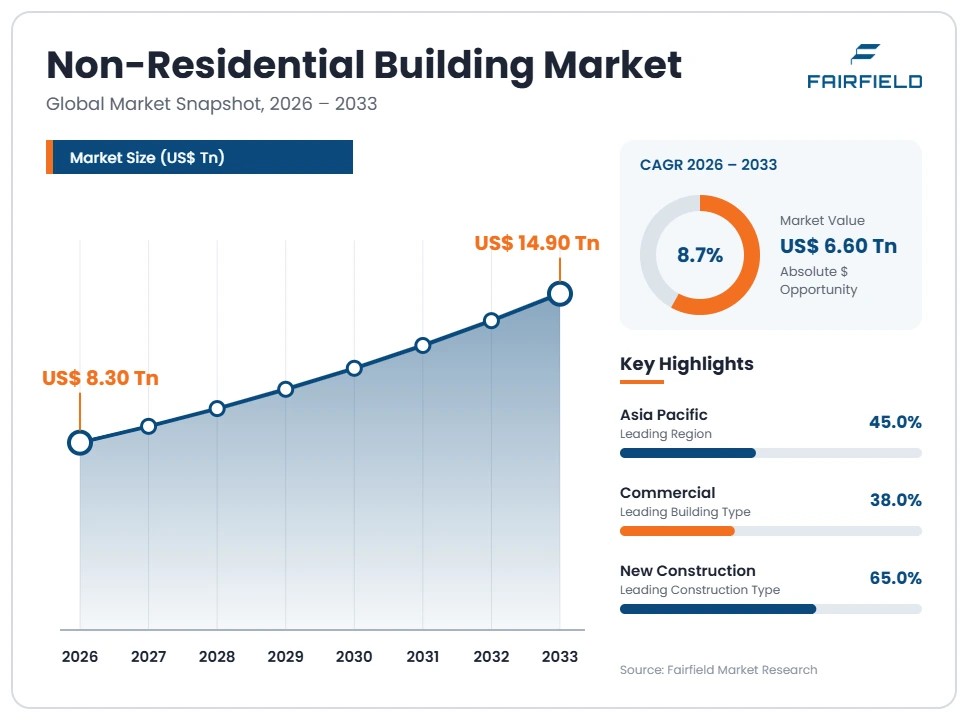
The global non-residential building market size is expected to be valued at US$ 8.30 trillion in 2026 and projected to reach US$ 14.90 trillion by 2033, growing at a CAGR of 8.7% between 2026 and 2033.
Between 2020 and 2025, the market grew at a CAGR of about 6.9%, as pandemic delays gave way to strong spending on warehouses, factories, hospitals, and public buildings, while office construction slowed with hybrid work. Non-residential buildings include offices, retail centers, hotels, warehouses, factories, data centers, healthcare facilities, schools, universities, airports, and government buildings. Three factors now drive growth: the boom in data centers for AI and cloud computing, government spending on infrastructure, health, and education, and new manufacturing plants for batteries, chips, and clean energy. The market is shifting toward green buildings with lower energy use, modular construction that speeds delivery, digital design tools such as building information modeling, and renovation of older buildings. In June 2026, US Census Bureau data showed that data centers construction spending topped US$ 50 billion on an annualized basis in April 2026 for the first time, underlining the scale of AI-driven commercial construction.
Key Report Takeaways
- By Building Type: Commercial held 38.0% share in 2026, while Healthcare Facilities are projected to expand at a 9.8% CAGR through 2033, driven by ageing populations, hospital modernization, and investment in clinics and laboratories.
- By Construction Type: New Construction held 65.0% share in 2026, while Renovation & Retrofit is projected to expand at a 9.4% CAGR through 2033, driven by energy efficiency rules, office conversions, and ageing building stock.
- By End User: Private Sector held 55.0% share in 2026, while Public-Private Partnerships are projected to expand at a 10.1% CAGR through 2033, driven by government demand for schools, hospitals, and transport buildings with private financing.
- By Region: Asia Pacific held 45.0% share in 2026, while Middle East & Africa is projected to expand at a 9.0% CAGR through 2033, driven by mega-projects in Saudi Arabia and the United Arab Emirates.
Global Non-Residential Building Market Trends and Insights
Drivers Impact Analysis
Two drivers carry the strongest influence on non-residential building demand during the forecast period.
| Driver | Impact on CAGR Forecast | Geographic Relevance | Impact Timeline |
| Data center, factory, and logistics construction | High | North America, Asia Pacific, Europe | Medium term (2–4 years) |
| Public investment in health, education, and civic buildings | High | Global | Long term (≥4 years) |
Data Center and Factory Construction Is Driving the Non-Residential Building Market
Data center, factory, and logistics construction is the strongest driver of the non-residential building market. Technology and industrial investment is creating huge building programs.
The mechanism is massive spending by technology and manufacturing companies. AI and cloud computing require large data centers with heavy power and cooling systems, and companies such as Microsoft, Amazon, Google, and Meta are spending tens of billions of dollars a year on new campuses. Skanska signed a US$ 1.2 billion contract to build four US data centers in August 2026. Governments support new factories for semiconductors, batteries, and electric vehicles, especially in the United States, Europe, India, and Japan. E-commerce and supply chain changes drive warehouse and logistics construction. Each project requires engineering, steel, concrete, electrical, and mechanical work. These investments create a large pipeline of high-value commercial construction projects.
Public Investment Is Expanding the Non-Residential Building Market
Public investment in health, education, and civic buildings is expanding the non-residential building market. Governments need modern public facilities.
The cause is population growth, ageing, and urbanization. Ageing populations need more hospitals, clinics, and care homes, and many existing healthcare facilities are outdated. Growing cities need schools, universities, courts, and government offices. Airports and transport terminals are expanding as travel recovers. Governments in Asia Pacific and Middle East & Africa are building new cities and civic centers. Public-private partnerships let governments use private capital and expertise. Stimulus and infrastructure laws in the United States and Europe fund public buildings. These programs provide a steady base of demand through economic cycles, because public budgets for health and education are less sensitive to interest rates than private development. Multilateral banks also fund schools and hospitals in developing countries, adding further demand.
Restraints Impact Analysis
Two restraints limit how quickly the non-residential building market grows.
| Restraint | Impact on CAGR Forecast | Geographic Relevance | Impact Timeline |
| High material costs, interest rates, and labor shortages | High | Global | Medium term (2–4 years) |
| Weak office and retail demand | Medium | North America, Europe | Medium term (2–4 years) |
Cost Pressures Slow the Non-Residential Building Market
High material costs, interest rates, and labor shortages slow the non-residential building market. Building has become more expensive.
The specific causes are inflation and tight labor markets. Prices of steel, cement, copper, electrical equipment, and other materials rose sharply after 2020, and tariffs added to costs in some countries. Higher interest rates increase financing costs for developers and make some projects uneconomic. Skilled trades such as electricians, welders, and equipment operators are in short supply in North America, Europe, and Japan. Long lead times for transformers and switchgear delay data centers and factories. Contractors face fixed-price risks when costs rise, and disputes over cost overruns have hurt several large firms in recent years. These factors delay or cancel some projects and squeeze contractor margins.
Weak Office Demand Restricts the Non-Residential Building Market
Weak office and retail demand restricts the non-residential building market. Some building types face structural decline.
The underlying causes are hybrid work and online shopping. Office vacancy rates in many cities in the United States and Europe remain high because companies need less space with hybrid work. New office construction has fallen sharply. Online shopping reduces demand for new shopping malls and stores. Some developers are converting offices to housing or other uses, which shifts work from new construction to renovation. Lenders are cautious about commercial real estate. These trends limit growth in traditional commercial construction segments. However, high-quality, energy-efficient offices in prime locations still attract tenants, and some developers are focusing on these premium buildings while older stock is renovated or repurposed.
Market Opportunities
Green Retrofits and Renovation Open a Fast-Growth Revenue Pool
Green buildings and energy retrofits open a fast-growth revenue pool in the non-residential building market. Older buildings must cut energy use and emissions.
Contractors, engineering firms, and building product makers can capture this opportunity. Buildings account for a large share of global energy use and carbon emissions. Rules such as the European Union Energy Performance of Buildings Directive and local laws in New York require owners to upgrade buildings. Retrofits include insulation, efficient heating and cooling, heat pumps, smart controls, and solar panels. Office-to-residential and office-to-laboratory conversions add work. Green building certifications raise property values. Companies with retrofit expertise can win steady, recurring projects. Energy service contracts, where savings pay for upgrades, help owners finance work without large upfront costs.
Modular and Digital Construction Create an Efficiency Revenue Pool
Modular construction and digital tools create an efficiency revenue pool in the non-residential building market. Builders want faster, cheaper delivery.
Construction and technology firms can capture this opportunity. Factory-built modules for hospitals, schools, hotels, and data centers reduce site work, labor needs, and schedules. Building information modeling, digital twins, drones, and AI improve planning and reduce errors. Prefabricated electrical and mechanical systems speed data center construction. Robotics and 3D printing are being tested on sites. Companies that combine design, manufacturing, and construction can deliver projects faster and more predictably. Hyperscale data center operators increasingly prefer standardized, repeatable designs that can be built quickly in many locations, which suits modular methods. Mass timber is also gaining use in offices and schools as a lower-carbon material.
Segment Analysis
- By Building Type: Commercial Leads While Healthcare Facilities Grow Fastest
Commercial held 38.0% share in 2026, the largest of any building type. Offices, retail centers, hotels, warehouses, and data centers make up the largest share of non-residential spending. Turner Construction, Skanska, China State Construction Engineering Corporation, and Vinci build major commercial projects, including offices, data centers, hotels, and logistics warehouses.
Healthcare Facilities are the fastest-growing building type, expanding at a 9.8% CAGR through 2033. Hospitals, outpatient centers, laboratories, and care homes are expanding to serve ageing populations and new treatments. Industrial, institutional, educational, and government buildings are other important types. For the market, healthcare growth adds complex, high-value projects that require specialist contractors. Industrial buildings, including chip, battery, and pharmaceutical plants, are another fast-growing type.
- By Construction Type: New Construction Leads While Renovation & Retrofit Grows Fastest
New Construction held 65.0% share in 2026. New data centers, factories, hospitals, and public buildings dominate spending, especially in Asia Pacific and Middle East & Africa, where cities are growing fast.
Renovation & Retrofit is the fastest-growing construction type, expanding at a 9.4% CAGR through 2033. Energy upgrades, office conversions, and modernization of ageing buildings are increasing. For the market, retrofit growth balances cycles in new construction. Many buildings in Europe and North America were built before modern energy codes and need new heating, cooling, lighting, and insulation to meet climate targets. Seismic upgrades, accessibility improvements, and fire safety work add further renovation demand. Retrofit projects are often smaller but more numerous and less sensitive to interest rates.
- By End User: Private Sector Leads While Public-Private Partnerships Grow Fastest
Private Sector held 55.0% share in 2026. Technology companies, manufacturers, developers, retailers, and hotel groups fund most non-residential buildings.
Public-Private Partnerships are the fastest-growing end user, expanding at a 10.1% CAGR through 2033. Governments use private finance to build hospitals, schools, and courts. The public sector also funds many projects directly. For the market, partnership growth adds long-term contracts that often include design, construction, financing, and maintenance for 20 to 30 years. Countries such as the United Kingdom, Canada, Australia, and India have well-established partnership programs. Public sector projects funded directly by governments remain important for schools, defense, and civic buildings, and they provide stable work when private investment slows.
Geography Analysis
- North America Builds the Non-Residential Building Market Through Data Centers and Factories
North America is a major non-residential building market. The United States leads the world in data center construction, and federal incentives support new chip and battery factories. Turner Construction, Bechtel, Kiewit, and Skanska USA are key builders with large technology and industrial backlogs. Canada adds institutional projects such as hospitals, universities, and transit stations, often delivered through partnership programs with private builders. Hospitals, universities, and airports are also expanding. Key barriers include labor shortages and long lead times for electrical equipment. One change shaping the region is AI data centers, which now attract record construction spending.
- Europe Builds the Non-Residential Building Market Through Renovation and Public Projects
Europe is a major non-residential building market. Germany, France, the United Kingdom, Spain, and Italy invest in hospitals, transport buildings, and energy retrofits. Vinci, Bouygues Construction, ACS Group, HOCHTIEF, and STRABAG are regional leaders with strong positions in public projects. The European Union’s climate and energy rules require large-scale upgrades of public and commercial buildings. Rising defense spending is also increasing construction of military bases and facilities across the region. Key barriers include weak office demand, high interest rates, and slow permitting. One opportunity is green retrofits of existing buildings.
- Which Region Is Leading the Non-Residential Building Market?
Asia Pacific is leading the non-residential building market with a 45.0% share in 2026. China and India drive demand through factories, airports, metro stations, hospitals, and commercial projects, and Japan and Australia invest heavily in data centers, hospitals, and transport hubs. China State Construction Engineering Corporation and Larsen & Toubro are major players with large order books. Vietnam, Indonesia, and Malaysia are attracting many new factories and data centers. Key barriers include property weakness in China, local government debt, and financing limits. One change shaping the region is manufacturing investment as companies diversify supply chains.
- Latin America Grows the Non-Residential Building Market Through Nearshoring
Latin America is a growing non-residential building market. Mexico is building factories and warehouses as companies move production closer to the United States, and Brazil invests in logistics and data centers. Industrial parks in northern Mexico are filling with manufacturing plants for automotive, electronics, and medical device makers. Chile, Peru, and Colombia invest in hospitals, airports, and schools through public-private partnership programs. Data center operators are building large campuses in São Paulo and Querétaro. Key barriers include high financing costs, currency swings, and political uncertainty. One opportunity is industrial parks serving large global manufacturers.
- Which Region Is Growing Fastest in the Non-Residential Building Market?
Middle East & Africa is growing fastest in the non-residential building market at a 9.0% CAGR through 2033. Saudi Arabia is building new cities, airports, and tourism projects, and the United Arab Emirates invests in commercial and data center projects. Qatar and Egypt are investing in civic, commercial, and tourism buildings, and Egypt is building a new administrative capital. Hospitals, universities, and data centers are expanding across the region. Nigeria, Kenya, and South Africa have growing commercial and industrial construction. Key barriers include funding pressures and delays in some large projects. One change shaping the region is mega-projects led by sovereign wealth funds.
Competitive Landscape
The non-residential building market is fragmented. China State Construction Engineering Corporation, Vinci, ACS Group, Bouygues Construction, and Skanska are among the largest contractors, while Larsen & Toubro, Bechtel, HOCHTIEF, STRABAG, Turner Construction, Obayashi, and Kajima are major players. Thousands of regional contractors also compete.
Companies compete on price, track record, safety, technical expertise, financing, and local presence. Data center experience is valuable, because these projects need specialist electrical, cooling, and commissioning skills, and clients repeat work with trusted builders. Chinese contractors win large projects in Asia Pacific and Middle East & Africa with competitive financing. European groups have strong positions in public-private partnerships. Local contractors dominate smaller projects. Consolidation and joint ventures help firms bid on very large projects.
Strategic moves show how competition is changing. In March 2026, Skanska signed a US$ 191 million US data center contract. In June 2026, US data center construction spending topped US$ 50 billion annualized. In August 2026, Skanska signed a US$ 1.2 billion contract for four data centers. These moves show competition shifting toward data centers and other technology buildings, where contractors with specialist mechanical and electrical skills can win repeat, large-scale work from a small number of very large clients.
Three themes shape vendor strategy. First, companies are targeting data centers. Second, they are expanding retrofits. Third, they are using modular and digital methods. Vendors that combine technical expertise, strong balance sheets, and global delivery capacity are best placed to win share.
Recent Industry Developments
- August 2026: Skanska signed a US$ 1.2 billion contract to build four data centers in the southeastern United States, with construction from 2026 to 2028 – shows the scale of data centers demand.
- June 2026: US Census Bureau data showed data center construction spending topped US$ 50 billion on an annualized basis in April 2026 for the first time – confirms AI-driven commercial construction growth.
- March 2026: Skanska signed a US$ 191 million contract to build a data center in the United States – adds to a growing pipeline of technology buildings.
Companies Covered in the Report
- China State Construction Engineering Corporation
- Vinci
- ACS Group
- Bouygues Construction
- Skanska
- Larsen & Toubro
- Bechtel
- HOCHTIEF
- STRABAG
- Turner Construction
- Obayashi
- Kajima
Non-Residential Building Market Report Scope
| Metric | Value |
| Study Period | 2020–2033 |
| Market Size 2026 | US$ 8.30 Trillion |
| Market Size 2033 | US$ 14.90 Trillion |
| CAGR 2026–2033 | 8.7% |
| Absolute Dollar Opportunity | US$ 6.60 Trillion |
| Largest Market | Asia Pacific |
| Fastest-Growing Market | Middle East & Africa |
| Market Concentration | Fragmented |
| Major Players | China State Construction Engineering Corporation, Vinci, ACS Group, Bouygues Construction, Skanska |
Non-Residential Building Market Segmentation
Building Type
- Commercial
- Industrial
- Institutional
- Healthcare Facilities
- Educational
- Government
Construction Type
- New Construction
- Renovation & Retrofit
End User
- Private Sector
- Public Sector
- Public-Private Partnerships
Regions
- North America
- Europe
- Asia Pacific
- Latin America
- Middle East & Africa
- Executive Summary
- Global Non-Residential Building Market Snapshot
- Future Projections
- Key Report Takeaways
- Regional Snapshot
- Market Overview
- Market Definition and Report Scope
- Historical Trends 2020–2025
- Market Dynamics
- Drivers
- Data Center and Factory Construction Is Driving the Non-Residential Building Market
- Public Investment Is Expanding the Non-Residential Building Market
- Restraints
- Cost Pressures Slow the Non-Residential Building Market
- Weak Office Demand Restricts the Non-Residential Building Market
- Market Opportunities
- Green Retrofits and Renovation Open a Fast-Growth Revenue Pool
- Modular and Digital Construction Create an Efficiency Revenue Pool
- Drivers
- Global Non-Residential Building Market Outlook, 2020-2033
- Global Non-Residential Building Market Outlook, by Building Type, Value (US$ Trillion), 2020-2033
- Commercial
- Industrial
- Institutional
- Healthcare Facilities
- Educational
- Government
- Global Non-Residential Building Market Outlook, by Construction Type, Value (US$ Trillion), 2020-2033
- New Construction
- Renovation & Retrofit
- Global Non-Residential Building Market Outlook, by End User, Value (US$ Trillion), 2020-2033
- Private Sector
- Public Sector
- Public-Private Partnerships
- Global Non-Residential Building Market Outlook, by Region, Value (US$ Trillion), 2020-2033
- North America
- Europe
- Asia Pacific
- Latin America
- Middle East & Africa
- Global Non-Residential Building Market Outlook, by Building Type, Value (US$ Trillion), 2020-2033
- North America Non-Residential Building Market Outlook, 2020-2033
- North America Non-Residential Building Market Outlook, by Building Type, Value (US$ Trillion), 2020-2033
- Commercial
- Industrial
- Institutional
- Healthcare Facilities
- Educational
- Government
- North America Non-Residential Building Market Outlook, by Construction Type, Value (US$ Trillion), 2020-2033
- New Construction
- Renovation & Retrofit
- North America Non-Residential Building Market Outlook, by End User, Value (US$ Trillion), 2020-2033
- Private Sector
- Public Sector
- Public-Private Partnerships
- North America Non-Residential Building Market Outlook, by Country, Value (US$ Trillion), 2020-2033
- United States Non-Residential Building Market Outlook, by Building Type, 2020-2033
- United States Non-Residential Building Market Outlook, by Construction Type, 2020-2033
- United States Non-Residential Building Market Outlook, by End User, 2020-2033
- Canada Non-Residential Building Market Outlook, by Building Type, 2020-2033
- Canada Non-Residential Building Market Outlook, by Construction Type, 2020-2033
- Canada Non-Residential Building Market Outlook, by End User, 2020-2033
- North America Non-Residential Building Market Outlook, by Building Type, Value (US$ Trillion), 2020-2033
- Europe Non-Residential Building Market Outlook, 2020-2033
- Europe Non-Residential Building Market Outlook, by Building Type, Value (US$ Trillion), 2020-2033
- Commercial
- Industrial
- Institutional
- Healthcare Facilities
- Educational
- Government
- Europe Non-Residential Building Market Outlook, by Construction Type, Value (US$ Trillion), 2020-2033
- New Construction
- Renovation & Retrofit
- Europe Non-Residential Building Market Outlook, by End User, Value (US$ Trillion), 2020-2033
- Private Sector
- Public Sector
- Public-Private Partnerships
- Europe Non-Residential Building Market Outlook, by Country, Value (US$ Trillion), 2020-2033
- Germany Non-Residential Building Market Outlook, by Building Type, 2020-2033
- Germany Non-Residential Building Market Outlook, by Construction Type, 2020-2033
- Germany Non-Residential Building Market Outlook, by End User, 2020-2033
- France Non-Residential Building Market Outlook, by Building Type, 2020-2033
- France Non-Residential Building Market Outlook, by Construction Type, 2020-2033
- France Non-Residential Building Market Outlook, by End User, 2020-2033
- United Kingdom Non-Residential Building Market Outlook, by Building Type, 2020-2033
- United Kingdom Non-Residential Building Market Outlook, by Construction Type, 2020-2033
- United Kingdom Non-Residential Building Market Outlook, by End User, 2020-2033
- Spain Non-Residential Building Market Outlook, by Building Type, 2020-2033
- Spain Non-Residential Building Market Outlook, by Construction Type, 2020-2033
- Spain Non-Residential Building Market Outlook, by End User, 2020-2033
- Italy Non-Residential Building Market Outlook, by Building Type, 2020-2033
- Italy Non-Residential Building Market Outlook, by Construction Type, 2020-2033
- Italy Non-Residential Building Market Outlook, by End User, 2020-2033
- Europe Non-Residential Building Market Outlook, by Building Type, Value (US$ Trillion), 2020-2033
- Asia Pacific Non-Residential Building Market Outlook, 2020-2033
- Asia Pacific Non-Residential Building Market Outlook, by Building Type, Value (US$ Trillion), 2020-2033
- Commercial
- Industrial
- Institutional
- Healthcare Facilities
- Educational
- Government
- Asia Pacific Non-Residential Building Market Outlook, by Construction Type, Value (US$ Trillion), 2020-2033
- New Construction
- Renovation & Retrofit
- Asia Pacific Non-Residential Building Market Outlook, by End User, Value (US$ Trillion), 2020-2033
- Private Sector
- Public Sector
- Public-Private Partnerships
- Asia Pacific Non-Residential Building Market Outlook, by Country, Value (US$ Trillion), 2020-2033
- China Non-Residential Building Market Outlook, by Building Type, 2020-2033
- China Non-Residential Building Market Outlook, by Construction Type, 2020-2033
- China Non-Residential Building Market Outlook, by End User, 2020-2033
- India Non-Residential Building Market Outlook, by Building Type, 2020-2033
- India Non-Residential Building Market Outlook, by Construction Type, 2020-2033
- India Non-Residential Building Market Outlook, by End User, 2020-2033
- Japan Non-Residential Building Market Outlook, by Building Type, 2020-2033
- Japan Non-Residential Building Market Outlook, by Construction Type, 2020-2033
- Japan Non-Residential Building Market Outlook, by End User, 2020-2033
- Australia Non-Residential Building Market Outlook, by Building Type, 2020-2033
- Australia Non-Residential Building Market Outlook, by Construction Type, 2020-2033
- Australia Non-Residential Building Market Outlook, by End User, 2020-2033
- Vietnam Non-Residential Building Market Outlook, by Building Type, 2020-2033
- Vietnam Non-Residential Building Market Outlook, by Construction Type, 2020-2033
- Vietnam Non-Residential Building Market Outlook, by End User, 2020-2033
- Indonesia Non-Residential Building Market Outlook, by Building Type, 2020-2033
- Indonesia Non-Residential Building Market Outlook, by Construction Type, 2020-2033
- Indonesia Non-Residential Building Market Outlook, by End User, 2020-2033
- Malaysia Non-Residential Building Market Outlook, by Building Type, 2020-2033
- Malaysia Non-Residential Building Market Outlook, by Construction Type, 2020-2033
- Malaysia Non-Residential Building Market Outlook, by End User, 2020-2033
- Asia Pacific Non-Residential Building Market Outlook, by Building Type, Value (US$ Trillion), 2020-2033
- Latin America Non-Residential Building Market Outlook, 2020-2033
- Latin America Non-Residential Building Market Outlook, by Building Type, Value (US$ Trillion), 2020-2033
- Commercial
- Industrial
- Institutional
- Healthcare Facilities
- Educational
- Government
- Latin America Non-Residential Building Market Outlook, by Construction Type, Value (US$ Trillion), 2020-2033
- New Construction
- Renovation & Retrofit
- Latin America Non-Residential Building Market Outlook, by End User, Value (US$ Trillion), 2020-2033
- Private Sector
- Public Sector
- Public-Private Partnerships
- Latin America Non-Residential Building Market Outlook, by Country, Value (US$ Trillion), 2020-2033
- Mexico Non-Residential Building Market Outlook, by Building Type, 2020-2033
- Mexico Non-Residential Building Market Outlook, by Construction Type, 2020-2033
- Mexico Non-Residential Building Market Outlook, by End User, 2020-2033
- Brazil Non-Residential Building Market Outlook, by Building Type, 2020-2033
- Brazil Non-Residential Building Market Outlook, by Construction Type, 2020-2033
- Brazil Non-Residential Building Market Outlook, by End User, 2020-2033
- Chile Non-Residential Building Market Outlook, by Building Type, 2020-2033
- Chile Non-Residential Building Market Outlook, by Construction Type, 2020-2033
- Chile Non-Residential Building Market Outlook, by End User, 2020-2033
- Peru Non-Residential Building Market Outlook, by Building Type, 2020-2033
- Peru Non-Residential Building Market Outlook, by Construction Type, 2020-2033
- Peru Non-Residential Building Market Outlook, by End User, 2020-2033
- Colombia Non-Residential Building Market Outlook, by Building Type, 2020-2033
- Colombia Non-Residential Building Market Outlook, by Construction Type, 2020-2033
- Colombia Non-Residential Building Market Outlook, by End User, 2020-2033
- Latin America Non-Residential Building Market Outlook, by Building Type, Value (US$ Trillion), 2020-2033
- Middle East & Africa Non-Residential Building Market Outlook, 2020-2033
- Middle East & Africa Non-Residential Building Market Outlook, by Building Type, Value (US$ Trillion), 2020-2033
- Commercial
- Industrial
- Institutional
- Healthcare Facilities
- Educational
- Government
- Middle East & Africa Non-Residential Building Market Outlook, by Construction Type, Value (US$ Trillion), 2020-2033
- New Construction
- Renovation & Retrofit
- Middle East & Africa Non-Residential Building Market Outlook, by End User, Value (US$ Trillion), 2020-2033
- Private Sector
- Public Sector
- Public-Private Partnerships
- Middle East & Africa Non-Residential Building Market Outlook, by Country, Value (US$ Trillion), 2020-2033
- Saudi Arabia Non-Residential Building Market Outlook, by Building Type, 2020-2033
- Saudi Arabia Non-Residential Building Market Outlook, by Construction Type, 2020-2033
- Saudi Arabia Non-Residential Building Market Outlook, by End User, 2020-2033
- United Arab Emirates Non-Residential Building Market Outlook, by Building Type, 2020-2033
- United Arab Emirates Non-Residential Building Market Outlook, by Construction Type, 2020-2033
- United Arab Emirates Non-Residential Building Market Outlook, by End User, 2020-2033
- Qatar Non-Residential Building Market Outlook, by Building Type, 2020-2033
- Qatar Non-Residential Building Market Outlook, by Construction Type, 2020-2033
- Qatar Non-Residential Building Market Outlook, by End User, 2020-2033
- Egypt Non-Residential Building Market Outlook, by Building Type, 2020-2033
- Egypt Non-Residential Building Market Outlook, by Construction Type, 2020-2033
- Egypt Non-Residential Building Market Outlook, by End User, 2020-2033
- Nigeria Non-Residential Building Market Outlook, by Building Type, 2020-2033
- Nigeria Non-Residential Building Market Outlook, by Construction Type, 2020-2033
- Nigeria Non-Residential Building Market Outlook, by End User, 2020-2033
- Kenya Non-Residential Building Market Outlook, by Building Type, 2020-2033
- Kenya Non-Residential Building Market Outlook, by Construction Type, 2020-2033
- Kenya Non-Residential Building Market Outlook, by End User, 2020-2033
- South Africa Non-Residential Building Market Outlook, by Building Type, 2020-2033
- South Africa Non-Residential Building Market Outlook, by Construction Type, 2020-2033
- South Africa Non-Residential Building Market Outlook, by End User, 2020-2033
- Middle East & Africa Non-Residential Building Market Outlook, by Building Type, Value (US$ Trillion), 2020-2033
- Competitive Landscape
- Market Concentration and Industry Leaders
- Competitive Differentiation
- Strategic Moves and Market Direction
- Recent Industry Developments
- Company Profiles
- China State Construction Engineering Corporation
- Vinci
- ACS Group
- Bouygues Construction
- Skanska
- Larsen & Toubro
- Bechtel
- HOCHTIEF
- STRABAG
- Turner Construction
- Obayashi
- Kajima
- Appendix
- Research Methodology
- Report Assumptions
- Acronyms and Abbreviations
Building Type
- Commercial
- Industrial
- Institutional
- Healthcare Facilities
- Educational
- Government
Construction Type
- New Construction
- Renovation & Retrofit
End User
- Private Sector
- Public Sector
- Public-Private Partnerships
Regions
- North America
- Europe
- Asia Pacific
- Latin America
- Middle East & Africa
Our Research Methodology
Considering the volatility of business today, traditional approaches to strategizing a game plan can be unfruitful if not detrimental. True ambiguity is no way to determine a forecast. A myriad of predetermined factors must be accounted for such as the degree of risk involved, the magnitude of circumstances, as well as conditions or consequences that are not known or unpredictable. To circumvent binary views that cast uncertainty, the application of market research intelligence to strategically posture, move, and enable actionable outcomes is necessary.
View Methodology
Quality Assured
Rigorous Validation Process

Confidentiality Assured
End-to-end Data Security

Custom Research Services
Tailored To Your Objectives
FAQs
The non-residential building market is valued at US$ 8.30 trillion in 2026, led by commercial buildings and Asia Pacific.
The market is projected to reach US$ 14.90 trillion by 2033, growing at an 8.7% CAGR and adding US$ 6.60 trillion.
Healthcare facilities are growing fastest at a 9.8% CAGR through 2033, driven by ageing populations and hospital modernization worldwide.
Middle East & Africa is growing fastest at a 9.0% CAGR through 2033, driven by mega-projects in Saudi Arabia and the UAE.
Asia Pacific holds the largest share at 45.0% in 2026, supported by factories, airports, and hospitals in China and India.
Related Reports
Conveying Equipment Market Size, Share, Insights, Competitive Landscape, and Forecast 2026 to 2033
Explore the conveying equipment market, projected to reach US$ 56.9 billion by 2033 at a 4.5% CAGR, with equipment, services and regional insights.
Bakery Packaging Machine Market Size, Share, Insights, Competitive Landscape, and Forecast 2026 to 2033
Explore the bakery packaging machine market, projected to reach US$ 4.44 billion by 2033 at a 4.6% CAGR, with automation, machine and regional insights.
EPC Construction Market Size, Share, Insights, Competitive Landscape, and Forecast 2026 to 2033
EPC construction market to grow from US$ 331.5 billion in 2026 to US$ 424.6 billion by 2033 at a 3.6% CAGR. Explore services, contracts and regional trends.
Hydraulic Manifold Market Size, Share, Insights, Competitive Landscape, and Forecast 2026 to 2033
Hydraulic manifold market to grow from US$ 750.0 million in 2026 to US$ 947.8 million by 2033 at a 3.4% CAGR. Explore types, applications and regional trends.
Hydrogen Compressor Market Size, Share, Insights, Competitive Landscape, and Forecast 2026 to 2033
Hydrogen compressor market to grow from US$ 3.3 billion in 2026 to US$ 4.7 billion by 2033 at a 5.2% CAGR. Explore types, end users and regional insights.
Pet Food Extrusion Market Size, Share, Insights, Competitive Landscape, and Forecast 2026 to 2033
The global pet food extrusion market is valued at US$2.29 billion in 2026, reaching US$3.68 billion by 2033, growing at a 7.0% CAGR