



Hydrogen Compressor Market
Hydrogen Compressor Market Size, Share, Insights, Competitive Landscape, and Forecast 2026 to 2033
Hydrogen Compressor Market Size and Trend Analysis
How Fast Is the Hydrogen Compressor Market Growing?
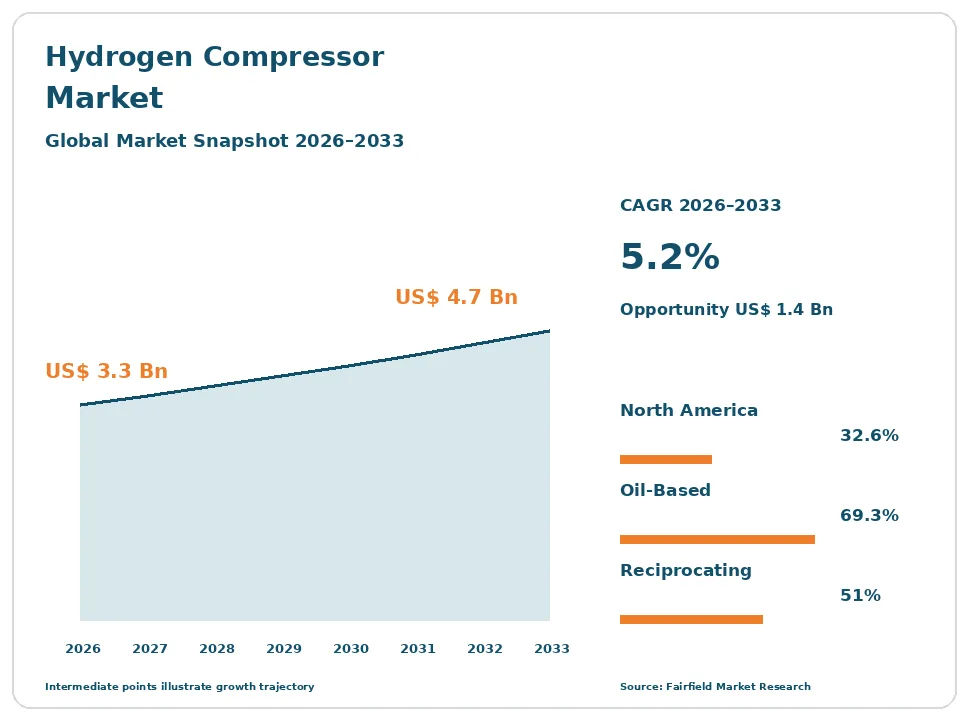
The global hydrogen compressor market size is expected to be valued at US$ 3.3 billion in 2026 and projected to reach US$ 4.7 billion by 2033, growing at a CAGR of 5.2% between 2026 and 2033.
Between 2020 and 2025, the market grew at a CAGR of about 4.3%, supported by steady demand from refineries and chemical plants and a new wave of orders tied to clean hydrogen projects, fueling stations, and pipeline pilots. A hydrogen compressor raises the pressure of hydrogen gas so it can be stored, moved through pipelines, loaded into trailers, or dispensed into vehicles. Because hydrogen molecules are tiny and light, compressors must handle leaks, embrittlement, and high pressure ratios, using reciprocating, diaphragm, centrifugal, ionic, and liquid-piston designs. Refineries use hydrogen for desulfurization and hydrocracking, while ammonia and methanol plants need large volumes. Growth comes from green hydrogen production, hydrogen refueling station buildouts, and decarbonization of industry. The market is shifting toward oil-free and high-pressure hydrogen compression for clean energy uses. In March 2026, Kawasaki Heavy Industries began testing a centrifugal compressor with 100% pure hydrogen.
Key Report Takeaways
- By Lubrication Type: Oil-Based held 69.3% share in 2026, while Oil-Free is projected to expand at a 6.4% CAGR through 2033, driven by fuel cell vehicles, electrolyzer plants, and other uses that require ultra-pure hydrogen without oil contamination.
- By End User: Petrochemical & Chemical held 45.8% share in 2026, while Hydrogen Mobility & Refueling is projected to expand at a 8.9% CAGR through 2033, driven by fueling stations for trucks, buses, and trains.
- By Compressor Type: Reciprocating held 51.0% share in 2026, while Diaphragm is projected to expand at a 7.1% CAGR through 2033, driven by high-pressure, leak-tight compression needs at fueling stations and in laboratory and electronics applications.
- By Region: North America held 32.6% share in 2026, while Asia Pacific is projected to expand at a 6.8% CAGR through 2033, driven by hydrogen strategies, fuel cell vehicle programs, and large electrolysis projects in China, Japan, South Korea, and India.
Global Hydrogen Compressor Market Trends and Insights
Drivers Impact Analysis
| Driver | Impact on CAGR Forecast | Geographic Relevance | Impact Timeline |
| Clean hydrogen production and industrial decarbonization | High | Global | Long term (≥4 years) |
| Refinery and chemical hydrogen demand | Medium | North America, Asia Pacific, Middle East & Africa | Medium term (2-4 years) |
Two drivers carry the strongest influence on hydrogen compressor demand during the forecast period.
Clean Hydrogen Projects Are Driving the Hydrogen Compressor Market
Clean hydrogen production and industrial decarbonization are the strongest driver of the hydrogen compressor market. Every hydrogen value chain needs compression.
The mechanism is investment in low-carbon hydrogen. Governments in the United States, Europe, Japan, South Korea, China, and India have hydrogen strategies with funding for electrolysis plants, pipelines, storage, and fueling. Electrolyzers typically produce hydrogen at low pressure, so compressors are needed to feed storage tanks, pipelines, ammonia synthesis, and trailers. Steel makers are testing hydrogen-based direct reduction, and voestalpine installed two 500 bar compressors at its H2Future pilot plant in Austria in March 2026. The U.S. Department of Energy issued a US$ 1.66 billion loan guarantee to Plug Power for hydrogen production plants. Each project creates demand for hydrogen compression equipment, service, and spare parts. These investments build a long-term order pipeline for compressor makers.
Refinery and Chemical Demand Is Expanding the Hydrogen Compressor Market
Refinery and chemical hydrogen demand is expanding the hydrogen compressor market. Industry still uses most of the world’s hydrogen.
The cause is steady demand for fuels and chemicals. Refineries use hydrogen to remove sulfur from diesel and gasoline and to upgrade heavy oil, and stricter fuel standards keep hydrogen use high. Ammonia plants for fertilizer and methanol plants need large compressors. New refinery and petrochemical complexes in Asia Pacific and Middle East & Africa require reciprocating and centrifugal compressors. Existing plants replace and upgrade aging units. Blue hydrogen projects with carbon capture add new orders. Industrial gas companies such as Air Liquide, Linde, and Air Products operate large hydrogen plants and pipelines that rely on compressors. Maintenance, overhauls, and spare parts add recurring revenue. These industrial users provide a stable base of demand.
Restraints Impact Analysis
| Restraint | Impact on CAGR Forecast | Geographic Relevance | Impact Timeline |
| Delays and cancellations of clean hydrogen projects | High | Global | Medium term (2-4 years) |
| Technical challenges and high equipment costs | Medium | Global | Long term (≥4 years) |
Two restraints limit how quickly the hydrogen compressor market grows.
Project Delays Slow the Hydrogen Compressor Market
Delays and cancellations of clean hydrogen projects slow the hydrogen compressor market. Many projects have not reached final investment decisions.
The specific causes are high costs and policy uncertainty. Green hydrogen remains much more expensive than hydrogen made from natural gas, and industrial buyers are reluctant to sign long-term offtake contracts at higher prices. Changes to subsidies, tax credits, and certification rules create uncertainty for developers and their lenders. Several large projects in Europe, Australia, and North America have been delayed, scaled back, or cancelled since 2024. Fuel cell car sales remain low, and some public fueling stations have closed because of low use and high operating costs. Electrolyzer makers have also faced financial strain. These delays push compressor orders into later years, create lumpy demand, and slow overall market growth even as long-term targets remain in place.
Technical Challenges Restrict the Hydrogen Compressor Market
Technical challenges and high equipment costs restrict the hydrogen compressor market. Hydrogen is one of the hardest gases to compress.
The underlying causes are hydrogen’s physical properties. Its very low molecular weight means centrifugal compressors need many stages or very high tip speeds, which stresses impellers, while reciprocating units face piston ring and valve wear that requires frequent maintenance. Hydrogen embrittles some steels and alloys, so builders must use special materials, seals, and designs. Leaks must be prevented because hydrogen is flammable over a wide range of concentrations. Compressor failures are a leading cause of fueling station downtime, which hurts customer confidence. Specialized engineers and service technicians are in short supply. Noise and vibration from large machines also require careful site design. These challenges raise purchase and maintenance costs and slow adoption in new applications.
Market Opportunities
Hydrogen Refueling Networks Open a Fast-Growth Revenue Pool
Hydrogen refueling station networks open a fast-growth revenue pool in the hydrogen compressor market. Heavy transport needs high-pressure fueling.
Compressor makers and station builders can capture this opportunity. Fuel cell trucks, buses, trains, ships, and forklifts need fueling at 350 or 700 bar, requiring compact, reliable, oil-free compressors that can run many cycles each day. China, South Korea, Japan, and Europe are funding truck and bus fueling corridors along major freight routes. Ionic and liquid-piston compressors promise lower maintenance and better efficiency than older designs. CATAGEN launched new liquid-piston compressors in September 2025. Standardized, containerized station modules can cut installation time. Companies that deliver reliable, low-cost station compressors with strong service support can win growing orders as fleets expand.
Pipelines, Storage, and Liquefaction Create a Large-Scale Revenue Pool
Pipelines, storage, and liquefaction create a large-scale revenue pool in the hydrogen compressor market. Moving hydrogen in bulk needs very large compressors.
Large compressor makers can capture this opportunity. Hydrogen pipeline networks planned in Europe, including converted natural gas lines, need centrifugal and reciprocating compressors for transmission. Underground storage in salt caverns requires injection and withdrawal compressors. Liquefaction plants use large compressors in their cooling cycles, and Kawasaki Heavy Industries is testing its KM Comp-H2 centrifugal compressor for this use. Ammonia and methanol carriers also need compression at export terminals. Advanced impeller materials, such as carbon fiber composites tested at record tip speeds, may make large centrifugal units more practical. Projects are large and long-lived, which supports multi-year service agreements. Companies that develop efficient large-scale industrial gas compressors can win major contracts.
Segment Analysis
By Lubrication Type: Oil-Based Leads While Oil-Free Grows Fastest
Oil-Based held 69.3% share in 2026. Oil-lubricated reciprocating and screw compressors are widely used in refineries, chemical plants, and industrial gas facilities, where extreme purity is not required and robustness, high flow, and proven reliability matter most. Downstream filters remove traces of oil when needed. Ariel Corporation, Burckhardt Compression, and NEUMAN & ESSER supply many of these machines.
Oil-Free is the fastest-growing lubrication type, expanding at a 6.4% CAGR through 2033. Fuel cells and some electronics processes need ultra-pure hydrogen, so oil-free diaphragm, ionic, liquid-piston, and dry piston compressors are preferred for mobility and electrolysis projects. Oil-free designs also avoid costly purification steps. For the market, oil-free growth reflects rising clean energy demand.
By End User: Petrochemical & Chemical Leads While Hydrogen Mobility & Refueling Grows Fastest
Petrochemical & Chemical held 45.8% share in 2026. Refineries, ammonia plants, methanol plants, and other chemical facilities are the largest users of hydrogen and compressors, operating large machines around the clock. Replacement and upgrade cycles at aging plants provide steady demand.
Hydrogen Mobility & Refueling is the fastest-growing end user, expanding at a 8.9% CAGR through 2033. Fueling stations for buses, trucks, trains, and forklifts need high-pressure compressors, and government programs in Asia Pacific and Europe support station construction. Oil and gas is the second-largest end user, with power generation, steel, and electronics forming other users. Station operators often buy compressors with long-term maintenance contracts to guarantee uptime. For the market, mobility growth adds new and recurring demand.
By Compressor Type: Reciprocating Leads While Diaphragm Grows Fastest
Reciprocating held 51.0% share in 2026. Piston compressors handle high pressure ratios and a wide range of flows, making them the workhorse of refinery, chemical, and pipeline service. They are well understood and supported by large service networks.
Diaphragm is the fastest-growing type, expanding at a 7.1% CAGR through 2033. Diaphragm units keep hydrogen completely separated from lubricants and are leak-tight, making them ideal for fueling stations, laboratories, and high-purity uses. PDC Machines and HAUG Sauer Kompressoren offer diaphragm and specialty designs. Centrifugal compressors serve very large flows in pipelines and liquefaction plants, while screw compressors handle low-pressure gas from electrolyzers. Ionic compressors, which use liquid salts instead of pistons, are gaining interest for fueling stations because they have fewer moving parts and lower energy use. For the market, diaphragm growth supports the fueling buildout.
Geography Analysis
Which Region Is Leading the Hydrogen Compressor Market?
North America is leading the hydrogen compressor market with a 32.6% share in 2026. The United States has large refining, chemical, ammonia, and industrial gas industries that use hydrogen every day, along with federal support for regional clean hydrogen hubs and loan guarantees for production plants. Ariel Corporation, Howden, Sundyne, Ingersoll Rand, and PDC Machines are active in the region, and California has the largest network of hydrogen car fueling stations. Canada adds demand through hydrogen strategies in Alberta and British Columbia. Key barriers include policy uncertainty and slow fuel cell vehicle sales. One change shaping the region is the development of hydrogen hubs.
Europe Advances the Hydrogen Compressor Market Through Hydrogen Strategy
Europe is a major hydrogen compressor market. Germany, Switzerland, the Netherlands, France, and Austria host leading makers such as Siemens Energy, Burckhardt Compression, and NEUMAN & ESSER. The European Union hydrogen strategy funds electrolysis, pipelines, and fueling corridors, and steel makers such as voestalpine are testing hydrogen in production. A planned hydrogen backbone network would need many transmission compressors, and port projects in the Netherlands and Germany plan to import hydrogen and ammonia. Fuel cell bus fleets in several cities need depot fueling with reliable compressors. Key barriers include project delays and high electricity costs. One opportunity is pipeline and storage compression.
Which Region Is Growing Fastest in the Hydrogen Compressor Market?
Asia Pacific is growing fastest in the hydrogen compressor market at a 6.8% CAGR through 2033. China leads in electrolyzer manufacturing and fuel cell trucks, while Japan and South Korea support fuel cell vehicles, power generation, and imported hydrogen. India is building green hydrogen and ammonia projects under its national mission, and completed its first safety assessment of a hydrogen compressor-dispenser system in January 2026. Kawasaki Heavy Industries is testing compressors for liquefaction. Large refinery and chemical complexes in China and India also need new and replacement compressors. Key barriers include high costs and fragmented standards. One change shaping the region is fuel cell truck deployment.
Latin America Grows the Hydrogen Compressor Market Through Green Hydrogen Projects
Latin America is a growing hydrogen compressor market. Chile and Brazil plan large green hydrogen and ammonia projects for export, using strong solar and wind resources, while Mexico and Colombia have refinery and chemical demand. Port-based industrial hubs are being designed for hydrogen production and shipping. Refinery upgrades in Brazil and Mexico also need compressors, and ammonia producers serve large fertilizer markets. International developers and development banks are funding feasibility studies. Key barriers include financing, infrastructure gaps, limited local manufacturing, and long development timelines. One opportunity is green ammonia production for export markets in Europe and Asia Pacific.
Middle East & Africa Develops the Hydrogen Compressor Market Through Export Projects
Middle East & Africa is a developing hydrogen compressor market. Saudi Arabia, Oman, the United Arab Emirates, Egypt, and Morocco are building or planning large hydrogen and ammonia projects for export, while existing refineries and fertilizer plants use large compressors. South Africa and Namibia have green hydrogen plans. Abundant solar energy, wind resources, and land give the region cost advantages for green hydrogen. National oil companies are investing in blue hydrogen with carbon capture, which also needs large compressors. Key barriers include execution risk and financing. One change shaping the region is the rise of hydrogen export hubs.
Competitive Landscape
The hydrogen compressor market is moderately consolidated. Burckhardt Compression, Siemens Energy, Howden, Ariel Corporation, and NEUMAN & ESSER are leading players, while Sundyne, Atlas Copco, Ingersoll Rand, Hitachi, Kawasaki Heavy Industries, HAUG Sauer Kompressoren, and PDC Machines compete strongly. Startups are developing ionic, electrochemical, and liquid-piston compressors that promise fewer moving parts, lower energy use, and less maintenance. Industrial gas companies and engineering contractors also influence compressor selection on large projects.
Companies compete on reliability, efficiency, purity, pressure range, materials expertise, footprint, and after-sales service. Large industrial compressors are long-life assets, so service contracts, spare parts, and upgrades provide recurring revenue. Mobility customers value compact, low-maintenance machines with high uptime and remote monitoring. Digital tools that predict wear and schedule maintenance are becoming a differentiator for leading suppliers. Experience in hydrogen service and safety certifications strongly influences buyer choice.
Strategic moves show how competition is changing. In September 2025, CATAGEN launched liquid-piston compressors at Gastech. In March 2026, Kawasaki Heavy Industries began testing its pure hydrogen centrifugal compressor. In March 2026, voestalpine installed two 500 bar compressors at its steel pilot plant. These moves show competition shifting toward new compressor designs and materials built specifically for clean hydrogen.
Three themes shape vendor strategy. First, companies are developing oil-free and high-pressure designs for mobility. Second, they are scaling centrifugal units for pipelines and liquefaction. Third, they are expanding service networks to improve uptime.
Hydrogen Compressor Market Industry Leaders
- Burckhardt Compression
- Siemens Energy
- Howden
- Ariel Corporation
- NEUMAN & ESSER
Recent Industry Developments
- March 2026: Kawasaki Heavy Industries began demonstration testing of its KM Comp-H2 centrifugal compressor with 100% pure hydrogen for liquefaction plants - advances large-scale hydrogen compression.
- March 2026: voestalpine installed two Hiperbaric compressors rated to 500 bar at its H2Future pilot plant in Austria - supports hydrogen use in steelmaking.
- September 2025: CATAGEN launched its ClimaHtech stationary and mobile liquid-piston compressors at Gastech 2025 in Milan - adds new options for hydrogen refueling station compression.
Companies Covered in the Report
- Burckhardt Compression
- Siemens Energy
- Howden
- Ariel Corporation
- NEUMAN & ESSER
- Sundyne
- Atlas Copco
- Ingersoll Rand
- Hitachi
- Kawasaki Heavy Industries
- HAUG Sauer Kompressoren
- PDC Machines
Hydrogen Compressor Market Report Scope
This report covers hydrogen compressors, including reciprocating, diaphragm, centrifugal, screw, ionic, and liquid-piston designs, in oil-based and oil-free versions, for petrochemical and chemical, oil and gas, hydrogen mobility and refueling, power, steel, and other end users. The base year is 2025, and the forecast period runs from 2026 to 2033. All values are expressed in US$ Billion.
Lubrication Type
- Oil-Based
- Oil-Free
End User
- Petrochemical & Chemical
- Oil & Gas
- Hydrogen Mobility & Refueling
- Others
Compressor Type
- Reciprocating
- Diaphragm
- Centrifugal
- Others
Regions
- North America
- Europe
- Asia Pacific
- Latin America
- Middle East & Africa
Key Questions Answered in the Report
How big is the hydrogen compressor market in 2026?
The hydrogen compressor market is valued at US$ 3.3 billion in 2026, led by oil-based compressors and North America.
What is the hydrogen compressor market forecast to 2033?
The market is projected to reach US$ 4.7 billion by 2033, growing at a 5.2% CAGR and adding US$ 1.4 billion.
Which end user is growing fastest in the hydrogen compressor market?
Hydrogen mobility and refueling is growing fastest at an 8.9% CAGR through 2033, driven by truck, bus, and train fueling stations.
Which region is growing fastest in the hydrogen compressor market?
Asia Pacific is growing fastest at a 6.8% CAGR through 2033, driven by hydrogen strategies and fuel cell vehicle programs.
Which region holds the largest hydrogen compressor market share?
North America holds the largest share at 32.6% in 2026, supported by large refining, chemical, and industrial gas industries.
1. Executive Summary
1.1. Global Hydrogen Compressor Market Snapshot
1.2. Future Projections
1.3. Key Report Takeaways
1.4. Regional Snapshot
2. Market Overview
2.1. Market Definition and Report Scope
2.2. Historical Trends 2020–2025
2.3. Market Dynamics
2.3.1. Drivers
2.3.1.1. Clean Hydrogen Projects Are Driving the Hydrogen Compressor Market
2.3.1.2. Refinery and Chemical Demand Is Expanding the Hydrogen Compressor Market
2.3.2. Restraints
2.3.2.1. Project Delays Slow the Hydrogen Compressor Market
2.3.2.2. Technical Challenges Restrict the Hydrogen Compressor Market
2.3.3. Market Opportunities
2.3.3.1. Hydrogen Refueling Networks Open a Fast-Growth Revenue Pool
2.3.3.2. Pipelines, Storage, and Liquefaction Create a Large-Scale Revenue Pool
3. Global Hydrogen Compressor Market Outlook, 2020-2033
3.1. Global Hydrogen Compressor Market Outlook, by Lubrication Type, Value (US$ Billion), 2020-2033
3.1.1. Oil-Based
3.1.2. Oil-Free
3.2. Global Hydrogen Compressor Market Outlook, by End User, Value (US$ Billion), 2020-2033
3.2.1. Petrochemical & Chemical
3.2.2. Oil & Gas
3.2.3. Hydrogen Mobility & Refueling
3.2.4. Others
3.3. Global Hydrogen Compressor Market Outlook, by Compressor Type, Value (US$ Billion), 2020-2033
3.3.1. Reciprocating
3.3.2. Diaphragm
3.3.3. Centrifugal
3.3.4. Others
3.4. Global Hydrogen Compressor Market Outlook, by Region, Value (US$ Billion), 2020-2033
3.4.1. North America
3.4.2. Europe
3.4.3. Asia Pacific
3.4.4. Latin America
3.4.5. Middle East & Africa
4. North America Hydrogen Compressor Market Outlook, 2020-2033
4.1. North America Hydrogen Compressor Market Outlook, by Lubrication Type, Value (US$ Billion), 2020-2033
4.1.1. Oil-Based
4.1.2. Oil-Free
4.2. North America Hydrogen Compressor Market Outlook, by End User, Value (US$ Billion), 2020-2033
4.2.1. Petrochemical & Chemical
4.2.2. Oil & Gas
4.2.3. Hydrogen Mobility & Refueling
4.2.4. Others
4.3. North America Hydrogen Compressor Market Outlook, by Compressor Type, Value (US$ Billion), 2020-2033
4.3.1. Reciprocating
4.3.2. Diaphragm
4.3.3. Centrifugal
4.3.4. Others
4.4. North America Hydrogen Compressor Market Outlook, by Country, Value (US$ Billion), 2020-2033
4.4.1. United States Hydrogen Compressor Market Outlook, by Lubrication Type, 2020-2033
4.4.2. United States Hydrogen Compressor Market Outlook, by End User, 2020-2033
4.4.3. United States Hydrogen Compressor Market Outlook, by Compressor Type, 2020-2033
4.4.4. Canada Hydrogen Compressor Market Outlook, by Lubrication Type, 2020-2033
4.4.5. Canada Hydrogen Compressor Market Outlook, by End User, 2020-2033
4.4.6. Canada Hydrogen Compressor Market Outlook, by Compressor Type, 2020-2033
5. Europe Hydrogen Compressor Market Outlook, 2020-2033
5.1. Europe Hydrogen Compressor Market Outlook, by Lubrication Type, Value (US$ Billion), 2020-2033
5.1.1. Oil-Based
5.1.2. Oil-Free
5.2. Europe Hydrogen Compressor Market Outlook, by End User, Value (US$ Billion), 2020-2033
5.2.1. Petrochemical & Chemical
5.2.2. Oil & Gas
5.2.3. Hydrogen Mobility & Refueling
5.2.4. Others
5.3. Europe Hydrogen Compressor Market Outlook, by Compressor Type, Value (US$ Billion), 2020-2033
5.3.1. Reciprocating
5.3.2. Diaphragm
5.3.3. Centrifugal
5.3.4. Others
5.4. Europe Hydrogen Compressor Market Outlook, by Country, Value (US$ Billion), 2020-2033
5.4.1. Germany Hydrogen Compressor Market Outlook, by Lubrication Type, 2020-2033
5.4.2. Germany Hydrogen Compressor Market Outlook, by End User, 2020-2033
5.4.3. Germany Hydrogen Compressor Market Outlook, by Compressor Type, 2020-2033
5.4.4. Switzerland Hydrogen Compressor Market Outlook, by Lubrication Type, 2020-2033
5.4.5. Switzerland Hydrogen Compressor Market Outlook, by End User, 2020-2033
5.4.6. Switzerland Hydrogen Compressor Market Outlook, by Compressor Type, 2020-2033
5.4.7. Netherlands Hydrogen Compressor Market Outlook, by Lubrication Type, 2020-2033
5.4.8. Netherlands Hydrogen Compressor Market Outlook, by End User, 2020-2033
5.4.9. Netherlands Hydrogen Compressor Market Outlook, by Compressor Type, 2020-2033
5.4.10. France Hydrogen Compressor Market Outlook, by Lubrication Type, 2020-2033
5.4.11. France Hydrogen Compressor Market Outlook, by End User, 2020-2033
5.4.12. France Hydrogen Compressor Market Outlook, by Compressor Type, 2020-2033
5.4.13. Austria Hydrogen Compressor Market Outlook, by Lubrication Type, 2020-2033
5.4.14. Austria Hydrogen Compressor Market Outlook, by End User, 2020-2033
5.4.15. Austria Hydrogen Compressor Market Outlook, by Compressor Type, 2020-2033
6. Asia Pacific Hydrogen Compressor Market Outlook, 2020-2033
6.1. Asia Pacific Hydrogen Compressor Market Outlook, by Lubrication Type, Value (US$ Billion), 2020-2033
6.1.1. Oil-Based
6.1.2. Oil-Free
6.2. Asia Pacific Hydrogen Compressor Market Outlook, by End User, Value (US$ Billion), 2020-2033
6.2.1. Petrochemical & Chemical
6.2.2. Oil & Gas
6.2.3. Hydrogen Mobility & Refueling
6.2.4. Others
6.3. Asia Pacific Hydrogen Compressor Market Outlook, by Compressor Type, Value (US$ Billion), 2020-2033
6.3.1. Reciprocating
6.3.2. Diaphragm
6.3.3. Centrifugal
6.3.4. Others
6.4. Asia Pacific Hydrogen Compressor Market Outlook, by Country, Value (US$ Billion), 2020-2033
6.4.1. China Hydrogen Compressor Market Outlook, by Lubrication Type, 2020-2033
6.4.2. China Hydrogen Compressor Market Outlook, by End User, 2020-2033
6.4.3. China Hydrogen Compressor Market Outlook, by Compressor Type, 2020-2033
6.4.4. Japan Hydrogen Compressor Market Outlook, by Lubrication Type, 2020-2033
6.4.5. Japan Hydrogen Compressor Market Outlook, by End User, 2020-2033
6.4.6. Japan Hydrogen Compressor Market Outlook, by Compressor Type, 2020-2033
6.4.7. South Korea Hydrogen Compressor Market Outlook, by Lubrication Type, 2020-2033
6.4.8. South Korea Hydrogen Compressor Market Outlook, by End User, 2020-2033
6.4.9. South Korea Hydrogen Compressor Market Outlook, by Compressor Type, 2020-2033
6.4.10. India Hydrogen Compressor Market Outlook, by Lubrication Type, 2020-2033
6.4.11. India Hydrogen Compressor Market Outlook, by End User, 2020-2033
6.4.12. India Hydrogen Compressor Market Outlook, by Compressor Type, 2020-2033
7. Latin America Hydrogen Compressor Market Outlook, 2020-2033
7.1. Latin America Hydrogen Compressor Market Outlook, by Lubrication Type, Value (US$ Billion), 2020-2033
7.1.1. Oil-Based
7.1.2. Oil-Free
7.2. Latin America Hydrogen Compressor Market Outlook, by End User, Value (US$ Billion), 2020-2033
7.2.1. Petrochemical & Chemical
7.2.2. Oil & Gas
7.2.3. Hydrogen Mobility & Refueling
7.2.4. Others
7.3. Latin America Hydrogen Compressor Market Outlook, by Compressor Type, Value (US$ Billion), 2020-2033
7.3.1. Reciprocating
7.3.2. Diaphragm
7.3.3. Centrifugal
7.3.4. Others
7.4. Latin America Hydrogen Compressor Market Outlook, by Country, Value (US$ Billion), 2020-2033
7.4.1. Chile Hydrogen Compressor Market Outlook, by Lubrication Type, 2020-2033
7.4.2. Chile Hydrogen Compressor Market Outlook, by End User, 2020-2033
7.4.3. Chile Hydrogen Compressor Market Outlook, by Compressor Type, 2020-2033
7.4.4. Brazil Hydrogen Compressor Market Outlook, by Lubrication Type, 2020-2033
7.4.5. Brazil Hydrogen Compressor Market Outlook, by End User, 2020-2033
7.4.6. Brazil Hydrogen Compressor Market Outlook, by Compressor Type, 2020-2033
7.4.7. Mexico Hydrogen Compressor Market Outlook, by Lubrication Type, 2020-2033
7.4.8. Mexico Hydrogen Compressor Market Outlook, by End User, 2020-2033
7.4.9. Mexico Hydrogen Compressor Market Outlook, by Compressor Type, 2020-2033
7.4.10. Colombia Hydrogen Compressor Market Outlook, by Lubrication Type, 2020-2033
7.4.11. Colombia Hydrogen Compressor Market Outlook, by End User, 2020-2033
7.4.12. Colombia Hydrogen Compressor Market Outlook, by Compressor Type, 2020-2033
8. Middle East & Africa Hydrogen Compressor Market Outlook, 2020-2033
8.1. Middle East & Africa Hydrogen Compressor Market Outlook, by Lubrication Type, Value (US$ Billion), 2020-2033
8.1.1. Oil-Based
8.1.2. Oil-Free
8.2. Middle East & Africa Hydrogen Compressor Market Outlook, by End User, Value (US$ Billion), 2020-2033
8.2.1. Petrochemical & Chemical
8.2.2. Oil & Gas
8.2.3. Hydrogen Mobility & Refueling
8.2.4. Others
8.3. Middle East & Africa Hydrogen Compressor Market Outlook, by Compressor Type, Value (US$ Billion), 2020-2033
8.3.1. Reciprocating
8.3.2. Diaphragm
8.3.3. Centrifugal
8.3.4. Others
8.4. Middle East & Africa Hydrogen Compressor Market Outlook, by Country, Value (US$ Billion), 2020-2033
8.4.1. Saudi Arabia Hydrogen Compressor Market Outlook, by Lubrication Type, 2020-2033
8.4.2. Saudi Arabia Hydrogen Compressor Market Outlook, by End User, 2020-2033
8.4.3. Saudi Arabia Hydrogen Compressor Market Outlook, by Compressor Type, 2020-2033
8.4.4. Oman Hydrogen Compressor Market Outlook, by Lubrication Type, 2020-2033
8.4.5. Oman Hydrogen Compressor Market Outlook, by End User, 2020-2033
8.4.6. Oman Hydrogen Compressor Market Outlook, by Compressor Type, 2020-2033
8.4.7. United Arab Emirates Hydrogen Compressor Market Outlook, by Lubrication Type, 2020-2033
8.4.8. United Arab Emirates Hydrogen Compressor Market Outlook, by End User, 2020-2033
8.4.9. United Arab Emirates Hydrogen Compressor Market Outlook, by Compressor Type, 2020-2033
8.4.10. Egypt Hydrogen Compressor Market Outlook, by Lubrication Type, 2020-2033
8.4.11. Egypt Hydrogen Compressor Market Outlook, by End User, 2020-2033
8.4.12. Egypt Hydrogen Compressor Market Outlook, by Compressor Type, 2020-2033
8.4.13. Morocco Hydrogen Compressor Market Outlook, by Lubrication Type, 2020-2033
8.4.14. Morocco Hydrogen Compressor Market Outlook, by End User, 2020-2033
8.4.15. Morocco Hydrogen Compressor Market Outlook, by Compressor Type, 2020-2033
8.4.16. South Africa Hydrogen Compressor Market Outlook, by Lubrication Type, 2020-2033
8.4.17. South Africa Hydrogen Compressor Market Outlook, by End User, 2020-2033
8.4.18. South Africa Hydrogen Compressor Market Outlook, by Compressor Type, 2020-2033
8.4.19. Namibia Hydrogen Compressor Market Outlook, by Lubrication Type, 2020-2033
8.4.20. Namibia Hydrogen Compressor Market Outlook, by End User, 2020-2033
8.4.21. Namibia Hydrogen Compressor Market Outlook, by Compressor Type, 2020-2033
9. Competitive Landscape
9.1. Market Concentration and Industry Leaders
9.2. Competitive Differentiation
9.3. Strategic Moves and Market Direction
9.4. Recent Industry Developments
9.5. Company Profiles
9.5.1. Burckhardt Compression
9.5.2. Siemens Energy
9.5.3. Howden
9.5.4. Ariel Corporation
9.5.5. NEUMAN & ESSER
9.5.6. Sundyne
9.5.7. Atlas Copco
9.5.8. Ingersoll Rand
9.5.9. Hitachi
9.5.10. Kawasaki Heavy Industries
9.5.11. HAUG Sauer Kompressoren
9.5.12. PDC Machines
10. Appendix
10.1. Research Methodology
10.2. Report Assumptions
10.3. Acronyms and Abbreviations
| Lubrication Type | Oil-Based, Oil-Free |
| End User | Petrochemical & Chemical, Oil & Gas, Hydrogen Mobility & Refueling, Others |
| Compressor Type | Reciprocating, Diaphragm, Centrifugal, Others |
| Regions | North America, Europe, Asia Pacific, Latin America, Middle East & Africa |
Our Research Methodology
Considering the volatility of business today, traditional approaches to strategizing a game plan can be unfruitful if not detrimental. True ambiguity is no way to determine a forecast. A myriad of predetermined factors must be accounted for such as the degree of risk involved, the magnitude of circumstances, as well as conditions or consequences that are not known or unpredictable. To circumvent binary views that cast uncertainty, the application of market research intelligence to strategically posture, move, and enable actionable outcomes is necessary.
View Methodology
Quality Assured
Rigorous Validation Process

Confidentiality Assured
End-to-end Data Security

Custom Research Services
Tailored To Your Objectives
FAQs
The hydrogen compressor market is valued at US$ 3.3 billion in 2026, led by oil-based compressors and North America.
The market is projected to reach US$ 4.7 billion by 2033, growing at a 5.2% CAGR and adding US$ 1.4 billion.
Hydrogen mobility and refueling is growing fastest at an 8.9% CAGR through 2033, driven by truck, bus, and train fueling stations.
Asia Pacific is growing fastest at a 6.8% CAGR through 2033, driven by hydrogen strategies and fuel cell vehicle programs.
North America holds the largest share at 32.6% in 2026, supported by large refining, chemical, and industrial gas industries.
Related Reports
Conveying Equipment Market Size, Share, Insights, Competitive Landscape, and Forecast 2026 to 2033
Explore the conveying equipment market, projected to reach US$ 56.9 billion by 2033 at a 4.5% CAGR, with equipment, services and regional insights.
Bakery Packaging Machine Market Size, Share, Insights, Competitive Landscape, and Forecast 2026 to 2033
Explore the bakery packaging machine market, projected to reach US$ 4.44 billion by 2033 at a 4.6% CAGR, with automation, machine and regional insights.
EPC Construction Market Size, Share, Insights, Competitive Landscape, and Forecast 2026 to 2033
EPC construction market to grow from US$ 331.5 billion in 2026 to US$ 424.6 billion by 2033 at a 3.6% CAGR. Explore services, contracts and regional trends.
Hydraulic Manifold Market Size, Share, Insights, Competitive Landscape, and Forecast 2026 to 2033
Hydraulic manifold market to grow from US$ 750.0 million in 2026 to US$ 947.8 million by 2033 at a 3.4% CAGR. Explore types, applications and regional trends.
Non-Residential Building Market Size, Share, Insights, Competitive Landscape, and Forecast 2026 to 2033
The global non-residential building market is valued at US$8.30 trillion in 2026, reaching US$14.90 trillion by 2033, growing at an 8.7% CAGR
Pet Food Extrusion Market Size, Share, Insights, Competitive Landscape, and Forecast 2026 to 2033
The global pet food extrusion market is valued at US$2.29 billion in 2026, reaching US$3.68 billion by 2033, growing at a 7.0% CAGR