



Pet Food Extrusion Market
Pet Food Extrusion Market Size, Share, Insights, Competitive Landscape, and Forecast 2026 to 2033
Pet Food Extrusion Market Size and Trend Analysis
How Fast Is the Pet Food Extrusion Market Growing?
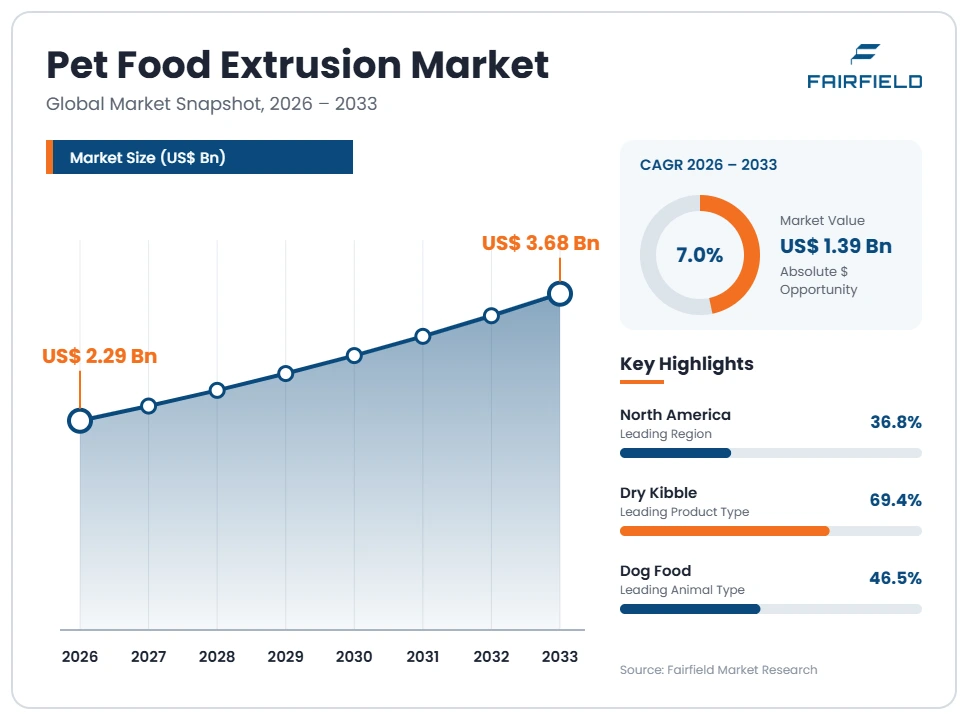
The global pet food extrusion market size is expected to be valued at US$ 2.29 billion in 2026 and projected to reach US$ 3.68 billion by 2033, growing at a CAGR of 7.0% between 2026 and 2033.
Between 2020 and 2025, the market grew at a CAGR of about 6.4%, as pet adoption jumped during the pandemic, pet owners shifted toward premium and specialized diets, and manufacturers added new production lines to keep up with demand. Pet food extrusion is the process of mixing, cooking, and shaping ingredients under heat and pressure inside a screw-driven machine, then cutting, drying, and coating the product. It produces most of the world’s dry kibble, along with many treats, chews, and semi-moist foods. Pet food extruders must handle meat, grains, plant proteins, vitamins, and fats while delivering consistent shape, texture, density, and food safety. Growth comes from rising pet ownership, premiumization, and new recipes with high fresh meat or novel proteins. The market is shifting toward twin-screw extruders, automation, and AI-driven process control. In April 2026, Coperion presented a new vacuum takeaway design to reduce contamination risk at Petfood Forum 2026.
Key Report Takeaways
- By Product Type: Dry Kibble held 69.4% share in 2025, while Pet Treats & Chews are projected to expand at a 8.9% CAGR through 2033, driven by humanization trends, functional dental and joint treats, and premium snack formats that need flexible extrusion lines.
- By Animal Type: Dog Food held 46.5% share in 2025, while Cat Food is projected to expand at a 8.4% CAGR through 2033, driven by rising cat ownership in cities, smaller living spaces, and demand for high-protein, specialized feline diets.
- By Raw Material: Meat & Meat By-Products held 41.6% share in 2025, while Plant & Vegetable Protein-Based is projected to expand at a 9.3% CAGR through 2033, driven by sustainability goals, novel proteins, and grain-free and hypoallergenic recipes.
- By Region: North America held 36.8% share in 2025, while Asia Pacific is projected to expand at a 9.8% CAGR through 2033, driven by rising pet ownership, urbanization, and new extrusion plants in China, India, Thailand, and Japan.
Global Pet Food Extrusion Market Trends and Insights
Drivers Impact Analysis
Two drivers carry the strongest influence on pet food extrusion demand during the forecast period.
| Driver | Impact on CAGR Forecast | Geographic Relevance | Impact Timeline |
| Rising pet ownership and pet humanization | High | Global | Long term (≥4 years) |
| Premiumization and new recipe complexity | High | North America, Europe, Asia Pacific | Medium term (2–4 years) |
Rising Pet Ownership Is Driving the Pet Food Extrusion Market
Rising pet ownership and pet humanization are the strongest driver of the pet food extrusion market. More pets need more manufactured food.
The mechanism is growing demand for commercial pet food. Pet ownership has risen in the United States, Europe, China, India, and Brazil, especially among younger adults and urban households. Many owners now treat pets as family members and move from table scraps or home-cooked meals to branded dry and wet foods. Dry kibble, made almost entirely by extrusion, is the most popular format because it is convenient, shelf-stable, and affordable. Pet food makers such as Mars, Nestlé Purina, Hill’s, and many regional brands are building new plants and adding lines to meet demand. Each new or expanded plant needs extruders, dryers, coaters, and control systems. These trends create steady demand for extrusion equipment and upgrades.
Premiumization Is Expanding the Pet Food Extrusion Market
Premiumization and new recipe complexity are expanding the pet food extrusion market. Premium recipes are harder to process.
The cause is demand for healthier, more natural pet diets. Owners seek high-protein, grain-free, fresh-meat, limited-ingredient, and functional foods that support digestion, skin, joints, and weight control. High levels of fresh meat, fat, and fiber are difficult to process in older single-screw machines, so manufacturers invest in twin-screw extruders with better mixing, cooking control, and flexibility. Wenger Manufacturing introduced a thermal twin-screw platform for high fresh-meat-inclusion kibble, and Bühler has shown high-moisture extrusion for wet pet food. Treats and chews come in many shapes, colors, and textures, requiring versatile dies and cutters. These shifts push manufacturers to replace and upgrade older equipment.
Restraints Impact Analysis
Two restraints limit how quickly the pet food extrusion market grows.
| Restraint | Impact on CAGR Forecast | Geographic Relevance | Impact Timeline |
| High capital cost of extrusion lines | High | Global | Long term (≥4 years) |
| Food safety rules and skilled operator shortages | Medium | Global | Medium term (2–4 years) |
High Capital Costs Slow the Pet Food Extrusion Market
High capital cost of extrusion lines slows the pet food extrusion market. Complete lines require large investment.
The specific causes are complex equipment and installation needs. A full extrusion line includes grinders, mixers, preconditioners, extruders, dryers, coaters, coolers, conveyors, and automation software, and large twin-screw lines can cost millions of dollars. Plants also need steam, power, dust control, and hygienic building design. Small and mid-sized pet food brands often cannot afford their own lines and rely on co-packers. Higher interest rates have raised financing costs for new plants, and some manufacturers delayed expansions after pandemic-era demand normalized. Long lead times for equipment add to project risk. Used equipment markets also compete with new machine sales. These cost barriers slow purchases, especially in emerging markets and among smaller producers.
Food Safety and Skills Gaps Restrict the Pet Food Extrusion Market
Food safety rules and skilled operator shortages restrict the pet food extrusion market. Extrusion requires careful control.
The underlying causes are strict regulation and process complexity. Pet food recalls due to Salmonella, mycotoxins, or nutrient errors damage brands, so regulators and retailers require strict hygiene, validation, and traceability. Equipment must be designed to prevent recontamination after the cooking step, and older lines may need costly upgrades. Running extruders well depends on experienced operators who understand how ingredients, moisture, temperature, and screw speed interact, and these workers are scarce. Changing recipes often requires long trial runs, which take production time and waste materials. Energy use for steam, drying, and cooling is high, adding to operating costs and sustainability pressure. Training new staff takes months. These factors increase costs and slow capacity growth across the industry.
Market Opportunities
AI and Automation Open a Fast-Growth Revenue Pool
AI and automation open a fast-growth revenue pool in the pet food extrusion market. Smarter lines can improve quality, safety, and output.
Equipment makers and software providers can capture this opportunity. Sensors measure moisture, density, temperature, and pressure in real time, while AI software adjusts settings automatically to keep product consistent and reduce waste. Wenger Manufacturing and Extru-Tech launched EXPRO AI, an AI-based extrusion optimization tool, in May 2025. Automation reduces reliance on scarce skilled operators and supports reliable multi-shift operations. Remote monitoring allows suppliers to offer service contracts, predictive maintenance, and faster troubleshooting. Digital twins help plan recipe changes and cut costly trial runs. Companies that combine machines with software and data services can earn recurring revenue and build long-term customer loyalty.
Alternative Proteins and Emerging Markets Create a Growth Revenue Pool
Alternative proteins and emerging markets create a growth revenue pool in the pet food extrusion market. New ingredients and regions need new lines.
Extruder makers can capture this opportunity. Insect protein, plant proteins, single-cell proteins, and upcycled ingredients are entering pet food to reduce environmental impact, and they behave differently in extrusion, requiring new process know-how. Asia Pacific, Latin America, and Middle East & Africa have fast-growing pet populations and few local plants, so manufacturers are building capacity close to consumers. Mid-size and modular lines, which cost less and start up faster, suit these markets. Contract manufacturers and co-packers are expanding fastest, serving private-label and challenger brands that do not own plants. Companies that offer flexible lines, operator training, and local service can capture this growth.
Segment Analysis
- By Product Type: Dry Kibble Leads While Pet Treats & Chews Grow Fastest
Dry Kibble held 69.4% share in 2025. Kibble is the most common pet food worldwide because it is affordable, easy to store, and nutritionally complete, and nearly all of it is produced by pet food extrusion. Large lines run continuously at high capacity in major pet food plants. Bühler, Wenger Manufacturing, and ANDRITZ supply many high-capacity kibble lines.
Pet Treats & Chews are the fastest-growing product type, expanding at a 8.9% CAGR through 2033. Owners buy dental chews, training treats, and functional snacks as rewards and health supplements, and these products come in many shapes and textures that require flexible extruders and dies. Semi-moist and wet foods form other segments, with high-moisture extrusion opening new wet formats. For the market, treat growth supports demand for versatile, smaller lines.
- By Animal Type: Dog Food Leads While Cat Food Grows Fastest
Dog Food held 46.5% share in 2025. Dogs eat larger volumes of food than cats, and dog owners are the largest buyers of kibble and treats worldwide, especially in North America, Europe, and Latin America. Large-breed, puppy, senior, and veterinary diets add variety.
Cat Food is the fastest-growing animal type, expanding at a 8.4% CAGR through 2033. Cat ownership is rising in apartments and cities, especially in Asia Pacific and Europe. Cats need high-protein diets, which require advanced extrusion control. Fish, birds, and small animals form other segments, with aquarium fish feed also using extrusion to make floating pellets. For the market, cat food growth adds demand for high-protein processing.
- By Raw Material: Meat & Meat By-Products Lead While Plant & Vegetable Protein-Based Grows Fastest
Meat & Meat By-Products held 41.6% share in 2025. Chicken, beef, lamb, fish, and meat meals are the main protein sources in most pet foods, and fresh meat inclusion is a key premium claim on packaging.
Plant & Vegetable Protein-Based is the fastest-growing raw material, expanding at a 9.3% CAGR through 2033. Pea, potato, soy, and other plant proteins support grain-free, hypoallergenic, and sustainable recipes. Insect proteins are an emerging option, with farms in Europe supplying pet food brands. Grains, legumes, and starches remain important for structure, expansion, and binding in kibble. Fats, vitamins, and minerals are added during coating after extrusion. For the market, plant protein growth requires new extrusion settings and know-how.
Geography Analysis
- Which Region Is Leading the Pet Food Extrusion Market?
North America is leading the pet food extrusion market with a 36.8% share in 2025. The United States is the world’s largest pet food market, with major producers such as Mars, Nestlé Purina, Hill’s, General Mills’ Blue Buffalo, and Diamond Pet Foods operating many extrusion plants. Wenger Manufacturing and Extru-Tech are based in Kansas, a center of pet food production, and Petfood Forum in Kansas City is a key industry event. Premium, fresh-meat, and grain-free recipes drive line upgrades. Canada and Mexico add demand. Key barriers include high labor and equipment costs. One change shaping the region is AI-driven automation.
- Europe Advances the Pet Food Extrusion Market Through Premium and Sustainable Recipes
Europe is a major pet food extrusion market. Germany, France, the United Kingdom, Italy, Poland, and the Netherlands have strong pet food industries and leading equipment makers such as Bühler, Clextral, Coperion, ANDRITZ, and Amandus Kahl. Consumers favor premium, natural, and sustainable products, including insect-based recipes. Strict feed safety rules require hygienic design and traceability, and many plants run high-volume private-label lines for retailers. Private-label production is strong. Key barriers include high energy costs and slow population growth. One opportunity is sustainable and alternative protein pet food.
- Which Region Is Growing Fastest in the Pet Food Extrusion Market?
Asia Pacific is growing fastest in the pet food extrusion market at a 9.8% CAGR through 2033. China has a rapidly growing pet population, especially cats, and local brands are building modern extrusion plants. Japan and Australia are mature premium markets with strong demand for small-breed and senior diets. India, Thailand, Indonesia, and Vietnam are seeing rising pet adoption, and Thailand is a major exporter of pet food. Global brands are building plants in the region to serve local demand. Key barriers include price sensitivity and limited skilled operators. One change shaping the region is local premium brand growth.
- Latin America Grows the Pet Food Extrusion Market Through Expanding Pet Ownership
Latin America is a growing pet food extrusion market. Brazil is one of the world’s largest pet food markets, and Mexico, Argentina, Chile, and Colombia add strong demand. Large-scale kibble production for dogs dominates, supported by local grain and meat supplies. Global and regional manufacturers are expanding capacity, and premium products are gaining share in urban areas. Brazilian producers also export pet food to neighboring countries, supporting investment in larger extrusion lines. Key barriers include currency swings, high interest rates, and import costs for equipment. One opportunity is premium and cat food production for growing urban markets.
- Middle East & Africa Develops the Pet Food Extrusion Market Through Urban Pet Ownership
Middle East & Africa is a developing pet food extrusion market. Saudi Arabia, the United Arab Emirates, and South Africa have growing pet ownership, especially cats, and rising demand for premium imported and local pet food. Local production is expanding to reduce imports, particularly in South Africa, which serves neighboring countries. Egypt, Morocco, and Nigeria have growing urban middle classes adopting pets. Hot climates make shelf-stable dry kibble the preferred format, which favors extrusion. Key barriers include small market size and limited local manufacturing. One change shaping the region is investment in local capacity.
Competitive Landscape
The pet food extrusion market is moderately consolidated. Bühler, Wenger Manufacturing, Clextral, Coperion, and ANDRITZ are leading players, while Extru-Tech, Baker Perkins, CPM, Amandus Kahl, Pavan Group, Brabender, and Insta-Pro International compete strongly. Several regional makers in China, India, and Italy serve price-sensitive markets with lower-cost single-screw and twin-screw extruders.
Companies compete mainly on extruder performance, flexibility, energy efficiency, hygiene, automation, and after-sales service. Leading suppliers offer complete turnkey lines and pilot plants where customers can test recipes before buying. Strong process expertise and training are key differentiators because extrusion results depend heavily on recipe and settings. Service networks, spare parts availability, and remote support matter because downtime is costly for plants that run around the clock.
Strategic moves show how competition is changing. In April 2025, Bühler presented new high-moisture extrusion methods for wet pet food. In May 2025, Wenger Manufacturing and Extru-Tech launched EXPRO AI. In April 2026, Coperion detailed a new vacuum takeaway design to reduce recontamination risk. These moves show competition shifting toward digital process control, wet and fresh-meat formats, and stronger food safety design across complete lines.
Three themes shape vendor strategy. First, companies are adding AI and automation to extrusion lines. Second, they are actively developing processes for fresh meat, wet foods, and alternative proteins. Third, they are improving hygienic design to meet stricter food safety standards worldwide.
Recent Industry Developments
- April 2026: Coperion detailed a reoriented vacuum takeaway system design at Petfood Forum 2026 aimed at reducing recontamination risk – improves food safety in pet food extrusion lines.
- May 2025: Wenger Manufacturing and Extru-Tech launched EXPRO AI, an AI-powered extrusion process optimization software – advances automation of pet food extruders.
- April 2025: Bühler presented new high-moisture extrusion methods for wet pet food at Petfood Forum 2025 in Kansas City – expands kibble production technology into wet formats.
Companies Covered in the Report
- Bühler
- Wenger Manufacturing
- Clextral
- Coperion
- ANDRITZ
- Extru-Tech
- Baker Perkins
- CPM
- Amandus Kahl
- Pavan Group
- Brabender
- Insta-Pro International
Pet Food Extrusion Market Report Scope
| Metric | Value |
| Study Period | 2020–2033 |
| Market Size 2026 | US$ 2.29 Billion |
| Market Size 2033 | US$ 3.68 Billion |
| CAGR 2026–2033 | 7.0% |
| Absolute Dollar Opportunity | US$ 1.39 Billion |
| Largest Market | North America |
| Fastest-Growing Market | Asia Pacific |
| Market Concentration | Moderately Consolidated |
| Major Players | Bühler, Wenger Manufacturing, Clextral, Coperion, ANDRITZ |
Pet Food Extrusion Market Segmentation
Product Type
- Dry Kibble
- Wet & Semi-Moist Food
- Pet Treats & Chews
Animal Type
- Dog Food
- Cat Food
- Others
Raw Material
- Meat & Meat By-Products
- Grains & Starches
- Plant & Vegetable Protein-Based
- Others
Regions
- North America
- Europe
- Asia Pacific
- Latin America
- Middle East & Africa
- Executive Summary
- Global Pet Food Extrusion Market Snapshot
- Future Projections
- Key Report Takeaways
- Regional Snapshot
- Market Overview
- Market Definition and Report Scope
- Historical Trends 2020–2025
- Market Dynamics
- Drivers
- Rising Pet Ownership Is Driving the Pet Food Extrusion Market
- Premiumization Is Expanding the Pet Food Extrusion Market
- Restraints
- High Capital Costs Slow the Pet Food Extrusion Market
- Food Safety and Skills Gaps Restrict the Pet Food Extrusion Market
- Market Opportunities
- AI and Automation Open a Fast-Growth Revenue Pool
- Alternative Proteins and Emerging Markets Create a Growth Revenue Pool
- Drivers
- Global Pet Food Extrusion Market Outlook, 2020-2033
- Global Pet Food Extrusion Market Outlook, by Product Type, Value (US$ Billion), 2020-2033
- Dry Kibble
- Wet & Semi-Moist Food
- Pet Treats & Chews
- Global Pet Food Extrusion Market Outlook, by Animal Type, Value (US$ Billion), 2020-2033
- Dog Food
- Cat Food
- Others
- Global Pet Food Extrusion Market Outlook, by Raw Material, Value (US$ Billion), 2020-2033
- Meat & Meat By-Products
- Grains & Starches
- Plant & Vegetable Protein-Based
- Others
- Global Pet Food Extrusion Market Outlook, by Region, Value (US$ Billion), 2020-2033
- North America
- Europe
- Asia Pacific
- Latin America
- Middle East & Africa
- Global Pet Food Extrusion Market Outlook, by Product Type, Value (US$ Billion), 2020-2033
- North America Pet Food Extrusion Market Outlook, 2020-2033
- North America Pet Food Extrusion Market Outlook, by Product Type, Value (US$ Billion), 2020-2033
- Dry Kibble
- Wet & Semi-Moist Food
- Pet Treats & Chews
- North America Pet Food Extrusion Market Outlook, by Animal Type, Value (US$ Billion), 2020-2033
- Dog Food
- Cat Food
- Others
- North America Pet Food Extrusion Market Outlook, by Raw Material, Value (US$ Billion), 2020-2033
- Meat & Meat By-Products
- Grains & Starches
- Plant & Vegetable Protein-Based
- Others
- North America Pet Food Extrusion Market Outlook, by Country, Value (US$ Billion), 2020-2033
- United States Pet Food Extrusion Market Outlook, by Product Type, 2020-2033
- United States Pet Food Extrusion Market Outlook, by Animal Type, 2020-2033
- United States Pet Food Extrusion Market Outlook, by Raw Material, 2020-2033
- Canada Pet Food Extrusion Market Outlook, by Product Type, 2020-2033
- Canada Pet Food Extrusion Market Outlook, by Animal Type, 2020-2033
- Canada Pet Food Extrusion Market Outlook, by Raw Material, 2020-2033
- Mexico Pet Food Extrusion Market Outlook, by Product Type, 2020-2033
- Mexico Pet Food Extrusion Market Outlook, by Animal Type, 2020-2033
- Mexico Pet Food Extrusion Market Outlook, by Raw Material, 2020-2033
- North America Pet Food Extrusion Market Outlook, by Product Type, Value (US$ Billion), 2020-2033
- Europe Pet Food Extrusion Market Outlook, 2020-2033
- Europe Pet Food Extrusion Market Outlook, by Product Type, Value (US$ Billion), 2020-2033
- Dry Kibble
- Wet & Semi-Moist Food
- Pet Treats & Chews
- Europe Pet Food Extrusion Market Outlook, by Animal Type, Value (US$ Billion), 2020-2033
- Dog Food
- Cat Food
- Others
- Europe Pet Food Extrusion Market Outlook, by Raw Material, Value (US$ Billion), 2020-2033
- Meat & Meat By-Products
- Grains & Starches
- Plant & Vegetable Protein-Based
- Others
- Europe Pet Food Extrusion Market Outlook, by Country, Value (US$ Billion), 2020-2033
- Germany Pet Food Extrusion Market Outlook, by Product Type, 2020-2033
- Germany Pet Food Extrusion Market Outlook, by Animal Type, 2020-2033
- Germany Pet Food Extrusion Market Outlook, by Raw Material, 2020-2033
- France Pet Food Extrusion Market Outlook, by Product Type, 2020-2033
- France Pet Food Extrusion Market Outlook, by Animal Type, 2020-2033
- France Pet Food Extrusion Market Outlook, by Raw Material, 2020-2033
- United Kingdom Pet Food Extrusion Market Outlook, by Product Type, 2020-2033
- United Kingdom Pet Food Extrusion Market Outlook, by Animal Type, 2020-2033
- United Kingdom Pet Food Extrusion Market Outlook, by Raw Material, 2020-2033
- Italy Pet Food Extrusion Market Outlook, by Product Type, 2020-2033
- Italy Pet Food Extrusion Market Outlook, by Animal Type, 2020-2033
- Italy Pet Food Extrusion Market Outlook, by Raw Material, 2020-2033
- Poland Pet Food Extrusion Market Outlook, by Product Type, 2020-2033
- Poland Pet Food Extrusion Market Outlook, by Animal Type, 2020-2033
- Poland Pet Food Extrusion Market Outlook, by Raw Material, 2020-2033
- Netherlands Pet Food Extrusion Market Outlook, by Product Type, 2020-2033
- Netherlands Pet Food Extrusion Market Outlook, by Animal Type, 2020-2033
- Netherlands Pet Food Extrusion Market Outlook, by Raw Material, 2020-2033
- Europe Pet Food Extrusion Market Outlook, by Product Type, Value (US$ Billion), 2020-2033
- Asia Pacific Pet Food Extrusion Market Outlook, 2020-2033
- Asia Pacific Pet Food Extrusion Market Outlook, by Product Type, Value (US$ Billion), 2020-2033
- Dry Kibble
- Wet & Semi-Moist Food
- Pet Treats & Chews
- Asia Pacific Pet Food Extrusion Market Outlook, by Animal Type, Value (US$ Billion), 2020-2033
- Dog Food
- Cat Food
- Others
- Asia Pacific Pet Food Extrusion Market Outlook, by Raw Material, Value (US$ Billion), 2020-2033
- Meat & Meat By-Products
- Grains & Starches
- Plant & Vegetable Protein-Based
- Others
- Asia Pacific Pet Food Extrusion Market Outlook, by Country, Value (US$ Billion), 2020-2033
- China Pet Food Extrusion Market Outlook, by Product Type, 2020-2033
- China Pet Food Extrusion Market Outlook, by Animal Type, 2020-2033
- China Pet Food Extrusion Market Outlook, by Raw Material, 2020-2033
- Japan Pet Food Extrusion Market Outlook, by Product Type, 2020-2033
- Japan Pet Food Extrusion Market Outlook, by Animal Type, 2020-2033
- Japan Pet Food Extrusion Market Outlook, by Raw Material, 2020-2033
- Australia Pet Food Extrusion Market Outlook, by Product Type, 2020-2033
- Australia Pet Food Extrusion Market Outlook, by Animal Type, 2020-2033
- Australia Pet Food Extrusion Market Outlook, by Raw Material, 2020-2033
- India Pet Food Extrusion Market Outlook, by Product Type, 2020-2033
- India Pet Food Extrusion Market Outlook, by Animal Type, 2020-2033
- India Pet Food Extrusion Market Outlook, by Raw Material, 2020-2033
- Thailand Pet Food Extrusion Market Outlook, by Product Type, 2020-2033
- Thailand Pet Food Extrusion Market Outlook, by Animal Type, 2020-2033
- Thailand Pet Food Extrusion Market Outlook, by Raw Material, 2020-2033
- Indonesia Pet Food Extrusion Market Outlook, by Product Type, 2020-2033
- Indonesia Pet Food Extrusion Market Outlook, by Animal Type, 2020-2033
- Indonesia Pet Food Extrusion Market Outlook, by Raw Material, 2020-2033
- Vietnam Pet Food Extrusion Market Outlook, by Product Type, 2020-2033
- Vietnam Pet Food Extrusion Market Outlook, by Animal Type, 2020-2033
- Vietnam Pet Food Extrusion Market Outlook, by Raw Material, 2020-2033
- Asia Pacific Pet Food Extrusion Market Outlook, by Product Type, Value (US$ Billion), 2020-2033
- Latin America Pet Food Extrusion Market Outlook, 2020-2033
- Latin America Pet Food Extrusion Market Outlook, by Product Type, Value (US$ Billion), 2020-2033
- Dry Kibble
- Wet & Semi-Moist Food
- Pet Treats & Chews
- Latin America Pet Food Extrusion Market Outlook, by Animal Type, Value (US$ Billion), 2020-2033
- Dog Food
- Cat Food
- Others
- Latin America Pet Food Extrusion Market Outlook, by Raw Material, Value (US$ Billion), 2020-2033
- Meat & Meat By-Products
- Grains & Starches
- Plant & Vegetable Protein-Based
- Others
- Latin America Pet Food Extrusion Market Outlook, by Country, Value (US$ Billion), 2020-2033
- Brazil Pet Food Extrusion Market Outlook, by Product Type, 2020-2033
- Brazil Pet Food Extrusion Market Outlook, by Animal Type, 2020-2033
- Brazil Pet Food Extrusion Market Outlook, by Raw Material, 2020-2033
- Mexico Pet Food Extrusion Market Outlook, by Product Type, 2020-2033
- Mexico Pet Food Extrusion Market Outlook, by Animal Type, 2020-2033
- Mexico Pet Food Extrusion Market Outlook, by Raw Material, 2020-2033
- Argentina Pet Food Extrusion Market Outlook, by Product Type, 2020-2033
- Argentina Pet Food Extrusion Market Outlook, by Animal Type, 2020-2033
- Argentina Pet Food Extrusion Market Outlook, by Raw Material, 2020-2033
- Chile Pet Food Extrusion Market Outlook, by Product Type, 2020-2033
- Chile Pet Food Extrusion Market Outlook, by Animal Type, 2020-2033
- Chile Pet Food Extrusion Market Outlook, by Raw Material, 2020-2033
- Colombia Pet Food Extrusion Market Outlook, by Product Type, 2020-2033
- Colombia Pet Food Extrusion Market Outlook, by Animal Type, 2020-2033
- Colombia Pet Food Extrusion Market Outlook, by Raw Material, 2020-2033
- Latin America Pet Food Extrusion Market Outlook, by Product Type, Value (US$ Billion), 2020-2033
- Middle East & Africa Pet Food Extrusion Market Outlook, 2020-2033
- Middle East & Africa Pet Food Extrusion Market Outlook, by Product Type, Value (US$ Billion), 2020-2033
- Dry Kibble
- Wet & Semi-Moist Food
- Pet Treats & Chews
- Middle East & Africa Pet Food Extrusion Market Outlook, by Animal Type, Value (US$ Billion), 2020-2033
- Dog Food
- Cat Food
- Others
- Middle East & Africa Pet Food Extrusion Market Outlook, by Raw Material, Value (US$ Billion), 2020-2033
- Meat & Meat By-Products
- Grains & Starches
- Plant & Vegetable Protein-Based
- Others
- Middle East & Africa Pet Food Extrusion Market Outlook, by Country, Value (US$ Billion), 2020-2033
- Saudi Arabia Pet Food Extrusion Market Outlook, by Product Type, 2020-2033
- Saudi Arabia Pet Food Extrusion Market Outlook, by Animal Type, 2020-2033
- Saudi Arabia Pet Food Extrusion Market Outlook, by Raw Material, 2020-2033
- United Arab Emirates Pet Food Extrusion Market Outlook, by Product Type, 2020-2033
- United Arab Emirates Pet Food Extrusion Market Outlook, by Animal Type, 2020-2033
- United Arab Emirates Pet Food Extrusion Market Outlook, by Raw Material, 2020-2033
- South Africa Pet Food Extrusion Market Outlook, by Product Type, 2020-2033
- South Africa Pet Food Extrusion Market Outlook, by Animal Type, 2020-2033
- South Africa Pet Food Extrusion Market Outlook, by Raw Material, 2020-2033
- Egypt Pet Food Extrusion Market Outlook, by Product Type, 2020-2033
- Egypt Pet Food Extrusion Market Outlook, by Animal Type, 2020-2033
- Egypt Pet Food Extrusion Market Outlook, by Raw Material, 2020-2033
- Morocco Pet Food Extrusion Market Outlook, by Product Type, 2020-2033
- Morocco Pet Food Extrusion Market Outlook, by Animal Type, 2020-2033
- Morocco Pet Food Extrusion Market Outlook, by Raw Material, 2020-2033
- Nigeria Pet Food Extrusion Market Outlook, by Product Type, 2020-2033
- Nigeria Pet Food Extrusion Market Outlook, by Animal Type, 2020-2033
- Nigeria Pet Food Extrusion Market Outlook, by Raw Material, 2020-2033
- Middle East & Africa Pet Food Extrusion Market Outlook, by Product Type, Value (US$ Billion), 2020-2033
- Competitive Landscape
- Market Concentration and Industry Leaders
- Competitive Differentiation
- Strategic Moves and Market Direction
- Recent Industry Developments
- Company Profiles
- Bühler
- Wenger Manufacturing
- Clextral
- Coperion
- ANDRITZ
- Extru-Tech
- Baker Perkins
- CPM
- Amandus Kahl
- Pavan Group
- Brabender
- Insta-Pro International
- Appendix
- Research Methodology
- Report Assumptions
- Acronyms and Abbreviations
Product Type
- Dry Kibble
- Wet & Semi-Moist Food
- Pet Treats & Chews
Animal Type
- Dog Food
- Cat Food
- Others
Raw Material
- Meat & Meat By-Products
- Grains & Starches
- Plant & Vegetable Protein-Based
- Others
Regions
- North America
- Europe
- Asia Pacific
- Latin America
- Middle East & Africa
Our Research Methodology
Considering the volatility of business today, traditional approaches to strategizing a game plan can be unfruitful if not detrimental. True ambiguity is no way to determine a forecast. A myriad of predetermined factors must be accounted for such as the degree of risk involved, the magnitude of circumstances, as well as conditions or consequences that are not known or unpredictable. To circumvent binary views that cast uncertainty, the application of market research intelligence to strategically posture, move, and enable actionable outcomes is necessary.
View Methodology
Quality Assured
Rigorous Validation Process

Confidentiality Assured
End-to-end Data Security

Custom Research Services
Tailored To Your Objectives
FAQs
The pet food extrusion market is valued at US$ 2.29 billion in 2026, led by dry kibble and North America.
The market is projected to reach US$ 3.68 billion by 2033, growing at a 7.0% CAGR and adding US$ 1.39 billion.
Pet treats and chews are growing fastest at an 8.9% CAGR through 2033, driven by functional and premium snack demand.
Asia Pacific is growing fastest at a 9.8% CAGR through 2033, driven by rising pet ownership and new plants in China.
North America holds the largest share at 36.8% in 2025, supported by the world’s largest pet food industry in the United States.
Related Reports
Conveying Equipment Market Size, Share, Insights, Competitive Landscape, and Forecast 2026 to 2033
Explore the conveying equipment market, projected to reach US$ 56.9 billion by 2033 at a 4.5% CAGR, with equipment, services and regional insights.
Bakery Packaging Machine Market Size, Share, Insights, Competitive Landscape, and Forecast 2026 to 2033
Explore the bakery packaging machine market, projected to reach US$ 4.44 billion by 2033 at a 4.6% CAGR, with automation, machine and regional insights.
EPC Construction Market Size, Share, Insights, Competitive Landscape, and Forecast 2026 to 2033
EPC construction market to grow from US$ 331.5 billion in 2026 to US$ 424.6 billion by 2033 at a 3.6% CAGR. Explore services, contracts and regional trends.
Hydraulic Manifold Market Size, Share, Insights, Competitive Landscape, and Forecast 2026 to 2033
Hydraulic manifold market to grow from US$ 750.0 million in 2026 to US$ 947.8 million by 2033 at a 3.4% CAGR. Explore types, applications and regional trends.
Hydrogen Compressor Market Size, Share, Insights, Competitive Landscape, and Forecast 2026 to 2033
Hydrogen compressor market to grow from US$ 3.3 billion in 2026 to US$ 4.7 billion by 2033 at a 5.2% CAGR. Explore types, end users and regional insights.
Non-Residential Building Market Size, Share, Insights, Competitive Landscape, and Forecast 2026 to 2033
The global non-residential building market is valued at US$8.30 trillion in 2026, reaching US$14.90 trillion by 2033, growing at an 8.7% CAGR