



Bakery Packaging Machine Market
Bakery Packaging Machine Market Size, Share, Insights, Competitive Landscape, and Forecast 2026 to 2033
Bakery Packaging Machine Market Size, Share, Insights, Competitive Landscape, and Forecast 2026 to 2033
How Fast Is the Bakery Packaging Machine Market Growing?
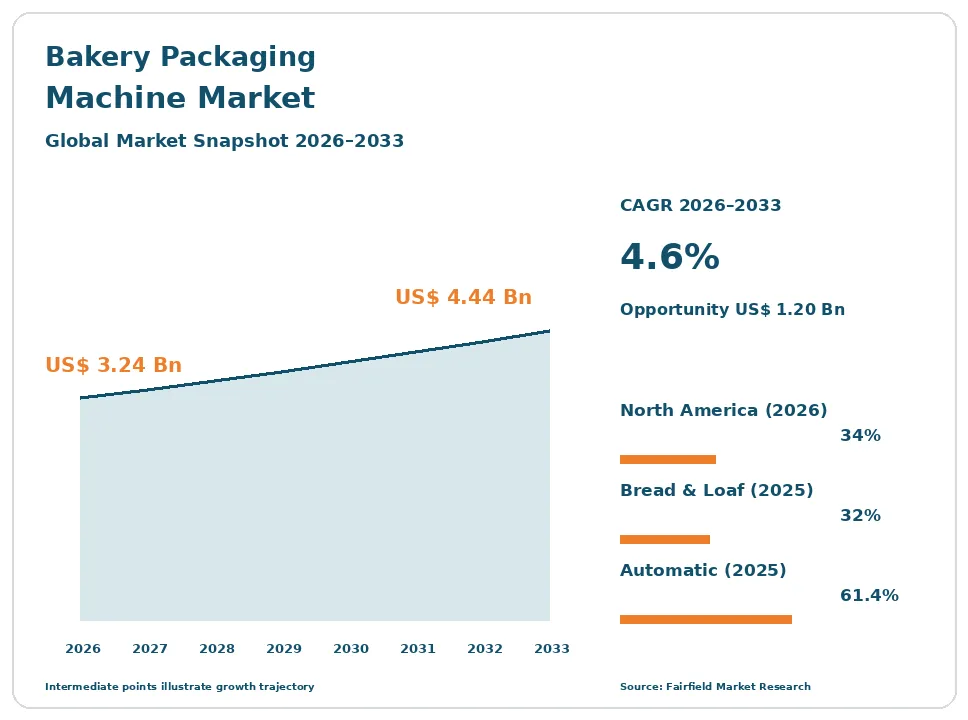
The global bakery packaging machine market size is expected to be valued at US$ 3.24 billion in 2026 and projected to reach US$ 4.44 billion by 2033, growing at a CAGR of 4.6% between 2026 and 2033.
Between 2020 and 2025, the market grew at a CAGR of about 4.0%, as bakeries handled a surge in demand for packaged bread during the pandemic, then invested in automation to cope with labor shortages, rising wages, and stricter hygiene expectations. Bakery packaging machines wrap, bag, seal, slice, count, tray, carton, label, and case-pack bread, buns, cakes, pastries, cookies, and frozen bakery products. Common equipment includes flow wrapping machines, bread baggers, tray sealers, form-fill-seal systems, cartoners, and robotic pick-and-place cells. These machines protect freshness, extend shelf life, and give products attractive retail presentation. Growth comes from rising packaged bakery consumption, labor shortages, and demand for flexible lines that handle many product sizes. The market is shifting toward bakery automation, robotics, and machines that run recyclable and paper-based films. In September 2025, Syntegon demonstrated a high-speed flow wrapper with amplified heat sealing at IBIE 2025 in Las Vegas.
Key Report Takeaways
- By Application: Bread & Loaf held 32.0% share in 2025, while Frozen Bakery Products are projected to expand at a 5.6% CAGR through 2033, driven by bake-off products, frozen dough, and retail and food service demand for long-shelf-life bakery items.
- By Machine Type: Flow Wrapping & Form-Fill-Seal held 38.0% share in 2026, while Cartoning & Case Packing is projected to expand at a 5.2% CAGR through 2033, driven by end-of-line automation, e-commerce shipments, and shelf-ready packaging.
- By Automation Grade: Automatic held 61.4% share in 2025 and is projected to expand at the fastest 5.0% CAGR through 2033, driven by labor shortages, higher line speeds, and the need for consistent hygiene and quality.
- By Region: North America held 34.0% share in 2026, while Asia Pacific is projected to expand at a 5.8% CAGR through 2033, driven by rising packaged bakery consumption, modern retail, and new industrial bakeries in China and India.
Global Bakery Packaging Machine Market Trends and Insights
Drivers Impact Analysis
| Driver | Impact on CAGR Forecast | Geographic Relevance | Impact Timeline |
| Rising packaged bakery consumption | High | Global | Long term (≥4 years) |
| Labor shortages and demand for automation | High | North America, Europe, Asia Pacific | Medium term (2-4 years) |
Two drivers carry the strongest influence on bakery packaging machine demand during the forecast period.
Packaged Bakery Demand Is Driving the Bakery Packaging Machine Market
Rising packaged bakery consumption is the strongest driver of the bakery packaging machine market. More bakery products are sold in packs.
The mechanism is the shift from loose, fresh-baked goods to packaged products sold through supermarkets, convenience stores, and online grocery. Urban consumers in Asia Pacific, Latin America, and Middle East & Africa increasingly buy sliced bread, buns, cakes, and cookies in sealed packs that stay fresh longer. In North America and Europe, demand grows for single-serve snacks, protein bars, gluten-free bread, and premium pastries, each requiring specialized packaging. Frozen and par-baked products need sealed, freezer-ready packs. Retailers want shelf-ready trays and cartons that speed restocking. Large industrial bakeries such as Grupo Bimbo, Flowers Foods, and Mondelez run many high-speed lines. These trends create steady demand for new and upgraded bakery packaging machines.
Labor Shortages Are Expanding the Bakery Packaging Machine Market
Labor shortages and demand for automation are expanding the bakery packaging machine market. Bakeries struggle to find packing staff.
The cause is a shrinking pool of workers willing to do repetitive, early-morning, and night-shift jobs. Packing and case loading have traditionally used many manual workers, but wages have risen sharply in North America and Europe since 2021. Automated wrappers, robotic pick-and-place cells, and case packers reduce headcount and keep lines running around the clock. Automation also improves hygiene by reducing human contact with food. Syntegon cites skilled-worker shortages and cost pressure as key reasons bakeries automate. Small and mid-size bakeries are moving from manual to semi-automatic machines, and suppliers now offer entry-level wrappers sized for them. These pressures make bakery automation a top investment priority.
Restraints Impact Analysis
| Restraint | Impact on CAGR Forecast | Geographic Relevance | Impact Timeline |
| High capital costs for small bakeries | High | Global | Long term (≥4 years) |
| Packaging material shifts and line complexity | Medium | Europe, North America | Medium term (2-4 years) |
Two restraints limit how quickly the bakery packaging machine market grows.
High Capital Costs Slow the Bakery Packaging Machine Market
High capital costs for small bakeries slow the bakery packaging machine market. Automated lines are expensive.
The specific causes are equipment prices and limited budgets. A high-speed flow wrapping line with feeders, robots, and case packers can cost millions of dollars, which is beyond the reach of many artisan, regional, and family-owned bakeries. Return on investment depends on volume, and small bakeries with many product types may not run machines enough to justify the cost. Higher interest rates have raised financing costs for new equipment. Installation may require factory layout changes, new utilities, and production downtime. Used machines offer a cheaper alternative and compete with new sales. Some bakeries also lack engineers to operate and maintain complex equipment. These cost barriers slow adoption among smaller producers, especially in emerging markets.
Material Shifts Restrict the Bakery Packaging Machine Market
Packaging material shifts and line complexity restrict the bakery packaging machine market. Sustainable films are harder to run.
The underlying causes are new rules and growing product variety. Packaging regulations in Europe and some U.S. states push bakeries toward recyclable mono-material films, paper-based wraps, and lower plastic use, while retailers set their own targets. These materials can behave differently on machines, stretching, tearing, or sealing poorly unless sealing jaws, temperature settings, and film handling are upgraded. Bakeries hesitate to buy new lines until material choices settle and costs become clear. At the same time, short product cycles, seasonal items, and many pack sizes demand frequent changeovers, which reduces line efficiency on older machines. Integrating equipment from several vendors adds complexity. These challenges slow purchasing decisions and lengthen project timelines.
Market Opportunities
Robotics and Flexible Lines Open a Fast-Growth Revenue Pool
Robotics and flexible lines open a fast-growth revenue pool in the bakery packaging machine market. Bakeries need to switch products quickly.
Machine builders can capture this opportunity. Robotic pick-and-place systems with vision can handle delicate pastries, cookies, and cakes of different shapes without damage, replacing manual loading. Servo-driven wrappers change formats at the push of a button, cutting changeover time from hours to minutes. Count feeders, such as Syntegon’s new cookie feeder shown at iba 2025, group products gently at high speed. Cloud software tracks overall equipment effectiveness, energy use, and waste, and predicts maintenance needs before breakdowns. Entry-level automated wrappers help small bakeries take their first step. Companies that offer flexible, connected lines can win orders from bakeries managing growing product ranges.
Sustainable Packaging Compatibility Creates an Upgrade Revenue Pool
Sustainable packaging compatibility creates an upgrade revenue pool in the bakery packaging machine market. Bakeries must adapt to new materials.
Machine makers can capture this opportunity. Retrofits and new machines that run paper-based, compostable, and mono-material films help bakeries meet regulations and retailer goals without losing speed. Reduced film widths, thinner materials, and smaller seals cut packaging costs and waste. Modified atmosphere and better seal integrity extend shelf life, reducing food waste in stores and homes. Machine builders work with film suppliers to test new materials before launch. Upgrade kits for existing machines offer a lower-cost path for bakeries. Digital tools that track film use help bakeries report on packaging targets. Companies that test and certify machines for sustainable materials can capture growing upgrade and replacement demand.
Segment Analysis
By Application: Bread & Loaf Leads While Frozen Bakery Products Grow Fastest
Bread & Loaf held 32.0% share in 2025. Sliced bread, buns, rolls, and baguettes are high-volume staples packed in bags or flow wraps by industrial bakeries. Bread lines often combine slicers, baggers, and clip or tie closers running at very high speeds. Large bread makers in North America, Latin America, and Europe run many lines around the clock, and replacement cycles support steady demand.
Frozen Bakery Products are the fastest-growing application, expanding at a 5.6% CAGR through 2033. Frozen dough, par-baked bread, frozen pastries, and frozen cakes for retail in-store bakeries and food service need freezer-safe packaging, cartons, and case packing. Cakes and pastries, biscuits and cookies, and specialty products such as gluten-free items form other applications. For the market, frozen growth adds specialized, higher-value equipment demand.
By Machine Type: Flow Wrapping & Form-Fill-Seal Leads While Cartoning & Case Packing Grows Fastest
Flow Wrapping & Form-Fill-Seal held 38.0% share in 2026. Flow wrapping machines pack cakes, bars, cookies, muffins, and buns at high speed in a sealed film, and vertical form-fill-seal machines bag smaller items. Syntegon, Ishida, Formost Fuji, and Multivac offer leading systems, often integrated with upstream feeders and downstream checkweighers and metal detectors.
Cartoning & Case Packing is the fastest-growing type, expanding at a 5.2% CAGR through 2033. End-of-line automation is a top priority because manual case packing is labor-intensive, and retailers want shelf-ready cartons. Bagging, tray sealing, and labeling machines form other types, with labeling needed for allergen and date information. For the market, cartoning growth supports retail-ready packs.
By Automation Grade: Automatic Leads and Grows Fastest
Automatic held 61.4% share in 2025 and is the fastest-growing grade, expanding at a 5.0% CAGR through 2033. Automatic lines dominate industrial bakeries because they deliver high speeds, consistent quality, and lower labor costs, and they integrate with upstream ovens, coolers, and slicers.
Semi-automatic machines, such as tabletop baggers and manual-feed wrappers, serve smaller bakeries and specialty producers that need flexibility and lower upfront costs, and they often act as a first step toward full automation. Many suppliers now offer entry-level automated machines, leasing, and financing options for this group. Automatic machines also make food safety audits easier by reducing manual handling and recording production data. For the market, automatic growth reflects persistent labor shortages and rising wages.
Geography Analysis
Which Region Is Leading the Bakery Packaging Machine Market?
North America is leading the bakery packaging machine market with a 34.0% share in 2026. The United States has large industrial bakeries, strong packaged bread and snack consumption, and high labor costs that encourage automation. Middleby, PAC Machinery, Arpac, and Pro Mach are active, along with global suppliers such as Syntegon and Ishida. IBIE in Las Vegas is a key trade event where many new machines launch. Canada and Mexico add demand, with Mexico hosting major bakery plants. Key barriers include high equipment costs for smaller bakeries. One change shaping the region is robotic end-of-line automation.
Europe Advances the Bakery Packaging Machine Market Through Sustainability
Europe is a major bakery packaging machine market. Germany, Italy, the Netherlands, the United Kingdom, and Switzerland host leading machine makers including Syntegon, Multivac, Rademaker, and SOMIC, and iba in Germany is a global bakery trade fair. Multivac acquired 80% of Italianpack in August 2024. European bakeries produce an especially wide range of breads, pastries, and biscuits, demanding flexible lines, and packaging rules push recyclable films. Key barriers include high energy costs, labor costs, and slow growth in bread consumption. One opportunity is machines optimized for recyclable and paper-based films.
Which Region Is Growing Fastest in the Bakery Packaging Machine Market?
Asia Pacific is growing fastest in the bakery packaging machine market at a 5.8% CAGR through 2033. China and India are expanding packaged bread, cake, and biscuit production as urban consumers adopt Western-style bakery products. Japan hosts Ishida, and Japan and South Korea have advanced convenience store bakery supply chains. Indonesia, Vietnam, and Australia add demand. Many new industrial bakeries in the region are building fully automated lines from the start, skipping manual stages. Key barriers include price sensitivity and competition from local machine makers. One change shaping the region is modern retail and convenience store expansion.
Latin America Grows the Bakery Packaging Machine Market Through Industrial Bakeries
Latin America is a growing bakery packaging machine market. Mexico and Brazil host large industrial bakeries, including Grupo Bimbo, one of the world’s largest bakery companies, which runs many high-speed lines. Colombia, Chile, and Argentina add demand from packaged bread and cookie makers. Rising labor costs, supermarket expansion, and retail modernization encourage automation, and multinational snack makers bring global packaging standards to their local plants. Local machine builders in Brazil supply lower-cost equipment, while global suppliers serve large plants. Key barriers include financing costs and currency swings. One opportunity is packaged bread and snack growth in urban areas.
Middle East & Africa Develops the Bakery Packaging Machine Market Through Food Processing
Middle East & Africa is a developing bakery packaging machine market. Saudi Arabia, the United Arab Emirates, and Egypt are investing in local food manufacturing, including large bakeries that supply supermarkets and food service. Ishida acquired National Packaging Systems in South Africa in March 2024 to expand its presence in the region. Nigeria and Kenya have growing packaged bread markets, and halal and food safety standards push bakeries toward hygienic, automated packing. Hot climates also increase the need for sealed packaging that protects freshness. Key barriers include high equipment costs and limited service networks. One change shaping the region is food manufacturing investment.
Competitive Landscape
The bakery packaging machine market is fragmented. Syntegon, Multivac, Ishida, Bühler, and Middleby are leading players, while Rademaker, PAC Machinery, Arpac, SOMIC, Viking Masek, Pro Mach, and Formost Fuji compete strongly. The top suppliers hold only a modest combined share, and many regional builders serve local bakeries. Chinese and Indian machine makers are expanding exports of lower-cost wrappers and baggers, increasing price competition in Asia Pacific, Latin America, and Middle East & Africa. Global suppliers respond with modular designs and local assembly.
Companies compete on speed, flexibility, hygiene, reliability, film compatibility, price, and service. Complete line suppliers such as Middleby and Bühler that integrate processing and packaging have an advantage with large bakeries, while specialists win with niche machines. Customers also value training, remote support, and digital performance tools. Local service and spare parts are critical because downtime is costly for bakeries with short product shelf lives.
Strategic moves show how competition is changing. In August 2024, Multivac acquired Italianpack. In May 2025, Syntegon premiered its cookie count feeder at iba. In September 2025, Syntegon demonstrated its high-speed flow wrapper and entry-level line at IBIE. These moves show competition shifting toward automation, gentle handling, and solutions for smaller bakeries.
Three themes shape vendor strategy. First, companies are adding robotics and digital monitoring. Second, they are making acquisitions to widen portfolios. Third, they are making machines compatible with sustainable films.
Bakery Packaging Machine Market Industry Leaders
- Syntegon
- Multivac
- Ishida
- Bühler
- Middleby
Recent Industry Developments
- September 2025: Syntegon demonstrated its HCM high-speed flow wrapper with amplified heat sealing and an entry-level line for smaller bakeries at IBIE 2025 in Las Vegas - advances bakery automation in North America.
- May 2025: Syntegon presented the European premiere of its FGCT count feeder for sandwich cookies at iba 2025 in Düsseldorf - improves gentle, high-speed feeding for flow wrapping machines.
- August 2024: Multivac acquired an 80% stake in Italianpack, an Italian packaging machine maker - expands its bakery packaging machines portfolio.
Companies Covered in the Report
- Syntegon
- Multivac
- Ishida
- Bühler
- Middleby
- Rademaker
- PAC Machinery
- Arpac
- SOMIC
- Viking Masek
- Pro Mach
- Formost Fuji
Bakery Packaging Machine Market Report Scope
This report covers bakery packaging machines, including flow wrapping and form-fill-seal machines, bagging machines, tray sealers, cartoning and case packing machines, and labeling machines, in automatic and semi-automatic grades, for bread and loaf, cakes and pastries, biscuits and cookies, frozen bakery, and specialty bakery products. The base year is 2025, and the forecast period runs from 2026 to 2033. All values are expressed in US$ Billion.
Application
- Bread & Loaf
- Cakes & Pastries
- Biscuits & Cookies
- Frozen Bakery Products
- Specialty Bakery
Machine Type
- Flow Wrapping & Form-Fill-Seal
- Bagging
- Tray Sealing
- Cartoning & Case Packing
- Labeling
Automation Grade
- Automatic
- Semi-Automatic
Regions
- North America
- Europe
- Asia Pacific
- Latin America
- Middle East & Africa
Key Questions Answered in the Report
How big is the bakery packaging machine market in 2026?
The bakery packaging machine market is valued at US$ 3.24 billion in 2026, led by bread packaging and North America.
What is the bakery packaging machine market forecast to 2033?
The market is projected to reach US$ 4.44 billion by 2033, growing at a 4.6% CAGR and adding US$ 1.20 billion.
Which application is growing fastest in the bakery packaging machine market?
Frozen bakery products are growing fastest at a 5.6% CAGR through 2033, driven by frozen dough and par-baked products.
Which region is growing fastest in the bakery packaging machine market?
Asia Pacific is growing fastest at a 5.8% CAGR through 2033, driven by packaged bakery growth in China and India.
Which region holds the largest bakery packaging machine market share?
North America holds the largest share at 34.0% in 2026, supported by large industrial bakeries and high automation demand.
1. Executive Summary
1.1. Global Bakery Packaging Machine Market Snapshot
1.2. Future Projections, 2026-2033
1.3. Key Market Trends
1.4. Regional Snapshot
2. Market Overview
2.1. Market Definition and Report Scope
2.2. Historical Market Trends, 2020-2025
2.3. Market Dynamics
2.3.1. Drivers Impact Analysis
2.3.1.1. Packaged Bakery Demand Is Driving the Bakery Packaging Machine Market
2.3.1.2. Labor Shortages Are Expanding the Bakery Packaging Machine Market
2.3.2. Restraints Impact Analysis
2.3.2.1. High Capital Costs Slow the Bakery Packaging Machine Market
2.3.2.2. Material Shifts Restrict the Bakery Packaging Machine Market
2.3.3. Market Opportunities
2.3.3.1. Robotics and Flexible Lines Open a Fast-Growth Revenue Pool
2.3.3.2. Sustainable Packaging Compatibility Creates an Upgrade Revenue Pool
3. Global Bakery Packaging Machine Market Outlook, 2020-2033
3.1. Global Bakery Packaging Machine Market Outlook, by Application, Value (US$ Billion), 2020-2033
3.1.1. Bread & Loaf
3.1.2. Cakes & Pastries
3.1.3. Biscuits & Cookies
3.1.4. Frozen Bakery Products
3.1.5. Specialty Bakery
3.2. Global Bakery Packaging Machine Market Outlook, by Machine Type, Value (US$ Billion), 2020-2033
3.2.1. Flow Wrapping & Form-Fill-Seal
3.2.2. Bagging
3.2.3. Tray Sealing
3.2.4. Cartoning & Case Packing
3.2.5. Labeling
3.3. Global Bakery Packaging Machine Market Outlook, by Automation Grade, Value (US$ Billion), 2020-2033
3.3.1. Automatic
3.3.2. Semi-Automatic
3.4. Global Bakery Packaging Machine Market Outlook, by Region, Value (US$ Billion), 2020-2033
3.4.1. North America
3.4.2. Europe
3.4.3. Asia Pacific
3.4.4. Latin America
3.4.5. Middle East & Africa
4. North America Bakery Packaging Machine Market Outlook, 2020-2033
4.1. North America Bakery Packaging Machine Market Outlook, by Application, Value (US$ Billion), 2020-2033
4.1.1. Bread & Loaf
4.1.2. Cakes & Pastries
4.1.3. Biscuits & Cookies
4.1.4. Frozen Bakery Products
4.1.5. Specialty Bakery
4.2. North America Bakery Packaging Machine Market Outlook, by Machine Type, Value (US$ Billion), 2020-2033
4.2.1. Flow Wrapping & Form-Fill-Seal
4.2.2. Bagging
4.2.3. Tray Sealing
4.2.4. Cartoning & Case Packing
4.2.5. Labeling
4.3. North America Bakery Packaging Machine Market Outlook, by Automation Grade, Value (US$ Billion), 2020-2033
4.3.1. Automatic
4.3.2. Semi-Automatic
4.4. North America Bakery Packaging Machine Market Outlook, by Country, Value (US$ Billion), 2020-2033
4.4.1. United States Bakery Packaging Machine Market Outlook, by Application, 2020-2033
4.4.2. United States Bakery Packaging Machine Market Outlook, by Machine Type, 2020-2033
4.4.3. United States Bakery Packaging Machine Market Outlook, by Automation Grade, 2020-2033
4.4.4. Canada Bakery Packaging Machine Market Outlook, by Application, 2020-2033
4.4.5. Canada Bakery Packaging Machine Market Outlook, by Machine Type, 2020-2033
4.4.6. Canada Bakery Packaging Machine Market Outlook, by Automation Grade, 2020-2033
4.4.7. Mexico Bakery Packaging Machine Market Outlook, by Application, 2020-2033
4.4.8. Mexico Bakery Packaging Machine Market Outlook, by Machine Type, 2020-2033
4.4.9. Mexico Bakery Packaging Machine Market Outlook, by Automation Grade, 2020-2033
5. Europe Bakery Packaging Machine Market Outlook, 2020-2033
5.1. Europe Bakery Packaging Machine Market Outlook, by Application, Value (US$ Billion), 2020-2033
5.1.1. Bread & Loaf
5.1.2. Cakes & Pastries
5.1.3. Biscuits & Cookies
5.1.4. Frozen Bakery Products
5.1.5. Specialty Bakery
5.2. Europe Bakery Packaging Machine Market Outlook, by Machine Type, Value (US$ Billion), 2020-2033
5.2.1. Flow Wrapping & Form-Fill-Seal
5.2.2. Bagging
5.2.3. Tray Sealing
5.2.4. Cartoning & Case Packing
5.2.5. Labeling
5.3. Europe Bakery Packaging Machine Market Outlook, by Automation Grade, Value (US$ Billion), 2020-2033
5.3.1. Automatic
5.3.2. Semi-Automatic
5.4. Europe Bakery Packaging Machine Market Outlook, by Country, Value (US$ Billion), 2020-2033
5.4.1. Germany Bakery Packaging Machine Market Outlook, by Application, 2020-2033
5.4.2. Germany Bakery Packaging Machine Market Outlook, by Machine Type, 2020-2033
5.4.3. Germany Bakery Packaging Machine Market Outlook, by Automation Grade, 2020-2033
5.4.4. Italy Bakery Packaging Machine Market Outlook, by Application, 2020-2033
5.4.5. Italy Bakery Packaging Machine Market Outlook, by Machine Type, 2020-2033
5.4.6. Italy Bakery Packaging Machine Market Outlook, by Automation Grade, 2020-2033
5.4.7. Netherlands Bakery Packaging Machine Market Outlook, by Application, 2020-2033
5.4.8. Netherlands Bakery Packaging Machine Market Outlook, by Machine Type, 2020-2033
5.4.9. Netherlands Bakery Packaging Machine Market Outlook, by Automation Grade, 2020-2033
5.4.10. United Kingdom Bakery Packaging Machine Market Outlook, by Application, 2020-2033
5.4.11. United Kingdom Bakery Packaging Machine Market Outlook, by Machine Type, 2020-2033
5.4.12. United Kingdom Bakery Packaging Machine Market Outlook, by Automation Grade, 2020-2033
5.4.13. Switzerland Bakery Packaging Machine Market Outlook, by Application, 2020-2033
5.4.14. Switzerland Bakery Packaging Machine Market Outlook, by Machine Type, 2020-2033
5.4.15. Switzerland Bakery Packaging Machine Market Outlook, by Automation Grade, 2020-2033
6. Asia Pacific Bakery Packaging Machine Market Outlook, 2020-2033
6.1. Asia Pacific Bakery Packaging Machine Market Outlook, by Application, Value (US$ Billion), 2020-2033
6.1.1. Bread & Loaf
6.1.2. Cakes & Pastries
6.1.3. Biscuits & Cookies
6.1.4. Frozen Bakery Products
6.1.5. Specialty Bakery
6.2. Asia Pacific Bakery Packaging Machine Market Outlook, by Machine Type, Value (US$ Billion), 2020-2033
6.2.1. Flow Wrapping & Form-Fill-Seal
6.2.2. Bagging
6.2.3. Tray Sealing
6.2.4. Cartoning & Case Packing
6.2.5. Labeling
6.3. Asia Pacific Bakery Packaging Machine Market Outlook, by Automation Grade, Value (US$ Billion), 2020-2033
6.3.1. Automatic
6.3.2. Semi-Automatic
6.4. Asia Pacific Bakery Packaging Machine Market Outlook, by Country, Value (US$ Billion), 2020-2033
6.4.1. China Bakery Packaging Machine Market Outlook, by Application, 2020-2033
6.4.2. China Bakery Packaging Machine Market Outlook, by Machine Type, 2020-2033
6.4.3. China Bakery Packaging Machine Market Outlook, by Automation Grade, 2020-2033
6.4.4. India Bakery Packaging Machine Market Outlook, by Application, 2020-2033
6.4.5. India Bakery Packaging Machine Market Outlook, by Machine Type, 2020-2033
6.4.6. India Bakery Packaging Machine Market Outlook, by Automation Grade, 2020-2033
6.4.7. Japan Bakery Packaging Machine Market Outlook, by Application, 2020-2033
6.4.8. Japan Bakery Packaging Machine Market Outlook, by Machine Type, 2020-2033
6.4.9. Japan Bakery Packaging Machine Market Outlook, by Automation Grade, 2020-2033
6.4.10. South Korea Bakery Packaging Machine Market Outlook, by Application, 2020-2033
6.4.11. South Korea Bakery Packaging Machine Market Outlook, by Machine Type, 2020-2033
6.4.12. South Korea Bakery Packaging Machine Market Outlook, by Automation Grade, 2020-2033
6.4.13. Indonesia Bakery Packaging Machine Market Outlook, by Application, 2020-2033
6.4.14. Indonesia Bakery Packaging Machine Market Outlook, by Machine Type, 2020-2033
6.4.15. Indonesia Bakery Packaging Machine Market Outlook, by Automation Grade, 2020-2033
6.4.16. Vietnam Bakery Packaging Machine Market Outlook, by Application, 2020-2033
6.4.17. Vietnam Bakery Packaging Machine Market Outlook, by Machine Type, 2020-2033
6.4.18. Vietnam Bakery Packaging Machine Market Outlook, by Automation Grade, 2020-2033
6.4.19. Australia Bakery Packaging Machine Market Outlook, by Application, 2020-2033
6.4.20. Australia Bakery Packaging Machine Market Outlook, by Machine Type, 2020-2033
6.4.21. Australia Bakery Packaging Machine Market Outlook, by Automation Grade, 2020-2033
7. Latin America Bakery Packaging Machine Market Outlook, 2020-2033
7.1. Latin America Bakery Packaging Machine Market Outlook, by Application, Value (US$ Billion), 2020-2033
7.1.1. Bread & Loaf
7.1.2. Cakes & Pastries
7.1.3. Biscuits & Cookies
7.1.4. Frozen Bakery Products
7.1.5. Specialty Bakery
7.2. Latin America Bakery Packaging Machine Market Outlook, by Machine Type, Value (US$ Billion), 2020-2033
7.2.1. Flow Wrapping & Form-Fill-Seal
7.2.2. Bagging
7.2.3. Tray Sealing
7.2.4. Cartoning & Case Packing
7.2.5. Labeling
7.3. Latin America Bakery Packaging Machine Market Outlook, by Automation Grade, Value (US$ Billion), 2020-2033
7.3.1. Automatic
7.3.2. Semi-Automatic
7.4. Latin America Bakery Packaging Machine Market Outlook, by Country, Value (US$ Billion), 2020-2033
7.4.1. Mexico Bakery Packaging Machine Market Outlook, by Application, 2020-2033
7.4.2. Mexico Bakery Packaging Machine Market Outlook, by Machine Type, 2020-2033
7.4.3. Mexico Bakery Packaging Machine Market Outlook, by Automation Grade, 2020-2033
7.4.4. Brazil Bakery Packaging Machine Market Outlook, by Application, 2020-2033
7.4.5. Brazil Bakery Packaging Machine Market Outlook, by Machine Type, 2020-2033
7.4.6. Brazil Bakery Packaging Machine Market Outlook, by Automation Grade, 2020-2033
7.4.7. Colombia Bakery Packaging Machine Market Outlook, by Application, 2020-2033
7.4.8. Colombia Bakery Packaging Machine Market Outlook, by Machine Type, 2020-2033
7.4.9. Colombia Bakery Packaging Machine Market Outlook, by Automation Grade, 2020-2033
7.4.10. Chile Bakery Packaging Machine Market Outlook, by Application, 2020-2033
7.4.11. Chile Bakery Packaging Machine Market Outlook, by Machine Type, 2020-2033
7.4.12. Chile Bakery Packaging Machine Market Outlook, by Automation Grade, 2020-2033
7.4.13. Argentina Bakery Packaging Machine Market Outlook, by Application, 2020-2033
7.4.14. Argentina Bakery Packaging Machine Market Outlook, by Machine Type, 2020-2033
7.4.15. Argentina Bakery Packaging Machine Market Outlook, by Automation Grade, 2020-2033
8. Middle East & Africa Bakery Packaging Machine Market Outlook, 2020-2033
8.1. Middle East & Africa Bakery Packaging Machine Market Outlook, by Application, Value (US$ Billion), 2020-2033
8.1.1. Bread & Loaf
8.1.2. Cakes & Pastries
8.1.3. Biscuits & Cookies
8.1.4. Frozen Bakery Products
8.1.5. Specialty Bakery
8.2. Middle East & Africa Bakery Packaging Machine Market Outlook, by Machine Type, Value (US$ Billion), 2020-2033
8.2.1. Flow Wrapping & Form-Fill-Seal
8.2.2. Bagging
8.2.3. Tray Sealing
8.2.4. Cartoning & Case Packing
8.2.5. Labeling
8.3. Middle East & Africa Bakery Packaging Machine Market Outlook, by Automation Grade, Value (US$ Billion), 2020-2033
8.3.1. Automatic
8.3.2. Semi-Automatic
8.4. Middle East & Africa Bakery Packaging Machine Market Outlook, by Country, Value (US$ Billion), 2020-2033
8.4.1. Saudi Arabia Bakery Packaging Machine Market Outlook, by Application, 2020-2033
8.4.2. Saudi Arabia Bakery Packaging Machine Market Outlook, by Machine Type, 2020-2033
8.4.3. Saudi Arabia Bakery Packaging Machine Market Outlook, by Automation Grade, 2020-2033
8.4.4. United Arab Emirates Bakery Packaging Machine Market Outlook, by Application, 2020-2033
8.4.5. United Arab Emirates Bakery Packaging Machine Market Outlook, by Machine Type, 2020-2033
8.4.6. United Arab Emirates Bakery Packaging Machine Market Outlook, by Automation Grade, 2020-2033
8.4.7. Egypt Bakery Packaging Machine Market Outlook, by Application, 2020-2033
8.4.8. Egypt Bakery Packaging Machine Market Outlook, by Machine Type, 2020-2033
8.4.9. Egypt Bakery Packaging Machine Market Outlook, by Automation Grade, 2020-2033
8.4.10. South Africa Bakery Packaging Machine Market Outlook, by Application, 2020-2033
8.4.11. South Africa Bakery Packaging Machine Market Outlook, by Machine Type, 2020-2033
8.4.12. South Africa Bakery Packaging Machine Market Outlook, by Automation Grade, 2020-2033
8.4.13. Nigeria Bakery Packaging Machine Market Outlook, by Application, 2020-2033
8.4.14. Nigeria Bakery Packaging Machine Market Outlook, by Machine Type, 2020-2033
8.4.15. Nigeria Bakery Packaging Machine Market Outlook, by Automation Grade, 2020-2033
8.4.16. Kenya Bakery Packaging Machine Market Outlook, by Application, 2020-2033
8.4.17. Kenya Bakery Packaging Machine Market Outlook, by Machine Type, 2020-2033
8.4.18. Kenya Bakery Packaging Machine Market Outlook, by Automation Grade, 2020-2033
9. Competitive Landscape
9.1. Market Concentration and Industry Leaders
9.2. Competitive Differentiation
9.3. Strategic Initiatives
9.4. Recent Industry Developments
9.5. Company Profiles
9.5.1. Syntegon
9.5.2. Multivac
9.5.3. Ishida
9.5.4. Bühler
9.5.5. Middleby
9.5.6. Rademaker
9.5.7. PAC Machinery
9.5.8. Arpac
9.5.9. SOMIC
9.5.10. Viking Masek
9.5.11. Pro Mach
9.5.12. Formost Fuji
10. Appendix
10.1. Research Methodology
10.2. Report Assumptions
10.3. Acronyms and Abbreviations
| Application | Bread & Loaf, Cakes & Pastries, Biscuits & Cookies, Frozen Bakery Products, Specialty Bakery |
| Machine Type | Flow Wrapping & Form-Fill-Seal, Bagging, Tray Sealing, Cartoning & Case Packing, Labeling |
| Automation Grade | Automatic, Semi-Automatic |
| Regions | North America, Europe, Asia Pacific, Latin America, Middle East & Africa |
Our Research Methodology
Considering the volatility of business today, traditional approaches to strategizing a game plan can be unfruitful if not detrimental. True ambiguity is no way to determine a forecast. A myriad of predetermined factors must be accounted for such as the degree of risk involved, the magnitude of circumstances, as well as conditions or consequences that are not known or unpredictable. To circumvent binary views that cast uncertainty, the application of market research intelligence to strategically posture, move, and enable actionable outcomes is necessary.
View Methodology
Quality Assured
Rigorous Validation Process

Confidentiality Assured
End-to-end Data Security

Custom Research Services
Tailored To Your Objectives
FAQs
The bakery packaging machine market is valued at US$ 3.24 billion in 2026, led by bread packaging and North America.
The market is projected to reach US$ 4.44 billion by 2033, growing at a 4.6% CAGR and adding US$ 1.20 billion.
Frozen bakery products are growing fastest at a 5.6% CAGR through 2033, driven by frozen dough and par-baked products.
Asia Pacific is growing fastest at a 5.8% CAGR through 2033, driven by packaged bakery growth in China and India.
North America holds the largest share at 34.0% in 2026, supported by large industrial bakeries and high automation demand.
Related Reports
Conveying Equipment Market Size, Share, Insights, Competitive Landscape, and Forecast 2026 to 2033
Explore the conveying equipment market, projected to reach US$ 56.9 billion by 2033 at a 4.5% CAGR, with equipment, services and regional insights.
EPC Construction Market Size, Share, Insights, Competitive Landscape, and Forecast 2026 to 2033
EPC construction market to grow from US$ 331.5 billion in 2026 to US$ 424.6 billion by 2033 at a 3.6% CAGR. Explore services, contracts and regional trends.
Hydraulic Manifold Market Size, Share, Insights, Competitive Landscape, and Forecast 2026 to 2033
Hydraulic manifold market to grow from US$ 750.0 million in 2026 to US$ 947.8 million by 2033 at a 3.4% CAGR. Explore types, applications and regional trends.
Hydrogen Compressor Market Size, Share, Insights, Competitive Landscape, and Forecast 2026 to 2033
Hydrogen compressor market to grow from US$ 3.3 billion in 2026 to US$ 4.7 billion by 2033 at a 5.2% CAGR. Explore types, end users and regional insights.
Non-Residential Building Market Size, Share, Insights, Competitive Landscape, and Forecast 2026 to 2033
The global non-residential building market is valued at US$8.30 trillion in 2026, reaching US$14.90 trillion by 2033, growing at an 8.7% CAGR
Pet Food Extrusion Market Size, Share, Insights, Competitive Landscape, and Forecast 2026 to 2033
The global pet food extrusion market is valued at US$2.29 billion in 2026, reaching US$3.68 billion by 2033, growing at a 7.0% CAGR