



High Torque Stepper Motor Market
High Torque Stepper Motor Market Size, Share, Insights, Competitive Landscape, and Forecast 2026 to 2033
High Torque Stepper Motor Market Size, Share, Insights, Competitive Landscape, and Forecast 2026 to 2033
How Fast Is the High Torque Stepper Motor Market Growing?
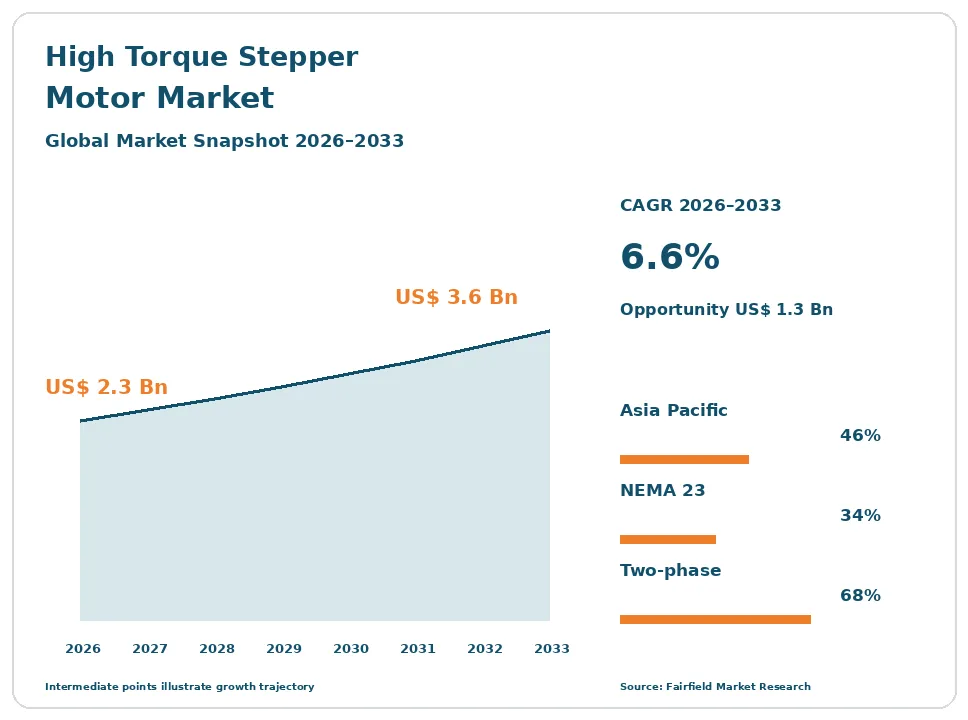
The global high torque stepper motor market size is expected to be valued at US$ 2.3 billion in 2026 and projected to reach US$ 3.6 billion by 2033, growing at a CAGR of 6.6% between 2026 and 2033.
The market compounded at roughly 5.8% between 2020 and 2025, lifted first by desktop additive manufacturing and later by closed-loop designs entering industrial machinery. Three factors shape the forecast. Machine builders still need accurate positioning without the cost, tuning and commissioning burden of a servo system. Closed-loop and encoder-equipped steppers have removed the missed-step risk that previously capped industrial use. Integrated motor-drive units are raising revenue per axis by absorbing cabinet hardware. Growth is solid but bounded, because the competitive frontier with low-cost servo drives keeps moving and limits how far upward steppers can extend.
Key Report Takeaways
- By Frame Size: NEMA 23 held a 34.0% share in 2026, while NEMA 34 is projected to expand at a 7.6% CAGR through 2033, as closed-loop control lets larger frames take work that previously required servos.
- By Phase Configuration: Two-phase designs held a 68.0% share in 2026, while three-phase steppers are projected to grow at a 7.8% CAGR through 2033, because they cut torque ripple, resonance and audible noise at higher speeds.
- By Product Configuration: Standalone hybrid stepper motors held a 58.0% share in 2026, while integrated motor-drive and motor-drive-controller units are projected to rise at a 9.2% CAGR through 2033, by removing cabinet space and wiring.
- By End-use Industry: Computer numerical control machining and routing held a 25.5% share in 2026, while 3D printing and additive manufacturing is projected to advance at an 8.9% CAGR through 2033, on desktop and industrial unit volumes.
- By Geography: Asia Pacific held a 46.0% share in 2026, while North America is projected to grow at a 7.2% CAGR through 2033, driven by medical device, laboratory automation and desktop machinery production.
Global High Torque Stepper Motor Market Trends and Insights
Drivers Impact Analysis
| Driver | Impact on CAGR Forecast | Geographic Relevance | Impact Timeline |
| Low-cost precision positioning in machinery that cannot justify servo systems | High | Global | Long term ≥4 years |
| Closed-loop stepper designs extending the technology upward into industrial duty | High | Asia Pacific, North America, Europe | Medium term 2–4 years |
Both drivers below rest on the same economic fact: a stepper positions accurately without feedback, tuning or commissioning effort.
Open-Loop Precision Keeps High Torque Stepper Motors Dominant in Low-Power Positioning
The stepper survives because it is cheap, simple and precise without feedback. It holds a commanded position with no encoder, no tuning and no commissioning specialist, which is why it still dominates low-to-mid power positioning in machine tools, printers, packaging lines and laboratory instruments. For a builder designing a four-axis machine at a competitive price, the stepper removes cost from the motor, the drive, the cabinet and the engineering hours together.
The mechanism is total system cost rather than motor price. A servo axis requires an encoder, a tuned drive, cabling and loop commissioning on every machine built, and those recurring costs scale with production volume. A stepper axis does not. NEMA ICS 16 and the NEMA frame size standards make motors mechanically and electrically interchangeable between suppliers, which lowers sourcing risk and keeps design effort reusable across machine generations.
Closed-Loop Control Extends High Torque Stepper Motors Into Industrial Machinery
Closed-loop designs have widened the stepper’s usable range and brought back applications previously conceded to servos. Adding an encoder removes the stall and missed-step risk that made engineers distrust steppers in unattended industrial duty, while retaining stepper simplicity and standstill holding torque. The result is a credible option for packaging machinery, textile and printing equipment, semiconductor handling and laboratory automation at torque levels that previously demanded a servo system.
The mechanism is improved current control and cheaper position feedback. Modern drive electronics vary current with load, which cuts heat at partial duty and improves efficiency, while magnetic and optical encoders have fallen sharply in cost. IEC 60034 rotating machine standards and IEC 61800 adjustable speed drive requirements, including the functional safety parts, give builders a recognised compliance route when steppers are used in guarded industrial motion control systems.
Restraints Impact Analysis
| Restraint | Impact on CAGR Forecast | Geographic Relevance | Impact Timeline |
| Torque roll-off with speed, standstill heating and resonance | High | Global | Long term ≥4 years |
| Rare earth magnet cost and export licensing concentration | Medium | Asia Pacific, Europe, North America | Short term ≤2 years |
Both restraints below are physical or geopolitical, and neither can be engineered away by the supplier alone.
Torque Roll-Off With Speed Caps High Torque Stepper Motor Adoption
Torque falls off sharply as speed rises, and that is a physical limit no specification sheet can remove. A hybrid stepper has many rotor teeth and therefore high pole count, so back electromotive force rises quickly with speed and available torque collapses well below the speeds a servo sustains. Above a certain duty cycle and speed, a servo simply wins, and that boundary caps the addressable range of stepper motion control.
Two related effects reinforce the limit. A stepper draws close to full current at standstill, so it generates heat even when doing no work, which constrains continuous duty, winding insulation life and enclosure design. Mid-band resonance and audible noise also remain, particularly in two-phase designs, and matter in laboratory, medical and office environments. Microstepping and current control reduce these effects but cannot eliminate them.
Rare Earth Magnet Cost and Export Licensing Constrain High Torque Stepper Motor Supply
Magnet supply is a live commercial risk rather than a theoretical one. Hybrid steppers use permanent magnets in the rotor, and the sintered neodymium-iron-boron magnet supply chain is concentrated in a small number of countries. Price moves in neodymium, praseodymium and dysprosium flow straight into motor cost, and buyers of low-priced standard frames have little pricing power to pass the increase downstream.
The cause is both geological and policy driven. Separation and magnet-making capacity, not ore, is the bottleneck, and that capacity is concentrated. Export licensing of rare earth elements and finished magnets has added lead time, documentation and end-use declarations to what was previously routine procurement. Manufacturers have responded by holding larger magnet inventories, qualifying second sources and, in some ranges, redesigning to reduce heavy rare earth content.
Market Opportunities
Both opportunities below raise revenue per axis rather than depending on more machines being built.
Integrated Motor-Drive Units Create a Higher-Value Product Pool in High Torque Stepper Motors
Integrated motor-drive and motor-drive-controller units open a revenue pool worth several times a bare motor. Putting the drive, and sometimes the controller and fieldbus interface, inside the motor housing removes a drive module from the cabinet, the motor cable and most of the wiring labour. Machine builders pay for that, because panel space, cable routing and assembly hours are real costs they can measure on every machine built.
Builders of modular machinery, laboratory instruments, packaging lines and automated test equipment create the demand, since their designs are distributed rather than centralised. Suppliers capture it by offering common fieldbus interfaces, standardised NEMA mounting and configuration software that shortens integration. The same packaging supports closed-loop upgrades, because the encoder sits inside the same housing and requires no additional cabling or cabinet changes from the customer.
Medical, Laboratory and Additive Manufacturing Demand Lifts High Torque Stepper Motor Content
Three equipment categories are adding stepper axes faster than general machinery. Laboratory automation, in vitro diagnostic analysers and medical devices need quiet, precise, low-duty positioning where a stepper is technically ideal and a servo is over-specified. Additive manufacturing, both desktop and industrial, puts multiple stepper axes in every machine built. Semiconductor and electronics handling equipment adds further axes in wafer, die and test positioning.
These customers create unusually durable demand, because designs are validated and then built unchanged for years. Medical and diagnostic equipment makers in particular require documented component change control, which favours suppliers with stable catalogues and long product life commitments. RoHS and REACH compliance documentation is a routine condition of supply. Vendors that combine compliance records, low noise designs and long-term availability can capture premium positions in these applications.
Segment Analysis
By Frame Size: NEMA 23 Holds the Volume While NEMA 34 Advances Quickest
NEMA 23 led with a 34.0% share in 2026, because it sits at the sweet spot between torque and cost for benchtop machining, routers, packaging modules, labelling heads and laboratory instruments. Its mounting pattern is a de facto industry default, which keeps design effort and sourcing risk low across machine generations. NEMA 34 is the fastest-growing frame at a 7.6% CAGR, as closed-loop control allows larger frames to take machine duties that previously required a servo axis, particularly in routing, plasma cutting and heavier gantry motion. NEMA 17 retains enormous unit volume in desktop additive manufacturing and small positioners, while NEMA 42 and larger frames remain a specialist niche. The commercial implication is that growth is concentrated where the stepper is pushing against the servo boundary rather than where its position is already secure.
By Phase Configuration: Two-Phase Designs Lead as Three-Phase Steppers Gain Ground
Two-phase hybrid steppers represented 68.0% of the market in 2026, reflecting decades of installed design practice, the widest drive availability and the lowest electronics cost per axis. Nearly every general-purpose stepper driver supports them, which makes substitution between suppliers straightforward. Three-phase designs are the fastest-growing configuration at a 7.8% CAGR, because they deliver smoother torque with lower ripple, reduced mid-band resonance and noticeably quieter running at higher speeds. That matters in medical, laboratory and office equipment where audible noise is a specification. Five-phase steppers continue to serve high-resolution positioning in semiconductor and precision instrument duties, with a small but defensible share. For suppliers, phase configuration increasingly travels with the drive: the motor alone no longer determines performance, so motor and electronics are developed and sold as a matched pair.
By Product Configuration: Standalone Motors Dominate While Integrated Units Scale Fastest
Standalone hybrid stepper motors accounted for 58.0% of 2026 revenue, since most machine builders still buy motors and drives separately to keep sourcing flexible and electronics centralised in one cabinet. Geared stepper assemblies hold a steady position where high output torque at low speed is needed in a small envelope, such as valve actuation and camera positioning. Closed-loop and encoder-equipped steppers continue to take share from open-loop designs in industrial duty. Integrated motor-drive and motor-drive-controller units are the fastest-growing configuration at a 9.2% CAGR, because they remove cabinet hardware, cabling and assembly labour from every machine built. The business implication is a shift in value capture: the motor becomes part of a mechatronic subsystem, and suppliers able to develop firmware, fieldbus support and configuration tools earn margin that pure motor manufacturers cannot.
By End-use Industry: Machining Leads While Additive Manufacturing Grows Fastest
Computer numerical control machining and routing held a 25.5% share in 2026, the largest end-use, because benchtop mills, routers, engravers, plasma tables and laser cutters use three to five stepper axes each and are produced in large numbers worldwide. Packaging and labelling, textile and printing, and general factory automation supply steady industrial volume. 3D printing and additive manufacturing is the fastest-growing industry at an 8.9% CAGR, carried by desktop and industrial printer output where each machine carries several motion axes. Semiconductor and laboratory automation, medical devices, and security and camera positioning contribute smaller but higher-value demand with tighter noise, documentation and reliability expectations. The practical consequence is a two-speed business: high-volume, price-sensitive machine building on one side, and lower-volume qualified applications with far better margins on the other.
Geography Analysis
Which Region Is Growing Fastest in the High Torque Stepper Motor Market?
North America is growing fastest in the high torque stepper motor market, at a 7.2% CAGR through 2033, from a 22.0% share in 2026. The driver is the composition of its machine building base. The United States builds a disproportionate share of the world’s laboratory automation, in vitro diagnostic instruments, medical devices and semiconductor back-end handling equipment, all of which favour quiet, precise, low-duty positioning. Desktop additive manufacturing and benchtop machining brands also design and assemble here. Reshoring incentives for electronics and medical manufacturing have added domestic equipment demand. Canada and Mexico contribute packaging, printing and automotive component machinery. Buyers here place unusual weight on long-term component availability and documented change control, which supports suppliers offering stable catalogues rather than the lowest unit price.
Europe Specifies High Torque Stepper Motors Around Safety, Noise and Compliance Rules
Europe accounted for 20.5% of the market in 2026 and is forecast to grow at 5.6% through 2033, the slowest of the five regions as machinery output remains broadly flat. Germany, Italy, Switzerland and the Nordic countries lead, supported by packaging, textile, printing, laboratory and medical equipment builders. Specification practice is distinctive: machine builders document compliance carefully, so CE marking and electromagnetic compatibility requirements, IEC 61800 drive standards and RoHS and REACH declarations are routine supply conditions rather than afterthoughts. Audible noise limits in laboratory and medical settings favour three-phase and well-controlled closed-loop designs. The European Union critical raw materials framework is also prompting builders to question magnet sourcing, which has made supply chain transparency a competitive factor alongside motor performance.
Which Region Is Leading the High Torque Stepper Motor Market?
Asia Pacific leads the high torque stepper motor market with a 46.0% share in 2026, growing at 6.8% through 2033. Leadership follows both production and consumption. China manufactures the majority of the world’s stepper motors and the drives that pair with them, and also builds most desktop additive manufacturing machines, benchtop routers, textile machinery and packaging equipment that consume them. Japan supplies high-specification steppers for semiconductor, medical and precision instrument duties, with long-standing strength in five-phase and geared designs. South Korea and Taiwan contribute electronics assembly and test equipment demand, while India is expanding packaging, printing and textile machinery production. Fierce domestic competition compresses pricing in standard frames, so regional suppliers increasingly differentiate through integrated drives, closed-loop control and firmware rather than motor construction.
Latin America Adopts High Torque Stepper Motors Through Packaging and Printing Machinery
Latin America represented 5.0% of the market in 2026 and is forecast to grow at 5.9% through 2033. Demand concentrates in Brazil, Mexico and Argentina, driven by food packaging and labelling lines, textile and garment machinery, printing and signage equipment, and a growing base of small machining and additive manufacturing workshops. Most motors are imported, often as part of complete machines rather than as components, which limits visibility for motor suppliers. Barriers are practical: import duties and currency volatility raise landed cost, technical support is thin outside major industrial cities, and few local integrators can commission closed-loop motion systems. The clearest opportunity lies with distributors offering stocked standard frames and integrated units with local application support, since availability usually decides selection here.
Middle East & Africa Builds High Torque Stepper Motor Demand From Light Manufacturing
Middle East & Africa held 6.5% of revenue in 2026 and is forecast to grow at 6.0% through 2033, from a small base. Turkey contributes substantial textile, packaging and printing machinery production, while the United Arab Emirates, Saudi Arabia, Egypt and South Africa add food processing, labelling, signage and light assembly equipment. Industrial diversification programmes in the Gulf are expanding domestic machine assembly, which gradually shifts purchasing from complete imported machines towards component sourcing. Barriers include limited local motion control engineering expertise, long lead times for specialist frames, and high ambient temperatures that shorten winding life in poorly ventilated cabinets. The opportunity is in integrated motor-drive units, which reduce the commissioning skill a local integrator needs to deploy multi-axis machines.
Competitive Landscape
The high torque stepper motor market is moderately concentrated, with a clear tiering by application rather than by scale alone. A group of established Japanese manufacturers holds the high-specification positions in semiconductor, medical and precision instrument duties, supported by long product lifecycles and deep application engineering. A second group of Chinese manufacturers has become dominant in volume frames for machine building, additive manufacturing and general automation, competing on cost, availability and increasingly on integrated electronics. European and North American specialists occupy defensible niches in harsh environment, vacuum, cryogenic and customised designs. Consolidation has been limited, because the technology is mature and barriers to entry in standard frames are modest.
Competition turns on the package rather than the motor. Buyers compare torque-speed curves at realistic bus voltages, standstill heating, audible noise and resonance behaviour, drive compatibility, fieldbus support, firmware quality and guaranteed availability over a machine’s production life. Price matters most in standard frames, where mechanical interchangeability under NEMA dimensions makes substitution easy. New approaches come mainly from drive electronics and firmware specialists moving into motor packaging, and from motion control suppliers bundling steppers with controllers and software as a single configured axis.
Strategic activity concentrates on three themes. Suppliers are extending integrated motor-drive ranges, since that is where margin is expanding and where switching cost is highest. They are investing in closed-loop control and current regulation to push the servo boundary further out. They are also working on magnet sourcing security, qualifying alternative suppliers and reducing heavy rare earth content where the design permits. The broader direction is away from selling motors and towards selling configured axes with documented compliance and long-term availability commitments.
High Torque Stepper Motor Industry Leaders
- Oriental Motor Co., Ltd.
- MinebeaMitsumi Inc.
- Nidec Corporation
- Sanyo Denki Co., Ltd.
- Moons’ Industries
Recent Industry Developments
- December 2023: China prohibited the export of rare earth extraction, separation and permanent magnet manufacturing technologies – it locked the magnet processing bottleneck in place and pushed motor makers to secure longer-term magnet supply agreements.
- May 2024: The European Union Critical Raw Materials Act entered into force, setting extraction, processing and recycling benchmarks for strategic materials including rare earth elements – it gave European motor buyers a policy basis to demand supply chain transparency.
- April 2025: China introduced export licensing requirements covering several medium and heavy rare earth elements and related permanent magnets – it added documentation, end-use declarations and lead time to magnet procurement for hybrid stepper motor manufacturing worldwide.
Companies Covered in the Report
- Oriental Motor Co., Ltd.
- Nidec Corporation
- MinebeaMitsumi Inc.
- Sanyo Denki Co., Ltd.
- Shinano Kenshi Co., Ltd.
- Moons’ Industries
- Leadshine Technology Co., Ltd.
- Lin Engineering
- Applied Motion Products
- Nanotec Electronic GmbH & Co. KG
- Phytron GmbH
- Autonics Corporation
- Portescap
High Torque Stepper Motor Market Report Scope
This report measures global revenue from stepper motors engineered for elevated holding and dynamic torque, including hybrid steppers across NEMA frames, closed-loop and integrated motor-drive units, and geared assemblies, with drives and controllers where sold together. Servo motors are the competing technology and are excluded, as are brushless direct current motors and stepper driver integrated circuits sold separately. The base year is 2025, and the forecast period runs from 2026 to 2033 in US$ Billion.
Frame Size
- NEMA 17
- NEMA 23
- NEMA 34
- NEMA 42 and larger
Phase Configuration
- Two-phase
- Three-phase
- Five-phase
Product Configuration
- Standalone hybrid stepper motors
- Geared stepper assemblies
- Closed-loop and encoder-equipped steppers
- Integrated motor-drive and motor-drive-controller units
End-use Industry
- Computer numerical control machining and routing
- 3D printing and additive manufacturing
- Packaging and labelling
- Textile and printing
- Semiconductor and laboratory automation
- Medical devices
- Security and camera positioning
- General factory automation
Regions
- North America
- Europe
- Asia Pacific
- Latin America
- Middle East & Africa
Key Questions Answered in the Report
How large is the high torque stepper motor market in 2026?
The global high torque stepper motor market is estimated at US$ 2.3 billion in 2026, covering hybrid, closed-loop, geared and integrated stepper products worldwide.
What is the forecast size and CAGR of the high torque stepper motor market?
The market is projected to reach US$ 3.6 billion by 2033, growing at a 6.6% CAGR and adding US$ 1.3 billion in absolute revenue opportunity.
Which frame size leads the high torque stepper motor market?
NEMA 23 leads with a 34.0% share in 2026, because it balances torque and cost for benchtop machining, packaging and laboratory equipment.
Which product configuration is growing fastest in the high torque stepper motor market?
Integrated motor-drive and motor-drive-controller units are growing fastest at a 9.2% CAGR, because they remove cabinet hardware, cabling and assembly labour.
How concentrated is the high torque stepper motor market?
Concentration is medium. Japanese suppliers hold high-specification positions, Chinese manufacturers dominate volume frames, and regional specialists serve harsh-environment niches.
1. Executive Summary
1.1. Global High Torque Stepper Motor Market Snapshot
1.2. Future Projections, 2026-2033
1.3. Key Market Trends
1.4. Regional Snapshot
2. Market Overview
2.1. Market Definition and Report Scope
2.2. Historical Market Trends, 2020-2025
2.3. Market Dynamics
2.3.1. Drivers Impact Analysis
2.3.1.1. Open-Loop Precision Keeps High Torque Stepper Motors Dominant in Low-Power Positioning
2.3.1.2. Closed-Loop Control Extends High Torque Stepper Motors Into Industrial Machinery
2.3.2. Restraints Impact Analysis
2.3.2.1. Torque Roll-Off With Speed Caps High Torque Stepper Motor Adoption
2.3.2.2. Rare Earth Magnet Cost and Export Licensing Constrain High Torque Stepper Motor Supply
2.3.3. Market Opportunities
2.3.3.1. Integrated Motor-Drive Units Create a Higher-Value Product Pool in High Torque Stepper Motors
2.3.3.2. Medical, Laboratory and Additive Manufacturing Demand Lifts High Torque Stepper Motor Content
3. Global High Torque Stepper Motor Market Outlook, 2020-2033
3.1. Global High Torque Stepper Motor Market Outlook, by Frame Size, Value (US$ Billion), 2020-2033
3.1.1. NEMA 17
3.1.2. NEMA 23
3.1.3. NEMA 34
3.1.4. NEMA 42 and larger
3.2. Global High Torque Stepper Motor Market Outlook, by Phase Configuration, Value (US$ Billion), 2020-2033
3.2.1. Two-phase
3.2.2. Three-phase
3.2.3. Five-phase
3.3. Global High Torque Stepper Motor Market Outlook, by Product Configuration, Value (US$ Billion), 2020-2033
3.3.1. Standalone hybrid stepper motors
3.3.2. Geared stepper assemblies
3.3.3. Closed-loop and encoder-equipped steppers
3.3.4. Integrated motor-drive and motor-drive-controller units
3.4. Global High Torque Stepper Motor Market Outlook, by End-use Industry, Value (US$ Billion), 2020-2033
3.4.1. Computer numerical control machining and routing
3.4.2. 3D printing and additive manufacturing
3.4.3. Packaging and labelling
3.4.4. Textile and printing
3.4.5. Semiconductor and laboratory automation
3.4.6. Medical devices
3.4.7. Security and camera positioning
3.4.8. General factory automation
3.5. Global High Torque Stepper Motor Market Outlook, by Region, Value (US$ Billion), 2020-2033
3.5.1. North America
3.5.2. Europe
3.5.3. Asia Pacific
3.5.4. Latin America
3.5.5. Middle East & Africa
4. North America High Torque Stepper Motor Market Outlook, 2020-2033
4.1. North America High Torque Stepper Motor Market Outlook, by Frame Size, Value (US$ Billion), 2020-2033
4.1.1. NEMA 17
4.1.2. NEMA 23
4.1.3. NEMA 34
4.1.4. NEMA 42 and larger
4.2. North America High Torque Stepper Motor Market Outlook, by Phase Configuration, Value (US$ Billion), 2020-2033
4.2.1. Two-phase
4.2.2. Three-phase
4.2.3. Five-phase
4.3. North America High Torque Stepper Motor Market Outlook, by Product Configuration, Value (US$ Billion), 2020-2033
4.3.1. Standalone hybrid stepper motors
4.3.2. Geared stepper assemblies
4.3.3. Closed-loop and encoder-equipped steppers
4.3.4. Integrated motor-drive and motor-drive-controller units
4.4. North America High Torque Stepper Motor Market Outlook, by End-use Industry, Value (US$ Billion), 2020-2033
4.4.1. Computer numerical control machining and routing
4.4.2. 3D printing and additive manufacturing
4.4.3. Packaging and labelling
4.4.4. Textile and printing
4.4.5. Semiconductor and laboratory automation
4.4.6. Medical devices
4.4.7. Security and camera positioning
4.4.8. General factory automation
4.5. North America High Torque Stepper Motor Market Outlook, by Country, Value (US$ Billion), 2020-2033
4.5.1. United States High Torque Stepper Motor Market Outlook, by Frame Size, 2020-2033
4.5.2. United States High Torque Stepper Motor Market Outlook, by Phase Configuration, 2020-2033
4.5.3. United States High Torque Stepper Motor Market Outlook, by Product Configuration, 2020-2033
4.5.4. United States High Torque Stepper Motor Market Outlook, by End-use Industry, 2020-2033
4.5.5. Canada High Torque Stepper Motor Market Outlook, by Frame Size, 2020-2033
4.5.6. Canada High Torque Stepper Motor Market Outlook, by Phase Configuration, 2020-2033
4.5.7. Canada High Torque Stepper Motor Market Outlook, by Product Configuration, 2020-2033
4.5.8. Canada High Torque Stepper Motor Market Outlook, by End-use Industry, 2020-2033
4.5.9. Mexico High Torque Stepper Motor Market Outlook, by Frame Size, 2020-2033
4.5.10. Mexico High Torque Stepper Motor Market Outlook, by Phase Configuration, 2020-2033
4.5.11. Mexico High Torque Stepper Motor Market Outlook, by Product Configuration, 2020-2033
4.5.12. Mexico High Torque Stepper Motor Market Outlook, by End-use Industry, 2020-2033
5. Europe High Torque Stepper Motor Market Outlook, 2020-2033
5.1. Europe High Torque Stepper Motor Market Outlook, by Frame Size, Value (US$ Billion), 2020-2033
5.1.1. NEMA 17
5.1.2. NEMA 23
5.1.3. NEMA 34
5.1.4. NEMA 42 and larger
5.2. Europe High Torque Stepper Motor Market Outlook, by Phase Configuration, Value (US$ Billion), 2020-2033
5.2.1. Two-phase
5.2.2. Three-phase
5.2.3. Five-phase
5.3. Europe High Torque Stepper Motor Market Outlook, by Product Configuration, Value (US$ Billion), 2020-2033
5.3.1. Standalone hybrid stepper motors
5.3.2. Geared stepper assemblies
5.3.3. Closed-loop and encoder-equipped steppers
5.3.4. Integrated motor-drive and motor-drive-controller units
5.4. Europe High Torque Stepper Motor Market Outlook, by End-use Industry, Value (US$ Billion), 2020-2033
5.4.1. Computer numerical control machining and routing
5.4.2. 3D printing and additive manufacturing
5.4.3. Packaging and labelling
5.4.4. Textile and printing
5.4.5. Semiconductor and laboratory automation
5.4.6. Medical devices
5.4.7. Security and camera positioning
5.4.8. General factory automation
5.5. Europe High Torque Stepper Motor Market Outlook, by Country and Subregion, Value (US$ Billion), 2020-2033
5.5.1. Germany High Torque Stepper Motor Market Outlook, by Frame Size, 2020-2033
5.5.2. Germany High Torque Stepper Motor Market Outlook, by Phase Configuration, 2020-2033
5.5.3. Germany High Torque Stepper Motor Market Outlook, by Product Configuration, 2020-2033
5.5.4. Germany High Torque Stepper Motor Market Outlook, by End-use Industry, 2020-2033
5.5.5. Italy High Torque Stepper Motor Market Outlook, by Frame Size, 2020-2033
5.5.6. Italy High Torque Stepper Motor Market Outlook, by Phase Configuration, 2020-2033
5.5.7. Italy High Torque Stepper Motor Market Outlook, by Product Configuration, 2020-2033
5.5.8. Italy High Torque Stepper Motor Market Outlook, by End-use Industry, 2020-2033
5.5.9. Switzerland High Torque Stepper Motor Market Outlook, by Frame Size, 2020-2033
5.5.10. Switzerland High Torque Stepper Motor Market Outlook, by Phase Configuration, 2020-2033
5.5.11. Switzerland High Torque Stepper Motor Market Outlook, by Product Configuration, 2020-2033
5.5.12. Switzerland High Torque Stepper Motor Market Outlook, by End-use Industry, 2020-2033
5.5.13. Nordic High Torque Stepper Motor Market Outlook, by Frame Size, 2020-2033
5.5.14. Nordic High Torque Stepper Motor Market Outlook, by Phase Configuration, 2020-2033
5.5.15. Nordic High Torque Stepper Motor Market Outlook, by Product Configuration, 2020-2033
5.5.16. Nordic High Torque Stepper Motor Market Outlook, by End-use Industry, 2020-2033
6. Asia Pacific High Torque Stepper Motor Market Outlook, 2020-2033
6.1. Asia Pacific High Torque Stepper Motor Market Outlook, by Frame Size, Value (US$ Billion), 2020-2033
6.1.1. NEMA 17
6.1.2. NEMA 23
6.1.3. NEMA 34
6.1.4. NEMA 42 and larger
6.2. Asia Pacific High Torque Stepper Motor Market Outlook, by Phase Configuration, Value (US$ Billion), 2020-2033
6.2.1. Two-phase
6.2.2. Three-phase
6.2.3. Five-phase
6.3. Asia Pacific High Torque Stepper Motor Market Outlook, by Product Configuration, Value (US$ Billion), 2020-2033
6.3.1. Standalone hybrid stepper motors
6.3.2. Geared stepper assemblies
6.3.3. Closed-loop and encoder-equipped steppers
6.3.4. Integrated motor-drive and motor-drive-controller units
6.4. Asia Pacific High Torque Stepper Motor Market Outlook, by End-use Industry, Value (US$ Billion), 2020-2033
6.4.1. Computer numerical control machining and routing
6.4.2. 3D printing and additive manufacturing
6.4.3. Packaging and labelling
6.4.4. Textile and printing
6.4.5. Semiconductor and laboratory automation
6.4.6. Medical devices
6.4.7. Security and camera positioning
6.4.8. General factory automation
6.5. Asia Pacific High Torque Stepper Motor Market Outlook, by Country, Value (US$ Billion), 2020-2033
6.5.1. China High Torque Stepper Motor Market Outlook, by Frame Size, 2020-2033
6.5.2. China High Torque Stepper Motor Market Outlook, by Phase Configuration, 2020-2033
6.5.3. China High Torque Stepper Motor Market Outlook, by Product Configuration, 2020-2033
6.5.4. China High Torque Stepper Motor Market Outlook, by End-use Industry, 2020-2033
6.5.5. Japan High Torque Stepper Motor Market Outlook, by Frame Size, 2020-2033
6.5.6. Japan High Torque Stepper Motor Market Outlook, by Phase Configuration, 2020-2033
6.5.7. Japan High Torque Stepper Motor Market Outlook, by Product Configuration, 2020-2033
6.5.8. Japan High Torque Stepper Motor Market Outlook, by End-use Industry, 2020-2033
6.5.9. South Korea High Torque Stepper Motor Market Outlook, by Frame Size, 2020-2033
6.5.10. South Korea High Torque Stepper Motor Market Outlook, by Phase Configuration, 2020-2033
6.5.11. South Korea High Torque Stepper Motor Market Outlook, by Product Configuration, 2020-2033
6.5.12. South Korea High Torque Stepper Motor Market Outlook, by End-use Industry, 2020-2033
6.5.13. Taiwan High Torque Stepper Motor Market Outlook, by Frame Size, 2020-2033
6.5.14. Taiwan High Torque Stepper Motor Market Outlook, by Phase Configuration, 2020-2033
6.5.15. Taiwan High Torque Stepper Motor Market Outlook, by Product Configuration, 2020-2033
6.5.16. Taiwan High Torque Stepper Motor Market Outlook, by End-use Industry, 2020-2033
6.5.17. India High Torque Stepper Motor Market Outlook, by Frame Size, 2020-2033
6.5.18. India High Torque Stepper Motor Market Outlook, by Phase Configuration, 2020-2033
6.5.19. India High Torque Stepper Motor Market Outlook, by Product Configuration, 2020-2033
6.5.20. India High Torque Stepper Motor Market Outlook, by End-use Industry, 2020-2033
7. Latin America High Torque Stepper Motor Market Outlook, 2020-2033
7.1. Latin America High Torque Stepper Motor Market Outlook, by Frame Size, Value (US$ Billion), 2020-2033
7.1.1. NEMA 17
7.1.2. NEMA 23
7.1.3. NEMA 34
7.1.4. NEMA 42 and larger
7.2. Latin America High Torque Stepper Motor Market Outlook, by Phase Configuration, Value (US$ Billion), 2020-2033
7.2.1. Two-phase
7.2.2. Three-phase
7.2.3. Five-phase
7.3. Latin America High Torque Stepper Motor Market Outlook, by Product Configuration, Value (US$ Billion), 2020-2033
7.3.1. Standalone hybrid stepper motors
7.3.2. Geared stepper assemblies
7.3.3. Closed-loop and encoder-equipped steppers
7.3.4. Integrated motor-drive and motor-drive-controller units
7.4. Latin America High Torque Stepper Motor Market Outlook, by End-use Industry, Value (US$ Billion), 2020-2033
7.4.1. Computer numerical control machining and routing
7.4.2. 3D printing and additive manufacturing
7.4.3. Packaging and labelling
7.4.4. Textile and printing
7.4.5. Semiconductor and laboratory automation
7.4.6. Medical devices
7.4.7. Security and camera positioning
7.4.8. General factory automation
7.5. Latin America High Torque Stepper Motor Market Outlook, by Country, Value (US$ Billion), 2020-2033
7.5.1. Brazil High Torque Stepper Motor Market Outlook, by Frame Size, 2020-2033
7.5.2. Brazil High Torque Stepper Motor Market Outlook, by Phase Configuration, 2020-2033
7.5.3. Brazil High Torque Stepper Motor Market Outlook, by Product Configuration, 2020-2033
7.5.4. Brazil High Torque Stepper Motor Market Outlook, by End-use Industry, 2020-2033
7.5.5. Mexico High Torque Stepper Motor Market Outlook, by Frame Size, 2020-2033
7.5.6. Mexico High Torque Stepper Motor Market Outlook, by Phase Configuration, 2020-2033
7.5.7. Mexico High Torque Stepper Motor Market Outlook, by Product Configuration, 2020-2033
7.5.8. Mexico High Torque Stepper Motor Market Outlook, by End-use Industry, 2020-2033
7.5.9. Argentina High Torque Stepper Motor Market Outlook, by Frame Size, 2020-2033
7.5.10. Argentina High Torque Stepper Motor Market Outlook, by Phase Configuration, 2020-2033
7.5.11. Argentina High Torque Stepper Motor Market Outlook, by Product Configuration, 2020-2033
7.5.12. Argentina High Torque Stepper Motor Market Outlook, by End-use Industry, 2020-2033
8. Middle East & Africa High Torque Stepper Motor Market Outlook, 2020-2033
8.1. Middle East & Africa High Torque Stepper Motor Market Outlook, by Frame Size, Value (US$ Billion), 2020-2033
8.1.1. NEMA 17
8.1.2. NEMA 23
8.1.3. NEMA 34
8.1.4. NEMA 42 and larger
8.2. Middle East & Africa High Torque Stepper Motor Market Outlook, by Phase Configuration, Value (US$ Billion), 2020-2033
8.2.1. Two-phase
8.2.2. Three-phase
8.2.3. Five-phase
8.3. Middle East & Africa High Torque Stepper Motor Market Outlook, by Product Configuration, Value (US$ Billion), 2020-2033
8.3.1. Standalone hybrid stepper motors
8.3.2. Geared stepper assemblies
8.3.3. Closed-loop and encoder-equipped steppers
8.3.4. Integrated motor-drive and motor-drive-controller units
8.4. Middle East & Africa High Torque Stepper Motor Market Outlook, by End-use Industry, Value (US$ Billion), 2020-2033
8.4.1. Computer numerical control machining and routing
8.4.2. 3D printing and additive manufacturing
8.4.3. Packaging and labelling
8.4.4. Textile and printing
8.4.5. Semiconductor and laboratory automation
8.4.6. Medical devices
8.4.7. Security and camera positioning
8.4.8. General factory automation
8.5. Middle East & Africa High Torque Stepper Motor Market Outlook, by Country, Value (US$ Billion), 2020-2033
8.5.1. Turkey High Torque Stepper Motor Market Outlook, by Frame Size, 2020-2033
8.5.2. Turkey High Torque Stepper Motor Market Outlook, by Phase Configuration, 2020-2033
8.5.3. Turkey High Torque Stepper Motor Market Outlook, by Product Configuration, 2020-2033
8.5.4. Turkey High Torque Stepper Motor Market Outlook, by End-use Industry, 2020-2033
8.5.5. United Arab Emirates High Torque Stepper Motor Market Outlook, by Frame Size, 2020-2033
8.5.6. United Arab Emirates High Torque Stepper Motor Market Outlook, by Phase Configuration, 2020-2033
8.5.7. United Arab Emirates High Torque Stepper Motor Market Outlook, by Product Configuration, 2020-2033
8.5.8. United Arab Emirates High Torque Stepper Motor Market Outlook, by End-use Industry, 2020-2033
8.5.9. Saudi Arabia High Torque Stepper Motor Market Outlook, by Frame Size, 2020-2033
8.5.10. Saudi Arabia High Torque Stepper Motor Market Outlook, by Phase Configuration, 2020-2033
8.5.11. Saudi Arabia High Torque Stepper Motor Market Outlook, by Product Configuration, 2020-2033
8.5.12. Saudi Arabia High Torque Stepper Motor Market Outlook, by End-use Industry, 2020-2033
8.5.13. Egypt High Torque Stepper Motor Market Outlook, by Frame Size, 2020-2033
8.5.14. Egypt High Torque Stepper Motor Market Outlook, by Phase Configuration, 2020-2033
8.5.15. Egypt High Torque Stepper Motor Market Outlook, by Product Configuration, 2020-2033
8.5.16. Egypt High Torque Stepper Motor Market Outlook, by End-use Industry, 2020-2033
8.5.17. South Africa High Torque Stepper Motor Market Outlook, by Frame Size, 2020-2033
8.5.18. South Africa High Torque Stepper Motor Market Outlook, by Phase Configuration, 2020-2033
8.5.19. South Africa High Torque Stepper Motor Market Outlook, by Product Configuration, 2020-2033
8.5.20. South Africa High Torque Stepper Motor Market Outlook, by End-use Industry, 2020-2033
9. Competitive Landscape
9.1. Market Concentration and Industry Leaders
9.2. Competitive Differentiation
9.3. Strategic Initiatives
9.4. Recent Industry Developments
9.5. Company Profiles
9.5.1. Oriental Motor Co., Ltd.
9.5.2. Nidec Corporation
9.5.3. MinebeaMitsumi Inc.
9.5.4. Sanyo Denki Co., Ltd.
9.5.5. Shinano Kenshi Co., Ltd.
9.5.6. Moons' Industries
9.5.7. Leadshine Technology Co., Ltd.
9.5.8. Lin Engineering
9.5.9. Applied Motion Products
9.5.10. Nanotec Electronic GmbH & Co. KG
9.5.11. Phytron GmbH
9.5.12. Autonics Corporation
9.5.13. Portescap
10. Appendix
10.1. Research Methodology
10.2. Report Assumptions
10.3. Acronyms and Abbreviations
| Frame Size | NEMA 17, NEMA 23, NEMA 34, NEMA 42 and larger |
| Phase Configuration | Two-phase, Three-phase, Five-phase |
| Product Configuration | Standalone hybrid stepper motors, Geared stepper assemblies, Closed-loop and encoder-equipped steppers, Integrated motor-drive and motor-drive-controller units |
| End-use Industry | Computer numerical control machining and routing, 3D printing and additive manufacturing, Packaging and labelling, Textile and printing, Semiconductor and laboratory automation, Medical devices, Security and camera positioning, General factory automation |
| Regions | North America, Europe, Asia Pacific, Latin America, Middle East & Africa |
Our Research Methodology
Considering the volatility of business today, traditional approaches to strategizing a game plan can be unfruitful if not detrimental. True ambiguity is no way to determine a forecast. A myriad of predetermined factors must be accounted for such as the degree of risk involved, the magnitude of circumstances, as well as conditions or consequences that are not known or unpredictable. To circumvent binary views that cast uncertainty, the application of market research intelligence to strategically posture, move, and enable actionable outcomes is necessary.
View Methodology
Quality Assured
Rigorous Validation Process

Confidentiality Assured
End-to-end Data Security

Custom Research Services
Tailored To Your Objectives
FAQs
The global high torque stepper motor market is estimated at US$ 2.3 billion in 2026, covering hybrid, closed-loop, geared and integrated stepper products worldwide.
The market is projected to reach US$ 3.6 billion by 2033, growing at a 6.6% CAGR and adding US$ 1.3 billion in absolute revenue opportunity.
NEMA 23 leads with a 34.0% share in 2026, because it balances torque and cost for benchtop machining, packaging and laboratory equipment.
Integrated motor-drive and motor-drive-controller units are growing fastest at a 9.2% CAGR, because they remove cabinet hardware, cabling and assembly labour.
Concentration is medium. Japanese suppliers hold high-specification positions, Chinese manufacturers dominate volume frames, and regional specialists serve harsh-environment niches.
Related Reports
Laser Technologies in Manufacturing Market Size, Share, Insights, Competitive Landscape, and Forecast 2026 to 2033
Explore the laser technologies in manufacturing market, valued at US$ 23.6 billion in 2026 and forecast to reach US$ 38.4 billion by 2033 at 7.2% CAGR.
FBG Interrogator Market Size, Share, Insights, Competitive Landscape, and Forecast 2026 to 2033
Explore the FBG interrogator market, projected to reach US$ 316.7 million by 2033 at an 8.5% CAGR, with technology, application and regional insights.
Conveying Equipment Market Size, Share, Insights, Competitive Landscape, and Forecast 2026 to 2033
Explore the conveying equipment market, projected to reach US$ 56.9 billion by 2033 at a 4.5% CAGR, with equipment, services and regional insights.
Bakery Packaging Machine Market Size, Share, Insights, Competitive Landscape, and Forecast 2026 to 2033
Explore the bakery packaging machine market, projected to reach US$ 4.44 billion by 2033 at a 4.6% CAGR, with automation, machine and regional insights.
EPC Construction Market Size, Share, Insights, Competitive Landscape, and Forecast 2026 to 2033
EPC construction market to grow from US$ 331.5 billion in 2026 to US$ 424.6 billion by 2033 at a 3.6% CAGR. Explore services, contracts and regional trends.
Hydraulic Manifold Market Size, Share, Insights, Competitive Landscape, and Forecast 2026 to 2033
Hydraulic manifold market to grow from US$ 750.0 million in 2026 to US$ 947.8 million by 2033 at a 3.4% CAGR. Explore types, applications and regional trends.