



Weather RADAR Market
Weather RADAR Market Size, Share, Insights, Competitive Landscape, and Forecast 2026 to 2033
How Fast Is the Weather RADAR Market Growing?
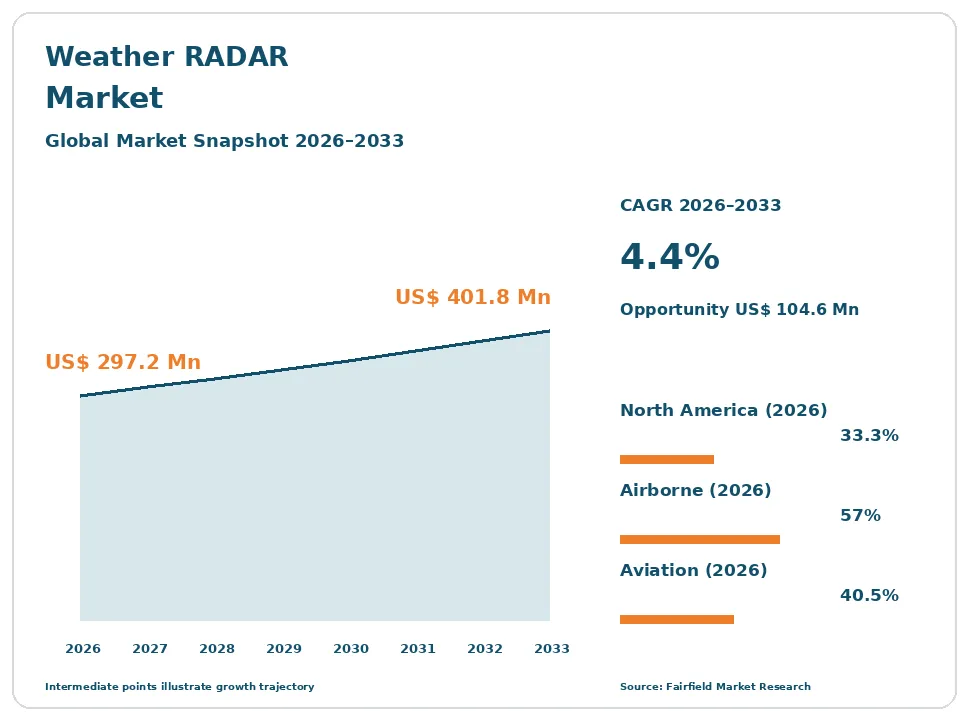
The global weather RADAR market size is expected to be valued at US$ 297.2 million in 2026 and projected to reach US$ 401.8 million by 2033, growing at a CAGR of 4.4% between 2026 and 2033.
Between 2020 and 2025, the market grew at a CAGR of about 3.8%, as national weather services replaced aging networks, airlines upgraded onboard radars, and extreme weather events raised demand for faster and more accurate warnings. Weather radar systems send out radio pulses and measure the echoes returned by rain, hail, snow, and dust to show where storms are, how strong they are, and how they move. Doppler weather radar also measures wind speed inside storms, which helps forecasters spot tornadoes, wind shear, and dangerous turbulence. Systems include large ground-based S-band and C-band radars, compact X-band radars for cities and valleys, and airborne radars fitted in aircraft noses. Growth comes from climate change, aviation safety rules, early-warning programs, and private radar networks for agriculture and energy. The market is shifting toward dual-polarization radar, phased-array designs, and AI-based nowcasting. In September 2025, Climavision expanded its private radar network across 15 U.S. states.
Key Report Takeaways
- By Radar Type: Airborne held 57.0% share in 2026, while Ground-Based is projected to expand at a 5.2% CAGR through 2033, driven by national network upgrades, early-warning programs, and private X-band networks that fill coverage gaps.
- By Application: Aviation held 40.5% share in 2026, while Meteorology & Hydrology is projected to expand at a 5.3% CAGR through 2033, driven by flood forecasting, severe storm warnings, and climate adaptation investment by governments worldwide.
- By Frequency Band: C-Band held 38.0% share in 2026, while X-Band is projected to expand at a 6.1% CAGR through 2033, driven by compact, lower-cost radars for cities, airports, mountains, and private weather networks.
- By Region: North America held 33.3% share in 2026, while Asia Pacific is projected to expand at a 5.8% CAGR through 2033, driven by monsoon and typhoon risks, radar network expansion in India and China, and rapid airline fleet growth.
Global Weather RADAR Market Trends and Insights
Drivers Impact Analysis
Two drivers carry the strongest influence on weather RADAR demand during the forecast period.
Extreme Weather Is Driving the Weather RADAR Market
Rising extreme weather and early-warning investment are the strongest driver of the weather RADAR market. Governments need better storm and flood warnings.
The mechanism is the growing cost of weather disasters. Floods, tornadoes, hurricanes, cyclones, hailstorms, and flash floods cause large losses each year, and climate change is making many events more intense. National weather services use radar networks to issue warnings minutes to hours ahead, saving lives and property. The United Nations Early Warnings for All initiative aims to cover every person with warning systems, and donors such as France and the United Kingdom fund programs for developing countries. The India Meteorological Department issued a tender for 20 C-band and 25 X-band Doppler radars in July 2025, and Vaisala was chosen to supply seven dual-polarization radars to Greece. These programs create steady demand for new weather radar systems and upgrades.
Aviation Safety Is Expanding the Weather RADAR Market
Aviation safety and fleet growth are expanding the weather RADAR market. Every commercial aircraft needs onboard weather radar.
The cause is rising air traffic and stricter safety expectations. Airborne radars help pilots avoid thunderstorms, hail, turbulence, and wind shear, and modern systems automatically scan and display threats in three dimensions. Airlines in Asia Pacific and Middle East & Africa are taking delivery of thousands of new aircraft, each fitted with radar from Honeywell or Collins Aerospace. Business jets and helicopters are upgrading older units. Airports also use terminal Doppler radars and wind shear systems to protect takeoffs and landings. Certifications such as Brazil’s approval of Honeywell’s IntuVue RDR-7000 for Learjet aircraft open retrofit opportunities. Military aircraft and drones also use weather radar for mission planning. These needs keep aviation the largest application.
| Driver | Impact on CAGR Forecast | Geographic Relevance | Impact Timeline |
| Rising extreme weather and early-warning investment | High | Global | Long term (≥4 years) |
| Aviation safety and fleet growth | Medium | Asia Pacific, North America, Middle East & Africa | Medium term (2-4 years) |
Restraints Impact Analysis
Two restraints limit how quickly the weather RADAR market grows.
High Costs Slow the Weather RADAR Market
High installation and maintenance costs slow the weather RADAR market. Radar networks are expensive to build and run.
The specific causes are equipment, infrastructure, and ongoing support. A large S-band or C-band radar can cost millions of dollars, plus towers, buildings, power supplies, data links, and software. Many developing countries depend on donor funding, which can be delayed or limited. After installation, radars need regular calibration, spare parts, and skilled technicians, and many radars in poorer regions stop working because maintenance budgets run out. Long procurement cycles and public tenders slow purchasing. Component shortages have extended lead times. Power outages and poor internet links in remote sites also interrupt data flow. Some countries buy radars without long-term service contracts, which leads to early failures. These cost barriers limit network expansion where warnings are needed most.
Spectrum Interference Restricts the Weather RADAR Market
Spectrum interference and skills shortages restrict the weather RADAR market. Radars share crowded radio bands.
The underlying causes are competition for spectrum and a shortage of trained staff. Wireless broadband, 5G networks, and Wi-Fi devices operate near weather radar frequencies, especially in the C-band, and can create false echoes or block signals. Regulators have tightened rules, but enforcement is uneven. Wind farms also cause clutter on radar displays. At the same time, fewer engineers are trained to maintain radar hardware, and many meteorology graduates lack electronics training. Weather services also struggle to retain staff, who are attracted by higher salaries in private industry. Training programs run by suppliers and international bodies help but cannot fully close the gap. Data sharing between countries is still limited in some regions, which reduces the value of individual radars for cross-border storms. These challenges reduce data quality and slow upgrades.
| Restraint | Impact on CAGR Forecast | Geographic Relevance | Impact Timeline |
| High installation and maintenance costs | High | Latin America, Middle East & Africa, Asia Pacific | Long term (≥4 years) |
| Spectrum interference and skills shortages | Medium | Global | Medium term (2-4 years) |
Market Opportunities
Private Radar Networks Open a Fast-Growth Revenue Pool
Private radar networks open a fast-growth revenue pool in the weather RADAR market. Businesses want local, high-resolution weather data.
Radar makers and weather data companies can capture this opportunity. Private operators such as Climavision install compact X-band radars to fill gaps in public networks, especially at low altitudes where large radars cannot see. Farmers, insurers, utilities, renewable energy operators, airports, and sports venues pay for detailed rainfall, hail, and wind data. Subscription data services create recurring revenue. Climavision expanded to 15 U.S. states in September 2025. Private radars can also be installed faster than public networks because they avoid long government tenders. Partnerships with farm equipment makers and insurers bring radar rainfall data directly into the software that customers already use every day. Companies that combine radars with analytics and alerts can build profitable data businesses.
Phased-Array and AI Nowcasting Create a Technology Revenue Pool
Phased-array radar and AI nowcasting create a technology revenue pool in the weather RADAR market. New technology can scan faster and predict better.
Technology leaders can capture this opportunity. Phased-array radars scan the sky electronically in seconds rather than minutes, improving tornado and flash flood warnings, and the United States is studying them to replace its aging national network. AI models turn radar data into short-term forecasts, and China’s weather agency upgraded its AI warning platform in July 2026. Solid-state transmitters reduce maintenance compared with older tube-based systems and last longer. Cloud platforms make radar data easier to share and combine with satellite and ground observations. Software upgrades can also add new features to radars already in service. Companies that lead in phased-array, solid-state, and AI tools can win next-generation contracts worth large sums over many years.
Segment Analysis
By Radar Type: Airborne Leads While Ground-Based Grows Fastest
Airborne held 57.0% share in 2026. Every commercial airliner, most business jets, and many helicopters and military aircraft carry weather radar in the nose, and new aircraft deliveries and retrofits create a large, steady market. Honeywell, Collins Aerospace, and Garmin lead airborne radar, offering multiscan and predictive wind shear features.
Ground-Based is the fastest-growing radar type, expanding at a 5.2% CAGR through 2033. National weather services, airports, and private operators are installing new Doppler weather radar and replacing old units. Mobile and transportable radars support research, wildfire monitoring, and disaster response, and they can be moved quickly to areas without coverage. Ship-borne radars serve maritime users. For the market, ground-based growth reflects climate adaptation spending.
By Application: Aviation Leads While Meteorology & Hydrology Grows Fastest
Aviation held 40.5% share in 2026. Airborne radars, airport terminal Doppler radars, and wind shear detection systems protect flights during takeoff, landing, and cruise, and aviation authorities require weather radar on commercial aircraft. Air navigation service providers also use radar data to route traffic around storms and reduce delays. Strong aircraft deliveries keep this segment large.
Meteorology & Hydrology is the fastest-growing application, expanding at a 5.3% CAGR through 2033. National weather services and water agencies use radar to issue severe storm warnings, estimate rainfall, forecast floods, and support research on climate. Early-warning programs funded by governments and donors are adding many new radars. Military, marine, and commercial uses, including agriculture, insurance, and energy, form other applications. For the market, meteorological growth reflects rising climate adaptation investment.
By Frequency Band: C-Band Leads While X-Band Grows Fastest
C-Band held 38.0% share in 2026. C-band radars balance range, resolution, and cost, and they are the standard choice for national networks in Europe, Asia Pacific, and many developing countries. Dual-polarization C-band systems from Vaisala, Leonardo, and Enterprise Electronics Corporation are widely installed.
X-Band is the fastest-growing band, expanding at a 6.1% CAGR through 2033. Compact X-band radars are cheaper, easier to install on rooftops or small towers, and give high-resolution data over short ranges, making them ideal for cities, airports, mountain valleys, and private networks. S-band radars cover large areas in tornado and hurricane regions but cost more. For the market, X-band growth supports dense local coverage.
Geography Analysis
Which Region Is Leading the Weather RADAR Market?
North America is leading the weather RADAR market with a 33.3% share in 2026. The United States operates the NEXRAD network of about 160 S-band Doppler radars and is planning its next-generation replacement, while private networks from Climavision and others add low-level coverage. Honeywell, Collins Aerospace, Garmin, and Enterprise Electronics Corporation are based in the region, serving both airborne and ground markets. Tornado and hurricane risks make radar warnings critical. Canada has modernized its national network. Key barriers include spectrum interference and federal budget pressure. One change shaping the region is the growth of private radar networks.
Europe Advances the Weather RADAR Market Through Network Modernization
Europe is a major weather RADAR market. Germany, France, the United Kingdom, Italy, and Finland operate dense radar networks that share data across borders through regional programs. Vaisala, based in Finland, and Leonardo, through its Selex ES radar business in Germany, are leading suppliers. Greece selected Vaisala for seven dual-polarization radars in April 2025. Flash floods in central and southern parts of the region have increased the focus on faster, more local warnings. Key barriers include wind farm clutter and spectrum conflicts. One opportunity is dual-polarization and phased-array upgrades.
Which Region Is Growing Fastest in the Weather RADAR Market?
Asia Pacific is growing fastest in the weather RADAR market at a 5.8% CAGR through 2033. India is adding dozens of C-band and X-band radars to improve monsoon, cyclone, and cloudburst warnings, and China operates one of the world’s largest networks with domestic suppliers such as Beijing Metstar Radar and Anhui Sun Create Electronics. Japan is testing phased-array radar, and Australia is upgrading its network. Fast airline growth in India and China adds strong airborne radar demand. Key barriers include high costs for smaller countries. One change shaping the region is better typhoon and monsoon warnings.
Latin America Grows the Weather RADAR Market Through Climate Adaptation
Latin America is a growing weather RADAR market. Brazil, Mexico, Chile, Argentina, and Colombia are adding or upgrading radars to manage floods, landslides, hailstorms, and droughts that affect cities and farms. Agriculture and hydropower operators use radar rainfall data for planning. International development banks and climate funds support some projects, and regional weather services are working to share data across borders. Airlines in the region are also renewing fleets, which adds airborne radar demand. Private radar services for large farms and sugarcane producers are beginning to appear in Brazil. Key barriers include limited funding and maintenance capacity. One opportunity is flood warning systems for fast-growing cities.
Middle East & Africa Develops the Weather RADAR Market Through Early Warnings
Middle East & Africa is a developing weather RADAR market. Donor-funded programs, including efforts backed by the African Development Bank, are supplying radars to weather services in Kenya, Nigeria, Senegal, and other countries to improve flood and drought warnings. Saudi Arabia and the United Arab Emirates use radar for aviation, dust storms, flash floods, and cloud seeding programs, and large new airports add terminal radar demand. Rapidly growing airlines in the region also need modern airborne radar on new aircraft. Key barriers include maintenance funding and skills. One change shaping the region is the push for early warnings for all.
Competitive Landscape
The weather RADAR market is moderately consolidated. Vaisala, Honeywell, Leonardo, Collins Aerospace, and Enterprise Electronics Corporation are leading players, while Furuno, Garmin, EWR Weather Radar, Beijing Metstar Radar, Anhui Sun Create Electronics, Glarun Technology, and Climavision compete strongly. Airborne and ground-based radar markets have quite different leaders.
Companies compete on detection accuracy, reliability, dual-polarization and Doppler features, software, price, and long-term service support. Ground-based suppliers win through public tenders that weigh price, local support, and track record, while airborne suppliers compete for line-fit positions on new aircraft and retrofits. Chinese suppliers dominate their domestic market and are expanding exports to developing countries. Weather data companies are emerging as new competitors, selling information rather than hardware. Service contracts, spare parts, and software upgrades provide recurring revenue for established suppliers, and local partners often handle installation and maintenance in developing countries.
Strategic moves show how competition is changing. In April 2025, Vaisala won a radar modernization contract in Greece. In June 2025, Honeywell’s IntuVue RDR-7000 gained certification in Brazil. In September 2025, Climavision expanded its private network to 15 states. These moves show competition shifting toward national network upgrades, aircraft retrofits, and private data services.
Three themes shape vendor strategy. First, companies are moving to dual-polarization and phased-array designs. Second, they are adding AI analytics and data services. Third, they are targeting early-warning programs in developing regions.
Weather RADAR Market Industry Leaders
- Vaisala
- Honeywell
- Leonardo
- Collins Aerospace
- Enterprise Electronics Corporation
Recent Industry Developments
- September 2025: Climavision expanded its private weather radar network across 15 U.S. states - adds low-level coverage with weather radar systems.
- July 2025: The India Meteorological Department issued a tender for 20 C-band and 25 X-band Doppler weather radar units - expands national coverage in India.
- June 2025: Brazil’s civil aviation agency certified Honeywell’s IntuVue RDR-7000 weather radar for Learjet 40 and 45 aircraft - opens airborne retrofit demand.
- April 2025: Vaisala was selected to modernize Greece’s meteorological infrastructure with seven dual-polarization radar systems - strengthens European network upgrades.
Companies Covered in the Report
- Vaisala
- Honeywell
- Leonardo
- Collins Aerospace
- Enterprise Electronics Corporation
- Furuno
- Garmin
- EWR Weather Radar
- Beijing Metstar Radar
- Anhui Sun Create Electronics
- Glarun Technology
- Climavision
Weather RADAR Market Report Scope
This report covers weather radar systems, including airborne, ground-based, ship-borne, and mobile radars, operating in S-band, C-band, X-band, and other bands, with Doppler and dual-polarization capabilities, for aviation, meteorology and hydrology, military, marine, and commercial applications. The base year is 2025, and the forecast period runs from 2026 to 2033. All values are expressed in US$ Million.
Radar Type
- Airborne
- Ground-Based
- Ship-Borne
- Mobile & Transportable
Application
- Aviation
- Meteorology & Hydrology
- Military
- Marine
- Commercial
Frequency Band
- S-Band
- C-Band
- X-Band
- Others
Regions
- North America
- Europe
- Asia Pacific
- Latin America
- Middle East & Africa
- 1. Executive Summary
- 1.1. Global Weather RADAR Market Snapshot
- 1.2. Future Projections, 2026-2033
- 1.3. Key Market Trends
- 1.4. Regional Snapshot
- 2. Market Overview
- 2.1. Market Definition and Report Scope
- 2.2. Historical Market Trends, 2020-2025
- 2.3. Market Dynamics
- 2.3.1. Drivers Impact Analysis
- 2.3.1.1. Extreme Weather Is Driving the Weather RADAR Market
- 2.3.1.2. Aviation Safety Is Expanding the Weather RADAR Market
- 2.3.2. Restraints Impact Analysis
- 2.3.2.1. High Costs Slow the Weather RADAR Market
- 2.3.2.2. Spectrum Interference Restricts the Weather RADAR Market
- 2.3.3. Market Opportunities
- 2.3.3.1. Private Radar Networks Open a Fast-Growth Revenue Pool
- 2.3.3.2. Phased-Array and AI Nowcasting Create a Technology Revenue Pool
- 2.3.1. Drivers Impact Analysis
- 3. Global Weather RADAR Market Outlook, 2020-2033
- 3.1. Global Weather RADAR Market Outlook, by Radar Type, Value (US$ Million), 2020-2033
- 3.1.1. Airborne
- 3.1.2. Ground-Based
- 3.1.3. Ship-Borne
- 3.1.4. Mobile & Transportable
- 3.2. Global Weather RADAR Market Outlook, by Application, Value (US$ Million), 2020-2033
- 3.2.1. Aviation
- 3.2.2. Meteorology & Hydrology
- 3.2.3. Military
- 3.2.4. Marine
- 3.2.5. Commercial
- 3.3. Global Weather RADAR Market Outlook, by Frequency Band, Value (US$ Million), 2020-2033
- 3.3.1. S-Band
- 3.3.2. C-Band
- 3.3.3. X-Band
- 3.3.4. Others
- 3.4. Global Weather RADAR Market Outlook, by Region, Value (US$ Million), 2020-2033
- 3.4.1. North America
- 3.4.2. Europe
- 3.4.3. Asia Pacific
- 3.4.4. Latin America
- 3.4.5. Middle East & Africa
- 3.1. Global Weather RADAR Market Outlook, by Radar Type, Value (US$ Million), 2020-2033
- 4. North America Weather RADAR Market Outlook, 2020-2033
- 4.1. North America Weather RADAR Market Outlook, by Radar Type, Value (US$ Million), 2020-2033
- 4.1.1. Airborne
- 4.1.2. Ground-Based
- 4.1.3. Ship-Borne
- 4.1.4. Mobile & Transportable
- 4.2. North America Weather RADAR Market Outlook, by Application, Value (US$ Million), 2020-2033
- 4.2.1. Aviation
- 4.2.2. Meteorology & Hydrology
- 4.2.3. Military
- 4.2.4. Marine
- 4.2.5. Commercial
- 4.3. North America Weather RADAR Market Outlook, by Frequency Band, Value (US$ Million), 2020-2033
- 4.3.1. S-Band
- 4.3.2. C-Band
- 4.3.3. X-Band
- 4.3.4. Others
- 4.4. North America Weather RADAR Market Outlook, by Country, Value (US$ Million), 2020-2033
- 4.4.1. United States Weather RADAR Market Outlook, by Radar Type, 2020-2033
- 4.4.2. United States Weather RADAR Market Outlook, by Application, 2020-2033
- 4.4.3. United States Weather RADAR Market Outlook, by Frequency Band, 2020-2033
- 4.4.4. Canada Weather RADAR Market Outlook, by Radar Type, 2020-2033
- 4.4.5. Canada Weather RADAR Market Outlook, by Application, 2020-2033
- 4.4.6. Canada Weather RADAR Market Outlook, by Frequency Band, 2020-2033
- 4.1. North America Weather RADAR Market Outlook, by Radar Type, Value (US$ Million), 2020-2033
- 5. Europe Weather RADAR Market Outlook, 2020-2033
- 5.1. Europe Weather RADAR Market Outlook, by Radar Type, Value (US$ Million), 2020-2033
- 5.1.1. Airborne
- 5.1.2. Ground-Based
- 5.1.3. Ship-Borne
- 5.1.4. Mobile & Transportable
- 5.2. Europe Weather RADAR Market Outlook, by Application, Value (US$ Million), 2020-2033
- 5.2.1. Aviation
- 5.2.2. Meteorology & Hydrology
- 5.2.3. Military
- 5.2.4. Marine
- 5.2.5. Commercial
- 5.3. Europe Weather RADAR Market Outlook, by Frequency Band, Value (US$ Million), 2020-2033
- 5.3.1. S-Band
- 5.3.2. C-Band
- 5.3.3. X-Band
- 5.3.4. Others
- 5.4. Europe Weather RADAR Market Outlook, by Country, Value (US$ Million), 2020-2033
- 5.4.1. Germany Weather RADAR Market Outlook, by Radar Type, 2020-2033
- 5.4.2. Germany Weather RADAR Market Outlook, by Application, 2020-2033
- 5.4.3. Germany Weather RADAR Market Outlook, by Frequency Band, 2020-2033
- 5.4.4. France Weather RADAR Market Outlook, by Radar Type, 2020-2033
- 5.4.5. France Weather RADAR Market Outlook, by Application, 2020-2033
- 5.4.6. France Weather RADAR Market Outlook, by Frequency Band, 2020-2033
- 5.4.7. United Kingdom Weather RADAR Market Outlook, by Radar Type, 2020-2033
- 5.4.8. United Kingdom Weather RADAR Market Outlook, by Application, 2020-2033
- 5.4.9. United Kingdom Weather RADAR Market Outlook, by Frequency Band, 2020-2033
- 5.4.10. Italy Weather RADAR Market Outlook, by Radar Type, 2020-2033
- 5.4.11. Italy Weather RADAR Market Outlook, by Application, 2020-2033
- 5.4.12. Italy Weather RADAR Market Outlook, by Frequency Band, 2020-2033
- 5.4.13. Finland Weather RADAR Market Outlook, by Radar Type, 2020-2033
- 5.4.14. Finland Weather RADAR Market Outlook, by Application, 2020-2033
- 5.4.15. Finland Weather RADAR Market Outlook, by Frequency Band, 2020-2033
- 5.4.16. Greece Weather RADAR Market Outlook, by Radar Type, 2020-2033
- 5.4.17. Greece Weather RADAR Market Outlook, by Application, 2020-2033
- 5.4.18. Greece Weather RADAR Market Outlook, by Frequency Band, 2020-2033
- 5.1. Europe Weather RADAR Market Outlook, by Radar Type, Value (US$ Million), 2020-2033
- 6. Asia Pacific Weather RADAR Market Outlook, 2020-2033
- 6.1. Asia Pacific Weather RADAR Market Outlook, by Radar Type, Value (US$ Million), 2020-2033
- 6.1.1. Airborne
- 6.1.2. Ground-Based
- 6.1.3. Ship-Borne
- 6.1.4. Mobile & Transportable
- 6.2. Asia Pacific Weather RADAR Market Outlook, by Application, Value (US$ Million), 2020-2033
- 6.2.1. Aviation
- 6.2.2. Meteorology & Hydrology
- 6.2.3. Military
- 6.2.4. Marine
- 6.2.5. Commercial
- 6.3. Asia Pacific Weather RADAR Market Outlook, by Frequency Band, Value (US$ Million), 2020-2033
- 6.3.1. S-Band
- 6.3.2. C-Band
- 6.3.3. X-Band
- 6.3.4. Others
- 6.4. Asia Pacific Weather RADAR Market Outlook, by Country, Value (US$ Million), 2020-2033
- 6.4.1. India Weather RADAR Market Outlook, by Radar Type, 2020-2033
- 6.4.2. India Weather RADAR Market Outlook, by Application, 2020-2033
- 6.4.3. India Weather RADAR Market Outlook, by Frequency Band, 2020-2033
- 6.4.4. China Weather RADAR Market Outlook, by Radar Type, 2020-2033
- 6.4.5. China Weather RADAR Market Outlook, by Application, 2020-2033
- 6.4.6. China Weather RADAR Market Outlook, by Frequency Band, 2020-2033
- 6.4.7. Japan Weather RADAR Market Outlook, by Radar Type, 2020-2033
- 6.4.8. Japan Weather RADAR Market Outlook, by Application, 2020-2033
- 6.4.9. Japan Weather RADAR Market Outlook, by Frequency Band, 2020-2033
- 6.4.10. Australia Weather RADAR Market Outlook, by Radar Type, 2020-2033
- 6.4.11. Australia Weather RADAR Market Outlook, by Application, 2020-2033
- 6.4.12. Australia Weather RADAR Market Outlook, by Frequency Band, 2020-2033
- 6.1. Asia Pacific Weather RADAR Market Outlook, by Radar Type, Value (US$ Million), 2020-2033
- 7. Latin America Weather RADAR Market Outlook, 2020-2033
- 7.1. Latin America Weather RADAR Market Outlook, by Radar Type, Value (US$ Million), 2020-2033
- 7.1.1. Airborne
- 7.1.2. Ground-Based
- 7.1.3. Ship-Borne
- 7.1.4. Mobile & Transportable
- 7.2. Latin America Weather RADAR Market Outlook, by Application, Value (US$ Million), 2020-2033
- 7.2.1. Aviation
- 7.2.2. Meteorology & Hydrology
- 7.2.3. Military
- 7.2.4. Marine
- 7.2.5. Commercial
- 7.3. Latin America Weather RADAR Market Outlook, by Frequency Band, Value (US$ Million), 2020-2033
- 7.3.1. S-Band
- 7.3.2. C-Band
- 7.3.3. X-Band
- 7.3.4. Others
- 7.4. Latin America Weather RADAR Market Outlook, by Country, Value (US$ Million), 2020-2033
- 7.4.1. Brazil Weather RADAR Market Outlook, by Radar Type, 2020-2033
- 7.4.2. Brazil Weather RADAR Market Outlook, by Application, 2020-2033
- 7.4.3. Brazil Weather RADAR Market Outlook, by Frequency Band, 2020-2033
- 7.4.4. Mexico Weather RADAR Market Outlook, by Radar Type, 2020-2033
- 7.4.5. Mexico Weather RADAR Market Outlook, by Application, 2020-2033
- 7.4.6. Mexico Weather RADAR Market Outlook, by Frequency Band, 2020-2033
- 7.4.7. Chile Weather RADAR Market Outlook, by Radar Type, 2020-2033
- 7.4.8. Chile Weather RADAR Market Outlook, by Application, 2020-2033
- 7.4.9. Chile Weather RADAR Market Outlook, by Frequency Band, 2020-2033
- 7.4.10. Argentina Weather RADAR Market Outlook, by Radar Type, 2020-2033
- 7.4.11. Argentina Weather RADAR Market Outlook, by Application, 2020-2033
- 7.4.12. Argentina Weather RADAR Market Outlook, by Frequency Band, 2020-2033
- 7.4.13. Colombia Weather RADAR Market Outlook, by Radar Type, 2020-2033
- 7.4.14. Colombia Weather RADAR Market Outlook, by Application, 2020-2033
- 7.4.15. Colombia Weather RADAR Market Outlook, by Frequency Band, 2020-2033
- 7.1. Latin America Weather RADAR Market Outlook, by Radar Type, Value (US$ Million), 2020-2033
- 8. Middle East & Africa Weather RADAR Market Outlook, 2020-2033
- 8.1. Middle East & Africa Weather RADAR Market Outlook, by Radar Type, Value (US$ Million), 2020-2033
- 8.1.1. Airborne
- 8.1.2. Ground-Based
- 8.1.3. Ship-Borne
- 8.1.4. Mobile & Transportable
- 8.2. Middle East & Africa Weather RADAR Market Outlook, by Application, Value (US$ Million), 2020-2033
- 8.2.1. Aviation
- 8.2.2. Meteorology & Hydrology
- 8.2.3. Military
- 8.2.4. Marine
- 8.2.5. Commercial
- 8.3. Middle East & Africa Weather RADAR Market Outlook, by Frequency Band, Value (US$ Million), 2020-2033
- 8.3.1. S-Band
- 8.3.2. C-Band
- 8.3.3. X-Band
- 8.3.4. Others
- 8.4. Middle East & Africa Weather RADAR Market Outlook, by Country, Value (US$ Million), 2020-2033
- 8.4.1. Kenya Weather RADAR Market Outlook, by Radar Type, 2020-2033
- 8.4.2. Kenya Weather RADAR Market Outlook, by Application, 2020-2033
- 8.4.3. Kenya Weather RADAR Market Outlook, by Frequency Band, 2020-2033
- 8.4.4. Nigeria Weather RADAR Market Outlook, by Radar Type, 2020-2033
- 8.4.5. Nigeria Weather RADAR Market Outlook, by Application, 2020-2033
- 8.4.6. Nigeria Weather RADAR Market Outlook, by Frequency Band, 2020-2033
- 8.4.7. Senegal Weather RADAR Market Outlook, by Radar Type, 2020-2033
- 8.4.8. Senegal Weather RADAR Market Outlook, by Application, 2020-2033
- 8.4.9. Senegal Weather RADAR Market Outlook, by Frequency Band, 2020-2033
- 8.4.10. Saudi Arabia Weather RADAR Market Outlook, by Radar Type, 2020-2033
- 8.4.11. Saudi Arabia Weather RADAR Market Outlook, by Application, 2020-2033
- 8.4.12. Saudi Arabia Weather RADAR Market Outlook, by Frequency Band, 2020-2033
- 8.4.13. United Arab Emirates Weather RADAR Market Outlook, by Radar Type, 2020-2033
- 8.4.14. United Arab Emirates Weather RADAR Market Outlook, by Application, 2020-2033
- 8.4.15. United Arab Emirates Weather RADAR Market Outlook, by Frequency Band, 2020-2033
- 8.1. Middle East & Africa Weather RADAR Market Outlook, by Radar Type, Value (US$ Million), 2020-2033
- 9. Competitive Landscape
- 9.1. Market Concentration and Industry Leaders
- 9.2. Competitive Differentiation
- 9.3. Strategic Initiatives
- 9.4. Recent Industry Developments
- 9.5. Company Profiles
- 9.5.1. Vaisala
- 9.5.2. Honeywell
- 9.5.3. Leonardo
- 9.5.4. Collins Aerospace
- 9.5.5. Enterprise Electronics Corporation
- 9.5.6. Furuno
- 9.5.7. Garmin
- 9.5.8. EWR Weather Radar
- 9.5.9. Beijing Metstar Radar
- 9.5.10. Anhui Sun Create Electronics
- 9.5.11. Glarun Technology
- 9.5.12. Climavision
- 10. Appendix
- 10.1. Research Methodology
- 10.2. Report Assumptions
- 10.3. Acronyms and Abbreviations
| Radar Type | Airborne, Ground-Based, Ship-Borne, Mobile & Transportable |
| Application | Aviation, Meteorology & Hydrology, Military, Marine, Commercial |
| Frequency Band | S-Band, C-Band, X-Band, Others |
| Regions | North America, Europe, Asia Pacific, Latin America, Middle East & Africa |
Our Research Methodology
Considering the volatility of business today, traditional approaches to strategizing a game plan can be unfruitful if not detrimental. True ambiguity is no way to determine a forecast. A myriad of predetermined factors must be accounted for such as the degree of risk involved, the magnitude of circumstances, as well as conditions or consequences that are not known or unpredictable. To circumvent binary views that cast uncertainty, the application of market research intelligence to strategically posture, move, and enable actionable outcomes is necessary.
View Methodology
Quality Assured
Rigorous Validation Process

Confidentiality Assured
End-to-end Data Security

Custom Research Services
Tailored To Your Objectives
FAQs
The weather RADAR market is valued at US$ 297.2 million in 2026, led by airborne radars and North America.
The market is projected to reach US$ 401.8 million by 2033, growing at a 4.4% CAGR and adding US$ 104.6 million.
X-band is growing fastest at a 6.1% CAGR through 2033, driven by compact radars for cities, airports, and private networks.
Asia Pacific is growing fastest at a 5.8% CAGR through 2033, driven by monsoon risks and radar network expansion in India.
North America holds the largest share at 33.3% in 2026, supported by its national Doppler network and leading avionics makers.
Related Reports
Rigid Mine Dumper Market Size, Share, Insights, Competitive Landscape, and Forecast 2026 to 2033
The global rigid mine dumper market is valued at US$9.8 billion in 2026, reaching US$14.6 billion by 2033, growing at a 5.9% CAGR
Product-as-a-Service Market Size, Share, Insights, Competitive Landscape, and Forecast 2026 to 2033
The global product-as-a-service market is valued at US$96.0 billion in 2026, reaching US$204.5 billion by 2033, growing at an 11.4% CAGR
Precision Hand Tools Market Size, Share, Insights, Competitive Landscape, and Forecast 2026 to 2033
The global precision hand tools market is valued at US$9.8 billion in 2026, reaching US$14.2 billion by 2033, growing at a 5.4% CAGR
Scroll and Absorption Chillers Market Size, Share, Insights, Competitive Landscape, and Forecast 2026 to 2033
Scroll and Absorption Chillers Market grows from US$ 14.27 billion in 2026 to US$ 19.31 billion by 2033 at a 4.4% CAGR. Explore key segments and trends.
Laser Technologies in Manufacturing Market Size, Share, Insights, Competitive Landscape, and Forecast 2026 to 2033
Explore the laser technologies in manufacturing market, valued at US$ 23.6 billion in 2026 and forecast to reach US$ 38.4 billion by 2033 at 7.2% CAGR.
High Torque Stepper Motor Market Size, Share, Insights, Competitive Landscape, and Forecast 2026 to 2033
Explore the high torque stepper motor market, projected to reach US$ 3.6 billion by 2033 at a 6.6% CAGR, with product and regional insights.