



Air Purifying Escape Respirator Market
Air Purifying Escape Respirator Market Size, Share, Insights, Competitive Landscape, and Forecast 2026 to 2033
How Large Is the Escape Respirator Market Today?
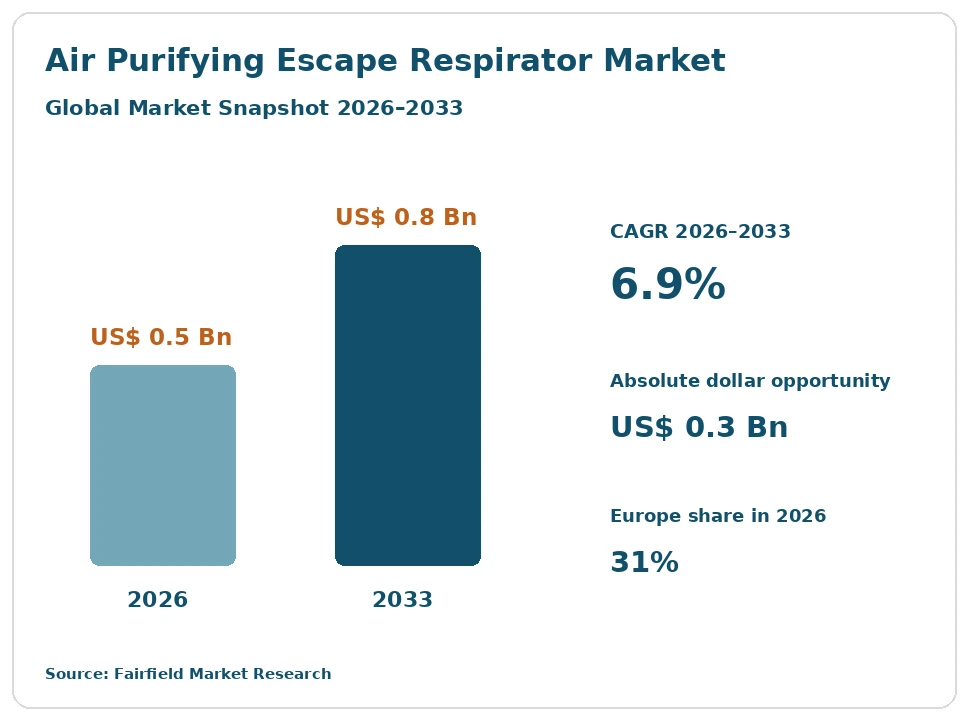
The global Air Purifying Escape Respirator market size is expected to be valued at US$ 0.5 billion in 2026 and projected to reach US$ 0.8 billion by 2033, growing at a CAGR of 6.9% between 2026 and 2033.
Between 2020 and 2025 the market grew at roughly a 6% CAGR, with a pandemic-era distortion in stockpile buying followed by normalisation. Three factors shape the outlook. Site risk assessments and flag state rules specify these devices, so demand follows obligation rather than preference. Devices carry a declared service life, which creates a scheduled replacement cycle across a large installed inventory. Civil protection and transport infrastructure programmes are adding volume. This remains a small, regulation-defined niche where approval status, not price, determines whether a device can be supplied at all.
Key Report Takeaways
- By Product Type: Escape Hoods with Combination Filters held 44% share in 2026, while Chemical, Biological, Radiological and Nuclear Escape Hoods are projected to expand at an 8.6% CAGR through 2033, driven by government stockpile programmes.
- By Certification Route: European Conformity under the Personal Protective Equipment Regulation held 38% share in 2026, while Marine and Flag State Approval is projected to expand at an 8.1% CAGR through 2033, because shipboard inventories are inspected on fixed schedules.
- By End Use: Industrial Plant and Refineries held 33% share in 2026, while Public Buildings and Transport Infrastructure is projected to expand at an 8.4% CAGR through 2033, as metro and tunnel operators formalise evacuation equipment specifications.
- By Distribution Channel: Safety Distributors and Resellers held 39% share in 2026, while Public Sector Tenders and Stockpile Programmes are projected to expand at an 8.9% CAGR through 2033, reflecting renewed civil preparedness budgets.
- By Geography: Europe held 31% share in 2026, while Asia Pacific is projected to expand at an 8.6% CAGR through 2033, supported by industrial safety enforcement in China, India and South Korea.
Global Air Purifying Escape Respirator Market Trends and Insights
Drivers Impact Analysis
The two forces below account for almost all predictable demand in this regulation-defined product category.
Mandated Specification, Not Buyer Preference, Creates Escape Respirator Demand
Demand in this category is created by rules. An escape respiratory device is purchased because a site risk assessment, a flag state marine requirement, an aviation rule or a civil protection programme requires one to be present, not because an operator chose to buy it. That makes volumes relatively insensitive to price and highly sensitive to whether a rule exists and is inspected. Where enforcement lapses, purchasing stops almost entirely.
The mechanism runs through inspection. In the European Union, these devices fall under the Personal Protective Equipment Regulation as category III equipment, which requires conformity assessment involving a notified body. At sea, SOLAS requirements oblige ships to carry emergency escape breathing devices in designated spaces, and port state inspection checks that they are present and in date. ISO 23269 addresses marine escape respiratory protection, giving procurement a defined reference to write into specifications.
Declared Service Life Turns the Installed Inventory Into a Scheduled Replacement Cycle
Replacement is the most reliable revenue in this market. Filters, seals and packaging have a declared service life stated by the manufacturer under the approval, after which a device must be withdrawn from inventory regardless of whether it has ever been opened. A refinery, ship or metro system therefore replaces a fixed proportion of its holding every year, and that flow continues through periods when no new sites are being equipped.
The cause is written into the standards themselves, which require shelf life to be declared and inspection and maintenance instructions to be supplied. Operators record expiry dates in maintenance systems, and auditors and port state inspectors check them. The result is a known forward order book tied to the age profile of installed inventory. Suppliers with large fitted bases can forecast this flow, which is why fleet and site contracts are valued more highly than single orders.
| Driver | Impact on CAGR Forecast | Geographic Relevance | Impact Timeline |
| Risk assessment, flag state and civil protection requirements specifying escape devices | High | Global | Short term ≤2 years |
| Declared service life creating a scheduled replacement cycle | Medium | Europe, North America | Medium term 2–4 years |
Restraints Impact Analysis
Both restraints below are commercial and administrative features of how this equipment is bought.
Recurring Replacement and Programme Costs Are Resisted During Quiet Periods
The recurring cost of expiry is the clearest commercial brake. Equipment that has never been opened still has to be discarded and repurchased on schedule, and budget holders who have seen no incident question the expense. In cost-constrained periods, operators extend intervals where rules permit, reduce holdings to the documented minimum, or delay replacement until an audit forces it. That behaviour flattens demand between inspection cycles.
Programme overhead adds to the resistance. Standards and employer duties treat training and periodic practice as part of the arrangement rather than optional, so the total cost includes instruction time, record keeping and competence checks alongside the hardware. Storage conditions must be controlled and documented, and inspection records maintained. For a site with several hundred units, the administrative burden can exceed the purchase price over a device lifetime, which buyers weigh when setting holdings.
Tender Timing and Non-Conforming Product Distort Revenue and Market Integrity
Revenue timing is unpredictable because much of the volume moves through public tenders. Civil protection stockpiles, transport authorities, defence ministries and state-owned industrial operators buy in large, infrequent lots that are tied to budget cycles and political decisions rather than to consumption. A single award can dominate a supplier’s year, and the following year can be empty. That volatility makes capacity planning difficult for manufacturers with specialised filter production lines.
Market integrity is the second problem. Non-conforming and counterfeit protective equipment has been a documented enforcement concern, with falsified conformity documentation and approval marks found in circulation at industry level. The European Union market surveillance framework and national enforcement bodies conduct checks and publish withdrawals, and the United States approval authority maintains notices on invalid approval claims. Verification adds procurement effort and undermines confidence in lower-priced supply.
| Restraint | Impact on CAGR Forecast | Geographic Relevance | Impact Timeline |
| Resistance to recurring replacement cost and programme overheads | High | Global | Long term ≥4 years |
| Tender-driven procurement timing and non-conforming product in circulation | Medium | Asia Pacific, Latin America, Middle East & Africa | Medium term 2–4 years |
Market Opportunities
Two revenue pools exist outside routine industrial site replacement.
Marine and Offshore Inventories Offer a Scheduled, Inspected Revenue Stream
Shipping and offshore installations represent the most predictable incremental pool. Vessels must carry escape breathing devices in designated spaces under SOLAS, holdings are listed in safety equipment records, and port state control checks dates during inspection. Because the fleet is large, geographically distributed and inspected on a cycle, replacement demand recurs with unusual reliability, and owners generally buy through established marine supply arrangements rather than open tender.
Manufacturers with flag state and marine approvals, and the ship chandlery networks that serve major ports, are positioned to capture this. Demand comes from commercial fleet operators, offshore production and drilling operators, and the ship management companies that administer safety equipment on owners’ behalf. ISO 23269 gives buyers a reference for marine escape respiratory protection, and the main commercial requirement is the ability to deliver approved stock into any port on schedule.
Civil Protection Stockpiles and Transport Infrastructure Open a Public Sector Pool
Government stockpiling is the largest single-order opportunity in the category. Civil protection agencies, health ministries and defence organisations hold escape hoods against chemical, biological, radiological and nuclear scenarios, and those holdings expire on the same basis as industrial stock. Renewed preparedness budgets in several countries have restarted programmes that lapsed, and awards are large enough to reshape a supplier’s order book for several years.
Transport infrastructure is the adjacent pool. Metro systems, road and rail tunnels, airports and major terminals increasingly specify escape equipment within published evacuation arrangements. Manufacturers holding approvals under the relevant national regime, including the NIOSH escape respirator and chemical, biological, radiological and nuclear escape approval programmes in the United States, can bid. The decisive requirement is holding the correct approval in the buyer’s jurisdiction, since mutual recognition between regimes is limited.
Segment Analysis
By Product Type: Combination Filter Hoods Lead While CBRN Variants Grow Fastest
Escape Hoods with Combination Filters hold 44% share in 2026, the largest product position. Combination designs address both particulate and gas or vapour contaminants defined in the applicable standard, which makes them the form most frequently written into industrial site specifications. Smoke Escape Hoods follow, specified widely in buildings, ships and transport settings where fire effluent is the hazard identified in the risk assessment.
Chemical, Biological, Radiological and Nuclear Escape Hoods expand fastest at an 8.6% CAGR through 2033, from a small base, driven by government stockpile renewal rather than industrial purchasing. Filtering Escape Devices and Mouthpiece Respirators remain a compact, lower-cost format used where storage space is limited. Every device in all four groups is an air-purifying type, which by definition filters the surrounding atmosphere and is therefore excluded by the standards from use where oxygen is deficient.
By Certification Route: European Conformity Leads While Marine Approval Advances Quickest
European Conformity under the Personal Protective Equipment Regulation accounts for 38% of the market in 2026. These devices are category III equipment, so conformity assessment involves a notified body and ongoing surveillance of production, and the marking is what permits supply across the single market. NIOSH approval is the second largest route, governing supply into the United States federal, state and industrial channels.
Marine and Flag State Approval grows fastest at an 8.1% CAGR through 2033, because shipboard holdings are inspected and replaced on fixed schedules regardless of economic conditions. Other national approvals cover markets that operate their own schemes. The business implication is structural: mutual recognition between regimes is limited, so manufacturers must fund separate approvals per jurisdiction, and the market fragments regionally along certification lines rather than technology lines.
By End Use: Industrial Plant Demand Leads While Transport Infrastructure Rises Fastest
Industrial Plant and Refineries lead with 33% share in 2026. Chemical processing, refining, petrochemical and gas handling sites conduct formal risk assessments that identify escape scenarios, and the resulting specifications cover large populations of workers and contractors. Mining follows, where filtering self-rescue devices are a long-established statutory item in many jurisdictions, and Marine and Offshore contributes steady inspected volume.
Public Buildings and Transport Infrastructure grows fastest at an 8.4% CAGR through 2033. Metro operators, tunnel authorities and airport managers are formalising evacuation equipment within published emergency arrangements, which converts informal practice into procurement. Aviation and Emergency Services and Defence complete the mix. For suppliers, the implication is that infrastructure buyers purchase through engineering specifications and framework agreements, which rewards documentation capability more than catalogue breadth.
By Distribution Channel: Safety Distributors Lead While Public Tenders Expand Fastest
Safety Distributors and Resellers account for 39% of sales in 2026. Most industrial sites buy escape devices alongside other personal protective equipment through established distribution relationships, which handle stock rotation, expiry tracking and delivery against framework pricing. Direct and Contract Supply to Industrial Sites follows, used by large operators that negotiate multi-site agreements covering replacement scheduling.
Public Sector Tenders and Stockpile Programmes expand fastest at an 8.9% CAGR through 2033, as civil protection budgets recover and lapsed holdings reach the end of declared service life together. Original Equipment Fitment into ships and aircraft remains a smaller but durable channel. The implication for suppliers is that tender capability, including documentation, approval evidence and the ability to deliver large lots on a fixed date, is a commercial competence distinct from distribution.
Geography Analysis
North America Buys Through Federal Approval Routes and Stockpile Programmes
North America accounts for 29% of the market in 2026, driven overwhelmingly by the United States with a smaller contribution from Canada. The defining feature is a single federal approval authority: devices supplied here carry NIOSH approval, including under the dedicated escape respirator and chemical, biological, radiological and nuclear escape approval programmes, and that approval is a precondition for most institutional purchasing. Refining and petrochemical concentrations along the Gulf Coast sustain industrial demand, while mining regulation maintains self-rescue device holdings. Federal, state and municipal preparedness budgets create periodic stockpile awards that move large volumes at once. The approval authority also publishes notices concerning invalid approval claims, which supports procurement verification. The main change ahead is the renewal of stockpiles purchased during earlier preparedness cycles.
Which Region Is Leading the Air Purifying Escape Respirator Market?
Europe leads with 31% share in 2026, with Germany, France, the United Kingdom, Italy, the Netherlands, Norway and Poland contributing most. Leadership rests on a dense regulatory structure rather than on market size alone. The Personal Protective Equipment Regulation places escape devices in category III, requiring notified body involvement and production surveillance, and employer duties oblige risk assessment and provision. EN 403 and EN 404 set requirements for filtering devices for self-rescue, while EN 13794 covers the self-contained escape apparatus that forms the comparison class. A large chemical and refining base, extensive shipping registers and major metro networks sustain holdings. The region’s market surveillance framework is also the most active enforcement regime. The opportunity lies in tunnel and metro infrastructure renewal programmes.
Which Region Is Growing Fastest in the Air Purifying Escape Respirator Market?
Asia Pacific grows fastest at an 8.6% CAGR between 2026 and 2033, rising from 27% share in 2026, led by China, India, South Korea, Japan, Australia and Singapore. Growth follows enforcement. Industrial safety inspection has been tightened across chemical parks, refineries and mines in China and India, and escape device provision is increasingly checked rather than merely required on paper. The region also operates the largest merchant fleets and shipbuilding capacity, which ties demand to marine inspection cycles. Japan, South Korea and Australia maintain mature national approval schemes and established industrial holdings. The principal constraint is price competition and the circulation of product whose conformity documentation is difficult to verify, which keeps procurement verification effort high across the region.
Latin America Holds Modest Volumes Concentrated in Refining and Mining
Latin America represents 6% of the market in 2026, concentrated in Brazil, Mexico, Chile, Colombia and Peru. Demand comes from state and international oil and gas operators, petrochemical complexes, and the large copper and precious metal mining industries, where self-rescue device provision is an established statutory item. Barriers are significant. Devices are imported and exposed to duties and currency movement, national approval processes add delay, enforcement of replacement scheduling is uneven outside major operators, and training programmes are inconsistently funded. Smaller industrial sites frequently hold minimum quantities only. The clearest opportunity is in mining, where regulators in Chile and Peru have been strengthening inspection of emergency arrangements, and in port and terminal infrastructure serving expanding export volumes.
Middle East & Africa Demand Follows Hydrocarbon Processing and Port Activity
Middle East & Africa holds 7% of the market in 2026, with activity centred on Saudi Arabia, the United Arab Emirates, Qatar, Kuwait, Egypt, Nigeria and South Africa. The Gulf hydrocarbon processing complex is the dominant source of demand, since refining, gas processing and petrochemical operators apply international site safety standards and equip large contractor populations. Major container ports and shipping registers add marine-driven replacement volume. South Africa maintains substantial mining holdings under long-standing self-rescue requirements. Barriers include dependence on distributors for approval documentation, uneven enforcement outside the largest operators, limited local training infrastructure, and difficulty verifying conformity claims on imported product. The opportunity lies in new petrochemical and industrial city developments, which specify equipment at the design stage.
Competitive Landscape
The market is moderately concentrated, and approvals rather than scale create the barrier. A small group of international respiratory protection manufacturers holds most revenue, because obtaining and maintaining category III conformity assessment, NIOSH approval and marine acceptance across multiple jurisdictions is expensive and slow, and the filter chemistry and sealing design behind an approved device is not easily replicated. Below that group sit regional specialists with strong positions in their home approval regimes, particularly in mining self-rescue and marine supply. Consolidation has been gradual, generally taking the form of diversified safety equipment groups absorbing specialist respiratory manufacturers to complete a portfolio.
Competition is unusual in that the approval mark is effectively the product. A device without the relevant approval in the buyer’s jurisdiction cannot be specified at any price, so vendors compete first on which approvals they hold and in which markets. Beyond that, they compete on declared service life and the resulting replacement economics, on packaging and storage format, on the documentation and training materials supplied with the device, and on the ability to deliver large tender lots on a fixed date. New entrants appear mainly in regional markets with their own approval schemes, where domestic certification is more accessible than the European Union or United States routes.
Strategic activity has centred on extending approval coverage into additional jurisdictions, securing filter media and sorbent supply, building tender and framework agreement capability for public sector buyers, and strengthening traceability so that customers can verify conformity documentation.
Strategic direction is converging on multi-jurisdiction approval portfolios, service agreements covering inventory and expiry management, and supply chain traceability as a response to non-conforming product.
Air Purifying Escape Respirator Industry Leaders
- MSA Safety Incorporated
- Drägerwerk AG & Co. KGaA
- Honeywell International Inc.
- Avon Protection plc
- Sundström Safety AB
Recent Industry Developments
- July 2002: Amendments to the International Maritime Organization SOLAS convention requiring emergency escape breathing devices in designated shipboard spaces entered into force, establishing a durable marine inventory obligation.
- April 2018: The European Union Personal Protective Equipment Regulation became applicable, placing escape respiratory devices in category III and requiring conformity assessment and production surveillance involving a notified body.
- January 2021: The United Kingdom introduced a separate national conformity marking regime for personal protective equipment, requiring approval through approved bodies for devices placed on the market there.
- July 2021: The European Union market surveillance and compliance regulation became applicable, strengthening border and in-market checks on protective equipment and formalising cooperation between national enforcement authorities.
Companies Covered in the Report
- MSA Safety Incorporated
- Drägerwerk AG & Co. KGaA
- Honeywell International Inc.
- 3M Company
- Avon Protection plc
- Sundström Safety AB
- ILC Dover LP
- Shigematsu Works Co., Ltd.
- Koken Ltd.
- Spasciani S.p.A.
- Dezega Group
- EKASTU Safety GmbH
Air Purifying Escape Respirator Market Report Scope
This report covers single-use respiratory protective devices intended only for escape from a contaminated atmosphere, not for work within one: escape and smoke hoods with combination filters, filtering escape devices and mouthpiece respirators, and chemical, biological, radiological and nuclear escape hoods. Self-contained escape breathing apparatus supplies its own air and is treated as the comparison device class, not counted here. The base year is 2025, with forecasts from 2026 to 2033 in US$ Billion.
| Metric | Value |
| Study Period | 2020–2033 |
| Market Size 2026 | US$ 0.5 Billion |
| Market Size 2033 | US$ 0.8 Billion |
| CAGR 2026–2033 | 6.9% |
| Absolute Dollar Opportunity | US$ 0.3 Billion |
| Largest Market | Europe, 31% share in 2026 |
| Fastest-Growing Market | Asia Pacific, 8.6% CAGR 2026–2033 |
| Market Concentration | Medium |
| Major Players | MSA Safety Incorporated, Drägerwerk AG & Co. KGaA, Honeywell International Inc., 3M Company, Avon Protection plc |
Product Type
- Escape Hoods with Combination Filters
- Smoke Escape Hoods
- Filtering Escape Devices and Mouthpiece Respirators
- Chemical, Biological, Radiological and Nuclear Escape Hoods
Certification Route
- European Conformity under the Personal Protective Equipment Regulation
- NIOSH Approval
- Marine and Flag State Approval
- Other National Approvals
End Use
- Industrial Plant and Refineries
- Mining
- Marine and Offshore
- Aviation
- Public Buildings and Transport Infrastructure
- Emergency Services and Defence
Distribution Channel
- Direct and Contract Supply to Industrial Sites
- Safety Distributors and Resellers
- Public Sector Tenders and Stockpile Programmes
- Original Equipment Fitment
Regions
- North America
- Europe
- Asia Pacific
- Latin America
- Middle East & Africa
1. Executive Summary
1.1. Global Air Purifying Escape Respirator Market Snapshot
1.2. Future Projections, 2026-2033
1.3. Key Market Trends
1.4. Regional Snapshot
2. Market Overview
2.1. Market Definition and Report Scope
2.2. Historical Market Trends, 2020-2025
2.3. Market Dynamics
2.3.1. Drivers Impact Analysis
2.3.1.1. Mandated Specification, Not Buyer Preference, Creates Escape Respirator Demand
2.3.1.2. Declared Service Life Turns the Installed Inventory Into a Scheduled Replacement Cycle
2.3.2. Restraints Impact Analysis
2.3.2.1. Recurring Replacement and Programme Costs Are Resisted During Quiet Periods
2.3.2.2. Tender Timing and Non-Conforming Product Distort Revenue and Market Integrity
2.3.3. Market Opportunities
2.3.3.1. Marine and Offshore Inventories Offer a Scheduled, Inspected Revenue Stream
2.3.3.2. Civil Protection Stockpiles and Transport Infrastructure Open a Public Sector Pool
3. Global Air Purifying Escape Respirator Market Outlook, 2020-2033
3.1. Global Air Purifying Escape Respirator Market Outlook, by Product Type, Value (US$ Billion), 2020-2033
3.1.1. Escape Hoods with Combination Filters
3.1.2. Smoke Escape Hoods
3.1.3. Filtering Escape Devices and Mouthpiece Respirators
3.1.4. Chemical, Biological, Radiological and Nuclear Escape Hoods
3.2. Global Air Purifying Escape Respirator Market Outlook, by Certification Route, Value (US$ Billion), 2020-2033
3.2.1. European Conformity under the Personal Protective Equipment Regulation
3.2.2. NIOSH Approval
3.2.3. Marine and Flag State Approval
3.2.4. Other National Approvals
3.3. Global Air Purifying Escape Respirator Market Outlook, by End Use, Value (US$ Billion), 2020-2033
3.3.1. Industrial Plant and Refineries
3.3.2. Mining
3.3.3. Marine and Offshore
3.3.4. Aviation
3.3.5. Public Buildings and Transport Infrastructure
3.3.6. Emergency Services and Defence
3.4. Global Air Purifying Escape Respirator Market Outlook, by Distribution Channel, Value (US$ Billion), 2020-2033
3.4.1. Direct and Contract Supply to Industrial Sites
3.4.2. Safety Distributors and Resellers
3.4.3. Public Sector Tenders and Stockpile Programmes
3.4.4. Original Equipment Fitment
3.5. Global Air Purifying Escape Respirator Market Outlook, by Region, Value (US$ Billion), 2020-2033
3.5.1. North America
3.5.2. Europe
3.5.3. Asia Pacific
3.5.4. Latin America
3.5.5. Middle East & Africa
4. North America Air Purifying Escape Respirator Market Outlook, 2020-2033
4.1. North America Air Purifying Escape Respirator Market Outlook, by Product Type, Value (US$ Billion), 2020-2033
4.1.1. Escape Hoods with Combination Filters
4.1.2. Smoke Escape Hoods
4.1.3. Filtering Escape Devices and Mouthpiece Respirators
4.1.4. Chemical, Biological, Radiological and Nuclear Escape Hoods
4.2. North America Air Purifying Escape Respirator Market Outlook, by Certification Route, Value (US$ Billion), 2020-2033
4.2.1. European Conformity under the Personal Protective Equipment Regulation
4.2.2. NIOSH Approval
4.2.3. Marine and Flag State Approval
4.2.4. Other National Approvals
4.3. North America Air Purifying Escape Respirator Market Outlook, by End Use, Value (US$ Billion), 2020-2033
4.3.1. Industrial Plant and Refineries
4.3.2. Mining
4.3.3. Marine and Offshore
4.3.4. Aviation
4.3.5. Public Buildings and Transport Infrastructure
4.3.6. Emergency Services and Defence
4.4. North America Air Purifying Escape Respirator Market Outlook, by Distribution Channel, Value (US$ Billion), 2020-2033
4.4.1. Direct and Contract Supply to Industrial Sites
4.4.2. Safety Distributors and Resellers
4.4.3. Public Sector Tenders and Stockpile Programmes
4.4.4. Original Equipment Fitment
4.5. North America Air Purifying Escape Respirator Market Outlook, by Country, Value (US$ Billion), 2020-2033
4.5.1. United States Air Purifying Escape Respirator Market Outlook, by Product Type, 2020-2033
4.5.2. United States Air Purifying Escape Respirator Market Outlook, by Certification Route, 2020-2033
4.5.3. United States Air Purifying Escape Respirator Market Outlook, by End Use, 2020-2033
4.5.4. United States Air Purifying Escape Respirator Market Outlook, by Distribution Channel, 2020-2033
4.5.5. Canada Air Purifying Escape Respirator Market Outlook, by Product Type, 2020-2033
4.5.6. Canada Air Purifying Escape Respirator Market Outlook, by Certification Route, 2020-2033
4.5.7. Canada Air Purifying Escape Respirator Market Outlook, by End Use, 2020-2033
4.5.8. Canada Air Purifying Escape Respirator Market Outlook, by Distribution Channel, 2020-2033
5. Europe Air Purifying Escape Respirator Market Outlook, 2020-2033
5.1. Europe Air Purifying Escape Respirator Market Outlook, by Product Type, Value (US$ Billion), 2020-2033
5.1.1. Escape Hoods with Combination Filters
5.1.2. Smoke Escape Hoods
5.1.3. Filtering Escape Devices and Mouthpiece Respirators
5.1.4. Chemical, Biological, Radiological and Nuclear Escape Hoods
5.2. Europe Air Purifying Escape Respirator Market Outlook, by Certification Route, Value (US$ Billion), 2020-2033
5.2.1. European Conformity under the Personal Protective Equipment Regulation
5.2.2. NIOSH Approval
5.2.3. Marine and Flag State Approval
5.2.4. Other National Approvals
5.3. Europe Air Purifying Escape Respirator Market Outlook, by End Use, Value (US$ Billion), 2020-2033
5.3.1. Industrial Plant and Refineries
5.3.2. Mining
5.3.3. Marine and Offshore
5.3.4. Aviation
5.3.5. Public Buildings and Transport Infrastructure
5.3.6. Emergency Services and Defence
5.4. Europe Air Purifying Escape Respirator Market Outlook, by Distribution Channel, Value (US$ Billion), 2020-2033
5.4.1. Direct and Contract Supply to Industrial Sites
5.4.2. Safety Distributors and Resellers
5.4.3. Public Sector Tenders and Stockpile Programmes
5.4.4. Original Equipment Fitment
5.5. Europe Air Purifying Escape Respirator Market Outlook, by Country, Value (US$ Billion), 2020-2033
5.5.1. Germany Air Purifying Escape Respirator Market Outlook, by Product Type, 2020-2033
5.5.2. Germany Air Purifying Escape Respirator Market Outlook, by Certification Route, 2020-2033
5.5.3. Germany Air Purifying Escape Respirator Market Outlook, by End Use, 2020-2033
5.5.4. Germany Air Purifying Escape Respirator Market Outlook, by Distribution Channel, 2020-2033
5.5.5. France Air Purifying Escape Respirator Market Outlook, by Product Type, 2020-2033
5.5.6. France Air Purifying Escape Respirator Market Outlook, by Certification Route, 2020-2033
5.5.7. France Air Purifying Escape Respirator Market Outlook, by End Use, 2020-2033
5.5.8. France Air Purifying Escape Respirator Market Outlook, by Distribution Channel, 2020-2033
5.5.9. United Kingdom Air Purifying Escape Respirator Market Outlook, by Product Type, 2020-2033
5.5.10. United Kingdom Air Purifying Escape Respirator Market Outlook, by Certification Route, 2020-2033
5.5.11. United Kingdom Air Purifying Escape Respirator Market Outlook, by End Use, 2020-2033
5.5.12. United Kingdom Air Purifying Escape Respirator Market Outlook, by Distribution Channel, 2020-2033
5.5.13. Italy Air Purifying Escape Respirator Market Outlook, by Product Type, 2020-2033
5.5.14. Italy Air Purifying Escape Respirator Market Outlook, by Certification Route, 2020-2033
5.5.15. Italy Air Purifying Escape Respirator Market Outlook, by End Use, 2020-2033
5.5.16. Italy Air Purifying Escape Respirator Market Outlook, by Distribution Channel, 2020-2033
5.5.17. Netherlands Air Purifying Escape Respirator Market Outlook, by Product Type, 2020-2033
5.5.18. Netherlands Air Purifying Escape Respirator Market Outlook, by Certification Route, 2020-2033
5.5.19. Netherlands Air Purifying Escape Respirator Market Outlook, by End Use, 2020-2033
5.5.20. Netherlands Air Purifying Escape Respirator Market Outlook, by Distribution Channel, 2020-2033
5.5.21. Norway Air Purifying Escape Respirator Market Outlook, by Product Type, 2020-2033
5.5.22. Norway Air Purifying Escape Respirator Market Outlook, by Certification Route, 2020-2033
5.5.23. Norway Air Purifying Escape Respirator Market Outlook, by End Use, 2020-2033
5.5.24. Norway Air Purifying Escape Respirator Market Outlook, by Distribution Channel, 2020-2033
5.5.25. Poland Air Purifying Escape Respirator Market Outlook, by Product Type, 2020-2033
5.5.26. Poland Air Purifying Escape Respirator Market Outlook, by Certification Route, 2020-2033
5.5.27. Poland Air Purifying Escape Respirator Market Outlook, by End Use, 2020-2033
5.5.28. Poland Air Purifying Escape Respirator Market Outlook, by Distribution Channel, 2020-2033
6. Asia Pacific Air Purifying Escape Respirator Market Outlook, 2020-2033
6.1. Asia Pacific Air Purifying Escape Respirator Market Outlook, by Product Type, Value (US$ Billion), 2020-2033
6.1.1. Escape Hoods with Combination Filters
6.1.2. Smoke Escape Hoods
6.1.3. Filtering Escape Devices and Mouthpiece Respirators
6.1.4. Chemical, Biological, Radiological and Nuclear Escape Hoods
6.2. Asia Pacific Air Purifying Escape Respirator Market Outlook, by Certification Route, Value (US$ Billion), 2020-2033
6.2.1. European Conformity under the Personal Protective Equipment Regulation
6.2.2. NIOSH Approval
6.2.3. Marine and Flag State Approval
6.2.4. Other National Approvals
6.3. Asia Pacific Air Purifying Escape Respirator Market Outlook, by End Use, Value (US$ Billion), 2020-2033
6.3.1. Industrial Plant and Refineries
6.3.2. Mining
6.3.3. Marine and Offshore
6.3.4. Aviation
6.3.5. Public Buildings and Transport Infrastructure
6.3.6. Emergency Services and Defence
6.4. Asia Pacific Air Purifying Escape Respirator Market Outlook, by Distribution Channel, Value (US$ Billion), 2020-2033
6.4.1. Direct and Contract Supply to Industrial Sites
6.4.2. Safety Distributors and Resellers
6.4.3. Public Sector Tenders and Stockpile Programmes
6.4.4. Original Equipment Fitment
6.5. Asia Pacific Air Purifying Escape Respirator Market Outlook, by Country, Value (US$ Billion), 2020-2033
6.5.1. China Air Purifying Escape Respirator Market Outlook, by Product Type, 2020-2033
6.5.2. China Air Purifying Escape Respirator Market Outlook, by Certification Route, 2020-2033
6.5.3. China Air Purifying Escape Respirator Market Outlook, by End Use, 2020-2033
6.5.4. China Air Purifying Escape Respirator Market Outlook, by Distribution Channel, 2020-2033
6.5.5. India Air Purifying Escape Respirator Market Outlook, by Product Type, 2020-2033
6.5.6. India Air Purifying Escape Respirator Market Outlook, by Certification Route, 2020-2033
6.5.7. India Air Purifying Escape Respirator Market Outlook, by End Use, 2020-2033
6.5.8. India Air Purifying Escape Respirator Market Outlook, by Distribution Channel, 2020-2033
6.5.9. South Korea Air Purifying Escape Respirator Market Outlook, by Product Type, 2020-2033
6.5.10. South Korea Air Purifying Escape Respirator Market Outlook, by Certification Route, 2020-2033
6.5.11. South Korea Air Purifying Escape Respirator Market Outlook, by End Use, 2020-2033
6.5.12. South Korea Air Purifying Escape Respirator Market Outlook, by Distribution Channel, 2020-2033
6.5.13. Japan Air Purifying Escape Respirator Market Outlook, by Product Type, 2020-2033
6.5.14. Japan Air Purifying Escape Respirator Market Outlook, by Certification Route, 2020-2033
6.5.15. Japan Air Purifying Escape Respirator Market Outlook, by End Use, 2020-2033
6.5.16. Japan Air Purifying Escape Respirator Market Outlook, by Distribution Channel, 2020-2033
6.5.17. Australia Air Purifying Escape Respirator Market Outlook, by Product Type, 2020-2033
6.5.18. Australia Air Purifying Escape Respirator Market Outlook, by Certification Route, 2020-2033
6.5.19. Australia Air Purifying Escape Respirator Market Outlook, by End Use, 2020-2033
6.5.20. Australia Air Purifying Escape Respirator Market Outlook, by Distribution Channel, 2020-2033
6.5.21. Singapore Air Purifying Escape Respirator Market Outlook, by Product Type, 2020-2033
6.5.22. Singapore Air Purifying Escape Respirator Market Outlook, by Certification Route, 2020-2033
6.5.23. Singapore Air Purifying Escape Respirator Market Outlook, by End Use, 2020-2033
6.5.24. Singapore Air Purifying Escape Respirator Market Outlook, by Distribution Channel, 2020-2033
7. Latin America Air Purifying Escape Respirator Market Outlook, 2020-2033
7.1. Latin America Air Purifying Escape Respirator Market Outlook, by Product Type, Value (US$ Billion), 2020-2033
7.1.1. Escape Hoods with Combination Filters
7.1.2. Smoke Escape Hoods
7.1.3. Filtering Escape Devices and Mouthpiece Respirators
7.1.4. Chemical, Biological, Radiological and Nuclear Escape Hoods
7.2. Latin America Air Purifying Escape Respirator Market Outlook, by Certification Route, Value (US$ Billion), 2020-2033
7.2.1. European Conformity under the Personal Protective Equipment Regulation
7.2.2. NIOSH Approval
7.2.3. Marine and Flag State Approval
7.2.4. Other National Approvals
7.3. Latin America Air Purifying Escape Respirator Market Outlook, by End Use, Value (US$ Billion), 2020-2033
7.3.1. Industrial Plant and Refineries
7.3.2. Mining
7.3.3. Marine and Offshore
7.3.4. Aviation
7.3.5. Public Buildings and Transport Infrastructure
7.3.6. Emergency Services and Defence
7.4. Latin America Air Purifying Escape Respirator Market Outlook, by Distribution Channel, Value (US$ Billion), 2020-2033
7.4.1. Direct and Contract Supply to Industrial Sites
7.4.2. Safety Distributors and Resellers
7.4.3. Public Sector Tenders and Stockpile Programmes
7.4.4. Original Equipment Fitment
7.5. Latin America Air Purifying Escape Respirator Market Outlook, by Country, Value (US$ Billion), 2020-2033
7.5.1. Brazil Air Purifying Escape Respirator Market Outlook, by Product Type, 2020-2033
7.5.2. Brazil Air Purifying Escape Respirator Market Outlook, by Certification Route, 2020-2033
7.5.3. Brazil Air Purifying Escape Respirator Market Outlook, by End Use, 2020-2033
7.5.4. Brazil Air Purifying Escape Respirator Market Outlook, by Distribution Channel, 2020-2033
7.5.5. Mexico Air Purifying Escape Respirator Market Outlook, by Product Type, 2020-2033
7.5.6. Mexico Air Purifying Escape Respirator Market Outlook, by Certification Route, 2020-2033
7.5.7. Mexico Air Purifying Escape Respirator Market Outlook, by End Use, 2020-2033
7.5.8. Mexico Air Purifying Escape Respirator Market Outlook, by Distribution Channel, 2020-2033
7.5.9. Chile Air Purifying Escape Respirator Market Outlook, by Product Type, 2020-2033
7.5.10. Chile Air Purifying Escape Respirator Market Outlook, by Certification Route, 2020-2033
7.5.11. Chile Air Purifying Escape Respirator Market Outlook, by End Use, 2020-2033
7.5.12. Chile Air Purifying Escape Respirator Market Outlook, by Distribution Channel, 2020-2033
7.5.13. Colombia Air Purifying Escape Respirator Market Outlook, by Product Type, 2020-2033
7.5.14. Colombia Air Purifying Escape Respirator Market Outlook, by Certification Route, 2020-2033
7.5.15. Colombia Air Purifying Escape Respirator Market Outlook, by End Use, 2020-2033
7.5.16. Colombia Air Purifying Escape Respirator Market Outlook, by Distribution Channel, 2020-2033
7.5.17. Peru Air Purifying Escape Respirator Market Outlook, by Product Type, 2020-2033
7.5.18. Peru Air Purifying Escape Respirator Market Outlook, by Certification Route, 2020-2033
7.5.19. Peru Air Purifying Escape Respirator Market Outlook, by End Use, 2020-2033
7.5.20. Peru Air Purifying Escape Respirator Market Outlook, by Distribution Channel, 2020-2033
8. Middle East & Africa Air Purifying Escape Respirator Market Outlook, 2020-2033
8.1. Middle East & Africa Air Purifying Escape Respirator Market Outlook, by Product Type, Value (US$ Billion), 2020-2033
8.1.1. Escape Hoods with Combination Filters
8.1.2. Smoke Escape Hoods
8.1.3. Filtering Escape Devices and Mouthpiece Respirators
8.1.4. Chemical, Biological, Radiological and Nuclear Escape Hoods
8.2. Middle East & Africa Air Purifying Escape Respirator Market Outlook, by Certification Route, Value (US$ Billion), 2020-2033
8.2.1. European Conformity under the Personal Protective Equipment Regulation
8.2.2. NIOSH Approval
8.2.3. Marine and Flag State Approval
8.2.4. Other National Approvals
8.3. Middle East & Africa Air Purifying Escape Respirator Market Outlook, by End Use, Value (US$ Billion), 2020-2033
8.3.1. Industrial Plant and Refineries
8.3.2. Mining
8.3.3. Marine and Offshore
8.3.4. Aviation
8.3.5. Public Buildings and Transport Infrastructure
8.3.6. Emergency Services and Defence
8.4. Middle East & Africa Air Purifying Escape Respirator Market Outlook, by Distribution Channel, Value (US$ Billion), 2020-2033
8.4.1. Direct and Contract Supply to Industrial Sites
8.4.2. Safety Distributors and Resellers
8.4.3. Public Sector Tenders and Stockpile Programmes
8.4.4. Original Equipment Fitment
8.5. Middle East & Africa Air Purifying Escape Respirator Market Outlook, by Country and Subregion, Value (US$ Billion), 2020-2033
8.5.1. Saudi Arabia Air Purifying Escape Respirator Market Outlook, by Product Type, 2020-2033
8.5.2. Saudi Arabia Air Purifying Escape Respirator Market Outlook, by Certification Route, 2020-2033
8.5.3. Saudi Arabia Air Purifying Escape Respirator Market Outlook, by End Use, 2020-2033
8.5.4. Saudi Arabia Air Purifying Escape Respirator Market Outlook, by Distribution Channel, 2020-2033
8.5.5. United Arab Emirates Air Purifying Escape Respirator Market Outlook, by Product Type, 2020-2033
8.5.6. United Arab Emirates Air Purifying Escape Respirator Market Outlook, by Certification Route, 2020-2033
8.5.7. United Arab Emirates Air Purifying Escape Respirator Market Outlook, by End Use, 2020-2033
8.5.8. United Arab Emirates Air Purifying Escape Respirator Market Outlook, by Distribution Channel, 2020-2033
8.5.9. Qatar Air Purifying Escape Respirator Market Outlook, by Product Type, 2020-2033
8.5.10. Qatar Air Purifying Escape Respirator Market Outlook, by Certification Route, 2020-2033
8.5.11. Qatar Air Purifying Escape Respirator Market Outlook, by End Use, 2020-2033
8.5.12. Qatar Air Purifying Escape Respirator Market Outlook, by Distribution Channel, 2020-2033
8.5.13. Kuwait Air Purifying Escape Respirator Market Outlook, by Product Type, 2020-2033
8.5.14. Kuwait Air Purifying Escape Respirator Market Outlook, by Certification Route, 2020-2033
8.5.15. Kuwait Air Purifying Escape Respirator Market Outlook, by End Use, 2020-2033
8.5.16. Kuwait Air Purifying Escape Respirator Market Outlook, by Distribution Channel, 2020-2033
8.5.17. Egypt Air Purifying Escape Respirator Market Outlook, by Product Type, 2020-2033
8.5.18. Egypt Air Purifying Escape Respirator Market Outlook, by Certification Route, 2020-2033
8.5.19. Egypt Air Purifying Escape Respirator Market Outlook, by End Use, 2020-2033
8.5.20. Egypt Air Purifying Escape Respirator Market Outlook, by Distribution Channel, 2020-2033
8.5.21. Nigeria Air Purifying Escape Respirator Market Outlook, by Product Type, 2020-2033
8.5.22. Nigeria Air Purifying Escape Respirator Market Outlook, by Certification Route, 2020-2033
8.5.23. Nigeria Air Purifying Escape Respirator Market Outlook, by End Use, 2020-2033
8.5.24. Nigeria Air Purifying Escape Respirator Market Outlook, by Distribution Channel, 2020-2033
8.5.25. South Africa Air Purifying Escape Respirator Market Outlook, by Product Type, 2020-2033
8.5.26. South Africa Air Purifying Escape Respirator Market Outlook, by Certification Route, 2020-2033
8.5.27. South Africa Air Purifying Escape Respirator Market Outlook, by End Use, 2020-2033
8.5.28. South Africa Air Purifying Escape Respirator Market Outlook, by Distribution Channel, 2020-2033
8.5.29. Gulf Air Purifying Escape Respirator Market Outlook, by Product Type, 2020-2033
8.5.30. Gulf Air Purifying Escape Respirator Market Outlook, by Certification Route, 2020-2033
8.5.31. Gulf Air Purifying Escape Respirator Market Outlook, by End Use, 2020-2033
8.5.32. Gulf Air Purifying Escape Respirator Market Outlook, by Distribution Channel, 2020-2033
9. Competitive Landscape
9.1. Market Concentration and Industry Leaders
9.2. Competitive Differentiation
9.3. Strategic Initiatives
9.4. Recent Industry Developments
9.5. Company Profiles
9.5.1. MSA Safety Incorporated
9.5.2. Drägerwerk AG & Co. KGaA
9.5.3. Honeywell International Inc.
9.5.4. 3M Company
9.5.5. Avon Protection plc
9.5.6. Sundström Safety AB
9.5.7. ILC Dover LP
9.5.8. Shigematsu Works Co., Ltd.
9.5.9. Koken Ltd.
9.5.10. Spasciani S.p.A.
9.5.11. Dezega Group
9.5.12. EKASTU Safety GmbH
10. Appendix
10.1. Research Methodology
10.2. Report Assumptions
10.3. Acronyms and Abbreviations
| Segment | Categories |
|---|---|
| Product Type | Escape Hoods with Combination Filters, Smoke Escape Hoods, Filtering Escape Devices and Mouthpiece Respirators, Chemical, Biological, Radiological and Nuclear Escape Hoods |
| Certification Route | European Conformity under the Personal Protective Equipment Regulation, NIOSH Approval, Marine and Flag State Approval, Other National Approvals |
| End Use | Industrial Plant and Refineries, Mining, Marine and Offshore, Aviation, Public Buildings and Transport Infrastructure, Emergency Services and Defence |
| Distribution Channel | Direct and Contract Supply to Industrial Sites, Safety Distributors and Resellers, Public Sector Tenders and Stockpile Programmes, Original Equipment Fitment |
| Regions | North America, Europe, Asia Pacific, Latin America, Middle East & Africa |
Our Research Methodology
Considering the volatility of business today, traditional approaches to strategizing a game plan can be unfruitful if not detrimental. True ambiguity is no way to determine a forecast. A myriad of predetermined factors must be accounted for such as the degree of risk involved, the magnitude of circumstances, as well as conditions or consequences that are not known or unpredictable. To circumvent binary views that cast uncertainty, the application of market research intelligence to strategically posture, move, and enable actionable outcomes is necessary.
View Methodology
Quality Assured
Rigorous Validation Process

Confidentiality Assured
End-to-end Data Security

Custom Research Services
Tailored To Your Objectives
FAQs
The market is valued at US$ 0.5 billion in 2026, covering single-use filtering escape devices supplied across industrial, marine, transport and public sector channels.
The market is projected to reach US$ 0.8 billion by 2033, growing at a 6.9% CAGR and adding US$ 0.3 billion in absolute opportunity.
Escape Hoods with Combination Filters lead with 44% share in 2026, because combination designs are most often written into industrial site equipment specifications.
Public Sector Tenders and Stockpile Programmes grow fastest at an 8.9% CAGR, while Asia Pacific expands at an 8.6% CAGR on tightened industrial inspection.
Europe holds 31% share in 2026, and the market is moderately concentrated, because maintaining multi-jurisdiction approvals creates a high barrier to entry.
Related Reports
Automated Truck Loading System Market Size, Share, Insights, Competitive Landscape, and Forecast 2026 to 2033
The automated truck loading system market is projected to grow from US$ 1.4 billion in 2026 to US$ 2.4 billion by 2033 at an 8.0% CAGR.
Rigid Mine Dumper Market Size, Share, Insights, Competitive Landscape, and Forecast 2026 to 2033
The global rigid mine dumper market is valued at US$9.8 billion in 2026, reaching US$14.6 billion by 2033, growing at a 5.9% CAGR
Product-as-a-Service Market Size, Share, Insights, Competitive Landscape, and Forecast 2026 to 2033
The global product-as-a-service market is valued at US$96.0 billion in 2026, reaching US$204.5 billion by 2033, growing at an 11.4% CAGR
Precision Hand Tools Market Size, Share, Insights, Competitive Landscape, and Forecast 2026 to 2033
The global precision hand tools market is valued at US$9.8 billion in 2026, reaching US$14.2 billion by 2033, growing at a 5.4% CAGR
Weather RADAR Market Size, Share, Insights, Competitive Landscape, and Forecast 2026 to 2033
The Weather RADAR Market is projected to rise from US$ 297.2 million in 2026 to US$ 401.8 million by 2033 at a 4.4% CAGR. Explore key segments.
Scroll and Absorption Chillers Market Size, Share, Insights, Competitive Landscape, and Forecast 2026 to 2033
Scroll and Absorption Chillers Market grows from US$ 14.27 billion in 2026 to US$ 19.31 billion by 2033 at a 4.4% CAGR. Explore key segments and trends.