



Spinning Machinery Market
Spinning Machinery Market Size, Share, Insights, Competitive Landscape, and Forecast 2026 to 2033
Spinning Machinery Market Size and Trend Analysis
How Fast Will Yarn Spinning Machinery Demand Grow?
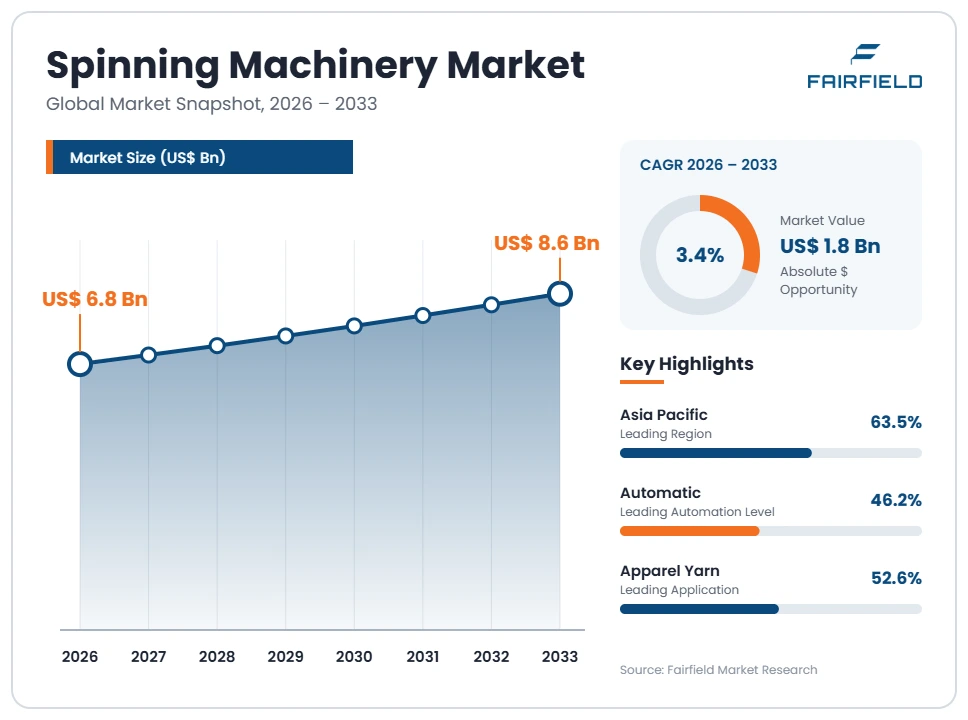
The global Spinning Machinery market size is expected to be valued at US$ 6.8 billion in 2026 and projected to reach US$ 8.6 billion by 2033, growing at a CAGR of 3.4% between 2026 and 2033.
Between 2020 and 2025 shipments and parts revenue together grew at roughly 2.2% a year, a figure that hides sharp swings between a post-pandemic ordering surge and a steep correction. Three things shape the outlook. First, spinning capacity keeps relocating toward countries with cheaper power, better cotton access or trade advantages, so machine demand follows construction rather than global yarn consumption. Second, wage increases in established spinning economies justify automatic doffing, transport and linked lines that were previously uneconomic. Third, spare parts, travellers, rings and aprons provide a recurring stream that cushions machine order volatility. The direction is modest, uneven growth, concentrated in a handful of countries building new mills while others retire capacity.
Key Report Takeaways
- By Product Type: Ring spinning frames held 28.4% share in 2026, while air-jet and vortex spinning machines are projected to expand at a 5.9% CAGR through 2033, as mills chase higher output per operator on man-made fibre yarns.
- By Automation Level: Automatic machines held 46.2% share in 2026, while fully linked and automated systems are projected to grow at a 6.4% CAGR, because rising mill wages finally justify automatic doffing and transport.
- By Fibre Type: Cotton held 44.8% share in 2026, while recycled fibre is projected to advance at a 7.2% CAGR, supported by collection and producer responsibility rules that increase reclaimed fibre supply.
- By Application: Apparel yarn held 52.6% share in 2026, while industrial and technical yarn is projected to rise at a 5.5% CAGR, reflecting demand from filtration, geotextiles, ropes and composite reinforcement.
- By Geography: Asia Pacific held 63.5% share in 2026, while Middle East & Africa is projected to grow at a 5.4% CAGR, as cotton-producing economies add domestic spinning capacity.
Global Spinning Machinery Market Trends and Insights
Drivers Impact Analysis
Both drivers are geographic and economic, and neither depends on global textile consumption rising.
| Driver | Impact on CAGR Forecast | Geographic Relevance | Impact Timeline |
| Relocation of spinning capacity toward cheaper power, cotton and trade access | High | Asia Pacific, Middle East & Africa | Long term ≥4 years |
| Wage inflation justifying automatic doffing, transport and linked lines | Medium | Asia Pacific, Europe | Medium term 2–4 years |
Capacity Relocation Decides Where Spinning Machines Are Actually Sold
Machine demand is set by where mills are being built this cycle, not by how much yarn the world consumes. Spindle capacity has moved repeatedly over four decades, following labour cost, electricity tariffs, cotton availability and preferential market access. The consequence is blunt: a handful of countries absorb most new equipment while mills close elsewhere, and a supplier without a strong position in those few markets sees its order book shrink regardless of global demand.
The causal mechanism is comparative cost. India combines domestic cotton with established machine building; Bangladesh and Viet Nam convert duty-advantaged garment exports into backward-integrated spinning; Uzbekistan has shifted from exporting raw cotton to spinning it; China continues to modernise rather than expand. Trade preference arrangements and tariff treatment move the calculation again whenever they change, and mills site new capacity where power is cheap and reliable, because electricity is the largest operating cost after fibre.
Rising Mill Wages Make Automatic Doffing and Linked Lines Pay for Themselves
Automation in spinning is bought to remove labour, and it only sells once wages pass a threshold. Below that level a mill simply hires more operators, which is why the same machine generation is adopted at very different rates across countries. Where wages have risen, mills buy automatic doffing, bobbin transport, linked ring frames and winders, compact spinning attachments and automated can handling to hold output with fewer people per thousand spindles.
The mechanism is measurable payback. Doffing and piecing are labour-intensive, repetitive and error-prone, so removing them cuts headcount and improves yarn consistency at the same time. Compact spinning reduces hairiness and breakage, lowering downstream intervention. Noise exposure rules and the noise test code under ISO 9902 push mills toward enclosed, quieter machine designs. As wages climb in China, Turkey and parts of India, the payback period shortens and fully linked lines become routine specification.
Restraints Impact Analysis
Both restraints reflect how mills actually behave with capital, not a shortage of available technology.
| Restraint | Impact on CAGR Forecast | Geographic Relevance | Impact Timeline |
| Weak mill margins, cotton price volatility and high electricity cost | High | Asia Pacific, Europe, Latin America | Short term ≤2 years |
| Rebuild and retrofit culture extending the life of installed machines | Medium | Asia Pacific, Middle East & Africa | Long term ≥4 years |
Weak Mill Margins and Energy Costs Stall New Machinery Investment
Spinning mills invest only when yarn spreads are healthy, and that condition has been intermittent. Cotton price swings, volatile man-made fibre feedstock costs and uneven apparel demand have squeezed margins in several recent years, leaving mills unable to service new equipment loans. When spreads narrow, mills run existing machines harder and postpone orders, which is why machinery revenue can drop much faster than yarn output.
Electricity is the specific cost that governs the decision. Power typically represents a large share of a spinning mill’s conversion cost, and ring spinning in particular is energy-intensive because the traveller and ring system consumes energy continuously. Where tariffs rise or supply is unreliable, planned capacity is shelved outright. Fibre working capital compounds the problem, since mills must fund cotton inventory bought at harvest while selling yarn months later at uncertain prices.
Rebuild and Retrofit Culture Pushes Replacement Orders Years into the Future
Spinning machines last far longer than most capital equipment, and the industry has built a culture around rebuilding rather than replacing them. A ring frame can run for decades with new drafting systems, drives, rings and travellers, and specialist rebuilders will modernise a frame for a fraction of new machine cost. That option permanently suppresses replacement demand and caps the growth rate of new machine sales.
The underlying cause is the machine’s construction and the economics of modernisation. The frame, creel and spindle rail are heavy mechanical assemblies that do not wear out quickly, while the parts that determine yarn quality are consumable and replaceable. Upgrading drafting components, fitting a compact spinning attachment or replacing drives restores much of the quality gap against a new machine. Second-hand machines also move internationally in volume, so retired capacity in one country reappears as competing supply in another.
Market Opportunities
Man-Made Fibre and Technical Yarn Spinning Opens a Higher-Value Equipment Pool
Spinning man-made and technical fibres requires different preparation, different drafting and different post-spinning handling, and that creates a revenue pool separate from commodity cotton equipment. Polyester, viscose, modal and high-performance fibres need adapted opening and carding settings, antistatic control and purpose-built texturising and twisting machines. Machines for these yarns carry higher content and better margins than standard cotton lines.
Suppliers with broad process capability capture this best, because the sale depends on proven settings for each fibre. Demand comes from producers serving filtration media, geotextiles, automotive interiors, ropes and composite reinforcement, as well as from apparel mills shifting away from cotton to manage fibre cost. Yarn designation and twist direction standards such as ISO 1139 and ISO 2 matter commercially here, because technical buyers specify yarn properties contractually and the machine must hold them repeatably.
Recycled Fibre Spinning Creates a Distinct Preparation Equipment Requirement
Recycled fibre needs its own preparation line, and that is a genuine new equipment requirement rather than a variation of existing demand. Mechanically recycled fibre is shorter, more variable in length and carries more contamination than virgin cotton, so blowroom cleaning, carding settings and draw frame control must all be adapted. Rotor and open-end spinning handle short recycled staple better than ring spinning, which changes the machine mix a mill buys.
Preparation equipment makers and rotor spinning suppliers stand to gain most. Demand comes from mills supplying brands with recycled content commitments and from converters in regions where textile collection is becoming organised. Contamination detection and classification equipment becomes more important, because recycled input varies batch to batch. Separate collection duties and producer responsibility schemes for textiles increase the volume of reclaimed material available, which is the precondition for this equipment demand.
Segment Analysis
- By Product Type: Ring Spinning Frames Hold Scale While Air-Jet Systems Accelerate
Ring spinning frames held 28.4% share in 2026, because ring spun yarn remains the quality benchmark for apparel and the installed spindle base is enormous. Air-jet and vortex spinning machines grow fastest at a 5.9% CAGR, since they produce yarn at far higher delivery speeds with fewer process steps and suit man-made and blended fibres well. Spare parts and consumables account for 19.6% of value and are included in this study, because travellers, rings, aprons and cots are replaced continuously and provide suppliers with revenue through downturns. Draw frames and combers hold 11.4%, carding 9.8%, and winding, texturising and twisting machines a further 9.8%. Blowroom and opening lines, roving frames and rotor spinning machines complete the mix. The implication is that suppliers with strong consumables businesses report far steadier results than machine-only competitors.
- By Automation Level: Automatic Machines Lead as Fully Linked Lines Gain Ground
Automatic machines held 46.2% share in 2026, the practical standard in most new mills where automatic doffing and can changing are expected. Fully linked and automated systems are the fastest-growing level at a 6.4% CAGR, joining roving frames, ring frames and winders into a continuous flow with automated bobbin transport and quality data capture. Manual and semi-automatic machines still account for a meaningful share, concentrated in low-wage markets and in rebuilt equipment. Adoption tracks wages closely: the same linked line that is routine in China or Turkey can be uneconomic where labour is cheap and plentiful. Electric motor efficiency classes under IEC 60034-30-1 are also pushing newer drive packages into these lines. For mills, the business implication is lower labour per thousand spindles and more consistent yarn, which supports higher-value contracts.
- By Fibre Type: Cotton Still Dominates While Recycled Fibre Grows Quickest
Cotton held 44.8% share in 2026, reflecting its continued dominance in apparel yarn and the large cotton-spinning bases in India, China, Pakistan and Turkey. Recycled fibre is the fastest-growing category at a 7.2% CAGR, driven by brand commitments and by collection rules that are increasing the supply of reclaimed material. Man-made fibre holds a large and stable share, since polyester and viscose are cheaper and less volatile than cotton in many years. Blended yarn remains commercially important because blends balance cost, comfort and performance. Cotton contamination and classification standards shape preparation equipment specification directly, as contamination detection in the blowroom determines how much waste a mill carries. The implication for machine builders is that preparation equipment, not spinning itself, is where fibre-type differences create the most new sales.
- By Application: Apparel Yarn Anchors Volume While Technical Yarn Expands Faster
Apparel yarn held 52.6% share in 2026 and remains the foundation of spinning machinery demand, because clothing consumes the largest volume of staple yarn worldwide. Industrial and technical yarn grows fastest at a 5.5% CAGR, supplying filtration media, geotextiles, ropes, conveyor and hose reinforcement, protective fabrics and composite preforms. Home textiles provide a steady mid-sized segment covering sheeting, towelling and upholstery yarns. Automotive textiles form a smaller but demanding application with strict specification and traceability requirements. Technical applications command higher prices and longer contracts, so mills serving them invest more readily in automation and testing. For suppliers, this shifts value toward machines that hold tight evenness and strength tolerances and toward integrated yarn testing, rather than toward raw spindle count.
Geography Analysis
- North America Retains a Narrow Spinning Base Focused on Technical Yarns
North America holds 6.4% share in 2026 and grows slowly at 2.0% to 2033. The United States retains spinning capacity largely because it grows cotton, has comparatively affordable industrial power and supplies yarn into protected trade flows with Mexico and Central American garment producers. Remaining mills are highly automated, since labour costs made anything else unviable decades ago, and they concentrate on open-end and technical yarns rather than fine apparel counts. Mexico contributes a smaller spinning base serving regional apparel and industrial fabric demand. Machine purchases here are mostly replacement and modernisation rather than greenfield capacity, with strong interest in automation that reduces headcount further. The change worth watching is nearshoring of garment assembly, which could support modest additional yarn capacity close to those plants.
- Europe Buys Technology and Builds Machines More Than It Spins Yarn
Europe accounts for 13.2% share in 2026 with the slowest growth at 1.7%, yet it remains central because it builds much of the world’s high-end spinning equipment. Switzerland, Germany and Italy host the suppliers that define machine design, and Turkey provides the largest remaining spinning base in the region alongside Portugal and Spain. High electricity tariffs have closed commodity spinning capacity, pushing surviving mills toward technical, recycled and specialty yarns where price competition is less brutal. Textile collection obligations and producer responsibility schemes are increasing reclaimed fibre volumes, which supports recycling-oriented preparation equipment. The barrier is simple cost: energy and labour make commodity yarn uncompetitive, so regional machine demand is tied to specialty niches and to replacement rather than expansion.
- Which Region Is Leading the Spinning Machinery Market?
Asia Pacific leads with 63.5% share in 2026 and grows at 3.5% to 2033, because almost all of the world’s new spinning capacity is built there. India is the most consistent buyer, combining domestic cotton, a large machine building industry and government incentives for textile capacity. China continues to modernise a vast installed base, replacing older frames with automated and compact systems rather than expanding spindle counts. Viet Nam, Bangladesh, Indonesia and Pakistan add capacity tied to garment export growth and backward integration. Japan contributes technology rather than volume. Rising wages across the region are the main change, converting mills from manual operation toward linked, automated lines and sustaining machine demand even where spindle growth has slowed considerably.
- Latin America Spins for Regional Apparel but Invests Cautiously
Latin America represents 5.1% share in 2026 with a 2.5% CAGR. Brazil holds the largest spinning base, supported by domestic cotton production and a sizeable home textile and apparel industry, while Mexico, Peru, Colombia and Argentina operate smaller mill sectors. Peruvian pima cotton and Brazilian cotton exports give the region fibre advantages it has never fully converted into spinning capacity. Barriers are persistent: expensive credit, currency volatility against hard-currency machine prices, import duties and competition from imported yarn. Electricity costs vary widely and constrain investment in several markets. The opportunity lies in nearshoring, since apparel buyers seeking shorter supply chains may support yarn capacity close to garment plants, which would finally justify new equipment rather than rebuilt machines.
- Which Region Is Growing Fastest in the Spinning Machinery Market?
Middle East & Africa is the fastest-growing geography at a 5.4% CAGR to 2033, from an 11.8% share in 2026 that already reflects substantial recent mill construction. Egypt is rebuilding and modernising its cotton spinning sector with state-backed investment in new mills. Ethiopia and other African producers have attracted textile investment tied to low wages and preferential market access, although that calculus changes whenever trade preferences lapse. Uzbekistan has converted from raw cotton export to domestic spinning, buying substantial new equipment. Gulf economies add smaller technical yarn and industrial textile capacity. Barriers include limited technical workforce depth, logistics costs and dependence on imported spare parts. The decisive variable is trade policy, which directs where garment-linked spinning capacity is built next.
Competitive Landscape
The spinning machinery industry is highly concentrated at the technology frontier and fragmented at the commodity end. A small group of European, Japanese and Indian suppliers accounts for most high-specification ring, rotor, air-jet and preparation equipment, supported by long customer relationships and dense service coverage. Chinese and Indian builders supply a large share of unit volume at lower price points, particularly for mills where capital cost outweighs output per operator. Consolidation has been extensive over two decades, with component, consumables and winding specialists absorbed into larger groups so a single supplier can quote a complete mill line from bale opening to winding.
Competition turns on yarn quality consistency, energy consumption per kilogram, output per operator and the cost and availability of consumables, rather than on machine price alone. Mills evaluate suppliers on total conversion cost, which makes traveller life, apron wear and spindle energy draw commercially decisive. Service response time matters intensely because unplanned downtime in a continuous spinning line is expensive. New entrants rarely appear in complete machine building; instead, specialists enter through drives, automation, yarn clearing, contamination detection and digital monitoring attached to existing machines.
Strategic activity centres on completing the line, so that suppliers can sell preparation, spinning and winding together with a single process guarantee and one data system. Builders have expanded assembly and service capacity in the countries where mills are actually being built, and have deepened consumables and rebuild offerings to steady revenue through the capital cycle. Exhibition cycles such as ITMA remain the industry’s main launch platform.
Strategic direction is consistent: sell measurable conversion cost savings, capture recurring consumables revenue, and position for man-made and recycled fibre processing rather than relying on cotton spindle growth.
Recent Industry Developments
- January 2025: European Union member states were required to have separate collection of textile waste in place – it increases reclaimed fibre volumes and underpins demand for recycling-capable preparation equipment.
- February 2025: European Union negotiators reached provisional agreement on extended producer responsibility for textiles within the revision of the bloc’s waste framework legislation – it creates a funded collection system that feeds recycled fibre spinning.
- April 2025: The European Commission adopted its first Ecodesign for Sustainable Products Regulation working plan, naming textiles and apparel among the priority product groups – it signals durability and recycled content rules that shape yarn specification.
- September 2025: The United States African Growth and Opportunity Act trade preference programme lapsed – it unsettles investment planning for garment-linked spinning capacity across African producing countries.
Companies Covered in the Report
- Rieter Holding AG
- Trützschler Group SE
- Saurer Intelligent Technology Co., Ltd.
- Murata Machinery, Ltd.
- Toyota Industries Corporation
- Lakshmi Machine Works Limited
- Marzoli Machines Textile S.r.l.
- Savio Macchine Tessili S.p.A.
- Jingwei Textile Machinery Co., Ltd.
- Qingdao Hongda Textile Machinery Co., Ltd.
- Bräcker AG
- Reiners + Fürst GmbH
Spinning Machinery Market Report Scope
| Metric | Value |
| Study Period | 2020–2033 |
| Market Size 2026 | US$ 6.8 Billion |
| Market Size 2033 | US$ 8.6 Billion |
| CAGR 2026–2033 | 3.4% |
| Absolute Dollar Opportunity | US$ 1.8 Billion |
| Largest Market | Asia Pacific (63.5% share in 2026) |
| Fastest-Growing Market | Middle East & Africa (5.4% CAGR) |
| Market Concentration | High |
| Major Players | Rieter Holding AG, Trützschler Group SE, Saurer Intelligent Technology Co., Ltd., Murata Machinery, Ltd., Lakshmi Machine Works Limited |
Spinning Machinery Market Segmentation
Product Type
- Blowroom and Opening Lines
- Carding Machines
- Draw Frames and Combers
- Roving Frames
- Ring Spinning Frames
- Rotor Spinning Machines
- Air-Jet and Vortex Spinning Machines
- Winding, Texturising and Twisting Machines
- Spare Parts and Consumables
Automation Level
- Manual and Semi-Automatic
- Automatic
- Fully Linked and Automated
Fibre Type
- Cotton
- Man-Made Fibre
- Blended Yarn
- Recycled Fibre
Application
- Apparel Yarn
- Home Textiles
- Industrial and Technical Yarn
- Automotive Textiles
Regions
- North America
- Europe
- Asia Pacific
- Latin America
- Middle East & Africa
- Executive Summary
- Global Spinning Machinery Market Snapshot
- Future Projections, 2026-2033
- Key Market Trends
- Regional Snapshot
- Market Overview
- Market Definition and Report Scope
- Historical Market Trends, 2020-2025
- Market Dynamics
- Drivers Impact Analysis
- Capacity Relocation Decides Where Spinning Machines Are Actually Sold
- Rising Mill Wages Make Automatic Doffing and Linked Lines Pay for Themselves
- Restraints Impact Analysis
- Weak Mill Margins and Energy Costs Stall New Machinery Investment
- Rebuild and Retrofit Culture Pushes Replacement Orders Years into the Future
- Market Opportunities
- Man-Made Fibre and Technical Yarn Spinning Opens a Higher-Value Equipment Pool
- Recycled Fibre Spinning Creates a Distinct Preparation Equipment Requirement
- Drivers Impact Analysis
- Global Spinning Machinery Market Outlook, 2020-2033
- Global Spinning Machinery Market Outlook, by Product Type, Value (US$ Billion), 2020-2033
- Blowroom and Opening Lines
- Carding Machines
- Draw Frames and Combers
- Roving Frames
- Ring Spinning Frames
- Rotor Spinning Machines
- Air-Jet and Vortex Spinning Machines
- Winding, Texturising and Twisting Machines
- Spare Parts and Consumables
- Global Spinning Machinery Market Outlook, by Automation Level, Value (US$ Billion), 2020-2033
- Manual and Semi-Automatic
- Automatic
- Fully Linked and Automated
- Global Spinning Machinery Market Outlook, by Fibre Type, Value (US$ Billion), 2020-2033
- Cotton
- Man-Made Fibre
- Blended Yarn
- Recycled Fibre
- Global Spinning Machinery Market Outlook, by Application, Value (US$ Billion), 2020-2033
- Apparel Yarn
- Home Textiles
- Industrial and Technical Yarn
- Automotive Textiles
- Global Spinning Machinery Market Outlook, by Region, Value (US$ Billion), 2020-2033
- North America
- Europe
- Asia Pacific
- Latin America
- Middle East & Africa
- Global Spinning Machinery Market Outlook, by Product Type, Value (US$ Billion), 2020-2033
- North America Spinning Machinery Market Outlook, 2020-2033
- North America Spinning Machinery Market Outlook, by Product Type, Value (US$ Billion), 2020-2033
- Blowroom and Opening Lines
- Carding Machines
- Draw Frames and Combers
- Roving Frames
- Ring Spinning Frames
- Rotor Spinning Machines
- Air-Jet and Vortex Spinning Machines
- Winding, Texturising and Twisting Machines
- Spare Parts and Consumables
- North America Spinning Machinery Market Outlook, by Automation Level, Value (US$ Billion), 2020-2033
- Manual and Semi-Automatic
- Automatic
- Fully Linked and Automated
- North America Spinning Machinery Market Outlook, by Fibre Type, Value (US$ Billion), 2020-2033
- Cotton
- Man-Made Fibre
- Blended Yarn
- Recycled Fibre
- North America Spinning Machinery Market Outlook, by Application, Value (US$ Billion), 2020-2033
- Apparel Yarn
- Home Textiles
- Industrial and Technical Yarn
- Automotive Textiles
- North America Spinning Machinery Market Outlook, by Country, Value (US$ Billion), 2020-2033
- United States Spinning Machinery Market Outlook, by Product Type, 2020-2033
- United States Spinning Machinery Market Outlook, by Automation Level, 2020-2033
- United States Spinning Machinery Market Outlook, by Fibre Type, 2020-2033
- United States Spinning Machinery Market Outlook, by Application, 2020-2033
- Mexico Spinning Machinery Market Outlook, by Product Type, 2020-2033
- Mexico Spinning Machinery Market Outlook, by Automation Level, 2020-2033
- Mexico Spinning Machinery Market Outlook, by Fibre Type, 2020-2033
- Mexico Spinning Machinery Market Outlook, by Application, 2020-2033
- North America Spinning Machinery Market Outlook, by Product Type, Value (US$ Billion), 2020-2033
- Europe Spinning Machinery Market Outlook, 2020-2033
- Europe Spinning Machinery Market Outlook, by Product Type, Value (US$ Billion), 2020-2033
- Blowroom and Opening Lines
- Carding Machines
- Draw Frames and Combers
- Roving Frames
- Ring Spinning Frames
- Rotor Spinning Machines
- Air-Jet and Vortex Spinning Machines
- Winding, Texturising and Twisting Machines
- Spare Parts and Consumables
- Europe Spinning Machinery Market Outlook, by Automation Level, Value (US$ Billion), 2020-2033
- Manual and Semi-Automatic
- Automatic
- Fully Linked and Automated
- Europe Spinning Machinery Market Outlook, by Fibre Type, Value (US$ Billion), 2020-2033
- Cotton
- Man-Made Fibre
- Blended Yarn
- Recycled Fibre
- Europe Spinning Machinery Market Outlook, by Application, Value (US$ Billion), 2020-2033
- Apparel Yarn
- Home Textiles
- Industrial and Technical Yarn
- Automotive Textiles
- Europe Spinning Machinery Market Outlook, by Country, Value (US$ Billion), 2020-2033
- Switzerland Spinning Machinery Market Outlook, by Product Type, 2020-2033
- Switzerland Spinning Machinery Market Outlook, by Automation Level, 2020-2033
- Switzerland Spinning Machinery Market Outlook, by Fibre Type, 2020-2033
- Switzerland Spinning Machinery Market Outlook, by Application, 2020-2033
- Germany Spinning Machinery Market Outlook, by Product Type, 2020-2033
- Germany Spinning Machinery Market Outlook, by Automation Level, 2020-2033
- Germany Spinning Machinery Market Outlook, by Fibre Type, 2020-2033
- Germany Spinning Machinery Market Outlook, by Application, 2020-2033
- Italy Spinning Machinery Market Outlook, by Product Type, 2020-2033
- Italy Spinning Machinery Market Outlook, by Automation Level, 2020-2033
- Italy Spinning Machinery Market Outlook, by Fibre Type, 2020-2033
- Italy Spinning Machinery Market Outlook, by Application, 2020-2033
- Turkey Spinning Machinery Market Outlook, by Product Type, 2020-2033
- Turkey Spinning Machinery Market Outlook, by Automation Level, 2020-2033
- Turkey Spinning Machinery Market Outlook, by Fibre Type, 2020-2033
- Turkey Spinning Machinery Market Outlook, by Application, 2020-2033
- Portugal Spinning Machinery Market Outlook, by Product Type, 2020-2033
- Portugal Spinning Machinery Market Outlook, by Automation Level, 2020-2033
- Portugal Spinning Machinery Market Outlook, by Fibre Type, 2020-2033
- Portugal Spinning Machinery Market Outlook, by Application, 2020-2033
- Spain Spinning Machinery Market Outlook, by Product Type, 2020-2033
- Spain Spinning Machinery Market Outlook, by Automation Level, 2020-2033
- Spain Spinning Machinery Market Outlook, by Fibre Type, 2020-2033
- Spain Spinning Machinery Market Outlook, by Application, 2020-2033
- Europe Spinning Machinery Market Outlook, by Product Type, Value (US$ Billion), 2020-2033
- Asia Pacific Spinning Machinery Market Outlook, 2020-2033
- Asia Pacific Spinning Machinery Market Outlook, by Product Type, Value (US$ Billion), 2020-2033
- Blowroom and Opening Lines
- Carding Machines
- Draw Frames and Combers
- Roving Frames
- Ring Spinning Frames
- Rotor Spinning Machines
- Air-Jet and Vortex Spinning Machines
- Winding, Texturising and Twisting Machines
- Spare Parts and Consumables
- Asia Pacific Spinning Machinery Market Outlook, by Automation Level, Value (US$ Billion), 2020-2033
- Manual and Semi-Automatic
- Automatic
- Fully Linked and Automated
- Asia Pacific Spinning Machinery Market Outlook, by Fibre Type, Value (US$ Billion), 2020-2033
- Cotton
- Man-Made Fibre
- Blended Yarn
- Recycled Fibre
- Asia Pacific Spinning Machinery Market Outlook, by Application, Value (US$ Billion), 2020-2033
- Apparel Yarn
- Home Textiles
- Industrial and Technical Yarn
- Automotive Textiles
- Asia Pacific Spinning Machinery Market Outlook, by Country, Value (US$ Billion), 2020-2033
- India Spinning Machinery Market Outlook, by Product Type, 2020-2033
- India Spinning Machinery Market Outlook, by Automation Level, 2020-2033
- India Spinning Machinery Market Outlook, by Fibre Type, 2020-2033
- India Spinning Machinery Market Outlook, by Application, 2020-2033
- China Spinning Machinery Market Outlook, by Product Type, 2020-2033
- China Spinning Machinery Market Outlook, by Automation Level, 2020-2033
- China Spinning Machinery Market Outlook, by Fibre Type, 2020-2033
- China Spinning Machinery Market Outlook, by Application, 2020-2033
- Viet Nam Spinning Machinery Market Outlook, by Product Type, 2020-2033
- Viet Nam Spinning Machinery Market Outlook, by Automation Level, 2020-2033
- Viet Nam Spinning Machinery Market Outlook, by Fibre Type, 2020-2033
- Viet Nam Spinning Machinery Market Outlook, by Application, 2020-2033
- Bangladesh Spinning Machinery Market Outlook, by Product Type, 2020-2033
- Bangladesh Spinning Machinery Market Outlook, by Automation Level, 2020-2033
- Bangladesh Spinning Machinery Market Outlook, by Fibre Type, 2020-2033
- Bangladesh Spinning Machinery Market Outlook, by Application, 2020-2033
- Indonesia Spinning Machinery Market Outlook, by Product Type, 2020-2033
- Indonesia Spinning Machinery Market Outlook, by Automation Level, 2020-2033
- Indonesia Spinning Machinery Market Outlook, by Fibre Type, 2020-2033
- Indonesia Spinning Machinery Market Outlook, by Application, 2020-2033
- Pakistan Spinning Machinery Market Outlook, by Product Type, 2020-2033
- Pakistan Spinning Machinery Market Outlook, by Automation Level, 2020-2033
- Pakistan Spinning Machinery Market Outlook, by Fibre Type, 2020-2033
- Pakistan Spinning Machinery Market Outlook, by Application, 2020-2033
- Japan Spinning Machinery Market Outlook, by Product Type, 2020-2033
- Japan Spinning Machinery Market Outlook, by Automation Level, 2020-2033
- Japan Spinning Machinery Market Outlook, by Fibre Type, 2020-2033
- Japan Spinning Machinery Market Outlook, by Application, 2020-2033
- Asia Pacific Spinning Machinery Market Outlook, by Product Type, Value (US$ Billion), 2020-2033
- Latin America Spinning Machinery Market Outlook, 2020-2033
- Latin America Spinning Machinery Market Outlook, by Product Type, Value (US$ Billion), 2020-2033
- Blowroom and Opening Lines
- Carding Machines
- Draw Frames and Combers
- Roving Frames
- Ring Spinning Frames
- Rotor Spinning Machines
- Air-Jet and Vortex Spinning Machines
- Winding, Texturising and Twisting Machines
- Spare Parts and Consumables
- Latin America Spinning Machinery Market Outlook, by Automation Level, Value (US$ Billion), 2020-2033
- Manual and Semi-Automatic
- Automatic
- Fully Linked and Automated
- Latin America Spinning Machinery Market Outlook, by Fibre Type, Value (US$ Billion), 2020-2033
- Cotton
- Man-Made Fibre
- Blended Yarn
- Recycled Fibre
- Latin America Spinning Machinery Market Outlook, by Application, Value (US$ Billion), 2020-2033
- Apparel Yarn
- Home Textiles
- Industrial and Technical Yarn
- Automotive Textiles
- Latin America Spinning Machinery Market Outlook, by Country, Value (US$ Billion), 2020-2033
- Brazil Spinning Machinery Market Outlook, by Product Type, 2020-2033
- Brazil Spinning Machinery Market Outlook, by Automation Level, 2020-2033
- Brazil Spinning Machinery Market Outlook, by Fibre Type, 2020-2033
- Brazil Spinning Machinery Market Outlook, by Application, 2020-2033
- Mexico Spinning Machinery Market Outlook, by Product Type, 2020-2033
- Mexico Spinning Machinery Market Outlook, by Automation Level, 2020-2033
- Mexico Spinning Machinery Market Outlook, by Fibre Type, 2020-2033
- Mexico Spinning Machinery Market Outlook, by Application, 2020-2033
- Peru Spinning Machinery Market Outlook, by Product Type, 2020-2033
- Peru Spinning Machinery Market Outlook, by Automation Level, 2020-2033
- Peru Spinning Machinery Market Outlook, by Fibre Type, 2020-2033
- Peru Spinning Machinery Market Outlook, by Application, 2020-2033
- Colombia Spinning Machinery Market Outlook, by Product Type, 2020-2033
- Colombia Spinning Machinery Market Outlook, by Automation Level, 2020-2033
- Colombia Spinning Machinery Market Outlook, by Fibre Type, 2020-2033
- Colombia Spinning Machinery Market Outlook, by Application, 2020-2033
- Argentina Spinning Machinery Market Outlook, by Product Type, 2020-2033
- Argentina Spinning Machinery Market Outlook, by Automation Level, 2020-2033
- Argentina Spinning Machinery Market Outlook, by Fibre Type, 2020-2033
- Argentina Spinning Machinery Market Outlook, by Application, 2020-2033
- Latin America Spinning Machinery Market Outlook, by Product Type, Value (US$ Billion), 2020-2033
- Middle East & Africa Spinning Machinery Market Outlook, 2020-2033
- Middle East & Africa Spinning Machinery Market Outlook, by Product Type, Value (US$ Billion), 2020-2033
- Blowroom and Opening Lines
- Carding Machines
- Draw Frames and Combers
- Roving Frames
- Ring Spinning Frames
- Rotor Spinning Machines
- Air-Jet and Vortex Spinning Machines
- Winding, Texturising and Twisting Machines
- Spare Parts and Consumables
- Middle East & Africa Spinning Machinery Market Outlook, by Automation Level, Value (US$ Billion), 2020-2033
- Manual and Semi-Automatic
- Automatic
- Fully Linked and Automated
- Middle East & Africa Spinning Machinery Market Outlook, by Fibre Type, Value (US$ Billion), 2020-2033
- Cotton
- Man-Made Fibre
- Blended Yarn
- Recycled Fibre
- Middle East & Africa Spinning Machinery Market Outlook, by Application, Value (US$ Billion), 2020-2033
- Apparel Yarn
- Home Textiles
- Industrial and Technical Yarn
- Automotive Textiles
- Middle East & Africa Spinning Machinery Market Outlook, by Country and Subregion, Value (US$ Billion), 2020-2033
- Egypt Spinning Machinery Market Outlook, by Product Type, 2020-2033
- Egypt Spinning Machinery Market Outlook, by Automation Level, 2020-2033
- Egypt Spinning Machinery Market Outlook, by Fibre Type, 2020-2033
- Egypt Spinning Machinery Market Outlook, by Application, 2020-2033
- Ethiopia Spinning Machinery Market Outlook, by Product Type, 2020-2033
- Ethiopia Spinning Machinery Market Outlook, by Automation Level, 2020-2033
- Ethiopia Spinning Machinery Market Outlook, by Fibre Type, 2020-2033
- Ethiopia Spinning Machinery Market Outlook, by Application, 2020-2033
- Uzbekistan Spinning Machinery Market Outlook, by Product Type, 2020-2033
- Uzbekistan Spinning Machinery Market Outlook, by Automation Level, 2020-2033
- Uzbekistan Spinning Machinery Market Outlook, by Fibre Type, 2020-2033
- Uzbekistan Spinning Machinery Market Outlook, by Application, 2020-2033
- Gulf Spinning Machinery Market Outlook, by Product Type, 2020-2033
- Gulf Spinning Machinery Market Outlook, by Automation Level, 2020-2033
- Gulf Spinning Machinery Market Outlook, by Fibre Type, 2020-2033
- Gulf Spinning Machinery Market Outlook, by Application, 2020-2033
- Middle East & Africa Spinning Machinery Market Outlook, by Product Type, Value (US$ Billion), 2020-2033
- Competitive Landscape
- Market Concentration and Industry Leaders
- Competitive Differentiation
- Strategic Initiatives
- Recent Industry Developments
- Company Profiles
- Rieter Holding AG
- Trützschler Group SE
- Saurer Intelligent Technology Co., Ltd.
- Murata Machinery, Ltd.
- Toyota Industries Corporation
- Lakshmi Machine Works Limited
- Marzoli Machines Textile S.r.l.
- Savio Macchine Tessili S.p.A.
- Jingwei Textile Machinery Co., Ltd.
- Qingdao Hongda Textile Machinery Co., Ltd.
- Bräcker AG
- Reiners + Fürst GmbH
- Appendix
- Research Methodology
- Report Assumptions
- Acronyms and Abbreviations
Product Type
- Blowroom and Opening Lines
- Carding Machines
- Draw Frames and Combers
- Roving Frames
- Ring Spinning Frames
- Rotor Spinning Machines
- Air-Jet and Vortex Spinning Machines
- Winding, Texturising and Twisting Machines
- Spare Parts and Consumables
Automation Level
- Manual and Semi-Automatic
- Automatic
- Fully Linked and Automated
Fibre Type
- Cotton
- Man-Made Fibre
- Blended Yarn
- Recycled Fibre
Application
- Apparel Yarn
- Home Textiles
- Industrial and Technical Yarn
- Automotive Textiles
Regions
- North America
- Europe
- Asia Pacific
- Latin America
- Middle East & Africa
Our Research Methodology
Considering the volatility of business today, traditional approaches to strategizing a game plan can be unfruitful if not detrimental. True ambiguity is no way to determine a forecast. A myriad of predetermined factors must be accounted for such as the degree of risk involved, the magnitude of circumstances, as well as conditions or consequences that are not known or unpredictable. To circumvent binary views that cast uncertainty, the application of market research intelligence to strategically posture, move, and enable actionable outcomes is necessary.
View Methodology
Quality Assured
Rigorous Validation Process

Confidentiality Assured
End-to-end Data Security

Custom Research Services
Tailored To Your Objectives
FAQs
The market is valued at US$ 6.8 billion in 2026, including machines together with spare parts, travellers, rings, aprons and other consumables.
Revenue is projected to reach US$ 8.6 billion by 2033, a 3.4% CAGR and an absolute dollar opportunity of US$ 1.8 billion.
Ring spinning frames lead with 28.4% share in 2026, supported by the quality benchmark ring yarn sets for apparel applications.
Recycled fibre spinning grows fastest among fibre categories at a 7.2% CAGR, as collection rules increase the supply of reclaimed material.
Asia Pacific leads with 63.5% share in 2026, and concentration is High, since few suppliers build complete high-specification spinning lines.
Related Reports
Plastic Injection Molding Machine Market Size, Share, Insights, Competitive Landscape, and Forecast 2026 to 2033
The global plastic injection molding machine market is valued at US$13.4 billion in 2026, reaching US$18.2 billion by 2033, growing at a 4.5% CAGR
Physical Vapor Deposition (PVD) Market Size, Share, Insights, Competitive Landscape, and Forecast 2026 to 2033
The global physical vapor deposition (PVD) market is valued at US$28.4 billion in 2026, reaching US$48.6 billion by 2033, growing at an 8.0% CAGR
Automated Truck Loading System Market Size, Share, Insights, Competitive Landscape, and Forecast 2026 to 2033
The automated truck loading system market is projected to grow from US$ 1.4 billion in 2026 to US$ 2.4 billion by 2033 at an 8.0% CAGR.
Air Purifying Escape Respirator Market Size, Share, Insights, Competitive Landscape, and Forecast 2026 to 2033
The air purifying escape respirator market is projected to grow from US$ 0.5 billion in 2026 to US$ 0.8 billion by 2033 at a 6.9% CAGR.
Rigid Mine Dumper Market Size, Share, Insights, Competitive Landscape, and Forecast 2026 to 2033
The global rigid mine dumper market is valued at US$9.8 billion in 2026, reaching US$14.6 billion by 2033, growing at a 5.9% CAGR
Product-as-a-Service Market Size, Share, Insights, Competitive Landscape, and Forecast 2026 to 2033
The global product-as-a-service market is valued at US$96.0 billion in 2026, reaching US$204.5 billion by 2033, growing at an 11.4% CAGR