



Electromagnetic Weapons Market
Electromagnetic Weapons Market Size, Share, Insights, Competitive Landscape, and Forecast 2026 to 2033
How Fast Is the Electromagnetic Weapons Market Growing?
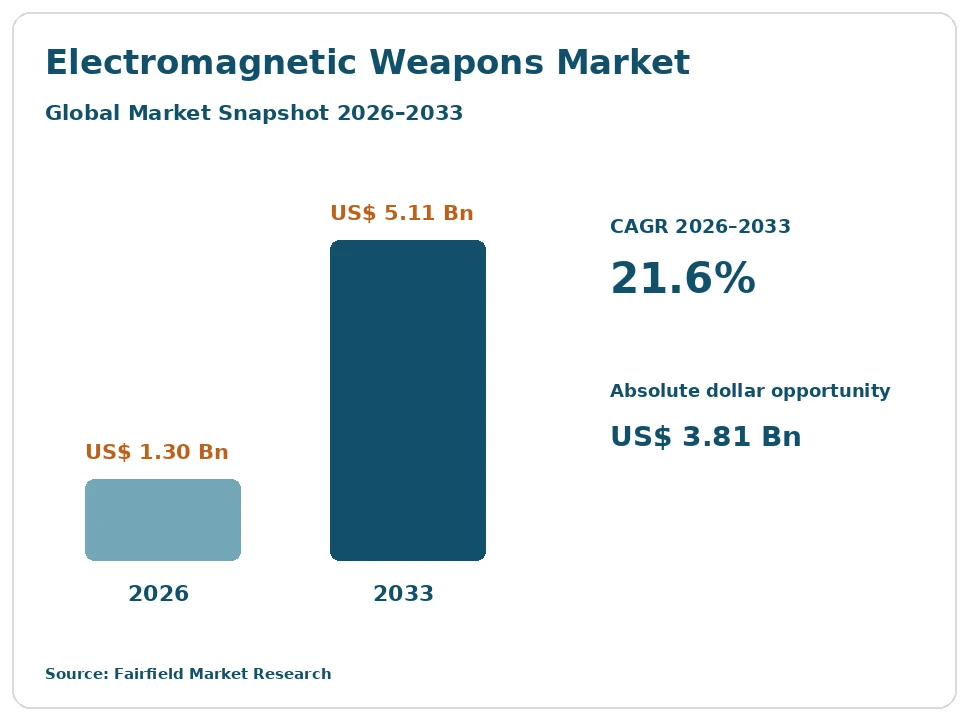
The global electromagnetic weapons market size is expected to be valued at US$ 1.30 billion in 2026 and projected to reach US$ 5.11 billion by 2033, growing at a CAGR of 21.6% between 2026 and 2033.
Between 2020 and 2025, the market grew at a CAGR of about 17.8%, as cheap drones used in conflicts in Ukraine and the Red Sea exposed the cost of shooting them down with missiles, pushing armed forces to fund new energy-based defenses. The electromagnetic weapons market covers high-power microwave systems, electromagnetic pulse devices, electronic attack and jamming systems, electromagnetic railguns, and coilguns that use electrical energy or radio frequency waves to disable electronics, stop drones and missiles, or launch projectiles at very high speed. These systems are used on land vehicles, ships, aircraft, and bases, and by homeland security agencies. High-power microwave systems can stop many drones at once at very low cost per shot. Growth comes from drone swarm threats, rising defense budgets, and maturing power and pulse technology. The market is shifting from prototypes to fielded counter-drone systems. In August 2026, the U.S. Marine Corps awarded Epirus an US$ 11 million contract for its HAVOC system.
Key Report Takeaways
- By Product: Non-lethal held about 64% share in 2025, while Lethal is projected to expand at a 22.4% CAGR through 2033, driven by electromagnetic railgun programs, hypersonic projectile research, and high-energy systems designed to destroy incoming missiles and drones.
- By Platform: Land held about 46% share in 2025, while Naval is projected to expand at a 23.0% CAGR through 2033, driven by ship defense against drone and missile swarms, abundant shipboard power, and railgun testing by Japan and China.
- By Technology: High-Power Microwave held about 41% share in 2025, while Electromagnetic Launch is projected to expand at a 23.6% CAGR through 2033, driven by railgun and coilgun research that promises long range and low cost per round.
- By Region: North America held about 42% share in 2025, while Asia Pacific is projected to expand at a 24.1% CAGR through 2033, driven by rising defense budgets, regional tensions, and active railgun and microwave programs in China, Japan, South Korea, and India.
Global Electromagnetic Weapons Market Trends and Insights
Drivers Impact Analysis
Two drivers carry the strongest influence on electromagnetic weapons market demand during the forecast period.
| Driver | Impact on CAGR Forecast | Geographic Relevance | Impact Timeline |
| Growing drone and swarm threats | High | Global, strongest in North America, Europe, and Middle East & Africa | Medium term (2-4 years) |
| Rising defense budgets and modernization programs | High | North America, Asia Pacific, Europe | Long term (≥4 years) |
Drone Threats Are Driving the Electromagnetic Weapons Market
Growing drone and swarm threats are the strongest driver of the electromagnetic weapons market. Cheap drones are hard to stop with missiles.
The mechanism is the cost gap between attack drones and traditional defenses. Small drones that cost a few thousand dollars are now used in large numbers in wars and attacks, and stopping each one with an interceptor missile that costs hundreds of thousands of dollars cannot be sustained. High-power microwave systems can disable many drones at once by frying their electronics, with a cost per shot of only a few dollars of electricity. Militaries have seen drones attack bases, ships, and cities, and want layered defenses that include microwave, jamming, and laser systems. The U.S. Army, U.S. Navy, and U.S. Marine Corps are buying prototype systems, and allies in Europe and Asia Pacific are following. These threats push steady funding into counter-drone electromagnetic weapons.
Defense Budgets Are Expanding the Electromagnetic Weapons Market
Rising defense budgets and modernization programs are expanding the electromagnetic weapons market. Countries are spending more on new technology.
The cause is higher military spending after the war in Ukraine and rising tension in Asia Pacific. Many countries in Europe now spend more on defense, and the United States funds directed energy research every year. China and Japan are testing naval railguns, and India is developing microwave and pulse systems. Programs that once stayed in labs now get funding for field trials and early production. Governments want weapons that cost little per shot and never run out of ammunition while power lasts. Defense planners also want weapons that can be powered by new hybrid electric vehicles and ships. Many allies have joined shared research programs to cut costs and speed testing. These budgets support development and steady growth over the forecast period.
Restraints Impact Analysis
Two restraints limit how quickly the electromagnetic weapons market grows.
| Restraint | Impact on CAGR Forecast | Geographic Relevance | Impact Timeline |
| Technical challenges in power, cooling, and range | High | Global | Long term (≥4 years) |
| Long testing timelines and export controls | Medium | Global | Medium term (2-4 years) |
Technical Challenges Slow the Electromagnetic Weapons Market
Technical challenges in power, cooling, and range slow the electromagnetic weapons market. These weapons need huge amounts of energy.
The specific causes are physics and engineering limits. Railguns need millions of amperes of current, which wears down rails quickly, and the U.S. Navy paused its railgun program in 2021 because of these problems and cost. Microwave weapons lose power quickly over distance, so their range is short, and weather can reduce effect. Systems need large power supplies, energy storage, and cooling that are hard to fit on small vehicles. Effects on targets can vary, making results harder to predict than with guns or missiles. Soldiers need special training to use new systems safely in the field. These issues slow the move from tests to wide use and raise costs for buyers.
Long Timelines Restrict the Electromagnetic Weapons Market
Long testing timelines and export controls restrict the electromagnetic weapons market. New weapons take years to approve and sell.
The underlying causes are strict defense rules and security concerns. Armed forces must test new systems for safety, reliability, and effects on friendly electronics before fielding them. Export rules limit sales of advanced systems to most countries, shrinking the market for each supplier. Budgets can shift between programs from year to year. Some programs end after tests if results disappoint, and companies may lose years of work. Small firms often depend on a few government contracts, which makes their revenue uneven. Rules on the safe use of microwave energy near civilians, aircraft, and medical devices also need to be settled. Long approval chains in defense ministries slow purchases even after successful tests. These factors restrict growth and delay revenue for many developers.
Market Opportunities
Counter-Drone Base Defense Opens a Fast-Growth Revenue Pool
Counter-drone base defense opens a fast-growth revenue pool in the electromagnetic weapons market. Bases need protection from swarms.
Defense firms can capture this opportunity. Military bases, airfields, ports, and power plants need defenses that can stop many drones at once without causing damage around them. Fixed and mobile microwave systems such as Epirus’s Leonidas fit this need. Armies are moving from test units to larger orders, and allies want similar systems. Civil sites such as airports and stadiums also face drone risks, creating a homeland security market. Companies offering proven, mobile, and easy-to-use systems that work with existing radars and command networks can win large contracts.
Naval Electromagnetic Systems Create a Growth Revenue Pool
Naval electromagnetic systems create a growth revenue pool in the electromagnetic weapons market. Ships have the power these weapons need.
Suppliers can capture this opportunity. Modern warships with electric drives can power microwave and railgun systems, and navies need defenses against swarms of drones and boats as well as missiles. Japan is testing a ship-based railgun, and China has tested a guided railgun projectile. Electromagnetic aircraft launch systems on carriers add related work. Shipbuilding programs in Asia Pacific are large. Navies also want systems that protect ships in ports, where drones and small boats are a growing threat. Railgun rounds cost far less than missiles and can be stored safely on ships without explosives. Companies with naval power, cooling, and integration skills can grow as new destroyers and frigates are designed with spare power for future energy weapons.
Segment Analysis
By Product: Non-lethal Leads While Lethal Grows Fastest
Non-lethal held about 64% share in 2025. Non-lethal systems such as high-power microwave, jamming, and pulse devices disable electronics without destroying targets physically, which makes them easier to use near people and buildings. They are the main tools for stopping drones near bases and cities, and they cost little per shot, often just the price of electricity.
Lethal is the fastest-growing product, expanding at a 22.4% CAGR through 2033. Lethal systems include railguns, coilguns, and high-energy systems that physically destroy targets such as missiles, aircraft, and boats. Research spending on these systems is rising again as navies look for cheaper ways to defend ships. For the market, lethal growth adds high-value programs.
By Platform: Land Leads While Naval Grows Fastest
Land held about 46% share in 2025. Ground vehicles, trailers, and fixed base systems are the most common platforms, because armies need to protect troops, bases, and convoys from drones. Many microwave systems are built into shipping containers or trucks for easy movement, and some can be carried on light vehicles to protect units on the move. Land forces also use jammers and pulse devices to stop drone signals and navigation.
Naval is the fastest-growing platform, expanding at a 23.0% CAGR through 2033. Ships have large power plants that can feed energy weapons, and navies face drone and missile swarms at sea. Airborne platforms form another segment, using jamming and pulse systems on aircraft and drones. For the market, naval growth supports larger systems.
By Technology: High-Power Microwave Leads While Electromagnetic Launch Grows Fastest
High-Power Microwave held about 41% share in 2025. Microwave systems send strong energy pulses that burn out drone electronics, and they can hit many targets at once over a wide area. Armies in the United States and Europe are buying these systems first. They need large power sources but have few moving parts, and they can work with radars that find targets. Prices are falling as designs mature and more units are produced.
Electromagnetic Launch is the fastest-growing technology, expanding at a 23.6% CAGR through 2033. Railguns and coilguns use magnetic forces to fire projectiles at very high speed without explosive propellant, offering long range and cheap rounds. Electromagnetic pulse and electronic warfare systems form other technologies. For the market, launch growth reflects renewed naval research.
Geography Analysis
Which Region Is Leading the Electromagnetic Weapons Market?
North America is leading the electromagnetic weapons market with about 42% share in 2025. The United States has the largest defense budget and runs many directed energy programs through the Army, Navy, Air Force, and Marine Corps, along with research labs such as AFRL and the Naval Research Laboratory. Lockheed Martin, RTX, Northrop Grumman, L3Harris Technologies, General Atomics, and Epirus are major suppliers. Many bases now test microwave systems against drones, and the services plan larger orders in coming years. Key barriers include long testing timelines. One change shaping the region is the move to production orders.
Europe Shapes the Electromagnetic Weapons Market Through Counter-Drone Programs
Europe is a major electromagnetic weapons market. The United Kingdom, Germany, France, and Italy are funding counter-drone and directed energy programs, and the war in Ukraine has shown the scale of the drone threat close to home. BAE Systems, Rheinmetall, Thales, QinetiQ, and MBDA develop systems, and the United Kingdom has tested radio frequency weapons against drone swarms. Defense budgets are rising across the region, and many governments are fast-tracking counter-drone purchases to protect bases, airports, and power plants. Key barriers include fragmented procurement. One opportunity is joint European programs.
Which Region Is Growing Fastest in the Electromagnetic Weapons Market?
Asia Pacific is growing fastest in the electromagnetic weapons market, expanding at a 24.1% CAGR through 2033. China has tested a naval railgun that fired a guided munition at more than five times the speed of sound, and Japan completed sea-based railgun firing tests in 2023. South Korea, India, Australia, and Taiwan are funding counter-drone and microwave systems as regional tensions rise. Large shipbuilding programs add naval demand, and many countries are building local defense industries with this technology. Key barriers include export controls. One change shaping the region is fast budget growth.
Latin America Grows the Electromagnetic Weapons Market Through Security Needs
Latin America is a small electromagnetic weapons market. Brazil, Mexico, Colombia, and Chile face drone use by criminal groups and need to protect prisons, borders, and critical infrastructure. Most countries buy jamming and non-lethal counter-drone tools rather than advanced weapons, and Brazil has defense research centers that study electronic warfare. Budgets are limited, and most systems are imported from the United States, Europe, and Israel. Police and prison services are early buyers of simple jamming tools, and armed forces in some countries are testing more advanced systems for border use. Key barriers include small defense budgets. One opportunity is homeland security.
Middle East & Africa Develops the Electromagnetic Weapons Market Through Drone Defense
Middle East & Africa is a developing electromagnetic weapons market. Israel, Saudi Arabia, and the United Arab Emirates face frequent drone and missile attacks and invest heavily in layered air defense, and Rafael and Elbit Systems in Israel develop directed energy and electronic warfare systems. Oil facilities and ports need protection. Many countries buy systems from the United States and Europe, and local defense firms in Saudi Arabia and the United Arab Emirates are growing through partnerships and joint ventures. Several countries have tested microwave systems in recent trials. Key barriers include export limits. One change shaping the region is rising air defense spending.
Competitive Landscape
The electromagnetic weapons market is moderately consolidated. Lockheed Martin, RTX, Northrop Grumman, BAE Systems, and Epirus are leading players, while L3Harris Technologies, General Atomics, Boeing, Leonardo DRS, Rheinmetall, Thales, QinetiQ, Rafael Advanced Defense Systems, and Elbit Systems compete strongly. Large defense primes win most big programs, while smaller firms such as Epirus, Envisioneering, and Leidos win prototype contracts for new microwave and pulse systems. Government labs in the United States, China, and Japan drive much of the core research.
Companies compete on power output, range, reliability, size and weight, cost per shot, integration with radars and command systems, and test results. Proven field performance is the most important factor, so companies invest in demonstrations with armed forces. Partnerships between startups and primes help combine new technology with production scale and military relationships. Export approvals shape which markets each company can serve.
Strategic moves show how competition is changing. In October 2024, the Naval Research Laboratory awarded Envisioneering a US$ 99 million contract for high-power electromagnetic weapon prototypes. In July 2025, the U.S. Army awarded Epirus about US$ 43.5 million for second-generation IFPC-HPM systems. In August 2026, the U.S. Marine Corps awarded Epirus an US$ 11 million contract for the HAVOC program. These moves show competition shifting toward fielded counter-drone microwave systems.
Three themes shape vendor strategy. First, companies are making microwave systems smaller, mobile, and cheaper. Second, they are combining microwave, jamming, laser, and missile systems in layered defense packages. Third, they are pursuing naval and allied orders in Asia Pacific, Europe, and Middle East & Africa.
Electromagnetic Weapons Market Industry Leaders
- Lockheed Martin
- RTX
- Northrop Grumman
- BAE Systems
- Epirus
Recent Industry Developments
- August 2026: The U.S. Marine Corps awarded Epirus an US$ 11 million contract for its HAVOC counter-drone high-power microwave program - extends high-power microwave systems to Marine units.
- July 2025: The U.S. Army awarded Epirus about US$ 43.5 million to build second-generation IFPC-HPM high-power microwave systems based on Leonidas - moves microwave counter-drone systems toward wider fielding.
- October 2024: The Naval Research Laboratory awarded Envisioneering a US$ 99 million contract to develop high-power electromagnetic weapon prototypes - supports naval research in the electromagnetic weapons market.
Companies Covered in the Report
- Lockheed Martin
- RTX
- Northrop Grumman
- BAE Systems
- Epirus
- L3Harris Technologies
- General Atomics
- Boeing
- Rheinmetall
- Thales
- QinetiQ
- Rafael Advanced Defense Systems
Electromagnetic Weapons Market Scope
This report covers the electromagnetic weapons market, including lethal and non-lethal systems based on high-power microwave, electromagnetic pulse, electronic warfare, and electromagnetic launch technologies such as railguns and coilguns, deployed on land, naval, and airborne platforms for defense and homeland security applications. The base year is 2025, and the forecast period runs from 2026 to 2033. All values are expressed in US$ Billion.
| Metric | Value |
| Study Period | 2020-2033 |
| Market Size 2026 | US$ 1.30 Billion |
| Market Size 2033 | US$ 5.11 Billion |
| CAGR 2026-2033 | 21.6% |
| Absolute Dollar Opportunity | US$ 3.81 Billion |
| Largest Market | North America |
| Fastest-Growing Market | Asia Pacific |
| Market Concentration | Moderately Consolidated |
| Major Players | Lockheed Martin, RTX, Northrop Grumman, BAE Systems, Epirus |
Product
- Lethal
- Non-lethal
Platform
- Land
- Naval
- Airborne
Technology
- High-Power Microwave
- Electromagnetic Pulse
- Electronic Warfare
- Electromagnetic Launch
Application
- Defense
- Homeland Security
Regions
- North America
- Europe
- Asia Pacific
- Latin America
- Middle East & Africa
1. Executive Summary
1.1. Global Electromagnetic Weapons Market Snapshot
1.2. Future Projections, 2026-2033
1.3. Key Market Trends
1.4. Regional Snapshot
2. Market Overview
2.1. Market Definition and Scope
2.2. Historical Market Trends, 2020-2025
2.3. Market Dynamics
2.3.1. Drivers Impact Analysis
2.3.1.1. Drone Threats Are Driving the Electromagnetic Weapons Market
2.3.1.2. Defense Budgets Are Expanding the Electromagnetic Weapons Market
2.3.2. Restraints Impact Analysis
2.3.2.1. Technical Challenges Slow the Electromagnetic Weapons Market
2.3.2.2. Long Timelines Restrict the Electromagnetic Weapons Market
2.3.3. Market Opportunities
2.3.3.1. Counter-Drone Base Defense Opens a Fast-Growth Revenue Pool
2.3.3.2. Naval Electromagnetic Systems Create a Growth Revenue Pool
3. Global Electromagnetic Weapons Market Outlook, 2020-2033
3.1. Global Electromagnetic Weapons Market Outlook, by Product, Value (US$ Billion), 2020-2033
3.1.1. Lethal
3.1.2. Non-lethal
3.2. Global Electromagnetic Weapons Market Outlook, by Platform, Value (US$ Billion), 2020-2033
3.2.1. Land
3.2.2. Naval
3.2.3. Airborne
3.3. Global Electromagnetic Weapons Market Outlook, by Technology, Value (US$ Billion), 2020-2033
3.3.1. High-Power Microwave
3.3.2. Electromagnetic Pulse
3.3.3. Electronic Warfare
3.3.4. Electromagnetic Launch
3.4. Global Electromagnetic Weapons Market Outlook, by Application, Value (US$ Billion), 2020-2033
3.4.1. Defense
3.4.2. Homeland Security
3.5. Global Electromagnetic Weapons Market Outlook, by Region, Value (US$ Billion), 2020-2033
3.5.1. North America
3.5.2. Europe
3.5.3. Asia Pacific
3.5.4. Latin America
3.5.5. Middle East & Africa
4. North America Electromagnetic Weapons Market Outlook, 2020-2033
4.1. North America Electromagnetic Weapons Market Outlook, by Product, Value (US$ Billion), 2020-2033
4.1.1. Lethal
4.1.2. Non-lethal
4.2. North America Electromagnetic Weapons Market Outlook, by Platform, Value (US$ Billion), 2020-2033
4.2.1. Land
4.2.2. Naval
4.2.3. Airborne
4.3. North America Electromagnetic Weapons Market Outlook, by Technology, Value (US$ Billion), 2020-2033
4.3.1. High-Power Microwave
4.3.2. Electromagnetic Pulse
4.3.3. Electronic Warfare
4.3.4. Electromagnetic Launch
4.4. North America Electromagnetic Weapons Market Outlook, by Application, Value (US$ Billion), 2020-2033
4.4.1. Defense
4.4.2. Homeland Security
4.5. North America Electromagnetic Weapons Market Outlook, by Country, Value (US$ Billion), 2020-2033
4.5.1. United States Electromagnetic Weapons Market Outlook, by Product, 2020-2033
4.5.2. United States Electromagnetic Weapons Market Outlook, by Platform, 2020-2033
4.5.3. United States Electromagnetic Weapons Market Outlook, by Technology, 2020-2033
4.5.4. United States Electromagnetic Weapons Market Outlook, by Application, 2020-2033
5. Europe Electromagnetic Weapons Market Outlook, 2020-2033
5.1. Europe Electromagnetic Weapons Market Outlook, by Product, Value (US$ Billion), 2020-2033
5.1.1. Lethal
5.1.2. Non-lethal
5.2. Europe Electromagnetic Weapons Market Outlook, by Platform, Value (US$ Billion), 2020-2033
5.2.1. Land
5.2.2. Naval
5.2.3. Airborne
5.3. Europe Electromagnetic Weapons Market Outlook, by Technology, Value (US$ Billion), 2020-2033
5.3.1. High-Power Microwave
5.3.2. Electromagnetic Pulse
5.3.3. Electronic Warfare
5.3.4. Electromagnetic Launch
5.4. Europe Electromagnetic Weapons Market Outlook, by Application, Value (US$ Billion), 2020-2033
5.4.1. Defense
5.4.2. Homeland Security
5.5. Europe Electromagnetic Weapons Market Outlook, by Country, Value (US$ Billion), 2020-2033
5.5.1. United Kingdom Electromagnetic Weapons Market Outlook, by Product, 2020-2033
5.5.2. United Kingdom Electromagnetic Weapons Market Outlook, by Platform, 2020-2033
5.5.3. United Kingdom Electromagnetic Weapons Market Outlook, by Technology, 2020-2033
5.5.4. United Kingdom Electromagnetic Weapons Market Outlook, by Application, 2020-2033
5.5.5. Germany Electromagnetic Weapons Market Outlook, by Product, 2020-2033
5.5.6. Germany Electromagnetic Weapons Market Outlook, by Platform, 2020-2033
5.5.7. Germany Electromagnetic Weapons Market Outlook, by Technology, 2020-2033
5.5.8. Germany Electromagnetic Weapons Market Outlook, by Application, 2020-2033
5.5.9. France Electromagnetic Weapons Market Outlook, by Product, 2020-2033
5.5.10. France Electromagnetic Weapons Market Outlook, by Platform, 2020-2033
5.5.11. France Electromagnetic Weapons Market Outlook, by Technology, 2020-2033
5.5.12. France Electromagnetic Weapons Market Outlook, by Application, 2020-2033
5.5.13. Italy Electromagnetic Weapons Market Outlook, by Product, 2020-2033
5.5.14. Italy Electromagnetic Weapons Market Outlook, by Platform, 2020-2033
5.5.15. Italy Electromagnetic Weapons Market Outlook, by Technology, 2020-2033
5.5.16. Italy Electromagnetic Weapons Market Outlook, by Application, 2020-2033
5.5.17. Ukraine Electromagnetic Weapons Market Outlook, by Product, 2020-2033
5.5.18. Ukraine Electromagnetic Weapons Market Outlook, by Platform, 2020-2033
5.5.19. Ukraine Electromagnetic Weapons Market Outlook, by Technology, 2020-2033
5.5.20. Ukraine Electromagnetic Weapons Market Outlook, by Application, 2020-2033
6. Asia Pacific Electromagnetic Weapons Market Outlook, 2020-2033
6.1. Asia Pacific Electromagnetic Weapons Market Outlook, by Product, Value (US$ Billion), 2020-2033
6.1.1. Lethal
6.1.2. Non-lethal
6.2. Asia Pacific Electromagnetic Weapons Market Outlook, by Platform, Value (US$ Billion), 2020-2033
6.2.1. Land
6.2.2. Naval
6.2.3. Airborne
6.3. Asia Pacific Electromagnetic Weapons Market Outlook, by Technology, Value (US$ Billion), 2020-2033
6.3.1. High-Power Microwave
6.3.2. Electromagnetic Pulse
6.3.3. Electronic Warfare
6.3.4. Electromagnetic Launch
6.4. Asia Pacific Electromagnetic Weapons Market Outlook, by Application, Value (US$ Billion), 2020-2033
6.4.1. Defense
6.4.2. Homeland Security
6.5. Asia Pacific Electromagnetic Weapons Market Outlook, by Country, Value (US$ Billion), 2020-2033
6.5.1. China Electromagnetic Weapons Market Outlook, by Product, 2020-2033
6.5.2. China Electromagnetic Weapons Market Outlook, by Platform, 2020-2033
6.5.3. China Electromagnetic Weapons Market Outlook, by Technology, 2020-2033
6.5.4. China Electromagnetic Weapons Market Outlook, by Application, 2020-2033
6.5.5. Japan Electromagnetic Weapons Market Outlook, by Product, 2020-2033
6.5.6. Japan Electromagnetic Weapons Market Outlook, by Platform, 2020-2033
6.5.7. Japan Electromagnetic Weapons Market Outlook, by Technology, 2020-2033
6.5.8. Japan Electromagnetic Weapons Market Outlook, by Application, 2020-2033
6.5.9. South Korea Electromagnetic Weapons Market Outlook, by Product, 2020-2033
6.5.10. South Korea Electromagnetic Weapons Market Outlook, by Platform, 2020-2033
6.5.11. South Korea Electromagnetic Weapons Market Outlook, by Technology, 2020-2033
6.5.12. South Korea Electromagnetic Weapons Market Outlook, by Application, 2020-2033
6.5.13. India Electromagnetic Weapons Market Outlook, by Product, 2020-2033
6.5.14. India Electromagnetic Weapons Market Outlook, by Platform, 2020-2033
6.5.15. India Electromagnetic Weapons Market Outlook, by Technology, 2020-2033
6.5.16. India Electromagnetic Weapons Market Outlook, by Application, 2020-2033
6.5.17. Australia Electromagnetic Weapons Market Outlook, by Product, 2020-2033
6.5.18. Australia Electromagnetic Weapons Market Outlook, by Platform, 2020-2033
6.5.19. Australia Electromagnetic Weapons Market Outlook, by Technology, 2020-2033
6.5.20. Australia Electromagnetic Weapons Market Outlook, by Application, 2020-2033
6.5.21. Taiwan Electromagnetic Weapons Market Outlook, by Product, 2020-2033
6.5.22. Taiwan Electromagnetic Weapons Market Outlook, by Platform, 2020-2033
6.5.23. Taiwan Electromagnetic Weapons Market Outlook, by Technology, 2020-2033
6.5.24. Taiwan Electromagnetic Weapons Market Outlook, by Application, 2020-2033
7. Latin America Electromagnetic Weapons Market Outlook, 2020-2033
7.1. Latin America Electromagnetic Weapons Market Outlook, by Product, Value (US$ Billion), 2020-2033
7.1.1. Lethal
7.1.2. Non-lethal
7.2. Latin America Electromagnetic Weapons Market Outlook, by Platform, Value (US$ Billion), 2020-2033
7.2.1. Land
7.2.2. Naval
7.2.3. Airborne
7.3. Latin America Electromagnetic Weapons Market Outlook, by Technology, Value (US$ Billion), 2020-2033
7.3.1. High-Power Microwave
7.3.2. Electromagnetic Pulse
7.3.3. Electronic Warfare
7.3.4. Electromagnetic Launch
7.4. Latin America Electromagnetic Weapons Market Outlook, by Application, Value (US$ Billion), 2020-2033
7.4.1. Defense
7.4.2. Homeland Security
7.5. Latin America Electromagnetic Weapons Market Outlook, by Country, Value (US$ Billion), 2020-2033
7.5.1. Brazil Electromagnetic Weapons Market Outlook, by Product, 2020-2033
7.5.2. Brazil Electromagnetic Weapons Market Outlook, by Platform, 2020-2033
7.5.3. Brazil Electromagnetic Weapons Market Outlook, by Technology, 2020-2033
7.5.4. Brazil Electromagnetic Weapons Market Outlook, by Application, 2020-2033
7.5.5. Mexico Electromagnetic Weapons Market Outlook, by Product, 2020-2033
7.5.6. Mexico Electromagnetic Weapons Market Outlook, by Platform, 2020-2033
7.5.7. Mexico Electromagnetic Weapons Market Outlook, by Technology, 2020-2033
7.5.8. Mexico Electromagnetic Weapons Market Outlook, by Application, 2020-2033
7.5.9. Colombia Electromagnetic Weapons Market Outlook, by Product, 2020-2033
7.5.10. Colombia Electromagnetic Weapons Market Outlook, by Platform, 2020-2033
7.5.11. Colombia Electromagnetic Weapons Market Outlook, by Technology, 2020-2033
7.5.12. Colombia Electromagnetic Weapons Market Outlook, by Application, 2020-2033
7.5.13. Chile Electromagnetic Weapons Market Outlook, by Product, 2020-2033
7.5.14. Chile Electromagnetic Weapons Market Outlook, by Platform, 2020-2033
7.5.15. Chile Electromagnetic Weapons Market Outlook, by Technology, 2020-2033
7.5.16. Chile Electromagnetic Weapons Market Outlook, by Application, 2020-2033
8. Middle East & Africa Electromagnetic Weapons Market Outlook, 2020-2033
8.1. Middle East & Africa Electromagnetic Weapons Market Outlook, by Product, Value (US$ Billion), 2020-2033
8.1.1. Lethal
8.1.2. Non-lethal
8.2. Middle East & Africa Electromagnetic Weapons Market Outlook, by Platform, Value (US$ Billion), 2020-2033
8.2.1. Land
8.2.2. Naval
8.2.3. Airborne
8.3. Middle East & Africa Electromagnetic Weapons Market Outlook, by Technology, Value (US$ Billion), 2020-2033
8.3.1. High-Power Microwave
8.3.2. Electromagnetic Pulse
8.3.3. Electronic Warfare
8.3.4. Electromagnetic Launch
8.4. Middle East & Africa Electromagnetic Weapons Market Outlook, by Application, Value (US$ Billion), 2020-2033
8.4.1. Defense
8.4.2. Homeland Security
8.5. Middle East & Africa Electromagnetic Weapons Market Outlook, by Country, Value (US$ Billion), 2020-2033
8.5.1. Israel Electromagnetic Weapons Market Outlook, by Product, 2020-2033
8.5.2. Israel Electromagnetic Weapons Market Outlook, by Platform, 2020-2033
8.5.3. Israel Electromagnetic Weapons Market Outlook, by Technology, 2020-2033
8.5.4. Israel Electromagnetic Weapons Market Outlook, by Application, 2020-2033
8.5.5. Saudi Arabia Electromagnetic Weapons Market Outlook, by Product, 2020-2033
8.5.6. Saudi Arabia Electromagnetic Weapons Market Outlook, by Platform, 2020-2033
8.5.7. Saudi Arabia Electromagnetic Weapons Market Outlook, by Technology, 2020-2033
8.5.8. Saudi Arabia Electromagnetic Weapons Market Outlook, by Application, 2020-2033
8.5.9. United Arab Emirates Electromagnetic Weapons Market Outlook, by Product, 2020-2033
8.5.10. United Arab Emirates Electromagnetic Weapons Market Outlook, by Platform, 2020-2033
8.5.11. United Arab Emirates Electromagnetic Weapons Market Outlook, by Technology, 2020-2033
8.5.12. United Arab Emirates Electromagnetic Weapons Market Outlook, by Application, 2020-2033
9. Competitive Landscape
9.1. Industry Leaders
9.2. Recent Industry Developments
9.3. Company Profiles
9.3.1. Lockheed Martin
9.3.2. RTX
9.3.3. Northrop Grumman
9.3.4. BAE Systems
9.3.5. Epirus
9.3.6. L3Harris Technologies
9.3.7. General Atomics
9.3.8. Boeing
9.3.9. Rheinmetall
9.3.10. Thales
9.3.11. QinetiQ
9.3.12. Rafael Advanced Defense Systems
10. Appendix
10.1. Research Methodology
10.2. Report Assumptions
10.3. Acronyms and Abbreviations
| Segment | Categories |
| Product | Lethal, Non-lethal, Platform |
| Land | Naval, Airborne |
| Technology | High-Power Microwave, Electromagnetic Pulse, Electronic Warfare, Electromagnetic Launch |
| Application | Defense, Homeland Security |
| Regions | North America, Europe, Asia Pacific, Latin America, Middle East & Africa |
Our Research Methodology
Considering the volatility of business today, traditional approaches to strategizing a game plan can be unfruitful if not detrimental. True ambiguity is no way to determine a forecast. A myriad of predetermined factors must be accounted for such as the degree of risk involved, the magnitude of circumstances, as well as conditions or consequences that are not known or unpredictable. To circumvent binary views that cast uncertainty, the application of market research intelligence to strategically posture, move, and enable actionable outcomes is necessary.
View Methodology
Quality Assured
Rigorous Validation Process

Confidentiality Assured
End-to-end Data Security

Custom Research Services
Tailored To Your Objectives
FAQs
The electromagnetic weapons market is valued at US$ 1.30 billion in 2026, led by non-lethal systems and North America.
The market is projected to reach US$ 5.11 billion by 2033, growing at a 21.6% CAGR and adding US$ 3.81 billion.
Naval is growing fastest at a 23.0% CAGR through 2033, driven by ship defense needs and ample shipboard electrical power supply.
Asia Pacific is growing fastest at a 24.1% CAGR through 2033, driven by rising budgets, regional tensions, and active railgun programs.
North America holds the largest share at about 42% in 2025, supported by the largest defense budget and many directed energy programs.
Related Reports
Laser Retroreflector Array Market Size, Share, Insights, Competitive Landscape, and Forecast 2026 to 2033
The laser retroreflector array market is forecast to grow from US$ 818.1 million in 2026 to US$ 1,505.3 million by 2033 at a 9.1% CAGR.
Agricultural Pumps Market Size, Share, Insights, Competitive Landscape, and Forecast 2026 to 2033
The global agricultural pumps market is valued at US$12.22 billion in 2026, reaching US$18.26 billion by 2033, growing at a 5.9% CAGR
Spinning Machinery Market Size, Share, Insights, Competitive Landscape, and Forecast 2026 to 2033
The global spinning machinery market is valued at US$6.8 billion in 2026, reaching US$8.6 billion by 2033, growing at a 3.4% CAGR
Plastic Injection Molding Machine Market Size, Share, Insights, Competitive Landscape, and Forecast 2026 to 2033
The global plastic injection molding machine market is valued at US$13.4 billion in 2026, reaching US$18.2 billion by 2033, growing at a 4.5% CAGR
Physical Vapor Deposition (PVD) Market Size, Share, Insights, Competitive Landscape, and Forecast 2026 to 2033
The global physical vapor deposition (PVD) market is valued at US$28.4 billion in 2026, reaching US$48.6 billion by 2033, growing at an 8.0% CAGR
Automated Truck Loading System Market Size, Share, Insights, Competitive Landscape, and Forecast 2026 to 2033
The automated truck loading system market is projected to grow from US$ 1.4 billion in 2026 to US$ 2.4 billion by 2033 at an 8.0% CAGR.