



Industrial Valves Market
Industrial Valves Market Size, Share, Insights, Competitive Landscape, and Forecast 2026 to 2033
Industrial Valves Market Size and Trend Analysis
How Fast Is the Industrial Valves Market Growing?
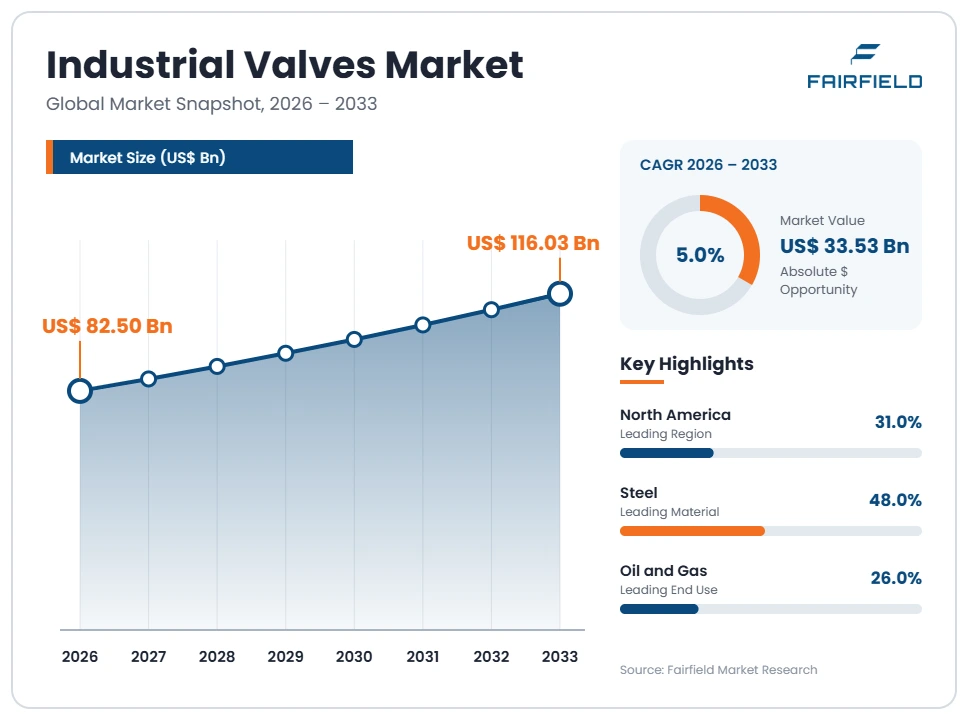
The global industrial valves market size is expected to be valued at US$ 82.50 billion in 2026 and projected to reach US$ 116.03 billion by 2033, growing at a CAGR of 5.0% between 2026 and 2033.
Between 2020 and 2025, the market grew at a CAGR of about 4.1%, as oil and gas projects were delayed in 2020, then energy, chemical, water, and power investments recovered strongly while supply chain problems and high metal prices stretched lead times in 2021 and 2022. The industrial valves market covers devices that start, stop, and regulate the flow of liquids, gases, and slurries in pipes, including ball, butterfly, gate, globe, plug, check, diaphragm, and safety valves, along with control valves, actuators, and positioners. Valves are made from cast iron, steel, stainless steel, alloys, and bronze. They are used in oil and gas, chemicals, water and wastewater, power generation, pharmaceuticals, food and beverage, HVAC, mining, and other industries where reliable flow control keeps plants safe and efficient. Growth comes from energy, water, and process industry spending. In July 2026, Flowserve completed its US$ 490 million acquisition of Trillium’s valves business.
Key Report Takeaways
- By Valve Type: Ball Valves held about 22% share in 2025, while Butterfly Valves is projected to expand at a 5.9% CAGR through 2033, driven by compact design, low cost, and growing use in water treatment, HVAC, power, and large pipelines.
- By Material: Steel held about 48% share in 2025, while Alloy-Based is projected to expand at a 6.1% CAGR through 2033, driven by corrosive, high-temperature, and high-pressure service in chemicals, hydrogen, nuclear, and liquefied natural gas plants.
- By End Use: Oil and Gas held about 26% share in 2025, while Water and Wastewater Treatment is projected to expand at a 6.4% CAGR through 2033, driven by aging network replacement, desalination, and stricter water quality rules in many countries.
- By Region: North America held about 31% share in 2025, while Asia Pacific is projected to expand at a 6.3% CAGR through 2033, driven by industrial growth, power and water investment, and new chemical and energy projects in China and India.
Global Industrial Valves Market Trends and Insights
Drivers Impact Analysis
Two drivers carry the strongest influence on industrial valves market demand during the forecast period.
| Driver | Impact on CAGR Forecast | Geographic Relevance | Impact Timeline |
| Energy, power, and process industry investment | High | North America, Asia Pacific, Middle East & Africa | Long term (≥4 years) |
| Water infrastructure and treatment spending | Medium | Global | Medium term (2-4 years) |
Energy Investment Is Driving the Industrial Valves Market
Energy, power, and process industry investment is the strongest driver of the industrial valves market. Every plant needs thousands of valves.
The mechanism is the central role of valves in moving fluids safely. Oil and gas fields, pipelines, refineries, liquefied natural gas terminals, chemical plants, and power stations all depend on valves to control flow, pressure, and temperature, and to shut down safely in emergencies. Liquefied natural gas export projects in the United States and Qatar, chemical capacity in China and India, and refinery upgrades in Saudi Arabia require large valve packages. Nuclear power is seeing renewed interest, with new reactors and life extensions in the United States, France, China, and India needing high-specification valves. Hydrogen, carbon capture, and biofuel projects add new demand for control valves and severe-service valves. Ongoing maintenance and replacement across existing plants create steady, long-term demand.
Water Spending Is Expanding the Industrial Valves Market
Water infrastructure and treatment spending is expanding the industrial valves market. Water networks use large numbers of valves.
The cause is aging pipes, growing cities, and water scarcity. Many water networks in North America and Europe are decades old and leak heavily, requiring replacement of pipes and valves. Cities in India, China, Indonesia, and Brazil are expanding water and sewer systems. Desalination plants in Saudi Arabia, the United Arab Emirates, and Israel use corrosion-resistant valves. Stricter rules on water quality and wastewater discharge require new treatment plants. Smart valves with sensors help utilities find leaks and manage pressure, cutting water losses. Government programs in the United States and India fund large water network projects. Industrial plants are also recycling more water, adding treatment equipment. These trends expand sales.
Restraints Impact Analysis
Two restraints limit how quickly the industrial valves market grows.
| Restraint | Impact on CAGR Forecast | Geographic Relevance | Impact Timeline |
| Volatile metal prices and long supply lead times | High | Global | Medium term (2-4 years) |
| Cyclical oil and gas spending and price competition | Medium | North America, Middle East & Africa | Medium term (2-4 years) |
Metal Prices and Lead Times Slow the Industrial Valves Market
Volatile metal prices and long supply lead times slow the industrial valves market. Valves depend on castings and forgings.
The specific causes are raw material swings and foundry limits. Steel, stainless steel, nickel, and special alloy prices rose sharply in 2021 and 2022, and many valve makers struggled to pass on costs under fixed-price contracts. Castings and forgings come from a limited number of foundries, and capacity shortages stretched lead times for large or special valves to many months. Skilled machinists, welders, and valve technicians are in short supply in North America and Europe, slowing output. Trade tariffs on steel and imported valves add costs. These factors delay projects and squeeze margins, especially for smaller manufacturers without long-term supply deals. Testing and certification add further time before shipment.
Cyclical Spending Restricts the Industrial Valves Market
Cyclical oil and gas spending and price competition restrict the industrial valves market. Demand rises and falls with energy prices.
The underlying causes are the boom-and-bust nature of oil and gas. When oil prices fall, producers cut spending on new wells, pipelines, and refineries, reducing valve orders. The energy transition also creates uncertainty about long-term investment in fossil fuel projects, and some banks limit funding for new oil and gas work. Low-cost producers in China and India compete strongly on price for standard valves, and large buyers run tough bidding processes that push down prices. Project cancellations and delays can leave valve makers with excess capacity and inventory. Long payment terms on large projects strain cash flow, and buyers often demand penalties for late delivery. These factors restrict growth.
Market Opportunities
Nuclear, Hydrogen, and LNG Open a Fast-Growth Revenue Pool
Nuclear, hydrogen, and liquefied natural gas projects open a fast-growth revenue pool in the industrial valves market. These projects need specialized valves.
Suppliers can capture this opportunity with specialized products. Nuclear plants need valves certified to strict safety standards, and new large reactors, small modular reactors, and life extensions are planned in North America, Europe, and Asia Pacific. Hydrogen is a tiny molecule that leaks easily and can weaken metals, so it needs special materials, seals, and testing. Liquefied natural gas plants use cryogenic valves that work at very low temperatures, and carbon capture plants need valves for corrosive gases. In July 2026, Flowserve completed its acquisition of Trillium’s valves business to deepen its nuclear and power position. Companies with certified products can win premium contracts.
Smart Valves and Digital Services Create a Growth Revenue Pool
Smart valves and digital services create a growth revenue pool in the industrial valves market. Plants want to predict failures.
Suppliers can capture this opportunity. Digital positioners, sensors, and software can monitor valve health, detect leaks, and predict when maintenance is needed, reducing costly shutdowns. Refineries, chemical plants, and water utilities are adopting connected valves as part of plant digitalization. Remote monitoring helps plants with fewer skilled workers and supports safer operation. Service contracts for repairs, upgrades, and spare parts provide steady revenue, and digital records of each valve’s history help plan shutdowns. Cybersecurity features are becoming important as valves connect to plant networks. Utilities can use smart valves to control pressure across water networks and reduce leaks. Companies offering smart valves and lifecycle services can earn higher margins and build long relationships with plant operators.
Segment Analysis
- By Valve Type: Ball Valves Lead While Butterfly Valves Grow Fastest
Ball Valves held about 22% share in 2025. Ball valves provide tight shutoff, quick quarter-turn operation, and long service life, making them widely used in oil and gas pipelines, chemical plants, and water systems. Large trunnion-mounted ball valves are critical in pipelines and liquefied natural gas terminals.
Butterfly Valves is the fastest-growing valve type, expanding at a 5.9% CAGR through 2033. Butterfly valves are lighter, smaller, and cheaper than other valves of the same size, making them popular for large-diameter pipes in water treatment, desalination, HVAC, power plants, and chemical processing. High-performance and triple-offset designs now handle higher pressures and temperatures. Gate, globe, plug, check, diaphragm, and other valves form further segments, with control valves used to regulate flow precisely. For the market, butterfly growth follows water investment.
- By Material: Steel Leads While Alloy-Based Grows Fastest
Steel held about 48% share in 2025. Carbon steel and stainless steel valves offer strength, pressure resistance, and durability, and they are standard in oil and gas, chemicals, power, and many industrial uses. Stainless steel is preferred where corrosion or hygiene matters, such as in food, pharmaceuticals, and water.
Alloy-Based is the fastest-growing material, expanding at a 6.1% CAGR through 2033. Nickel, titanium, duplex, and other special alloys resist corrosion, high temperatures, and very high pressures, making them essential in chemicals, nuclear, hydrogen, sour gas, and offshore uses. Cast iron, bronze, and other materials form further segments, with cast iron common in water and HVAC, and bronze used in marine and building systems. For the market, alloy growth adds high-value demand.
- By End Use: Oil and Gas Leads While Water and Wastewater Treatment Grows Fastest
Oil and Gas held about 26% share in 2025. Upstream fields, offshore platforms, pipelines, liquefied natural gas plants, storage terminals, and refineries use large numbers of valves, many in severe service with high pressures and corrosive fluids. Maintenance and replacement keep demand steady even when new project spending slows, and safety rules require regular valve testing.
Water and Wastewater Treatment is the fastest-growing end use, expanding at a 6.4% CAGR through 2033. Aging networks, new treatment plants, desalination, and stricter rules drive investment in North America, Europe, Asia Pacific, and Middle East & Africa. Chemicals, power generation, pharmaceuticals, food and beverage, HVAC, mining, and other industries form further end uses. For the market, water growth adds steady, less cyclical demand.
Geography Analysis
- Which Region Is Leading the Industrial Valves Market?
North America is leading the industrial valves market with about 31% share in 2025. The United States has large oil and gas, liquefied natural gas, chemical, refining, power, and water industries, and is home to Emerson Electric, Flowserve, Crane, and SLB’s valve businesses. Liquefied natural gas export terminals in Texas and Louisiana, chemical plant expansions, and federal water infrastructure funding support strong demand. Nuclear plant life extensions and new reactor plans add high-value orders. Canada adds oil sands, mining, and power demand. Key barriers include skilled labor shortages and tariffs on imported parts. One change shaping the region is renewed nuclear investment.
- Europe Shapes the Industrial Valves Market Through Process Industries and Water
Europe is a major industrial valves market. Germany, France, Italy, the United Kingdom, the Netherlands, and Spain have large chemical, pharmaceutical, power, and water industries. KSB, IMI, Spirax Group, and many Italian and German valve makers are based in the region. Nuclear projects in France and the United Kingdom, hydrogen projects in the Netherlands and Germany, and water network upgrades support demand. Pharmaceutical and food plants in Ireland, Switzerland, and Denmark use hygienic valves. Key barriers include high energy costs and slow chemical industry output. One opportunity is hydrogen and nuclear valves.
- Which Region Is Growing Fastest in the Industrial Valves Market?
Asia Pacific is growing fastest in the industrial valves market, expanding at a 6.3% CAGR through 2033. China is the largest producer and user of valves, with huge chemical, power, water, and manufacturing industries. India is investing in refineries, chemical plants, power stations, water systems, and city gas networks, while Australia has large liquefied natural gas and mining projects. Japan’s Kitz and South Korea add advanced manufacturing. Indonesia and Vietnam are adding industrial capacity. Key barriers include price competition and quality differences among local makers. One change shaping the region is nuclear power growth in China and India.
- Latin America Grows the Industrial Valves Market Through Oil, Gas, and Mining
Latin America is a growing industrial valves market. Brazil has large offshore oil fields, refineries, and water projects, while Mexico is investing in refining and gas pipelines. Argentina’s Vaca Muerta shale field needs pipelines and processing plants. Chile and Peru have large copper mines that use slurry and water valves, and desalination plants supply water to mines in dry northern Chile. Water and sanitation programs in Brazil and Colombia add demand. State oil companies such as Petrobras and Pemex are major buyers. Key barriers include economic swings, currency changes, and project delays. One opportunity is supplying offshore oil and mining projects.
- Middle East & Africa Builds the Industrial Valves Market Through Energy and Desalination
Middle East & Africa is a major and growing industrial valves market. Saudi Arabia, the United Arab Emirates, Qatar, and Kuwait are investing in oil and gas production, liquefied natural gas expansion, refineries, petrochemicals, and desalination plants. Qatar’s liquefied natural gas expansion is one of the world’s largest energy projects. Nigeria, Egypt, and South Africa add oil, gas, mining, and water demand. Key barriers include project delays and price competition. One opportunity is local valve manufacturing under national programs.
Competitive Landscape
The industrial valves market is moderately fragmented. Emerson Electric, Flowserve, SLB, Crane, and IMI are leading players, while KSB, Kitz, Valmet, Spirax Group, Velan, Baker Hughes, and Georg Fischer compete strongly. The top companies offer broad ranges of valves, actuators, and services for global energy and process customers, while thousands of regional makers in China, India, Italy, and other countries compete in standard valves for local markets.
Companies compete on product quality, certifications, engineering for severe service, delivery times, installed base, aftermarket service, and price. Large projects require valves approved to industry standards and specific customer specifications, which creates high barriers for new suppliers. Aftermarket repairs, spare parts, and service contracts provide steady revenue and keep customers loyal over the long life of each plant.
Strategic moves show how competition is changing. In November 2025, IMI agreed to sell its Truflo Marine business for £225 million. In December 2025, Valmet agreed to acquire Severn Group, a severe-service control valves maker. In July 2026, Flowserve completed its US$ 490 million acquisition of Trillium’s valves division to grow in nuclear and power. These moves show competition shifting toward portfolio focus and high-specification valves.
Three themes shape vendor strategy. First, companies are buying businesses that serve nuclear, power, and severe-service markets. Second, they are adding smart valves and digital services. Third, they are expanding in Asia Pacific and Middle East & Africa, where energy and water investment is growing.
Industrial Valves Market Industry Leaders
Emerson Electric Flowserve SLB Crane IMI
Recent Industry Developments
- July 2026: Flowserve completed its US$ 490 million acquisition of Trillium Flow Technologies’ valves division, first announced in February 2026 - strengthens its nuclear and power position in the industrial valves market.
- December 2025: Valmet agreed to acquire Severn Group, a maker of severe-service control valves - expands Valmet’s flow control offering for energy and process industries.
- November 2025: IMI agreed to sell its Truflo Marine business to Fairbanks Morse Defense for £225 million - sharpens IMI’s focus on core industrial and process automation markets.
Companies Covered in the Report
- Emerson Electric
- Flowserve
- SLB
- Crane
- IMI
- KSB
- Kitz
- Valmet
- Spirax Group
- Velan
- Baker Hughes
- Georg Fischer
Industrial Valves Market Report Scope
| Metric | Value |
| Study Period | 2020-2033 |
| Market Size 2026 | US$ 82.50 Billion |
| Market Size 2033 | US$ 116.03 Billion |
| CAGR 2026-2033 | 5.0% |
| Absolute Dollar Opportunity | US$ 33.53 Billion |
| Largest Market | North America |
| Fastest-Growing Market | Asia Pacific |
| Market Concentration | Moderately Fragmented |
| Major Players | Emerson Electric, Flowserve, SLB, Crane, IMI |
Industrial Valves Market Segmentation
- Executive Summary
- Global Industrial Valves Market Snapshot
- Future Projections, 2026-2033
- Key Market Trends
- Regional Snapshot
- Market Overview
- Market Definition and Report Scope
- Historical Market Trends
- Market Dynamics
- Drivers Impact Analysis
- Energy Investment Is Driving the Industrial Valves Market
- Water Spending Is Expanding the Industrial Valves Market
- Restraints Impact Analysis
- Metal Prices and Lead Times Slow the Industrial Valves Market
- Cyclical Spending Restricts the Industrial Valves Market
- Market Opportunities
- Nuclear, Hydrogen, and LNG Open a Fast-Growth Revenue Pool
- Smart Valves and Digital Services Create a Growth Revenue Pool
- Drivers Impact Analysis
- Global Industrial Valves Market Outlook, 2020-2033
- Global Industrial Valves Market Outlook, by Valve Type, Value (US$ Billion), 2020-2033
- Ball Valves
- Butterfly Valves
- Gate Valves
- Globe Valves
- Plug Valves
- Check Valves
- Diaphragm Valves
- Others
- Global Industrial Valves Market Outlook, by Material, Value (US$ Billion), 2020-2033
- Steel
- Cast Iron
- Alloy-Based
- Bronze
- Others
- Global Industrial Valves Market Outlook, by End Use, Value (US$ Billion), 2020-2033
- Oil and Gas
- Chemicals
- Water and Wastewater Treatment
- Power Generation
- Pharmaceuticals
- Food and Beverage
- Others
- Global Industrial Valves Market Outlook, by Region, Value (US$ Billion), 2020-2033
- North America
- Europe
- Asia Pacific
- Latin America
- Middle East & Africa
- Global Industrial Valves Market Outlook, by Valve Type, Value (US$ Billion), 2020-2033
- North America Industrial Valves Market Outlook, 2020-2033
- North America Industrial Valves Market Outlook, by Valve Type, Value (US$ Billion), 2020-2033
- Ball Valves
- Butterfly Valves
- Gate Valves
- Globe Valves
- Plug Valves
- Check Valves
- Diaphragm Valves
- Others
- North America Industrial Valves Market Outlook, by Material, Value (US$ Billion), 2020-2033
- Steel
- Cast Iron
- Alloy-Based
- Bronze
- Others
- North America Industrial Valves Market Outlook, by End Use, Value (US$ Billion), 2020-2033
- Oil and Gas
- Chemicals
- Water and Wastewater Treatment
- Power Generation
- Pharmaceuticals
- Food and Beverage
- Others
- North America Industrial Valves Market Outlook, by Country, Value (US$ Billion), 2020-2033
- United States Industrial Valves Market Outlook, by Valve Type, 2020-2033
- United States Industrial Valves Market Outlook, by Material, 2020-2033
- United States Industrial Valves Market Outlook, by End Use, 2020-2033
- Canada Industrial Valves Market Outlook, by Valve Type, 2020-2033
- Canada Industrial Valves Market Outlook, by Material, 2020-2033
- Canada Industrial Valves Market Outlook, by End Use, 2020-2033
- North America Industrial Valves Market Outlook, by Valve Type, Value (US$ Billion), 2020-2033
- Europe Industrial Valves Market Outlook, 2020-2033
- Europe Industrial Valves Market Outlook, by Valve Type, Value (US$ Billion), 2020-2033
- Ball Valves
- Butterfly Valves
- Gate Valves
- Globe Valves
- Plug Valves
- Check Valves
- Diaphragm Valves
- Others
- Europe Industrial Valves Market Outlook, by Material, Value (US$ Billion), 2020-2033
- Steel
- Cast Iron
- Alloy-Based
- Bronze
- Others
- Europe Industrial Valves Market Outlook, by End Use, Value (US$ Billion), 2020-2033
- Oil and Gas
- Chemicals
- Water and Wastewater Treatment
- Power Generation
- Pharmaceuticals
- Food and Beverage
- Others
- Europe Industrial Valves Market Outlook, by Country, Value (US$ Billion), 2020-2033
- Germany Industrial Valves Market Outlook, by Valve Type, 2020-2033
- Germany Industrial Valves Market Outlook, by Material, 2020-2033
- Germany Industrial Valves Market Outlook, by End Use, 2020-2033
- France Industrial Valves Market Outlook, by Valve Type, 2020-2033
- France Industrial Valves Market Outlook, by Material, 2020-2033
- France Industrial Valves Market Outlook, by End Use, 2020-2033
- Italy Industrial Valves Market Outlook, by Valve Type, 2020-2033
- Italy Industrial Valves Market Outlook, by Material, 2020-2033
- Italy Industrial Valves Market Outlook, by End Use, 2020-2033
- United Kingdom Industrial Valves Market Outlook, by Valve Type, 2020-2033
- United Kingdom Industrial Valves Market Outlook, by Material, 2020-2033
- United Kingdom Industrial Valves Market Outlook, by End Use, 2020-2033
- Netherlands Industrial Valves Market Outlook, by Valve Type, 2020-2033
- Netherlands Industrial Valves Market Outlook, by Material, 2020-2033
- Netherlands Industrial Valves Market Outlook, by End Use, 2020-2033
- Spain Industrial Valves Market Outlook, by Valve Type, 2020-2033
- Spain Industrial Valves Market Outlook, by Material, 2020-2033
- Spain Industrial Valves Market Outlook, by End Use, 2020-2033
- Ireland Industrial Valves Market Outlook, by Valve Type, 2020-2033
- Ireland Industrial Valves Market Outlook, by Material, 2020-2033
- Ireland Industrial Valves Market Outlook, by End Use, 2020-2033
- Switzerland Industrial Valves Market Outlook, by Valve Type, 2020-2033
- Switzerland Industrial Valves Market Outlook, by Material, 2020-2033
- Switzerland Industrial Valves Market Outlook, by End Use, 2020-2033
- Denmark Industrial Valves Market Outlook, by Valve Type, 2020-2033
- Denmark Industrial Valves Market Outlook, by Material, 2020-2033
- Denmark Industrial Valves Market Outlook, by End Use, 2020-2033
- Europe Industrial Valves Market Outlook, by Valve Type, Value (US$ Billion), 2020-2033
- Asia Pacific Industrial Valves Market Outlook, 2020-2033
- Asia Pacific Industrial Valves Market Outlook, by Valve Type, Value (US$ Billion), 2020-2033
- Ball Valves
- Butterfly Valves
- Gate Valves
- Globe Valves
- Plug Valves
- Check Valves
- Diaphragm Valves
- Others
- Asia Pacific Industrial Valves Market Outlook, by Material, Value (US$ Billion), 2020-2033
- Steel
- Cast Iron
- Alloy-Based
- Bronze
- Others
- Asia Pacific Industrial Valves Market Outlook, by End Use, Value (US$ Billion), 2020-2033
- Oil and Gas
- Chemicals
- Water and Wastewater Treatment
- Power Generation
- Pharmaceuticals
- Food and Beverage
- Others
- Asia Pacific Industrial Valves Market Outlook, by Country, Value (US$ Billion), 2020-2033
- China Industrial Valves Market Outlook, by Valve Type, 2020-2033
- China Industrial Valves Market Outlook, by Material, 2020-2033
- China Industrial Valves Market Outlook, by End Use, 2020-2033
- India Industrial Valves Market Outlook, by Valve Type, 2020-2033
- India Industrial Valves Market Outlook, by Material, 2020-2033
- India Industrial Valves Market Outlook, by End Use, 2020-2033
- Australia Industrial Valves Market Outlook, by Valve Type, 2020-2033
- Australia Industrial Valves Market Outlook, by Material, 2020-2033
- Australia Industrial Valves Market Outlook, by End Use, 2020-2033
- Japan Industrial Valves Market Outlook, by Valve Type, 2020-2033
- Japan Industrial Valves Market Outlook, by Material, 2020-2033
- Japan Industrial Valves Market Outlook, by End Use, 2020-2033
- South Korea Industrial Valves Market Outlook, by Valve Type, 2020-2033
- South Korea Industrial Valves Market Outlook, by Material, 2020-2033
- South Korea Industrial Valves Market Outlook, by End Use, 2020-2033
- Indonesia Industrial Valves Market Outlook, by Valve Type, 2020-2033
- Indonesia Industrial Valves Market Outlook, by Material, 2020-2033
- Indonesia Industrial Valves Market Outlook, by End Use, 2020-2033
- Vietnam Industrial Valves Market Outlook, by Valve Type, 2020-2033
- Vietnam Industrial Valves Market Outlook, by Material, 2020-2033
- Vietnam Industrial Valves Market Outlook, by End Use, 2020-2033
- Asia Pacific Industrial Valves Market Outlook, by Valve Type, Value (US$ Billion), 2020-2033
- Latin America Industrial Valves Market Outlook, 2020-2033
- Latin America Industrial Valves Market Outlook, by Valve Type, Value (US$ Billion), 2020-2033
- Ball Valves
- Butterfly Valves
- Gate Valves
- Globe Valves
- Plug Valves
- Check Valves
- Diaphragm Valves
- Others
- Latin America Industrial Valves Market Outlook, by Material, Value (US$ Billion), 2020-2033
- Steel
- Cast Iron
- Alloy-Based
- Bronze
- Others
- Latin America Industrial Valves Market Outlook, by End Use, Value (US$ Billion), 2020-2033
- Oil and Gas
- Chemicals
- Water and Wastewater Treatment
- Power Generation
- Pharmaceuticals
- Food and Beverage
- Others
- Latin America Industrial Valves Market Outlook, by Country, Value (US$ Billion), 2020-2033
- Brazil Industrial Valves Market Outlook, by Valve Type, 2020-2033
- Brazil Industrial Valves Market Outlook, by Material, 2020-2033
- Brazil Industrial Valves Market Outlook, by End Use, 2020-2033
- Mexico Industrial Valves Market Outlook, by Valve Type, 2020-2033
- Mexico Industrial Valves Market Outlook, by Material, 2020-2033
- Mexico Industrial Valves Market Outlook, by End Use, 2020-2033
- Argentina Industrial Valves Market Outlook, by Valve Type, 2020-2033
- Argentina Industrial Valves Market Outlook, by Material, 2020-2033
- Argentina Industrial Valves Market Outlook, by End Use, 2020-2033
- Chile Industrial Valves Market Outlook, by Valve Type, 2020-2033
- Chile Industrial Valves Market Outlook, by Material, 2020-2033
- Chile Industrial Valves Market Outlook, by End Use, 2020-2033
- Peru Industrial Valves Market Outlook, by Valve Type, 2020-2033
- Peru Industrial Valves Market Outlook, by Material, 2020-2033
- Peru Industrial Valves Market Outlook, by End Use, 2020-2033
- Colombia Industrial Valves Market Outlook, by Valve Type, 2020-2033
- Colombia Industrial Valves Market Outlook, by Material, 2020-2033
- Colombia Industrial Valves Market Outlook, by End Use, 2020-2033
- Latin America Industrial Valves Market Outlook, by Valve Type, Value (US$ Billion), 2020-2033
- Middle East & Africa Industrial Valves Market Outlook, 2020-2033
- Middle East & Africa Industrial Valves Market Outlook, by Valve Type, Value (US$ Billion), 2020-2033
- Ball Valves
- Butterfly Valves
- Gate Valves
- Globe Valves
- Plug Valves
- Check Valves
- Diaphragm Valves
- Others
- Middle East & Africa Industrial Valves Market Outlook, by Material, Value (US$ Billion), 2020-2033
- Steel
- Cast Iron
- Alloy-Based
- Bronze
- Others
- Middle East & Africa Industrial Valves Market Outlook, by End Use, Value (US$ Billion), 2020-2033
- Oil and Gas
- Chemicals
- Water and Wastewater Treatment
- Power Generation
- Pharmaceuticals
- Food and Beverage
- Others
- Middle East & Africa Industrial Valves Market Outlook, by Country, Value (US$ Billion), 2020-2033
- Saudi Arabia Industrial Valves Market Outlook, by Valve Type, 2020-2033
- Saudi Arabia Industrial Valves Market Outlook, by Material, 2020-2033
- Saudi Arabia Industrial Valves Market Outlook, by End Use, 2020-2033
- United Arab Emirates Industrial Valves Market Outlook, by Valve Type, 2020-2033
- United Arab Emirates Industrial Valves Market Outlook, by Material, 2020-2033
- United Arab Emirates Industrial Valves Market Outlook, by End Use, 2020-2033
- Qatar Industrial Valves Market Outlook, by Valve Type, 2020-2033
- Qatar Industrial Valves Market Outlook, by Material, 2020-2033
- Qatar Industrial Valves Market Outlook, by End Use, 2020-2033
- Kuwait Industrial Valves Market Outlook, by Valve Type, 2020-2033
- Kuwait Industrial Valves Market Outlook, by Material, 2020-2033
- Kuwait Industrial Valves Market Outlook, by End Use, 2020-2033
- Nigeria Industrial Valves Market Outlook, by Valve Type, 2020-2033
- Nigeria Industrial Valves Market Outlook, by Material, 2020-2033
- Nigeria Industrial Valves Market Outlook, by End Use, 2020-2033
- Egypt Industrial Valves Market Outlook, by Valve Type, 2020-2033
- Egypt Industrial Valves Market Outlook, by Material, 2020-2033
- Egypt Industrial Valves Market Outlook, by End Use, 2020-2033
- South Africa Industrial Valves Market Outlook, by Valve Type, 2020-2033
- South Africa Industrial Valves Market Outlook, by Material, 2020-2033
- South Africa Industrial Valves Market Outlook, by End Use, 2020-2033
- Middle East & Africa Industrial Valves Market Outlook, by Valve Type, Value (US$ Billion), 2020-2033
- Competitive Landscape
- Industry Leaders
- Recent Industry Developments
- Company Profiles
- Emerson Electric
- Flowserve
- SLB
- Crane
- IMI
- KSB
- Kitz
- Valmet
- Spirax Group
- Velan
- Baker Hughes
- Georg Fischer
- Appendix
- Research Methodology
- Report Assumptions
- Acronyms and Abbreviations
Valve Type
- Ball Valves
- Butterfly Valves
- Gate Valves
- Globe Valves
- Plug Valves
- Check Valves
- Diaphragm Valves
- Others
Material
- Steel
- Cast Iron
- Alloy-Based
- Bronze
- Others
End Use
- Oil and Gas
- Chemicals
- Water and Wastewater Treatment
- Power Generation
- Pharmaceuticals
- Food and Beverage
- Others
Regions
- North America
- Europe
- Asia Pacific
- Latin America
- Middle East & Africa
Our Research Methodology
Considering the volatility of business today, traditional approaches to strategizing a game plan can be unfruitful if not detrimental. True ambiguity is no way to determine a forecast. A myriad of predetermined factors must be accounted for such as the degree of risk involved, the magnitude of circumstances, as well as conditions or consequences that are not known or unpredictable. To circumvent binary views that cast uncertainty, the application of market research intelligence to strategically posture, move, and enable actionable outcomes is necessary.
View Methodology
Quality Assured
Rigorous Validation Process

Confidentiality Assured
End-to-end Data Security

Custom Research Services
Tailored To Your Objectives
FAQs
The industrial valves market is valued at US$ 82.50 billion in 2026, led by ball valves, steel products, and North America.
The market is projected to reach US$ 116.03 billion by 2033, growing at a 5.0% CAGR and adding US$ 33.53 billion.
Water and wastewater treatment is growing fastest at a 6.4% CAGR through 2033, driven by aging networks, desalination, and stricter rules.
Asia Pacific is growing fastest at a 6.3% CAGR through 2033, driven by chemical, power, and water investment in China and India.
North America holds the largest share at about 31% in 2025, supported by energy, chemical, and water industries and leading valve makers.
Related Reports
Lawn Mowers Market Size, Share, Insights, Competitive Landscape, and Forecast 2026 to 2033
The lawn mowers market is projected to reach US$47.0 billion by 2033. Explore demand for riding, robotic, and battery-powered mowers across key regions.
Laser Cladding Market Size, Share, Insights, Competitive Landscape, and Forecast 2026 to 2033
The laser cladding market is projected to reach US$2.0 billion by 2033. Explore powder-fed and wire-fed processes, repair services, and demand by industry.
Industrial Fasteners Market Size, Share, Insights, Competitive Landscape, and Forecast 2026 to 2033
The global industrial fasteners market is valued at US$94.21 billion in 2026, reaching US$119.70 billion by 2033, growing at a 3.5% CAGR
Industrial Electrification Market Size, Share, Insights, Competitive Landscape, and Forecast 2026 to 2033
The global industrial electrification market is valued at US$42.80 billion in 2026, reaching US$69.06 billion by 2033, growing at a 7.1% CAGR
Piping and Fittings Market Size, Share, Insights, Competitive Landscape, and Forecast 2026 to 2033
The global piping and fittings market is valued at US$186.0 billion in 2026, reaching US$258.0 billion by 2033, growing at a 4.8% CAGR
Laser Retroreflector Array Market Size, Share, Insights, Competitive Landscape, and Forecast 2026 to 2033
The laser retroreflector array market is forecast to grow from US$ 818.1 million in 2026 to US$ 1,505.3 million by 2033 at a 9.1% CAGR.