



Industrial Transmitter Market
Global Industrial Transmitter Industry Analysis, Size, Share, Growth, Trends, and Forecast 2026-2033 – (By Product Type, By Fluid Type,By Measurement Application, By Geographic Coverage and By Company)
Industrial Transmitter Market Size, Share, and Growth Forecast 2026 - 2033
Key Market Highlights
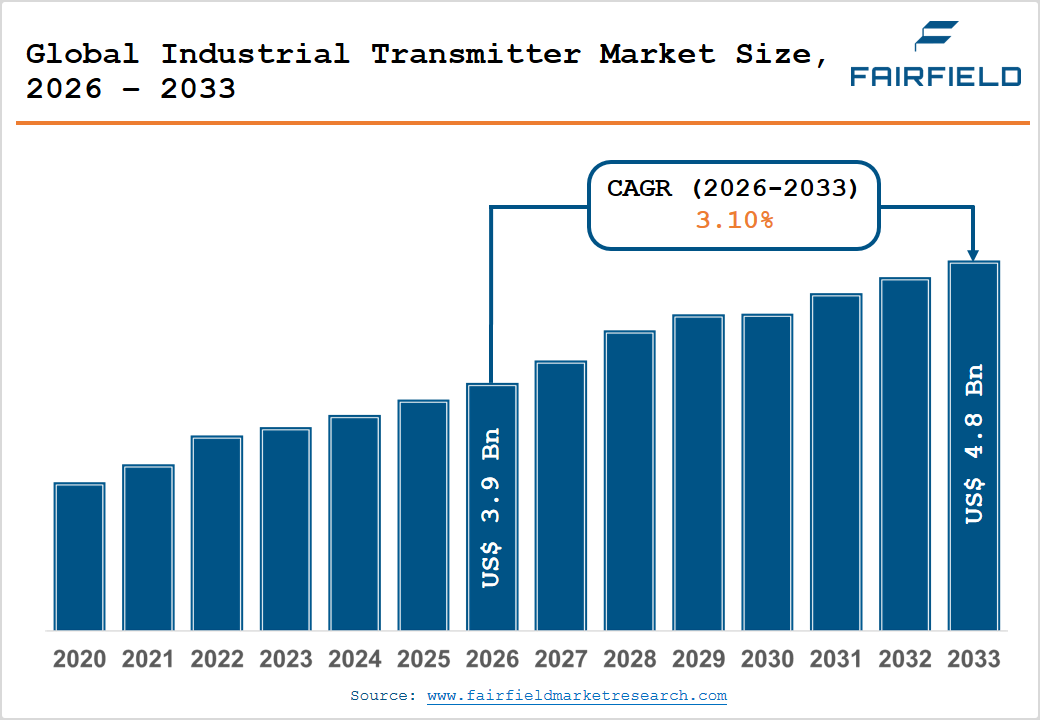
- The global Industrial Transmitter Market size is likely to be valued at US$ 3.9 Billion in 2026 and is expected to reach US$ 4.8 Billion by 2033, growing at a CAGR of 3.10% during the forecast period from 2026 to 2033.
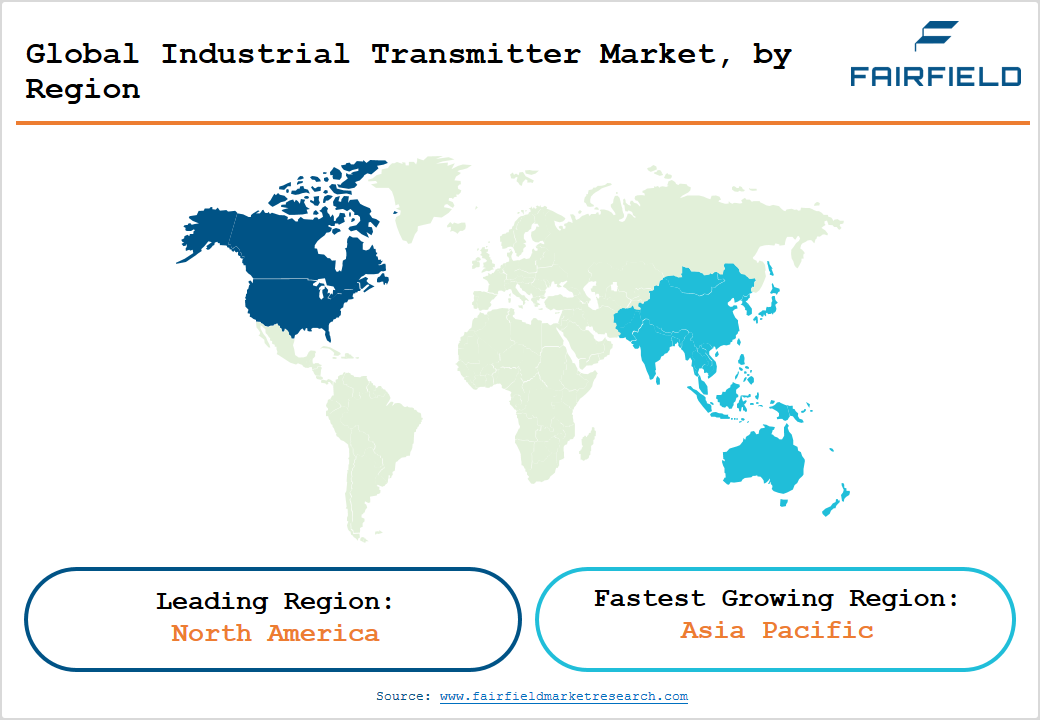
- North America dominates the industrial transmitter market with approximately 40% revenue share, anchored by the U.S. oil and gas sector, stringent OSHA/EPA process safety regulations, and a dense concentration of chemical manufacturing operations.
- Asia Pacific is the fastest-growing region, driven by China's chemical park investments, India's refinery expansions and National Water Mission, and rapid ASEAN industrial diversification creating broad-based transmitter demand.
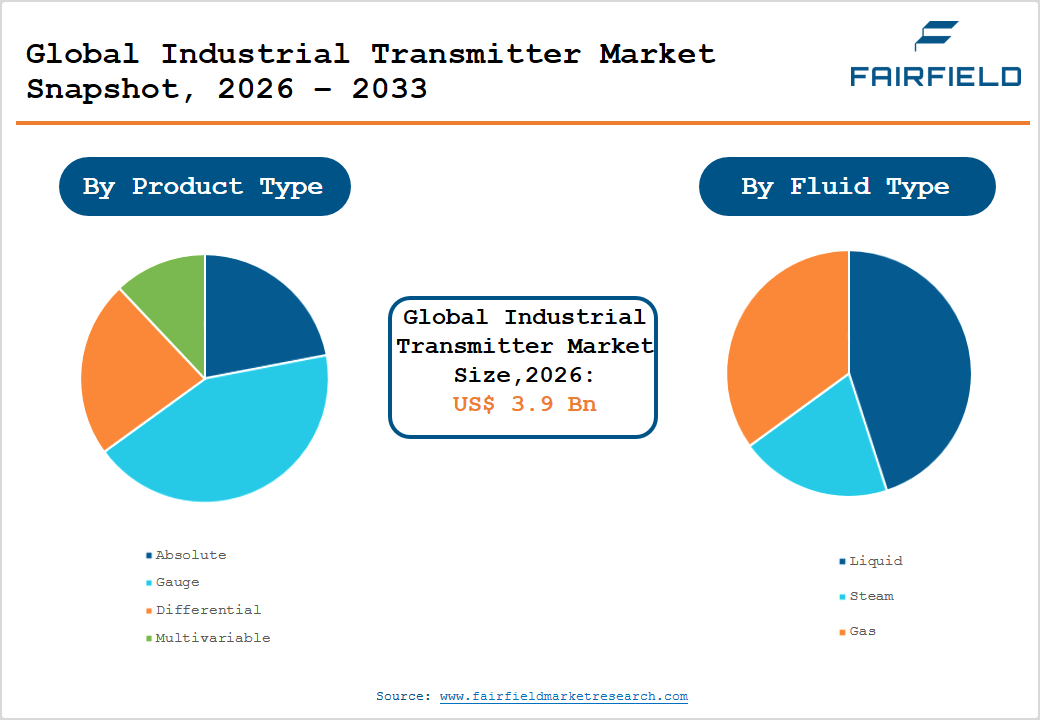
- Differential pressure transmitters lead the product type segment with approximately 38% market share, owing to their versatility in simultaneous flow, level, and pressure measurement applications across oil and gas, chemicals, and water sectors.
- Wireless industrial transmitters leveraging WirelessHART and ISA100.11a protocols represent the fastest-growing technology trend, offering 30-50% lower installation costs and enabling remote monitoring in previously inaccessible locations.
- IIoT-integrated wireless transmitter platforms enabling predictive maintenance and real-time process optimization represent the most significant commercial opportunity, with WirelessHART installations already exceeding 50 million field devices globally.
Market Dynamics
Market Growth Drivers
- Accelerating Industrial Automation and Process Control Adoption
The global shift toward automated process environments is a primary structural driver for the industrial transmitter market. Industrial transmitters including differential, gauge, and multivariable types are foundational components of distributed control systems (DCS) and programmable logic controllers (PLC), enabling continuous real-time monitoring of critical process parameters. According to the International Federation of Robotics (IFR), global industrial robot installations reached a record approximately 590,000 units in 2023, signaling the depth of automation investment in manufacturing industries worldwide. The oil and gas sector alone accounts for a significant share of transmitter demand, as operators deploy advanced pressure and flow transmitters to optimize hydrocarbon extraction, refining throughput, and pipeline integrity monitoring across upstream and downstream operations.
- Expansion of Smart Grid and Energy Infrastructure
The global transition toward modernized power generation and smart energy grids is generating sustained demand for industrial transmitters in utilities and energy applications. Power plants whether thermal, nuclear, or renewable rely extensively on pressure transmitters for steam line monitoring, differential transmitters for flow measurement in cooling circuits, and level transmitters for boiler drum management. The International Energy Agency (IEA) projects that global power sector investment will exceed trillions annually through 2030, encompassing new generation capacity and grid modernization initiatives. The rapid deployment of liquefied natural gas (LNG) terminals, hydrogen production facilities, and carbon capture systems further diversifies the application base for precision industrial transmitters in the global energy transition.
Market Restraints
- Cybersecurity Vulnerabilities in Connected Transmitter Networks
As industrial transmitters become increasingly networked through IIoT protocols and cloud-connected platforms, cybersecurity vulnerabilities have emerged as a significant market restraint. The U.S. Cybersecurity and Infrastructure Security Agency (CISA) documented a 25% year-on-year increase in cyberattacks targeting industrial control systems in 2023. Concerns over unauthorized access to critical process data and operational disruption are prompting end-users in regulated sectors including chemicals, nuclear power, and water utilities to delay deployment of networked transmitters or to incur substantial additional costs for cybersecurity hardening, effectively raising the total cost of ownership and dampening procurement velocity.
- High Calibration and Maintenance Requirements
Industrial transmitters require periodic calibration, verification, and recertification to maintain measurement accuracy within specified tolerances a process that is both time-intensive and costly, particularly in hazardous environments governed by standards such as IEC 61511 and ATEX/IECEx. For operators in remote or offshore installations, calibration logistics can represent a meaningful share of the lifecycle cost of a transmitter installation. This ongoing maintenance burden, combined with the skilled technician shortages reported across the process industries, can decelerate transmitter adoption and constrain replacement cycle velocity in certain end-user segments.
Market Opportunities
- Wireless Transmitter Adoption and IIoT Integration in Process Industries
The transition from wired to wireless industrial transmitters leveraging communication protocols such as WirelessHART and ISA100.11a represents one of the most significant near-term commercial opportunities in the industrial transmitter market. Wireless transmitters dramatically reduce installation costs and enable deployment in locations where cabling is impractical. The HART Communication Foundation reports that WirelessHART installations have surpassed 50 million field devices globally. As industries invest in IIoT-enabled predictive maintenance architectures, the demand for self-powered, low-maintenance wireless pressure and flow transmitters is projected to grow significantly, particularly in the oil and gas, water, and chemical sectors where remote monitoring is critical.
-
Asia Pacific Process Industry Expansion and Infrastructure Modernization
Asia Pacific's rapidly expanding chemical, pharmaceutical, food and beverage, and water treatment industries are creating a compelling demand opportunity for industrial transmitter manufacturers. China's massive investment in chemical industrial parks with over 50 national-level chemical industry parks under development and India's expanding refinery and petrochemical capacity under the Petroleum and Natural Gas Regulatory Board (PNGRB) framework are generating large-scale process instrumentation procurement. India's National Water Mission and the smart city program are also driving adoption of level and flow transmitters in urban water distribution networks. Companies offering localized technical support, application-specific transmitter configurations, and competitive lifecycle cost propositions are well-positioned to capture incremental share in this fastest-growing regional market through 2033.
Segmental Insights
- By Product Type Analysis
Among all product types, Differential pressure transmitters hold the leading position in the global industrial transmitter market, accounting for approximately 38% of total segment revenue. Differential pressure transmitters are the most versatile instruments in process measurement, serving simultaneously as flow meters, level gauges, and filter condition monitors. Their broad applicability across oil and gas, chemicals, power generation, and water treatment combined with mature product ecosystems and well-established installation standards underpins their market leadership. Key manufacturers including Emerson Electric Co. and Honeywell International Inc. continue to invest in differential transmitter product lines featuring enhanced turndown ratios and multivariable sensing capabilities.
- By Fluid Type Analysis
The Liquid fluid type segment commands the leading position in the industrial transmitter market, representing approximately 52% of total revenue. The dominance of the liquid segment reflects the vast range of industries that require precision measurement of liquid process streams from crude oil and refined petroleum products to water, wastewater, chemicals, and pharmaceutical fluids. Municipal water and wastewater utilities alone represent a major end-use base, with the World Health Organization (WHO) estimating that over 2.2 billion people lack access to safely managed drinking water a statistic driving accelerated investment in water treatment infrastructure and associated flow and level transmitter procurement globally. The chemical and pharmaceutical manufacturing sectors further reinforce liquid transmitter demand.
- By Measurement Application Analysis
Pressure measurement is the dominant application segment in the industrial transmitter market, accounting for approximately 45% of global revenue. Pressure transmitters are ubiquitous across virtually all process industries measuring gauge, absolute, and differential pressure in pipelines, vessels, reactors, and utility systems. Their criticality in process safety applications, including overpressure protection and safety instrumented systems (SIS), governed by IEC 61511 and ISA-84 standards, ensures regulatory-mandated deployment across oil and gas, chemicals, and nuclear power sectors. The oil and gas sector alone encompassing upstream wellheads, midstream pipelines, and downstream refineries represents the single largest end-use vertical for pressure transmitters, consolidating the segment's market leadership.
Regional Insights
- North America Industrial Transmitter Market Trends
North America leads the global industrial transmitter market with approximately 40% revenue share, anchored by U.S. position as the world's largest oil and gas producer and a global hub for advanced process manufacturing. The U.S. Energy Information Administration (EIA) reports that U.S. crude oil production consistently exceeds millions of barrels per day, requiring extensive pressure, flow, and level transmitter installations across wellheads, pipelines, and refining operations. The region's dense network of chemical manufacturing complexes particularly along the Gulf Coast further sustains transmitter procurement volumes.
Regulatory frameworks from the U.S. Occupational Safety and Health Administration (OSHA) and the U.S. EPA's Risk Management Program (RMP) mandate robust process measurement and monitoring in hazardous chemical operations, driving baseline transmitter demand. The CHIPS and Science Act and Inflation Reduction Act are catalyzing new semiconductor and clean energy facility construction, each requiring advanced process instrumentation, reinforcing North America's market leadership position.
- Europe Industrial Transmitter Market Trends
Europe is a mature, innovation-intensive market for industrial transmitters, with Germany serving as the epicenter of process instrumentation manufacturing and R&D. Germany's chemical industry, the largest in Europe and fourth largest globally, contributing over billions in annual output per the German Chemical Industry Association (VCI) is a cornerstone demand driver. U.K. and France sustain demand through their nuclear power and offshore oil and gas sectors, both of which require high-specification, safety-certified transmitter installations.
The EU Industrial Emissions Directive (IED) and the Seveso III Directive impose rigorous process monitoring and emergency shutdown requirements on chemical and petrochemical operators, underpinning mandated transmitter procurement. Spain's growing renewable energy sector including the largest solar installed capacity in continental Europe is emerging as a new demand source for transmitters in hydrogen production and energy storage facility process monitoring, aligned with the EU Green Deal's decarbonization agenda through 2050.
- Asia Pacific Industrial Transmitter Market Trends
Asia Pacific is the fastest-growing regional market for industrial transmitters, propelled by large-scale expansion in chemical manufacturing, oil refining, water infrastructure, and power generation across China, Japan, and India. China's ongoing investment in mega chemical industrial parks, coupled with its role as the world's largest refiner of crude oil, creates continuous transmitter procurement demand. Japan's sophisticated process industries particularly semiconductors, specialty chemicals, and pharmaceuticals require the highest-precision transmitters with narrow accuracy tolerances, sustaining demand for premium-tier instrumentation from global leaders.
India's rapid industrial expansion, supported by the Production Linked Incentive (PLI) scheme and growing investments in petroleum refining under companies such as Indian Oil Corporation (IOC) and Reliance Industries, is driving significant transmitter procurement. ASEAN nations including Vietnam, Indonesia, and Thailand are attracting diversified industrial investment, expanding the regional addressable market for process transmitters. The combination of manufacturing cost advantages, fast-growing domestic industrial bases, and infrastructure modernization programs positions Asia Pacific as the most dynamic growth region for the industrial transmitter market through 2033.
Competitive Landscape
The global industrial transmitter market is moderately consolidated, with a small group of multinational process automation companies commanding the majority of revenue. Leaders such as Emerson Electric Co., Honeywell International Inc., ABB Ltd., Siemens AG, and Endress+Hauser AG compete on the basis of measurement accuracy, functional safety certification, digital connectivity, and global service infrastructure. Key differentiators include investment in multivariable transmitter platforms, integration with cloud-based asset management systems, and SIL-rated (Safety Integrity Level) product portfolios. Strategic acquisitions, expansion in Asia Pacific service networks, and development of wireless and self-diagnostic transmitter platforms are prominent growth strategies across leading market participants.
Key Developments
- In January 2025, Emerson Electric Co. launched its Rosemount™ 3051S series with enhanced WirelessHART capabilities and extended diagnostics, targeting offshore oil and gas and chemical process applications requiring reduced maintenance intervention.
- In September 2024, ABB Ltd. introduced its next-generation 266 series multivariable pressure transmitter with integrated process temperature sensing, enabling simultaneous measurement of differential pressure, static pressure, and temperature in a single device for flow applications.
- In March 2024, Endress+Hauser AG announced a strategic expansion of its manufacturing and calibration center in India, enhancing local production capacity and regional service support for the fast-growing South Asian process instrumentation market.
Companies Covered in Industrial Transmitter Market
- Emerson Electric Co.
- Honeywell International Inc.
- Siemens AG
- ABB Ltd.
- Endress+Hauser AG
- Yokogawa Electric Corporation
- Schneider Electric SE
- Rockwell Automation Inc.
- KROHNE Group
- AMETEK Inc.
- Danfoss AS
- Omega Engineering Inc.
- Vega Grieshaber KG
- Keller AG für Druckmesstechnik
- Dwyer Instruments Inc.
Market Segmentation
By Product Type
- Absolute
- Gauge
- Differential
- Multivariable
By Fluid Type
- Liquid
- Steam
- Gas
By Measurement Application
- Flow
- Level
- Pressure
By Region
- North America
- Europe
- Asia Pacific
- Latin America
- Middle East & Africa
- Executive Summary
- Global Industrial Transmitter Market Snapshot
- Future Projections
- Key Market Trends
- Regional Snapshot, by Value, 2026
- Analyst Recommendations
- Market Overview
- Market Definitions and Segmentations
- Market Dynamics
- Drivers
- Restraints
- Market Opportunities
- Value Chain Analysis
- COVID-19 Impact Analysis
- Porter's Five Forces Analysis
- Impact of Russia-Ukraine Conflict
- PESTLE Analysis
- Regulatory Analysis
- Price Trend Analysis
- Current Prices and Future Projections, 2025-2033
- Price Impact Factors
- Global Industrial Transmitter Market Outlook, 2020 - 2033
- Global Industrial Transmitter Market Outlook, by Product Type, Value (US$ Bn), 2020-2033
- Absolute
- Gauge
- Differential
- Multivariable
- Global Industrial Transmitter Market Outlook, by Fluid Type, Value (US$ Bn), 2020-2033
- Liquid
- Steam
- Gas
- Global Industrial Transmitter Market Outlook, by Measurement Application, Value (US$ Bn), 2020-2033
- Flow
- Level
- Pressure
- Global Industrial Transmitter Market Outlook, by Region, Value (US$ Bn), 2020-2033
- North America
- Europe
- Asia Pacific
- Latin America
- Middle East & Africa
- Global Industrial Transmitter Market Outlook, by Product Type, Value (US$ Bn), 2020-2033
- North America Industrial Transmitter Market Outlook, 2020 - 2033
- North America Industrial Transmitter Market Outlook, by Product Type, Value (US$ Bn), 2020-2033
- Absolute
- Gauge
- Differential
- Multivariable
- North America Industrial Transmitter Market Outlook, by Fluid Type, Value (US$ Bn), 2020-2033
- Liquid
- Steam
- Gas
- North America Industrial Transmitter Market Outlook, by Measurement Application, Value (US$ Bn), 2020-2033
- Flow
- Level
- Pressure
- North America Industrial Transmitter Market Outlook, by Country, Value (US$ Bn), 2020-2033
- S. Industrial Transmitter Market Outlook, by Product Type, 2020-2033
- S. Industrial Transmitter Market Outlook, by Fluid Type, 2020-2033
- S. Industrial Transmitter Market Outlook, by Measurement Application, 2020-2033
- Canada Industrial Transmitter Market Outlook, by Product Type, 2020-2033
- Canada Industrial Transmitter Market Outlook, by Fluid Type, 2020-2033
- Canada Industrial Transmitter Market Outlook, by Measurement Application, 2020-2033
- BPS Analysis/Market Attractiveness Analysis
- North America Industrial Transmitter Market Outlook, by Product Type, Value (US$ Bn), 2020-2033
- Europe Industrial Transmitter Market Outlook, 2020 - 2033
- Europe Industrial Transmitter Market Outlook, by Product Type, Value (US$ Bn), 2020-2033
- Absolute
- Gauge
- Differential
- Multivariable
- Europe Industrial Transmitter Market Outlook, by Fluid Type, Value (US$ Bn), 2020-2033
- Liquid
- Steam
- Gas
- Europe Industrial Transmitter Market Outlook, by Measurement Application, Value (US$ Bn), 2020-2033
- Flow
- Level
- Pressure
- Europe Industrial Transmitter Market Outlook, by Country, Value (US$ Bn), 2020-2033
- Germany Industrial Transmitter Market Outlook, by Product Type, 2020-2033
- Germany Industrial Transmitter Market Outlook, by Fluid Type, 2020-2033
- Germany Industrial Transmitter Market Outlook, by Measurement Application, 2020-2033
- Italy Industrial Transmitter Market Outlook, by Product Type, 2020-2033
- Italy Industrial Transmitter Market Outlook, by Fluid Type, 2020-2033
- Italy Industrial Transmitter Market Outlook, by Measurement Application, 2020-2033
- France Industrial Transmitter Market Outlook, by Product Type, 2020-2033
- France Industrial Transmitter Market Outlook, by Fluid Type, 2020-2033
- France Industrial Transmitter Market Outlook, by Measurement Application, 2020-2033
- K. Industrial Transmitter Market Outlook, by Product Type, 2020-2033
- K. Industrial Transmitter Market Outlook, by Fluid Type, 2020-2033
- K. Industrial Transmitter Market Outlook, by Measurement Application, 2020-2033
- Spain Industrial Transmitter Market Outlook, by Product Type, 2020-2033
- Spain Industrial Transmitter Market Outlook, by Fluid Type, 2020-2033
- Spain Industrial Transmitter Market Outlook, by Measurement Application, 2020-2033
- Russia Industrial Transmitter Market Outlook, by Product Type, 2020-2033
- Russia Industrial Transmitter Market Outlook, by Fluid Type, 2020-2033
- Russia Industrial Transmitter Market Outlook, by Measurement Application, 2020-2033
- Rest of Europe Industrial Transmitter Market Outlook, by Product Type, 2020-2033
- Rest of Europe Industrial Transmitter Market Outlook, by Fluid Type, 2020-2033
- Rest of Europe Industrial Transmitter Market Outlook, by Measurement Application, 2020-2033
- BPS Analysis/Market Attractiveness Analysis
- Europe Industrial Transmitter Market Outlook, by Product Type, Value (US$ Bn), 2020-2033
- Asia Pacific Industrial Transmitter Market Outlook, 2020 - 2033
- Asia Pacific Industrial Transmitter Market Outlook, by Product Type, Value (US$ Bn), 2020-2033
- Absolute
- Gauge
- Differential
- Multivariable
- Asia Pacific Industrial Transmitter Market Outlook, by Fluid Type, Value (US$ Bn), 2020-2033
- Liquid
- Steam
- Gas
- Asia Pacific Industrial Transmitter Market Outlook, by Measurement Application, Value (US$ Bn), 2020-2033
- Flow
- Level
- Pressure
- Asia Pacific Industrial Transmitter Market Outlook, by Country, Value (US$ Bn), 2020-2033
- China Industrial Transmitter Market Outlook, by Product Type, 2020-2033
- China Industrial Transmitter Market Outlook, by Fluid Type, 2020-2033
- China Industrial Transmitter Market Outlook, by Measurement Application, 2020-2033
- Japan Industrial Transmitter Market Outlook, by Product Type, 2020-2033
- Japan Industrial Transmitter Market Outlook, by Fluid Type, 2020-2033
- Japan Industrial Transmitter Market Outlook, by Measurement Application, 2020-2033
- South Korea Industrial Transmitter Market Outlook, by Product Type, 2020-2033
- South Korea Industrial Transmitter Market Outlook, by Fluid Type, 2020-2033
- South Korea Industrial Transmitter Market Outlook, by Measurement Application, 2020-2033
- India Industrial Transmitter Market Outlook, by Product Type, 2020-2033
- India Industrial Transmitter Market Outlook, by Fluid Type, 2020-2033
- India Industrial Transmitter Market Outlook, by Measurement Application, 2020-2033
- Southeast Asia Industrial Transmitter Market Outlook, by Product Type, 2020-2033
- Southeast Asia Industrial Transmitter Market Outlook, by Fluid Type, 2020-2033
- Southeast Asia Industrial Transmitter Market Outlook, by Measurement Application, 2020-2033
- Rest of SAO Industrial Transmitter Market Outlook, by Product Type, 2020-2033
- Rest of SAO Industrial Transmitter Market Outlook, by Fluid Type, 2020-2033
- Rest of SAO Industrial Transmitter Market Outlook, by Measurement Application, 2020-2033
- BPS Analysis/Market Attractiveness Analysis
- Asia Pacific Industrial Transmitter Market Outlook, by Product Type, Value (US$ Bn), 2020-2033
- Latin America Industrial Transmitter Market Outlook, 2020 - 2033
- Latin America Industrial Transmitter Market Outlook, by Product Type, Value (US$ Bn), 2020-2033
- Absolute
- Gauge
- Differential
- Multivariable
- Latin America Industrial Transmitter Market Outlook, by Fluid Type, Value (US$ Bn), 2020-2033
- Liquid
- Steam
- Gas
- Latin America Industrial Transmitter Market Outlook, by Measurement Application, Value (US$ Bn), 2020-2033
- Flow
- Level
- Pressure
- Latin America Industrial Transmitter Market Outlook, by Country, Value (US$ Bn), 2020-2033
- Brazil Industrial Transmitter Market Outlook, by Product Type, 2020-2033
- Brazil Industrial Transmitter Market Outlook, by Fluid Type, 2020-2033
- Brazil Industrial Transmitter Market Outlook, by Measurement Application, 2020-2033
- Mexico Industrial Transmitter Market Outlook, by Product Type, 2020-2033
- Mexico Industrial Transmitter Market Outlook, by Fluid Type, 2020-2033
- Mexico Industrial Transmitter Market Outlook, by Measurement Application, 2020-2033
- Argentina Industrial Transmitter Market Outlook, by Product Type, 2020-2033
- Argentina Industrial Transmitter Market Outlook, by Fluid Type, 2020-2033
- Argentina Industrial Transmitter Market Outlook, by Measurement Application, 2020-2033
- Rest of LATAM Industrial Transmitter Market Outlook, by Product Type, 2020-2033
- Rest of LATAM Industrial Transmitter Market Outlook, by Fluid Type, 2020-2033
- Rest of LATAM Industrial Transmitter Market Outlook, by Measurement Application, 2020-2033
- BPS Analysis/Market Attractiveness Analysis
- Latin America Industrial Transmitter Market Outlook, by Product Type, Value (US$ Bn), 2020-2033
- Middle East & Africa Industrial Transmitter Market Outlook, 2020 - 2033
- Middle East & Africa Industrial Transmitter Market Outlook, by Product Type, Value (US$ Bn), 2020-2033
- Absolute
- Gauge
- Differential
- Multivariable
- Middle East & Africa Industrial Transmitter Market Outlook, by Fluid Type, Value (US$ Bn), 2020-2033
- Liquid
- Steam
- Gas
- Middle East & Africa Industrial Transmitter Market Outlook, by Measurement Application, Value (US$ Bn), 2020-2033
- Flow
- Level
- Pressure
- Middle East & Africa Industrial Transmitter Market Outlook, by Country, Value (US$ Bn), 2020-2033
- GCC Industrial Transmitter Market Outlook, by Product Type, 2020-2033
- GCC Industrial Transmitter Market Outlook, by Fluid Type, 2020-2033
- GCC Industrial Transmitter Market Outlook, by Measurement Application, 2020-2033
- South Africa Industrial Transmitter Market Outlook, by Product Type, 2020-2033
- South Africa Industrial Transmitter Market Outlook, by Fluid Type, 2020-2033
- South Africa Industrial Transmitter Market Outlook, by Measurement Application, 2020-2033
- Egypt Industrial Transmitter Market Outlook, by Product Type, 2020-2033
- Egypt Industrial Transmitter Market Outlook, by Fluid Type, 2020-2033
- Egypt Industrial Transmitter Market Outlook, by Measurement Application, 2020-2033
- Nigeria Industrial Transmitter Market Outlook, by Product Type, 2020-2033
- Nigeria Industrial Transmitter Market Outlook, by Fluid Type, 2020-2033
- Nigeria Industrial Transmitter Market Outlook, by Measurement Application, 2020-2033
- Rest of Middle East Industrial Transmitter Market Outlook, by Product Type, 2020-2033
- Rest of Middle East Industrial Transmitter Market Outlook, by Fluid Type, 2020-2033
- Rest of Middle East Industrial Transmitter Market Outlook, by Measurement Application, 2020-2033
- BPS Analysis/Market Attractiveness Analysis
- Middle East & Africa Industrial Transmitter Market Outlook, by Product Type, Value (US$ Bn), 2020-2033
- Competitive Landscape
- Company Vs Segment Heatmap
- Company Market Share Analysis, 2025
- Competitive Dashboard
- Company Profiles
- Emerson Electric Co.
- Company Overview
- Product Portfolio
- Financial Overview
- Business Strategies and Developments
- Honeywell International Inc.
- Siemens AG
- ABB Ltd.
- Endress+Hauser AG
- Yokogawa Electric Corporation
- Schneider Electric SE
- Rockwell Automation Inc.
- KROHNE Group
- AMETEK Inc.
- Danfoss AS
- Omega Engineering Inc.
- Emerson Electric Co.
- Appendix
- Research Methodology
- Report Assumptions
- Acronyms and Abbreviations
|
BASE YEAR |
HISTORICAL DATA |
FORECAST PERIOD |
UNITS |
|||
 |
2025 |
 |
2019 - 2024 |
 |
2026 - 2033 |
Value: US$ Million |
|
REPORT FEATURES |
DETAILS |
|
By Product Type Coverage |
|
|
By Fluid Type Coverage |
|
|
Geographical Coverage |
|
|
Leading Companies |
|
|
Report Highlights |
Key Market Indicators, Macro-micro economic impact analysis, Technological Roadmap, Key Trends, Driver, Restraints, and Future Opportunities & Revenue Pockets, Porter’s 5 Forces Analysis, Historical Trend (2019-2024), Market Estimates and Forecast, Market Dynamics, Industry Trends, Competition Landscape, Category, Region, Country-wise Trends & Analysis, COVID-19 Impact Analysis (Demand and Supply Chain) |
Our Research Methodology
Considering the volatility of business today, traditional approaches to strategizing a game plan can be unfruitful if not detrimental. True ambiguity is no way to determine a forecast. A myriad of predetermined factors must be accounted for such as the degree of risk involved, the magnitude of circumstances, as well as conditions or consequences that are not known or unpredictable. To circumvent binary views that cast uncertainty, the application of market research intelligence to strategically posture, move, and enable actionable outcomes is necessary.
View Methodology
Quality Assured
Rigorous Validation Process

Confidentiality Assured
End-to-end Data Security

Custom Research Services
Tailored To Your Objectives
FAQs
The Industrial Transmitter Market size is US$ 3.9 Billion in 2026.
The Industrial Transmitter Market is projected 3.10% CAGR by 2033.
The Industrial Transmitter Market growth drivers include automation/IIoT integration, regulatory compliance for process safety, and energy sector modernization.
North America is the dominating region for Industrial Transmitter Market.
Emerson Electric, Honeywell, Siemens, ABB, and Endress+Hauser are some leading industry players in the Industrial Transmitter Market.
Related Reports
Built To Rent Residential Market Insights, Competitive Landscape, and Market Forecast 2033
Built to Rent Residential Market to reach USD 76.26 Bn by 2033, growing at 8.9% CAGR, driven by rental demand, housing affordability, and institutional investment.
Building Inspection Services Market Insights, Competitive Landscape, and Market Forecast 2033
Building Inspection Services Market to reach USD 23.93 Bn by 2033, growing at 6.7% CAGR, driven by aging buildings, safety regulations, and real estate demand.
Transformer Protection Equipment Market Forecast - 2033
The global transformer protection equipment market is set to reach US$ 8.66 billion by 2033, growing at a 6.4% CAGR from 2026-2033
Industrial Demand Response Management Systems Market Forecast - 2033
The global industrial demand response management systems market is set to reach US$ 6.81 billion by 2033, growing at an 11.4% CAGR from 2026-2033
Embroidery Machine Market Insights, Competitive Landscape, and Market Forecast 2033
The embroidery machines market will grow from USD 1.85 billion in 2026 to USD 2.64 billion by 2033, driven by customized and branded apparel demand.
Electric Vehicle CNC Turning Centers Market Insights, Competitive Landscape, and Market Forecast 2033
The electric vehicle CNC turning centers market is projected to rise from USD 1.35 billion in 2026 to USD 2.60 billion by 2033, driven by rising EV production.