



Metal Replacement Market
Global Metal Replacement Industry Analysis, Size, Share, Growth, Trends, and Forecast 2026-2033 – (By Product Type, By End-Use, By Geographic Coverage and By Company)
Metal Replacement Market Size, Share, and Growth Forecast 2026 - 2033
Key Market Highlights
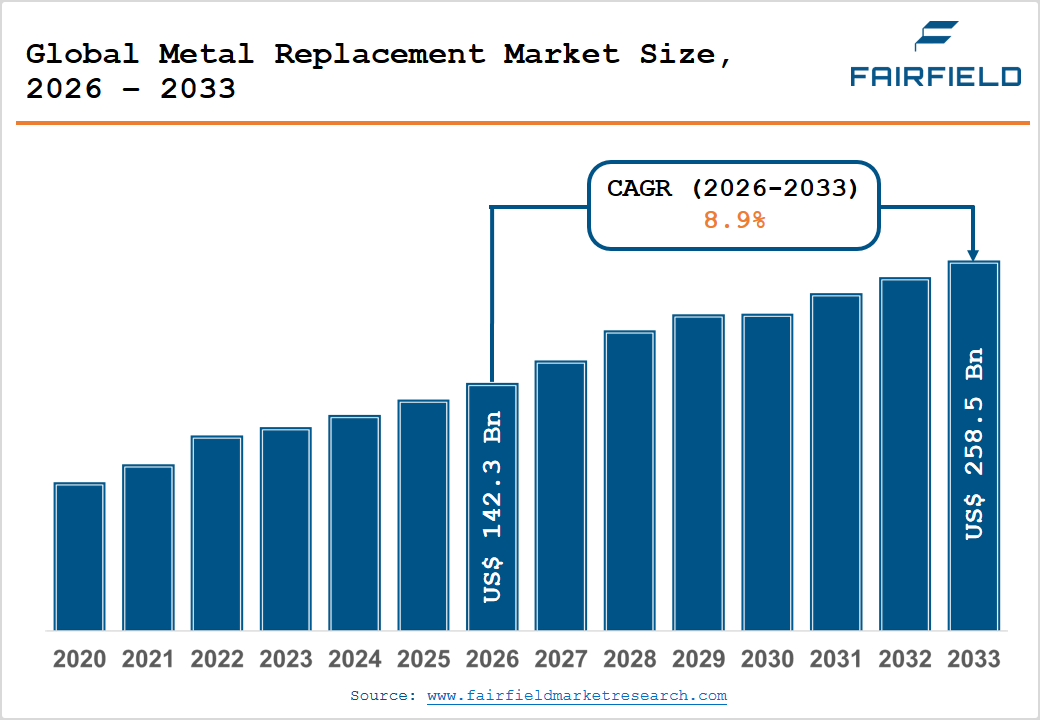
- The global Metal Replacement market size is likely to be valued at US$ 142.3 Billion in 2026 and is expected to reach US$ 258.5 Billion by 2033, growing at a CAGR of 8.90% during the forecast period from 2026 to 2033.
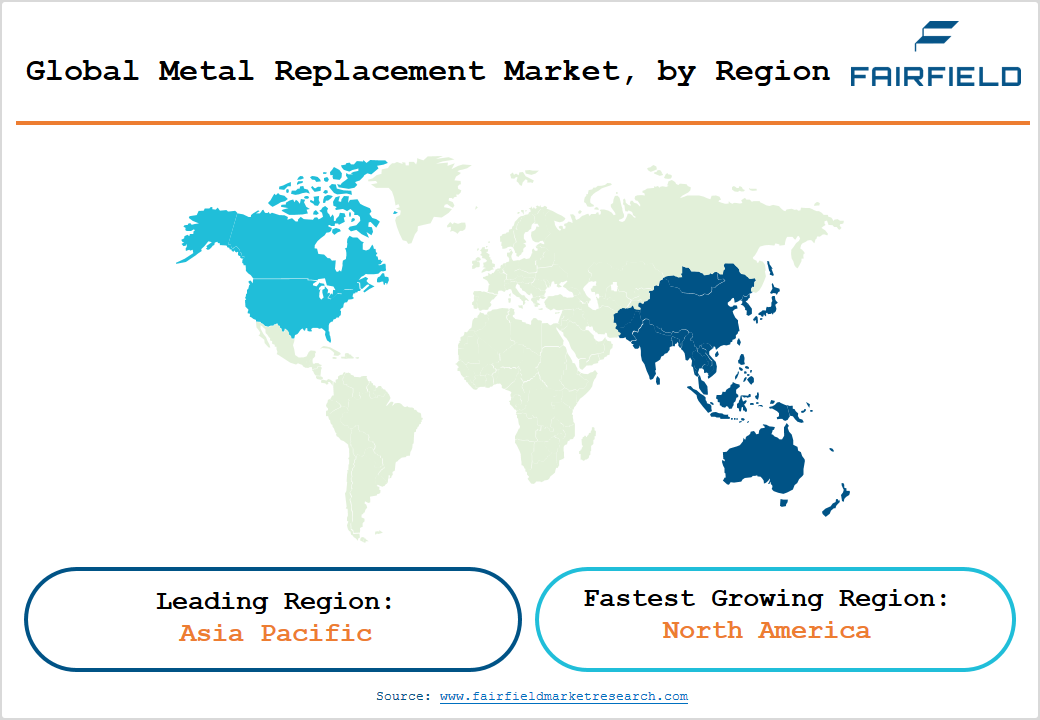
- Leading Region Market: Asia Pacific leads the global metal replacement market with approximately 33% revenue share in 2026, driven by China's dominance in automotive and EV manufacturing and Japan's technological leadership in advanced engineering plastics and carbon fiber composites.
- Fastest Growing Region Market: North America is the fastest growing regional market, propelled by substantial S. DOE investment in lightweight materials R&D, rapid EV adoption by leading OEMs, and advanced composites integration by major aerospace and defense manufacturers.
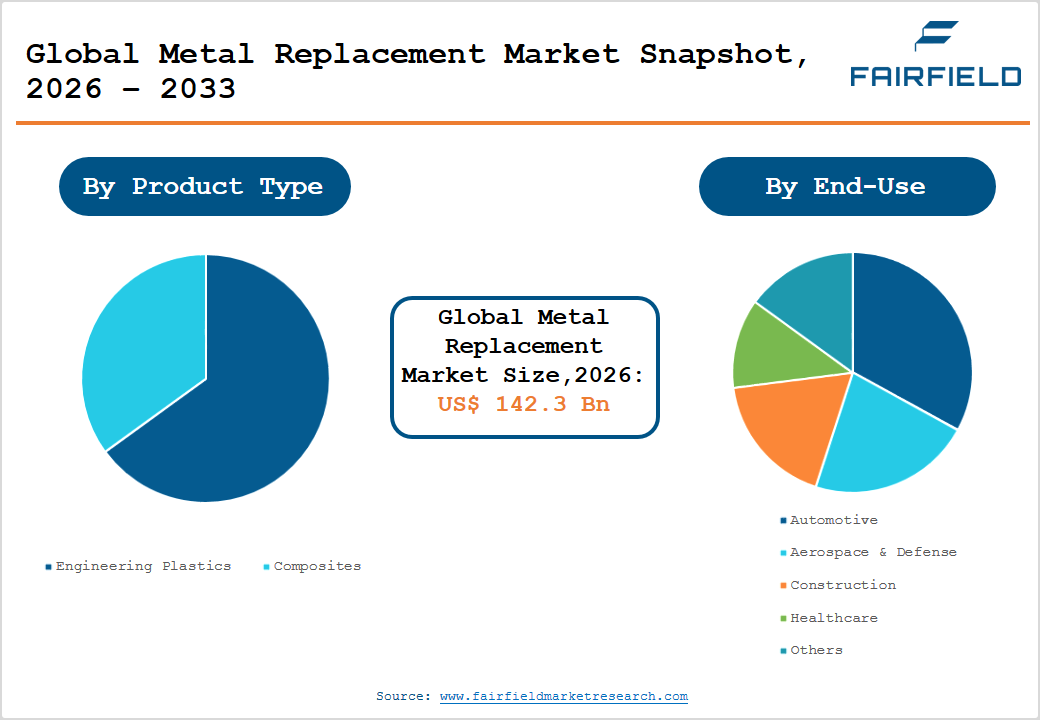
- Dominant Product Segment: Engineering plastics is the dominant product type segment, commanding approximately 59% of market share in 2026, owing to their versatility, cost-effectiveness, and seamless compatibility with high-volume injection molding and extrusion manufacturing processes.
- Fastest Growing End-use Segment: The automotive end-use segment is experiencing the strongest growth, fueled by EV-driven lightweighting imperatives and the accelerating integration of composites and engineering thermoplastics by global OEMs including Volkswagen, Toyota, and BMW.
- Key Market Opportunity: EV manufacturers seek advanced lightweight composites and engineering plastics to offset battery weight, with the IEA projecting EVs to account for over 60% of new global car sales by 2030.
Market Dynamics
Market Growth Drivers
- Stringent Fuel Efficiency and Emission Norms Accelerating Material Substitution
Regulatory pressure from governments worldwide to curtail vehicular emissions is among the most powerful catalysts for the metal replacement market. The European Union's CO₂ emission target of 95 g/km for passenger cars, codified under Regulation (EU) 2019/631, has compelled automotive OEMs to significantly reduce vehicle weight. Replacing conventional metals such as steel and aluminum with engineering plastics or fiber-reinforced composites can reduce component weight by 30% to 60%, directly translating to lower fuel consumption and reduced tailpipe emissions. The U.S. Corporate Average Fuel Economy (CAFE) standards, which set a fleet-wide target of approximately 49 miles per gallon by 2026, further strengthen this momentum. As automotive manufacturers race to meet these benchmarks, adoption of advanced polymer composites and thermoplastics is rapidly accelerating across structural and non-structural vehicle components, underpinning consistent long-term market demand.
- Growing Adoption of Advanced Composites in Aerospace & Defense
The aerospace and defense sector is a pivotal growth driver for the metal replacement market, given its uncompromising demand for materials offering high strength-to-weight ratios, fatigue resistance, and dimensional stability. Carbon fiber-reinforced polymers (CFRPs) and glass fiber-reinforced composites are progressively replacing aluminum and titanium in aircraft fuselages, wings, and interior components. According to Airbus, composite materials account for approximately 53% of the total structural weight of the A350 XWB aircraft a transformative shift from earlier-generation aircraft that relied almost entirely on metals. Similarly, Boeing's 787 Dreamliner incorporates composites in approximately 50% of its structure. With global air passenger traffic projected to double by 2040 per the International Air Transport Association (IATA), robust new aircraft orders are expected to sustain strong demand for advanced metal replacement materials throughout the forecast period.
Market Restraints
- High Material and Processing Costs Limiting Widespread Adoption
Despite their superior performance profile, advanced composites and high-performance engineering plastics carry considerably higher material and processing costs compared to conventional metals. For instance, carbon fiber a critical input in composite manufacturing costs approximately US$ 15-25 per kg, compared to structural steel at roughly US$ 0.5-1 per kg. This significant cost gap creates a persistent barrier, particularly in cost-sensitive sectors such as construction and mass-market consumer goods. Specialized manufacturing processes including resin transfer molding (RTM) and autoclave curing require substantial capital investment, further deterring small and medium-sized manufacturers from transitioning to metal replacement materials and constraining overall market penetration.
- Technical and Regulatory Challenges in Structural Applications
Metal replacement in structural and load-bearing applications continues to encounter technical hurdles related to material certification, long-term durability testing, and recyclability. Regulatory bodies such as the Federal Aviation Administration (FAA) and the European Union Aviation Safety Agency (EASA) mandate extensive testing and certification protocols for composite components used in commercial aircraft, extending development timelines and amplifying R&D costs. Additionally, the recyclability of thermoset composites remains technically limited compared to metals a growing concern given that the EU End-of-Life Vehicle (ELV) Directive requires 95% of vehicle weight to be recoverable or recyclable, creating compliance challenges for composite-intensive vehicle designs.
Market Opportunities
- Electrification of Vehicles Creating New Demand for Lightweight Metal Replacement Materials
The global electric vehicle (EV) transition presents an extraordinary opportunity for the metal replacement market. Battery packs in EVs typically add 300-600 kg of weight, compelling manufacturers to aggressively lightweight vehicle bodies, chassis, and structural components through advanced materials substitution. According to the International Energy Agency (IEA), global EV sales surpassed 14 million units in 2023 and are projected to represent over 60% of new car sales globally by 2030. This structural shift is generating unprecedented demand for high-performance engineering plastics and fiber-reinforced composites as substitutes for steel and aluminum in battery enclosures, underbody shields, and body panels. Companies developing tailored thermoplastic composites for EV platforms are exceptionally well-positioned to capitalize on this large and accelerating demand wave in the metal replacement ecosystem.
- Additive Manufacturing Unlocking Complex Composite Geometries
The rapid advancement of additive manufacturing (3D printing) technologies is transforming the economics of composite and polymer-based metal replacement. Industrial-scale 3D printing platforms now support high-performance polymers such as PEEK (polyether ether ketone), PEKK, and carbon fiber-reinforced nylons, enabling production of complex, topology-optimized structures that are unachievable via traditional metal-forming methods. According to a Wohlers Associates industry report, the global additive manufacturing industry exceeded US$ 18 billion in 2022 and continues expanding at double-digit rates. This technology is progressively reducing per-unit production costs for customized composite parts, making metal replacement more economically viable across medical devices, aerospace, and industrial machinery substantially broadening the addressable base for metal replacement market participants.
Segmental Insights
- Product Type Analysis
Engineering plastics represent the leading segment in the metal replacement market by product type, commanding approximately 59% of total market share in 2026. This dominance is underpinned by the versatility, cost-efficiency, and processability of engineering plastics such as polyamide (PA), polycarbonate (PC), polyphenylene sulfide (PPS), and polybutylene terephthalate (PBT). These materials are widely deployed across automotive interiors, electronic housings, industrial components, and consumer goods as direct substitutes for zinc, aluminum, and steel castings, engineering thermoplastics account for a significant and growing share of total polymer consumption in Europe. Their compatibility with conventional manufacturing processes particularly injection molding and extrusion combined with ongoing improvements in heat resistance and mechanical properties, continues to reinforce engineering plastics as the preferred material category for metal substitution across diverse end-use industries globally.
- End-Use Analysis
The automotive industry is the dominant segment in the metal replacement market by end-use, holding approximately 36% of total market share in 2026. Automakers are progressively integrating engineering plastics and composites into powertrain components, exterior body panels, structural elements, and interior systems to meet stringent weight reduction targets. The European Automobile Manufacturers’ Association (ACEA) reports that a modern passenger vehicle incorporates over 100 kg of plastics and composites on average a figure expected to rise substantially with accelerating electrification. The dual pressure of CO₂ emission regulations and consumer demand for enhanced fuel economy and EV range is compelling OEMs globally to intensify material substitution initiatives. Leading automakers including Volkswagen, Toyota, and BMW have publicly committed to extensive use of lightweight composites in next-generation vehicle platforms, cementing automotive's leadership in the metal replacement end-use landscape.
Regional Insights
- North America Metal Replacement Trends
North America is the fastest growing region in the metal replacement market, driven by robust investment in electric vehicles, aerospace manufacturing, and defense modernization programs. The U.S. Department of Energy (DOE) has committed over US$ 3 billion through its Vehicle Technologies Office to advance lightweight materials research and development, directly supporting metal replacement innovation and commercialization. Major OEMs such as Ford, General Motors, and Tesla are aggressively adopting aluminum alloys, composites, and engineering plastics to reduce vehicle curb weight and extend EV range, creating significant pull-through demand.
The United States is also home to a dynamic aerospace manufacturing ecosystem. Companies including Boeing, Lockheed Martin, and Northrop Grumman are at the forefront of integrating advanced composite materials into next-generation aircraft and defense platforms. The strong presence of tier-1 material innovators and a supportive policy environment including NASA's Advanced Composites Project alongside well-developed R&D infrastructure, further accelerates North America's growth trajectory and positions the region as a global leader in metal replacement material innovation.
- Europe Metal Replacement Trends
Europe represents a mature yet steadily advancing market for metal replacement materials, driven by some of the world's most rigorous environmental and sustainability mandates. Germany, home to premier automotive OEMs including Volkswagen, BMW, and Mercedes-Benz, is the largest consumer of advanced polymers and composites for metal replacement in the region. The EU Green Deal and associated Fit for 55 legislative package mandate drastic reductions in carbon emissions, compelling automakers to integrate lightweight materials at an accelerating pace throughout vehicle development cycles.
France, Spain, and the United Kingdom are significant contributors to the European aerospace composite market, with Airbus production centers across these nations serving as key demand anchors. Solvay S.A. and the European operations of Toray Industries play pivotal roles in supplying specialized thermoplastic composites to the region. Regulatory harmonization through REACH (Registration, Evaluation, Authorisation and Restriction of Chemicals) compliance frameworks continues to shape material innovation trends, ensuring that metal replacement materials meet rigorous safety and environmental standards across the European single market.
- Asia Pacific Metal Replacement Trends
Asia Pacific is the leading region in the global metal replacement market, accounting for approximately 33% of total market share in 2026. The region's dominance is attributable to its vast automotive manufacturing base, rapidly expanding aerospace industry, and government-led infrastructure development programs. China is the single largest national market for metal replacement materials, underpinned by its status as the world's largest automotive producer and a global epicenter of EV manufacturing. China Jushi Co. Ltd. and other domestic players are scaling fiberglass composite production significantly to satisfy surging domestic and export demand from automotive and construction end-users.
Japan is a recognized technology leader in advanced engineering plastics and carbon fiber, with companies such as Toray Industries, Asahi Kasei Corporation, and Mitsubishi Chemical Group driving continuous material innovation. India is emerging as a high-growth market, supported by its expanding automotive sector and the government's Production Linked Incentive (PLI) scheme for advanced chemistry cell batteries, which is catalyzing EV production and associated demand for lightweight metal replacement solutions. ASEAN nations, including Thailand, Vietnam, and Indonesia, are also gaining traction as automotive manufacturing hubs, further reinforcing Asia Pacific's market leadership position through the forecast period.
Competitive Landscape
The global metal replacement market exhibits a moderately consolidated structure, with a handful of multinational chemical and advanced materials companies commanding significant shares through diversified product portfolios and global manufacturing footprints. Key players including BASF SE, DuPont de Nemours Inc., Solvay S.A., Toray Industries Inc., and Covestro AG pursue strategies centered on R&D investment, strategic partnerships with automotive OEMs and aerospace Tier-1 suppliers, and capacity expansions in high-growth regions. Competitive differentiation is increasingly driven by material performance metrics (heat resistance, tensile strength, and chemical resistance), sustainability credentials (bio-based and recyclable polymers), and application-specific engineering support. Smaller specialized players compete effectively in niche segments such as medical-grade composites, defense-grade materials, and customized thermoplastic solutions.
Key Market Developments
- March 2025: Toray Industries Inc. announced the expansion of its carbon fiber production capacity in the United States, targeting surging demand from the EV and aerospace sectors, with a planned capital investment of approximately US$ 300 million to increase annual output at its South Carolina facility.
- September 2024: Covestro AG launched a new line of bio-attributed polycarbonate materials under its Makrolon® RE brand, aimed at automotive OEMs seeking sustainable metal replacement solutions aligned with EU Green Deal decarbonization objectives and circular economy commitments.
- June 2024: BASF SE unveiled its next-generation Ultramid® Advanced N polyamide grades specifically engineered for high-temperature automotive powertrain components, offering up to 40% weight reduction over conventional aluminum die castings while meeting stringent thermal and chemical resistance requirements.
Companies Covered in Metal Replacement Market
- BASF SE
- DuPont de Nemours Inc.
- Solvay S.A.
- Toray Industries Inc.
- Celanese Corporation
- SGL Carbon SE
- Asahi Kasei Corporation
- China Jushi Co. Ltd.
- DOMO Chemicals GmbH
- Victrex plc
- Covestro AG
- Mitsubishi Chemical Group Corporation
- Owens Corning
- K. Industries Inc.
- Teijin Limited
- Hexcel Corporation
- Lanxess AG
- Evonik Industries AG
- SABIC (Saudi Basic Industries Corporation)
- Sika AG
Market Segmentation
By Product Type
- Engineering Plastics
- Composites
By End-Use
- Automotive
- Aerospace & Defense
- Construction
- Healthcare
Regions
- North America
- Europe
- Asia Pacific
- Latin America
- Middle East & Africa
- Executive Summary
- Global Metal Replacement Market Snapshot
- Future Projections
- Key Market Trends
- Regional Snapshot, by Value, 2026
- Analyst Recommendations
- Market Overview
- Market Definitions and Segmentations
- Market Dynamics
- Drivers
- Restraints
- Market Opportunities
- Value Chain Analysis
- COVID-19 Impact Analysis
- Porter's Five Forces Analysis
- Impact of Russia-Ukraine Conflict
- PESTLE Analysis
- Regulatory Analysis
- Price Trend Analysis
- Current Prices and Future Projections, 2025-2033
- Price Impact Factors
- Global Metal Replacement Market Outlook, 2020 - 2033
- Global Metal Replacement Market Outlook, by Product Type, Value (US$ Bn), 2020-2033
- Engineering Plastics
- Composites
- Global Metal Replacement Market Outlook, by End-Use, Value (US$ Bn), 2020-2033
- Automotive
- Aerospace & Defense
- Construction
- Healthcare
- Others
- Global Metal Replacement Market Outlook, by Region, Value (US$ Bn), 2020-2033
- North America
- Europe
- Asia Pacific
- Latin America
- Middle East & Africa
- Global Metal Replacement Market Outlook, by Product Type, Value (US$ Bn), 2020-2033
- North America Metal Replacement Market Outlook, 2020 - 2033
- North America Metal Replacement Market Outlook, by Product Type, Value (US$ Bn), 2020-2033
- Engineering Plastics
- Composites
- North America Metal Replacement Market Outlook, by End-Use, Value (US$ Bn), 2020-2033
- Automotive
- Aerospace & Defense
- Construction
- Healthcare
- Others
- North America Metal Replacement Market Outlook, by Country, Value (US$ Bn), 2020-2033
- U.S. Metal Replacement Market Outlook, by Product Type, 2020-2033
- U.S. Metal Replacement Market Outlook, by End-Use, 2020-2033
- Canada Metal Replacement Market Outlook, by Product Type, 2020-2033
- Canada Metal Replacement Market Outlook, by End-Use, 2020-2033
- BPS Analysis/Market Attractiveness Analysis
- North America Metal Replacement Market Outlook, by Product Type, Value (US$ Bn), 2020-2033
- Europe Metal Replacement Market Outlook, 2020 - 2033
- Europe Metal Replacement Market Outlook, by Product Type, Value (US$ Bn), 2020-2033
- Engineering Plastics
- Composites
- Europe Metal Replacement Market Outlook, by End-Use, Value (US$ Bn), 2020-2033
- Automotive
- Aerospace & Defense
- Construction
- Healthcare
- Others
- Europe Metal Replacement Market Outlook, by Country, Value (US$ Bn), 2020-2033
- Germany Metal Replacement Market Outlook, by Product Type, 2020-2033
- Germany Metal Replacement Market Outlook, by End-Use, 2020-2033
- Italy Metal Replacement Market Outlook, by Product Type, 2020-2033
- Italy Metal Replacement Market Outlook, by End-Use, 2020-2033
- France Metal Replacement Market Outlook, by Product Type, 2020-2033
- France Metal Replacement Market Outlook, by End-Use, 2020-2033
- U.K. Metal Replacement Market Outlook, by Product Type, 2020-2033
- U.K. Metal Replacement Market Outlook, by End-Use, 2020-2033
- Spain Metal Replacement Market Outlook, by Product Type, 2020-2033
- Spain Metal Replacement Market Outlook, by End-Use, 2020-2033
- Russia Metal Replacement Market Outlook, by Product Type, 2020-2033
- Russia Metal Replacement Market Outlook, by End-Use, 2020-2033
- Rest of Europe Metal Replacement Market Outlook, by Product Type, 2020-2033
- Rest of Europe Metal Replacement Market Outlook, by End-Use, 2020-2033
- BPS Analysis/Market Attractiveness Analysis
- Europe Metal Replacement Market Outlook, by Product Type, Value (US$ Bn), 2020-2033
- Asia Pacific Metal Replacement Market Outlook, 2020 - 2033
- Asia Pacific Metal Replacement Market Outlook, by Product Type, Value (US$ Bn), 2020-2033
- Engineering Plastics
- Composites
- Asia Pacific Metal Replacement Market Outlook, by End-Use, Value (US$ Bn), 2020-2033
- Automotive
- Aerospace & Defense
- Construction
- Healthcare
- Others
- Asia Pacific Metal Replacement Market Outlook, by Country, Value (US$ Bn), 2020-2033
- China Metal Replacement Market Outlook, by Product Type, 2020-2033
- China Metal Replacement Market Outlook, by End-Use, 2020-2033
- Japan Metal Replacement Market Outlook, by Product Type, 2020-2033
- Japan Metal Replacement Market Outlook, by End-Use, 2020-2033
- South Korea Metal Replacement Market Outlook, by Product Type, 2020-2033
- South Korea Metal Replacement Market Outlook, by End-Use, 2020-2033
- India Metal Replacement Market Outlook, by Product Type, 2020-2033
- India Metal Replacement Market Outlook, by End-Use, 2020-2033
- Southeast Asia Metal Replacement Market Outlook, by Product Type, 2020-2033
- Southeast Asia Metal Replacement Market Outlook, by End-Use, 2020-2033
- Rest of SAO Metal Replacement Market Outlook, by Product Type, 2020-2033
- Rest of SAO Metal Replacement Market Outlook, by End-Use, 2020-2033
- BPS Analysis/Market Attractiveness Analysis
- Asia Pacific Metal Replacement Market Outlook, by Product Type, Value (US$ Bn), 2020-2033
- Latin America Metal Replacement Market Outlook, 2020 - 2033
- Latin America Metal Replacement Market Outlook, by Product Type, Value (US$ Bn), 2020-2033
- Engineering Plastics
- Composites
- Latin America Metal Replacement Market Outlook, by End-Use, Value (US$ Bn), 2020-2033
- Automotive
- Aerospace & Defense
- Construction
- Healthcare
- Others
- Latin America Metal Replacement Market Outlook, by Country, Value (US$ Bn), 2020-2033
- Brazil Metal Replacement Market Outlook, by Product Type, 2020-2033
- Brazil Metal Replacement Market Outlook, by End-Use, 2020-2033
- Mexico Metal Replacement Market Outlook, by Product Type, 2020-2033
- Mexico Metal Replacement Market Outlook, by End-Use, 2020-2033
- Argentina Metal Replacement Market Outlook, by Product Type, 2020-2033
- Argentina Metal Replacement Market Outlook, by End-Use, 2020-2033
- Rest of LATAM Metal Replacement Market Outlook, by Product Type, 2020-2033
- Rest of LATAM Metal Replacement Market Outlook, by End-Use, 2020-2033
- BPS Analysis/Market Attractiveness Analysis
- Latin America Metal Replacement Market Outlook, by Product Type, Value (US$ Bn), 2020-2033
- Middle East & Africa Metal Replacement Market Outlook, 2020 - 2033
- Middle East & Africa Metal Replacement Market Outlook, by Product Type, Value (US$ Bn), 2020-2033
- Engineering Plastics
- Composites
- Middle East & Africa Metal Replacement Market Outlook, by End-Use, Value (US$ Bn), 2020-2033
- Automotive
- Aerospace & Defense
- Construction
- Healthcare
- Others
- Middle East & Africa Metal Replacement Market Outlook, by Country, Value (US$ Bn), 2020-2033
- GCC Metal Replacement Market Outlook, by Product Type, 2020-2033
- GCC Metal Replacement Market Outlook, by End-Use, 2020-2033
- South Africa Metal Replacement Market Outlook, by Product Type, 2020-2033
- South Africa Metal Replacement Market Outlook, by End-Use, 2020-2033
- Egypt Metal Replacement Market Outlook, by Product Type, 2020-2033
- Egypt Metal Replacement Market Outlook, by End-Use, 2020-2033
- Nigeria Metal Replacement Market Outlook, by Product Type, 2020-2033
- Nigeria Metal Replacement Market Outlook, by End-Use, 2020-2033
- Rest of Middle East Metal Replacement Market Outlook, by Product Type, 2020-2033
- Rest of Middle East Metal Replacement Market Outlook, by End-Use, 2020-2033
- BPS Analysis/Market Attractiveness Analysis
- Middle East & Africa Metal Replacement Market Outlook, by Product Type, Value (US$ Bn), 2020-2033
- Competitive Landscape
- Company Vs Segment Heatmap
- Company Market Share Analysis, 2025
- Competitive Dashboard
- Company Profiles
- BASF
- Company Overview
- Product Portfolio
- Financial Overview
- Business Strategies and Developments
- DuPont de Nemours Inc.
- Solvay S.A.
- Toray Industries Inc.
- Celanese Corporation
- SGL Carbon SE
- Asahi Kasei Corporation
- China Jushi Co. Ltd.
- DOMO Chemicals GmbH
- Victrex pls
- Covestro AG
- Mitsubishi Chemical
- Owens Corning
- K. Industries Inc.
- BASF
- Appendix
- Research Methodology
- Report Assumptions
- Acronyms and Abbreviations
|
BASE YEAR |
HISTORICAL DATA |
FORECAST PERIOD |
UNITS |
|||
 |
2025 |
 |
2019 - 2024 |
 |
2026 - 2033 |
Value: US$ Million |
|
REPORT FEATURES |
DETAILS |
|
By Product Type Coverage |
|
|
By End-Use Coverage |
|
|
Geographical Coverage |
|
|
Leading Companies |
|
|
Report Highlights |
Key Market Indicators, Macro-micro economic impact analysis, Technological Roadmap, Key Trends, Driver, Restraints, and Future Opportunities & Revenue Pockets, Porter’s 5 Forces Analysis, Historical Trend (2019-2024), Market Estimates and Forecast, Market Dynamics, Industry Trends, Competition Landscape, Category, Region, Country-wise Trends & Analysis, COVID-19 Impact Analysis (Demand and Supply Chain) |
Our Research Methodology
Considering the volatility of business today, traditional approaches to strategizing a game plan can be unfruitful if not detrimental. True ambiguity is no way to determine a forecast. A myriad of predetermined factors must be accounted for such as the degree of risk involved, the magnitude of circumstances, as well as conditions or consequences that are not known or unpredictable. To circumvent binary views that cast uncertainty, the application of market research intelligence to strategically posture, move, and enable actionable outcomes is necessary.
View Methodology
Quality Assured
Rigorous Validation Process

Confidentiality Assured
End-to-end Data Security

Custom Research Services
Tailored To Your Objectives
FAQs
The metal replacement market size is US$ 142.3 Billion in 2026.
The metal replacement market is projected to grow at a CAGR of 8.90% by 2033.
The metal replacement market growth drivers include stringent emission regulations, rising EV adoption, and increasing use of advanced composites in aerospace.
Asia Pacific is a dominating region for metal replacement market.
BASF SE, DuPont de Nemours Inc., Solvay S.A., Toray Industries Inc., and Covestro AG are some leading industry players in the metal replacement market.
Related Reports
Built To Rent Residential Market Insights, Competitive Landscape, and Market Forecast 2033
Built to Rent Residential Market to reach USD 76.26 Bn by 2033, growing at 8.9% CAGR, driven by rental demand, housing affordability, and institutional investment.
Building Inspection Services Market Insights, Competitive Landscape, and Market Forecast 2033
Building Inspection Services Market to reach USD 23.93 Bn by 2033, growing at 6.7% CAGR, driven by aging buildings, safety regulations, and real estate demand.
Transformer Protection Equipment Market Forecast - 2033
The global transformer protection equipment market is set to reach US$ 8.66 billion by 2033, growing at a 6.4% CAGR from 2026-2033
Industrial Demand Response Management Systems Market Forecast - 2033
The global industrial demand response management systems market is set to reach US$ 6.81 billion by 2033, growing at an 11.4% CAGR from 2026-2033
Embroidery Machine Market Insights, Competitive Landscape, and Market Forecast 2033
The embroidery machines market will grow from USD 1.85 billion in 2026 to USD 2.64 billion by 2033, driven by customized and branded apparel demand.
Electric Vehicle CNC Turning Centers Market Insights, Competitive Landscape, and Market Forecast 2033
The electric vehicle CNC turning centers market is projected to rise from USD 1.35 billion in 2026 to USD 2.60 billion by 2033, driven by rising EV production.