



Infant Incubator Market
Global Infant Incubator Insights, Competitive Landscape, and Market Forecast 2033
Global Infant Incubator Market Forecast
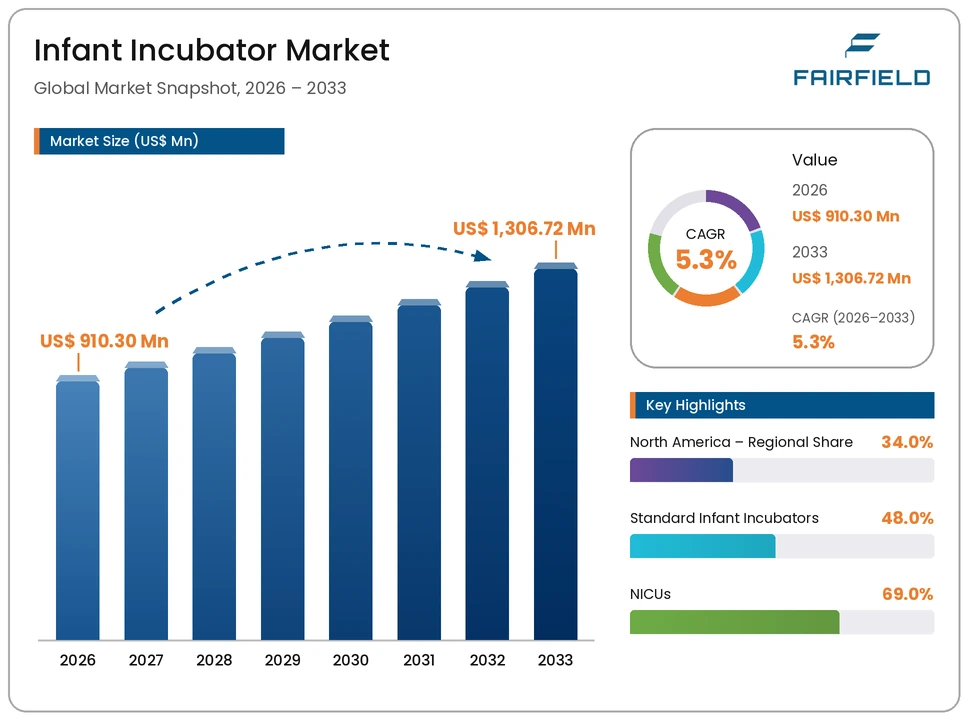
The global infant incubator market is expected to be valued at US$ 910.30 Million in 2026 and is projected to reach US$ 1306.72 Million by 2033, growing at a CAGR of 5.3% between 2026 and 2033. This trajectory reflects both replacement demand in mature markets and first-installation procurement in expanding neonatal intensive care networks across South Asia, Sub-Saharan Africa, and Southeast Asia. The World Health Organization (WHO), which estimates approximately 15 million preterm births annually, has elevated neonatal thermoregulation technology to a core priority under its Every Newborn Action Plan, providing institutional momentum that reinforces procurement cycles across both public and donor-funded health systems.
Key Highlights
- North America's structural advantage in the infant incubator market is reinforced by CMS reimbursement frameworks and high NICU density, the region commands 34.0% of global market value at US$ 309.50 Million in 2026.
- Preterm birth prevalence, estimated at over 13 million cases annually in low- and middle-income countries per UNICEF data, underpins demand growth across the infant incubator industry with unusual resilience.
- Standard Infant Incubators retain 48.0% segment dominance because tertiary NICU clinical protocols for extremely preterm infants, specifically those requiring sustained humidity control above 80%, are not substitutable with open radiant warmers or hybrid platforms.
- Transport Infant Incubators are the fastest-growing segment within the infant incubator landscape, propelled by formalised inter-facility neonatal transport programmes.
- The integration of connected device architecture, specifically IEC 62443-compliant network-enabled incubators linked to hospital information systems, represents the highest-value strategic opportunity for established infant incubator manufacturers through 2033. Health systems investing in unified patient monitoring platforms are creating premium tender categories that exclude cost-only competitors, rewarding manufacturers with demonstrated interoperability credentials and long-term software support commitments.
Key Growth Determinants
- Rising Preterm Birth Rates and Expanding NICU Infrastructure
Globally, preterm birth rates remain persistently elevated, with the WHO reporting that complications from preterm delivery account for approximately 35% of all neonatal deaths. This burden is driving systematic NICU capacity expansion across middle-income countries. India's Pradhan Mantri Matru Vandana Yojana scheme and broader National Health Mission allocations have accelerated district-level hospital upgrades, many of which now include dedicated neonatal care bays requiring servo-controlled incubators with integrated humidity and oxygen concentration management. Procurement volumes are rising in direct proportion to facility commissioning, making public health capital expenditure cycles a reliable demand anchor for infant incubator manufacturers and their distribution partners.
Key Growth Barriers
- High Capital Cost and Constrained Public Health Budgets
Premium servo-controlled incubators with integrated monitoring capability command unit prices exceeding US$ 15,000, placing significant strain on procurement budgets in low- and lower-middle-income countries. Even where donor financing through organisations such as UNICEF partially subsidises acquisition, ongoing maintenance costs, including calibration, sensor replacement, and canopy seal integrity management, frequently outpace local technical capacity. This cost-maintenance burden creates a structural ceiling on penetration rates in the markets with the highest clinical need.
Market Opportunities
- Telehealth Integration and Remote Neonatal Monitoring
The convergence of connected device architecture with neonatal care is creating a new category of network-enabled incubators capable of transmitting real-time thermoregulation data, weight trends, and alarm logs to central nursing stations and remote clinician dashboards. GE HealthCare has invested in its Carescape platform to enable bedside-to-cloud connectivity for NICU equipment, a direction that aligns with hospital system procurement priorities centred on unified patient data infrastructure. As health systems in North America and Western Europe accelerate electronic health record integration at the device level, manufacturers offering IEC 62443-compliant connected incubators are positioned to capture premium contract value in public tender processes.
Category-wise Insights
- Product Type Analysis
Standard Infant Incubators account for 48.0% of the global infant incubator market in 2026, equivalent to US$ 436.94 Million. Their dominance reflects the enduring clinical preference for closed, humidity-controlled environments in tertiary NICUs managing very preterm infants requiring prolonged thermoregulation. Large academic medical centres and level-III NICU operators, including university hospital networks in the United States and Germany, specify closed incubators for infants born before 28 weeks of gestation, where skin barrier immaturity demands sustained humidification at 80–90% relative humidity. Procurement cycles are well-established, with fleet replacement contracts typically spanning five to seven years.
Transport Infant Incubators represent the fastest-growing segment, driven by the formalisation of neonatal transport networks that link district and community hospitals to tertiary referral centres. Dräger's Isolette TI500 transport system, cleared by the FDA in 2023, exemplifies the product evolution toward battery-operated, vibration-dampened platforms compatible with road, air, and inter-facility helicopter transfer, directly addressing the clinical requirement for sustained servo-control during transport of haemodynamically unstable neonates.
- Application Analysis
Neonatal Intensive Care Units (NICUs) account for 69.0% of the global infant incubator market in 2026, equivalent to US$ 628.11 Million. NICUs are the primary procurement channel because care protocols for very-low-birthweight and extremely preterm infants require continuous, regulated thermal environments for weeks or months. Major academic NICUs such as those affiliated with Children's Hospital of Philadelphia and King's College Hospital NHS Foundation Trust in London operate fleets of 20–60 incubators, generating significant recurring capital and service revenue. Tender specifications at this level routinely require integrated alarm escalation, data logging, and compatibility with bedside monitoring ecosystems.
Pediatric & Specialty Hospitals are the fastest-growing application segment, fuelled by the global proliferation of dedicated women's and children's hospital campuses. Apollo Hospitals Group in India has commissioned multiple standalone children's facilities since 2023, each incorporating purpose-built NICU wards that require full incubator fleet procurement. These facilities increasingly specify hybrid incubators capable of transitioning between closed thermoregulation and open radiant warmer modes, reflecting clinical pathways that progress stable infants toward skin-to-skin care
- End User Analysis
Hospitals account for 72.0% of the global infant incubator market in 2026, equivalent to US$ 655.42 Million. Hospital procurement dominance reflects the concentration of neonatal clinical capacity within inpatient settings, where capital equipment budgets, biomedical engineering support, and 24-hour clinical staffing justify investment in full-featured servo-controlled platforms. Public hospital networks, including those operating under NHS England's Long Term Workforce Plan, which targets NICU expansion, place multi-unit tenders that sustain baseline volume for all major manufacturers. Service contract attachment rates are high in this channel, reinforcing recurring revenue streams.
Specialty Neonatal Centers are the fastest-growing end-user segment, catalysed by private-sector investment in standalone neonatal care facilities in Gulf Cooperation Council countries and Southeast Asia. NMC Healthcare, operating across the UAE, has developed dedicated neonatal units within its maternity network since 2024, procuring advanced closed-incubator systems with integrated neonatal monitoring. These centres prioritise premium, feature-rich platforms and are less price-sensitive than public hospital procurement, making them high-value target accounts for tier-one infant incubator manufacturers.
Regional Insights
- North America Infant Incubator Market Trends and Insights
North America accounts for 34.0% of the global infant incubator market in 2026, representing US$ 309.50 Million. The region's leadership rests on a dense infrastructure of level-III and level-IV NICUs, sustained reimbursement frameworks under U.S. Centers for Medicare & Medicaid Services (CMS) DRG codes, and active fleet replacement cycles driven by IEC 60601-2-19 compliance requirements. Hospital consolidation among large health systems, particularly within IDN (integrated delivery network) procurement consortia, is concentrating purchasing power and elevating technical specifications across contract tenders.
United States Infant Incubator Market Size
The United States infant incubator market represents 84.0% of the North America regional market in 2026, equivalent to US$ 259.98 Million. Demand is anchored by approximately 3.5 million births annually (U.S. Centers for Disease Control and Prevention data), with a preterm rate near 10.4% sustaining consistent NICU admission volumes. Connected-device procurement mandates within Epic Systems-integrated hospital networks are accelerating the upgrade cycle toward data-enabled incubator platforms.
Canada Infant Incubator Market Size
The Canada infant incubator market represents 16.0% of the North America regional market in 2026, equivalent to US$ 49.52 Million. Provincial health authority bulk procurement under frameworks managed by HealthPRO Procurement Services sustains predictable replacement demand. Health Canada's medical device licensing framework under the Food and Drugs Act requires Class III device authorisation for infant incubators, and planned hospital infrastructure investments under the Canada Health Transfer are expected to support NICU capacity additions through 2030.
- Asia Pacific Infant Incubator Market Trends and Insights
Asia Pacific accounts for 27.0% of the global infant incubator market in 2026, representing US$ 245.78 Million, and leads all regions on growth velocity at an estimated 7% CAGR. The acceleration reflects simultaneous demand expansion across three distinct market tiers: hospital network modernisation in China, greenfield NICU buildout in India, and premium replacement procurement in Japan and Australia. UNICEF's Every Child Alive campaign has provided technical and financing assistance that accelerates public procurement timelines across lower-income Asia Pacific markets.
China Infant Incubator Market Size
The China infant incubator market represents 36.0% of the Asia Pacific regional market in 2026, equivalent to US$ 88.48 Million. Government policy under the Healthy China 2030 initiative, which targets reductions in neonatal mortality through improved NICU infrastructure, is generating structured procurement programmes across tier-II and tier-III city hospitals. Domestic manufacturers including Zhengzhou Dison Instrument And Meter Co. Ltd. are gaining share in public tender processes through competitive pricing and local regulatory compliance.
Japan Infant Incubator Market Size
The Japan infant incubator market represents 21.0% of the Asia Pacific regional market in 2026, equivalent to US$ 51.61 Million. Japan's persistently low birth rate, approximately 758,000 births in 2023 per the Ministry of Health, Labour and Welfare, concentrates neonatal care into a smaller number of high-acuity, technologically advanced NICUs, sustaining demand for premium closed-incubator platforms. Fleet modernisation driven by the transition to Pharmaceuticals and Medical Devices Agency (PMDA) updated device standards will sustain replacement procurement through the forecast period.
India Infant Incubator Market Size
The India infant incubator market represents 17.0% of the Asia Pacific regional market in 2026, equivalent to US$ 41.78 Million. India registers approximately 25 million births annually (Government of India, Sample Registration System), with a preterm rate that sustains structurally high NICU demand. Phoenix Medical Systems and Nice Neotech Medical Systems Pvt. Ltd. serve the domestic public procurement market with locally manufactured, cost-optimised platforms aligned to government hospital tender specifications, positioning India as both a high-volume consumption market and an emerging export manufacturing base.
Competitive Landscape
The infant incubator industry operates as a moderately concentrated market at the premium tier, with GE HealthCare and Dräger collectively commanding significant share in North American and European level-III NICU procurement through established service networks, device integration capabilities, and brand trust among biomedical procurement committees. Atom Medical Corporation and Fanem Ltda. hold strong regional positions in Japan and Latin America, respectively, while a second tier of manufacturers, including Inspiration Healthcare Group plc and Natus Medical Incorporated, compete on feature-price positioning in mid-acuity hospital segments. Competition in Asia Pacific and Africa is increasingly contested by locally headquartered manufacturers offering IEC 60601-2-19-compliant platforms at 30–50% cost advantages over imported equivalents, reshaping the competitive calculus for global players dependent on volume in price-sensitive public tender markets.
Companies Covered in Infant Incubator Market
- GE HealthCare
- Dräger
- Atom Medical Corporation
- Fanem Ltda.
- Phoenix Medical Systems
- Inspiration Healthcare Group plc
- Natus Medical Incorporated
- MEDICOR Elektronika Zrt.
- Zhengzhou Dison Instrument And Meter Co. Ltd.
- Nice Neotech Medical Systems Pvt. Ltd.
- Fisher & Paykel Healthcare
- Spacelabs Healthcare
- Weyer GmbH
- AVI Healthcare
- BioSystem
Market Segmentation
By Product Type
- Standard Infant Incubators
- Transport Infant Incubators
- Hybrid Infant Incubators
By Application
- Neonatal Intensive Care Units (NICUs)
- Maternity & General Hospitals
- Pediatric & Specialty Hospitals
By End User
- Hospitals
- Specialty Neonatal Centers
- Ambulatory & Research Institutions
By Regions
- North America
- Europe
- East Asia
- South Asia & Oceania
- Latin America
- Middle East & Africa
- Executive Summary
- Global Infant Incubator Market Snapshot
- Future Projections
- Key Market Trends
- Regional Snapshot, by Value, 2026
- Analyst Recommendations
- Market Overview
- Market Definitions and Segmentations
- Market Dynamics
- Drivers
- Restraints
- Market Opportunities
- Value Chain Analysis
- COVID-19 Impact Analysis
- Porter's Five Forces Analysis
- Impact of Russia-Ukraine Conflict
- PESTLE Analysis
- Regulatory Analysis
- Price Trend Analysis
- Current Prices and Future Projections, 2025-2033
- Price Impact Factors
- Global Infant Incubator Market Outlook, 2020 - 2033
- Global Infant Incubator Market Outlook, by Product Type, Value (US$ Mn), 2020-2033
- Standard Infant Incubators
- Transport Infant Incubators
- Hybrid Infant Incubators
- Global Infant Incubator Market Outlook, by Application, Value (US$ Mn), 2020-2033
- Neonatal Intensive Care Units (NICUs)
- Maternity & General Hospitals
- Pediatric & Specialty Hospitals
- Global Infant Incubator Market Outlook, by End User, Value (US$ Mn), 2020-2033
- Hospitals
- Specialty Neonatal Centers
- Ambulatory & Research Institutions
- Global Infant Incubator Market Outlook, by Region, Value (US$ Mn), 2020-2033
- North America
- Europe
- Asia Pacific
- Latin America
- Middle East & Africa
- Global Infant Incubator Market Outlook, by Product Type, Value (US$ Mn), 2020-2033
- North America Infant Incubator Market Outlook, 2020 - 2033
- North America Infant Incubator Market Outlook, by Product Type, Value (US$ Mn), 2020-2033
- Standard Infant Incubators
- Transport Infant Incubators
- Hybrid Infant Incubators
- North America Infant Incubator Market Outlook, by Application, Value (US$ Mn), 2020-2033
- Neonatal Intensive Care Units (NICUs)
- Maternity & General Hospitals
- Pediatric & Specialty Hospitals
- North America Infant Incubator Market Outlook, by End User, Value (US$ Mn), 2020-2033
- Hospitals
- Specialty Neonatal Centers
- Ambulatory & Research Institutions
- North America Infant Incubator Market Outlook, by Country, Value (US$ Mn), 2020-2033
- U.S. Infant Incubator Market Outlook, by Product Type, 2020-2033
- U.S. Infant Incubator Market Outlook, by Application, 2020-2033
- U.S. Infant Incubator Market Outlook, by End User, 2020-2033
- Canada Infant Incubator Market Outlook, by Product Type, 2020-2033
- Canada Infant Incubator Market Outlook, by Application, 2020-2033
- Canada Infant Incubator Market Outlook, by End User, 2020-2033
- BPS Analysis/Market Attractiveness Analysis
- North America Infant Incubator Market Outlook, by Product Type, Value (US$ Mn), 2020-2033
- Europe Infant Incubator Market Outlook, 2020 - 2033
- Europe Infant Incubator Market Outlook, by Product Type, Value (US$ Mn), 2020-2033
- Standard Infant Incubators
- Transport Infant Incubators
- Hybrid Infant Incubators
- Europe Infant Incubator Market Outlook, by Application, Value (US$ Mn), 2020-2033
- Neonatal Intensive Care Units (NICUs)
- Maternity & General Hospitals
- Pediatric & Specialty Hospitals
- Europe Infant Incubator Market Outlook, by End User, Value (US$ Mn), 2020-2033
- Hospitals
- Specialty Neonatal Centers
- Ambulatory & Research Institutions
- Europe Infant Incubator Market Outlook, by Country, Value (US$ Mn), 2020-2033
- Germany Infant Incubator Market Outlook, by Product Type, 2020-2033
- Germany Infant Incubator Market Outlook, by Application, 2020-2033
- Germany Infant Incubator Market Outlook, by End User, 2020-2033
- Italy Infant Incubator Market Outlook, by Product Type, 2020-2033
- Italy Infant Incubator Market Outlook, by Application, 2020-2033
- Italy Infant Incubator Market Outlook, by End User, 2020-2033
- France Infant Incubator Market Outlook, by Product Type, 2020-2033
- France Infant Incubator Market Outlook, by Application, 2020-2033
- France Infant Incubator Market Outlook, by End User, 2020-2033
- U.K. Infant Incubator Market Outlook, by Product Type, 2020-2033
- U.K. Infant Incubator Market Outlook, by Application, 2020-2033
- U.K. Infant Incubator Market Outlook, by End User, 2020-2033
- Spain Infant Incubator Market Outlook, by Product Type, 2020-2033
- Spain Infant Incubator Market Outlook, by Application, 2020-2033
- Spain Infant Incubator Market Outlook, by End User, 2020-2033
- Russia Infant Incubator Market Outlook, by Product Type, 2020-2033
- Russia Infant Incubator Market Outlook, by Application, 2020-2033
- Russia Infant Incubator Market Outlook, by End User, 2020-2033
- Rest of Europe Infant Incubator Market Outlook, by Product Type, 2020-2033
- Rest of Europe Infant Incubator Market Outlook, by Application, 2020-2033
- Rest of Europe Infant Incubator Market Outlook, by End User, 2020-2033
- BPS Analysis/Market Attractiveness Analysis
- Europe Infant Incubator Market Outlook, by Product Type, Value (US$ Mn), 2020-2033
- Asia Pacific Infant Incubator Market Outlook, 2020 - 2033
- Asia Pacific Infant Incubator Market Outlook, by Product Type, Value (US$ Mn), 2020-2033
- Standard Infant Incubators
- Transport Infant Incubators
- Hybrid Infant Incubators
- Asia Pacific Infant Incubator Market Outlook, by Application, Value (US$ Mn), 2020-2033
- Neonatal Intensive Care Units (NICUs)
- Maternity & General Hospitals
- Pediatric & Specialty Hospitals
- Asia Pacific Infant Incubator Market Outlook, by End User, Value (US$ Mn), 2020-2033
- Hospitals
- Specialty Neonatal Centers
- Ambulatory & Research Institutions
- Asia Pacific Infant Incubator Market Outlook, by Country, Value (US$ Mn), 2020-2033
- China Infant Incubator Market Outlook, by Product Type, 2020-2033
- China Infant Incubator Market Outlook, by Application, 2020-2033
- China Infant Incubator Market Outlook, by End User, 2020-2033
- Japan Infant Incubator Market Outlook, by Product Type, 2020-2033
- Japan Infant Incubator Market Outlook, by Application, 2020-2033
- Japan Infant Incubator Market Outlook, by End User, 2020-2033
- South Korea Infant Incubator Market Outlook, by Product Type, 2020-2033
- South Korea Infant Incubator Market Outlook, by Application, 2020-2033
- South Korea Infant Incubator Market Outlook, by End User, 2020-2033
- India Infant Incubator Market Outlook, by Product Type, 2020-2033
- India Infant Incubator Market Outlook, by Application, 2020-2033
- India Infant Incubator Market Outlook, by End User, 2020-2033
- Southeast Asia Infant Incubator Market Outlook, by Product Type, 2020-2033
- Southeast Asia Infant Incubator Market Outlook, by Application, 2020-2033
- Southeast Asia Infant Incubator Market Outlook, by End User, 2020-2033
- Rest of SAO Infant Incubator Market Outlook, by Product Type, 2020-2033
- Rest of SAO Infant Incubator Market Outlook, by Application, 2020-2033
- Rest of SAO Infant Incubator Market Outlook, by End User, 2020-2033
- BPS Analysis/Market Attractiveness Analysis
- Asia Pacific Infant Incubator Market Outlook, by Product Type, Value (US$ Mn), 2020-2033
- Latin America Infant Incubator Market Outlook, 2020 - 2033
- Latin America Infant Incubator Market Outlook, by Product Type, Value (US$ Mn), 2020-2033
- Standard Infant Incubators
- Transport Infant Incubators
- Hybrid Infant Incubators
- Latin America Infant Incubator Market Outlook, by Application, Value (US$ Mn), 2020-2033
- Neonatal Intensive Care Units (NICUs)
- Maternity & General Hospitals
- Pediatric & Specialty Hospitals
- Latin America Infant Incubator Market Outlook, by End User, Value (US$ Mn), 2020-2033
- Hospitals
- Specialty Neonatal Centers
- Ambulatory & Research Institutions
- Latin America Infant Incubator Market Outlook, by Country, Value (US$ Mn), 2020-2033
- Brazil Infant Incubator Market Outlook, by Product Type, 2020-2033
- Brazil Infant Incubator Market Outlook, by Application, 2020-2033
- Brazil Infant Incubator Market Outlook, by End User, 2020-2033
- Mexico Infant Incubator Market Outlook, by Product Type, 2020-2033
- Mexico Infant Incubator Market Outlook, by Application, 2020-2033
- Mexico Infant Incubator Market Outlook, by End User, 2020-2033
- Argentina Infant Incubator Market Outlook, by Product Type, 2020-2033
- Argentina Infant Incubator Market Outlook, by Application, 2020-2033
- Argentina Infant Incubator Market Outlook, by End User, 2020-2033
- Rest of LATAM Infant Incubator Market Outlook, by Product Type, 2020-2033
- Rest of LATAM Infant Incubator Market Outlook, by Application, 2020-2033
- Rest of LATAM Infant Incubator Market Outlook, by End User, 2020-2033
- BPS Analysis/Market Attractiveness Analysis
- Latin America Infant Incubator Market Outlook, by Product Type, Value (US$ Mn), 2020-2033
- Middle East & Africa Infant Incubator Market Outlook, 2020 - 2033
- Middle East & Africa Infant Incubator Market Outlook, by Product Type, Value (US$ Mn), 2020-2033
- Standard Infant Incubators
- Transport Infant Incubators
- Hybrid Infant Incubators
- Middle East & Africa Infant Incubator Market Outlook, by Application, Value (US$ Mn), 2020-2033
- Neonatal Intensive Care Units (NICUs)
- Maternity & General Hospitals
- Pediatric & Specialty Hospitals
- Middle East & Africa Infant Incubator Market Outlook, by End User, Value (US$ Mn), 2020-2033
- Hospitals
- Specialty Neonatal Centers
- Ambulatory & Research Institutions
- Middle East & Africa Infant Incubator Market Outlook, by Country, Value (US$ Mn), 2020-2033
- GCC Infant Incubator Market Outlook, by Product Type, 2020-2033
- GCC Infant Incubator Market Outlook, by Application, 2020-2033
- GCC Infant Incubator Market Outlook, by End User, 2020-2033
- South Africa Infant Incubator Market Outlook, by Product Type, 2020-2033
- South Africa Infant Incubator Market Outlook, by Application, 2020-2033
- South Africa Infant Incubator Market Outlook, by End User, 2020-2033
- Egypt Infant Incubator Market Outlook, by Product Type, 2020-2033
- Egypt Infant Incubator Market Outlook, by Application, 2020-2033
- Egypt Infant Incubator Market Outlook, by End User, 2020-2033
- Nigeria Infant Incubator Market Outlook, by Product Type, 2020-2033
- Nigeria Infant Incubator Market Outlook, by Application, 2020-2033
- Nigeria Infant Incubator Market Outlook, by End User, 2020-2033
- Rest of Middle East Infant Incubator Market Outlook, by Product Type, 2020-2033
- Rest of Middle East Infant Incubator Market Outlook, by Application, 2020-2033
- Rest of Middle East Infant Incubator Market Outlook, by End User, 2020-2033
- BPS Analysis/Market Attractiveness Analysis
- Middle East & Africa Infant Incubator Market Outlook, by Product Type, Value (US$ Mn), 2020-2033
- Competitive Landscape
- Company Vs Segment Heatmap
- Company Market Share Analysis, 2025
- Competitive Dashboard
- Company Profiles
- GE HealthCare
- Company Overview
- Product Portfolio
- Financial Overview
- Business Strategies and Developments
- Dräger
- Atom Medical Corporation
- Fanem Ltda.
- Phoenix Medical Systems
- Inspiration Healthcare Group plc
- Natus Medical Incorporated
- MEDICOR Elektronika Zrt.
- Zhengzhou Dison Instrument And Meter Co. Ltd.
- Nice Neotech Medical Systems Pvt. Ltd.
- GE HealthCare
- Appendix
- Research Methodology
- Report Assumptions
- Acronyms and Abbreviations
By Product Type
- Standard Infant Incubators
- Transport Infant Incubators
- Hybrid Infant Incubators
By Application
- Neonatal Intensive Care Units (NICUs)
- Maternity & General Hospitals
- Pediatric & Specialty Hospitals
By End User
- Hospitals
- Specialty Neonatal Centers
- Ambulatory & Research Institutions
By Regions
- North America
- Europe
- East Asia
- South Asia & Oceania
- Latin America
- Middle East & Africa
Our Research Methodology
Considering the volatility of business today, traditional approaches to strategizing a game plan can be unfruitful if not detrimental. True ambiguity is no way to determine a forecast. A myriad of predetermined factors must be accounted for such as the degree of risk involved, the magnitude of circumstances, as well as conditions or consequences that are not known or unpredictable. To circumvent binary views that cast uncertainty, the application of market research intelligence to strategically posture, move, and enable actionable outcomes is necessary.
View Methodology
Quality Assured
Rigorous Validation Process

Confidentiality Assured
End-to-end Data Security

Custom Research Services
Tailored To Your Objectives
FAQs
The global infant incubator market is valued at US$ 910.30 Million in 2026 and is forecast to reach US$ 1306.72 Million by 2033, expanding at a 5.3% CAGR.
Two structural forces dominate: the global preterm birth burden, which the March of Dimes estimates affects one in ten births worldwide, and mandatory fleet modernisation under updated IEC 60601-2-19 safety standards that compel replacement of legacy closed-incubator systems. Government healthcare capital expenditure programmes in Brazil, Indonesia, and Nigeria are additionally generating first-installation procurement volumes not captured in historical growth rates.
Standard Infant Incubators hold the largest product-type share at 48.0%, sustained by the irreplaceable clinical function of closed humidified environments for extremely preterm neonates requiring care over extended periods.
North America leads with 34.0% of global market value, anchored by high NICU density per capita and robust reimbursement architecture under CMS diagnosis-related group frameworks that sustain procurement budgets.
Related Reports
Hematology Analyzer Market Size, Share, Insights, Competitive Landscape, and Forecast 2026 to 2033
Explore the hematology analyzer market, projected to reach US$3.70 billion by 2033 at 4.60% CAGR, with segment, regional and company insights.
Zirconia Based Dental Materials Market Size, Share, Insights, Competitive Landscape, and Forecast 2026 to 2033
The global zirconia based dental materials market is valued at US$1.6 billion in 2026, reaching US$2.8 billion by 2033, growing at an 8.3% CAGR
Wheelchair Market Size, Share, Insights, Competitive Landscape, and Forecast 2026 to 2033
The global wheelchair market is valued at US$6.4 billion in 2026, reaching US$9.8 billion by 2033, growing at a 6.3% CAGR
3D Bioprinting Market Size, Share, Insights, Competitive Landscape, and Forecast 2026 to 2033
The global 3D bioprinting market is valued at US$2.81 billion in 2026, reaching US$10.11 billion by 2033, growing at a 20.1% CAGR
3D Bioengineered Skin Grafts Market Size, Share, Insights, Competitive Landscape, and Forecast 2026 to 2033
The global 3D bioengineered skin grafts market is valued at US$2.50 billion in 2026, reaching US$4.45 billion by 2033, growing at an 8.6% CAGR
Respiratory Diagnostics Market Size, Share, Insights, Competitive Landscape, and Forecast 2026 to 2033
The global respiratory diagnostics market is valued at US$9.66 billion in 2026, reaching US$14.69 billion by 2033, growing at a 6.2% CAGR