



Vaginal Rejuvenation Market
Vaginal Rejuvenation Market Insights, Competitive Landscape, and Market Forecast 2026–2033
Global Vaginal Rejuvenation Market Size and Trend Analysis
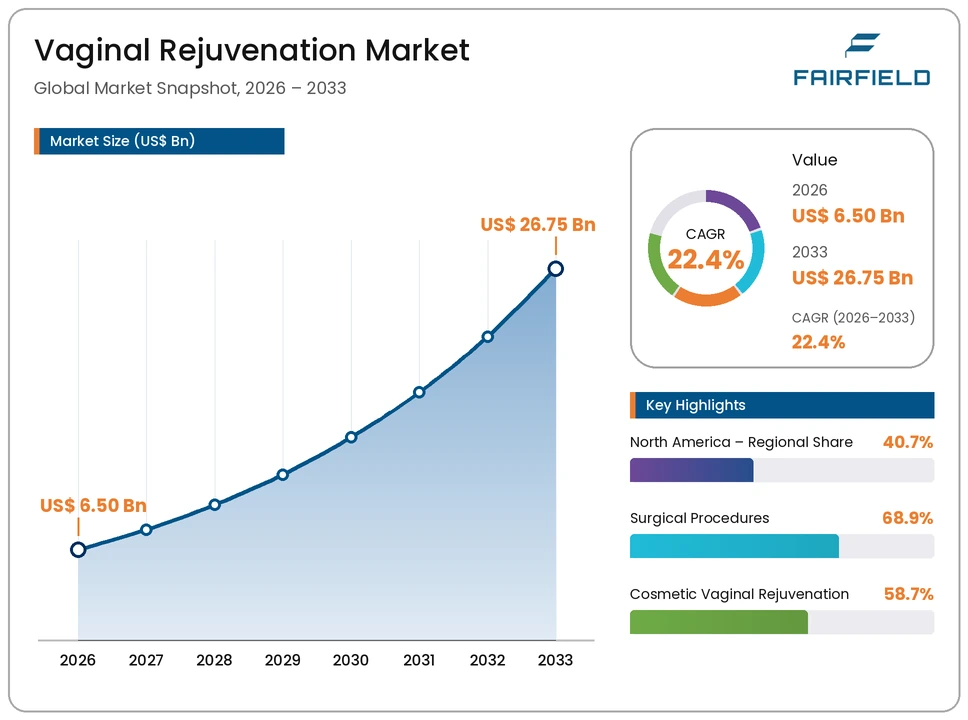
The global vaginal rejuvenation market is expected to be valued at US$ 6.50 Billion in 2026 and is projected to reach US$ 26.75 Billion by 2033, growing at a CAGR of 22.4% between 2026 and 2033. This trajectory reflects both pent-up demand among perimenopausal and postpartum patient cohorts and the accelerating commercial deployment of fractional CO? laser and radiofrequency (RF) ablation platforms by aesthetic clinics globally. The American College of Obstetricians and Gynecologists (ACOG) has progressively clarified clinical guidance on non-surgical intimate health interventions, providing the institutional legitimacy that supports broader adoption.
Key Highlights
- North America leads the vaginal rejuvenation market with a 40.7% share valued at US$ 2.65 billion in 2026, supported by a strong network of urogynecologists and a well-established cash-pay aesthetic medicine industry.
- Asia Pacific is the fastest-growing regional market with a 25.3% CAGR, driven by expanding private healthcare infrastructure in China and rising aesthetic procedure adoption in South Korea.
- Surgical procedures account for the largest market share at 68.9%, supported by established reconstructive applications and strong adoption in hospital-based urogynecology practices.
- Non-surgical vaginal rejuvenation is the fastest-growing segment, driven by energy-based technologies that offer minimally invasive treatments with little to no recovery time.
- Aging- and childbirth-related treatments represent the largest growth opportunity, supported by increasing demand for women's intimate health solutions among aging populations and postpartum patients.
Key Growth Determinants
- Rising Prevalence of Genitourinary Syndrome of Menopause and Postpartum Pelvic Floor Dysfunction
Genitourinary syndrome of menopause affects an estimated 40–50% of postmenopausal women according to data published by the North American Menopause Society (NAMS), yet historically fewer than a quarter sought clinical treatment. That gap is narrowing decisively. Ob-gyn and urogynecology practices across North America and Western Europe are now systematically screening patients during routine visits, driving referral volumes into aesthetic medicine and surgical practices that offer vaginal rejuvenation procedures. Postpartum pelvic floor dysfunction including stress urinary incontinence and vaginal laxity represents a structurally large, underpenetrated demand cohort that is reaching providers as cultural stigma around intimate health discussion continues to erode.
Key Growth Barriers
- Regulatory Scrutiny and Reimbursement Ambiguity for Non-Surgical Procedures
The U.S. Food and Drug Administration (FDA) issued a Safety Communication in 2018 warning against the use of energy-based devices for vaginal rejuvenation without sufficient clinical evidence, and this position continues to shape payer behaviour. Most private insurers in the United States classify cosmetic vaginal rejuvenation as elective, excluding it from reimbursement schedules. This out-of-pocket cost burden narrows the addressable patient pool, concentrating demand among higher-income demographics and limiting penetration in cost-sensitive markets.
Vaginal Rejuvenation Market Opportunities
- Medical Tourism Infrastructure Enabling Cross-Border Access to Vaginal Rejuvenation Procedures
South Korea, Thailand, and Turkey have emerged as high-volume destinations for women seeking both surgical and non-surgical vaginal rejuvenation at materially lower out-of-pocket cost than in Western markets. Thailand's Joint Commission International (JCI)-accredited hospital network has actively marketed women's wellness packages that bundle intimate health consultations with rejuvenation procedures. For device manufacturers and platform operators, this medical tourism corridor represents a scalable distribution opportunity particularly as digital health platforms enable pre-procedure teleconsultation across borders, reducing patient acquisition friction for clinic partners.
Market Segmentation Analysis
- Product Type Analysis
Surgical procedures account for 68.9% of the global vaginal rejuvenation market in 2026, equivalent to US$ 4.48 Billion. Surgical dominance reflects the established clinical pathways and insurance-adjacent reimbursability for reconstructive procedures such as vaginoplasty and perineoplasty performed in hospital or accredited surgical centre settings.
Board-certified plastic surgeons and urogynecologists routinely recommend surgical intervention for patients presenting with significant structural laxity or pelvic floor prolapse conditions where energy-based non-surgical modalities cannot deliver equivalent anatomical correction. Major academic medical centres, including those affiliated with the American Urogynecologic Society (AUGS), operate dedicated pelvic floor reconstruction programmes that sustain consistent surgical procedure volumes.
Non-surgical vaginal rejuvenation is the fastest-growing segment, propelled by the Fotona SMOOTH Er:YAG laser protocol, which gained broad European clinical adoption from 2023 onward following expanded peer-reviewed clinical data on mucosal tightening efficacy. Non-surgical platforms appeal strongly to patients seeking zero downtime and no general anaesthesia, opening the procedure to a substantially broader demographic than surgical candidates.
- Treatment Type Analysis
Cosmetic vaginal rejuvenation accounts for 58.7% of the global vaginal rejuvenation market in 2026, equivalent to US$ 3.82 Billion. Consumer-facing demand for aesthetic genital procedures including labiaplasty, clitoral hood reduction, and non-surgical vaginal tightening has grown steadily as social media discussion of intimate aesthetics becomes normalised.
ISAPS global procedure data consistently ranks labiaplasty among the fastest-rising cosmetic surgery procedures worldwide, with women aged 25–44 representing the core elective buyer cohort. Medical spas and boutique aesthetic practices price these procedures at a premium, sustaining strong revenue concentration in the cosmetic treatment sub-segment.
Reconstructive vaginal rejuvenation is the fastest-growing treatment type, driven by expanded gynaecological screening for pelvic organ prolapse and stress urinary incontinence. Boston Scientific Corporation extended its pelvic health product portfolio in 2024, reinforcing clinical infrastructure supporting reconstructive urogynecological workflows. As postpartum care protocols incorporate pelvic floor assessment more systematically, the referral pipeline for reconstructive procedures is expanding across hospital systems in Europe and North America.
- Application Analysis
The aesthetic purposes segment accounts for 39.5% of the global vaginal rejuvenation market in 2026, equivalent to US$ 2.57 Billion. Patient demand is anchored by elective cosmetic procedures performed at private aesthetic clinics and medical spas, where practitioners deploy energy-based devices or perform surgical reshaping to address appearance-related concerns.
Upscale aesthetic chains in the U.S. U.K. actively market vaginal rejuvenation alongside facial aesthetic and body contouring services, positioning the procedure within comprehensive feminine wellness offerings. The high-margin, cash-pay nature of aesthetic intimate procedures makes this segment commercially attractive for both device manufacturers and clinic operators.
The aging and childbirth application segment is the fastest-growing category, reflecting demographic tailwinds from aging postmenopausal populations across developed markets. Cynosure, following its acquisition by Clayton, Dubilier & Rice, relaunched its TempSure Vitalia RF platform in 2023 with enhanced clinical protocols targeting postmenopausal tissue atrophy and postpartum laxity, directly addressing this patient cohort and accelerating procedure adoption across women's health practices.
Regional Insights
- North America Vaginal Rejuvenation Market Trends and Insights
North America accounts for 40.7% of the global vaginal rejuvenation market in 2026, representing US$ 2.65 Billion. The region's leadership rests on a dense network of board-certified plastic surgeons, urogynecologists, and medically supervised aesthetic practices, supported by high per-capita healthcare expenditure and robust patient awareness. Federal research funding from the National Institutes of Health (NIH) into pelvic floor disorders has elevated clinical prioritization of intimate health interventions. North America will maintain its lead through the forecast period, though its share will moderate as Asia Pacific accelerates.
U.S. Vaginal Rejuvenation Market Size
The U.S. vaginal rejuvenation market represents 86.5% of the North America regional market in 2026, equivalent to US$ 2.29 Billion. Demand is sustained by approximately 6,000 board-certified plastic surgeons practicing across the country, a large medically underserved postmenopausal demographic, and the proliferation of cash-pay aesthetic medicine chains. Continued device innovation and expanding direct-to-consumer marketing by clinic operators will sustain above-average growth through 2033.
Canada Vaginal Rejuvenation Market Size
The Canada vaginal rejuvenation market represents 9.3% of the North America regional market in 2026, equivalent to US$ 0.25 Billion. Growing awareness of genitourinary syndrome of menopause among Canadian primary care providers, supported by Society of Obstetricians and Gynaecologists of Canada (SOGC) clinical practice guidelines on vulvovaginal atrophy, is progressively directing patients toward rejuvenation services. Expansion of private aesthetic clinic chains in major urban centres including Toronto and Vancouver is expected to accelerate market development.
- Asia Pacific Vaginal Rejuvenation Market Trends and Insights
Asia Pacific accounts for 27.8% of the global vaginal rejuvenation market in 2026, representing US$ 1.81 Billion, and is the fastest-growing region at an estimated CAGR of 25.3% through 2033. Rising disposable income, rapidly scaling medical aesthetic clinic infrastructure, and declining cultural stigma around intimate health procedures are the primary structural accelerants. South Korea's global aesthetic medicine influence continues to diffuse procedural norms across the broader region, drawing patient flows and legitimising vaginal rejuvenation as a standard wellness service.
China Vaginal Rejuvenation Market Size
The China vaginal rejuvenation market represents 33.6% of the Asia Pacific regional market in 2026, equivalent to US$ 0.61 Billion. A rapidly expanding private hospital and aesthetic clinic sector partially enabled by regulatory reform under the National Health Commission of the People's Republic of China is broadening procedure access. As urban middle-class women increasingly prioritise post-childbirth recovery services, clinical volumes in major cities are projected to scale sharply through the forecast period.
Japan Vaginal Rejuvenation Market Size
The Japan vaginal rejuvenation market represents 19.2% of the Asia Pacific regional market in 2026, equivalent to US$ 0.35 Billion. An ageing female population with women over 60 comprising a structurally large demographic sustains consistent demand for GSM-related vaginal rejuvenation interventions. Expanded marketing by domestic aesthetic clinic chains and growing acceptance of non-invasive intimate health procedures among Japanese women over 45 will support steady growth through 2033
South Korea Vaginal Rejuvenation Market Size
The South Korea vaginal rejuvenation market represents 17.8% of the Asia Pacific regional market in 2026, equivalent to US$ 0.32 Billion. South Korea's position as the global epicentre of aesthetic medicine innovation gives its domestic vaginal rejuvenation sector a distinct first-mover advantage in adopting next-generation energy-based platforms. Hironic, a Korean medical device manufacturer, has developed RF-based intimate health platforms distributed across domestic clinics, positioning South Korea as both a significant consumer and an emerging technology exporter in this space.
Competitive Landscape
The vaginal rejuvenation market is moderately fragmented, with competition occurring across two distinct axes: capital equipment manufacturers competing for device placement in clinics, and clinic operators competing for patient wallet-share. Lumenis, Alma Lasers, Cynosure, and Fotona anchor the energy-based device segment, differentiating primarily on clinical evidence depth, procedural protocol breadth, and after-sales training support.
Viveve and VenusConcept compete on the strength of proprietary RF delivery technology and outcomes data. What determines competitive advantage in this market is not price alone it is the ability to demonstrate reproducible clinical outcomes through peer-reviewed data, securing both clinician confidence and, where applicable, insurer engagement.
Companies Covered in Vaginal Rejuvenation Market
- Alma Lasers
- Lutronic
- Viveve
- BTL Group of Companies
- VenusConcept
- Fotona
- Candela Corporation
- Hironic
- Cynosure
- Lumenis
Market Segmentation
By Product Type
- Surgical
- Non-surgical
By Treatment Type
- Reconstructive Vaginal Rejuvenation
- Cosmetic Vaginal Rejuvenation
By Application
- Incontinence
- Aesthetic Purposes
- Aging and Childbirth
- Others
By Regions
- North America
- Europe
- Asia Pacific
- Latin America
- Middle East & Africa
- Executive Summary
- Global Vaginal Rejuvenation Market Snapshot
- Future Projections
- Key Market Trends
- Regional Snapshot, by Value, 2026
- Analyst Recommendations
- Market Overview
- Market Definitions and Segmentations
- Market Dynamics
- Drivers
- Restraints
- Market Opportunities
- Value Chain Analysis
- COVID-19 Impact Analysis
- Porter's Five Forces Analysis
- Impact of Russia-Ukraine Conflict
- PESTLE Analysis
- Regulatory Analysis
- Price Trend Analysis
- Current Prices and Future Projections, 2025-2033
- Price Impact Factors
- Global Vaginal Rejuvenation Market Outlook, 2020 - 2033
- Global Vaginal Rejuvenation Market Outlook, by Product Type, Value (US$ Bn), 2020-2033
- Surgical
- Non-surgical
- Global Vaginal Rejuvenation Market Outlook, by Treatment Type, Value (US$ Bn), 2020-2033
- Reconstructive Vaginal Rejuvenation
- Cosmetic Vaginal Rejuvenation
- Global Vaginal Rejuvenation Market Outlook, by Application , Value (US$ Bn), 2020-2033
- Incontinence
- Aesthetic Purposes
- Aging And Childbirth
- Others
- Global Vaginal Rejuvenation Market Outlook, by Region, Value (US$ Bn), 2020-2033
- North America
- Europe
- Asia Pacific
- Latin America
- Middle East & Africa
- Global Vaginal Rejuvenation Market Outlook, by Product Type, Value (US$ Bn), 2020-2033
- North America Vaginal Rejuvenation Market Outlook, 2020 - 2033
- North America Vaginal Rejuvenation Market Outlook, by Product Type, Value (US$ Bn), 2020-2033
- Surgical
- Non-surgical
- North America Vaginal Rejuvenation Market Outlook, by Treatment Type, Value (US$ Bn), 2020-2033
- Reconstructive Vaginal Rejuvenation
- Cosmetic Vaginal Rejuvenation
- North America Vaginal Rejuvenation Market Outlook, by Application , Value (US$ Bn), 2020-2033
- Incontinence
- Aesthetic Purposes
- Aging And Childbirth
- Others
- North America Vaginal Rejuvenation Market Outlook, by Country, Value (US$ Bn), 2020-2033
- U.S. Vaginal Rejuvenation Market Outlook, by Product Type, 2020-2033
- U.S. Vaginal Rejuvenation Market Outlook, by Treatment Type, 2020-2033
- U.S. Vaginal Rejuvenation Market Outlook, by Application , 2020-2033
- Canada Vaginal Rejuvenation Market Outlook, by Product Type, 2020-2033
- Canada Vaginal Rejuvenation Market Outlook, by Treatment Type, 2020-2033
- Canada Vaginal Rejuvenation Market Outlook, by Application , 2020-2033
- BPS Analysis/Market Attractiveness Analysis
- North America Vaginal Rejuvenation Market Outlook, by Product Type, Value (US$ Bn), 2020-2033
- Europe Vaginal Rejuvenation Market Outlook, 2020 - 2033
- Europe Vaginal Rejuvenation Market Outlook, by Product Type, Value (US$ Bn), 2020-2033
- Surgical
- Non-surgical
- Europe Vaginal Rejuvenation Market Outlook, by Treatment Type, Value (US$ Bn), 2020-2033
- Reconstructive Vaginal Rejuvenation
- Cosmetic Vaginal Rejuvenation
- Europe Vaginal Rejuvenation Market Outlook, by Application , Value (US$ Bn), 2020-2033
- Incontinence
- Aesthetic Purposes
- Aging And Childbirth
- Others
- Europe Vaginal Rejuvenation Market Outlook, by Country, Value (US$ Bn), 2020-2033
- Germany Vaginal Rejuvenation Market Outlook, by Product Type, 2020-2033
- Germany Vaginal Rejuvenation Market Outlook, by Treatment Type, 2020-2033
- Germany Vaginal Rejuvenation Market Outlook, by Application , 2020-2033
- Italy Vaginal Rejuvenation Market Outlook, by Product Type, 2020-2033
- Italy Vaginal Rejuvenation Market Outlook, by Treatment Type, 2020-2033
- Italy Vaginal Rejuvenation Market Outlook, by Application , 2020-2033
- France Vaginal Rejuvenation Market Outlook, by Product Type, 2020-2033
- France Vaginal Rejuvenation Market Outlook, by Treatment Type, 2020-2033
- France Vaginal Rejuvenation Market Outlook, by Application , 2020-2033
- U.K. Vaginal Rejuvenation Market Outlook, by Product Type, 2020-2033
- U.K. Vaginal Rejuvenation Market Outlook, by Treatment Type, 2020-2033
- U.K. Vaginal Rejuvenation Market Outlook, by Application , 2020-2033
- Spain Vaginal Rejuvenation Market Outlook, by Product Type, 2020-2033
- Spain Vaginal Rejuvenation Market Outlook, by Treatment Type, 2020-2033
- Spain Vaginal Rejuvenation Market Outlook, by Application , 2020-2033
- Russia Vaginal Rejuvenation Market Outlook, by Product Type, 2020-2033
- Russia Vaginal Rejuvenation Market Outlook, by Treatment Type, 2020-2033
- Russia Vaginal Rejuvenation Market Outlook, by Application , 2020-2033
- Rest of Europe Vaginal Rejuvenation Market Outlook, by Product Type, 2020-2033
- Rest of Europe Vaginal Rejuvenation Market Outlook, by Treatment Type, 2020-2033
- Rest of Europe Vaginal Rejuvenation Market Outlook, by Application , 2020-2033
- BPS Analysis/Market Attractiveness Analysis
- Europe Vaginal Rejuvenation Market Outlook, by Product Type, Value (US$ Bn), 2020-2033
- Asia Pacific Vaginal Rejuvenation Market Outlook, 2020 - 2033
- Asia Pacific Vaginal Rejuvenation Market Outlook, by Product Type, Value (US$ Bn), 2020-2033
- Surgical
- Non-surgical
- Asia Pacific Vaginal Rejuvenation Market Outlook, by Treatment Type, Value (US$ Bn), 2020-2033
- Reconstructive Vaginal Rejuvenation
- Cosmetic Vaginal Rejuvenation
- Asia Pacific Vaginal Rejuvenation Market Outlook, by Application , Value (US$ Bn), 2020-2033
- Incontinence
- Aesthetic Purposes
- Aging And Childbirth
- Others
- Asia Pacific Vaginal Rejuvenation Market Outlook, by Country, Value (US$ Bn), 2020-2033
- China Vaginal Rejuvenation Market Outlook, by Product Type, 2020-2033
- China Vaginal Rejuvenation Market Outlook, by Treatment Type, 2020-2033
- China Vaginal Rejuvenation Market Outlook, by Application , 2020-2033
- Japan Vaginal Rejuvenation Market Outlook, by Product Type, 2020-2033
- Japan Vaginal Rejuvenation Market Outlook, by Treatment Type, 2020-2033
- Japan Vaginal Rejuvenation Market Outlook, by Application , 2020-2033
- South Korea Vaginal Rejuvenation Market Outlook, by Product Type, 2020-2033
- South Korea Vaginal Rejuvenation Market Outlook, by Treatment Type, 2020-2033
- South Korea Vaginal Rejuvenation Market Outlook, by Application , 2020-2033
- India Vaginal Rejuvenation Market Outlook, by Product Type, 2020-2033
- India Vaginal Rejuvenation Market Outlook, by Treatment Type, 2020-2033
- India Vaginal Rejuvenation Market Outlook, by Application , 2020-2033
- Southeast Asia Vaginal Rejuvenation Market Outlook, by Product Type, 2020-2033
- Southeast Asia Vaginal Rejuvenation Market Outlook, by Treatment Type, 2020-2033
- Southeast Asia Vaginal Rejuvenation Market Outlook, by Application , 2020-2033
- Rest of SAO Vaginal Rejuvenation Market Outlook, by Product Type, 2020-2033
- Rest of SAO Vaginal Rejuvenation Market Outlook, by Treatment Type, 2020-2033
- Rest of SAO Vaginal Rejuvenation Market Outlook, by Application , 2020-2033
- BPS Analysis/Market Attractiveness Analysis
- Asia Pacific Vaginal Rejuvenation Market Outlook, by Product Type, Value (US$ Bn), 2020-2033
- Latin America Vaginal Rejuvenation Market Outlook, 2020 - 2033
- Latin America Vaginal Rejuvenation Market Outlook, by Product Type, Value (US$ Bn), 2020-2033
- Surgical
- Non-surgical
- Latin America Vaginal Rejuvenation Market Outlook, by Treatment Type, Value (US$ Bn), 2020-2033
- Reconstructive Vaginal Rejuvenation
- Cosmetic Vaginal Rejuvenation
- Latin America Vaginal Rejuvenation Market Outlook, by Application , Value (US$ Bn), 2020-2033
- Incontinence
- Aesthetic Purposes
- Aging And Childbirth
- Others
- Latin America Vaginal Rejuvenation Market Outlook, by Country, Value (US$ Bn), 2020-2033
- Brazil Vaginal Rejuvenation Market Outlook, by Product Type, 2020-2033
- Brazil Vaginal Rejuvenation Market Outlook, by Treatment Type, 2020-2033
- Brazil Vaginal Rejuvenation Market Outlook, by Application , 2020-2033
- Mexico Vaginal Rejuvenation Market Outlook, by Product Type, 2020-2033
- Mexico Vaginal Rejuvenation Market Outlook, by Treatment Type, 2020-2033
- Mexico Vaginal Rejuvenation Market Outlook, by Application , 2020-2033
- Argentina Vaginal Rejuvenation Market Outlook, by Product Type, 2020-2033
- Argentina Vaginal Rejuvenation Market Outlook, by Treatment Type, 2020-2033
- Argentina Vaginal Rejuvenation Market Outlook, by Application , 2020-2033
- Rest of LATAM Vaginal Rejuvenation Market Outlook, by Product Type, 2020-2033
- Rest of LATAM Vaginal Rejuvenation Market Outlook, by Treatment Type, 2020-2033
- Rest of LATAM Vaginal Rejuvenation Market Outlook, by Application , 2020-2033
- BPS Analysis/Market Attractiveness Analysis
- Latin America Vaginal Rejuvenation Market Outlook, by Product Type, Value (US$ Bn), 2020-2033
- Middle East & Africa Vaginal Rejuvenation Market Outlook, 2020 - 2033
- Middle East & Africa Vaginal Rejuvenation Market Outlook, by Product Type, Value (US$ Bn), 2020-2033
- Surgical
- Non-surgical
- Middle East & Africa Vaginal Rejuvenation Market Outlook, by Treatment Type, Value (US$ Bn), 2020-2033
- Reconstructive Vaginal Rejuvenation
- Cosmetic Vaginal Rejuvenation
- Middle East & Africa Vaginal Rejuvenation Market Outlook, by Application , Value (US$ Bn), 2020-2033
- Incontinence
- Aesthetic Purposes
- Aging And Childbirth
- Others
- Middle East & Africa Vaginal Rejuvenation Market Outlook, by Country, Value (US$ Bn), 2020-2033
- GCC Vaginal Rejuvenation Market Outlook, by Product Type, 2020-2033
- GCC Vaginal Rejuvenation Market Outlook, by Treatment Type, 2020-2033
- GCC Vaginal Rejuvenation Market Outlook, by Application , 2020-2033
- South Africa Vaginal Rejuvenation Market Outlook, by Product Type, 2020-2033
- South Africa Vaginal Rejuvenation Market Outlook, by Treatment Type, 2020-2033
- South Africa Vaginal Rejuvenation Market Outlook, by Application , 2020-2033
- Egypt Vaginal Rejuvenation Market Outlook, by Product Type, 2020-2033
- Egypt Vaginal Rejuvenation Market Outlook, by Treatment Type, 2020-2033
- Egypt Vaginal Rejuvenation Market Outlook, by Application , 2020-2033
- Nigeria Vaginal Rejuvenation Market Outlook, by Product Type, 2020-2033
- Nigeria Vaginal Rejuvenation Market Outlook, by Treatment Type, 2020-2033
- Nigeria Vaginal Rejuvenation Market Outlook, by Application , 2020-2033
- Rest of Middle East Vaginal Rejuvenation Market Outlook, by Product Type, 2020-2033
- Rest of Middle East Vaginal Rejuvenation Market Outlook, by Treatment Type, 2020-2033
- Rest of Middle East Vaginal Rejuvenation Market Outlook, by Application , 2020-2033
- BPS Analysis/Market Attractiveness Analysis
- Middle East & Africa Vaginal Rejuvenation Market Outlook, by Product Type, Value (US$ Bn), 2020-2033
- Competitive Landscape
- Company Vs Segment Heatmap
- Company Market Share Analysis, 2025
- Competitive Dashboard
- Company Profiles
- Alma Lasers
- Company Overview
- Product Portfolio
- Financial Overview
- Business Strategies and Developments
- Lutronic
- Viveve
- BTL Group of Companies
- VenusConcept
- Fotona
- Candela Corporation
- Hironic
- Cynosure
- Lumenis
- Alma Lasers
- Appendix
- Research Methodology
- Report Assumptions
- Acronyms and Abbreviations
By Product Type
- Surgical
- Non-surgical
By Treatment Type
- Reconstructive Vaginal Rejuvenation
- Cosmetic Vaginal Rejuvenation
By Application
- Incontinence
- Aesthetic Purposes
- Aging and Childbirth
- Others
By Regions
- North America
- Europe
- Asia Pacific
- Latin America
- Middle East & Africa
Our Research Methodology
Considering the volatility of business today, traditional approaches to strategizing a game plan can be unfruitful if not detrimental. True ambiguity is no way to determine a forecast. A myriad of predetermined factors must be accounted for such as the degree of risk involved, the magnitude of circumstances, as well as conditions or consequences that are not known or unpredictable. To circumvent binary views that cast uncertainty, the application of market research intelligence to strategically posture, move, and enable actionable outcomes is necessary.
View Methodology
Quality Assured
Rigorous Validation Process

Confidentiality Assured
End-to-end Data Security

Custom Research Services
Tailored To Your Objectives
FAQs
The global vaginal rejuvenation market is valued at US$ 6.50 Billion in 2026 and is forecast to reach US$ 26.75 Billion by 2033, advancing at a CAGR of 22.4%.
Growth is driven by increasing clinical recognition of genitourinary syndrome of menopause (GSM), expanding adoption of energy-based treatment devices, and greater awareness of women’s intimate health.
The surgical segment leads with a 68.9% market share due to strong demand for reconstructive procedures that effectively treat pelvic floor dysfunction and related conditions.
North America dominates with a 40.7% market share, supported by advanced aesthetic healthcare infrastructure, specialist expertise, and strong consumer spending on intimate wellness treatments.
The greatest opportunity lies in combination therapies for postmenopausal and postpartum women, supported by expanding women’s wellness clinics and advanced energy-based treatment platforms.
Related Reports
Hematology Analyzer Market Size, Share, Insights, Competitive Landscape, and Forecast 2026 to 2033
Explore the hematology analyzer market, projected to reach US$3.70 billion by 2033 at 4.60% CAGR, with segment, regional and company insights.
Zirconia Based Dental Materials Market Size, Share, Insights, Competitive Landscape, and Forecast 2026 to 2033
The global zirconia based dental materials market is valued at US$1.6 billion in 2026, reaching US$2.8 billion by 2033, growing at an 8.3% CAGR
Wheelchair Market Size, Share, Insights, Competitive Landscape, and Forecast 2026 to 2033
The global wheelchair market is valued at US$6.4 billion in 2026, reaching US$9.8 billion by 2033, growing at a 6.3% CAGR
3D Bioprinting Market Size, Share, Insights, Competitive Landscape, and Forecast 2026 to 2033
The global 3D bioprinting market is valued at US$2.81 billion in 2026, reaching US$10.11 billion by 2033, growing at a 20.1% CAGR
3D Bioengineered Skin Grafts Market Size, Share, Insights, Competitive Landscape, and Forecast 2026 to 2033
The global 3D bioengineered skin grafts market is valued at US$2.50 billion in 2026, reaching US$4.45 billion by 2033, growing at an 8.6% CAGR
Respiratory Diagnostics Market Size, Share, Insights, Competitive Landscape, and Forecast 2026 to 2033
The global respiratory diagnostics market is valued at US$9.66 billion in 2026, reaching US$14.69 billion by 2033, growing at a 6.2% CAGR