



3D Bioengineered Skin Grafts Market
3D Bioengineered Skin Grafts Market Size, Share, Insights, Competitive Landscape, and Forecast 2026 to 2033
3D Bioengineered Skin Grafts Market Size and Trend Analysis
How Fast Is the 3D Bioengineered Skin Grafts Market Growing?
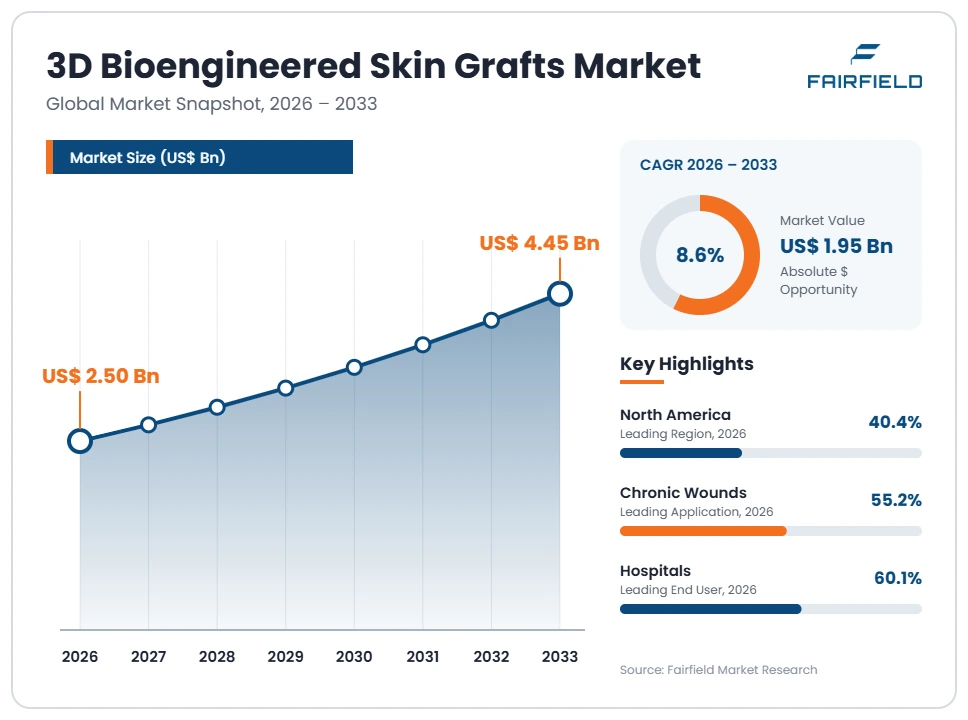
The global 3D bioengineered skin grafts market size is expected to be valued at US$ 2.50 billion in 2026 and projected to reach US$ 4.45 billion by 2033, growing at a CAGR of 8.6% between 2026 and 2033.
Between 2020 and 2025, the market grew at a CAGR of about 9.4%, as use of skin substitutes for diabetic foot ulcers and venous leg ulcers rose sharply in United States outpatient settings. Three factors now support growth: the rising number of chronic wounds linked to diabetes and aging, better outcomes in burn care from cell-based products, and approvals of new gene-corrected and autologous skin therapies. The market is shifting from simple acellular matrices toward multilayered, cell-based, and personalized grafts, while new Medicare payment rules push manufacturers to prove clinical value.
Key Report Takeaways
- By Product Type: Bilayered Grafts held 40.1% share in 2026, while Biosynthetic & Hybrid Grafts are projected to expand at a 10.4% CAGR through 2033, driven by combinations of synthetic scaffolds and living cells that improve durability.
- By Cell Source: Allogeneic held 47.6% share in 2026, while Autologous is projected to expand at a 10.9% CAGR through 2033, driven by patient-derived spray-on and gene-corrected skin products.
- By Application: Chronic Wounds held 55.2% share in 2026, while Acute Wounds & Burns are projected to expand at a 10.1% CAGR through 2033, driven by faster healing and less donor-site damage in burn care.
- By End User: Hospitals held 60.1% share in 2026, while Ambulatory Surgical Centers are projected to expand at a 9.8% CAGR through 2033, driven by outpatient wound procedures and lower treatment costs.
- By Region: North America held 40.4% share in 2026, while Asia Pacific is projected to expand at a 10.6% CAGR through 2033, driven by rising diabetes prevalence and expanding burn centers in China and India.
Global 3D Bioengineered Skin Grafts Market Trends and Insights
Drivers Impact Analysis
Two drivers carry the strongest influence on 3D bioengineered skin graft demand during the forecast period.
| Driver | Impact on CAGR Forecast | Geographic Relevance | Impact Timeline |
| Rising burden of diabetic and chronic wounds | High | Global, strongest in North America and Asia Pacific | Long term (≥4 years) |
| New cell-based and gene-corrected skin approvals | Medium | North America, Europe | Medium term (2–4 years) |
Diabetic and Chronic Wounds Are Driving Demand for 3D Bioengineered Skin Grafts
The rising number of diabetic foot ulcers, venous leg ulcers, and pressure ulcers is the main driver of 3D bioengineered skin graft demand. Chronic wounds can take months to heal and often lead to infection, hospitalization, and amputation.
The scale of the problem is growing with diabetes. The International Diabetes Federation estimates that about 589 million adults were living with diabetes in 2024. Up to a third of people with diabetes may develop a foot ulcer during their lifetime, and these wounds are a leading cause of lower-limb amputation. Aging populations in North America, Europe, and Japan add pressure ulcers and venous ulcers. Bioengineered skin substitutes provide living or structural support that encourages the body to rebuild tissue. Clinical evidence that these products speed wound closure supports their use in specialized wound care centers.
New Cell-Based and Gene-Corrected Approvals Expand the 3D Bioengineered Skin Grafts Market
New approvals of cell-based and gene-corrected skin products are expanding the 3D bioengineered skin grafts market into new indications. These products go beyond traditional matrices by using living cells to rebuild skin layers.
The evidence is recent regulatory activity. In April 2025, the U.S. Food and Drug Administration approved Abeona Therapeutics’ Zevaskyn, a gene-corrected skin cell sheet therapy for wounds in recessive dystrophic epidermolysis bullosa. Each patient’s skin cells are engineered to produce type VII collagen and grown into credit-card-sized sheets. The therapy carries a wholesale price of about US$ 3.1 million. AVITA Medical’s RECELL System uses a patient’s own skin cells to treat burns and other wounds. Vericel’s Epicel grows cultured epidermal autografts for severe burns. These advances raise the value of personalized grafts.
Restraints Impact Analysis
Two restraints limit how quickly 3D bioengineered skin grafts reach more patients.
| Restraint | Impact on CAGR Forecast | Geographic Relevance | Impact Timeline |
| Medicare payment reform for skin substitutes | High | North America | Short term (≤2 years) |
| High manufacturing costs and short shelf life | Medium | Global | Long term (≥4 years) |
Medicare Payment Reform Pressures 3D Bioengineered Skin Graft Pricing
Medicare payment reform is putting strong pressure on prices for 3D bioengineered skin grafts in the United States, the largest market. Spending on skin substitutes in the outpatient setting grew rapidly in recent years, prompting regulators to act.
The specific cause is a change in how products are paid. In November 2025, the Centers for Medicare & Medicaid Services finalized the CY 2026 Physician Fee Schedule, reclassifying many skin substitutes as incident-to supplies. From 1 January 2026, they are paid at about US$ 127.28 per square centimeter, subject to geographic adjustment. This replaces product-specific prices that were often much higher. Manufacturers with high-priced products face sharp revenue declines unless they can show strong clinical value. Smaller companies with limited evidence may exit the market, while others may consolidate.
High Manufacturing Costs and Short Shelf Life Limit 3D Bioengineered Skin Graft Adoption
High manufacturing costs and short shelf life limit adoption of 3D bioengineered skin grafts, especially living cell products. Many grafts require specialized facilities, careful handling, temperature control, and fast delivery to patients.
The underlying causes are biology and regulation. Living cell products must be grown under strict good manufacturing practice conditions, often in clean rooms with highly trained staff. Autologous products require taking a biopsy, growing cells for weeks, and delivering them to the bedside within days. Zevaskyn sheets, for example, take about 25 days to manufacture and have a shelf life of about 84 hours. Cold-chain shipping adds cost and limits access in remote regions and smaller hospitals. These factors keep prices high and restrict use to specialized hospitals and wound centers, particularly in emerging markets with limited funding.
Market Opportunities
Burn Care and Trauma Reconstruction Open a High-Value Revenue Pool for 3D Bioengineered Skin Grafts
Burn care and trauma reconstruction create a high-value revenue pool for 3D bioengineered skin grafts. Severe burns destroy large areas of skin, and patients often lack enough healthy skin for traditional split-thickness grafts.
Companies with autologous and cell-based technologies can capture this demand. AVITA Medical’s RECELL System prepares a suspension of a patient’s own skin cells that can cover large areas from a small donor sample, reducing donor-site wounds. Vericel’s Epicel provides cultured skin for patients with very large burns. The World Health Organization estimates that burns cause about 180,000 deaths each year, mostly in low- and middle-income countries. Burn centers, trauma hospitals, and military medical services are the main customers for these products. Products that shorten hospital stays and improve scar outcomes can justify premium pricing.
Rare Genetic Skin Disorders Create a Specialized Revenue Pool for 3D Bioengineered Skin Grafts
Rare genetic skin disorders create a specialized, high-value revenue pool for 3D bioengineered skin grafts. Conditions such as epidermolysis bullosa cause fragile skin that blisters and tears easily, leading to chronic wounds and pain.
Gene therapy and cell therapy developers are positioned to capture this opportunity. Abeona Therapeutics gained approval for Zevaskyn in 2025, with about 1,500 patients in the United States estimated to be eligible. The company is offering outcomes-based agreements that rebate part of the cost if previously treated wounds need re-treatment within three years. Specialized hospitals with experience in epidermolysis bullosa are the main treatment centers. Similar approaches may extend to other rare skin diseases. Although patient numbers are small, very high prices create meaningful revenue and strengthen the case for personalized engineered skin.
Segment Analysis
- By Product Type: Bilayered Grafts Lead While Biosynthetic & Hybrid Grafts Grow Fastest
Bilayered Grafts held 40.1% share in 2026. These products mimic both the outer epidermis and the deeper dermis, often combining living cells with a collagen matrix. Products such as Organogenesis’ Apligraf have long been used for diabetic foot ulcers and venous leg ulcers, with strong clinical evidence and familiarity among wound specialists.
Biosynthetic & Hybrid Grafts are the fastest-growing product type, expanding at a 10.4% CAGR through 2033. These grafts combine synthetic scaffolds with biological materials or cells to improve strength, shelf life, and consistency. Trilayered grafts and dermal matrices also add options for deep wounds. Developers are using 3D bioprinting and electrospinning to create more realistic skin structures. For the broader market, hybrid products may lower manufacturing costs while maintaining clinical benefits, which matters under new payment rules.
- By Cell Source: Allogeneic Leads While Autologous Grows Fastest
Allogeneic held 47.6% share in 2026. These products use donor cells, often from neonatal foreskin, which can be expanded into large batches and stored for later use. This allows off-the-shelf availability, standardized quality, and consistent supply to wound clinics and hospitals.
Autologous is the fastest-growing cell source, expanding at a 10.9% CAGR through 2033. Products made from a patient’s own cells avoid immune rejection and can be gene-corrected for genetic disorders. AVITA Medical’s RECELL and Abeona’s Zevaskyn show how autologous approaches are reaching commercial use. Acellular grafts remain important for cost-sensitive uses and long-term storage. For the market, autologous growth adds high-value personalized therapies, though they require complex logistics and specialized treatment centers.
- By Application: Chronic Wounds Lead While Acute Wounds & Burns Grow Fastest
Chronic Wounds held 55.2% share in 2026. Diabetic foot ulcers, venous leg ulcers, and pressure ulcers represent the largest use of bioengineered skin substitutes. These wounds affect millions of patients and often fail to heal with standard care alone.
Acute Wounds & Burns are the fastest-growing application, expanding at a 10.1% CAGR through 2033. Burn centers use cell-based grafts to cover large wounds, reduce donor-site damage, and improve scar outcomes. Trauma, surgical, and reconstructive wounds also benefit from bioengineered skin. Genetic skin disorders such as epidermolysis bullosa represent a small but valuable segment. For the market, acute wound growth adds premium hospital demand that is less affected by outpatient payment reform than chronic wound care.
- By End User: Hospitals Lead While Ambulatory Surgical Centers Grow Fastest
Hospitals held 60.1% share in 2026. Burn units, trauma centers, and wound care departments in hospitals treat the most complex cases and have the facilities to handle living cell products. Hospitals also manage patients with severe infections, vascular disease, and amputation risk.
Ambulatory Surgical Centers are the fastest-growing end user, expanding at a 9.8% CAGR through 2033. Many wound procedures, including debridement and graft application, can be performed safely outside hospitals at lower cost. Payers encourage this shift to reduce spending. Wound clinics and physician offices also apply skin substitutes for routine chronic ulcer care. For the market, growth in outpatient settings increases procedure volumes but also exposes manufacturers to payment rules that cap per-centimeter reimbursement.
Geography Analysis
- Which Region Is Leading the 3D Bioengineered Skin Grafts Market?
North America is leading the 3D bioengineered skin grafts market with a 40.4% share in 2026, worth about US$ 1.0 billion. The United States has high diabetes rates, many specialized wound care centers, and leading manufacturers such as Organogenesis, Integra LifeSciences, AVITA Medical, Vericel, and MiMedx Group. Organogenesis reported 2025 net product revenue of about US$ 563 million. However, new Medicare payment rules from January 2026 will pressure prices. Canada adds demand from burn and wound care programs. One change shaping the region is a shift toward evidence-based purchasing and cost-effectiveness reviews.
- Europe Advances Regulated Advanced Therapies in the 3D Bioengineered Skin Grafts Market
Europe is the second-largest regional market, supported by strong burn care and wound management systems. Germany, the United Kingdom, France, Italy, and Spain lead regional demand. Mölnlycke Health Care in Sweden, Tissue Regenix in the United Kingdom, and Kerecis, owned by Coloplast, are important regional players. Cell-based products are regulated as advanced therapy medicinal products under the European Medicines Agency, which raises approval costs and timelines. National health technology assessments strongly influence reimbursement and hospital purchasing. One opportunity is diabetic foot programs that use advanced grafts to reduce amputations.
- Which Region Is Growing Fastest in the 3D Bioengineered Skin Grafts Market?
Asia Pacific is growing fastest in the 3D bioengineered skin grafts market at a 10.6% CAGR through 2033. China and India have the largest numbers of adults with diabetes, which creates large diabetic foot ulcer populations. Burn injuries from cooking fires and industrial accidents are also common in the region. Japan has an aging population and approved regenerative medicine products such as JACE, a cultured epidermal autograft. South Korea and Australia have advanced biotechnology sectors, and AROA Biosurgery in New Zealand supplies tissue matrices. One opportunity is affordable, locally manufactured grafts for public hospitals and diabetic foot programs.
- Latin America Expands Wound Care in the 3D Bioengineered Skin Grafts Market
Latin America is an emerging region in this market, where diabetes and burn injuries drive demand. Brazil and Mexico have large diabetic populations and fast-growing private hospital networks. Argentina, Colombia, and Chile are expanding specialized wound and burn centers in major cities. Key barriers include limited public reimbursement for advanced products, high import costs, long regulatory reviews, and currency volatility. Many public hospitals still rely on traditional skin grafts and basic dressings for burns and ulcers. One opportunity is regional tissue banks and local manufacturing partnerships that lower costs and improve access to bioengineered skin in public health systems.
- Middle East & Africa Builds Burn and Diabetic Care in the 3D Bioengineered Skin Grafts Market
Middle East & Africa is a developing region with high diabetes rates in the Gulf and a heavy burn injury burden in Africa. Saudi Arabia, the United Arab Emirates, and Kuwait have some of the world’s highest diabetes prevalence, creating demand for advanced wound care. Gulf governments are investing in specialized hospitals and diabetic foot clinics. In Africa, burns are a major cause of injury, but access to advanced grafts is very limited. Key barriers include cost, limited burn centers, and cold-chain gaps. One opportunity is acellular grafts that can be stored without refrigeration in hot climates.
Competitive Landscape
The 3D bioengineered skin grafts market is moderately concentrated. Organogenesis, Integra LifeSciences, MiMedx Group, AVITA Medical, and Vericel hold strong positions in North America. Smith & Nephew, Mölnlycke Health Care, Kerecis, Tissue Regenix, and AROA Biosurgery compete globally. Newer entrants such as Abeona Therapeutics focus on gene-corrected cell therapies, while research companies such as Genoskin supply skin models.
Companies compete on clinical evidence, healing rates, ease of use, shelf life, price, and reimbursement support services for providers. Under new Medicare rules, proof of cost-effectiveness and real-world healing outcomes has become critical for winning business. Strong relationships with wound care centers, burn units, and group purchasing organizations also matter.
Strategic moves show how competition is changing. Abeona Therapeutics gained FDA approval for Zevaskyn in April 2025, creating a new category of gene-corrected skin. Organogenesis reported 2025 net product revenue of about US$ 563 million, with advanced wound care revenue up 17%. AVITA Medical continues to expand RECELL use in burns and trauma. CMS finalized a flat payment rate for many skin substitutes in November 2025. Together, these moves show competition shifting from volume toward clinical evidence and differentiated technology.
Three themes shape vendor strategy. First, companies are building clinical evidence to justify value under new payment rules. Second, they are expanding into burns, trauma, and rare diseases. Third, they are actively developing 3D bioprinted and hybrid grafts that may lower costs while improving outcomes.
Recent Industry Developments
- March 2026: Organogenesis reported 2025 net product revenue of about US$ 563 million – shows continued demand before new payment rules took effect.
- November 2025: CMS finalized a flat payment of about US$ 127.28 per square centimeter for many skin substitutes – resets pricing for outpatient wound care.
- April 2025: Abeona Therapeutics received FDA approval for Zevaskyn – introduces gene-corrected skin sheets for epidermolysis bullosa.
Companies Covered in the Report
- Organogenesis
- Integra LifeSciences
- AVITA Medical
- Vericel
- MiMedx Group
- Smith & Nephew
- Mölnlycke Health Care
- Kerecis (Coloplast)
- Tissue Regenix
- AROA Biosurgery
- Abeona Therapeutics
- Genoskin
3D Bioengineered Skin Grafts Market Report Scope
| Metric | Value |
| Study Period | 2020–2033 |
| Market Size 2026 | US$ 2.50 Billion |
| Market Size 2033 | US$ 4.45 Billion |
| CAGR 2026–2033 | 8.6% |
| Absolute Dollar Opportunity | US$ 1.95 Billion |
| Largest Market | North America |
| Fastest-Growing Market | Asia Pacific |
| Market Concentration | Medium |
| Major Players | Organogenesis, Integra LifeSciences, AVITA Medical, Vericel, MiMedx Group |
3D Bioengineered Skin Grafts Market Segmentation
Product Type
- Bilayered Grafts
- Trilayered Grafts
- Biosynthetic & Hybrid Grafts
- Cultured Epidermal Grafts
Cell Source
- Allogeneic
- Autologous
- Acellular
Application
- Chronic Wounds
- Acute Wounds & Burns
- Genetic Skin Disorders
- Reconstructive Surgery
End User
- Hospitals
- Ambulatory Surgical Centers
- Wound Care Clinics
Regions
- North America
- Europe
- Asia Pacific
- Latin America
- Middle East & Africa
- Executive Summary
- Global 3D Bioengineered Skin Grafts Market Snapshot
- Future Projections
- Key Report Takeaways
- Regional Snapshot
- Market Overview
- Market Definition and Report Scope
- Historical Trends 2020–2025
- Market Dynamics
- Drivers
- Diabetic and Chronic Wounds Are Driving Demand for 3D Bioengineered Skin Grafts
- New Cell-Based and Gene-Corrected Approvals Expand the 3D Bioengineered Skin Grafts Market
- Restraints
- Medicare Payment Reform Pressures 3D Bioengineered Skin Graft Pricing
- High Manufacturing Costs and Short Shelf Life Limit 3D Bioengineered Skin Graft Adoption
- Market Opportunities
- Burn Care and Trauma Reconstruction Open a High-Value Revenue Pool for 3D Bioengineered Skin Grafts
- Rare Genetic Skin Disorders Create a Specialized Revenue Pool for 3D Bioengineered Skin Grafts
- Drivers
- Global 3D Bioengineered Skin Grafts Market Outlook, 2020–2033
- Global 3D Bioengineered Skin Grafts Market Outlook, by Product Type, Value (US$ Billion), 2020–2033
- Bilayered Grafts
- Trilayered Grafts
- Biosynthetic & Hybrid Grafts
- Cultured Epidermal Grafts
- Global 3D Bioengineered Skin Grafts Market Outlook, by Cell Source, Value (US$ Billion), 2020–2033
- Allogeneic
- Autologous
- Acellular
- Global 3D Bioengineered Skin Grafts Market Outlook, by Application, Value (US$ Billion), 2020–2033
- Chronic Wounds
- Acute Wounds & Burns
- Genetic Skin Disorders
- Reconstructive Surgery
- Global 3D Bioengineered Skin Grafts Market Outlook, by End User, Value (US$ Billion), 2020–2033
- Hospitals
- Ambulatory Surgical Centers
- Wound Care Clinics
- Global 3D Bioengineered Skin Grafts Market Outlook, by Region, Value (US$ Billion), 2020–2033
- North America
- Europe
- Asia Pacific
- Latin America
- Middle East & Africa
- Global 3D Bioengineered Skin Grafts Market Outlook, by Product Type, Value (US$ Billion), 2020–2033
- North America 3D Bioengineered Skin Grafts Market Outlook, 2020–2033
- North America 3D Bioengineered Skin Grafts Market Outlook, by Product Type, Value (US$ Billion), 2020–2033
- Bilayered Grafts
- Trilayered Grafts
- Biosynthetic & Hybrid Grafts
- Cultured Epidermal Grafts
- North America 3D Bioengineered Skin Grafts Market Outlook, by Cell Source, Value (US$ Billion), 2020–2033
- Allogeneic
- Autologous
- Acellular
- North America 3D Bioengineered Skin Grafts Market Outlook, by Application, Value (US$ Billion), 2020–2033
- Chronic Wounds
- Acute Wounds & Burns
- Genetic Skin Disorders
- Reconstructive Surgery
- North America 3D Bioengineered Skin Grafts Market Outlook, by End User, Value (US$ Billion), 2020–2033
- Hospitals
- Ambulatory Surgical Centers
- Wound Care Clinics
- North America 3D Bioengineered Skin Grafts Market Outlook, by Country, Value (US$ Billion), 2020–2033
- United States 3D Bioengineered Skin Grafts Market Outlook, by Product Type, 2020–2033
- United States 3D Bioengineered Skin Grafts Market Outlook, by Cell Source, 2020–2033
- United States 3D Bioengineered Skin Grafts Market Outlook, by Application, 2020–2033
- United States 3D Bioengineered Skin Grafts Market Outlook, by End User, 2020–2033
- Canada 3D Bioengineered Skin Grafts Market Outlook, by Product Type, 2020–2033
- Canada 3D Bioengineered Skin Grafts Market Outlook, by Cell Source, 2020–2033
- Canada 3D Bioengineered Skin Grafts Market Outlook, by Application, 2020–2033
- Canada 3D Bioengineered Skin Grafts Market Outlook, by End User, 2020–2033
- North America 3D Bioengineered Skin Grafts Market Outlook, by Product Type, Value (US$ Billion), 2020–2033
- Europe 3D Bioengineered Skin Grafts Market Outlook, 2020–2033
- Europe 3D Bioengineered Skin Grafts Market Outlook, by Product Type, Value (US$ Billion), 2020–2033
- Bilayered Grafts
- Trilayered Grafts
- Biosynthetic & Hybrid Grafts
- Cultured Epidermal Grafts
- Europe 3D Bioengineered Skin Grafts Market Outlook, by Cell Source, Value (US$ Billion), 2020–2033
- Allogeneic
- Autologous
- Acellular
- Europe 3D Bioengineered Skin Grafts Market Outlook, by Application, Value (US$ Billion), 2020–2033
- Chronic Wounds
- Acute Wounds & Burns
- Genetic Skin Disorders
- Reconstructive Surgery
- Europe 3D Bioengineered Skin Grafts Market Outlook, by End User, Value (US$ Billion), 2020–2033
- Hospitals
- Ambulatory Surgical Centers
- Wound Care Clinics
- Europe 3D Bioengineered Skin Grafts Market Outlook, by Country, Value (US$ Billion), 2020–2033
- Germany 3D Bioengineered Skin Grafts Market Outlook, by Product Type, 2020–2033
- Germany 3D Bioengineered Skin Grafts Market Outlook, by Cell Source, 2020–2033
- Germany 3D Bioengineered Skin Grafts Market Outlook, by Application, 2020–2033
- Germany 3D Bioengineered Skin Grafts Market Outlook, by End User, 2020–2033
- United Kingdom 3D Bioengineered Skin Grafts Market Outlook, by Product Type, 2020–2033
- United Kingdom 3D Bioengineered Skin Grafts Market Outlook, by Cell Source, 2020–2033
- United Kingdom 3D Bioengineered Skin Grafts Market Outlook, by Application, 2020–2033
- United Kingdom 3D Bioengineered Skin Grafts Market Outlook, by End User, 2020–2033
- France 3D Bioengineered Skin Grafts Market Outlook, by Product Type, 2020–2033
- France 3D Bioengineered Skin Grafts Market Outlook, by Cell Source, 2020–2033
- France 3D Bioengineered Skin Grafts Market Outlook, by Application, 2020–2033
- France 3D Bioengineered Skin Grafts Market Outlook, by End User, 2020–2033
- Italy 3D Bioengineered Skin Grafts Market Outlook, by Product Type, 2020–2033
- Italy 3D Bioengineered Skin Grafts Market Outlook, by Cell Source, 2020–2033
- Italy 3D Bioengineered Skin Grafts Market Outlook, by Application, 2020–2033
- Italy 3D Bioengineered Skin Grafts Market Outlook, by End User, 2020–2033
- Spain 3D Bioengineered Skin Grafts Market Outlook, by Product Type, 2020–2033
- Spain 3D Bioengineered Skin Grafts Market Outlook, by Cell Source, 2020–2033
- Spain 3D Bioengineered Skin Grafts Market Outlook, by Application, 2020–2033
- Spain 3D Bioengineered Skin Grafts Market Outlook, by End User, 2020–2033
- Sweden 3D Bioengineered Skin Grafts Market Outlook, by Product Type, 2020–2033
- Sweden 3D Bioengineered Skin Grafts Market Outlook, by Cell Source, 2020–2033
- Sweden 3D Bioengineered Skin Grafts Market Outlook, by Application, 2020–2033
- Sweden 3D Bioengineered Skin Grafts Market Outlook, by End User, 2020–2033
- Europe 3D Bioengineered Skin Grafts Market Outlook, by Product Type, Value (US$ Billion), 2020–2033
- Asia Pacific 3D Bioengineered Skin Grafts Market Outlook, 2020–2033
- Asia Pacific 3D Bioengineered Skin Grafts Market Outlook, by Product Type, Value (US$ Billion), 2020–2033
- Bilayered Grafts
- Trilayered Grafts
- Biosynthetic & Hybrid Grafts
- Cultured Epidermal Grafts
- Asia Pacific 3D Bioengineered Skin Grafts Market Outlook, by Cell Source, Value (US$ Billion), 2020–2033
- Allogeneic
- Autologous
- Acellular
- Asia Pacific 3D Bioengineered Skin Grafts Market Outlook, by Application, Value (US$ Billion), 2020–2033
- Chronic Wounds
- Acute Wounds & Burns
- Genetic Skin Disorders
- Reconstructive Surgery
- Asia Pacific 3D Bioengineered Skin Grafts Market Outlook, by End User, Value (US$ Billion), 2020–2033
- Hospitals
- Ambulatory Surgical Centers
- Wound Care Clinics
- Asia Pacific 3D Bioengineered Skin Grafts Market Outlook, by Country, Value (US$ Billion), 2020–2033
- China 3D Bioengineered Skin Grafts Market Outlook, by Product Type, 2020–2033
- China 3D Bioengineered Skin Grafts Market Outlook, by Cell Source, 2020–2033
- China 3D Bioengineered Skin Grafts Market Outlook, by Application, 2020–2033
- China 3D Bioengineered Skin Grafts Market Outlook, by End User, 2020–2033
- India 3D Bioengineered Skin Grafts Market Outlook, by Product Type, 2020–2033
- India 3D Bioengineered Skin Grafts Market Outlook, by Cell Source, 2020–2033
- India 3D Bioengineered Skin Grafts Market Outlook, by Application, 2020–2033
- India 3D Bioengineered Skin Grafts Market Outlook, by End User, 2020–2033
- Japan 3D Bioengineered Skin Grafts Market Outlook, by Product Type, 2020–2033
- Japan 3D Bioengineered Skin Grafts Market Outlook, by Cell Source, 2020–2033
- Japan 3D Bioengineered Skin Grafts Market Outlook, by Application, 2020–2033
- Japan 3D Bioengineered Skin Grafts Market Outlook, by End User, 2020–2033
- South Korea 3D Bioengineered Skin Grafts Market Outlook, by Product Type, 2020–2033
- South Korea 3D Bioengineered Skin Grafts Market Outlook, by Cell Source, 2020–2033
- South Korea 3D Bioengineered Skin Grafts Market Outlook, by Application, 2020–2033
- South Korea 3D Bioengineered Skin Grafts Market Outlook, by End User, 2020–2033
- Australia 3D Bioengineered Skin Grafts Market Outlook, by Product Type, 2020–2033
- Australia 3D Bioengineered Skin Grafts Market Outlook, by Cell Source, 2020–2033
- Australia 3D Bioengineered Skin Grafts Market Outlook, by Application, 2020–2033
- Australia 3D Bioengineered Skin Grafts Market Outlook, by End User, 2020–2033
- New Zealand 3D Bioengineered Skin Grafts Market Outlook, by Product Type, 2020–2033
- New Zealand 3D Bioengineered Skin Grafts Market Outlook, by Cell Source, 2020–2033
- New Zealand 3D Bioengineered Skin Grafts Market Outlook, by Application, 2020–2033
- New Zealand 3D Bioengineered Skin Grafts Market Outlook, by End User, 2020–2033
- Asia Pacific 3D Bioengineered Skin Grafts Market Outlook, by Product Type, Value (US$ Billion), 2020–2033
- Latin America 3D Bioengineered Skin Grafts Market Outlook, 2020–2033
- Latin America 3D Bioengineered Skin Grafts Market Outlook, by Product Type, Value (US$ Billion), 2020–2033
- Bilayered Grafts
- Trilayered Grafts
- Biosynthetic & Hybrid Grafts
- Cultured Epidermal Grafts
- Latin America 3D Bioengineered Skin Grafts Market Outlook, by Cell Source, Value (US$ Billion), 2020–2033
- Allogeneic
- Autologous
- Acellular
- Latin America 3D Bioengineered Skin Grafts Market Outlook, by Application, Value (US$ Billion), 2020–2033
- Chronic Wounds
- Acute Wounds & Burns
- Genetic Skin Disorders
- Reconstructive Surgery
- Latin America 3D Bioengineered Skin Grafts Market Outlook, by End User, Value (US$ Billion), 2020–2033
- Hospitals
- Ambulatory Surgical Centers
- Wound Care Clinics
- Latin America 3D Bioengineered Skin Grafts Market Outlook, by Country, Value (US$ Billion), 2020–2033
- Brazil 3D Bioengineered Skin Grafts Market Outlook, by Product Type, 2020–2033
- Brazil 3D Bioengineered Skin Grafts Market Outlook, by Cell Source, 2020–2033
- Brazil 3D Bioengineered Skin Grafts Market Outlook, by Application, 2020–2033
- Brazil 3D Bioengineered Skin Grafts Market Outlook, by End User, 2020–2033
- Mexico 3D Bioengineered Skin Grafts Market Outlook, by Product Type, 2020–2033
- Mexico 3D Bioengineered Skin Grafts Market Outlook, by Cell Source, 2020–2033
- Mexico 3D Bioengineered Skin Grafts Market Outlook, by Application, 2020–2033
- Mexico 3D Bioengineered Skin Grafts Market Outlook, by End User, 2020–2033
- Argentina 3D Bioengineered Skin Grafts Market Outlook, by Product Type, 2020–2033
- Argentina 3D Bioengineered Skin Grafts Market Outlook, by Cell Source, 2020–2033
- Argentina 3D Bioengineered Skin Grafts Market Outlook, by Application, 2020–2033
- Argentina 3D Bioengineered Skin Grafts Market Outlook, by End User, 2020–2033
- Colombia 3D Bioengineered Skin Grafts Market Outlook, by Product Type, 2020–2033
- Colombia 3D Bioengineered Skin Grafts Market Outlook, by Cell Source, 2020–2033
- Colombia 3D Bioengineered Skin Grafts Market Outlook, by Application, 2020–2033
- Colombia 3D Bioengineered Skin Grafts Market Outlook, by End User, 2020–2033
- Chile 3D Bioengineered Skin Grafts Market Outlook, by Product Type, 2020–2033
- Chile 3D Bioengineered Skin Grafts Market Outlook, by Cell Source, 2020–2033
- Chile 3D Bioengineered Skin Grafts Market Outlook, by Application, 2020–2033
- Chile 3D Bioengineered Skin Grafts Market Outlook, by End User, 2020–2033
- Latin America 3D Bioengineered Skin Grafts Market Outlook, by Product Type, Value (US$ Billion), 2020–2033
- Middle East & Africa 3D Bioengineered Skin Grafts Market Outlook, 2020–2033
- Middle East & Africa 3D Bioengineered Skin Grafts Market Outlook, by Product Type, Value (US$ Billion), 2020–2033
- Bilayered Grafts
- Trilayered Grafts
- Biosynthetic & Hybrid Grafts
- Cultured Epidermal Grafts
- Middle East & Africa 3D Bioengineered Skin Grafts Market Outlook, by Cell Source, Value (US$ Billion), 2020–2033
- Allogeneic
- Autologous
- Acellular
- Middle East & Africa 3D Bioengineered Skin Grafts Market Outlook, by Application, Value (US$ Billion), 2020–2033
- Chronic Wounds
- Acute Wounds & Burns
- Genetic Skin Disorders
- Reconstructive Surgery
- Middle East & Africa 3D Bioengineered Skin Grafts Market Outlook, by End User, Value (US$ Billion), 2020–2033
- Hospitals
- Ambulatory Surgical Centers
- Wound Care Clinics
- Middle East & Africa 3D Bioengineered Skin Grafts Market Outlook, by Country, Value (US$ Billion), 2020–2033
- Saudi Arabia 3D Bioengineered Skin Grafts Market Outlook, by Product Type, 2020–2033
- Saudi Arabia 3D Bioengineered Skin Grafts Market Outlook, by Cell Source, 2020–2033
- Saudi Arabia 3D Bioengineered Skin Grafts Market Outlook, by Application, 2020–2033
- Saudi Arabia 3D Bioengineered Skin Grafts Market Outlook, by End User, 2020–2033
- United Arab Emirates 3D Bioengineered Skin Grafts Market Outlook, by Product Type, 2020–2033
- United Arab Emirates 3D Bioengineered Skin Grafts Market Outlook, by Cell Source, 2020–2033
- United Arab Emirates 3D Bioengineered Skin Grafts Market Outlook, by Application, 2020–2033
- United Arab Emirates 3D Bioengineered Skin Grafts Market Outlook, by End User, 2020–2033
- Kuwait 3D Bioengineered Skin Grafts Market Outlook, by Product Type, 2020–2033
- Kuwait 3D Bioengineered Skin Grafts Market Outlook, by Cell Source, 2020–2033
- Kuwait 3D Bioengineered Skin Grafts Market Outlook, by Application, 2020–2033
- Kuwait 3D Bioengineered Skin Grafts Market Outlook, by End User, 2020–2033
- Middle East & Africa 3D Bioengineered Skin Grafts Market Outlook, by Product Type, Value (US$ Billion), 2020–2033
- Competitive Landscape
- Market Concentration and Industry Leaders
- Competitive Differentiation
- Strategic Moves and Market Direction
- Recent Industry Developments
- Company Profiles
- Organogenesis
- Integra LifeSciences
- AVITA Medical
- Vericel
- MiMedx Group
- Smith & Nephew
- Mölnlycke Health Care
- Kerecis (Coloplast)
- Tissue Regenix
- AROA Biosurgery
- Abeona Therapeutics
- Genoskin
- Appendix
- Research Methodology
- Report Assumptions
- Acronyms and Abbreviations
Product Type
- Bilayered Grafts
- Trilayered Grafts
- Biosynthetic & Hybrid Grafts
- Cultured Epidermal Grafts
Cell Source
- Allogeneic
- Autologous
- Acellular
Application
- Chronic Wounds
- Acute Wounds & Burns
- Genetic Skin Disorders
- Reconstructive Surgery
End User
- Hospitals
- Ambulatory Surgical Centers
- Wound Care Clinics
Regions
- North America
- Europe
- Asia Pacific
- Latin America
- Middle East & Africa
Our Research Methodology
Considering the volatility of business today, traditional approaches to strategizing a game plan can be unfruitful if not detrimental. True ambiguity is no way to determine a forecast. A myriad of predetermined factors must be accounted for such as the degree of risk involved, the magnitude of circumstances, as well as conditions or consequences that are not known or unpredictable. To circumvent binary views that cast uncertainty, the application of market research intelligence to strategically posture, move, and enable actionable outcomes is necessary.
View Methodology
Quality Assured
Rigorous Validation Process

Confidentiality Assured
End-to-end Data Security

Custom Research Services
Tailored To Your Objectives
FAQs
The 3D bioengineered skin grafts market is valued at US$ 2.50 billion in 2026, led by bilayered grafts for chronic wounds.
The market is projected to reach US$ 4.45 billion by 2033, growing at an 8.6% CAGR and adding US$ 1.95 billion.
Chronic Wounds lead with 55.2% share in 2026, driven by diabetic foot ulcers, venous leg ulcers, and pressure ulcers.
Asia Pacific is growing fastest at a 10.6% CAGR through 2033, driven by diabetes prevalence and expanding burn centers.
North America holds the largest share at 40.4% in 2026, supported by specialized wound care centers and leading manufacturers.
Related Reports
Respiratory Diagnostics Market Size, Share, Insights, Competitive Landscape, and Forecast 2026 to 2033
The global respiratory diagnostics market is valued at US$9.66 billion in 2026, reaching US$14.69 billion by 2033, growing at a 6.2% CAGR
Microtainer Blood Collection Market Size, Share, Insights, Competitive Landscape, and Forecast 2026 to 2033
The global microtainer blood collection market is valued at US$1.37 billion in 2026, reaching US$2.20 billion by 2033, growing at a 7.0% CAGR
Orthopedic Pulse Lavage Systems Market Size, Share, Insights, Competitive Landscape, and Forecast 2026 to 2033
The global orthopedic pulse lavage systems market is valued at US$0.6 billion in 2026, reaching US$0.9 billion by 2033, at a 6.0% CAGR
Diabetic Lancing Device Market Size, Share, Insights, Competitive Landscape, and Forecast 2026 to 2033
The global diabetic lancing device market is valued at US$2.1 billion in 2026, reaching US$2.4 billion by 2033, growing at a 1.93% CAGR
Ankle Boots Market Insights, Competitive Landscape, and Market Forecast 2033
The ankle boots market is valued at USD 18.50 Bn in 2026 and is projected to reach USD 27.45 Bn by 2033, expanding at a CAGR of 5.8% during 2026-2033
Foot And Ankle Devices Market Insights, Competitive Landscape, and Market Forecast 2033
The foot and ankle devices market will grow from USD 6.40 Bn in 2026 to USD 10.14 Bn by 2033 at a CAGR of 6.8%, driven by rising trauma & sports injuries.