



Orthopedic Pulse Lavage Systems Market
Orthopedic Pulse Lavage Systems Market Size, Share, Insights, Competitive Landscape, and Forecast 2026 to 2033
Orthopedic Pulse Lavage Systems Market Size and Trend Analysis
How Big Is the Orthopedic Pulse Lavage Systems Market?
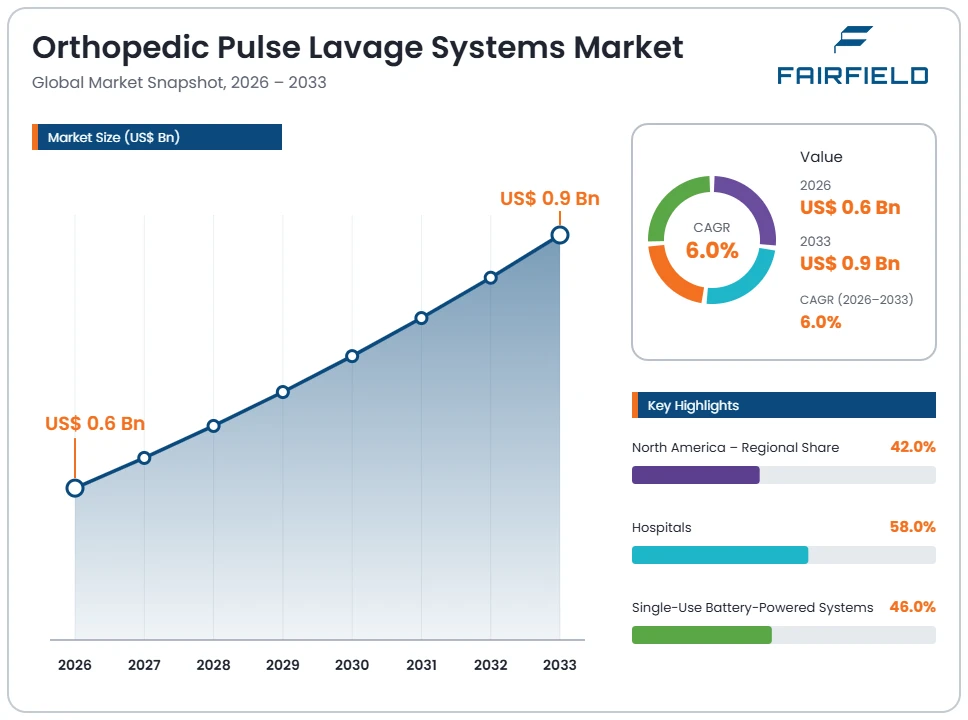
The global Orthopedic Pulse Lavage Systems market size is expected to be valued at US$ 0.6 billion in 2026 and projected to reach US$ 0.9 billion by 2033, growing at a CAGR of 6.0% between 2026 and 2033.
Between 2020 and 2025 the market expanded at a 4.8% CAGR, held back by deferred elective surgery in the early part of that period. Three factors support the current outlook. Rising volumes of primary and revision joint replacement in ageing populations lift consumption of single-use handpieces and tip sets. Infection-prevention programmes built around the U.S. Centers for Disease Control and Prevention and World Health Organization surgical site infection guidelines keep mechanical irrigation inside routine operating room practice. Hospital supply teams also favour sealed, battery-powered disposables that remove reprocessing work and validation paperwork. The direction of travel is steady rather than rapid, because the underlying procedure base grows in single digits and consolidated purchasing contracts limit realised value per unit.
Key Report Takeaways
- By Product Type: Single-Use Battery-Powered Systems held 46% share in 2026, while Tip Sets and Accessories are projected to expand at a 7.4% CAGR through 2033, driven by procedure-specific nozzle and splash-shield configurations sold alongside each handpiece.
- By Application: Joint Replacement Surgery held 38% share in 2026, while Wound Debridement and Soft Tissue is projected to expand at a 7.8% CAGR through 2033, driven by wider use of staged washout protocols in periprosthetic and diabetic wound care.
- By End User: Hospitals held 58% share in 2026, while Ambulatory Surgical Centers are projected to expand at an 8.6% CAGR through 2033, driven by payer-led migration of lower-acuity arthroplasty and sports medicine cases to outpatient settings.
- By Pressure Setting: High-Pressure Systems held 44% share in 2026, while Low-Pressure Systems are projected to expand at an 8.1% CAGR through 2033, driven by surgeon concern about soft tissue damage and bacterial displacement at higher irrigation pressures.
- By Geography: North America held 42% share in 2026, while Asia Pacific is projected to expand at an 8.4% CAGR through 2033, driven by hospital construction and rising arthroplasty access in China, India and South Korea.
Global Orthopedic Pulse Lavage Systems Market Trends and Insights
Drivers Impact Analysis
Two demand forces account for most of the forecast growth in powered surgical irrigation.
| Driver | Impact on CAGR Forecast | Geographic Relevance | Impact Timeline |
| Growth in primary and revision joint replacement procedures | High | North America, Europe, Asia Pacific | Long term ≥4 years |
| Migration from reusable consoles to single-use battery-powered handpieces | Medium | North America, Europe | Medium term 2–4 years |
Rising Joint Replacement and Revision Volumes Lift Pulse Lavage Consumable Use
Growth in hip and knee arthroplasty is the single largest demand input for pulsatile lavage devices. Each arthroplasty case that uses powered irrigation consumes one handpiece, one or more tips and a suction set, so device demand tracks procedure counts almost directly. Revision cases consume more, because surgeons irrigate larger exposed surfaces and often perform staged washouts. National joint registries in Australia, the United Kingdom and the Nordic countries record steady annual increases in both primary and revision procedures.
The mechanism is demographic rather than technological. Populations above 65 years are growing in every major healthcare market, and osteoarthritis prevalence rises sharply with age. Implant longevity also means a larger installed base of prostheses reaching revision. Bone cement interdigitation depends on a clean, debris-free cancellous surface, which keeps irrigation inside cemented arthroplasty technique and sustains orthopedic irrigation and suction demand.
Single-Use Battery-Powered Handpieces Raise Device Value per Surgical Case
The move away from reusable consoles toward sealed battery-powered handpieces raises the revenue captured from each procedure. A reusable system spreads capital cost across hundreds of cases and charges only for tubing sets. A disposable handpiece, by contrast, is billed per case at a far higher unit price, which lifts realised value even where procedure counts are flat. This substitution is the main reason value growth outpaces volume growth in surgical irrigation systems.
Sterile processing economics drive the switch. Reprocessing a powered device requires validated cleaning cycles, lumen brushing, functional testing and documented traceability under hospital quality systems aligned to ISO 13485 supplier requirements. Staffing shortages in central sterile departments have made that work harder to guarantee. Single-use lavage handpieces remove the cleaning validation burden and the cross-contamination question in one step.
Restraints Impact Analysis
Two structural constraints hold back faster expansion of this surgical consumables niche.
| Restraint | Impact on CAGR Forecast | Geographic Relevance | Impact Timeline |
| Contested clinical evidence on high-pressure pulsatile irrigation | High | Global | Long term ≥4 years |
| Consolidated hospital purchasing and disposable waste handling costs | Medium | North America, Europe | Short term ≤2 years |
Contested Evidence on High-Pressure Irrigation Limits Pulse Lavage Penetration
Clinical uncertainty is the most important brake on adoption. Evidence on whether high-pressure pulsatile lavage improves outcomes over low-pressure or gravity bulb irrigation remains contested across the orthopaedic literature. Several studies have reported that higher irrigation pressures can damage cancellous bone architecture and soft tissue, and can drive bacteria deeper into tissue planes rather than removing them. Where surgical teams read the evidence as unsettled, bulb syringes remain an accepted and far cheaper alternative.
The underlying cause is methodological. Randomised trials in this field vary widely in irrigant choice, pressure setting, timing and contamination model, so results do not pool cleanly. Open fracture trials comparing irrigation pressures have reported no outcome advantage for high-pressure delivery. That ambiguity pushes some institutions toward restrictive protocols and slows capital and consumable commitments to pulsatile lavage devices.
Consolidated Purchasing and Disposable Waste Costs Compress Lavage Margins
Price pressure from organised hospital buying limits margin on every unit sold. Group purchasing organisations and national tender bodies aggregate demand across hundreds of sites and award contracts largely on landed cost per case. Suppliers that lose a contract cycle can lose an entire hospital network at once. This concentrates negotiating power on the buyer side and keeps list-to-net discounting wide across single-use lavage handpieces.
Disposal economics add a second cost layer. A pulse lavage case generates a rigid plastic handpiece, tubing, a splash shield and a volume of blood-contaminated irrigant suctioned into canisters. That waste is classified as regulated medical waste in most jurisdictions and is charged by weight, at rates well above general waste. Battery-containing handpieces also attract separate electrical waste handling obligations in European Union member states.
Market Opportunities
Two revenue pools sit outside the traditional hospital inpatient channel.
Outpatient Arthroplasty Creates a Compact Lavage Kit Revenue Pool
The shift of joint replacement into ambulatory surgical centres opens a product tier that barely existed a decade ago. Outpatient facilities run tight turnover schedules, limited sterile processing capacity and smaller storage footprints. They need low-cost, fully disposable kits that arrive pre-assembled with tip, shield and suction line in one sterile pouch. Vendors that package for this setting can win share without competing on inpatient tender pricing.
Payer policy creates the demand. Reimbursement authorities in several markets have moved total knee and total hip procedures onto outpatient-eligible lists, and surgical centres have invested accordingly. Orthopaedic specialty groups that own their facilities buy consumables directly rather than through hospital contracts, which shortens the sales cycle considerably. Compact wound debridement equipment sized for day-case theatres fits this purchasing pattern well, and single-pouch kits reduce both storage space and theatre setup time.
Pressure-Regulated and Low-Pressure Systems Open a Safety-Led Product Tier
Devices that let surgeons select and verify irrigation pressure create a differentiated premium tier. Because the clinical debate centres on pressure rather than on irrigation itself, a handpiece offering calibrated low-pressure, medium-pressure and high-pressure modes answers the objection directly. Products with documented flow and pressure specifications allow hospitals to standardise protocols by procedure type instead of banning powered irrigation outright.
Infection prevention committees and value analysis teams are the buyers here, not only surgeons. These committees assess devices against surgical site infection guidance from the World Health Organization and national bodies, and they reward documented performance claims. Suppliers able to show verified pressure output across the trigger range, supported by testing under IEC 60601-1 electrical safety requirements, can defend price in categories where undifferentiated pulsatile lavage devices are discounted heavily.
Segment Analysis
- By Product Type: Single-Use Battery-Powered Systems Lead While Tip Sets and Accessories Gain Pace
Single-Use Battery-Powered Systems held 46% of revenue in 2026, the largest share of any product category. Sealed disposable handpieces suit hospitals that want to avoid reprocessing validation, and they deliver consistent flow without a capital console. Their price per case is several times that of a tubing set for a reusable unit, which concentrates value in this line. Tip Sets and Accessories are the fastest-growing product line at a 7.4% CAGR through 2033. Surgeons increasingly select procedure-specific nozzles, including fan sprays for broad cancellous surfaces, brush tips for cement removal and narrow tips for intramedullary canals. Splash shields and suction wands attach to the same platform and are sold per case. Reusable Powered Systems retain a position in high-volume public hospitals with mature sterile processing capacity. The practical implication is that attachment rate per handpiece, rather than handpiece unit count alone, now determines supplier revenue growth.
- By Application: Joint Replacement Surgery Anchors Volume as Wound Debridement Accelerates
Joint Replacement Surgery accounted for 38% of demand in 2026 and remains the anchor application for pulsatile lavage devices. Cemented hip and knee procedures depend on a clean cancellous bed for cement interdigitation, which makes irrigation part of standard technique rather than an optional step. Trauma and Fracture Fixation follows, supported by open fracture management protocols. Wound Debridement and Soft Tissue is expanding fastest at a 7.8% CAGR to 2033. Growth here comes from staged washout protocols in periprosthetic joint infection, from diabetic foot and pressure ulcer care, and from burn and contaminated wound management outside the orthopaedic theatre. Spine Surgery contributes a smaller but stable share, concentrated in instrumented fusion cases. The business implication is that suppliers can extend an orthopaedic installed base into wound care departments without building a new manufacturing platform, since the handpiece is common and only the tip changes.
- By End User: Hospitals Carry the Volume While Ambulatory Surgical Centers Scale Fastest
Hospitals represented 58% of purchases in 2026, reflecting their continued ownership of complex arthroplasty, polytrauma and infected revision caseloads. Inpatient theatres also handle the procedures that consume the most irrigant and the widest range of tips. Orthopedic Specialty Clinics and Trauma and Emergency Centers together make up the balance alongside outpatient facilities. Ambulatory Surgical Centers are the fastest-growing end user at an 8.6% CAGR through 2033. Reimbursement changes have moved a meaningful share of unicompartmental knee, total knee and anterior approach hip procedures into day surgery, and these centres buy fully disposable kits because they lack large sterile processing departments. Purchasing authority sits with facility managers and physician owners rather than with central supply committees. For suppliers this changes the commercial model, since direct and distributor-led selling to independent facilities replaces multi-year hospital tender negotiation and allows faster adoption of new tip configurations.
- By Pressure Setting: High-Pressure Systems Still Lead While Low-Pressure Options Close the Gap
High-Pressure Systems held 44% share in 2026, a position built on installed surgeon preference and on the belief that greater mechanical energy removes more debris and bacterial load. These settings remain common in cement removal and heavily contaminated trauma wounds. Medium-Pressure Systems hold a substantial middle position and are often the default on multi-setting handpieces. Low-Pressure Systems are growing fastest at an 8.1% CAGR to 2033. That shift follows published concern that higher pressures may damage cancellous bone and drive contaminants into soft tissue planes, and it follows institutional protocols that now specify a pressure ceiling for certain wound types. The commercial consequence is a move toward multi-mode handpieces with verified output across the range, because a device that supports several protocols protects the supplier whichever way local clinical guidance settles.
Geography Analysis
- Which Region Is Leading the Orthopedic Pulse Lavage Systems Market?
North America leads with 42% of global revenue in 2026, supported by the highest arthroplasty rate per capita of any region. The United States accounts for most of that figure, with Canada contributing a smaller but stable base. Three causes stand out. Procedure volumes are high and well documented through registry participation. Reimbursement structures reward infection avoidance, since readmission for surgical site infection carries direct financial penalties for hospitals. Single-use device preference is also strongest here, which lifts value per case above other regions. The U.S. Food and Drug Administration regulates these products as Class II devices cleared through the 510(k) pathway, a predictable route that keeps the supplier base wide. The main change underway is the migration of arthroplasty into outpatient settings, which reshapes who buys the devices rather than how many are used.
- Europe Ties Pulse Lavage Purchasing to Medical Device Regulation Compliance
Europe held 27% of revenue in 2026, the second-largest position, with Germany, France, the United Kingdom and Italy forming the core. Public tender purchasing dominates, which keeps unit pricing tight and rewards suppliers with broad catalogue coverage. Regulatory cost is the defining regional feature. The Medical Device Regulation (EU) 2017/745 raised clinical evidence, technical documentation and post-market surveillance requirements for Class II devices, and Regulation (EU) 2023/607 extended transition timelines to ease notified body capacity pressure. Smaller suppliers have narrowed their portfolios in response, which has concentrated supply. Reprocessing rules for single-use devices differ by member state and shape the balance between disposable and reusable systems. The regional opportunity lies in day surgery expansion, as several health systems move routine arthroplasty toward short-stay pathways.
- Which Region Is Growing Fastest in the Orthopedic Pulse Lavage Systems Market?
Asia Pacific is growing fastest, at an 8.4% CAGR between 2026 and 2033, from 21% share in 2026. China, India, Japan, South Korea and Australia drive that expansion. The mechanism is access rather than substitution. Arthroplasty rates per capita remain far below Western levels, and public insurance expansion in China and India is bringing elective joint replacement within reach of far more patients. Hospital construction programmes add operating theatres each year, and private hospital groups equip them to international standards. Domestic manufacturing in China and India lowers device prices, which supports adoption even where budgets are constrained. The pressure point is clinical training capacity, because surgeon numbers grow more slowly than facility capacity. Standards alignment with IEC 60601-1 has eased regional market entry for established suppliers.
- Latin America Builds Pulse Lavage Demand Around Public Hospital Trauma Care
Latin America accounted for 6% of revenue in 2026, with Brazil and Mexico supplying most of the demand. Trauma caseloads, driven by high road injury rates, shape purchasing more than elective arthroplasty does in much of the region. Public hospital systems buy through centralised tenders with long cycles and strict price ceilings, which favours reusable consoles and low-cost tip sets over premium disposables. Currency movement against the dollar is a persistent barrier, since nearly all powered irrigation devices are imported. Registration timelines with national health authorities add further delay for new product introductions. The clearest regional change is growth in private hospital networks in Brazil, Chile and Colombia, which purchase outside public tender rules and adopt single-use lavage handpieces more readily.
- Middle East & Africa Relies on Imported Lavage Systems and Tender Cycles
Middle East & Africa held 4% of revenue in 2026, the smallest regional position but one with visible momentum in the Gulf states. Saudi Arabia, the United Arab Emirates and Israel account for a disproportionate share, supported by hospital investment programmes and medical tourism positioning. South Africa anchors demand on the African continent. Barriers are substantial across the wider region. Device procurement depends almost entirely on imports and on episodic government tenders, so demand arrives in large, irregular blocks rather than steady reorders. Surgical capacity and orthopaedic specialist density are low outside major urban centres, and distribution networks for sterile consumables are thin. The opportunity lies in new tertiary hospital capacity in the Gulf, where specifications are written to international standards and disposable surgical irrigation systems are accepted practice.
Competitive Landscape
The market is moderately concentrated. A small group of large orthopaedic and medical-surgical suppliers controls the majority of global revenue, while a long tail of regional manufacturers competes in price-sensitive tenders. Concentration comes from channel reach rather than technology. The dominant positions belong to companies that already sell implants, powered instruments or broad operating room consumables into the same accounts, because pulse lavage is rarely bought as a standalone decision. Contract manufacturers supply several brands, which means product differentiation at the handpiece level is narrower than brand count suggests.
Competition turns on four factors. Landed cost per case is the first, since organised purchasing groups evaluate on that basis. Breadth of tip and accessory range is the second, because surgeons want one platform to cover cement removal, cancellous irrigation and canal lavage. Documented pressure and flow performance is the third, given the unsettled evidence on high-pressure irrigation. Regulatory file quality is the fourth, which has become a real barrier in Europe under current device rules. New entrants arrive mostly from China and India, competing on price in tender markets and gradually building regulatory dossiers for Western approval.
Strategic activity is concentrated on portfolio bundling rather than on standalone device innovation. Suppliers such as Stryker Corporation and Zimmer Biomet Holdings, Inc. position irrigation inside wider arthroplasty and infection management offerings, while B. Braun Melsungen AG and Medline Industries, LP route it through broad hospital supply catalogues. Custom procedure trays, which combine lavage with drapes, sutures and other single-use items, are a common route to lock in accounts.
Strategic direction across the field points toward disposable platforms with verified pressure control, deeper accessory ranges, and packaging designed for outpatient theatres. Sustainability pressure on single-use plastics is an emerging counterweight that vendors are beginning to address through material reduction and recyclable packaging.
Recent Industry Developments
- May 2017: The U.S. Centers for Disease Control and Prevention published its updated Guideline for the Prevention of Surgical Site Infection – the guidance keeps intraoperative wound irrigation within formal infection prevention review, which shapes hospital protocol decisions on powered lavage.
- May 2021: The Medical Device Regulation (EU) 2017/745 became applicable across the European Union – it raised clinical evidence and post-market surveillance obligations for Class II surgical devices, increasing the compliance cost of keeping a lavage portfolio on the market.
- March 2023: Regulation (EU) 2023/607 extended the transition timelines under the Medical Device Regulation – the extension relieved notified body capacity pressure and allowed existing lavage certificates to remain valid while recertification work continued.
- February 2024: The U.S. Food and Drug Administration issued its Quality Management System Regulation final rule aligning device quality requirements with ISO 13485, with compliance required from February 2026 – it narrows the gap between domestic and international quality audits for manufacturers serving both regions.
Companies Covered in the Report
- Stryker Corporation
- Zimmer Biomet Holdings, Inc.
- B. Braun Melsungen AG
- Becton, Dickinson and Company
- Medline Industries, LP
- Teleflex Incorporated
- Arthrex, Inc.
- Integra LifeSciences Holdings Corporation
- Medtronic plc
- CONMED Corporation
- Smith & Nephew plc
- Bioventus Inc.
Orthopedic Pulse Lavage Systems Market Report Scope
| Metric | Value |
| Study Period | 2020–2033 |
| Market Size 2026 | US$ 0.6 Billion |
| Market Size 2033 | US$ 0.9 Billion |
| CAGR 2026–2033 | 6.0% |
| Absolute Dollar Opportunity | US$ 0.3 Billion |
| Largest Market | North America, 42% share in 2026 |
| Fastest-Growing Market | Asia Pacific, 8.4% CAGR |
| Market Concentration | Medium |
| Major Players | Stryker Corporation, Zimmer Biomet Holdings, Inc., B. Braun Melsungen AG, Becton, Dickinson and Company, Medline Industries, LP |
Orthopedic Pulse Lavage Systems Market Segmentation
Product Type
- Single-Use Battery-Powered Systems
- Reusable Powered Systems
- Tip Sets and Accessories
- Suction and Waste Management Components
Application
- Joint Replacement Surgery
- Trauma and Fracture Fixation
- Wound Debridement and Soft Tissue
- Spine Surgery
End User
- Hospitals
- Ambulatory Surgical Centers
- Orthopedic Specialty Clinics
- Trauma and Emergency Centers
Pressure Setting
- High-Pressure Systems
- Medium-Pressure Systems
- Low-Pressure Systems
Regions
- North America
- Europe
- Asia Pacific
- Latin America
- Middle East & Africa
- Executive Summary
- Global Orthopedic Pulse Lavage Systems Market Snapshot
- Market Size and Trend Analysis 2020–2033
- Historical Growth 2020–2025
- Base Year 2025
- Forecast Outlook 2026–2033
- Key Report Takeaways
- Market Overview
- Market Definition and Report Scope
- Market Dynamics
- Drivers
- Rising Joint Replacement and Revision Volumes Lift Pulse Lavage Consumable Use
- Single-Use Battery-Powered Handpieces Raise Device Value per Surgical Case
- Restraints
- Contested Evidence on High-Pressure Irrigation Limits Pulse Lavage Penetration
- Consolidated Purchasing and Disposable Waste Costs Compress Lavage Margins
- Market Opportunities
- Outpatient Arthroplasty Creates a Compact Lavage Kit Revenue Pool
- Pressure-Regulated and Low-Pressure Systems Open a Safety-Led Product Tier
- Drivers
- Segment Analysis
- By Product Type: Single-Use Battery-Powered Systems Lead While Tip Sets and Accessories Gain Pace
- By Application: Joint Replacement Surgery Anchors Volume as Wound Debridement Accelerates
- By End User: Hospitals Carry the Volume While Ambulatory Surgical Centers Scale Fastest
- By Pressure Setting: High-Pressure Systems Still Lead While Low-Pressure Options Close the Gap
- Global Orthopedic Pulse Lavage Systems Market Outlook, 2020–2033
- Global Orthopedic Pulse Lavage Systems Market Outlook, by Product Type, Value (US$ Billion), 2020–2033
- Single-Use Battery-Powered Systems
- Reusable Powered Systems
- Tip Sets and Accessories
- Suction and Waste Management Components
- Global Orthopedic Pulse Lavage Systems Market Outlook, by Application, Value (US$ Billion), 2020–2033
- Joint Replacement Surgery
- Trauma and Fracture Fixation
- Wound Debridement and Soft Tissue
- Spine Surgery
- Global Orthopedic Pulse Lavage Systems Market Outlook, by End User, Value (US$ Billion), 2020–2033
- Hospitals
- Ambulatory Surgical Centers
- Orthopedic Specialty Clinics
- Trauma and Emergency Centers
- Global Orthopedic Pulse Lavage Systems Market Outlook, by Pressure Setting, Value (US$ Billion), 2020–2033
- High-Pressure Systems
- Medium-Pressure Systems
- Low-Pressure Systems
- Global Orthopedic Pulse Lavage Systems Market Outlook, by Region, Value (US$ Billion), 2020–2033
- North America
- Europe
- Asia Pacific
- Latin America
- Middle East & Africa
- Global Orthopedic Pulse Lavage Systems Market Outlook, by Product Type, Value (US$ Billion), 2020–2033
- North America Orthopedic Pulse Lavage Systems Market Outlook, 2020–2033
- Regional Market Leadership
- North America Orthopedic Pulse Lavage Systems Market Outlook, by Product Type, Value (US$ Billion), 2020–2033
- Single-Use Battery-Powered Systems
- Reusable Powered Systems
- Tip Sets and Accessories
- Suction and Waste Management Components
- North America Orthopedic Pulse Lavage Systems Market Outlook, by Application, Value (US$ Billion), 2020–2033
- Joint Replacement Surgery
- Trauma and Fracture Fixation
- Wound Debridement and Soft Tissue
- Spine Surgery
- North America Orthopedic Pulse Lavage Systems Market Outlook, by End User, Value (US$ Billion), 2020–2033
- Hospitals
- Ambulatory Surgical Centers
- Orthopedic Specialty Clinics
- Trauma and Emergency Centers
- North America Orthopedic Pulse Lavage Systems Market Outlook, by Pressure Setting, Value (US$ Billion), 2020–2033
- High-Pressure Systems
- Medium-Pressure Systems
- Low-Pressure Systems
- North America Orthopedic Pulse Lavage Systems Market Outlook, by Country, Value (US$ Billion), 2020–2033
- United States Orthopedic Pulse Lavage Systems Market Outlook, by Product Type, 2020–2033
- United States Orthopedic Pulse Lavage Systems Market Outlook, by Application, 2020–2033
- United States Orthopedic Pulse Lavage Systems Market Outlook, by End User, 2020–2033
- United States Orthopedic Pulse Lavage Systems Market Outlook, by Pressure Setting, 2020–2033
- Canada Orthopedic Pulse Lavage Systems Market Outlook, by Product Type, 2020–2033
- Canada Orthopedic Pulse Lavage Systems Market Outlook, by Application, 2020–2033
- Canada Orthopedic Pulse Lavage Systems Market Outlook, by End User, 2020–2033
- Canada Orthopedic Pulse Lavage Systems Market Outlook, by Pressure Setting, 2020–2033
- Europe Orthopedic Pulse Lavage Systems Market Outlook, 2020–2033
- Europe Ties Pulse Lavage Purchasing to Medical Device Regulation Compliance
- Europe Orthopedic Pulse Lavage Systems Market Outlook, by Product Type, Value (US$ Billion), 2020–2033
- Single-Use Battery-Powered Systems
- Reusable Powered Systems
- Tip Sets and Accessories
- Suction and Waste Management Components
- Europe Orthopedic Pulse Lavage Systems Market Outlook, by Application, Value (US$ Billion), 2020–2033
- Joint Replacement Surgery
- Trauma and Fracture Fixation
- Wound Debridement and Soft Tissue
- Spine Surgery
- Europe Orthopedic Pulse Lavage Systems Market Outlook, by End User, Value (US$ Billion), 2020–2033
- Hospitals
- Ambulatory Surgical Centers
- Orthopedic Specialty Clinics
- Trauma and Emergency Centers
- Europe Orthopedic Pulse Lavage Systems Market Outlook, by Pressure Setting, Value (US$ Billion), 2020–2033
- High-Pressure Systems
- Medium-Pressure Systems
- Low-Pressure Systems
- Europe Orthopedic Pulse Lavage Systems Market Outlook, by Country, Value (US$ Billion), 2020–2033
- Germany Orthopedic Pulse Lavage Systems Market Outlook, by Product Type, 2020–2033
- Germany Orthopedic Pulse Lavage Systems Market Outlook, by Application, 2020–2033
- Germany Orthopedic Pulse Lavage Systems Market Outlook, by End User, 2020–2033
- Germany Orthopedic Pulse Lavage Systems Market Outlook, by Pressure Setting, 2020–2033
- France Orthopedic Pulse Lavage Systems Market Outlook, by Product Type, 2020–2033
- France Orthopedic Pulse Lavage Systems Market Outlook, by Application, 2020–2033
- France Orthopedic Pulse Lavage Systems Market Outlook, by End User, 2020–2033
- France Orthopedic Pulse Lavage Systems Market Outlook, by Pressure Setting, 2020–2033
- United Kingdom Orthopedic Pulse Lavage Systems Market Outlook, by Product Type, 2020–2033
- United Kingdom Orthopedic Pulse Lavage Systems Market Outlook, by Application, 2020–2033
- United Kingdom Orthopedic Pulse Lavage Systems Market Outlook, by End User, 2020–2033
- United Kingdom Orthopedic Pulse Lavage Systems Market Outlook, by Pressure Setting, 2020–2033
- Italy Orthopedic Pulse Lavage Systems Market Outlook, by Product Type, 2020–2033
- Italy Orthopedic Pulse Lavage Systems Market Outlook, by Application, 2020–2033
- Italy Orthopedic Pulse Lavage Systems Market Outlook, by End User, 2020–2033
- Italy Orthopedic Pulse Lavage Systems Market Outlook, by Pressure Setting, 2020–2033
- Asia Pacific Orthopedic Pulse Lavage Systems Market Outlook, 2020–2033
- Regional Growth Outlook
- Asia Pacific Orthopedic Pulse Lavage Systems Market Outlook, by Product Type, Value (US$ Billion), 2020–2033
- Single-Use Battery-Powered Systems
- Reusable Powered Systems
- Tip Sets and Accessories
- Suction and Waste Management Components
- Asia Pacific Orthopedic Pulse Lavage Systems Market Outlook, by Application, Value (US$ Billion), 2020–2033
- Joint Replacement Surgery
- Trauma and Fracture Fixation
- Wound Debridement and Soft Tissue
- Spine Surgery
- Asia Pacific Orthopedic Pulse Lavage Systems Market Outlook, by End User, Value (US$ Billion), 2020–2033
- Hospitals
- Ambulatory Surgical Centers
- Orthopedic Specialty Clinics
- Trauma and Emergency Centers
- Asia Pacific Orthopedic Pulse Lavage Systems Market Outlook, by Pressure Setting, Value (US$ Billion), 2020–2033
- High-Pressure Systems
- Medium-Pressure Systems
- Low-Pressure Systems
- Asia Pacific Orthopedic Pulse Lavage Systems Market Outlook, by Country, Value (US$ Billion), 2020–2033
- China Orthopedic Pulse Lavage Systems Market Outlook, by Product Type, 2020–2033
- China Orthopedic Pulse Lavage Systems Market Outlook, by Application, 2020–2033
- China Orthopedic Pulse Lavage Systems Market Outlook, by End User, 2020–2033
- China Orthopedic Pulse Lavage Systems Market Outlook, by Pressure Setting, 2020–2033
- India Orthopedic Pulse Lavage Systems Market Outlook, by Product Type, 2020–2033
- India Orthopedic Pulse Lavage Systems Market Outlook, by Application, 2020–2033
- India Orthopedic Pulse Lavage Systems Market Outlook, by End User, 2020–2033
- India Orthopedic Pulse Lavage Systems Market Outlook, by Pressure Setting, 2020–2033
- Japan Orthopedic Pulse Lavage Systems Market Outlook, by Product Type, 2020–2033
- Japan Orthopedic Pulse Lavage Systems Market Outlook, by Application, 2020–2033
- Japan Orthopedic Pulse Lavage Systems Market Outlook, by End User, 2020–2033
- Japan Orthopedic Pulse Lavage Systems Market Outlook, by Pressure Setting, 2020–2033
- South Korea Orthopedic Pulse Lavage Systems Market Outlook, by Product Type, 2020–2033
- South Korea Orthopedic Pulse Lavage Systems Market Outlook, by Application, 2020–2033
- South Korea Orthopedic Pulse Lavage Systems Market Outlook, by End User, 2020–2033
- South Korea Orthopedic Pulse Lavage Systems Market Outlook, by Pressure Setting, 2020–2033
- Australia Orthopedic Pulse Lavage Systems Market Outlook, by Product Type, 2020–2033
- Australia Orthopedic Pulse Lavage Systems Market Outlook, by Application, 2020–2033
- Australia Orthopedic Pulse Lavage Systems Market Outlook, by End User, 2020–2033
- Australia Orthopedic Pulse Lavage Systems Market Outlook, by Pressure Setting, 2020–2033
- Latin America Orthopedic Pulse Lavage Systems Market Outlook, 2020–2033
- Latin America Builds Pulse Lavage Demand Around Public Hospital Trauma Care
- Latin America Orthopedic Pulse Lavage Systems Market Outlook, by Product Type, Value (US$ Billion), 2020–2033
- Single-Use Battery-Powered Systems
- Reusable Powered Systems
- Tip Sets and Accessories
- Suction and Waste Management Components
- Latin America Orthopedic Pulse Lavage Systems Market Outlook, by Application, Value (US$ Billion), 2020–2033
- Joint Replacement Surgery
- Trauma and Fracture Fixation
- Wound Debridement and Soft Tissue
- Spine Surgery
- Latin America Orthopedic Pulse Lavage Systems Market Outlook, by End User, Value (US$ Billion), 2020–2033
- Hospitals
- Ambulatory Surgical Centers
- Orthopedic Specialty Clinics
- Trauma and Emergency Centers
- Latin America Orthopedic Pulse Lavage Systems Market Outlook, by Pressure Setting, Value (US$ Billion), 2020–2033
- High-Pressure Systems
- Medium-Pressure Systems
- Low-Pressure Systems
- Latin America Orthopedic Pulse Lavage Systems Market Outlook, by Country, Value (US$ Billion), 2020–2033
- Brazil Orthopedic Pulse Lavage Systems Market Outlook, by Product Type, 2020–2033
- Brazil Orthopedic Pulse Lavage Systems Market Outlook, by Application, 2020–2033
- Brazil Orthopedic Pulse Lavage Systems Market Outlook, by End User, 2020–2033
- Brazil Orthopedic Pulse Lavage Systems Market Outlook, by Pressure Setting, 2020–2033
- Mexico Orthopedic Pulse Lavage Systems Market Outlook, by Product Type, 2020–2033
- Mexico Orthopedic Pulse Lavage Systems Market Outlook, by Application, 2020–2033
- Mexico Orthopedic Pulse Lavage Systems Market Outlook, by End User, 2020–2033
- Mexico Orthopedic Pulse Lavage Systems Market Outlook, by Pressure Setting, 2020–2033
- Chile Orthopedic Pulse Lavage Systems Market Outlook, by Product Type, 2020–2033
- Chile Orthopedic Pulse Lavage Systems Market Outlook, by Application, 2020–2033
- Chile Orthopedic Pulse Lavage Systems Market Outlook, by End User, 2020–2033
- Chile Orthopedic Pulse Lavage Systems Market Outlook, by Pressure Setting, 2020–2033
- Colombia Orthopedic Pulse Lavage Systems Market Outlook, by Product Type, 2020–2033
- Colombia Orthopedic Pulse Lavage Systems Market Outlook, by Application, 2020–2033
- Colombia Orthopedic Pulse Lavage Systems Market Outlook, by End User, 2020–2033
- Colombia Orthopedic Pulse Lavage Systems Market Outlook, by Pressure Setting, 2020–2033
- Middle East & Africa Orthopedic Pulse Lavage Systems Market Outlook, 2020–2033
- Middle East & Africa Relies on Imported Lavage Systems and Tender Cycles
- Middle East & Africa Orthopedic Pulse Lavage Systems Market Outlook, by Product Type, Value (US$ Billion), 2020–2033
- Single-Use Battery-Powered Systems
- Reusable Powered Systems
- Tip Sets and Accessories
- Suction and Waste Management Components
- Middle East & Africa Orthopedic Pulse Lavage Systems Market Outlook, by Application, Value (US$ Billion), 2020–2033
- Joint Replacement Surgery
- Trauma and Fracture Fixation
- Wound Debridement and Soft Tissue
- Spine Surgery
- Middle East & Africa Orthopedic Pulse Lavage Systems Market Outlook, by End User, Value (US$ Billion), 2020–2033
- Hospitals
- Ambulatory Surgical Centers
- Orthopedic Specialty Clinics
- Trauma and Emergency Centers
- Middle East & Africa Orthopedic Pulse Lavage Systems Market Outlook, by Pressure Setting, Value (US$ Billion), 2020–2033
- High-Pressure Systems
- Medium-Pressure Systems
- Low-Pressure Systems
- Middle East & Africa Orthopedic Pulse Lavage Systems Market Outlook, by Country, Value (US$ Billion), 2020–2033
- Saudi Arabia Orthopedic Pulse Lavage Systems Market Outlook, by Product Type, 2020–2033
- Saudi Arabia Orthopedic Pulse Lavage Systems Market Outlook, by Application, 2020–2033
- Saudi Arabia Orthopedic Pulse Lavage Systems Market Outlook, by End User, 2020–2033
- Saudi Arabia Orthopedic Pulse Lavage Systems Market Outlook, by Pressure Setting, 2020–2033
- United Arab Emirates Orthopedic Pulse Lavage Systems Market Outlook, by Product Type, 2020–2033
- United Arab Emirates Orthopedic Pulse Lavage Systems Market Outlook, by Application, 2020–2033
- United Arab Emirates Orthopedic Pulse Lavage Systems Market Outlook, by End User, 2020–2033
- United Arab Emirates Orthopedic Pulse Lavage Systems Market Outlook, by Pressure Setting, 2020–2033
- Israel Orthopedic Pulse Lavage Systems Market Outlook, by Product Type, 2020–2033
- Israel Orthopedic Pulse Lavage Systems Market Outlook, by Application, 2020–2033
- Israel Orthopedic Pulse Lavage Systems Market Outlook, by End User, 2020–2033
- Israel Orthopedic Pulse Lavage Systems Market Outlook, by Pressure Setting, 2020–2033
- South Africa Orthopedic Pulse Lavage Systems Market Outlook, by Product Type, 2020–2033
- South Africa Orthopedic Pulse Lavage Systems Market Outlook, by Application, 2020–2033
- South Africa Orthopedic Pulse Lavage Systems Market Outlook, by End User, 2020–2033
- South Africa Orthopedic Pulse Lavage Systems Market Outlook, by Pressure Setting, 2020–2033
- Competitive Landscape
- Market Concentration and Supplier Participation
- Competitive Factors and Strategic Direction
- Recent Industry Developments
- CDC Surgical Site Infection Prevention Guideline May 2017
- EU Medical Device Regulation Application May 2021
- EU Medical Device Transition Extension March 2023
- FDA Quality Management System Regulation Final Rule February 2024
- Company Profiles
- Stryker Corporation
- Zimmer Biomet Holdings, Inc.
- B. Braun Melsungen AG
- Becton, Dickinson and Company
- Medline Industries, LP
- Teleflex Incorporated
- Arthrex, Inc.
- Integra LifeSciences Holdings Corporation
- Medtronic plc
- CONMED Corporation
- Smith & Nephew plc
- Bioventus Inc.
- Appendix
- Research Methodology
- Report Assumptions
- Acronyms and Abbreviations
Product Type
- Single-Use Battery-Powered Systems
- Reusable Powered Systems
- Tip Sets and Accessories
- Suction and Waste Management Components
Application
- Joint Replacement Surgery
- Trauma and Fracture Fixation
- Wound Debridement and Soft Tissue
- Spine Surgery
End User
- Hospitals
- Ambulatory Surgical Centers
- Orthopedic Specialty Clinics
- Trauma and Emergency Centers
Pressure Setting
- High-Pressure Systems
- Medium-Pressure Systems
- Low-Pressure Systems
Regions
- North America
- Europe
- Asia Pacific
- Latin America
- Middle East & Africa
Our Research Methodology
Considering the volatility of business today, traditional approaches to strategizing a game plan can be unfruitful if not detrimental. True ambiguity is no way to determine a forecast. A myriad of predetermined factors must be accounted for such as the degree of risk involved, the magnitude of circumstances, as well as conditions or consequences that are not known or unpredictable. To circumvent binary views that cast uncertainty, the application of market research intelligence to strategically posture, move, and enable actionable outcomes is necessary.
View Methodology
Quality Assured
Rigorous Validation Process

Confidentiality Assured
End-to-end Data Security

Custom Research Services
Tailored To Your Objectives
FAQs
The market is valued at US$ 0.6 billion in 2026, covering powered pulsatile irrigation handpieces, tip sets and related suction components used in orthopaedic surgery.
Revenue is projected to reach US$ 0.9 billion by 2033, a 6.0% CAGR and an absolute dollar opportunity of US$ 0.3 billion across the forecast period.
Single-Use Battery-Powered Systems lead with 46% share in 2026, because disposable handpieces remove sterile reprocessing work and carry a higher price per surgical case.
Ambulatory Surgical Centers grow fastest at an 8.6% CAGR through 2033, as reimbursement changes move routine knee and hip arthroplasty into outpatient facilities.
North America holds 42% share in 2026, supported by high arthroplasty volumes, strong single-use device preference and financial penalties tied to surgical site infection.
Related Reports
Diabetic Lancing Device Market Size, Share, Insights, Competitive Landscape, and Forecast 2026 to 2033
The global diabetic lancing device market is valued at US$2.1 billion in 2026, reaching US$2.4 billion by 2033, growing at a 1.93% CAGR
Ankle Boots Market Insights, Competitive Landscape, and Market Forecast 2033
The ankle boots market is valued at USD 18.50 Bn in 2026 and is projected to reach USD 27.45 Bn by 2033, expanding at a CAGR of 5.8% during 2026-2033
Foot And Ankle Devices Market Insights, Competitive Landscape, and Market Forecast 2033
The foot and ankle devices market will grow from USD 6.40 Bn in 2026 to USD 10.14 Bn by 2033 at a CAGR of 6.8%, driven by rising trauma & sports injuries.
Digital Therapeutics Delivery Devices Market Insights, Competitive Landscape, and Market Forecast 2033
The digital therapeutics delivery devices market will expand at a 15.5% CAGR from USD 2.10 Bn in 2026 to USD 5.76 Bn by 2033, led by wearable devices.
Global Infant Incubator Insights, Competitive Landscape, and Market Forecast 2033
Infant Incubator Market to reach US$1,306.72 Mn by 2033, growing at 5.3% CAGR, driven by preterm births, NICU expansion and transport incubators care.
Pulse Electromagnetic Field Therapy Devices Market Insights, Competitive Landscape, and Market Forecast 2026–2033
Pulse Electromagnetic Field Therapy Devices Market to reach US$930.86 Mn by 2033, driven by pain management and wearable devices.