



Pulse Electromagnetic Field Therapy Devices Market
Pulse Electromagnetic Field Therapy Devices Market Insights, Competitive Landscape, and Market Forecast 2026–2033
Global Pulse Electromagnetic Field Therapy Devices Market Forecast
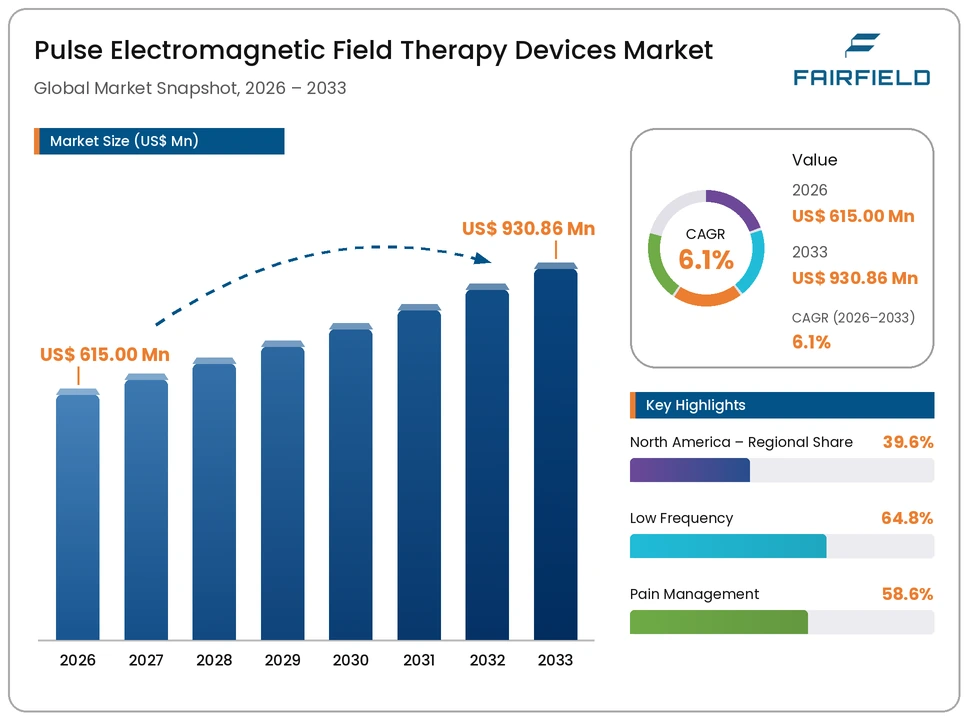
The global pulse electromagnetic field therapy devices market is expected to be valued at US$ 615.00 Million in 2026 and is projected to reach US$ 930.86 Million by 2033, growing at a CAGR of 6.1% between 2026 and 2033. This trajectory reflects both institutional adoption in hospital rehabilitation units and a parallel consumer shift toward wearable PEMF devices for at-home musculoskeletal care. The U.S. Food and Drug Administration (FDA) has cleared multiple PEMF devices under the 510(k) pathway for applications including bone fracture healing and pain management, lending clinical legitimacy that continues to unlock reimbursement discussions and accelerate procurement across integrated health systems.
Key Highlights
- North America held 39.6% of the global pulse electromagnetic field therapy devices market in 2026, supported by advanced healthcare infrastructure and favorable reimbursement policies.
- Asia Pacific is projected to be the fastest-growing region, expanding at a CAGR of 9.4% through 2033 due to aging populations and rising healthcare investments.
- Low-frequency PEMF devices accounted for 64.8% of the market in 2026, driven by strong clinical evidence and widespread hospital adoption.
- Pain management led the application segment with 58.6% of market revenue in 2026, supported by increasing demand for non-invasive musculoskeletal treatment.
- Consumer-grade wearable PEMF devices are expected to be the fastest-growing opportunity, fueled by direct-to-consumer sales and expanding telehealth integration.
Key Growth Determinants
- Rising Burden of Musculoskeletal Disorders and Non-Opioid Treatment Mandates
Musculoskeletal conditions affect an estimated 1.71 billion people globally, according to the World Health Organization (WHO), making them the leading cause of disability worldwide. Clinicians managing chronic low-back pain, osteoarthritis, and post-surgical recovery are under mounting institutional pressure accelerated by the U.S. Centers for Disease Control and Prevention (CDC) 2022 Clinical Practice Guideline update to deploy non-opioid modalities as primary interventions. PEMF therapy occupies a structurally advantageous position: it is non-invasive, repeatable, and supported by a growing body of peer-reviewed evidence demonstrating analgesic and anti-inflammatory effects through cell membrane depolarisation and ion transport modulation. Orthopedic rehabilitation departments at major academic medical centres are integrating clinical-grade PEMF systems into standard post-operative recovery protocols, expanding the addressable institutional buyer base.
Key Growth Barriers
- Inconsistent Clinical Evidence Across Indications and Regulatory Variability
The evidence base supporting PEMF therapy is robust for specific indications notably delayed bone union but remains contested for broader applications including wound healing and neurological rehabilitation. This evidentiary inconsistency complicates payer justification and exposes manufacturers to reimbursement denials. Simultaneously, regulatory frameworks differ substantially across geographies: the European Medicines Agency (EMA) classification approach for medical electrical equipment under EU Medical Device Regulation (EU MDR 2017/745), which entered full enforcement in May 2024, imposes heightened clinical evidence requirements that increase compliance costs for PEMF device manufacturers seeking CE marking across multiple product lines.
Pulse Electromagnetic Field Therapy Market Opportunities
- Geriatric Population Growth and Bone Health Applications in Asia Pacific
Asia Pacific's rapidly ageing demographic base presents a high-value opportunity for bone growth stimulation applications. Japan's Ministry of Health, Labour and Welfare projects that adults over 65 will constitute approximately 38% of the country's population by 2065, intensifying clinical demand for non-surgical osteoporosis management and fracture healing support. India and China are simultaneously expanding public health insurance coverage for medical device therapies, reducing out-of-pocket barriers. Manufacturers positioned in the pulse electromagnetic field therapy devices space with locally registered devices and domestic distribution partnerships are best placed to capitalise on this demographic-driven demand inflection through the forecast period.
Market Segmentation Analysis
- Power Analysis
Low frequency PEMF devices account for 64.8% of the global pulse electromagnetic field therapy devices market in 2026, equivalent to US$ 398.52 Million. This dominance reflects the segment's established clinical validation: low-frequency electromagnetic fields typically operating below 1,000 Hz interact with biological tissue at cellular membrane level, making them the standard configuration in FDA-cleared bone growth stimulators and hospital-grade rehabilitation systems. Orthopedic surgeons prescribe low-frequency PEMF devices for non-union fracture patients, and physical therapy departments deploy them in post-knee-replacement recovery programmes. The incumbent installed base, combined with established CPT billing codes referencing low-frequency parameters, sustains the segment's structural leadership.
High-frequency PEMF systems are the fastest-growing power segment, driven by emerging research into transcranial and neural stimulation applications. Nuage Health and peers are developing high-frequency devices targeting neurological pain pathways and cognitive wellness, a use case accelerating following FDA Breakthrough Device Designation activity in transcranial magnetic stimulation between 2022 and 2024, which has raised clinical awareness of frequency-dependent electromagnetic therapeutic mechanisms.
- Application Analysis
Pain management accounts for 58.6% of the global pulse electromagnetic field therapy devices market in 2026, equivalent to US$ 360.39 Million. The segment leads because chronic pain represents the most prevalent, reimbursable, and clinically validated indication for PEMF intervention. Rheumatologists and physical medicine specialists prescribe PEMF therapy for osteoarthritis of the knee and hip conditions affecting hundreds of millions of patients globally where evidence demonstrates measurable reductions in Visual Analogue Scale (VAS) pain scores. Hospital pain management units and outpatient rehabilitation clinics constitute the primary institutional buyers, reinforcing consistent procurement volumes that anchor the segment's share.
Bone growth stimulation is the fastest-growing application segment. Orthofix Medical Inc.'s ongoing post-market clinical studies for its SpinalLogic and PhysioStim product lines, published between 2023 and 2025, are broadening the evidence base for spinal fusion augmentation. Growing trauma surgery volumes globally, combined with rising delayed-union fracture incidence among older patients, are expanding the addressable clinical indication for bone growth PEMF devices at a rate that outpaces the broader market.
- End-use Analysis
Hospitals account for 49.7% of the global pulse electromagnetic field therapy devices market in 2026, equivalent to US$ 305.65 Million. Hospitals dominate because clinical-grade PEMF devices require professional supervision, calibrated dosimetry protocols, and integration into multidisciplinary care pathways conditions that naturally concentrate deployment in inpatient and outpatient hospital settings. Orthopedic and rehabilitation departments at tertiary-care hospitals procure multi-applicator PEMF systems capable of treating multiple patients per session, supporting high capital expenditure thresholds. Established group purchasing organisation (GPO) contracts such as those managed by Vizient, Inc. in the United States facilitate bulk acquisition and reinforce hospital-channel dominance.
Home care settings are the fastest-growing end-use segment. Bemer USA, LLC expanded its direct-sales network across North America and Europe through 2023–2024, placing portable PEMF mat systems in consumer homes for daily musculoskeletal wellness management. Post-pandemic patient preference for out-of-clinic care, supported by remote monitoring applications, is accelerating adoption among elderly and chronically ill populations managing conditions independently between clinical visits.
Regional Insights
- North America Pulse Electromagnetic Field Therapy Devices Market Trends and Insights
North America is projected to lead the regional market command for around 39.6% of the pulse electromagnetic field therapy devices market in 2026, representing US$ 243.54 Million. The region's dominance rests on the density of its hospital infrastructure, a mature reimbursement ecosystem through CMS and private insurers, and the concentration of leading PEMF device manufacturers. The FDA's active 510(k) clearance pipeline ensures a steady flow of commercially viable products entering the market, sustaining both clinical adoption and investor interest through 2033.
U.S. Pulse Electromagnetic Field Therapy Devices Market Size
The U.S. is lead, hold around 85.2% of the North America regional market in 2026, equivalent to US$ 207.50 Million. High chronic disease prevalence, strong physician awareness of PEMF therapy, and expanding DME reimbursement under CMS Part B are the primary demand drivers. Continued investment by health systems in non-pharmacological pain management protocols positions the U.S. for sustained above-regional-average growth through the forecast horizon.
Canada Pulse Electromagnetic Field Therapy Devices Market Size
The Canada market represents 14.8% of the North America regional market in 2026, equivalent to US$ 36.04 Million. Health Canada's medical device licensing framework under the Medical Devices Regulations (SOR/98-282) governs PEMF device approvals, and recent regulatory harmonisation initiatives with the U.S. are shortening approval timelines. Growing physiotherapy integration into provincial publicly funded rehabilitation programmes supports incremental institutional procurement through 2033.
- Asia Pacific Pulse Electromagnetic Field Therapy Devices Market Trends and Insights
Asia Pacific accounts for 22.4% of the pulse electromagnetic field therapy devices market in 2026, representing US$ 137.76 Million, and is the fastest-growing regional market at a projected CAGR of 9.4%. The primary acceleration force is the region's rapidly ageing population combined with expanding universal health coverage schemes in China and India. China's National Healthcare Security Administration (NHSA) has progressively added medical device therapies to its reimbursement catalogue, directly stimulating hospital procurement of PEMF systems through 2025.
China Pulse Electromagnetic Field Therapy Devices Market Size
The China market represents 33.9% of the Asia Pacific regional market in 2026, equivalent to US$ 46.70 Million. Domestic manufacturing scale and regulatory streamlining by the National Medical Products Administration (NMPA) are lowering device costs and shortening market-entry timelines for local PEMF producers. Rising orthopedic surgery volumes driven by China's ageing population underpin sustained hospital-channel demand through the forecast period.
Japan Pulse Electromagnetic Field Therapy Devices Market Size
The Japan market represents 20.4% of the Asia Pacific regional market in 2026, equivalent to US$ 28.10 Million. Japan's Pharmaceuticals and Medical Devices Agency (PMDA) maintains a rigorous approval process that, once navigated, provides strong market exclusivity for cleared PEMF devices. The country's advanced geriatric care infrastructure and high per-capita healthcare expenditure drive sustained demand for bone stimulation and pain management PEMF applications among elderly inpatients.
India Pulse Electromagnetic Field Therapy Devices Market Size
The India market represents 17.8% of the Asia Pacific regional market in 2026, equivalent to US$ 24.52 Million. Expansion of the Ayushman Bharat Pradhan Mantri Jan Arogya Yojana (PM-JAY) health insurance scheme is extending coverage to lower-income populations, increasing the share of the population with access to hospitalised therapeutic interventions. Rising medical tourism and private hospital investment in rehabilitation infrastructure across tier-one cities signal above-average growth through 2033.
Competitive Landscape
The global pulse electromagnetic field therapy devices landscape is moderately fragmented, with a clear bifurcation between clinical-grade manufacturers and consumer wellness device companies. Orthofix Medical Inc. holds significant institutional credibility through its FDA-cleared bone stimulation portfolio, while Bemer USA, LLC leads the consumer-direct segment through network marketing and direct-sales distribution.
Competition in the clinical tier centres on regulatory credentials, clinical evidence depth, and GPO contracting relationships factors that create durable moats. In the consumer segment, brand trust, device portability, and digital ecosystem integration are the primary competitive differentiators. Mid-tier players including I-Tech Medical Division, Medithera, and Oxford Medical Instruments compete on application-specific device design and regional distribution strength.
Companies Covered in the Pulse Electromagnetic Field Therapy Devices Market
- Bedfont Scientific Ltd.
- Orthofix Medical Inc.
- I-Tech Medical Division
- Oska Wellness
- Medithera
- NiuDeSai
- Nuage Health
- Oxford Medical Instruments
- Bemer USA, LLC
Market Segmentation
By Power
- Low Frequency
- High Frequency
By Application
- Pain Management
- Bone Growth
- Others
By End-use
- Hospitals
- Home Care Settings
- Others
By Region
- North America
- Europe
- Asia Pacific
- Latin America
- Middle East & Africa
- Executive Summary
- Global Pulse Electromagnetic Field Therapy Devices Market Snapshot
- Future Projections
- Key Market Trends
- Regional Snapshot, by Value, 2026
- Analyst Recommendations
- Market Overview
- Market Definitions and Segmentations
- Market Dynamics
- Drivers
- Restraints
- Market Opportunities
- Value Chain Analysis
- COVID-19 Impact Analysis
- Porter's Five Forces Analysis
- Impact of Russia-Ukraine Conflict
- PESTLE Analysis
- Regulatory Analysis
- Price Trend Analysis
- Current Prices and Future Projections, 2025-2033
- Price Impact Factors
- Global Pulse Electromagnetic Field Therapy Devices Market Outlook, 2020 - 2033
- Global Pulse Electromagnetic Field Therapy Devices Market Outlook, by Power , Value (US$ Mn), 2020-2033
- Low Frequency
- High Frequency
- Global Pulse Electromagnetic Field Therapy Devices Market Outlook, by Application, Value (US$ Mn), 2020-2033
- Pain Management
- Bone Growth
- Others
- Global Pulse Electromagnetic Field Therapy Devices Market Outlook, by End-use, Value (US$ Mn), 2020-2033
- Hospitals
- Home Care Settings
- Others
- Global Pulse Electromagnetic Field Therapy Devices Market Outlook, by Region, Value (US$ Mn), 2020-2033
- North America
- Europe
- Asia Pacific
- Latin America
- Middle East & Africa
- Global Pulse Electromagnetic Field Therapy Devices Market Outlook, by Power , Value (US$ Mn), 2020-2033
- North America Pulse Electromagnetic Field Therapy Devices Market Outlook, 2020 - 2033
- North America Pulse Electromagnetic Field Therapy Devices Market Outlook, by Power , Value (US$ Mn), 2020-2033
- Low Frequency
- High Frequency
- North America Pulse Electromagnetic Field Therapy Devices Market Outlook, by Application, Value (US$ Mn), 2020-2033
- Pain Management
- Bone Growth
- Others
- North America Pulse Electromagnetic Field Therapy Devices Market Outlook, by End-use, Value (US$ Mn), 2020-2033
- Hospitals
- Home Care Settings
- Others
- North America Pulse Electromagnetic Field Therapy Devices Market Outlook, by Country, Value (US$ Mn), 2020-2033
- U.S. Pulse Electromagnetic Field Therapy Devices Market Outlook, by Power , 2020-2033
- U.S. Pulse Electromagnetic Field Therapy Devices Market Outlook, by Application, 2020-2033
- U.S. Pulse Electromagnetic Field Therapy Devices Market Outlook, by End-use, 2020-2033
- Canada Pulse Electromagnetic Field Therapy Devices Market Outlook, by Power , 2020-2033
- Canada Pulse Electromagnetic Field Therapy Devices Market Outlook, by Application, 2020-2033
- Canada Pulse Electromagnetic Field Therapy Devices Market Outlook, by End-use, 2020-2033
- BPS Analysis/Market Attractiveness Analysis
- North America Pulse Electromagnetic Field Therapy Devices Market Outlook, by Power , Value (US$ Mn), 2020-2033
- Europe Pulse Electromagnetic Field Therapy Devices Market Outlook, 2020 - 2033
- Europe Pulse Electromagnetic Field Therapy Devices Market Outlook, by Power , Value (US$ Mn), 2020-2033
- Low Frequency
- High Frequency
- Europe Pulse Electromagnetic Field Therapy Devices Market Outlook, by Application, Value (US$ Mn), 2020-2033
- Pain Management
- Bone Growth
- Others
- Europe Pulse Electromagnetic Field Therapy Devices Market Outlook, by End-use, Value (US$ Mn), 2020-2033
- Hospitals
- Home Care Settings
- Others
- Europe Pulse Electromagnetic Field Therapy Devices Market Outlook, by Country, Value (US$ Mn), 2020-2033
- Germany Pulse Electromagnetic Field Therapy Devices Market Outlook, by Power , 2020-2033
- Germany Pulse Electromagnetic Field Therapy Devices Market Outlook, by Application, 2020-2033
- Germany Pulse Electromagnetic Field Therapy Devices Market Outlook, by End-use, 2020-2033
- Italy Pulse Electromagnetic Field Therapy Devices Market Outlook, by Power , 2020-2033
- Italy Pulse Electromagnetic Field Therapy Devices Market Outlook, by Application, 2020-2033
- Italy Pulse Electromagnetic Field Therapy Devices Market Outlook, by End-use, 2020-2033
- France Pulse Electromagnetic Field Therapy Devices Market Outlook, by Power , 2020-2033
- France Pulse Electromagnetic Field Therapy Devices Market Outlook, by Application, 2020-2033
- France Pulse Electromagnetic Field Therapy Devices Market Outlook, by End-use, 2020-2033
- U.K. Pulse Electromagnetic Field Therapy Devices Market Outlook, by Power , 2020-2033
- U.K. Pulse Electromagnetic Field Therapy Devices Market Outlook, by Application, 2020-2033
- U.K. Pulse Electromagnetic Field Therapy Devices Market Outlook, by End-use, 2020-2033
- Spain Pulse Electromagnetic Field Therapy Devices Market Outlook, by Power , 2020-2033
- Spain Pulse Electromagnetic Field Therapy Devices Market Outlook, by Application, 2020-2033
- Spain Pulse Electromagnetic Field Therapy Devices Market Outlook, by End-use, 2020-2033
- Russia Pulse Electromagnetic Field Therapy Devices Market Outlook, by Power , 2020-2033
- Russia Pulse Electromagnetic Field Therapy Devices Market Outlook, by Application, 2020-2033
- Russia Pulse Electromagnetic Field Therapy Devices Market Outlook, by End-use, 2020-2033
- Rest of Europe Pulse Electromagnetic Field Therapy Devices Market Outlook, by Power , 2020-2033
- Rest of Europe Pulse Electromagnetic Field Therapy Devices Market Outlook, by Application, 2020-2033
- Rest of Europe Pulse Electromagnetic Field Therapy Devices Market Outlook, by End-use, 2020-2033
- BPS Analysis/Market Attractiveness Analysis
- Europe Pulse Electromagnetic Field Therapy Devices Market Outlook, by Power , Value (US$ Mn), 2020-2033
- Asia Pacific Pulse Electromagnetic Field Therapy Devices Market Outlook, 2020 - 2033
- Asia Pacific Pulse Electromagnetic Field Therapy Devices Market Outlook, by Power , Value (US$ Mn), 2020-2033
- Low Frequency
- High Frequency
- Asia Pacific Pulse Electromagnetic Field Therapy Devices Market Outlook, by Application, Value (US$ Mn), 2020-2033
- Pain Management
- Bone Growth
- Others
- Asia Pacific Pulse Electromagnetic Field Therapy Devices Market Outlook, by End-use, Value (US$ Mn), 2020-2033
- Hospitals
- Home Care Settings
- Others
- Asia Pacific Pulse Electromagnetic Field Therapy Devices Market Outlook, by Country, Value (US$ Mn), 2020-2033
- China Pulse Electromagnetic Field Therapy Devices Market Outlook, by Power , 2020-2033
- China Pulse Electromagnetic Field Therapy Devices Market Outlook, by Application, 2020-2033
- China Pulse Electromagnetic Field Therapy Devices Market Outlook, by End-use, 2020-2033
- Japan Pulse Electromagnetic Field Therapy Devices Market Outlook, by Power , 2020-2033
- Japan Pulse Electromagnetic Field Therapy Devices Market Outlook, by Application, 2020-2033
- Japan Pulse Electromagnetic Field Therapy Devices Market Outlook, by End-use, 2020-2033
- South Korea Pulse Electromagnetic Field Therapy Devices Market Outlook, by Power , 2020-2033
- South Korea Pulse Electromagnetic Field Therapy Devices Market Outlook, by Application, 2020-2033
- South Korea Pulse Electromagnetic Field Therapy Devices Market Outlook, by End-use, 2020-2033
- India Pulse Electromagnetic Field Therapy Devices Market Outlook, by Power , 2020-2033
- India Pulse Electromagnetic Field Therapy Devices Market Outlook, by Application, 2020-2033
- India Pulse Electromagnetic Field Therapy Devices Market Outlook, by End-use, 2020-2033
- Southeast Asia Pulse Electromagnetic Field Therapy Devices Market Outlook, by Power , 2020-2033
- Southeast Asia Pulse Electromagnetic Field Therapy Devices Market Outlook, by Application, 2020-2033
- Southeast Asia Pulse Electromagnetic Field Therapy Devices Market Outlook, by End-use, 2020-2033
- Rest of SAO Pulse Electromagnetic Field Therapy Devices Market Outlook, by Power , 2020-2033
- Rest of SAO Pulse Electromagnetic Field Therapy Devices Market Outlook, by Application, 2020-2033
- Rest of SAO Pulse Electromagnetic Field Therapy Devices Market Outlook, by End-use, 2020-2033
- BPS Analysis/Market Attractiveness Analysis
- Asia Pacific Pulse Electromagnetic Field Therapy Devices Market Outlook, by Power , Value (US$ Mn), 2020-2033
- Latin America Pulse Electromagnetic Field Therapy Devices Market Outlook, 2020 - 2033
- Latin America Pulse Electromagnetic Field Therapy Devices Market Outlook, by Power , Value (US$ Mn), 2020-2033
- Low Frequency
- High Frequency
- Latin America Pulse Electromagnetic Field Therapy Devices Market Outlook, by Application, Value (US$ Mn), 2020-2033
- Pain Management
- Bone Growth
- Others
- Latin America Pulse Electromagnetic Field Therapy Devices Market Outlook, by End-use, Value (US$ Mn), 2020-2033
- Hospitals
- Home Care Settings
- Others
- Latin America Pulse Electromagnetic Field Therapy Devices Market Outlook, by Country, Value (US$ Mn), 2020-2033
- Brazil Pulse Electromagnetic Field Therapy Devices Market Outlook, by Power , 2020-2033
- Brazil Pulse Electromagnetic Field Therapy Devices Market Outlook, by Application, 2020-2033
- Brazil Pulse Electromagnetic Field Therapy Devices Market Outlook, by End-use, 2020-2033
- Mexico Pulse Electromagnetic Field Therapy Devices Market Outlook, by Power , 2020-2033
- Mexico Pulse Electromagnetic Field Therapy Devices Market Outlook, by Application, 2020-2033
- Mexico Pulse Electromagnetic Field Therapy Devices Market Outlook, by End-use, 2020-2033
- Argentina Pulse Electromagnetic Field Therapy Devices Market Outlook, by Power , 2020-2033
- Argentina Pulse Electromagnetic Field Therapy Devices Market Outlook, by Application, 2020-2033
- Argentina Pulse Electromagnetic Field Therapy Devices Market Outlook, by End-use, 2020-2033
- Rest of LATAM Pulse Electromagnetic Field Therapy Devices Market Outlook, by Power , 2020-2033
- Rest of LATAM Pulse Electromagnetic Field Therapy Devices Market Outlook, by Application, 2020-2033
- Rest of LATAM Pulse Electromagnetic Field Therapy Devices Market Outlook, by End-use, 2020-2033
- BPS Analysis/Market Attractiveness Analysis
- Latin America Pulse Electromagnetic Field Therapy Devices Market Outlook, by Power , Value (US$ Mn), 2020-2033
- Middle East & Africa Pulse Electromagnetic Field Therapy Devices Market Outlook, 2020 - 2033
- Middle East & Africa Pulse Electromagnetic Field Therapy Devices Market Outlook, by Power , Value (US$ Mn), 2020-2033
- Low Frequency
- High Frequency
- Middle East & Africa Pulse Electromagnetic Field Therapy Devices Market Outlook, by Application, Value (US$ Mn), 2020-2033
- Pain Management
- Bone Growth
- Others
- Middle East & Africa Pulse Electromagnetic Field Therapy Devices Market Outlook, by End-use, Value (US$ Mn), 2020-2033
- Hospitals
- Home Care Settings
- Others
- Middle East & Africa Pulse Electromagnetic Field Therapy Devices Market Outlook, by Country, Value (US$ Mn), 2020-2033
- GCC Pulse Electromagnetic Field Therapy Devices Market Outlook, by Power , 2020-2033
- GCC Pulse Electromagnetic Field Therapy Devices Market Outlook, by Application, 2020-2033
- GCC Pulse Electromagnetic Field Therapy Devices Market Outlook, by End-use, 2020-2033
- South Africa Pulse Electromagnetic Field Therapy Devices Market Outlook, by Power , 2020-2033
- South Africa Pulse Electromagnetic Field Therapy Devices Market Outlook, by Application, 2020-2033
- South Africa Pulse Electromagnetic Field Therapy Devices Market Outlook, by End-use, 2020-2033
- Egypt Pulse Electromagnetic Field Therapy Devices Market Outlook, by Power , 2020-2033
- Egypt Pulse Electromagnetic Field Therapy Devices Market Outlook, by Application, 2020-2033
- Egypt Pulse Electromagnetic Field Therapy Devices Market Outlook, by End-use, 2020-2033
- Nigeria Pulse Electromagnetic Field Therapy Devices Market Outlook, by Power , 2020-2033
- Nigeria Pulse Electromagnetic Field Therapy Devices Market Outlook, by Application, 2020-2033
- Nigeria Pulse Electromagnetic Field Therapy Devices Market Outlook, by End-use, 2020-2033
- Rest of Middle East Pulse Electromagnetic Field Therapy Devices Market Outlook, by Power , 2020-2033
- Rest of Middle East Pulse Electromagnetic Field Therapy Devices Market Outlook, by Application, 2020-2033
- Rest of Middle East Pulse Electromagnetic Field Therapy Devices Market Outlook, by End-use, 2020-2033
- BPS Analysis/Market Attractiveness Analysis
- Middle East & Africa Pulse Electromagnetic Field Therapy Devices Market Outlook, by Power , Value (US$ Mn), 2020-2033
- Competitive Landscape
- Company Vs Segment Heatmap
- Company Market Share Analysis, 2025
- Competitive Dashboard
- Company Profiles
- Bedfont Scientific Ltd.
- Company Overview
- Product Portfolio
- Financial Overview
- Business Strategies and Developments
- Orthofix Medical Inc.
- I-Tech Medical Division
- Oska Wellness
- Medithera
- NiuDeSai
- Nuage Health
- Oxford Medical Instruments Health Store
- Bemer USA, LLC
- Bedfont Scientific Ltd.
- Appendix
- Research Methodology
- Report Assumptions
- Acronyms and Abbreviations
By Power
- Low Frequency
- High Frequency
By Application
- Pain Management
- Bone Growth
- Others
By End-use
- Hospitals
- Home Care Settings
- Others
By Region
- North America
- Europe
- Asia Pacific
- Latin America
- Middle East & Africa
Our Research Methodology
Considering the volatility of business today, traditional approaches to strategizing a game plan can be unfruitful if not detrimental. True ambiguity is no way to determine a forecast. A myriad of predetermined factors must be accounted for such as the degree of risk involved, the magnitude of circumstances, as well as conditions or consequences that are not known or unpredictable. To circumvent binary views that cast uncertainty, the application of market research intelligence to strategically posture, move, and enable actionable outcomes is necessary.
View Methodology
Quality Assured
Rigorous Validation Process

Confidentiality Assured
End-to-end Data Security

Custom Research Services
Tailored To Your Objectives
FAQs
The global pulse electromagnetic field therapy devices market is valued at US$ 615.00 Million in 2026 and is forecast to reach US$ 930.86 Million by 2033, at a CAGR of 6.1%.
Market growth is driven by the rising prevalence of musculoskeletal disorders and expanding reimbursement support for non-invasive therapies.
Pain management leads the market with a 58.6% revenue share in 2026 due to its broad clinical applications and proven effectiveness.
North America dominates with a 39.6% market share, supported by advanced healthcare infrastructure, FDA-cleared devices, and favorable reimbursement policies.
The biggest opportunity lies in home care PEMF devices, driven by portable technologies, telehealth integration, and direct-to-consumer business models.
Related Reports
Ankle Boots Market Insights, Competitive Landscape, and Market Forecast 2033
The ankle boots market is valued at USD 18.50 Bn in 2026 and is projected to reach USD 27.45 Bn by 2033, expanding at a CAGR of 5.8% during 2026-2033
Foot And Ankle Devices Market Insights, Competitive Landscape, and Market Forecast 2033
The foot and ankle devices market will grow from USD 6.40 Bn in 2026 to USD 10.14 Bn by 2033 at a CAGR of 6.8%, driven by rising trauma & sports injuries.
Digital Therapeutics Delivery Devices Market Insights, Competitive Landscape, and Market Forecast 2033
The digital therapeutics delivery devices market will expand at a 15.5% CAGR from USD 2.10 Bn in 2026 to USD 5.76 Bn by 2033, led by wearable devices.
Global Infant Incubator Insights, Competitive Landscape, and Market Forecast 2033
Infant Incubator Market to reach US$1,306.72 Mn by 2033, growing at 5.3% CAGR, driven by preterm births, NICU expansion and transport incubators care.
Vaginal Rejuvenation Market Insights, Competitive Landscape, and Market Forecast 2026–2033
Vaginal Rejuvenation Market to Reach US$26.75 Billion by 2033, Driven by Rising Demand for Minimally Invasive Women's Health Solutions.
Red Light Therapy Market Insights, Competitive Landscape, and Market Forecast 2033
The red light therapy market will grow from US$587.50 Mn in 2026 to US$1,130.38 Mn by 2033 at a 9.8% CAGR, driven by clinical adoption & FDA clearances.