



Respiratory Diagnostics Market
Respiratory Diagnostics Market Size, Share, Insights, Competitive Landscape, and Forecast 2026 to 2033
Respiratory Diagnostics Market Size and Trend Analysis
How Fast Is the Respiratory Diagnostics Market Growing?
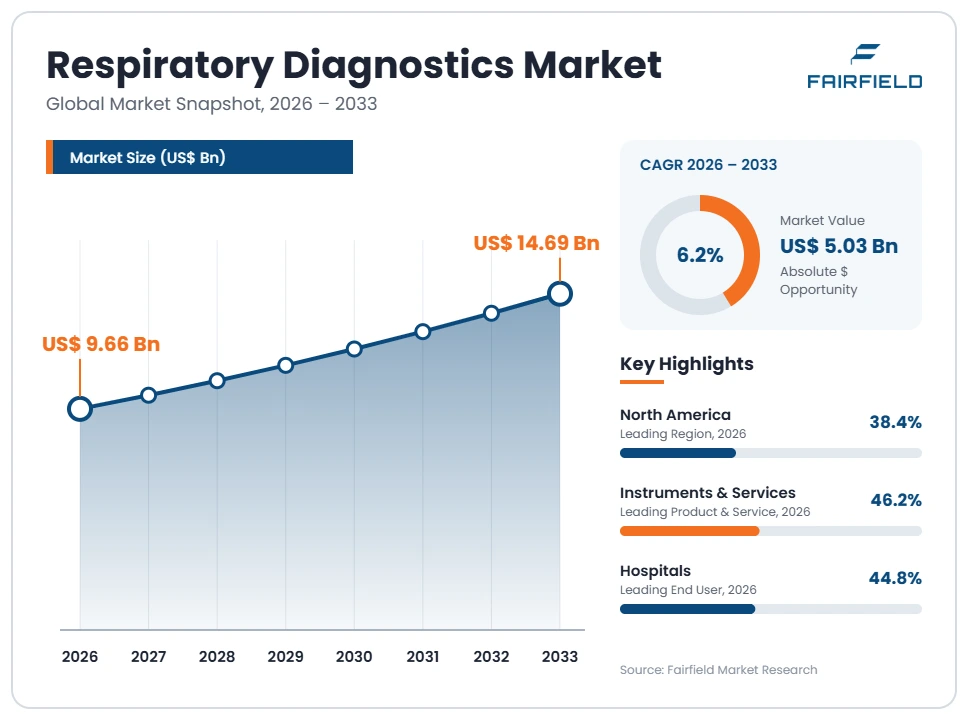
The global respiratory diagnostics market size is expected to be valued at US$ 9.66 billion in 2026 and projected to reach US$ 14.69 billion by 2033, growing at a CAGR of 6.2% between 2026 and 2033.
Between 2020 and 2025, the market grew at a CAGR of about 3.1%, as an extreme pandemic testing peak in 2021 was followed by a sharp normalization in COVID-19 test volumes across most major markets. Three factors now support growth: the heavy and rising burden of respiratory infections, chronic lung diseases such as COPD and asthma, and tuberculosis; faster adoption of multiplex PCR and point-of-care testing; and expanding home testing. The market is shifting from single-pathogen tests toward syndromic panels, digital spirometry, and decentralized testing in clinics and homes.
Key Report Takeaways
- By Product & Service: Instruments & Services held 46.2% share in 2026, while Assays & Reagents are projected to expand at a 7.1% CAGR through 2033, driven by recurring test volumes on installed molecular platforms.
- By Test Type: Traditional Diagnostic Tests held 39.5% share in 2026, while Molecular Diagnostic Tests are projected to expand at an 8.6% CAGR through 2033, driven by multiplex panels that identify many pathogens from one swab.
- By Disease: Tuberculosis held 27.3% share in 2026, while Lung Cancer is projected to expand at an 8.4% CAGR through 2033, driven by low-dose CT screening programs and biomarker testing.
- By End User: Hospitals held 44.8% share in 2026, while Home Care Settings are projected to expand at a 9.2% CAGR through 2033, driven by over-the-counter combination tests and connected spirometers.
- By Region: North America held 38.4% share in 2026, while Asia Pacific is projected to expand at an 8.1% CAGR through 2033, driven by tuberculosis programs in India and air pollution-related lung disease in China.
Global Respiratory Diagnostics Market Trends and Insights
Drivers Impact Analysis
Two drivers carry the strongest influence on respiratory diagnostics demand during the forecast period.
| Driver | Impact on CAGR Forecast | Geographic Relevance | Impact Timeline |
| High burden of seasonal respiratory infections | High | North America, Europe | Short term (≤2 years) |
| Rising chronic lung disease and tuberculosis burden | High | Global, strongest in Asia Pacific | Long term (≥4 years) |
Severe Respiratory Infection Seasons Are Driving Respiratory Diagnostics Volumes
Severe seasons of influenza, COVID-19, and respiratory syncytial virus are lifting testing volumes across hospitals, clinics, and pharmacies. Doctors need fast answers to decide whether to prescribe antivirals, avoid unnecessary antibiotics, and isolate infectious patients, especially in crowded emergency departments during winter peaks.
The evidence comes from recent surveillance data. The Centers for Disease Control and Prevention estimated that the 2024–2025 influenza season in the United States caused about 51 million illnesses and 710,000 hospitalizations, and it was classified as high severity. Co-circulation of several viruses makes symptoms hard to tell apart clinically. This pushes providers toward multiplex PCR panels that test for many pathogens at once. Antimicrobial stewardship programs also encourage accurate diagnosis before prescribing antibiotics, adding further demand for rapid molecular diagnostics in hospitals and outpatient clinics.
Rising Chronic Lung Disease and Tuberculosis Burden Expands Respiratory Diagnostics Demand
Chronic lung diseases and tuberculosis create long-term, steady demand for respiratory diagnostics. Patients with chronic obstructive pulmonary disease and asthma need lung function tests for diagnosis and regular monitoring, while tuberculosis control depends on fast, accurate detection that stops onward transmission.
The scale of the burden is large. The World Health Organization reports that chronic obstructive pulmonary disease is the fourth leading cause of death worldwide, causing about 3.5 million deaths in 2021. The World Health Organization also estimated that 10.8 million people fell ill with tuberculosis in 2023. Aging populations, smoking, and air pollution increase chronic lung disease in Asia Pacific and other regions. National tuberculosis programs are replacing smear microscopy with molecular tuberculosis testing, and wider access to spirometry improves early detection of chronic conditions.
Restraints Impact Analysis
Two restraints limit how quickly respiratory diagnostics revenue can grow.
| Restraint | Impact on CAGR Forecast | Geographic Relevance | Impact Timeline |
| Post-pandemic volume decline and reimbursement pressure | Medium | North America, Europe | Short term (≤2 years) |
| Limited diagnostic access and skilled staff in low-income settings | Medium | Asia Pacific, Latin America, Middle East & Africa | Long term (≥4 years) |
Post-Pandemic Volume Declines and Reimbursement Pressure Weigh on Respiratory Diagnostics
The collapse in COVID-19 testing volumes and tighter reimbursement weigh on respiratory diagnostics revenue. Many manufacturers built large capacity during the pandemic, and demand fell sharply once emergency testing programs ended.
The specific causes are policy changes and payer scrutiny. Government-funded testing programs in the United States and Europe wound down, and emergency use authorizations ended for many tests. Payers now question the use of large multiplex panels for routine outpatient cases, and some limit reimbursement to patients with specific risk factors. Laboratories face pressure to justify higher-cost molecular tests over cheaper antigen tests. Manufacturers also carry costs from idle production lines and inventory write-downs. These pressures slow revenue growth even as the underlying respiratory disease burden remains high, forcing companies to restructure capacity and refocus portfolios.
Limited Access and Skills Gaps Slow Respiratory Diagnostics Adoption in Emerging Markets
Limited diagnostic access and skilled staff shortages slow respiratory diagnostics adoption in emerging markets. Many clinics in rural Asia Pacific, Africa, and Latin America lack molecular testing equipment, reliable power, and trained technicians.
The underlying causes are cost and infrastructure. Molecular platforms and cartridges remain expensive for public health systems with tight budgets. Spirometry requires trained operators to coach patients and ensure test quality, which limits use in primary care. Sample transport from remote areas to central laboratories causes delays and lost samples. Cold-chain requirements for some reagents add further cost and complexity. As a result, many cases of tuberculosis, chronic obstructive pulmonary disease, and pneumonia remain undiagnosed. Global health funding from donors such as the Global Fund helps, but large gaps persist in the poorest regions.
Market Opportunities
Point-of-Care Syndromic Panels Open a Fast-Growing Revenue Pool in Respiratory Diagnostics
Point-of-care syndromic panels create a fast-growing revenue pool in respiratory diagnostics. These compact PCR systems test for many respiratory pathogens at once and deliver results during a single clinic visit, which helps doctors choose treatment immediately.
Manufacturers with simple, cartridge-based molecular platforms can capture this demand. In September 2026, Cepheid, a Danaher company, received U.S. Food and Drug Administration clearance for its Xpert Respiratory Panel, which detects 13 pathogens from one swab on existing GeneXpert systems. In May 2024, Qiagen's QIAstat-Dx Respiratory Panel Plus gained clearance. bioMérieux's BIOFIRE SPOTFIRE system offers a CLIA-waived respiratory panel for physician offices. Urgent care centers, physician offices, retail clinics, and emergency departments are the main customers. Recurring cartridge sales create predictable revenue once instruments are installed.
Home Testing and Connected Spirometry Create a Consumer Revenue Pool in Respiratory Diagnostics
Home testing and connected spirometry form an emerging consumer revenue pool. Patients increasingly want to test for respiratory infections at home and track chronic lung conditions between doctor visits.
Diagnostic makers and digital health companies can capture this opportunity. In October 2024, the U.S. Food and Drug Administration granted marketing authorization to Healgen Scientific for an over-the-counter home test that detects COVID-19 and influenza, the first such test authorized outside emergency use rules. Connected spirometers and peak flow meters send lung function data to clinicians, supporting remote monitoring for asthma and chronic obstructive pulmonary disease. Pharmacies, telehealth providers, employers, and patients managing chronic disease are the main customers, and app-based reporting helps clinicians act on home results quickly. Reimbursement for remote patient monitoring in the United States supports adoption.
Segment Analysis
- By Product & Service: Instruments & Services Lead While Assays & Reagents Grow Fastest
Instruments & Services held 46.2% share in 2026. Hospitals and laboratories invest in spirometers, polysomnography systems, imaging equipment, and molecular analyzers, along with service contracts for maintenance and calibration. These high-value systems remain central to respiratory care.
Assays & Reagents are the fastest-growing segment, expanding at a 7.1% CAGR through 2033. Every test on a molecular or immunoassay platform uses a cartridge, reagent kit, or consumable, so recurring volumes rise with the installed base. Multiplex respiratory panels command higher prices than single-pathogen tests. Tuberculosis programs also consume large volumes of molecular cartridges. For the market, consumable growth creates predictable, recurring revenue and encourages manufacturers to place instruments at low cost in exchange for long-term reagent contracts.
- By Test Type: Traditional Diagnostic Tests Lead While Molecular Diagnostic Tests Expand Fastest
Traditional Diagnostic Tests held 39.5% share in 2026. Chest X-rays, spirometry, sputum analysis, and blood gas tests remain standard tools in nearly every hospital and clinic. They are widely available, familiar to clinicians, and often reimbursed as routine care.
Molecular Diagnostic Tests are the fastest-growing test type, expanding at an 8.6% CAGR through 2033. Multiplex PCR panels identify viruses and bacteria quickly and accurately, which supports targeted treatment and infection control. Molecular tuberculosis tests also detect drug resistance, which guides therapy. Point-of-care testing platforms are bringing molecular methods closer to patients. Imaging and mechanical tests remain important for chronic disease. For the market, the shift to molecular diagnostics raises average test prices and rewards companies with broad assay menus.
- By Disease: Tuberculosis Leads While Lung Cancer Expands Fastest
Tuberculosis held 27.3% share in 2026. High case numbers in India, Indonesia, China, the Philippines, and Pakistan drive large testing volumes. National programs supported by the World Health Organization and global donors fund molecular tuberculosis testing to detect cases and drug resistance early.
Lung Cancer is the fastest-growing disease segment, expanding at an 8.4% CAGR through 2033. Low-dose CT screening programs for high-risk smokers are expanding in the United States, the United Kingdom, and parts of Asia Pacific. Biomarker tests guide targeted therapies and immunotherapy. Liquid biopsy offers less invasive monitoring. Chronic obstructive pulmonary disease, asthma, and infections remain large segments. For the market, lung cancer growth adds high-value imaging and molecular testing, which raises revenue per patient.
- By End User: Hospitals Lead While Home Care Settings Grow Fastest
Hospitals held 44.8% share in 2026. Hospitals perform most imaging, lung function testing, sleep studies, and complex molecular panels, especially for emergency and inpatient care. They also manage severe infections and chronic disease flare-ups that need rapid diagnosis.
Home Care Settings are the fastest-growing end user, expanding at a 9.2% CAGR through 2033. Over-the-counter tests for COVID-19 and influenza let patients test quickly at home. Connected spirometers and pulse oximeters support remote monitoring of chronic lung disease. Telehealth providers use home results to guide treatment without clinic visits. Diagnostic laboratories and clinics remain important for confirmatory and specialized testing. For the market, home testing growth expands consumer channels and encourages manufacturers to design simpler, app-connected devices.
Geography Analysis
- Which Region Is Leading the Respiratory Diagnostics Market?
North America is leading the respiratory diagnostics market with a 38.4% share in 2026. The United States has high testing rates, strong reimbursement, and wide access to molecular diagnostics in hospitals, urgent care centers, and pharmacies. Severe influenza seasons, such as 2024–2025, raise demand for multiplex panels. Major companies including Danaher, Abbott, Becton Dickinson, and Thermo Fisher Scientific are based in the region. Canada adds demand through provincial public health testing programs and chronic disease care. One change shaping the region is the rapid growth of home and pharmacy-based testing, supported by test-to-treat programs.
- Europe Expands Molecular and Lung Cancer Testing in Respiratory Diagnostics
Europe is a major market supported by universal healthcare systems and strong laboratory networks. Germany, France, the United Kingdom, Italy, and Spain lead demand. bioMérieux in France and Qiagen in Germany are major regional suppliers. The United Kingdom is expanding targeted lung health checks, which use low-dose CT scans for high-risk groups. The In Vitro Diagnostic Regulation increases compliance costs but raises quality standards. Budget pressure limits use of costly panels in some public health systems, especially for outpatients. One opportunity is integrated respiratory surveillance combining molecular testing with digital reporting to public health agencies.
- Which Region Is Growing Fastest in the Respiratory Diagnostics Market?
Asia Pacific is growing fastest in the respiratory diagnostics market at an 8.1% CAGR through 2033. India carries the world's largest tuberculosis burden and is expanding molecular testing through its national program. China faces high chronic obstructive pulmonary disease rates linked to smoking and air pollution. Japan and South Korea have aging populations with growing chronic lung disease. Seegene in South Korea is a major supplier of multiplex PCR assays. Expanding hospital capacity, rising private laboratory networks, and wider insurance coverage support adoption across the region. One opportunity is affordable point-of-care testing in rural clinics and primary health centers.
- Latin America Builds Testing Capacity in the Respiratory Diagnostics Market
Latin America is an emerging region where infections, tuberculosis, and chronic lung disease drive demand. Brazil and Mexico lead the region, supported by public health systems and growing private laboratories. Peru and Brazil have significant tuberculosis burdens, which support molecular testing programs backed by health ministries. Key barriers include limited public funding, uneven access between urban and rural areas, and currency volatility that raises import costs. Many public clinics still rely on chest X-rays and sputum smear microscopy. One opportunity is regional manufacturing and distribution partnerships that lower test costs and improve availability in public hospitals and primary care networks.
- Middle East & Africa Strengthens Tuberculosis and Infection Testing in Respiratory Diagnostics
Middle East & Africa is a developing region with high tuberculosis burdens in sub-Saharan Africa and growing investment in Gulf healthcare. South Africa and Nigeria have large national tuberculosis programs that use molecular tests to detect drug resistance. Saudi Arabia and the United Arab Emirates invest heavily in modern hospitals, reference laboratories, and national screening programs under health transformation plans. Key barriers include limited laboratory and transport infrastructure, scarce skilled staff, and heavy dependence on donor funding in many African countries. One opportunity is battery-powered and portable molecular systems suited to remote clinics with unreliable electricity and limited staff.
Competitive Landscape
The respiratory diagnostics market is moderately concentrated. Large diagnostic companies, including bioMérieux, Danaher through Cepheid, Abbott, Thermo Fisher Scientific, Becton Dickinson, Roche, and Qiagen, lead molecular and immunoassay testing. Device makers such as Philips, ResMed, and COSMED compete in lung function and sleep diagnostics. Regional companies such as Seegene add strong competition in multiplex PCR, especially on price and assay breadth.
Companies compete on assay menu breadth, speed, accuracy, ease of use, installed base, and cost per test. CLIA-waived status is a key advantage in the United States because it allows testing outside central laboratories. Digital connectivity, automated result reporting, and integration with hospital information systems are becoming important differentiators.
Strategic moves show how competition is changing. Cepheid received clearance for its 13-pathogen Xpert Respiratory Panel in September 2026, strengthening its position on a large installed GeneXpert base. Qiagen gained clearance for its QIAstat-Dx Respiratory Panel Plus in May 2024. bioMérieux expanded its BIOFIRE SPOTFIRE point-of-care platform with CLIA-waived panels. Healgen Scientific received authorization for a home COVID-19 and influenza test in October 2024. Together, these moves show competition moving toward decentralized, multiplex, and consumer testing.
Three themes shape vendor strategy. First, companies are expanding syndromic panels for point-of-care use. Second, they are developing home and over-the-counter tests. Third, they are targeting tuberculosis and chronic disease programs in emerging markets with affordable, rugged platforms and tiered pricing.
Recent Industry Developments
- September 2026: Cepheid received FDA clearance for the Xpert Respiratory Panel – adds a 13-pathogen test to its large installed base.
- October 2024: Healgen Scientific received FDA marketing authorization for a home COVID-19 and influenza test – opens a regular, non-emergency consumer pathway.
- May 2024: Qiagen received FDA clearance for the QIAstat-Dx Respiratory Panel Plus – strengthens its syndromic testing portfolio.
Companies Covered in the Report
- bioMérieux
- Danaher (Cepheid)
- Abbott
- Thermo Fisher Scientific
- Becton Dickinson
- Roche
- Qiagen
- Seegene
- Philips
- ResMed
- Bio-Rad Laboratories
- COSMED
Respiratory Diagnostics Market Report Scope
| Metric | Value |
| Study Period | 2020–2033 |
| Market Size 2026 | US$ 9.66 Billion |
| Market Size 2033 | US$ 14.69 Billion |
| CAGR 2026–2033 | 6.2% |
| Absolute Dollar Opportunity | US$ 5.03 Billion |
| Largest Market | North America |
| Fastest-Growing Market | Asia Pacific |
| Market Concentration | Medium |
| Major Players | bioMérieux, Danaher (Cepheid), Abbott, Thermo Fisher Scientific, Becton Dickinson |
Respiratory Diagnostics Market Segmentation
Product & Service
- Instruments & Services
- Assays & Reagents
- Software
Test Type
- Traditional Diagnostic Tests
- Mechanical Tests
- Imaging Tests
- Molecular Diagnostic Tests
- Rapid Antigen Tests
Disease
- Tuberculosis
- Chronic Obstructive Pulmonary Disease
- Asthma
- Lung Cancer
- Respiratory Infections
- Others
End User
- Hospitals
- Diagnostic Laboratories
- Clinics & Urgent Care
- Home Care Settings
Regions
- North America
- Europe
- Asia Pacific
- Latin America
- Middle East & Africa
- Executive Summary
- Global Respiratory Diagnostics Market Snapshot
- Future Projections
- Key Report Takeaways
- Regional Snapshot
- Market Overview
- Market Definition and Report Scope
- Historical Trends 2020–2025
- Market Dynamics
- Drivers
- Severe Respiratory Infection Seasons Are Driving Respiratory Diagnostics Volumes
- Rising Chronic Lung Disease and Tuberculosis Burden Expands Respiratory Diagnostics Demand
- Restraints
- Post-Pandemic Volume Declines and Reimbursement Pressure Weigh on Respiratory Diagnostics
- Limited Access and Skills Gaps Slow Respiratory Diagnostics Adoption in Emerging Markets
- Market Opportunities
- Point-of-Care Syndromic Panels Open a Fast-Growing Revenue Pool in Respiratory Diagnostics
- Home Testing and Connected Spirometry Create a Consumer Revenue Pool in Respiratory Diagnostics
- Drivers
- Global Respiratory Diagnostics Market Outlook, 2020–2033
- Global Respiratory Diagnostics Market Outlook, by Product & Service, Value (US$ Billion), 2020–2033
- Instruments & Services
- Assays & Reagents
- Software
- Global Respiratory Diagnostics Market Outlook, by Test Type, Value (US$ Billion), 2020–2033
- Traditional Diagnostic Tests
- Mechanical Tests
- Imaging Tests
- Molecular Diagnostic Tests
- Rapid Antigen Tests
- Global Respiratory Diagnostics Market Outlook, by Disease, Value (US$ Billion), 2020–2033
- Tuberculosis
- Chronic Obstructive Pulmonary Disease
- Asthma
- Lung Cancer
- Respiratory Infections
- Others
- Global Respiratory Diagnostics Market Outlook, by End User, Value (US$ Billion), 2020–2033
- Hospitals
- Diagnostic Laboratories
- Clinics & Urgent Care
- Home Care Settings
- Global Respiratory Diagnostics Market Outlook, by Region, Value (US$ Billion), 2020–2033
- North America
- Europe
- Asia Pacific
- Latin America
- Middle East & Africa
- Global Respiratory Diagnostics Market Outlook, by Product & Service, Value (US$ Billion), 2020–2033
- North America Respiratory Diagnostics Market Outlook, 2020–2033
- North America Respiratory Diagnostics Market Outlook, by Product & Service, Value (US$ Billion), 2020–2033
- Instruments & Services
- Assays & Reagents
- Software
- North America Respiratory Diagnostics Market Outlook, by Test Type, Value (US$ Billion), 2020–2033
- Traditional Diagnostic Tests
- Mechanical Tests
- Imaging Tests
- Molecular Diagnostic Tests
- Rapid Antigen Tests
- North America Respiratory Diagnostics Market Outlook, by Disease, Value (US$ Billion), 2020–2033
- Tuberculosis
- Chronic Obstructive Pulmonary Disease
- Asthma
- Lung Cancer
- Respiratory Infections
- Others
- North America Respiratory Diagnostics Market Outlook, by End User, Value (US$ Billion), 2020–2033
- Hospitals
- Diagnostic Laboratories
- Clinics & Urgent Care
- Home Care Settings
- North America Respiratory Diagnostics Market Outlook, by Country, Value (US$ Billion), 2020–2033
- United States Respiratory Diagnostics Market Outlook, by Product & Service, 2020–2033
- United States Respiratory Diagnostics Market Outlook, by Test Type, 2020–2033
- United States Respiratory Diagnostics Market Outlook, by Disease, 2020–2033
- United States Respiratory Diagnostics Market Outlook, by End User, 2020–2033
- Canada Respiratory Diagnostics Market Outlook, by Product & Service, 2020–2033
- Canada Respiratory Diagnostics Market Outlook, by Test Type, 2020–2033
- Canada Respiratory Diagnostics Market Outlook, by Disease, 2020–2033
- Canada Respiratory Diagnostics Market Outlook, by End User, 2020–2033
- North America Respiratory Diagnostics Market Outlook, by Product & Service, Value (US$ Billion), 2020–2033
- Europe Respiratory Diagnostics Market Outlook, 2020–2033
- Europe Respiratory Diagnostics Market Outlook, by Product & Service, Value (US$ Billion), 2020–2033
- Instruments & Services
- Assays & Reagents
- Software
- Europe Respiratory Diagnostics Market Outlook, by Test Type, Value (US$ Billion), 2020–2033
- Traditional Diagnostic Tests
- Mechanical Tests
- Imaging Tests
- Molecular Diagnostic Tests
- Rapid Antigen Tests
- Europe Respiratory Diagnostics Market Outlook, by Disease, Value (US$ Billion), 2020–2033
- Tuberculosis
- Chronic Obstructive Pulmonary Disease
- Asthma
- Lung Cancer
- Respiratory Infections
- Others
- Europe Respiratory Diagnostics Market Outlook, by End User, Value (US$ Billion), 2020–2033
- Hospitals
- Diagnostic Laboratories
- Clinics & Urgent Care
- Home Care Settings
- Europe Respiratory Diagnostics Market Outlook, by Country, Value (US$ Billion), 2020–2033
- Germany Respiratory Diagnostics Market Outlook, by Product & Service, 2020–2033
- Germany Respiratory Diagnostics Market Outlook, by Test Type, 2020–2033
- Germany Respiratory Diagnostics Market Outlook, by Disease, 2020–2033
- Germany Respiratory Diagnostics Market Outlook, by End User, 2020–2033
- France Respiratory Diagnostics Market Outlook, by Product & Service, 2020–2033
- France Respiratory Diagnostics Market Outlook, by Test Type, 2020–2033
- France Respiratory Diagnostics Market Outlook, by Disease, 2020–2033
- France Respiratory Diagnostics Market Outlook, by End User, 2020–2033
- United Kingdom Respiratory Diagnostics Market Outlook, by Product & Service, 2020–2033
- United Kingdom Respiratory Diagnostics Market Outlook, by Test Type, 2020–2033
- United Kingdom Respiratory Diagnostics Market Outlook, by Disease, 2020–2033
- United Kingdom Respiratory Diagnostics Market Outlook, by End User, 2020–2033
- Italy Respiratory Diagnostics Market Outlook, by Product & Service, 2020–2033
- Italy Respiratory Diagnostics Market Outlook, by Test Type, 2020–2033
- Italy Respiratory Diagnostics Market Outlook, by Disease, 2020–2033
- Italy Respiratory Diagnostics Market Outlook, by End User, 2020–2033
- Spain Respiratory Diagnostics Market Outlook, by Product & Service, 2020–2033
- Spain Respiratory Diagnostics Market Outlook, by Test Type, 2020–2033
- Spain Respiratory Diagnostics Market Outlook, by Disease, 2020–2033
- Spain Respiratory Diagnostics Market Outlook, by End User, 2020–2033
- Europe Respiratory Diagnostics Market Outlook, by Product & Service, Value (US$ Billion), 2020–2033
- Asia Pacific Respiratory Diagnostics Market Outlook, 2020–2033
- Asia Pacific Respiratory Diagnostics Market Outlook, by Product & Service, Value (US$ Billion), 2020–2033
- Instruments & Services
- Assays & Reagents
- Software
- Asia Pacific Respiratory Diagnostics Market Outlook, by Test Type, Value (US$ Billion), 2020–2033
- Traditional Diagnostic Tests
- Mechanical Tests
- Imaging Tests
- Molecular Diagnostic Tests
- Rapid Antigen Tests
- Asia Pacific Respiratory Diagnostics Market Outlook, by Disease, Value (US$ Billion), 2020–2033
- Tuberculosis
- Chronic Obstructive Pulmonary Disease
- Asthma
- Lung Cancer
- Respiratory Infections
- Others
- Asia Pacific Respiratory Diagnostics Market Outlook, by End User, Value (US$ Billion), 2020–2033
- Hospitals
- Diagnostic Laboratories
- Clinics & Urgent Care
- Home Care Settings
- Asia Pacific Respiratory Diagnostics Market Outlook, by Country, Value (US$ Billion), 2020–2033
- India Respiratory Diagnostics Market Outlook, by Product & Service, 2020–2033
- India Respiratory Diagnostics Market Outlook, by Test Type, 2020–2033
- India Respiratory Diagnostics Market Outlook, by Disease, 2020–2033
- India Respiratory Diagnostics Market Outlook, by End User, 2020–2033
- China Respiratory Diagnostics Market Outlook, by Product & Service, 2020–2033
- China Respiratory Diagnostics Market Outlook, by Test Type, 2020–2033
- China Respiratory Diagnostics Market Outlook, by Disease, 2020–2033
- China Respiratory Diagnostics Market Outlook, by End User, 2020–2033
- Japan Respiratory Diagnostics Market Outlook, by Product & Service, 2020–2033
- Japan Respiratory Diagnostics Market Outlook, by Test Type, 2020–2033
- Japan Respiratory Diagnostics Market Outlook, by Disease, 2020–2033
- Japan Respiratory Diagnostics Market Outlook, by End User, 2020–2033
- South Korea Respiratory Diagnostics Market Outlook, by Product & Service, 2020–2033
- South Korea Respiratory Diagnostics Market Outlook, by Test Type, 2020–2033
- South Korea Respiratory Diagnostics Market Outlook, by Disease, 2020–2033
- South Korea Respiratory Diagnostics Market Outlook, by End User, 2020–2033
- Asia Pacific Respiratory Diagnostics Market Outlook, by Product & Service, Value (US$ Billion), 2020–2033
- Latin America Respiratory Diagnostics Market Outlook, 2020–2033
- Latin America Respiratory Diagnostics Market Outlook, by Product & Service, Value (US$ Billion), 2020–2033
- Instruments & Services
- Assays & Reagents
- Software
- Latin America Respiratory Diagnostics Market Outlook, by Test Type, Value (US$ Billion), 2020–2033
- Traditional Diagnostic Tests
- Mechanical Tests
- Imaging Tests
- Molecular Diagnostic Tests
- Rapid Antigen Tests
- Latin America Respiratory Diagnostics Market Outlook, by Disease, Value (US$ Billion), 2020–2033
- Tuberculosis
- Chronic Obstructive Pulmonary Disease
- Asthma
- Lung Cancer
- Respiratory Infections
- Others
- Latin America Respiratory Diagnostics Market Outlook, by End User, Value (US$ Billion), 2020–2033
- Hospitals
- Diagnostic Laboratories
- Clinics & Urgent Care
- Home Care Settings
- Latin America Respiratory Diagnostics Market Outlook, by Country, Value (US$ Billion), 2020–2033
- Brazil Respiratory Diagnostics Market Outlook, by Product & Service, 2020–2033
- Brazil Respiratory Diagnostics Market Outlook, by Test Type, 2020–2033
- Brazil Respiratory Diagnostics Market Outlook, by Disease, 2020–2033
- Brazil Respiratory Diagnostics Market Outlook, by End User, 2020–2033
- Mexico Respiratory Diagnostics Market Outlook, by Product & Service, 2020–2033
- Mexico Respiratory Diagnostics Market Outlook, by Test Type, 2020–2033
- Mexico Respiratory Diagnostics Market Outlook, by Disease, 2020–2033
- Mexico Respiratory Diagnostics Market Outlook, by End User, 2020–2033
- Peru Respiratory Diagnostics Market Outlook, by Product & Service, 2020–2033
- Peru Respiratory Diagnostics Market Outlook, by Test Type, 2020–2033
- Peru Respiratory Diagnostics Market Outlook, by Disease, 2020–2033
- Peru Respiratory Diagnostics Market Outlook, by End User, 2020–2033
- Latin America Respiratory Diagnostics Market Outlook, by Product & Service, Value (US$ Billion), 2020–2033
- Middle East & Africa Respiratory Diagnostics Market Outlook, 2020–2033
- Middle East & Africa Respiratory Diagnostics Market Outlook, by Product & Service, Value (US$ Billion), 2020–2033
- Instruments & Services
- Assays & Reagents
- Software
- Middle East & Africa Respiratory Diagnostics Market Outlook, by Test Type, Value (US$ Billion), 2020–2033
- Traditional Diagnostic Tests
- Mechanical Tests
- Imaging Tests
- Molecular Diagnostic Tests
- Rapid Antigen Tests
- Middle East & Africa Respiratory Diagnostics Market Outlook, by Disease, Value (US$ Billion), 2020–2033
- Tuberculosis
- Chronic Obstructive Pulmonary Disease
- Asthma
- Lung Cancer
- Respiratory Infections
- Others
- Middle East & Africa Respiratory Diagnostics Market Outlook, by End User, Value (US$ Billion), 2020–2033
- Hospitals
- Diagnostic Laboratories
- Clinics & Urgent Care
- Home Care Settings
- Middle East & Africa Respiratory Diagnostics Market Outlook, by Country, Value (US$ Billion), 2020–2033
- South Africa Respiratory Diagnostics Market Outlook, by Product & Service, 2020–2033
- South Africa Respiratory Diagnostics Market Outlook, by Test Type, 2020–2033
- South Africa Respiratory Diagnostics Market Outlook, by Disease, 2020–2033
- South Africa Respiratory Diagnostics Market Outlook, by End User, 2020–2033
- Nigeria Respiratory Diagnostics Market Outlook, by Product & Service, 2020–2033
- Nigeria Respiratory Diagnostics Market Outlook, by Test Type, 2020–2033
- Nigeria Respiratory Diagnostics Market Outlook, by Disease, 2020–2033
- Nigeria Respiratory Diagnostics Market Outlook, by End User, 2020–2033
- Saudi Arabia Respiratory Diagnostics Market Outlook, by Product & Service, 2020–2033
- Saudi Arabia Respiratory Diagnostics Market Outlook, by Test Type, 2020–2033
- Saudi Arabia Respiratory Diagnostics Market Outlook, by Disease, 2020–2033
- Saudi Arabia Respiratory Diagnostics Market Outlook, by End User, 2020–2033
- United Arab Emirates Respiratory Diagnostics Market Outlook, by Product & Service, 2020–2033
- United Arab Emirates Respiratory Diagnostics Market Outlook, by Test Type, 2020–2033
- United Arab Emirates Respiratory Diagnostics Market Outlook, by Disease, 2020–2033
- United Arab Emirates Respiratory Diagnostics Market Outlook, by End User, 2020–2033
- Middle East & Africa Respiratory Diagnostics Market Outlook, by Product & Service, Value (US$ Billion), 2020–2033
- Competitive Landscape
- Market Concentration and Industry Leaders
- Competitive Differentiation
- Strategic Moves and Market Direction
- Recent Industry Developments
- Company Profiles
- bioMérieux
- Danaher (Cepheid)
- Abbott
- Thermo Fisher Scientific
- Becton Dickinson
- Roche
- Qiagen
- Seegene
- Philips
- ResMed
- Bio-Rad Laboratories
- COSMED
- Appendix
- Research Methodology
- Report Assumptions
- Acronyms and Abbreviations
Product & Service
- Instruments & Services
- Assays & Reagents
- Software
Test Type
- Traditional Diagnostic Tests
- Mechanical Tests
- Imaging Tests
- Molecular Diagnostic Tests
- Rapid Antigen Tests
Disease
- Tuberculosis
- Chronic Obstructive Pulmonary Disease
- Asthma
- Lung Cancer
- Respiratory Infections
- Others
End User
- Hospitals
- Diagnostic Laboratories
- Clinics & Urgent Care
- Home Care Settings
Regions
- North America
- Europe
- Asia Pacific
- Latin America
- Middle East & Africa
Our Research Methodology
Considering the volatility of business today, traditional approaches to strategizing a game plan can be unfruitful if not detrimental. True ambiguity is no way to determine a forecast. A myriad of predetermined factors must be accounted for such as the degree of risk involved, the magnitude of circumstances, as well as conditions or consequences that are not known or unpredictable. To circumvent binary views that cast uncertainty, the application of market research intelligence to strategically posture, move, and enable actionable outcomes is necessary.
View Methodology
Quality Assured
Rigorous Validation Process

Confidentiality Assured
End-to-end Data Security

Custom Research Services
Tailored To Your Objectives
FAQs
The respiratory diagnostics market is valued at US$ 9.66 billion in 2026, led by instruments and services used in hospitals.
The market is projected to reach US$ 14.69 billion by 2033, growing at a 6.2% CAGR and adding US$ 5.03 billion.
Molecular Diagnostic Tests are growing fastest at an 8.6% CAGR through 2033, driven by multiplex panels that identify many pathogens quickly.
Asia Pacific is growing fastest at an 8.1% CAGR through 2033, driven by tuberculosis programs in India and lung disease in China.
North America holds the largest share at 38.4% in 2026, supported by high testing rates, strong reimbursement, and molecular diagnostics access.
Related Reports
Microtainer Blood Collection Market Size, Share, Insights, Competitive Landscape, and Forecast 2026 to 2033
The global microtainer blood collection market is valued at US$1.37 billion in 2026, reaching US$2.20 billion by 2033, growing at a 7.0% CAGR
Orthopedic Pulse Lavage Systems Market Size, Share, Insights, Competitive Landscape, and Forecast 2026 to 2033
The global orthopedic pulse lavage systems market is valued at US$0.6 billion in 2026, reaching US$0.9 billion by 2033, at a 6.0% CAGR
Diabetic Lancing Device Market Size, Share, Insights, Competitive Landscape, and Forecast 2026 to 2033
The global diabetic lancing device market is valued at US$2.1 billion in 2026, reaching US$2.4 billion by 2033, growing at a 1.93% CAGR
Ankle Boots Market Insights, Competitive Landscape, and Market Forecast 2033
The ankle boots market is valued at USD 18.50 Bn in 2026 and is projected to reach USD 27.45 Bn by 2033, expanding at a CAGR of 5.8% during 2026-2033
Foot And Ankle Devices Market Insights, Competitive Landscape, and Market Forecast 2033
The foot and ankle devices market will grow from USD 6.40 Bn in 2026 to USD 10.14 Bn by 2033 at a CAGR of 6.8%, driven by rising trauma & sports injuries.
Digital Therapeutics Delivery Devices Market Insights, Competitive Landscape, and Market Forecast 2033
The digital therapeutics delivery devices market will expand at a 15.5% CAGR from USD 2.10 Bn in 2026 to USD 5.76 Bn by 2033, led by wearable devices.