



Hematology Analyzer Market
Hematology Analyzer Market Size, Share, Insights, Competitive Landscape, and Forecast 2026 to 2033
Hematology Analyzer Market Size and Trend Analysis
What drives hematology analyzer purchasing through 2033?
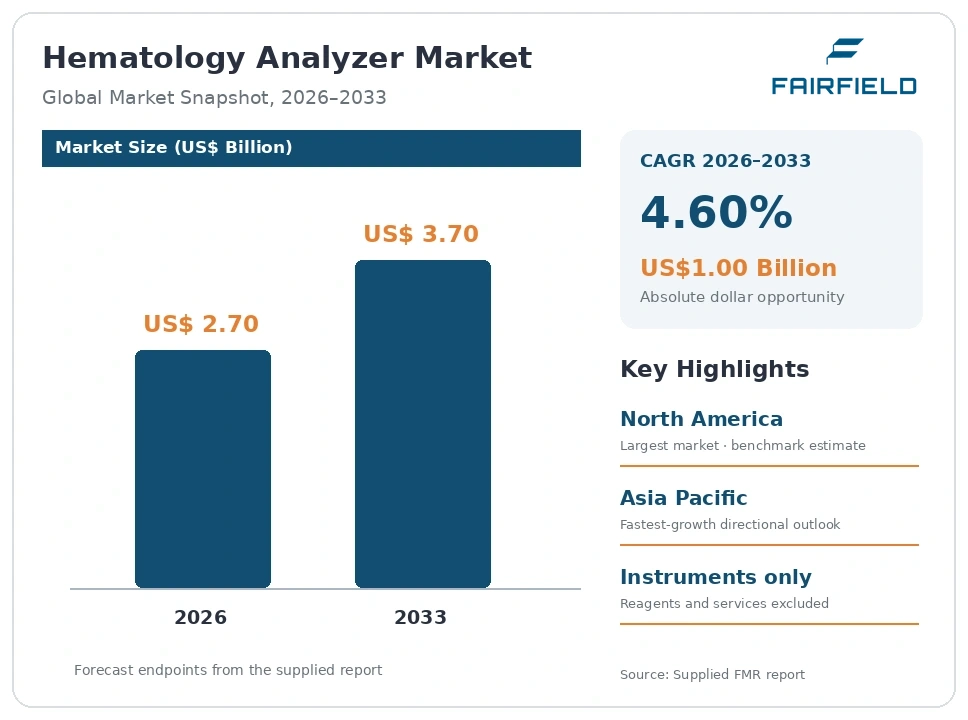
The global Hematology Analyzer market size is expected to be valued at US$2.70 billion in 2026 and projected to reach US$3.70 billion by 2033, growing at a CAGR of 4.60% between 2026 and 2033. Purchasing centers on instruments that support blood-cell counting and related hematology analysis. Laboratories assess analytical requirements, workflow, service access, and complete operating cost when replacing or expanding equipment.
During 2020–2025, suppliers developed compact platforms, connected systems, and broader workflow capabilities. A consistent historical CAGR is unavailable; backcasting the selected endpoint growth implies a 2025 value near US$2.58 billion. Routine complete blood count testing, instrument replacement, and laboratory integration support demand. Reagent continuity and quality-control requirements influence adoption. The overall direction favors fit-for-purpose equipment, while instrument revenue remains distinct from separately sold reagents, maintenance, and adjacent diagnostic systems that may appear in broader market estimates.
Key Report Takeaways
- By Workflow Configuration: Independent Bench Systems suit laboratories needing a discrete instrument, while Connected Workcell Systems coordinate analyzers with other workflow components. Documented products support both configurations. Comparable shares and fastest-growth rates are unavailable for these independently defined segments.
- By Purchasing Organization: Provider-Owned Laboratories and Independent Testing Organizations have different procurement priorities, while Other Organizations completes the customer taxonomy. Buyers evaluate workload and service requirements. The selected benchmark identifies hospitals as important customers, without mapping its share directly onto these broader categories.
- By Installation Role: Primary Capacity supports routine workloads, Backup Capacity addresses continuity needs, and Distributed Access supports testing away from the main laboratory. These roles are assigned by the principal purchasing purpose, avoiding overlap between a small instrument and its operational role.
- By Geography: North America leads the selected benchmark estimate, while Asia Pacific has its fastest-growth direction. Comparable country rankings and a regional forecast CAGR are unavailable. Manufacturing localization and service coverage affect purchasing access alongside laboratory investment and replacement cycles.
- By Competition: Sysmex, Beckman Coulter, HORIBA, Mindray, and Siemens Healthineers document relevant hematology offerings. Suppliers compete through analytical suitability, workflow integration, consumable availability, and support. Product availability and clinical claims require verification for the customer’s jurisdiction and intended use.
Global Hematology Analyzer Market Trends and Insights
Drivers Impact Analysis
The impact ratings describe analyst judgement about purchasing mechanisms, without assigning unsupported percentages to market growth.
| Driver | Impact on CAGR Forecast | Geographic Relevance | Impact Timeline |
| Routine testing and instrument replacement | High | All five standard regions | Short term (≤2 years) |
| Connected workflows and broader analytical requirements | Medium | Established laboratory networks | Medium term (2–4 years) |
Hematology Analyzer Demand Begins With Routine Testing Capacity
Routine blood testing creates demand for reliable hematology equipment that fits a laboratory’s workload and reporting requirements. Instrument purchases can support replacement, additional capacity, or access at a new site. These are different triggers, and growth in test orders does not automatically require equivalent instrument growth. Customers may first improve scheduling, operating hours, or existing equipment utilization. Suppliers should therefore connect their proposals to actual bottlenecks and analytical needs rather than assume every workload increase creates a new placement.
Sysmex, Beckman Coulter, and Mindray document automated blood-analysis products, establishing direct participation in routine testing. The World Health Organization’s anaemia estimates provide a broader context for continuing diagnostic needs, without defining an instrument-sales forecast. Commercial decisions still depend on service access, budgets, and pathways. A supplier can strengthen its case through workload assessment, appropriate configurations, and reliable support, while avoiding unsupported claims that one analyzer independently establishes a complete diagnosis.
Hematology Analyzer Integration Can Reduce Disconnected Workflow Steps
Connected workflows support purchasing when laboratories need to coordinate sample processing, result review, and data management. The relevant value is how an instrument fits the complete workflow, rather than its nominal throughput alone. A laboratory may need interfaces with information systems, consistent review rules, or coordinated slide preparation. These requirements can favor integrated proposals, but their benefits depend on local processes and implementation quality. Buyers should identify the actual operational problem before configuration selection.
Beckman Coulter documents connected hematology workcells, while Siemens Healthineers describes hematology automation and data-management capabilities. Sysmex’s recent platform introduction also emphasizes workflow. These offerings establish supplier attention to integration, without proving a universal staffing or turnaround benefit. Specific purchasing considerations include sample routing, exception handling, interface reliability, and ongoing support. Suppliers can differentiate through clear implementation responsibilities and measurable workflow objectives, separating analyzer functionality from additional software, morphology, or automation components within the proposed contract.
Restraints Impact Analysis
Ownership costs and implementation requirements can limit equipment adoption even where laboratories have clear testing needs.
| Restraint | Impact on CAGR Forecast | Geographic Relevance | Impact Timeline |
| Reagents, quality control, and service costs | High | Budget-constrained laboratories | Short term (≤2 years) |
| Qualification, interfaces, and product availability | Medium | New platforms and network deployments | Medium term (2–4 years) |
Hematology Analyzer Ownership Costs Extend Beyond Acquisition
Ownership costs can restrict analyzer purchases when customers assess reagents, controls, calibration, maintenance, training, and waste handling alongside the instrument price. Low-volume laboratories may find that recurring costs are more important than nominal processing capacity. Buyers also need to understand minimum purchase commitments and supply availability. A low upfront price therefore does not establish an economical operating model. Suppliers should explain complete costs and the assumptions used to compare configurations across expected workload and period.
Beckman Coulter’s product documentation includes quality-control, calibration, maintenance, and support functions, demonstrating relevant operating responsibilities. HORIBA also documents connected support for reagent consumption and instrument status. These capabilities do not remove the associated customer costs. Constraints include logistics, service visits, staff time, and work required during equipment interruptions. Buyers should examine realistic sample volumes and continuity arrangements. Suppliers can improve procurement confidence through transparent contracts, reliable consumables, and appropriate local technical support throughout operation.
Hematology Analyzer Deployment Requires Local Verification and Training
Deployment requirements can slow adoption when a laboratory introduces a new platform, replaces established methods, or connects several sites. Customers need appropriate performance verification, staff training, operating procedures, and interfaces. Product availability and permitted claims also differ by jurisdiction. A global announcement is therefore insufficient evidence that an analyzer can immediately be purchased and used for every proposed application. These requirements create work for both the supplier and the laboratory before routine operation can begin.
The U.S. Food and Drug Administration records a substantial-equivalence decision for the Sysmex XR-20 in June 2025, illustrating a specific commercialization pathway. That decision should not be generalized to all products or countries. Implementation costs include validation materials, interface configuration, training, and parallel operation where required. Suppliers can reduce friction through clear documentation and local expertise. Buyers should confirm the exact configuration, intended use, and continuing support arrangements without assuming identical capabilities across product families.
Market Opportunities
Hematology Analyzer Distributed Access Creates Service-Led Placement Opportunities
Distributed testing creates an opportunity for appropriately configured instruments at satellite laboratories and other sites outside a central testing operation. The purchasing case may concern access, sample transport, or local workflow rather than maximum throughput. Suppliers can earn instrument and associated service revenue where workload justifies placement. A smaller footprint alone does not establish suitability: staffing, sample handling, quality control, reporting, and consumable supply must still be organized around the intended clinical service.
HORIBA’s compact analyzer development and Mindray’s documented integrated testing products illustrate relevant supplier capabilities. Provider networks and independent testing organizations can create demand when central processing does not meet a site’s practical requirements. Providers should assess local sample volumes and confirm product availability before placement. Commercial proposals can combine training, remote support, and reliable deliveries. This opportunity differs from general laboratory replacement through a new site or redistributed workflow, beyond equipment replacement.
Hematology Analyzer Network Standardization Can Support Replacement Programs
Network standardization creates an opportunity to coordinate equipment replacement across laboratories with shared needs. Customers may seek consistent training, service arrangements, data handling, and consumable management. Suppliers can capture instrument placements and implementation services through a phased program rather than a single isolated sale. The commercial case depends on installed equipment and replacement timing. Standardization should not be assumed to require identical equipment at sites with very different workloads.
Sysmex’s manufacturing activity in India demonstrates investment in regional instrument and reagent supply. Siemens Healthineers and Beckman Coulter document broader workflow capabilities relevant to coordinated laboratories. These examples support a practical supplier base without proving a specific network contract. Providers can differentiate through assessment, compatible configurations, and transition planning. Customers should retain continuity during installation and define responsibilities for interfaces, training, and consumables. Revenue assessment should separate instruments from recurring reagent and service charges preventing instrument-revenue overstatement.
Segment Analysis
By Workflow Configuration: Hematology Analyzer Integration Changes Procurement Requirements
Independent Bench Systems perform their purchased role as discrete instruments, even when results are transmitted electronically. Connected Workcell Systems form part of a coordinated equipment configuration with automated workflow connections. This distinction avoids treating every analyzer with a data interface as a complete automation workcell. Beckman Coulter documents connected configurations, while compact offerings from HORIBA and Mindray illustrate other purchasing options. Configuration is assigned at the delivered instrument-system level to prevent double counting.
Comparable segment leadership and fastest-growth rates are unavailable. Buyers should evaluate sample routing, review processes, maintenance, and downtime management alongside throughput. Integrated configurations can require additional interfaces and implementation work, while independent instruments may offer practical flexibility at smaller sites. Suppliers should allocate the value of adjacent morphology, staining, and automation equipment separately where necessary. The commercial implication is to compare like-for-like analyzer scope and actual workflow requirements rather than assume broader equipment bundles always create better economics for every laboratory.
By Purchasing Organization: Hematology Analyzer Buyers Have Different Operating Priorities
Provider-Owned Laboratories include testing operations owned by healthcare providers. Independent Testing Organizations cover separate diagnostic businesses purchasing equipment for their testing services. Other Organizations includes remaining relevant purchasers, such as research or other institutional settings within the defined scope. Assignment follows the purchasing entity, making categories mutually exclusive even when a laboratory processes samples from several external sources. A customer group’s sample mix does not automatically change its organizational classification.
Public evidence does not establish shares or growth rankings for these independent categories. Provider-owned buyers may prioritize clinical integration and continuity, while independent organizations may emphasize network logistics and standardized operating cost. Those are procurement considerations, not universal behaviors. Suppliers should assess each customer’s workload, reporting obligations, and support needs. Product portfolios from Sysmex, Beckman Coulter, and Siemens Healthineers demonstrate relevant supply options, but do not establish equal availability across countries or prove that every configuration suits each buyer.
By Installation Role: Hematology Analyzer Capacity Serves More Than Routine Volume
Primary Capacity supports a site’s main routine workload. Backup Capacity is purchased principally to maintain continuity when primary equipment is unavailable. Distributed Access supports testing moved closer to a separate service location. Each instrument is assigned by its principal documented purchase purpose, preventing a compact backup analyzer from being counted again solely because it is physically located away from a main bench. Instrument size and installation role are therefore separate commercial attributes.
Comparable shares and fastest-growth rates are unavailable. Backup equipment requires maintenance and quality-control resources even when use is intermittent. Distributed installations require local staffing, sample handling, and consumable access. Primary instruments need an appropriate balance of throughput, review processes, and support. Suppliers can improve proposals through role-specific workload assessment and continuity planning. Buyers should consider how the proposed installation will operate during normal service and interruptions, rather than treating unused nominal capacity as equivalent to a functioning backup arrangement with trained operators and available reagents.
Geography Analysis
Which Region Is Leading the Hematology Analyzer Market?
North America leads the selected benchmark estimate, with established laboratory purchasing and documented platform availability. The United States provides a specific example through the FDA decision for Sysmex XR-20 and Sysmex America’s subsequent platform introduction. Canada is another relevant customer setting, but a United States decision does not independently establish Canadian availability or permitted claims. Exact product status requires local confirmation.
Opportunities include replacement, connected workflows, and distributed capacity where supported by customer needs. Buyers assess service, consumables, interfaces, and operating cost alongside analytical functionality. Suppliers need evidence appropriate to each proposed configuration. Procurement cycles and implementation work can delay conversion from interest to sales, making actual placements and installed-base transitions more useful commercial measures than product announcements alone.
Hematology Analyzer European Purchasing Emphasizes Local Product Scope
Europe has a documented hematology supplier ecosystem and diverse laboratory configurations. France is relevant to HORIBA’s hematology activity, while Germany and the United Kingdom provide important customer-development settings. Siemens Healthineers also documents hematology and workflow offerings. These examples establish commercial participation without supplying comparable national market shares or implying identical product availability across all countries.
Opportunities include compact system replacement, network coordination, and suitable workflow integration. Suppliers should confirm local requirements, intended use, and available support for the exact analyzer configuration. Laboratories need to assess complete ownership cost and transition responsibilities. Differences in procurement, staffing, and existing infrastructure can affect adoption. A credible regional strategy therefore begins with local customer needs and verified commercial access rather than a uniform assumption about every European laboratory.
Which Region Is Growing Fastest in the Hematology Analyzer Market?
Asia Pacific has the fastest-growth direction in the selected benchmark, without a comparable forecast CAGR adopted here. China, India, and Japan provide distinct customer and supplier settings. Sysmex began full-scale operations at its new Indian manufacturing base in April 2025, including production of XQ-320 instruments. Mindray documents hematology products for laboratories with varied requirements. These developments support a regional supply context rather than a national growth ranking.
Opportunities include instrument access, service coverage, and replacement aligned with local workloads. Price sensitivity, consumable logistics, training, and implementation resources can constrain adoption. Suppliers should distinguish manufacturing output from local end-user sales. Country-specific product status and customer capacity remain necessary checks before treating a regional platform announcement as a realized equipment opportunity.
Hematology Analyzer Latin American Demand Requires Reliable Support
Latin America offers selective opportunities across provider-owned and independent laboratory operations. Brazil, Mexico, and Argentina are relevant customer-development settings without implying a verified ranking. Buyers may need replacement equipment, additional capacity, or local testing access. These needs should be established through actual workload and service requirements rather than inferred directly from population growth or broad healthcare investment announcements.
Import costs, currency exposure, consumable availability, and technical support can limit purchasing. Suppliers can work with qualified distributors to coordinate installation, training, and recurring deliveries. Opportunities include appropriate compact configurations and transparent replacement programs. Customers should compare complete ownership costs and the response available during equipment interruptions. Reliable operating support can be decisive when a laboratory has limited redundancy and must maintain routine testing with a small staff.
Hematology Analyzer Middle East & Africa Needs Fit-for-Purpose Deployment
Middle East & Africa includes varied hospital, independent, and distributed laboratory settings. Saudi Arabia, the United Arab Emirates, and South Africa are potential focus countries for customer assessment. These examples are not verified market-share leaders. Product availability, purchasing processes, and service infrastructure differ, making the exact installation and intended workflow more useful than a single regional equipment assumption.
Barriers include budget constraints, training requirements, consumable logistics, and technical-service access. Opportunities may arise through replacement programs and testing access where local operating support is feasible. Suppliers should demonstrate appropriate product status and delivery capacity before proposing expansion. Customers need a realistic plan for quality control, maintenance, and interruptions. A placement creates durable commercial value when the laboratory can operate the instrument consistently, rather than merely acquire equipment without continuing support.
Competitive Landscape
Competition is shaped by analytical capability, installed relationships, consumables, and service infrastructure. High concentration is a qualitative analyst judgement about established global platform suppliers, rather than a calculated company-share result. Sysmex, Beckman Coulter, HORIBA, Mindray, and Siemens Healthineers have verified relevant offerings. Their wider diagnostic revenues should not be used to rank hematology analyzer sales, because those portfolios include other instruments, reagents, software, and services with different market boundaries.
Customers compare fit to workload, reporting needs, implementation effort, and complete operating cost. New entrants can address compact systems or specific workflow gaps, but require evidence, product access, consumable continuity, and support. An attractive technical demonstration does not independently establish readiness for routine laboratory use. Established suppliers also face customer scrutiny when proposing broader configurations whose equipment, software, and recurring charges extend beyond the replacement analyzer itself.
Documented developments show several competitive approaches. HORIBA introduced compact combined-testing analyzers in June 2024. Sysmex expanded regional manufacturing operations in April 2025 and introduced its next-generation platform in the United States in May 2026. These moves concern product design, local supply, and platform rollout respectively. They should not be treated as equivalent additions to instrument demand or evidence that every customer will adopt the same configuration.
Strategic direction should connect verified analytical functions with a workable customer operating model. Suppliers can differentiate through clear specifications, appropriate configurations, reliable support, and realistic transition plans. Buyers should establish which components are included and confirm the exact product status locally. Contracts should distinguish instrument revenue from reagents, software, maintenance, and adjacent equipment. This supports meaningful comparison without predicting winners, assigning unsupported rankings, or presenting supplier marketing claims as universal improvements in clinical or operational outcomes.
Hematology Analyzer Industry Leaders
- Sysmex
- Beckman Coulter
- HORIBA
- Mindray
- Siemens Healthineers
Recent Industry Developments
June 2024: HORIBA introduced compact Yumizen H550E and H500E models combining blood-count testing with sedimentation-rate functionality, extending its compact portfolio.
April 2025: Sysmex began full-scale operations at its new Indian manufacturing base and commenced local XQ-320 production, supporting regional supply capabilities.
May 2026: Sysmex America introduced its next-generation XR-Series, emphasizing analytical and workflow capabilities for clinical laboratories in its stated market.
Companies Covered in the Report
Sysmex; Beckman Coulter; HORIBA; Mindray; Siemens Healthineers. Participation is verified through product or company disclosures, with no unsupported company-share ranking assigned.
Hematology Analyzer Market Report Scope
| Metric | Value |
| Study Period | 2020–2033 |
| Market Size 2026 | US$2.70 Billion |
| Market Size 2033 | US$3.70 Billion |
| CAGR 2026–2033 | 4.60% |
| Absolute Dollar Opportunity | US$1.00 Billion |
| Largest Market | North America, benchmark estimate |
| Fastest-Growing Market | Asia Pacific, directional outlook |
| Market Concentration | High, qualitative analyst judgement |
| Major Players | Sysmex, Beckman Coulter, HORIBA, Mindray, Siemens Healthineers |
The Hematology Analyzer Market covers instruments used for blood-cell counting and related hematology analysis in human laboratory workflows. It includes analyzer value within connected configurations but excludes separately sold reagents, maintenance, unrelated chemistry and coagulation systems, and standalone morphology equipment. Adjacent services are discussed where they affect purchasing. The base year is 2025, with historical context from 2020 and a 2026–2033 forecast. Monetary values use US$ Billion, with bundled contracts requiring appropriate allocation.
Hematology Analyzer Market Segmentation
Workflow Configuration
- Independent Bench Systems
- Connected Workcell Systems
Purchasing Organization
- Provider-Owned Laboratories
- Independent Testing Organizations
- Other Organizations
Installation Role
- Primary Capacity
- Backup Capacity
- Distributed Access
Regions
- North America
- Europe
- Asia Pacific
- Latin America
- Middle East & Africa
- Executive Summary
- Global Hematology Analyzer Market Snapshot
- Future Projections
- Key Report Takeaways
- Regional Snapshot
- Market Overview
- Market Definition and Report Scope
- Historical Trends 2020–2025
- Market Dynamics
- Drivers
- Hematology Analyzer Demand Begins With Routine Testing Capacity
- Hematology Analyzer Integration Can Reduce Disconnected Workflow Steps
- Restraints
- Hematology Analyzer Ownership Costs Extend Beyond Acquisition
- Hematology Analyzer Deployment Requires Local Verification and Training
- Market Opportunities
- Hematology Analyzer Distributed Access Creates Service-Led Placement Opportunities
- Hematology Analyzer Network Standardization Can Support Replacement Programs
- Drivers
- Global Hematology Analyzer Market Outlook, 2020–2033
- Global Hematology Analyzer Market Outlook, by Workflow Configuration, Value (US$ Billion), 2020–2033
- Independent Bench Systems
- Connected Workcell Systems
- Global Hematology Analyzer Market Outlook, by Purchasing Organization, Value (US$ Billion), 2020–2033
- Provider-Owned Laboratories
- Independent Testing Organizations
- Other Organizations
- Global Hematology Analyzer Market Outlook, by Installation Role, Value (US$ Billion), 2020–2033
- Primary Capacity
- Backup Capacity
- Distributed Access
- Global Hematology Analyzer Market Outlook, by Region, Value (US$ Billion), 2020–2033
- North America
- Europe
- Asia Pacific
- Latin America
- Middle East & Africa
- Global Hematology Analyzer Market Outlook, by Workflow Configuration, Value (US$ Billion), 2020–2033
- North America Hematology Analyzer Market Outlook, 2020–2033
- North America Hematology Analyzer Market Outlook, by Workflow Configuration, Value (US$ Billion), 2020–2033
- Independent Bench Systems
- Connected Workcell Systems
- North America Hematology Analyzer Market Outlook, by Purchasing Organization, Value (US$ Billion), 2020–2033
- Provider-Owned Laboratories
- Independent Testing Organizations
- Other Organizations
- North America Hematology Analyzer Market Outlook, by Installation Role, Value (US$ Billion), 2020–2033
- Primary Capacity
- Backup Capacity
- Distributed Access
- North America Hematology Analyzer Market Outlook, by Country, Value (US$ Billion), 2020–2033
- United States Hematology Analyzer Market Outlook, by Workflow Configuration, 2020–2033
- United States Hematology Analyzer Market Outlook, by Purchasing Organization, 2020–2033
- United States Hematology Analyzer Market Outlook, by Installation Role, 2020–2033
- Canada Hematology Analyzer Market Outlook, by Workflow Configuration, 2020–2033
- Canada Hematology Analyzer Market Outlook, by Purchasing Organization, 2020–2033
- Canada Hematology Analyzer Market Outlook, by Installation Role, 2020–2033
- North America Hematology Analyzer Market Outlook, by Workflow Configuration, Value (US$ Billion), 2020–2033
- Europe Hematology Analyzer Market Outlook, 2020–2033
- Europe Hematology Analyzer Market Outlook, by Workflow Configuration, Value (US$ Billion), 2020–2033
- Independent Bench Systems
- Connected Workcell Systems
- Europe Hematology Analyzer Market Outlook, by Purchasing Organization, Value (US$ Billion), 2020–2033
- Provider-Owned Laboratories
- Independent Testing Organizations
- Other Organizations
- Europe Hematology Analyzer Market Outlook, by Installation Role, Value (US$ Billion), 2020–2033
- Primary Capacity
- Backup Capacity
- Distributed Access
- Europe Hematology Analyzer Market Outlook, by Country, Value (US$ Billion), 2020–2033
- France Hematology Analyzer Market Outlook, by Workflow Configuration, 2020–2033
- France Hematology Analyzer Market Outlook, by Purchasing Organization, 2020–2033
- France Hematology Analyzer Market Outlook, by Installation Role, 2020–2033
- Germany Hematology Analyzer Market Outlook, by Workflow Configuration, 2020–2033
- Germany Hematology Analyzer Market Outlook, by Purchasing Organization, 2020–2033
- Germany Hematology Analyzer Market Outlook, by Installation Role, 2020–2033
- United Kingdom Hematology Analyzer Market Outlook, by Workflow Configuration, 2020–2033
- United Kingdom Hematology Analyzer Market Outlook, by Purchasing Organization, 2020–2033
- United Kingdom Hematology Analyzer Market Outlook, by Installation Role, 2020–2033
- Europe Hematology Analyzer Market Outlook, by Workflow Configuration, Value (US$ Billion), 2020–2033
- Asia Pacific Hematology Analyzer Market Outlook, 2020–2033
- Asia Pacific Hematology Analyzer Market Outlook, by Workflow Configuration, Value (US$ Billion), 2020–2033
- Independent Bench Systems
- Connected Workcell Systems
- Asia Pacific Hematology Analyzer Market Outlook, by Purchasing Organization, Value (US$ Billion), 2020–2033
- Provider-Owned Laboratories
- Independent Testing Organizations
- Other Organizations
- Asia Pacific Hematology Analyzer Market Outlook, by Installation Role, Value (US$ Billion), 2020–2033
- Primary Capacity
- Backup Capacity
- Distributed Access
- Asia Pacific Hematology Analyzer Market Outlook, by Country, Value (US$ Billion), 2020–2033
- China Hematology Analyzer Market Outlook, by Workflow Configuration, 2020–2033
- China Hematology Analyzer Market Outlook, by Purchasing Organization, 2020–2033
- China Hematology Analyzer Market Outlook, by Installation Role, 2020–2033
- India Hematology Analyzer Market Outlook, by Workflow Configuration, 2020–2033
- India Hematology Analyzer Market Outlook, by Purchasing Organization, 2020–2033
- India Hematology Analyzer Market Outlook, by Installation Role, 2020–2033
- Japan Hematology Analyzer Market Outlook, by Workflow Configuration, 2020–2033
- Japan Hematology Analyzer Market Outlook, by Purchasing Organization, 2020–2033
- Japan Hematology Analyzer Market Outlook, by Installation Role, 2020–2033
- Asia Pacific Hematology Analyzer Market Outlook, by Workflow Configuration, Value (US$ Billion), 2020–2033
- Latin America Hematology Analyzer Market Outlook, 2020–2033
- Latin America Hematology Analyzer Market Outlook, by Workflow Configuration, Value (US$ Billion), 2020–2033
- Independent Bench Systems
- Connected Workcell Systems
- Latin America Hematology Analyzer Market Outlook, by Purchasing Organization, Value (US$ Billion), 2020–2033
- Provider-Owned Laboratories
- Independent Testing Organizations
- Other Organizations
- Latin America Hematology Analyzer Market Outlook, by Installation Role, Value (US$ Billion), 2020–2033
- Primary Capacity
- Backup Capacity
- Distributed Access
- Latin America Hematology Analyzer Market Outlook, by Country, Value (US$ Billion), 2020–2033
- Brazil Hematology Analyzer Market Outlook, by Workflow Configuration, 2020–2033
- Brazil Hematology Analyzer Market Outlook, by Purchasing Organization, 2020–2033
- Brazil Hematology Analyzer Market Outlook, by Installation Role, 2020–2033
- Mexico Hematology Analyzer Market Outlook, by Workflow Configuration, 2020–2033
- Mexico Hematology Analyzer Market Outlook, by Purchasing Organization, 2020–2033
- Mexico Hematology Analyzer Market Outlook, by Installation Role, 2020–2033
- Argentina Hematology Analyzer Market Outlook, by Workflow Configuration, 2020–2033
- Argentina Hematology Analyzer Market Outlook, by Purchasing Organization, 2020–2033
- Argentina Hematology Analyzer Market Outlook, by Installation Role, 2020–2033
- Latin America Hematology Analyzer Market Outlook, by Workflow Configuration, Value (US$ Billion), 2020–2033
- Middle East & Africa Hematology Analyzer Market Outlook, 2020–2033
- Middle East & Africa Hematology Analyzer Market Outlook, by Workflow Configuration, Value (US$ Billion), 2020–2033
- Independent Bench Systems
- Connected Workcell Systems
- Middle East & Africa Hematology Analyzer Market Outlook, by Purchasing Organization, Value (US$ Billion), 2020–2033
- Provider-Owned Laboratories
- Independent Testing Organizations
- Other Organizations
- Middle East & Africa Hematology Analyzer Market Outlook, by Installation Role, Value (US$ Billion), 2020–2033
- Primary Capacity
- Backup Capacity
- Distributed Access
- Middle East & Africa Hematology Analyzer Market Outlook, by Country, Value (US$ Billion), 2020–2033
- Saudi Arabia Hematology Analyzer Market Outlook, by Workflow Configuration, 2020–2033
- Saudi Arabia Hematology Analyzer Market Outlook, by Purchasing Organization, 2020–2033
- Saudi Arabia Hematology Analyzer Market Outlook, by Installation Role, 2020–2033
- United Arab Emirates Hematology Analyzer Market Outlook, by Workflow Configuration, 2020–2033
- United Arab Emirates Hematology Analyzer Market Outlook, by Purchasing Organization, 2020–2033
- United Arab Emirates Hematology Analyzer Market Outlook, by Installation Role, 2020–2033
- South Africa Hematology Analyzer Market Outlook, by Workflow Configuration, 2020–2033
- South Africa Hematology Analyzer Market Outlook, by Purchasing Organization, 2020–2033
- South Africa Hematology Analyzer Market Outlook, by Installation Role, 2020–2033
- Middle East & Africa Hematology Analyzer Market Outlook, by Workflow Configuration, Value (US$ Billion), 2020–2033
- Competitive Landscape
- Market Concentration and Industry Leaders
- Competitive Differentiation
- Strategic Moves and Market Direction
- Recent Industry Developments
- Company Profiles
- Sysmex
- Beckman Coulter
- HORIBA
- Mindray
- Siemens Healthineers
- Appendix
- Research Methodology
- Report Assumptions
- Acronyms and Abbreviations
Workflow Configuration
- Independent Bench Systems
- Connected Workcell Systems
Purchasing Organization
- Provider-Owned Laboratories
- Independent Testing Organizations
- Other Organizations
Installation Role
- Primary Capacity
- Backup Capacity
- Distributed Access
Regions
- North America
- Europe
- Asia Pacific
- Latin America
- Middle East & Africa
Our Research Methodology
Considering the volatility of business today, traditional approaches to strategizing a game plan can be unfruitful if not detrimental. True ambiguity is no way to determine a forecast. A myriad of predetermined factors must be accounted for such as the degree of risk involved, the magnitude of circumstances, as well as conditions or consequences that are not known or unpredictable. To circumvent binary views that cast uncertainty, the application of market research intelligence to strategically posture, move, and enable actionable outcomes is necessary.
View Methodology
Quality Assured
Rigorous Validation Process

Confidentiality Assured
End-to-end Data Security

Custom Research Services
Tailored To Your Objectives
FAQs
The Hematology Analyzer Market is estimated at US$2.70 billion in 2026, covering instruments for blood-cell counting and related human laboratory hematology analysis.
The Hematology Analyzer Market is projected to reach US$3.70 billion by 2033, implying 4.60% annual growth and US$1.00 billion additional instrument revenue opportunity.
A comparable leader is unavailable for the independent workflow taxonomy; Independent Bench Systems and Connected Workcell Systems serve different workload and integration requirements.
Asia Pacific has the fastest-growth direction in the selected benchmark, with manufacturing localization and laboratory investment supporting opportunity; a comparable forecast CAGR remains unavailable.
North America leads the selected benchmark estimate, supported by established laboratory purchasing and documented product availability, although a current country-specific ranking is unavailable.
Related Reports
Zirconia Based Dental Materials Market Size, Share, Insights, Competitive Landscape, and Forecast 2026 to 2033
The global zirconia based dental materials market is valued at US$1.6 billion in 2026, reaching US$2.8 billion by 2033, growing at an 8.3% CAGR
Wheelchair Market Size, Share, Insights, Competitive Landscape, and Forecast 2026 to 2033
The global wheelchair market is valued at US$6.4 billion in 2026, reaching US$9.8 billion by 2033, growing at a 6.3% CAGR
3D Bioprinting Market Size, Share, Insights, Competitive Landscape, and Forecast 2026 to 2033
The global 3D bioprinting market is valued at US$2.81 billion in 2026, reaching US$10.11 billion by 2033, growing at a 20.1% CAGR
3D Bioengineered Skin Grafts Market Size, Share, Insights, Competitive Landscape, and Forecast 2026 to 2033
The global 3D bioengineered skin grafts market is valued at US$2.50 billion in 2026, reaching US$4.45 billion by 2033, growing at an 8.6% CAGR
Respiratory Diagnostics Market Size, Share, Insights, Competitive Landscape, and Forecast 2026 to 2033
The global respiratory diagnostics market is valued at US$9.66 billion in 2026, reaching US$14.69 billion by 2033, growing at a 6.2% CAGR
Microtainer Blood Collection Market Size, Share, Insights, Competitive Landscape, and Forecast 2026 to 2033
The global microtainer blood collection market is valued at US$1.37 billion in 2026, reaching US$2.20 billion by 2033, growing at a 7.0% CAGR