



Zirconia Based Dental Materials Market
Zirconia Based Dental Materials Market Size, Share, Insights, Competitive Landscape, and Forecast 2026 to 2033
Zirconia Based Dental Materials Market Size and Trend Analysis
What Is Driving Zirconia Dental Material Demand Today?
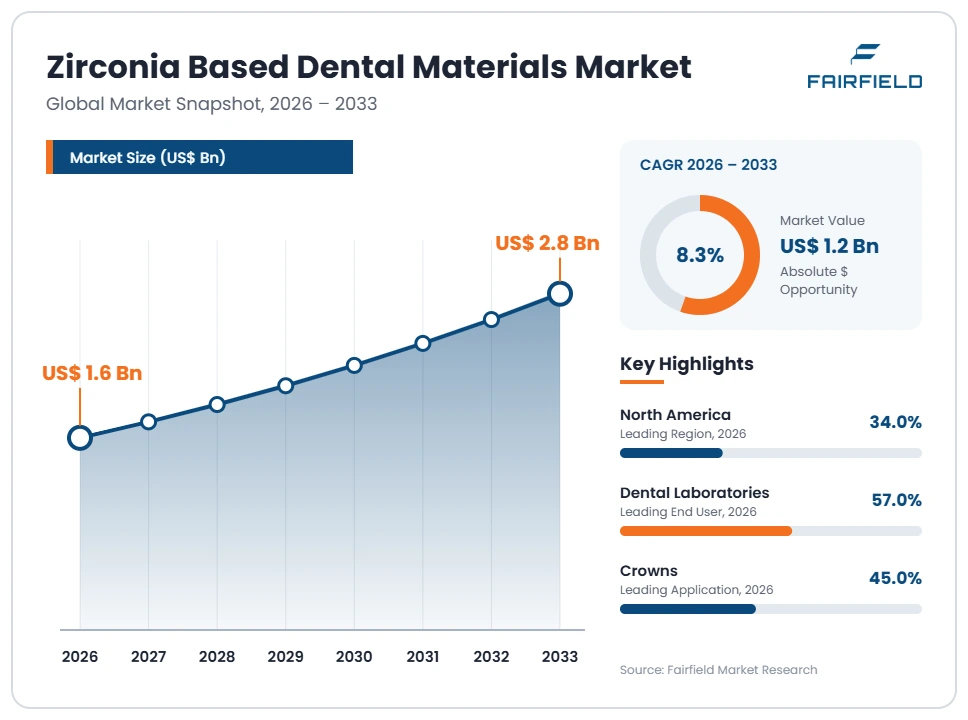
The global Zirconia Based Dental Materials market size is expected to be valued at US$ 1.6 billion in 2026 and projected to reach US$ 2.8 billion by 2033, growing at a CAGR of 8.3% between 2026 and 2033.
Between 2020 and 2025 the market grew at roughly 6.1% a year, reaching close to US$ 1.48 billion. Three factors explain the acceleration. Monolithic zirconia has displaced much veneered restoration work, because chipping of layered porcelain was a persistent failure mode. Translucent 4Y and 5Y partially stabilised grades and multilayer gradient blanks have widened the indication range beyond posterior crowns. Digital workflows built on intraoral scanning and open STL exchange have cut the cost of producing milled restorations at scale. This study counts yttria-stabilised zirconia discs, blanks and blocks, zirconia implants and abutments, and the sintering furnaces, stains and glazes used to process them. Chairside composite, lithium disilicate and metal alloys are excluded.
Key Report Takeaways
- By Product Type: Milling Discs and Blanks held 44% share in 2026, while Zirconia Implants and Abutments are projected to expand at a 10.2% CAGR through 2033, driven by patient preference for metal-free implant components and improving one-piece ceramic designs.
- By Material Grade: 3Y-TZP held 38% share in 2026, while Multilayer Gradient Zirconia is projected to expand at a 10.8% CAGR through 2033, driven by single-blank shade and translucency transitions that remove manual layering from laboratory workflows.
- By Application: Crowns held 45% share in 2026, while Implant-Supported Restorations are projected to expand at a 10.5% CAGR through 2033, driven by rising implant placement volumes and the shift toward screw-retained monolithic superstructures.
- By End User: Dental Laboratories held 57% share in 2026, while Dental Clinics and Chairside Milling Centres are projected to expand at a 10.9% CAGR through 2033, driven by fast-sintering furnaces that make same-day ceramic restorations practical.
- By Geography: North America held 34% share in 2026, while Asia Pacific is projected to expand at a 10.4% CAGR through 2033, driven by dense milling-centre capacity and rapidly growing private dental chains.
Global Zirconia Based Dental Materials Market Trends and Insights
Drivers Impact Analysis
Two structural shifts in restorative practice account for most forecast growth in zirconia consumption.
| Driver | Impact on CAGR Forecast | Geographic Relevance | Impact Timeline |
| Shift from veneered frameworks to monolithic zirconia restorations | High | Global | Medium term 2–4 years |
| Digital dentistry workflows linking intraoral scanning to open milling | High | North America, Europe, Asia Pacific | Long term ≥4 years |
Monolithic Restorations Replace Veneered Frameworks and Lift Zirconia Blank Consumption
The move to monolithic restorations is the dominant volume driver. Veneered zirconia frameworks suffered chipping of the overlying feldspathic porcelain, a well-documented failure mode that generated remakes and warranty cost for laboratories. Milling the full contour from a single zirconia blank removes that interface entirely, and it also consumes substantially more ceramic per unit than a thin coping.
The enabling change is material, not marketing. Early 3Y-TZP was strong but opaque, so anterior work still needed layering. Translucent 4Y and 5Y partially stabilised grades, together with multilayer gradient blanks that shift shade and translucency through the disc, made full-contour restorations visually acceptable in more positions. Laboratories responded by standardising on larger blank inventories. Because monolithic work also shortens turnaround, the economics favour it even where appearance requirements are modest, reinforcing the consumption shift.
Digital Scanning and Open CAD/CAM Exchange Expand Zirconia Milling Throughput
Digital workflow adoption is the second engine. Intraoral scanners replace conventional impressions, design software generates the restoration, and the file moves straight to a milling unit. Each step removes manual handling, which raises the number of ceramic units a laboratory can produce without adding technicians and makes zirconia the default material for that throughput.
Open file exchange is the causal mechanism. Standardised STL and related open formats let clinics send scan data to any laboratory or milling centre, breaking the closed scanner-to-mill chains that once limited material choice. That interoperability widened the addressable base of zirconia buyers from large laboratories to small practices and independent milling centres. Sintering furnace makers responded with faster cycles, and blank producers introduced disc geometries matched to common milling machines, further lowering the barrier to entry.
Restraints Impact Analysis
Two technical and regulatory constraints temper the pace of zirconia adoption in dentistry.
| Restraint | Impact on CAGR Forecast | Geographic Relevance | Impact Timeline |
| Strength and translucency trade-off across 3Y to 5Y grades | Medium | Global | Long term ≥4 years |
| Medical device conformity assessment cost and capacity constraints | Medium | Europe | Short term ≤2 years |
Strength Falls as Translucency Rises, Limiting Universal Zirconia Grade Adoption
The central material constraint is that translucency is bought with strength. Moving from 3Y-TZP toward 5Y partially stabilised compositions raises the cubic phase fraction and improves light transmission, but flexural strength declines across that range. Laboratories therefore cannot standardise on a single grade, and must hold multiple disc inventories, which raises working capital and complicates ordering.
Two further technical issues shape the limit. Low-temperature degradation, commonly called ageing, is a documented phenomenon in tetragonal zirconia in which surface tetragonal grains transform over time in moist conditions, and it remains a legitimate long-term durability question that material suppliers address through composition and processing control. Separately, sintering shrinkage of pre-sintered blanks must be compensated precisely in software, so a furnace deviation or a mismatched shrinkage factor produces unusable work and scrapped material.
Medical Device Conformity Costs Slow Zirconia Product Introductions in Regulated Markets
Regulatory cost is the main commercial brake, particularly in the European Union. Zirconia implants and abutments sit in a higher risk class than restorative blanks, so conformity assessment requires notified body involvement, clinical evaluation and continuing post-market surveillance. Smaller blank producers delay or abandon launches rather than carry that burden, which narrows the supply of new grades.
The cost source is specific rather than general. Regulation (EU) 2017/745 raised clinical evidence expectations and expanded technical documentation requirements, while notified body capacity has been limited relative to the volume of devices needing recertification. Firms must also maintain ISO 13485 quality systems and demonstrate conformity with ISO 6872 for dental ceramics and ISO 13356 for implant-grade material. In the United States, 510(k) submissions for dental ceramics and abutments add a parallel evidence and testing workload.
Market Opportunities
Zirconia Implants and Abutments Open a Premium Metal-Free Revenue Pool
Ceramic implant components are the highest-value opportunity in the category. Zirconia implants and abutments command far higher prices per unit than restorative blanks, and they address patients and clinicians who prefer to avoid titanium for aesthetic or biocompatibility reasons. The pool is still small relative to titanium systems, which is precisely why its growth headroom is large.
Capture favours firms that already hold implant regulatory files and clinical evidence capability. Demand originates with implantology-focused practices and specialist clinics, particularly where anterior gingival appearance matters and thin biotypes expose metal shadowing. ISO 13356 sets requirements for ceramic materials based on yttria-stabilised tetragonal zirconia used in surgical implants, giving manufacturers a recognised specification. Blank producers without implant experience can participate by supplying certified implant-grade feedstock and abutment preforms to established implant system companies.
Chairside Milling Centres Create a Distributed Zirconia Consumables Revenue Stream
Same-day chairside production is the clearest emerging revenue pool outside the traditional laboratory channel. Practices that install a mill and a fast-sintering furnace buy small blocks, stains and glazes directly, at higher per-unit prices than laboratories negotiate, and they reorder frequently because they hold little inventory. This converts a one-time equipment sale into recurring consumables revenue.
The demand comes from group practices and dental service organisations standardising equipment across many sites, and from single-visit restorative positioning used to attract patients. Speed-sintering furnace cycles measured in minutes rather than hours made the model practical, and compact block formats matched to chairside mills completed it. Suppliers that bundle blocks, shade systems, furnace programmes and training capture the whole basket, while dental CAD/CAM distributors provide the service network these practices require.
Segment Analysis
- By Product Type: Milling Discs and Blanks Lead While Implants and Abutments Accelerate
Milling Discs and Blanks hold 44% of revenue in 2026, because laboratory production of crowns, bridges and frameworks consumes large-format pre-sintered discs in continuous volume. Disc formats suit high-throughput milling and allow nesting of many units per blank, which keeps cost per restoration low. Zirconia Implants and Abutments grow fastest at a 10.2% CAGR, reflecting demand for metal-free implant components and improving one-piece and two-piece ceramic designs validated against ISO 13356. Zirconia Blocks serve chairside mills in smaller geometries, while Processing Equipment and Accessories covers sintering furnaces, stains and glazes that attach to every blank sold. The business implication is that value is shifting from bulk ceramic toward regulated, clinically evidenced components, so suppliers with medical device infrastructure can grow revenue faster than blank tonnage alone would suggest.
- By Material Grade: 3Y-TZP Holds the Base as Multilayer Gradient Blanks Gain Share
3Y-TZP retains 38% share in 2026 because its high flexural strength remains the reference choice for posterior crowns, long-span frameworks and implant-supported superstructures where load matters more than light transmission. Multilayer Gradient Zirconia expands fastest at a 10.8% CAGR, since a single blank delivers graded shade and translucency from cervical to incisal regions, removing manual layering and the chipping risk that came with it. 4Y and 5Y partially stabilised grades occupy the middle and anterior aesthetic ground, trading flexural strength for translucency as the cubic phase fraction rises. That trade-off is a clinical selection decision rather than an upgrade path. For suppliers, the implication is portfolio breadth: laboratories now qualify a vendor on the completeness of its grade range, not on one flagship material.
- By Application: Crowns Dominate Volume While Implant-Supported Work Grows Quickest
Crowns account for 45% of zirconia dental material consumption in 2026, the single largest application, because single-unit restorations are by far the most frequent indication and monolithic zirconia has become a default choice for posterior units. Implant-Supported Restorations grow fastest at a 10.5% CAGR, tracking rising implant placement volumes and the move toward screw-retained monolithic superstructures and full-arch frameworks milled from one blank. Bridges and Frameworks remain substantial, using the strongest grades for multi-unit spans. Inlays, Onlays and Veneers form a smaller category where translucent grades compete with glass ceramics. The commercial implication is that full-arch and implant work consumes several times more ceramic per case than a single crown, so a modest rise in case count produces a disproportionate increase in blank volume.
- By End User: Dental Laboratories Lead While Chairside Milling Centres Scale Fastest
Dental Laboratories represent 57% of demand in 2026, because most restorations are still designed and milled off-site by technicians who operate multi-axis mills, large sintering furnaces and finishing stations that individual practices cannot justify. Dental Clinics and Chairside Milling Centres grow fastest at a 10.9% CAGR, enabled by speed-sintering furnaces with cycles short enough to complete a ceramic restoration in a single appointment. Hospitals and Academic Institutes form a smaller but influential group, driving material evaluation and training. The structural consequence is channel fragmentation: suppliers must now serve both consolidated laboratory accounts buying discs by the case and thousands of small clinical accounts buying blocks in ones and twos, which changes distribution economics and raises the value of dental CAD/CAM service networks.
Geography Analysis
- Which Region Is Leading the Zirconia Based Dental Materials Market?
North America leads the zirconia based dental materials market with 34% share in 2026, worth about US$ 544 million. The United States drives this through high restorative spending, broad private dental insurance coverage, and rapid consolidation of practices into dental service organisations that standardise materials and equipment across many sites. Those groups buy centrally, which favours suppliers able to guarantee consistent shade and sintering behaviour at volume. The Food and Drug Administration clears dental ceramics and abutments through the 510(k) pathway, giving a predictable route to market for established material families. Large commercial laboratories operating centralised milling plants add further scale. The clearest regional change is the spread of chairside milling into group practices, which converts a laboratory purchase into a recurring in-office consumables order.
- Europe Sets the Material Standards That Shape Zirconia Restorative Practice
Europe holds 30% of revenue in 2026, the second-largest position and the most standards-driven. Germany leads, supported by a dense base of dental material manufacturers and technically sophisticated laboratories, followed by Italy, France, Switzerland and the United Kingdom. Regulation (EU) 2017/745 governs dental devices, and Regulation (EU) 2023/607 extended transition timelines after notified body capacity proved insufficient for the volume of recertification work. ISO 6872 for dental ceramics and ISO 13356 for implant-grade yttria-stabilised zirconia originate in this standards ecosystem and are referenced worldwide. Master technician training traditions keep demand weighted toward premium multilayer blanks and sophisticated staining systems. The regional constraint is conformity assessment cost, which slows new grade introductions, particularly for smaller independent blank producers.
- Which Region Is Growing Fastest in Zirconia Based Dental Materials?
Asia Pacific is growing fastest in zirconia based dental materials at a 10.4% CAGR between 2026 and 2033, from a 26% share in 2026. The region already accounts for the largest share of global milling-centre volume, even though its value share trails because average selling prices are lower. China hosts extensive zirconia blank manufacturing and large export-oriented laboratories, while Japan contributes advanced powder and material technology and a strong domestic premium segment. South Korea has built a substantial implant and digital dentistry industry, and India is expanding rapidly through private dental chains and growing middle-class demand for fixed restorations. The structural shift underway is upgrading rather than expansion alone, as regional producers invest in higher-translucency multilayer grades and tighter quality systems to compete beyond price in export markets.
- Latin America Expands Zirconia Adoption Through Private Clinics and Dental Tourism
Latin America contributes 6% of zirconia dental material revenue in 2026, with Brazil and Mexico accounting for most of it. Growth is led by private clinic networks and by dental tourism, where patients travel for fixed restorative and implant treatment at lower cost, which concentrates demand in border cities and major metropolitan centres. Brazil also has a sizeable domestic dental manufacturing and laboratory base. Barriers are real: import duties and currency volatility raise landed blank prices, equipment financing for mills and sintering furnaces is expensive, and regulatory registration timelines differ by country. Reimbursement for ceramic restorations is largely out of pocket, which caps case volume. The main opportunity is local milling-centre investment, which shortens turnaround and makes monolithic restorations price-competitive with conventional alternatives.
- Middle East & Africa Builds Zirconia Capability From Gulf Clinical Investment
Middle East & Africa accounts for 4% of revenue in 2026, the smallest share and the least penetrated. The United Arab Emirates, Saudi Arabia and Qatar generate most of the value through well-funded private clinics, medical city developments and health system investment programmes that include advanced dental services. Türkiye adjacent demand and South Africa provide additional laboratory capacity, while Egypt and Nigeria represent early-stage volume. The barriers are significant: limited numbers of trained dental technicians, dependence on imported blanks and equipment, uneven regulatory frameworks across national authorities, and service coverage gaps for milling and sintering equipment. Growth is concentrated rather than broad. The region’s opportunity lies in technician training and regional milling hubs that serve several countries from one accredited facility.
Competitive Landscape
The zirconia based dental materials market is moderately concentrated, with concentration varying sharply by layer of the value chain. Zirconia powder supply is narrow, since producing yttria-stabilised tetragonal zirconia powder with controlled yttria content, grain size and sintering behaviour requires specialist ceramic expertise; Tosoh Corporation is a long-established supplier of such powders. Blank and disc manufacturing is far more fragmented, with dozens of producers in Europe, Asia and North America pressing and pre-sintering discs. Full-line dental companies such as Dentsply Sirona Inc., Ivoclar Vivadent AG, Kuraray Noritake Dental Inc. and VITA Zahnfabrik H. Rauter GmbH & Co. KG compete on complete systems rather than on blanks alone.
Competition rests on four factors. The first is optical and mechanical performance, meaning how convincingly a grade balances translucency against flexural strength, and how reliably shade reproduces batch to batch. The second is workflow integration, covering validated milling strategies, sintering programmes, shade libraries and compatibility with open scanner files. The third is regulatory depth, since implant components demand clinical evidence and quality systems that blank producers may lack. The fourth is price, which is decisive in high-volume laboratory accounts. New entrants are mainly Asian blank specialists moving upmarket from commodity discs into multilayer gradient products.
Strategic activity centres on completing the chain from scanner to finished restoration. Established vendors have broadened grade ranges, matched blanks to furnace programmes, and built milling-centre partnerships rather than only selling materials. Several have integrated backward toward powder specification control to stabilise quality.
Strategic direction across vendors points toward bundled digital ecosystems, deeper clinical evidence for ceramic implant components, and education programmes that lock laboratories into a validated material and equipment combination.
Recent Industry Developments
- 2015: The International Organization for Standardization issued the current edition of ISO 13356, covering ceramic materials based on yttria-stabilised tetragonal zirconia for surgical implants – it provides the recognised specification against which zirconia implant and abutment materials are assessed.
- March 2016: The International Organization for Standardization published ISO 13485:2016 for medical device quality management systems – it became the baseline quality framework that dental ceramic and implant manufacturers must maintain to supply regulated markets.
- April 2017: The European Union adopted Regulation (EU) 2017/745 on medical devices – it raised clinical evidence and technical documentation requirements for dental devices, including zirconia implants and abutments.
- May 2021: Regulation (EU) 2017/745 became applicable across the European Union, replacing the earlier medical devices directive – it changed conformity assessment routes for dental ceramic products sold in Europe.
- March 2023: The European Union adopted Regulation (EU) 2023/607 extending the medical device transition deadlines – it relieved notified body capacity pressure and prevented withdrawal of legacy dental devices awaiting recertification.
Companies Covered in the Report
- Kuraray Noritake Dental Inc.
- Ivoclar Vivadent AG
- Dentsply Sirona Inc.
- Tosoh Corporation
- VITA Zahnfabrik H. Rauter GmbH & Co. KG
- Zirkonzahn GmbH
- Amann Girrbach AG
- GC Corporation
- Shofu Inc.
- Dental Direkt GmbH
- Aidite (Qinhuangdao) Technology Co. Ltd.
- Upcera Dental Technology Co. Ltd.
Zirconia Based Dental Materials Market Report Scope
| Metric | Value |
| Study Period | 2020–2033 |
| Market Size 2026 | US$ 1.6 Billion |
| Market Size 2033 | US$ 2.8 Billion |
| CAGR 2026–2033 | 8.3% |
| Absolute Dollar Opportunity | US$ 1.2 Billion |
| Largest Market | North America |
| Fastest-Growing Market | Asia Pacific |
| Market Concentration | Medium |
| Major Players | Kuraray Noritake Dental Inc., Ivoclar Vivadent AG, Dentsply Sirona Inc., Tosoh Corporation, VITA Zahnfabrik H. Rauter GmbH & Co. KG |
Zirconia Based Dental Materials Market Segmentation
Product Type
- Milling Discs and Blanks
- Zirconia Blocks
- Zirconia Implants and Abutments
- Processing Equipment and Accessories
Material Grade
- 3Y-TZP
- 4Y Partially Stabilised Zirconia
- 5Y Partially Stabilised Zirconia
- Multilayer Gradient Zirconia
Application
- Crowns
- Bridges and Frameworks
- Implant-Supported Restorations
- Inlays, Onlays and Veneers
End User
- Dental Laboratories
- Dental Clinics and Chairside Milling Centres
- Hospitals and Academic Institutes
Regions
- North America
- Europe
- Asia Pacific
- Latin America
- Middle East & Africa
- Executive Summary
- Global Zirconia Based Dental Materials Market Snapshot
- Future Projections
- Key Report Takeaways
- Regional Snapshot
- Market Overview
- Market Definition and Report Scope
- Historical Trends 2020–2025
- Market Dynamics
- Drivers
- Monolithic Restorations Replace Veneered Frameworks and Lift Zirconia Blank Consumption
- Digital Scanning and Open CAD/CAM Exchange Expand Zirconia Milling Throughput
- Restraints
- Strength Falls as Translucency Rises, Limiting Universal Zirconia Grade Adoption
- Medical Device Conformity Costs Slow Zirconia Product Introductions in Regulated Markets
- Market Opportunities
- Zirconia Implants and Abutments Open a Premium Metal-Free Revenue Pool
- Chairside Milling Centres Create a Distributed Zirconia Consumables Revenue Stream
- Drivers
- Global Zirconia Based Dental Materials Market Outlook, 2020–2033
- Global Zirconia Based Dental Materials Market Outlook, by Product Type, Value (US$ Billion), 2020–2033
- Milling Discs and Blanks
- Zirconia Blocks
- Zirconia Implants and Abutments
- Processing Equipment and Accessories
- Global Zirconia Based Dental Materials Market Outlook, by Material Grade, Value (US$ Billion), 2020–2033
- 3Y-TZP
- 4Y Partially Stabilised Zirconia
- 5Y Partially Stabilised Zirconia
- Multilayer Gradient Zirconia
- Global Zirconia Based Dental Materials Market Outlook, by Application, Value (US$ Billion), 2020–2033
- Crowns
- Bridges and Frameworks
- Implant-Supported Restorations
- Inlays, Onlays and Veneers
- Global Zirconia Based Dental Materials Market Outlook, by End User, Value (US$ Billion), 2020–2033
- Dental Laboratories
- Dental Clinics and Chairside Milling Centres
- Hospitals and Academic Institutes
- Global Zirconia Based Dental Materials Market Outlook, by Region, Value (US$ Billion), 2020–2033
- North America
- Europe
- Asia Pacific
- Latin America
- Middle East & Africa
- Global Zirconia Based Dental Materials Market Outlook, by Product Type, Value (US$ Billion), 2020–2033
- North America Zirconia Based Dental Materials Market Outlook, 2020–2033
- North America Zirconia Based Dental Materials Market Outlook, by Product Type, Value (US$ Billion), 2020–2033
- Milling Discs and Blanks
- Zirconia Blocks
- Zirconia Implants and Abutments
- Processing Equipment and Accessories
- North America Zirconia Based Dental Materials Market Outlook, by Material Grade, Value (US$ Billion), 2020–2033
- 3Y-TZP
- 4Y Partially Stabilised Zirconia
- 5Y Partially Stabilised Zirconia
- Multilayer Gradient Zirconia
- North America Zirconia Based Dental Materials Market Outlook, by Application, Value (US$ Billion), 2020–2033
- Crowns
- Bridges and Frameworks
- Implant-Supported Restorations
- Inlays, Onlays and Veneers
- North America Zirconia Based Dental Materials Market Outlook, by End User, Value (US$ Billion), 2020–2033
- Dental Laboratories
- Dental Clinics and Chairside Milling Centres
- Hospitals and Academic Institutes
- North America Zirconia Based Dental Materials Market Outlook, by Country, Value (US$ Billion), 2020–2033
- United States Zirconia Based Dental Materials Market Outlook, by Product Type, 2020–2033
- United States Zirconia Based Dental Materials Market Outlook, by Material Grade, 2020–2033
- United States Zirconia Based Dental Materials Market Outlook, by Application, 2020–2033
- United States Zirconia Based Dental Materials Market Outlook, by End User, 2020–2033
- North America Zirconia Based Dental Materials Market Outlook, by Product Type, Value (US$ Billion), 2020–2033
- Europe Zirconia Based Dental Materials Market Outlook, 2020–2033
- Europe Zirconia Based Dental Materials Market Outlook, by Product Type, Value (US$ Billion), 2020–2033
- Milling Discs and Blanks
- Zirconia Blocks
- Zirconia Implants and Abutments
- Processing Equipment and Accessories
- Europe Zirconia Based Dental Materials Market Outlook, by Material Grade, Value (US$ Billion), 2020–2033
- 3Y-TZP
- 4Y Partially Stabilised Zirconia
- 5Y Partially Stabilised Zirconia
- Multilayer Gradient Zirconia
- Europe Zirconia Based Dental Materials Market Outlook, by Application, Value (US$ Billion), 2020–2033
- Crowns
- Bridges and Frameworks
- Implant-Supported Restorations
- Inlays, Onlays and Veneers
- Europe Zirconia Based Dental Materials Market Outlook, by End User, Value (US$ Billion), 2020–2033
- Dental Laboratories
- Dental Clinics and Chairside Milling Centres
- Hospitals and Academic Institutes
- Europe Zirconia Based Dental Materials Market Outlook, by Country, Value (US$ Billion), 2020–2033
- Germany Zirconia Based Dental Materials Market Outlook, by Product Type, 2020–2033
- Germany Zirconia Based Dental Materials Market Outlook, by Material Grade, 2020–2033
- Germany Zirconia Based Dental Materials Market Outlook, by Application, 2020–2033
- Germany Zirconia Based Dental Materials Market Outlook, by End User, 2020–2033
- Italy Zirconia Based Dental Materials Market Outlook, by Product Type, 2020–2033
- Italy Zirconia Based Dental Materials Market Outlook, by Material Grade, 2020–2033
- Italy Zirconia Based Dental Materials Market Outlook, by Application, 2020–2033
- Italy Zirconia Based Dental Materials Market Outlook, by End User, 2020–2033
- France Zirconia Based Dental Materials Market Outlook, by Product Type, 2020–2033
- France Zirconia Based Dental Materials Market Outlook, by Material Grade, 2020–2033
- France Zirconia Based Dental Materials Market Outlook, by Application, 2020–2033
- France Zirconia Based Dental Materials Market Outlook, by End User, 2020–2033
- Switzerland Zirconia Based Dental Materials Market Outlook, by Product Type, 2020–2033
- Switzerland Zirconia Based Dental Materials Market Outlook, by Material Grade, 2020–2033
- Switzerland Zirconia Based Dental Materials Market Outlook, by Application, 2020–2033
- Switzerland Zirconia Based Dental Materials Market Outlook, by End User, 2020–2033
- United Kingdom Zirconia Based Dental Materials Market Outlook, by Product Type, 2020–2033
- United Kingdom Zirconia Based Dental Materials Market Outlook, by Material Grade, 2020–2033
- United Kingdom Zirconia Based Dental Materials Market Outlook, by Application, 2020–2033
- United Kingdom Zirconia Based Dental Materials Market Outlook, by End User, 2020–2033
- Europe Zirconia Based Dental Materials Market Outlook, by Product Type, Value (US$ Billion), 2020–2033
- Asia Pacific Zirconia Based Dental Materials Market Outlook, 2020–2033
- Asia Pacific Zirconia Based Dental Materials Market Outlook, by Product Type, Value (US$ Billion), 2020–2033
- Milling Discs and Blanks
- Zirconia Blocks
- Zirconia Implants and Abutments
- Processing Equipment and Accessories
- Asia Pacific Zirconia Based Dental Materials Market Outlook, by Material Grade, Value (US$ Billion), 2020–2033
- 3Y-TZP
- 4Y Partially Stabilised Zirconia
- 5Y Partially Stabilised Zirconia
- Multilayer Gradient Zirconia
- Asia Pacific Zirconia Based Dental Materials Market Outlook, by Application, Value (US$ Billion), 2020–2033
- Crowns
- Bridges and Frameworks
- Implant-Supported Restorations
- Inlays, Onlays and Veneers
- Asia Pacific Zirconia Based Dental Materials Market Outlook, by End User, Value (US$ Billion), 2020–2033
- Dental Laboratories
- Dental Clinics and Chairside Milling Centres
- Hospitals and Academic Institutes
- Asia Pacific Zirconia Based Dental Materials Market Outlook, by Country, Value (US$ Billion), 2020–2033
- China Zirconia Based Dental Materials Market Outlook, by Product Type, 2020–2033
- China Zirconia Based Dental Materials Market Outlook, by Material Grade, 2020–2033
- China Zirconia Based Dental Materials Market Outlook, by Application, 2020–2033
- China Zirconia Based Dental Materials Market Outlook, by End User, 2020–2033
- Japan Zirconia Based Dental Materials Market Outlook, by Product Type, 2020–2033
- Japan Zirconia Based Dental Materials Market Outlook, by Material Grade, 2020–2033
- Japan Zirconia Based Dental Materials Market Outlook, by Application, 2020–2033
- Japan Zirconia Based Dental Materials Market Outlook, by End User, 2020–2033
- South Korea Zirconia Based Dental Materials Market Outlook, by Product Type, 2020–2033
- South Korea Zirconia Based Dental Materials Market Outlook, by Material Grade, 2020–2033
- South Korea Zirconia Based Dental Materials Market Outlook, by Application, 2020–2033
- South Korea Zirconia Based Dental Materials Market Outlook, by End User, 2020–2033
- India Zirconia Based Dental Materials Market Outlook, by Product Type, 2020–2033
- India Zirconia Based Dental Materials Market Outlook, by Material Grade, 2020–2033
- India Zirconia Based Dental Materials Market Outlook, by Application, 2020–2033
- India Zirconia Based Dental Materials Market Outlook, by End User, 2020–2033
- Asia Pacific Zirconia Based Dental Materials Market Outlook, by Product Type, Value (US$ Billion), 2020–2033
- Latin America Zirconia Based Dental Materials Market Outlook, 2020–2033
- Latin America Zirconia Based Dental Materials Market Outlook, by Product Type, Value (US$ Billion), 2020–2033
- Milling Discs and Blanks
- Zirconia Blocks
- Zirconia Implants and Abutments
- Processing Equipment and Accessories
- Latin America Zirconia Based Dental Materials Market Outlook, by Material Grade, Value (US$ Billion), 2020–2033
- 3Y-TZP
- 4Y Partially Stabilised Zirconia
- 5Y Partially Stabilised Zirconia
- Multilayer Gradient Zirconia
- Latin America Zirconia Based Dental Materials Market Outlook, by Application, Value (US$ Billion), 2020–2033
- Crowns
- Bridges and Frameworks
- Implant-Supported Restorations
- Inlays, Onlays and Veneers
- Latin America Zirconia Based Dental Materials Market Outlook, by End User, Value (US$ Billion), 2020–2033
- Dental Laboratories
- Dental Clinics and Chairside Milling Centres
- Hospitals and Academic Institutes
- Latin America Zirconia Based Dental Materials Market Outlook, by Country, Value (US$ Billion), 2020–2033
- Brazil Zirconia Based Dental Materials Market Outlook, by Product Type, 2020–2033
- Brazil Zirconia Based Dental Materials Market Outlook, by Material Grade, 2020–2033
- Brazil Zirconia Based Dental Materials Market Outlook, by Application, 2020–2033
- Brazil Zirconia Based Dental Materials Market Outlook, by End User, 2020–2033
- Mexico Zirconia Based Dental Materials Market Outlook, by Product Type, 2020–2033
- Mexico Zirconia Based Dental Materials Market Outlook, by Material Grade, 2020–2033
- Mexico Zirconia Based Dental Materials Market Outlook, by Application, 2020–2033
- Mexico Zirconia Based Dental Materials Market Outlook, by End User, 2020–2033
- Latin America Zirconia Based Dental Materials Market Outlook, by Product Type, Value (US$ Billion), 2020–2033
- Middle East & Africa Zirconia Based Dental Materials Market Outlook, 2020–2033
- Middle East & Africa Zirconia Based Dental Materials Market Outlook, by Product Type, Value (US$ Billion), 2020–2033
- Milling Discs and Blanks
- Zirconia Blocks
- Zirconia Implants and Abutments
- Processing Equipment and Accessories
- Middle East & Africa Zirconia Based Dental Materials Market Outlook, by Material Grade, Value (US$ Billion), 2020–2033
- 3Y-TZP
- 4Y Partially Stabilised Zirconia
- 5Y Partially Stabilised Zirconia
- Multilayer Gradient Zirconia
- Middle East & Africa Zirconia Based Dental Materials Market Outlook, by Application, Value (US$ Billion), 2020–2033
- Crowns
- Bridges and Frameworks
- Implant-Supported Restorations
- Inlays, Onlays and Veneers
- Middle East & Africa Zirconia Based Dental Materials Market Outlook, by End User, Value (US$ Billion), 2020–2033
- Dental Laboratories
- Dental Clinics and Chairside Milling Centres
- Hospitals and Academic Institutes
- Middle East & Africa Zirconia Based Dental Materials Market Outlook, by Country, Value (US$ Billion), 2020–2033
- United Arab Emirates Zirconia Based Dental Materials Market Outlook, by Product Type, 2020–2033
- United Arab Emirates Zirconia Based Dental Materials Market Outlook, by Material Grade, 2020–2033
- United Arab Emirates Zirconia Based Dental Materials Market Outlook, by Application, 2020–2033
- United Arab Emirates Zirconia Based Dental Materials Market Outlook, by End User, 2020–2033
- Saudi Arabia Zirconia Based Dental Materials Market Outlook, by Product Type, 2020–2033
- Saudi Arabia Zirconia Based Dental Materials Market Outlook, by Material Grade, 2020–2033
- Saudi Arabia Zirconia Based Dental Materials Market Outlook, by Application, 2020–2033
- Saudi Arabia Zirconia Based Dental Materials Market Outlook, by End User, 2020–2033
- Qatar Zirconia Based Dental Materials Market Outlook, by Product Type, 2020–2033
- Qatar Zirconia Based Dental Materials Market Outlook, by Material Grade, 2020–2033
- Qatar Zirconia Based Dental Materials Market Outlook, by Application, 2020–2033
- Qatar Zirconia Based Dental Materials Market Outlook, by End User, 2020–2033
- Türkiye Zirconia Based Dental Materials Market Outlook, by Product Type, 2020–2033
- Türkiye Zirconia Based Dental Materials Market Outlook, by Material Grade, 2020–2033
- Türkiye Zirconia Based Dental Materials Market Outlook, by Application, 2020–2033
- Türkiye Zirconia Based Dental Materials Market Outlook, by End User, 2020–2033
- South Africa Zirconia Based Dental Materials Market Outlook, by Product Type, 2020–2033
- South Africa Zirconia Based Dental Materials Market Outlook, by Material Grade, 2020–2033
- South Africa Zirconia Based Dental Materials Market Outlook, by Application, 2020–2033
- South Africa Zirconia Based Dental Materials Market Outlook, by End User, 2020–2033
- Egypt Zirconia Based Dental Materials Market Outlook, by Product Type, 2020–2033
- Egypt Zirconia Based Dental Materials Market Outlook, by Material Grade, 2020–2033
- Egypt Zirconia Based Dental Materials Market Outlook, by Application, 2020–2033
- Egypt Zirconia Based Dental Materials Market Outlook, by End User, 2020–2033
- Nigeria Zirconia Based Dental Materials Market Outlook, by Product Type, 2020–2033
- Nigeria Zirconia Based Dental Materials Market Outlook, by Material Grade, 2020–2033
- Nigeria Zirconia Based Dental Materials Market Outlook, by Application, 2020–2033
- Nigeria Zirconia Based Dental Materials Market Outlook, by End User, 2020–2033
- Middle East & Africa Zirconia Based Dental Materials Market Outlook, by Product Type, Value (US$ Billion), 2020–2033
- Competitive Landscape
- Market Concentration and Industry Leaders
- Competitive Differentiation
- Strategic Moves and Market Direction
- Recent Industry Developments
- Company Profiles
- Kuraray Noritake Dental Inc.
- Ivoclar Vivadent AG
- Dentsply Sirona Inc.
- Tosoh Corporation
- VITA Zahnfabrik H. Rauter GmbH & Co. KG
- Zirkonzahn GmbH
- Amann Girrbach AG
- GC Corporation
- Shofu Inc.
- Dental Direkt GmbH
- Aidite (Qinhuangdao) Technology Co. Ltd.
- Upcera Dental Technology Co. Ltd.
- Appendix
- Research Methodology
- Report Assumptions
- Acronyms and Abbreviations
Product Type
- Milling Discs and Blanks
- Zirconia Blocks
- Zirconia Implants and Abutments
- Processing Equipment and Accessories
Material Grade
- 3Y-TZP
- 4Y Partially Stabilised Zirconia
- 5Y Partially Stabilised Zirconia
- Multilayer Gradient Zirconia
Application
- Crowns
- Bridges and Frameworks
- Implant-Supported Restorations
- Inlays, Onlays and Veneers
End User
- Dental Laboratories
- Dental Clinics and Chairside Milling Centres
- Hospitals and Academic Institutes
Regions
- North America
- Europe
- Asia Pacific
- Latin America
- Middle East & Africa
Our Research Methodology
Considering the volatility of business today, traditional approaches to strategizing a game plan can be unfruitful if not detrimental. True ambiguity is no way to determine a forecast. A myriad of predetermined factors must be accounted for such as the degree of risk involved, the magnitude of circumstances, as well as conditions or consequences that are not known or unpredictable. To circumvent binary views that cast uncertainty, the application of market research intelligence to strategically posture, move, and enable actionable outcomes is necessary.
View Methodology
Quality Assured
Rigorous Validation Process

Confidentiality Assured
End-to-end Data Security

Custom Research Services
Tailored To Your Objectives
FAQs
The market is valued at US$ 1.6 billion in 2026, covering zirconia discs, blanks, blocks, implants, abutments and associated processing equipment worldwide.
Revenue is projected to reach US$ 2.8 billion by 2033, growing at an 8.3% CAGR and adding US$ 1.2 billion in absolute dollar opportunity.
Milling Discs and Blanks lead with 44% share in 2026, because laboratory production of crowns and frameworks consumes large-format pre-sintered discs continuously.
Multilayer Gradient Zirconia grows fastest at a 10.8% CAGR, because one blank delivers graded shade and translucency without manual layering by technicians.
North America holds 34% share in 2026, supported by high restorative spending, broad insurance coverage and consolidated dental service organisation purchasing.
Related Reports
Wheelchair Market Size, Share, Insights, Competitive Landscape, and Forecast 2026 to 2033
The global wheelchair market is valued at US$6.4 billion in 2026, reaching US$9.8 billion by 2033, growing at a 6.3% CAGR
3D Bioprinting Market Size, Share, Insights, Competitive Landscape, and Forecast 2026 to 2033
The global 3D bioprinting market is valued at US$2.81 billion in 2026, reaching US$10.11 billion by 2033, growing at a 20.1% CAGR
3D Bioengineered Skin Grafts Market Size, Share, Insights, Competitive Landscape, and Forecast 2026 to 2033
The global 3D bioengineered skin grafts market is valued at US$2.50 billion in 2026, reaching US$4.45 billion by 2033, growing at an 8.6% CAGR
Respiratory Diagnostics Market Size, Share, Insights, Competitive Landscape, and Forecast 2026 to 2033
The global respiratory diagnostics market is valued at US$9.66 billion in 2026, reaching US$14.69 billion by 2033, growing at a 6.2% CAGR
Microtainer Blood Collection Market Size, Share, Insights, Competitive Landscape, and Forecast 2026 to 2033
The global microtainer blood collection market is valued at US$1.37 billion in 2026, reaching US$2.20 billion by 2033, growing at a 7.0% CAGR
Orthopedic Pulse Lavage Systems Market Size, Share, Insights, Competitive Landscape, and Forecast 2026 to 2033
The global orthopedic pulse lavage systems market is valued at US$0.6 billion in 2026, reaching US$0.9 billion by 2033, at a 6.0% CAGR