



Insulin Delivery Device Market
Insulin Delivery Device Market Size, Share, Insights, Competitive Landscape, and Forecast 2026 to 2033
Insulin Delivery Device Market
Insulin Delivery Device Market Size and Trend Analysis
How Fast Is the Insulin Delivery Device Market Growing?
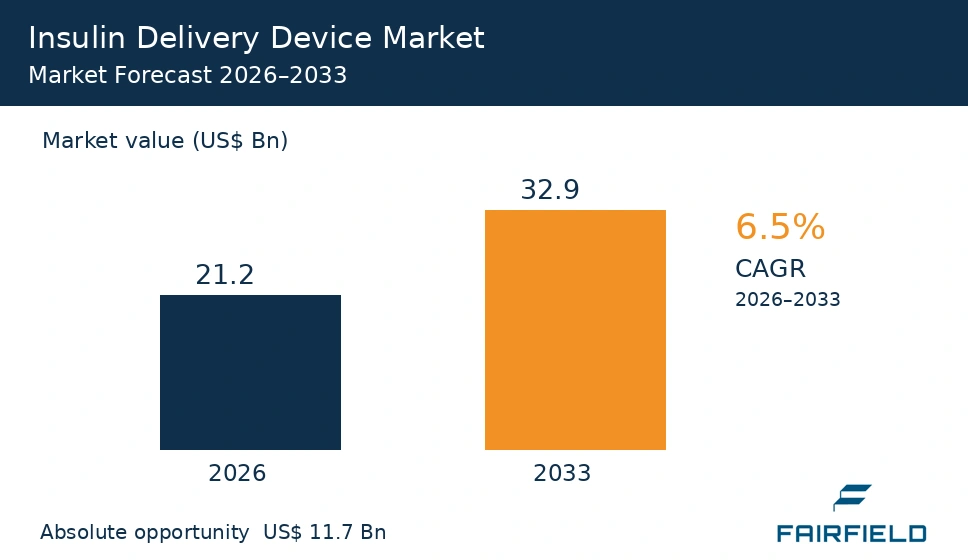
The global insulin delivery device market size is expected to be valued at US$ 21.2 billion in 2026 and projected to reach US$ 32.9 billion by 2033, growing at a CAGR of 6.5% between 2026 and 2033.
Between 2020 and 2025, the market grew at a CAGR of about 5.7%, rising from roughly US$ 15.1 billion to about US$ 19.9 billion, as the number of people living with diabetes kept rising, more patients moved from syringes to pens, and automated insulin delivery systems that link pumps with continuous glucose monitors gained wide adoption. The insulin delivery device market covers insulin pens, pen needles, syringes, tethered and tubeless insulin pumps, automated insulin delivery systems, smart pens, and jet injectors used to give insulin to people with type 1 and type 2 diabetes. These devices are used at home, in hospitals, and in diabetes clinics, and they are sold through retail pharmacies, hospital pharmacies, online pharmacies, and durable medical equipment suppliers. In November 2026, MiniMed received US Food and Drug Administration clearance for MiniMed Fit, its first tubeless insulin pump.
Key Report Takeaways
-
By Product Type: Insulin Pens held about 43% share in 2025, while Insulin Pumps are projected to expand at a 9.1% CAGR through 2033, driven by automated insulin delivery systems, new tubeless patch pumps, and wider use among people with type 2 diabetes.
-
By Distribution Channel: Retail Pharmacies held about 48% share in 2025, while Online Pharmacies are projected to expand at a 9.4% CAGR through 2033, driven by home delivery, digital prescriptions, subscription refills, and pharmacy-channel access for pumps.
-
By End User: Homecare Settings held about 66% share in 2025 and are also projected to expand fastest at a 6.9% CAGR through 2033, driven by self-management of diabetes, easy-to-use pens and pumps, and remote monitoring.
-
By Region: North America held about 36% share in 2025, while Asia Pacific is projected to expand at an 8.3% CAGR through 2033, driven by very large diabetic populations in China and India, rising insulin use, and better access to pens.
Global Insulin Delivery Device Market Trends and Insights
Drivers Impact Analysis
Two drivers carry the strongest influence on insulin delivery device market demand during the forecast period.
| Driver | Impact on CAGR Forecast | Geographic Relevance | Impact Timeline |
| Rising diabetes prevalence and insulin use | High | Global, with focus on Asia Pacific | Long term (≥4 years) |
| Automated insulin delivery and tubeless pump adoption | High | North America, Europe | Medium term (2-4 years) |
Rising Diabetes Prevalence Is Driving the Insulin Delivery Device Market
Rising diabetes prevalence and insulin use are the strongest drivers of the insulin delivery device market. More people need insulin every day.
The mechanism is that more than 500 million adults worldwide live with diabetes, and the number keeps rising because of aging populations, obesity, inactive lifestyles, and urban diets. All people with type 1 diabetes and many with type 2 diabetes need insulin, often several times a day. China and India have the largest numbers of adults with diabetes, while the United States has one of the highest spending levels per patient. As more patients start insulin and move from vials and syringes to pens, device use grows steadily. Better screening and diagnosis also bring more people into treatment. Each insulin user needs pens, needles, or pump supplies every day, creating steady recurring demand.
Automated Insulin Delivery Is Expanding the Insulin Delivery Device Market
The adoption of automated insulin delivery systems and tubeless pumps is expanding the insulin delivery device market. Technology is making insulin therapy easier.
The cause is that automated insulin delivery systems combine an insulin pump, a continuous glucose monitor, and an algorithm that adjusts insulin doses automatically, improving time in range and reducing low blood sugar. Tubeless patch pumps such as Insulet's Omnipod 5 have made pumps more comfortable and discreet. In 2026, the US Food and Drug Administration cleared Beta Bionics' Mint patch pump in September, and Tandem Mobi as a tubeless system and MiniMed Fit in November. Expanded coverage for people with type 2 diabetes is widening the patient pool. These devices raise value per patient and create recurring revenue from pods and supplies.
Restraints Impact Analysis
Two restraints limit how quickly the insulin delivery device market grows.
| Restraint | Impact on CAGR Forecast | Geographic Relevance | Impact Timeline |
| High costs and limited reimbursement | High | Asia Pacific, Latin America, Middle East & Africa | Long term (≥4 years) |
| GLP-1 drugs and device safety concerns | Medium | North America, Europe | Medium term (2-4 years) |
High Costs and Limited Reimbursement Slow the Insulin Delivery Device Market
High costs and limited reimbursement slow the insulin delivery device market. Advanced devices are out of reach for many patients.
The problem is that insulin pumps, automated systems, and their supplies can cost thousands of dollars a year, and many health systems in Asia Pacific, Latin America, and Middle East & Africa do not fully cover them. Even in wealthy countries, patients may face high co-payments and complex insurance rules. Many people with type 2 diabetes still use low-cost vials and syringes because pens and pumps cost more. Training needs and limited access to diabetes specialists also slow adoption. These factors keep many patients on basic devices, limiting value growth. Price caps and tender systems in some countries also push suppliers to cut prices on pens and needles, which squeezes margins.
GLP-1 Drugs and Safety Concerns Restrict the Insulin Delivery Device Market
The rise of GLP-1 drugs and device safety concerns restrict the insulin delivery device market. Some patients may need less insulin.
The constraint is that GLP-1 receptor agonists and related medicines such as semaglutide and tirzepatide help people with type 2 diabetes lower blood sugar and lose weight, which can delay or reduce insulin use for some patients. Some pumps and pens have faced recalls for software issues, battery faults, or dosing errors, which can harm trust. Cybersecurity risks in connected devices also worry regulators. Devices must meet strict approval rules that take time and money. These factors limit growth in some patient groups. However, many patients still need insulin as diabetes progresses, so the long-term demand for delivery devices remains strong, and some GLP-1 drugs are also given using pen injectors.
Market Opportunities
Tubeless, Smart, and Connected Devices Open a Premium Revenue Pool
Tubeless, smart, and connected devices open a premium revenue pool. Patients want easier and smarter diabetes care.
The opportunity comes from tubeless patch pumps, fully automated systems that need fewer meal inputs, smart insulin pens that track doses and connect to apps, longer-wear infusion sets, and integration with continuous glucose monitors from Dexcom and Abbott. Beta Bionics plans to make at least 1.5 million disposable Mint units in 2027. Pharmacy-channel distribution of pumps lowers upfront costs for patients. Companies that offer simple, connected systems with strong software and data tools can earn high margins and recurring supply revenue. Once-weekly insulins in development may also need new pen designs, and fully closed-loop systems that remove the need for meal announcements could attract many new users.
Asia Pacific and Pen Adoption Create a Growth Revenue Pool
Asia Pacific and pen adoption create a growth revenue pool. Very large patient groups are moving to modern devices.
The opportunity reflects the huge number of adults with diabetes in China, India, Indonesia, Pakistan, and Bangladesh, rising insulin use, and the shift from vials and syringes to prefilled pens and pen needles. Governments are expanding diabetes programs, and local makers in China and India produce low-cost pens and needles. Biosimilar insulins are lowering treatment costs for many families. Companies that offer affordable pens, local manufacturing, and patient education can capture this growth across both urban and rural areas. Partnerships with government health programs, pharmacies, and diabetes clinics can also improve access, while mobile apps in local languages help patients learn to use pens correctly.
Segment Analysis
By Product Type: Insulin Pens Lead While Insulin Pumps Grow Fastest
Insulin Pens held about 43% share in 2025. Prefilled disposable pens and reusable pens from Novo Nordisk, Eli Lilly, and Sanofi are easy to carry, accurate, and simple to use, and they are the main delivery method for many people with type 1 and type 2 diabetes. Pen needles from Embecta, Ypsomed, Owen Mumford, and Terumo add recurring volume, giving this product the largest share.
Insulin Pumps are the fastest-growing product type, expanding at a 9.1% CAGR through 2033. Tethered and tubeless pumps linked with continuous glucose monitors in automated systems offer better glucose control and fewer daily injections. New tubeless pumps from Insulet, Tandem, MiniMed, and Beta Bionics are expanding choice. Syringes, Pen Needles, and Others form other segments. For the market, pump growth raises value per patient.
By Distribution Channel: Retail Pharmacies Lead While Online Pharmacies Grow Fastest
Retail Pharmacies held about 48% share in 2025. Community and chain pharmacies dispense most pens, pen needles, and syringes, and some now supply tubeless pumps through pharmacy benefits instead of durable medical equipment channels. Pharmacists also help patients learn how to use pens and manage supplies, and many patients refill prescriptions monthly at local pharmacies.
Online Pharmacies are the fastest-growing channel, expanding at a 9.4% CAGR through 2033. Home delivery, digital prescriptions, automatic refills, and price comparison make online channels convenient for people who use supplies every day. Hospital Pharmacies and Others form other segments, serving inpatients and clinics. Hospital pharmacies supply insulin devices for inpatients and newly diagnosed patients. For the market, online growth improves patient access and adherence.
By End User: Homecare Settings Lead and Grow Fastest
Homecare Settings held about 66% share in 2025 and are also the fastest-growing end user, expanding at a 6.9% CAGR through 2033. Most people with diabetes manage insulin therapy themselves at home using pens, pumps, and connected apps, supported by remote monitoring from care teams. Easy-to-use pens, tubeless pumps, and smartphone apps make home management simpler, and continuous glucose monitors send data to doctors between visits. Telehealth visits also reduce the need for clinic trips.
Hospitals and Clinics form the other segment, where insulin is given to inpatients and new patients are trained on devices. Hospitals also use insulin pens to reduce dosing errors and needle-stick injuries among staff. For the market, homecare growth supports recurring supply sales.
Geography Analysis
Which Region Is Leading the Insulin Delivery Device Market?
North America is leading the insulin delivery device market with about 36% share in 2025. The United States has high diabetes rates, strong insurance coverage for pumps and continuous glucose monitors, and fast adoption of automated insulin delivery systems. Insulet, Tandem, MiniMed, Beta Bionics, Eli Lilly, and Embecta are based in the country. Several new tubeless pumps were cleared in 2026, giving patients more choice. Key barriers include high out-of-pocket costs for uninsured patients. Canada also funds pumps in several provinces. One change shaping the region is the move to pharmacy-channel pump access.
Insulin Delivery Device Market in Europe
Europe is a large and mature insulin delivery device market. Germany, the United Kingdom, France, Italy, and Spain have strong public health systems that cover pens and, increasingly, pumps and automated systems. Novo Nordisk in Denmark, Sanofi in France, Ypsomed in Switzerland, and Roche are major suppliers. The United Kingdom is rolling out automated systems for many people with type 1 diabetes through its national health service. Key barriers include tight health budgets and long approval times. Biosimilar insulins are lowering costs. One change shaping the region is wider automated insulin delivery coverage.
Which Region Is Growing Fastest in the Insulin Delivery Device Market?
Asia Pacific is the fastest-growing region in the insulin delivery device market, expanding at an 8.3% CAGR through 2033. China and India have the world's largest numbers of adults with diabetes, and insulin pen use is rising quickly. Japan, South Korea, and Australia are adopting pumps and automated systems with growing insurance support. Local makers produce affordable pens and needles, and biosimilar insulins from companies in China and India are expanding access. Government programs support diabetes care. Key barriers include limited reimbursement for pumps and sensors. One change shaping the region is the shift from syringes to pens.
Insulin Delivery Device Market in Latin America
Latin America is a growing insulin delivery device market with rising insulin use. Brazil, Mexico, Argentina, and Colombia have large and rising diabetic populations, and public health systems are expanding access to insulin pens and pen needles for many patients. Private insurance supports pump use among higher-income patients in large cities. Local production of insulin and pens is growing in Brazil and Mexico, which can lower costs over time. Key barriers include economic swings, currency changes, and limited coverage for pumps. One opportunity is affordable pens and pen needles supplied through large public health programs.
Insulin Delivery Device Market in Middle East & Africa
Middle East & Africa is a developing insulin delivery device market with high needs. Saudi Arabia, the United Arab Emirates, Kuwait, and Qatar have some of the world's highest diabetes rates, and wealthier health systems are adopting pens, pumps, and continuous glucose monitors for many patients. South Africa, Egypt, and Nigeria have growing needs, but many patients still use vials and syringes. Cold storage for insulin is a challenge in hot climates and remote areas. Key barriers include high costs and limited access in rural areas. One opportunity is affordable pens and patient education programs.
Competitive Landscape
The insulin delivery device market is consolidated. Novo Nordisk, Insulet, MiniMed, Eli Lilly, and Embecta are leading players, while Sanofi, Tandem, Ypsomed, Beta Bionics, Roche, Terumo, and Owen Mumford compete strongly. The large insulin makers lead the pen segment because their prefilled pens are sold together with their insulins, while pump makers compete on automated systems and tubeless designs. Pen needle and syringe makers supply very large volumes at low prices to pharmacies and hospitals. MiniMed is moving toward full separation from Medtronic after its initial public offering, which gives it more focus on diabetes.
Companies mainly compete on ease of use, comfort, wear time, accuracy, automation algorithms, integration with continuous glucose monitors, smartphone control, safety, reliability, insurance coverage, pharmacy access, training and support, and price. Partnerships with sensor makers such as Dexcom and Abbott are very important for automated systems. Strong patient support, training programs, and relationships with endocrinologists and diabetes educators also help companies win and keep users.
Strategic moves show how competition is changing. MiniMed received clearance for MiniMed Flex in March 2026, Beta Bionics won clearance for its Mint patch pump in September 2026, and Tandem and MiniMed won clearances for tubeless systems in November 2026. These moves will soon end Insulet's long lead as the only major tubeless pump supplier.
Three themes shape vendor strategy. First, suppliers are launching tubeless pumps. Second, they are improving automation. Third, they are expanding pharmacy access.
Insulin Delivery Device Market Industry Leaders
- Novo Nordisk A/S
- Insulet Corporation
- MiniMed
- Eli Lilly and Company
- Embecta Corp.
Recent Industry Developments
-
November 2026: MiniMed received US Food and Drug Administration clearance for MiniMed Fit, its first tubeless insulin pump with up to seven days of wear, for people with type 1 and type 2 diabetes aged seven and older - expands competition in patch pumps.
-
November 2026: Tandem Diabetes Care received clearance for Tandem Mobi as a tubeless automated insulin delivery system with up to seven days of wear, setting up a 2027 tubeless launch - adds a new tubeless option.
-
September 2026: Beta Bionics received clearance for Mint, its first insulin patch pump, ahead of a planned first-quarter 2027 launch through pharmacy channels - creates a new rival to Omnipod 5.
-
March 2026: MiniMed received clearance for MiniMed Flex, its smallest insulin pump and first smartphone-controlled design - strengthens its tubed pump range.
Companies Covered in the Report
-
Novo Nordisk A/S
-
Insulet Corporation
-
MiniMed
-
Eli Lilly and Company
-
Embecta Corp.
-
Sanofi S.A.
-
Tandem Diabetes Care, Inc.
-
Ypsomed AG
-
Beta Bionics, Inc.
-
F. Hoffmann-La Roche Ltd
-
Terumo Corporation
-
Owen Mumford Ltd.
Insulin Delivery Device Market Report Scope
This report covers the global insulin delivery device market, including insulin pens, insulin pumps, syringes, pen needles, and other devices, sold through retail, hospital, and online pharmacies and other channels, for homecare settings and hospitals and clinics, across North America, Europe, Asia Pacific, Latin America, and Middle East & Africa. The base year is 2025, and the forecast period runs from 2026 to 2033.
| Product Type | Insulin Pens, Insulin Pumps, Syringes, Pen Needles, Others |
| Distribution Channel | Retail Pharmacies, Hospital Pharmacies, Online Pharmacies, Others |
| End User | Homecare Settings, Hospitals and Clinics |
| Regions | North America, Europe, Asia Pacific, Latin America, Middle East & Africa |
1. Executive Summary
1.1 Insulin Delivery Device Market Snapshot
1.2 Future Projections
1.3 Key Market Trends
1.4 Regional Snapshot
2. Market Overview
2.1 Market Definition and Report Scope
2.2 Historical Market Trends
2.3 Market Dynamics
2.3.1 Drivers
2.3.1.1 Rising Diabetes Prevalence Is Driving the Insulin Delivery Device Market
2.3.1.2 Automated Insulin Delivery Is Expanding the Insulin Delivery Device Market
2.3.2 Restraints
2.3.2.1 High Costs and Limited Reimbursement Slow the Insulin Delivery Device Market
2.3.2.2 GLP-1 Drugs and Safety Concerns Restrict the Insulin Delivery Device Market
2.3.3 Market Opportunities
2.3.3.1 Tubeless, Smart, and Connected Devices Open a Premium Revenue Pool
2.3.3.2 Asia Pacific and Pen Adoption Create a Growth Revenue Pool
3. Global Insulin Delivery Device Market Outlook, 2020–2033
3.1 Global Insulin Delivery Device Market Outlook, by Product Type, Value (US$ Billion), 2020–2033
3.1.1 Insulin Pens
3.1.2 Insulin Pumps
3.1.3 Syringes
3.1.4 Pen Needles
3.1.5 Others
3.2 Global Insulin Delivery Device Market Outlook, by Distribution Channel, Value (US$ Billion), 2020–2033
3.2.1 Retail Pharmacies
3.2.2 Hospital Pharmacies
3.2.3 Online Pharmacies
3.2.4 Others
3.3 Global Insulin Delivery Device Market Outlook, by End User, Value (US$ Billion), 2020–2033
3.3.1 Homecare Settings
3.3.2 Hospitals and Clinics
3.4 Global Insulin Delivery Device Market Outlook, by Region, Value (US$ Billion), 2020–2033
3.4.1 North America
3.4.2 Europe
3.4.3 Asia Pacific
3.4.4 Latin America
3.4.5 Middle East & Africa
4. North America Insulin Delivery Device Market Outlook, 2020–2033
4.1 North America Insulin Delivery Device Market Outlook, by Product Type, Value (US$ Billion), 2020–2033
4.1.1 Insulin Pens
4.1.2 Insulin Pumps
4.1.3 Syringes
4.1.4 Pen Needles
4.1.5 Others
4.2 North America Insulin Delivery Device Market Outlook, by Distribution Channel, Value (US$ Billion), 2020–2033
4.2.1 Retail Pharmacies
4.2.2 Hospital Pharmacies
4.2.3 Online Pharmacies
4.2.4 Others
4.3 North America Insulin Delivery Device Market Outlook, by End User, Value (US$ Billion), 2020–2033
4.3.1 Homecare Settings
4.3.2 Hospitals and Clinics
4.4 North America Insulin Delivery Device Market Outlook, by Country, Value (US$ Billion), 2020–2033
4.4.1 United States Insulin Delivery Device Market Outlook, by Product Type, 2020–2033
4.4.2 United States Insulin Delivery Device Market Outlook, by Distribution Channel, 2020–2033
4.4.3 United States Insulin Delivery Device Market Outlook, by End User, 2020–2033
4.4.4 Canada Insulin Delivery Device Market Outlook, by Product Type, 2020–2033
4.4.5 Canada Insulin Delivery Device Market Outlook, by Distribution Channel, 2020–2033
4.4.6 Canada Insulin Delivery Device Market Outlook, by End User, 2020–2033
5. Europe Insulin Delivery Device Market Outlook, 2020–2033
5.1 Europe Insulin Delivery Device Market Outlook, by Product Type, Value (US$ Billion), 2020–2033
5.1.1 Insulin Pens
5.1.2 Insulin Pumps
5.1.3 Syringes
5.1.4 Pen Needles
5.1.5 Others
5.2 Europe Insulin Delivery Device Market Outlook, by Distribution Channel, Value (US$ Billion), 2020–2033
5.2.1 Retail Pharmacies
5.2.2 Hospital Pharmacies
5.2.3 Online Pharmacies
5.2.4 Others
5.3 Europe Insulin Delivery Device Market Outlook, by End User, Value (US$ Billion), 2020–2033
5.3.1 Homecare Settings
5.3.2 Hospitals and Clinics
5.4 Europe Insulin Delivery Device Market Outlook, by Country, Value (US$ Billion), 2020–2033
5.4.1 Germany Insulin Delivery Device Market Outlook, by Product Type, 2020–2033
5.4.2 Germany Insulin Delivery Device Market Outlook, by Distribution Channel, 2020–2033
5.4.3 Germany Insulin Delivery Device Market Outlook, by End User, 2020–2033
5.4.4 United Kingdom Insulin Delivery Device Market Outlook, by Product Type, 2020–2033
5.4.5 United Kingdom Insulin Delivery Device Market Outlook, by Distribution Channel, 2020–2033
5.4.6 United Kingdom Insulin Delivery Device Market Outlook, by End User, 2020–2033
5.4.7 France Insulin Delivery Device Market Outlook, by Product Type, 2020–2033
5.4.8 France Insulin Delivery Device Market Outlook, by Distribution Channel, 2020–2033
5.4.9 France Insulin Delivery Device Market Outlook, by End User, 2020–2033
5.4.10 Italy Insulin Delivery Device Market Outlook, by Product Type, 2020–2033
5.4.11 Italy Insulin Delivery Device Market Outlook, by Distribution Channel, 2020–2033
5.4.12 Italy Insulin Delivery Device Market Outlook, by End User, 2020–2033
5.4.13 Spain Insulin Delivery Device Market Outlook, by Product Type, 2020–2033
5.4.14 Spain Insulin Delivery Device Market Outlook, by Distribution Channel, 2020–2033
5.4.15 Spain Insulin Delivery Device Market Outlook, by End User, 2020–2033
5.4.16 Denmark Insulin Delivery Device Market Outlook, by Product Type, 2020–2033
5.4.17 Denmark Insulin Delivery Device Market Outlook, by Distribution Channel, 2020–2033
5.4.18 Denmark Insulin Delivery Device Market Outlook, by End User, 2020–2033
5.4.19 Switzerland Insulin Delivery Device Market Outlook, by Product Type, 2020–2033
5.4.20 Switzerland Insulin Delivery Device Market Outlook, by Distribution Channel, 2020–2033
5.4.21 Switzerland Insulin Delivery Device Market Outlook, by End User, 2020–2033
6. Asia Pacific Insulin Delivery Device Market Outlook, 2020–2033
6.1 Asia Pacific Insulin Delivery Device Market Outlook, by Product Type, Value (US$ Billion), 2020–2033
6.1.1 Insulin Pens
6.1.2 Insulin Pumps
6.1.3 Syringes
6.1.4 Pen Needles
6.1.5 Others
6.2 Asia Pacific Insulin Delivery Device Market Outlook, by Distribution Channel, Value (US$ Billion), 2020–2033
6.2.1 Retail Pharmacies
6.2.2 Hospital Pharmacies
6.2.3 Online Pharmacies
6.2.4 Others
6.3 Asia Pacific Insulin Delivery Device Market Outlook, by End User, Value (US$ Billion), 2020–2033
6.3.1 Homecare Settings
6.3.2 Hospitals and Clinics
6.4 Asia Pacific Insulin Delivery Device Market Outlook, by Country, Value (US$ Billion), 2020–2033
6.4.1 China Insulin Delivery Device Market Outlook, by Product Type, 2020–2033
6.4.2 China Insulin Delivery Device Market Outlook, by Distribution Channel, 2020–2033
6.4.3 China Insulin Delivery Device Market Outlook, by End User, 2020–2033
6.4.4 India Insulin Delivery Device Market Outlook, by Product Type, 2020–2033
6.4.5 India Insulin Delivery Device Market Outlook, by Distribution Channel, 2020–2033
6.4.6 India Insulin Delivery Device Market Outlook, by End User, 2020–2033
6.4.7 Japan Insulin Delivery Device Market Outlook, by Product Type, 2020–2033
6.4.8 Japan Insulin Delivery Device Market Outlook, by Distribution Channel, 2020–2033
6.4.9 Japan Insulin Delivery Device Market Outlook, by End User, 2020–2033
6.4.10 South Korea Insulin Delivery Device Market Outlook, by Product Type, 2020–2033
6.4.11 South Korea Insulin Delivery Device Market Outlook, by Distribution Channel, 2020–2033
6.4.12 South Korea Insulin Delivery Device Market Outlook, by End User, 2020–2033
6.4.13 Australia Insulin Delivery Device Market Outlook, by Product Type, 2020–2033
6.4.14 Australia Insulin Delivery Device Market Outlook, by Distribution Channel, 2020–2033
6.4.15 Australia Insulin Delivery Device Market Outlook, by End User, 2020–2033
7. Latin America Insulin Delivery Device Market Outlook, 2020–2033
7.1 Latin America Insulin Delivery Device Market Outlook, by Product Type, Value (US$ Billion), 2020–2033
7.1.1 Insulin Pens
7.1.2 Insulin Pumps
7.1.3 Syringes
7.1.4 Pen Needles
7.1.5 Others
7.2 Latin America Insulin Delivery Device Market Outlook, by Distribution Channel, Value (US$ Billion), 2020–2033
7.2.1 Retail Pharmacies
7.2.2 Hospital Pharmacies
7.2.3 Online Pharmacies
7.2.4 Others
7.3 Latin America Insulin Delivery Device Market Outlook, by End User, Value (US$ Billion), 2020–2033
7.3.1 Homecare Settings
7.3.2 Hospitals and Clinics
7.4 Latin America Insulin Delivery Device Market Outlook, by Country, Value (US$ Billion), 2020–2033
7.4.1 Brazil Insulin Delivery Device Market Outlook, by Product Type, 2020–2033
7.4.2 Brazil Insulin Delivery Device Market Outlook, by Distribution Channel, 2020–2033
7.4.3 Brazil Insulin Delivery Device Market Outlook, by End User, 2020–2033
7.4.4 Mexico Insulin Delivery Device Market Outlook, by Product Type, 2020–2033
7.4.5 Mexico Insulin Delivery Device Market Outlook, by Distribution Channel, 2020–2033
7.4.6 Mexico Insulin Delivery Device Market Outlook, by End User, 2020–2033
7.4.7 Argentina Insulin Delivery Device Market Outlook, by Product Type, 2020–2033
7.4.8 Argentina Insulin Delivery Device Market Outlook, by Distribution Channel, 2020–2033
7.4.9 Argentina Insulin Delivery Device Market Outlook, by End User, 2020–2033
7.4.10 Colombia Insulin Delivery Device Market Outlook, by Product Type, 2020–2033
7.4.11 Colombia Insulin Delivery Device Market Outlook, by Distribution Channel, 2020–2033
7.4.12 Colombia Insulin Delivery Device Market Outlook, by End User, 2020–2033
8. Middle East & Africa Insulin Delivery Device Market Outlook, 2020–2033
8.1 Middle East & Africa Insulin Delivery Device Market Outlook, by Product Type, Value (US$ Billion), 2020–2033
8.1.1 Insulin Pens
8.1.2 Insulin Pumps
8.1.3 Syringes
8.1.4 Pen Needles
8.1.5 Others
8.2 Middle East & Africa Insulin Delivery Device Market Outlook, by Distribution Channel, Value (US$ Billion), 2020–2033
8.2.1 Retail Pharmacies
8.2.2 Hospital Pharmacies
8.2.3 Online Pharmacies
8.2.4 Others
8.3 Middle East & Africa Insulin Delivery Device Market Outlook, by End User, Value (US$ Billion), 2020–2033
8.3.1 Homecare Settings
8.3.2 Hospitals and Clinics
8.4 Middle East & Africa Insulin Delivery Device Market Outlook, by Country, Value (US$ Billion), 2020–2033
8.4.1 Saudi Arabia Insulin Delivery Device Market Outlook, by Product Type, 2020–2033
8.4.2 Saudi Arabia Insulin Delivery Device Market Outlook, by Distribution Channel, 2020–2033
8.4.3 Saudi Arabia Insulin Delivery Device Market Outlook, by End User, 2020–2033
8.4.4 United Arab Emirates Insulin Delivery Device Market Outlook, by Product Type, 2020–2033
8.4.5 United Arab Emirates Insulin Delivery Device Market Outlook, by Distribution Channel, 2020–2033
8.4.6 United Arab Emirates Insulin Delivery Device Market Outlook, by End User, 2020–2033
8.4.7 Kuwait Insulin Delivery Device Market Outlook, by Product Type, 2020–2033
8.4.8 Kuwait Insulin Delivery Device Market Outlook, by Distribution Channel, 2020–2033
8.4.9 Kuwait Insulin Delivery Device Market Outlook, by End User, 2020–2033
8.4.10 Qatar Insulin Delivery Device Market Outlook, by Product Type, 2020–2033
8.4.11 Qatar Insulin Delivery Device Market Outlook, by Distribution Channel, 2020–2033
8.4.12 Qatar Insulin Delivery Device Market Outlook, by End User, 2020–2033
8.4.13 South Africa Insulin Delivery Device Market Outlook, by Product Type, 2020–2033
8.4.14 South Africa Insulin Delivery Device Market Outlook, by Distribution Channel, 2020–2033
8.4.15 South Africa Insulin Delivery Device Market Outlook, by End User, 2020–2033
8.4.16 Egypt Insulin Delivery Device Market Outlook, by Product Type, 2020–2033
8.4.17 Egypt Insulin Delivery Device Market Outlook, by Distribution Channel, 2020–2033
8.4.18 Egypt Insulin Delivery Device Market Outlook, by End User, 2020–2033
8.4.19 Nigeria Insulin Delivery Device Market Outlook, by Product Type, 2020–2033
8.4.20 Nigeria Insulin Delivery Device Market Outlook, by Distribution Channel, 2020–2033
8.4.21 Nigeria Insulin Delivery Device Market Outlook, by End User, 2020–2033
9. Competitive Landscape
9.1 Insulin Delivery Device Market Industry Leaders
9.2 Recent Industry Developments
9.3 Company Profiles
9.3.1 Novo Nordisk A/S
9.3.2 Insulet Corporation
9.3.3 MiniMed
9.3.4 Eli Lilly and Company
9.3.5 Embecta Corp.
9.3.6 Sanofi S.A.
9.3.7 Tandem Diabetes Care, Inc.
9.3.8 Ypsomed AG
9.3.9 Beta Bionics, Inc.
9.3.10 F. Hoffmann-La Roche Ltd
9.3.11 Terumo Corporation
9.3.12 Owen Mumford Ltd.
10. Appendix
10.1 Research Methodology
10.2 Report Assumptions
10.3 Acronyms and Abbreviations
| Product Type | Insulin Pens, Insulin Pumps, Syringes, Pen Needles, Others |
| Distribution Channel | Retail Pharmacies, Hospital Pharmacies, Online Pharmacies, Others |
| End User | Homecare Settings, Hospitals and Clinics |
| Regions | North America, Europe, Asia Pacific, Latin America, Middle East & Africa |
Our Research Methodology
Considering the volatility of business today, traditional approaches to strategizing a game plan can be unfruitful if not detrimental. True ambiguity is no way to determine a forecast. A myriad of predetermined factors must be accounted for such as the degree of risk involved, the magnitude of circumstances, as well as conditions or consequences that are not known or unpredictable. To circumvent binary views that cast uncertainty, the application of market research intelligence to strategically posture, move, and enable actionable outcomes is necessary.
View Methodology
Quality Assured
Rigorous Validation Process

Confidentiality Assured
End-to-end Data Security

Custom Research Services
Tailored To Your Objectives
FAQs
The global insulin delivery device market is expected to be valued at US$ 21.2 billion in 2026, driven by rising diabetes and pump adoption.
The market is projected to grow at a 6.5% CAGR from 2026 to 2033, reaching about US$ 32.9 billion by 2033.
North America leads with about 36% share, supported by high diabetes rates, strong insurance coverage, and fast automated system adoption.
Asia Pacific is growing fastest at an 8.3% CAGR, driven by large diabetic populations in China and India and rising pen use.
Key players include Novo Nordisk, Insulet, MiniMed, Eli Lilly, and Embecta, competing on ease of use, automation, connectivity, and price.
Related Reports
Microneedle Drug Delivery Market Size, Share, Insights, Competitive Landscape, and Forecast 2026 to 2033
The microneedle drug delivery market is projected to grow from US$4.2 billion in 2026 to US$6.4 billion by 2033, registering a CAGR of 6.2%.
Medical Speciality Bags Market Size, Share, Insights, Competitive Landscape, and Forecast 2026 to 2033
The medical speciality bags market is projected to grow from US$10.2 billion in 2026 to US$17.9 billion by 2033, registering a CAGR of 8.4%.
Urinary Incontinence Devices Market Size, Share, Insights, Competitive Landscape, and Forecast 2026 to 2033
The global urinary incontinence devices market is valued at US$4.8 billion in 2026, reaching US$9.24 billion by 2033, growing at a 9.8% CAGR
Lyophilization Equipment Market Size, Share, Insights, Competitive Landscape, and Forecast 2026 to 2033
Explore the Lyophilization Equipment Market, valued at US$8.1 billion in 2026 and forecast to reach US$20.9 billion by 2033, growing at a 14.5% CAGR.
Health and Wellness Devices Market Size, Share, Insights, Competitive Landscape, and Forecast 2026 to 2033
Explore the Health and Wellness Devices Market, valued at US$38.8 billion in 2026 and forecast at US$70.47 billion by 2033, growing at an 8.9% CAGR.
Antimicrobial Susceptibility Testing Market Size, Share, Insights, Competitive Landscape, and Forecast 2026 to 2033
Explore the Antimicrobial Susceptibility Testing Market, valued at US$6.6 billion in 2026 and forecast at US$10.46 billion by 2033, with a 6.8% CAGR.